USMLE Step 2 CK exam break time works like one prepaid balance for the whole session: the USMLE Step 2 CK examination page lists a minimum of 45 minutes for administrations before May 7, 2026, and the newer format is described as 55 minutes, while transitions draw from the same balance and early finishes can add to it.
The practical question is not how many breaks you get. It is how much remains for lunch after computer transitions, a restroom trip, and security re-entry.
Treat every minute between blocks as a withdrawal, then budget the rest before test day.
By Ace Med Boards Editorial Team
Step 2 CK Break Time at a Glance
Which break allowance applies to your Step 2 CK administration? The answer depends on a single detail: your scheduled exam date. The day you registered or began studying has no effect on which timing rules apply.
For administrations before May 7, 2026, the USMLE Step 2 CK examination page describes a nine-hour session containing eight 60-minute blocks, approximately 318 questions, a minimum of 45 minutes of break time, and a 15-minute optional tutorial. Under these timing rules, unused tutorial or block time carries into the break allowance.
The USMLE 2027 Bulletin of Information sets a 55-minute minimum allowance under the newer format and confirms that early completion of the tutorial or a testing block adds those minutes to authorized break time.
Step 2 CK break allowance by exam format
| Feature | Before May 7, 2026 | From May 7, 2026 |
|---|---|---|
| Testing blocks | Eight 60-minute blocks | Sixteen blocks |
| Minimum break allowance | 45 minutes | 55 minutes |
| Finishing blocks or the tutorial early | Unused minutes added to the break balance | Unused minutes added to the break balance |
Treat the minimum as a starting balance. Finish one block three minutes early under the newer format, and your available allowance becomes 58 minutes; every later break action spends from that running figure. Confirm which format your administration date falls under before you build a mock-day schedule around either column.
Key Takeaways
- One balance funds everything. Meals, restroom trips, minutes spent between blocks, and security re-entry all draw from the same allowance.
- Budget the whole gap. Break time is consumed by the entire interval away from questions, so plan for the full cost of each exit rather than the meal alone.
- Treat early finishes as a bonus. A sound schedule stands on the minimum alone and never depends on rushing through blocks to bank extra minutes.
- Match preparation to the format. Your scheduled date selects the column above, and the USMLE timing and scheduling guide for medical students helps fit that format into a broader study calendar.
Practical rule: The published minimum is your planning floor. The accumulated balance is what you can actually spend at any given moment.
How the Break Pool Actually Works
The simplest analogy is a shared bank account. The candidate begins with the applicable allowance, unused testing or tutorial time can increase it, and between-block activity spends it.
The USMLE Step 2 CK exam-content guidance explains that authorized breaks include time between blocks even when the candidate remains seated, as well as computer transitions. Leaving the secure area also requires security procedures, so an exit involves more than the time spent eating or using the restroom.
Follow the balance through a block gap
Consider a candidate who completes a block, stays seated to recover briefly, then leaves for water and returns through security. The candidate hasn't taken several independently funded breaks. Each part of that interval uses the same available balance.
| Timeline stage | What happens to the balance |
|---|---|
| Block underway | Active question-solving uses testing time |
| Block ends early | Unused block time is added to the break pool |
| Computer transition | Available break time decreases |
| Seated reset or authorized exit | Available break time continues to decrease |
| Check-out and re-entry | These procedures consume part of the same interval |
| Next block starts | Active testing resumes with the remaining break balance preserved |
The timeline should be read as a sequence, not a recommendation to leave after every block.
Separate clock rules from pacing choices
Finishing the optional tutorial early can add time, but tutorial familiarity should come from preparation with the appropriate interface. Likewise, finishing a testing block early can increase the balance, but that possibility isn't a reason to sacrifice useful answer review.
Once a testing block begins, leaving the room is generally prohibited except for an emergency. If accumulated break time is exceeded, the excess reduces testing time.
The official mechanics apply to everyone using that format. Preferences don't: one candidate may benefit from frequent seated resets, while another may prefer fewer interruptions and a longer food break.
Remaining seated doesn't make the time between blocks free.
A candidate's minimum allowance is therefore the safe starting point for planning, not a promise of extra time later. Any added minutes should be treated as flexibility earned during the actual session.
Break-Budget Worksheet for Your Mock Day
A useful worksheet separates planned recovery from the overhead required to reach it. A 30-minute meal that ignores walking, check-out, and re-entry is really a 30-minute plan that secretly borrows from everything else in the pool.
The USMLE 2026 Bulletin of Information provides the planning basis: a minimum of 45 minutes across eight blocks under the earlier structure and 55 minutes across sixteen blocks under the later structure. Confirm the allowance for your scheduled administration in the current bulletin before applying the examples below.
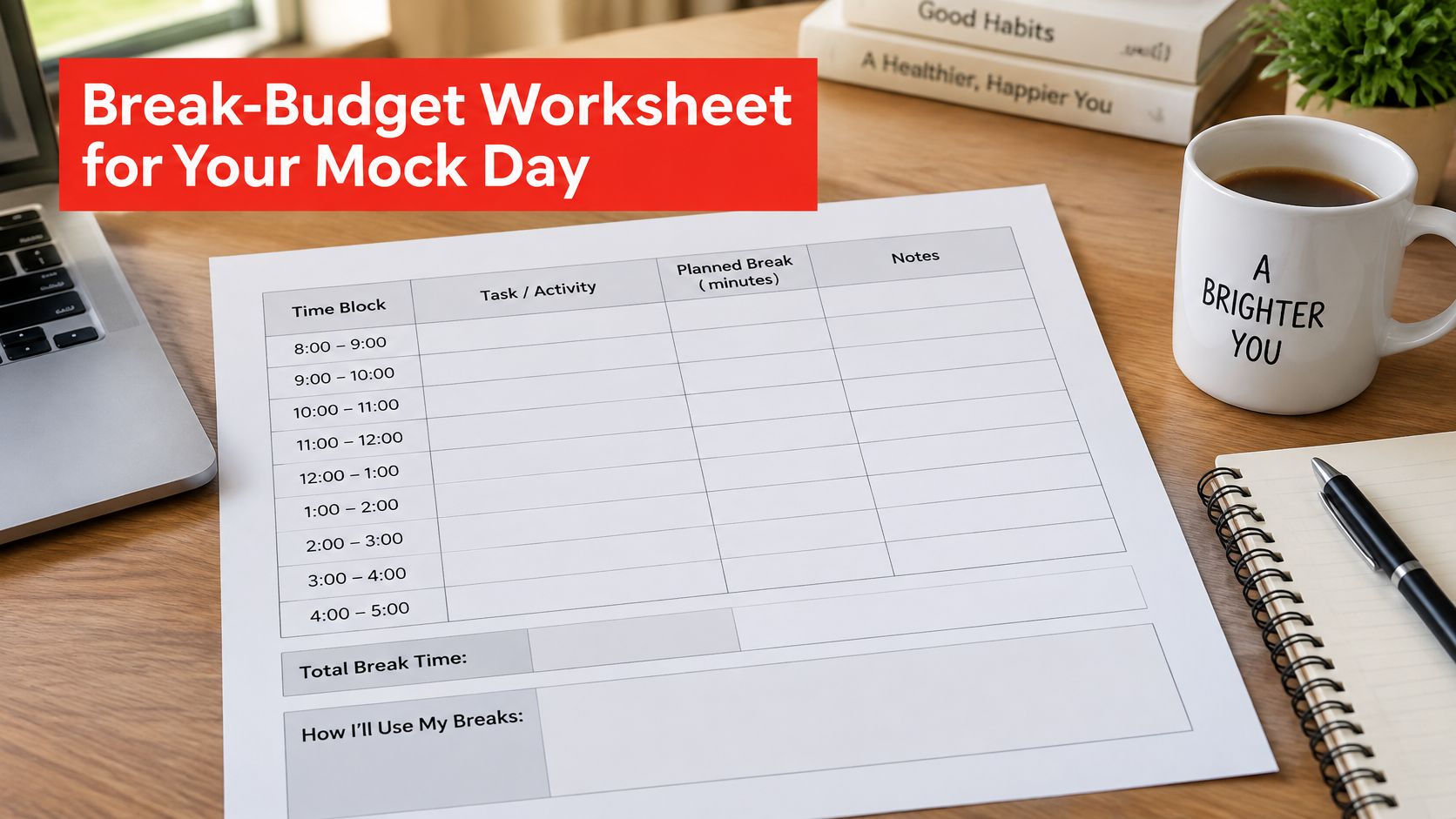
Build the worksheet
- Write down the applicable starting pool. Use the allowance confirmed for your scheduled format. Expected early finishes do not belong in the base budget.
- List the block boundaries where you expect to break. Mark which stops involve remaining seated and which involve leaving the secure area, because each type draws differently on the same balance.
- Estimate transition and re-entry overhead. Time ordinary transitions during a mock. Security procedures cannot be reproduced faithfully at home, so add margin rather than treating a home measurement as a test-center guarantee.
- Set aside a reserve. In a hypothetical plan, a candidate might protect 10 to 15 minutes for an unexpected restroom trip or a slow transition. Treat that figure as a pacing choice you set for yourself, then adjust it based on how your mocks really go.
- Label each planned stop by purpose: short reset, food break, or longer midday break. Combine compatible tasks so one exit covers water, restroom, and a snack instead of three separate trips through security.
- Run a full-length timed mock. Record the displayed or simulated balance at the end of every block, including the transition overhead each stop consumed.
- Rebalance mid-plan if needed. If the running balance falls below your reserve by the midpoint, shorten optional stops rather than counting on later blocks to finish early.
Compare worked examples
Three illustrative break plans from a 55-minute pool
The numbers below are hypothetical allocations. The final column shows what subtraction from the starting pool leaves, before actual transitions are deducted.
| Plan | Break pattern | Planned break minutes | Left for transitions and reserve |
|---|---|---|---|
| A: Frequent short resets | Six 5-minute resets across seven selected block gaps | 30 | 25, calculated as 55 − 30 |
| B: One longer midday break | Two 5-minute resets plus one 30-minute midday break | 40 | 15, calculated as 55 − 40 |
| C: Minimal breaks with buffer | Three 5-minute restroom or water stops | 15 | 40, calculated as 55 − 15 |
Plan A offers repeated chances to recover, yet every exit and re-entry draws from the same column that funds the reserve. Plan B simplifies meal logistics but leaves the thinnest margin if early transitions run long. Plan C keeps flexibility high, though it suits only candidates who stay attentive without frequent resets.
The reserve column isn't all spare time. Transitions must come out of it before an emergency buffer remains.
A full-length run under realistic timing shows which plan actually fits. The NBME Step 2 CK practice-exam guide can help structure that assessment, though a practice test alone does not reproduce check-in lines or security re-entry, so the worksheet should still carry margin for both.
Food, Hydration and Test-Day Logistics Checklist
Food and logistics should be predictable enough that the candidate doesn't need to solve new problems during a break. Familiar choices are more useful than an elaborate exam-day menu.
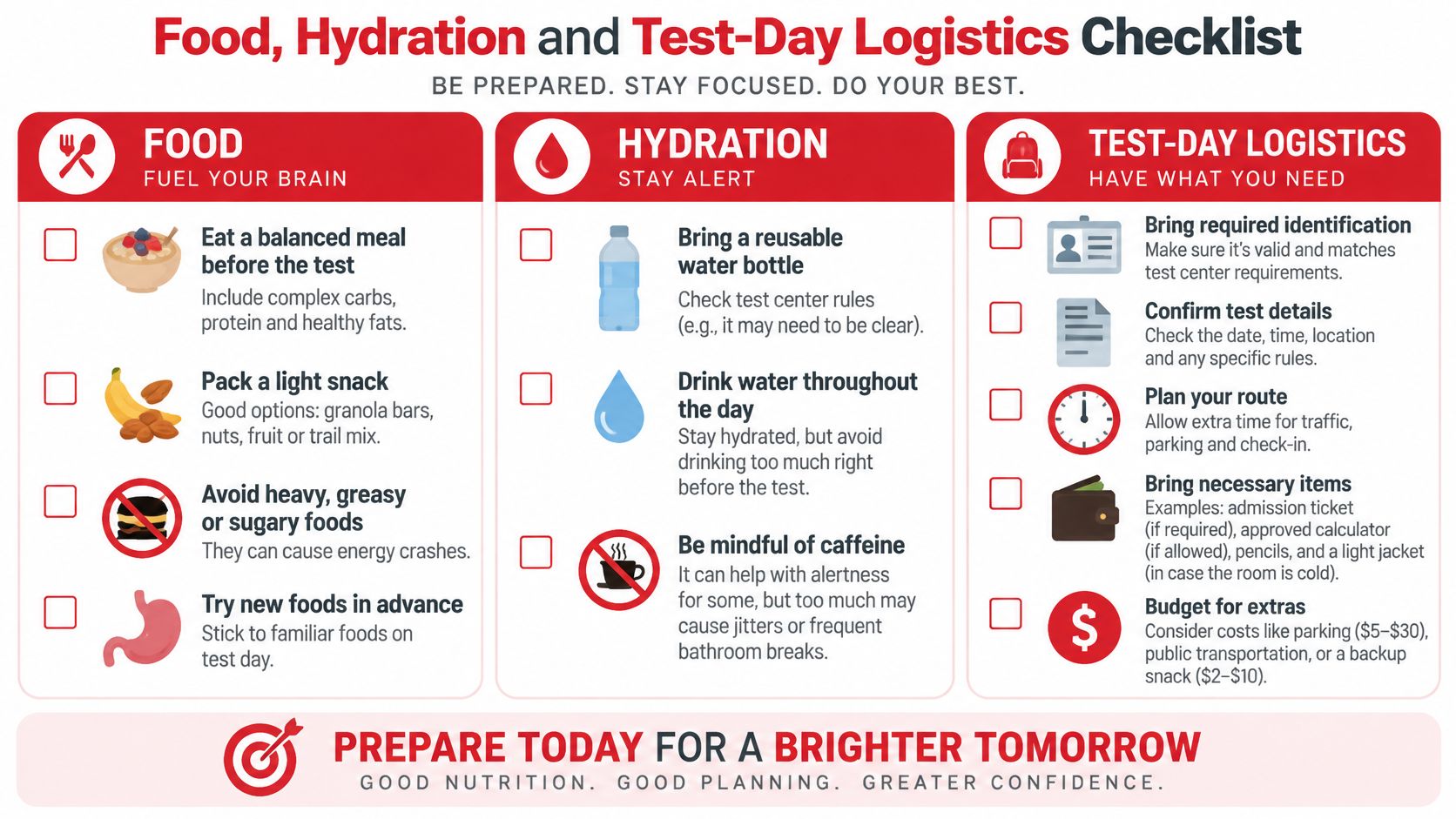
Before arrival
- Confirm the appointment. Check the test-center location, required arrival time, identification instructions, and scheduling documents against current official test-day rules.
- Check permitted items. Confirm food, drink, container, device, and storage policies rather than assuming a study guide describes current rules.
- Pack familiar food. Choose a light, easy-to-eat option already tried during a mock. Avoid messy packaging, strong scents, and unusually heavy meals.
- Plan comfortable clothing. Select layers that can accommodate a room that feels warmer or cooler than expected, subject to current security rules.
- Address medical needs early. Medication timing belongs with the candidate's clinician. Any accommodation request should follow the official USMLE process, with its current requirements and deadlines checked directly.
For ordinary snack ideas, Rip Van's healthy snacks for studying offers a starting point for food selection, not authority on examination policy. Candidates should test any choice during preparation rather than introduce unfamiliar foods on exam day.
During authorized breaks
- Keep hydration familiar. Use the drinking pattern rehearsed during preparation instead of making a sudden change.
- Combine tasks. Retrieve food, drink where permitted, and use the restroom within a planned exit when practical.
- Check storage locations. Establish where food and permitted supplies can be accessed under the center's rules.
- Avoid medication improvisation. Don't start, stop, or change treatment because of a break-planning article.
Before starting the next block
- Check the balance. Confirm that the next planned stop remains realistic.
- Consider restroom needs. Use an authorized break when needed rather than assuming an active block can be interrupted.
- Reset posture and attention. Settle comfortably before launching the next block.
The guide to foods before a test offers additional preparation context. These suggestions are educational and aren't individualized medical advice.
Break Mistakes That Cost Testing Time
Returning after the available balance is exhausted has the clearest direct cost: less testing time. Other problems often begin earlier, when a candidate budgets only the visible activity and overlooks everything needed to complete it.
A long break isn't automatically poor planning. An unbudgeted break, even a short one, is harder to manage because the candidate hasn't decided what must remain afterward.
Break mistakes, their cost and their fix
| Mistake | What It Costs | Fix |
|---|---|---|
| Treating the allowance as eight separate pauses | Breaks planned that don't exist | Track one shared balance rather than fixed entitlements |
| Ignoring transition time | Break balance runs short before the final block | Measure ordinary transitions during a timed mock |
| Leaving the secure area without planning | Security procedures consume available minutes | Combine tasks into a planned exit during a longer break |
| Eating a heavy meal during a break | Possible sluggishness or digestive discomfort, with less recovery time available | Choose a light option tested during preparation |
| Not checking the displayed balance | A surprise shortfall late in the examination | Glance at the balance at each block end |
| Returning late from a break | Excess time deducted from testing time | Set a return checkpoint that preserves the chosen buffer |
| Rushing blocks to bank minutes | Avoidable errors may outweigh the benefit of saved time | Bank time only after comfortable completion and useful review |
Use checkpoints without depending on a phone
A return checkpoint means deciding how much balance must remain when re-entry begins. It shouldn't depend on having access to a personal device.
Personal devices are generally not permitted in the testing room; candidates must verify the current device and break-access rules before deciding how to monitor an authorized exit. A plan should remain workable without a phone alarm or smartwatch.
The test-taking strategies guide provides broader approaches to maintaining accuracy under time pressure. Break planning should support those skills, not encourage candidates to finish blocks before they're ready.
A timed mock is the most reliable practical way for a candidate to identify which break-management mistake needs correction.
Confirm Your Break Plan Before Test Day
The USMLE Step 2 CK content outline and specifications states that examinations before May 7, 2026 included up to 318 items, a minimum of 45 minutes of break time, and a 15-minute optional tutorial. Treat those figures as a dated snapshot: confirm the format assigned to your administration before locking the worksheet, because food, restroom exits, security screening, and reset time all draw from the same balance.
Complete the final checks
- Confirm the administration format. Check the current USMLE bulletin and content outline, and record the date of that check beside the worksheet.
- Read the current test-day policies. Note the food, device, restroom, storage, identification, and re-entry instructions that decide whether each planned exit is allowed and how it is timed.
- Finalize the break budget. Use the confirmed starting allowance and keep a reserve for overhead, so a late security line does not consume the minutes meant for recovery.
- Run a full-length timed mock with breaks. Include the actual snacks, exits, and reset actions you plan to use, then adjust the worksheet where the balance falls faster than expected.
- Review logistics close to the exam. Leave enough time to fix missing documents, unclear travel plans, packing problems, or a break pattern that still depends on guesswork.
Step 1 and Step 3 have their own formats and break rules. Use the bulletin for that exam rather than carrying over Step 2 CK numbers. If any page updates after your check, change the worksheet first and the schedule second; the shared balance is the constraint that decides whether the plan still fits.
For the surrounding readiness tasks, use the broader exam-day preparation checklist to organize documents, travel, sleep, and packing. If practice blocks keep ending with too little balance for the exits you need, USMLE tutoring information explains Ace Med Boards' private online Step 2 CK support: clinical reasoning, diagnosis, and management questions, plus an individual study schedule, question review, and feedback on reasoning and study approach. Scheduling can reflect the exam date, practice performance, coursework or clinical responsibilities, and available study time, and can be adjusted as preparation develops.