
Is a USMLE Step 3 question bank enough for COMLEX Level 3?
It can carry most of the clinical reasoning, with a predictable shortfall outside the domains a Step-style bank writes densely. UWorld fits as one core question source inside a plan built on the official NBOME blueprint, plus deliberate additions for osteopathic content and clinical decision-making cases.
A bank works like a road atlas: thick where the publisher drew routes, thin where the licensing map marks a town the atlas barely names. Check your own UWorld dashboard for clustered misses, correct guesses you never flagged, blocks that ran out of time, and topics with almost no osteopathic reasoning. Those signals show what to add. Volume alone will not.
Key takeaways
- Blueprint first. Level 3 is scored against seven NBOME competency domains that do not share the exam equally, so distribution matters more than raw question volume.
- Coverage isn't published. The company material reviewed here confirms that UWorld sells COMLEX products. It does not confirm a Level 3 pass-rate advantage, a score gain, or an item count.
- Format depends on your test date. The planned schedule keeps a two-day administration through December 19, 2026 and changes to a one-day format on January 13, 2027, with the blueprint unchanged. A question bank does not choose which of those clocks you will sit.
- Percent correct hides two problems. Unflagged guessing and slow pacing can both look like a steady score.
Pacing and osteopathic gaps stay decisions you make beside the bank, not settings the bank settles for you.
Where UWorld Fits and Where COMLEX Level 3 Gaps Remain
A question bank works like a practice gym. You get better at the movements it stocks. The licensing blueprint is the workout card that says which movements count more, and a thin rack does not fill itself.
UWorld can serve as a core question bank for COMLEX-USA Level 3. Material reviewed for this guide does not show that its Level 3 items match every domain of the official blueprint in equal depth. It belongs inside a plan. It is not the whole plan.
COMLEX-USA is the exam. The National Board of Osteopathic Medical Examiners (NBOME) writes the rules. Two labels trip people up early. Clinical decision-making (CDM) cases follow one patient through linked questions, so an early choice changes what comes next. Osteopathic manipulative treatment (OMT) items test technique and the somatic dysfunction reasoning behind it. If a case feels like a single vignette with an osteopathic word dropped in, it is not doing either job.
The bank's COMLEX line grew out of a longer question-writing history. Physician Chandra Pemmasani wrote medical test-preparation questions in a Pennsylvania dorm room, then joined Ravi Pemmasani and Chandresh Chhatpar to publish them online as USMLEWorld. COMLEX products came later, combining the Step 1 and Step 2 CK banks with OMT questions, according to UWorld's account of its medical products.
That record documents product history. It does not document a verified pass-rate advantage, a score increase, a question count, or an independent efficacy statistic for the COMLEX Level 3 materials. Keep performance claims separate from company milestones, and judge coverage from your own dashboard.
Minimum shares differ across the seven competency domains. Exact shares belong on the current NBOME blueprint, not in an unsourced table. What you can check today is whether tagged items exist at all.
| Competency domain | Question-bank check |
|---|---|
| Osteopathic patient care and procedural skills | Count tagged MCQ and CDM items on patient care and procedures |
| Application of osteopathic medical knowledge | Check whether explanations link findings to osteopathic concepts |
| Osteopathic principles, practice, and manipulative treatment | Count OMT items and mark sparse coverage as a gap |
| Practice-based learning and improvement | Use your own error log rather than item counts |
| Professionalism | Look for scenario items on ethics and professional conduct |
| Systems-based practice | Check systems-based items inside CDM cases |
| Interpersonal and communication skills | Check whether cases test communication decisions |
Run that column against the filters you see. A missing tag is not the same as a weak score. It means the bank cannot tell you where you stand.
The Gaps a Question Bank Can't Close
- OMT density. Osteopathic principles, practice, and manipulative treatment is its own domain, not a footnote on medicine. Few tagged OMT items means you add another source. Skipping the domain does not shrink it on the exam.
- CDM structure. Real cases make you live with question one. A set of unrelated vignettes trains a different skill, even when the medicine is hard.
- Osteopathic reasoning in explanations. Open a few explanations. Ask whether they connect physical findings to osteopathic concepts or stop at the allopathic differential.
- Domain tagging. Untagged items cannot sort you into the seven areas. Count only what the dashboard labels.
- Pacing across formats. A timer inside the bank does not decide how you spend attention on the current two-day administration or on the one-day administration that begins January 13, 2027. You still have to practice the sitting you will take. The blueprint does not shrink because the day gets shorter.
Readers who used the bank for the earlier exam will recognize the shift in emphasis. The UWorld for COMLEX Level 2 guide shows how that administration rewards a different balance of content.
Write one line per domain. Note what the dashboard shows, what you will add, and whether the gap is content, case structure, or pacing. A question bank cannot settle those three by volume alone.
Build a Study Calendar Around the 2027 Format Change
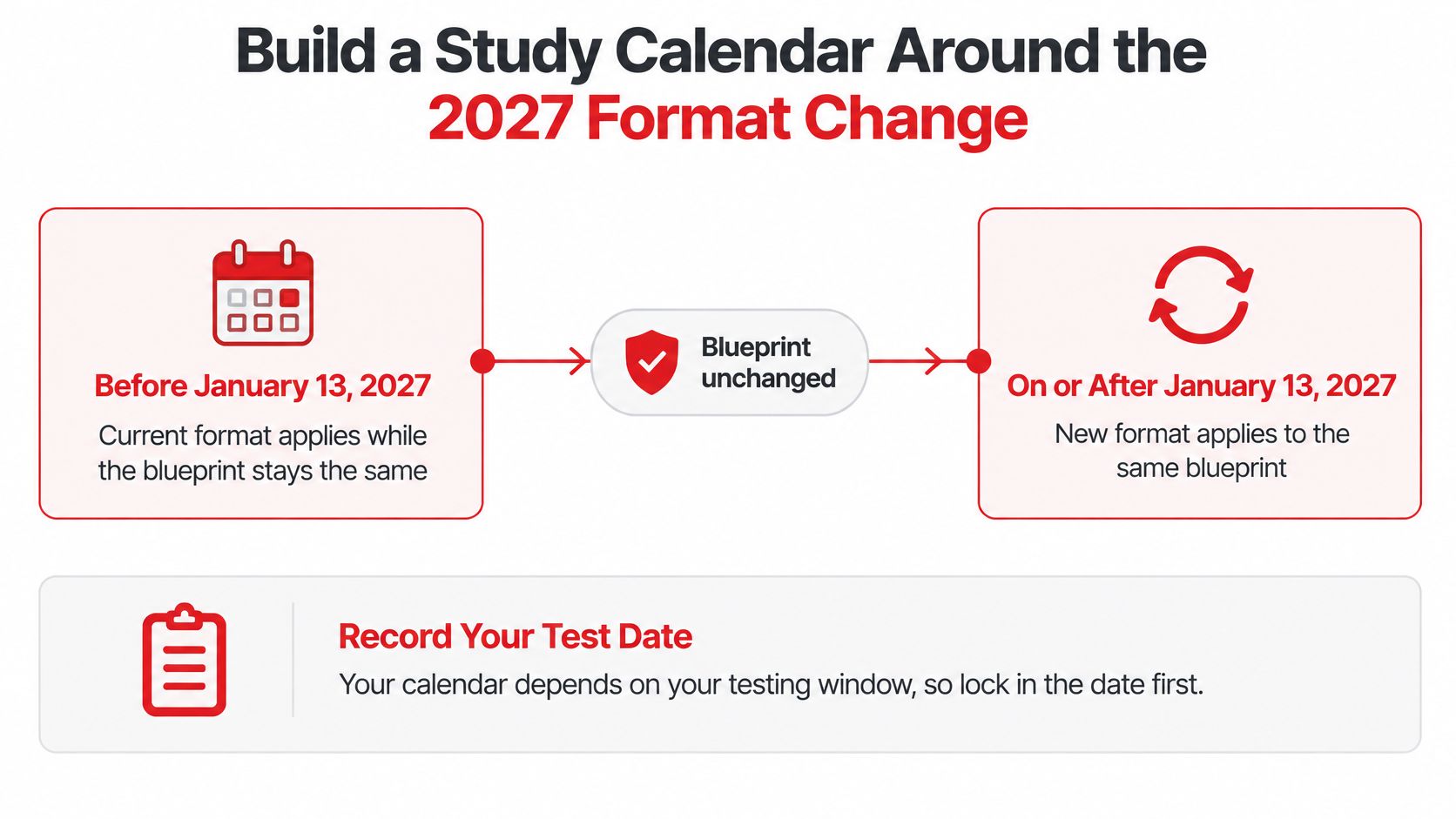
Which date is on your permit? That single fact decides whether you rehearse two long days or one eight-hour day. NBOME announced that Level 3 moves from a two-day examination to a one-day format effective January 13, 2027, with the blueprint retained. The announced administration contains 240 multiple-choice questions and 16 CDM cases across four two-hour sessions, per the NBOME announcement of COMLEX-USA exam enhancements.
The shorter exam still holds you to the same material. What changes is how long you sit and how you split the week. A question bank's timer will not choose your test window, your break pattern, or how much room you leave for osteopathic work the bank does not cover. Those stay your decisions.
| Testing window | Format | Session structure | Planning focus |
|---|---|---|---|
| Administrations through December 19, 2026 | Two-day exam with single-best-answer MCQs and CDM cases | Four 3.5-hour sessions, two per day | Endurance across two days and sequential CDM practice |
| Scheduled from January 13, 2027 | One day, eight hours; 240 MCQs and 16 CDM cases | Four two-hour sessions | Shorter timed blocks with the same blueprint coverage |
Map the Calendar to Your Test Window
Treat the calendar like a training plan for a race of known distance. You do not invent the course on race morning.
- Confirm eligibility before anything else. NBOME requires candidates to have passed COMLEX-USA Levels 1 and 2-CE, graduated from an accredited college of osteopathic medicine, and obtained a good academic and professional standing attestation from the residency program director, and it recommends at least six months of graduate medical education before sitting Level 3, per the NBOME eligibility guidance. That recommendation is why residency cases make good study material.
- Lock the date and the format. Record the day you checked the NBOME Level 3 page and the announcement, since both can change.
- Take a timed baseline in week one. Mixed content, real conditions, no tutor mode.
- Count the weeks available. Assign timed mixed blocks to those weeks before you assign reading.
- Schedule CDM practice separately from MCQ blocks. They train different skills and should not compete for the same hour.
- Put a review day after every timed block. A block you do not review is a score, not a study session.
- Keep a schedule log. Skipped weeks stay visible instead of disappearing.
A sample week for the current two-day format looks like this. Monday, one 3.5-hour timed session. Tuesday, review of flagged items. Wednesday, a second timed session on a different mix. Thursday, CDM sequences. Friday, error-category review. Weekend, one full-length simulation with the breaks you plan to use.
For the 2027 administration, keep that rhythm, shorten blocks to two-hour sessions, and rehearse one full eight-hour simulation before test day. Pacing is the part a bank cannot settle for you: match the session length to the window you will sit.
One practical note before buying anything. Third-party accounts must stay in your own name, with login credentials not shared, and Ace Med Boards does not include or resell UWorld or any other question bank.
Review Each Block and Track Whether Scores Mean Progress
A review session earns its place only if it changes what you study next week. A percentage that drifts from 58 to 61 without changing your behavior is entertainment.
NBOME reports Level 3 results as Pass or Fail together with a three-digit score and performance profiles for clinical disciplines and blueprint areas, and it applies a criterion-based standard, so the share of candidates who pass isn't fixed in advance; raw answers convert to the three-digit standard score, and performance is judged on the total examination rather than area-by-area decisions, per the COMLEX-USA Bulletin of Information.
That has a practical consequence. Your practice percentage describes a sample of items you chose to sit. It isn't a forecast of a standard score against the 350 threshold reported by the NBOME FAQ, where the score reflects multiple-choice performance together with key features from the CDM cases.
A workable setup is unglamorous: one screen for the block report, one page for the rules you missed.
A Review Loop That Changes the Next Block
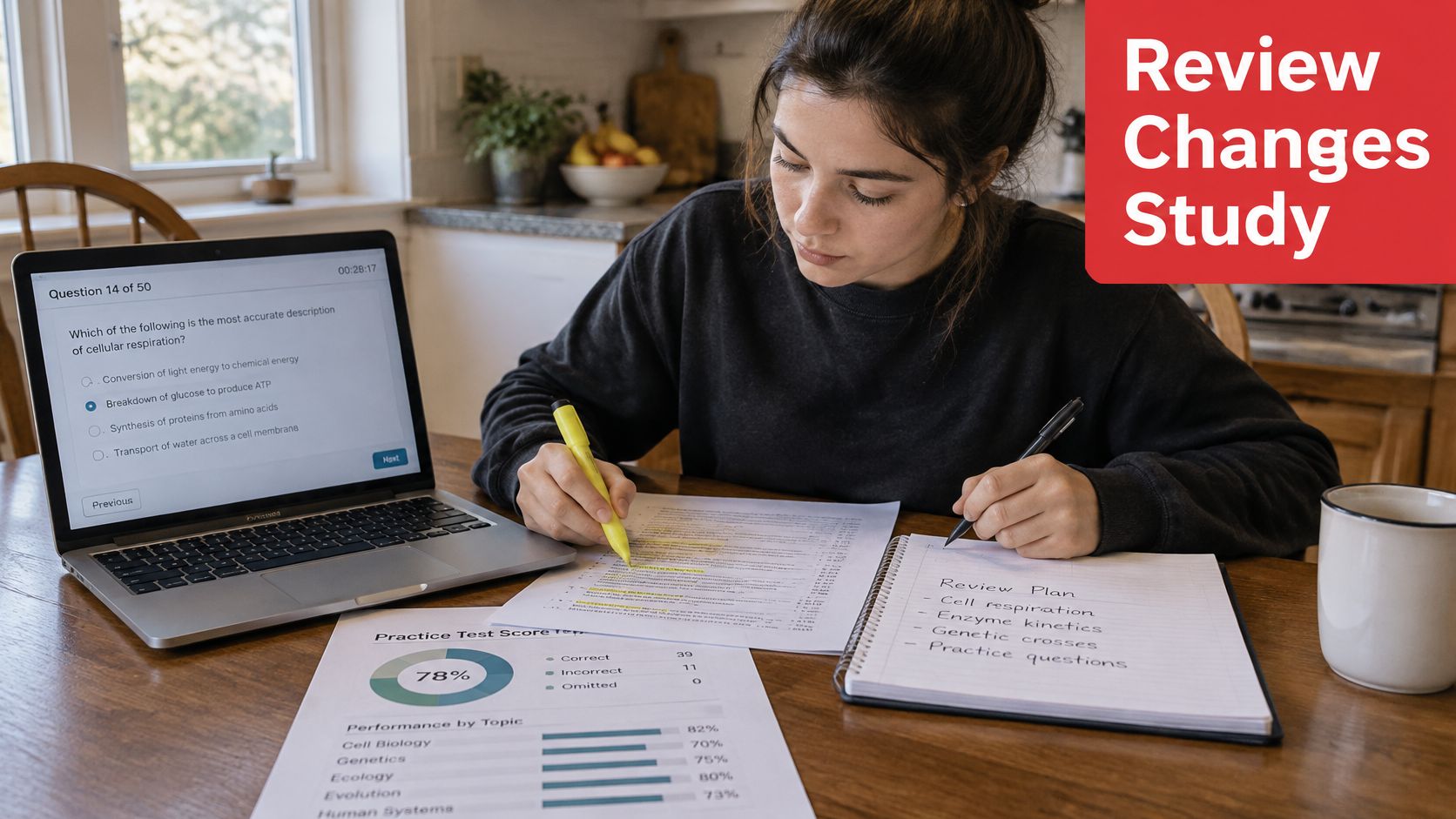
- Flag under timed conditions. Mark every item you guessed or felt unsure about while the clock runs. Don't withdraw a flag because the answer turned out right.
- Review flagged items first, including correct ones. Read the stem again before the explanation. A lucky correct answer is a miss with better branding.
- Assign one category per miss. Diagnosis, management step, osteopathic content, or test-taking process. One category only, or the log stops telling you anything.
- Write the rule, not the answer. A case stated instability, and you chose the management step meant for a stable patient. The rule becomes "check the stability criterion before selecting a management step." That transfers to the next case. The drug name doesn't.
- Verify the concept in an authoritative reference and note which one. The rule then carries a source you can re-check rather than a memory of a screen.
- Retest in an unseen block. Two weeks later, answer fresh items on the same concept and log whether the category returns.
Category discipline: one miss, one category. Tag a single item as diagnosis, management, and pacing and the log becomes noise.
Five Measures Worth Logging Each Block
- Percent correct. The headline number, useful only beside the four below it.
- Uncertainty-adjusted accuracy. Correct answers you didn't flag. This is the honest measure of what you own under time.
- Time per item. Median, not average, because one stalled CDM sequence drags an average into nonsense.
- Completion rate. Items answered inside the block limit. Rising accuracy with more unfinished items is a pacing problem wearing a progress costume.
- Error-category counts. How many misses land in diagnosis, management, osteopathic content, and process.
| Block 6, illustrative example (not real data) | Value |
|---|---|
| Items in block | 45 |
| Correct | 27 (60%) |
| Flagged as uncertain | 8 |
| Misses in diagnosis | 5 of 18 |
| Unfinished at the time limit | 2 |
Reading the Trend Instead of the Percentage
One block tells you almost nothing. Three or four blocks in comparable conditions start to show a direction, and the direction is what you act on.
- Accuracy up, time per item steady. Progress. Keep the format and add content in weak domains.
- Accuracy up, unfinished items climbing. Pacing trouble. Shorten blocks and rehearse the skip-and-mark habit before adding content.
- One error category that won't move. A concept to study, not a verdict about your ceiling.
- Accuracy that only rises on items you've already seen. That's memory of the item, not command of the concept. Move to unseen material.
Trend rule: three blocks, same format, same conditions. Anything shorter is a mood.
Everything above is exam-focused education. It isn't medical advice and doesn't describe patient care, where decisions rest on the full clinical picture and current authoritative guidance.
Close OMT and Osteopathic Gaps With Complementary Resources
A question bank can flag a weak domain. It cannot decide how you will close an osteopathic gap, or whether the items on your dashboard even cover Level 3.
Osteopathic principles and manipulative treatment belong in the plan early, not in a leftover week after the multiple-choice sets feel finished. In 2025, the free COMLEX sample-question page listed access for COMLEX Levels 1 and 2 only, not Level 3, according to UWorld's COMLEX sample questions page. A sample page is not a product catalog. Confirm Level 3 scope on the vendor's current product page before you build a calendar around that sample.
What Else Belongs in the Plan
| Resource | Best used for | Limit to verify | Where to check |
|---|---|---|---|
| UWorld question bank | Timed MCQ and case practice with explanations | Level 3 content breakdown and item count | UWorld product page |
| Third-party COMLEX question bank such as COMBANK | Extra MCQ volume in weak domains | Current Level 3 scope and access terms | The vendor's current catalog |
| NBOME practice materials | Official-format review where offered | Level 3 availability and format of each practice product | NBOME Level 3 page |
| Osteopathic textbooks and OMT references | Depth on manipulative treatment and osteopathic principles | Not question-based; pair with practice items | Publisher listing and course syllabus |
| Authoritative clinical references | Management reasoning behind CDM answers | Exam-focused simplification; not individualized clinical guidance | Current specialty or society guidelines |
Before you add another resource, run this against your own UWorld dashboard:
- Filter or tag osteopathic and OMT misses. A thin or empty bucket means the bank is not measuring that gap.
- Read a few explanations in that bucket. If they stop at a technique name, the depth still has to come from a text.
- Set those items beside official practice materials when Level 3 versions are offered, and note style differences.
- Do not use a Step 3 question count to estimate Level 3 volume.
Two cautions save wasted weeks. Third-party banks can add useful volume in a thin domain, but check that the Level 3 material is current and that access terms suit your timeline. Keep USMLE Step 3 separate from COMLEX Level 3. A 2024 third-party post on Telegram reported 1,975 questions in the UWorld Step 3 bank, which describes a different examination's bank. That number is a Step 3 figure, not a Level 3 figure.
For manipulative treatment specifically, the OMM board review guide is one place to start, alongside the practice items and textbooks listed above. A textbook works like a labeled atlas of principles and technique. It is not question-based, so pair it with practice items or that depth never becomes retrieval under a timer.
Pace Each Session on the Two-Day Format
The current administration is an endurance exam before it's a knowledge exam. For test dates through December 19, 2026, candidates sit four 3.5-hour sessions, two per day, with a 60-minute pooled break allowance each day, as the NBOME COMLEX-USA Level 3 page sets out.
The case format shapes pacing more than most candidates expect. Each CDM case contains two to four questions, the multiple-choice portion is organized into 70-item sections, testing runs over two days inside a 14-day window, and unused time from one separately timed session doesn't carry forward to the next, per the NBOME examination format page.
That last rule matters. Finish a session early and those minutes are gone, not banked.
- Set a per-item target from your own blocks. Take the median time per item across two timed sets and use that. A number borrowed from someone else's post describes someone else.
- Adopt a skip-and-mark rule. If an item runs well past target, mark it, commit to the best answer you have, and move on. One marked item you can revisit beats three unmarked items you never reach.
- Budget CDM sequences separately. A long case sequence can consume the time a later section needs, so cap the minutes you'll spend on any single sequence.
- Plan breaks rather than improvising them. Food, fluids, and a short reset, rehearsed in a full simulation.
- Count unfinished items after every simulation. That number decides your next adjustment, not the percentage.
The COMLEX Level 3 format breakdown maps the sessions in more detail if you want a session-by-session schedule to simulate. From January 13, 2027, apply the same rules to two-hour sessions and rebuild the simulation before you sit the shortened exam.
Run Your First Baseline and Decide on Support
Run one timed mixed block this week, before you buy or add anything. The result decides which branch you take.
Decision rule: gaps in one or two domains point to adding the matching resource and retesting in four to six weeks. Gaps that persist across several domains, or a pacing problem that survives repeated simulations, point to structured help.
Ace Med Boards lists COMLEX-USA tutoring for Level 1, Level 2-CE, and Level 3 on its COMLEX tutoring service page, including work with students facing a plateau or returning after an unsuccessful attempt. Scope, pricing, and terms sit on that page, so check them there rather than relying on this article. Tutoring complements official practice materials, question banks, and independent study. It doesn't replace them.
If the baseline felt shakier than expected, the COMLEX Level 3 practice test guidance explains how to build a realistic simulation before the next attempt. A free COMLEX consultation is available to talk through exam level and timeline, and it's a reasonable next step when the gap list is long and the calendar is short.
Sources
Which document answers which question? Start there before a study note stands in for the exam rules.
The National Board of Osteopathic Medical Examiners publishes the COMLEX-USA Level 3 examination page. That page describes how the current Level 3 exam is organized.
The NBOME announcement of COMLEX-USA exam enhancements for 2026-2027 describes the one-day format that takes effect on January 13, 2027, including the multiple-choice items and CDM cases spread across four sessions. If your date is on or after that day, read this announcement before you lock a calendar built on the earlier structure.
The NBOME COMLEX-USA Bulletin of Information, 2025-2026, covers score reporting: Pass or Fail, a three-digit score, and performance profiles, plus a criterion-based passing standard.
NBOME eligibility guidance covers the Level 1 and Level 2-CE requirement and the recommendation of at least six months of graduate medical education.
The UWorld COMLEX sample-question page, in its 2025 listing, showed free sample access for Levels 1 and 2. A sample set is a preview. It is not the Level 3 blueprint, and it does not decide pacing or osteopathic gaps for you.
Ace Med Boards offers one-on-one online tutoring for COMLEX Level 1, Level 2-CE, and Level 3, covering content review, clinical reasoning, question approach, and pacing. A free COMLEX consultation is available through Ace Med Boards.