
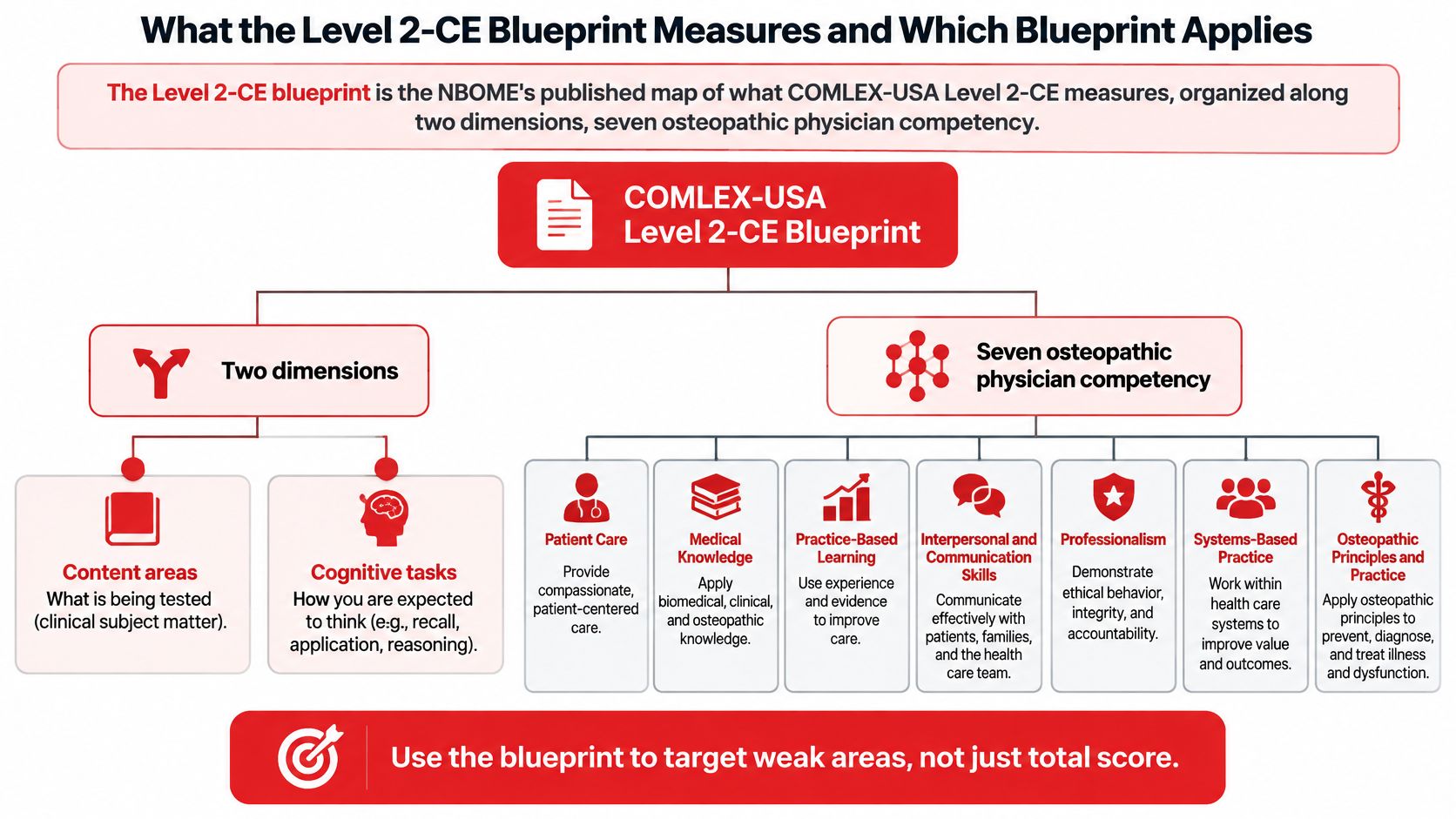
The COMLEX Level 2-CE blueprint describes what the exam measures across two overlapping dimensions, seven osteopathic physician competency domains and ten clinical presentation categories. The largest single allocation is Osteopathic Patient Care and Procedural Skills at a minimum of 30%, followed by Application of Knowledge for Osteopathic Medical Practice at 26% and Osteopathic Principles, Practice, and Manipulative Treatment at a minimum of 10%.
An overall practice percentage tells you almost nothing about which of those grids is weak. Two students can both score 68% on the same mixed block, and one may be missing patient-care decisions while the other keeps missing musculoskeletal stems. Their next four weeks shouldn't look alike.
That's the confusion worth clearing up first. The blueprint isn't a ranked list of diseases to grind through in order. It's two grids laid over the same questions, and once you can tag an item on both grids, planning stops being guesswork.
Key Takeaways
- Two dimensions, one item bank. Every question sits in a competency domain and a presentation category at the same time, so a single review hour can serve both if you tag it correctly.
- Patient care leads the domain grid. Osteopathic Patient Care and Procedural Skills carries the largest minimum at 30%, ahead of Application of Knowledge at 26%.
- Musculoskeletal leads the presentation grid at 13%, with Community Health and Wellness next at 12%.
- The published domain weights add to 90%, not 100%, so read them as relative emphasis rather than a pie chart.
- The pass decision is based on total examination performance against a standard score of 400, with no separate per-domain cutoff published.
What the Level 2-CE Blueprint Measures and Which Blueprint Applies
Which blueprint should guide your Level 2-CE preparation, and how should you read its categories? The exam's content is organized along two overlapping dimensions: seven osteopathic physician competency domains and ten clinical presentation categories. The NBOME Level 2-CE blueprint is the place to check the specifications that apply to your test date.
COMLEX-USA is the osteopathic medical licensing examination administered by the National Board of Osteopathic Medical Examiners (NBOME). Level 2-CE assesses clinical evaluation through questions that bring together clinical and foundational biomedical sciences, osteopathic principles, patient care, communication, professionalism, and systems-based practice. Osteopathic manipulative treatment (OMT) is tested within clinical reasoning, rather than as a separate topic detached from patient care.
The seven competency domains and their stated weightings
The table below shows the published weighting for each domain. Tagging a practice question by both its competency domain and its clinical presentation helps you see whether a missed item reflects a reasoning skill, a content area, or both.
| Competency domain | Stated weighting | What it covers in practice |
|---|---|---|
| Osteopathic Patient Care and Procedural Skills | At least 30% | Diagnosis, management and procedural decisions in patient scenarios |
| Application of Knowledge for Osteopathic Medical Practice | 26% | Applying biomedical and clinical knowledge to patient problems |
| Osteopathic Principles, Practice, and Manipulative Treatment | At least 10% | Osteopathic principles and OMT, often embedded in clinical decisions |
| Practice-Based Learning and Improvement | 7% | Self-assessment and improvement in clinical practice |
| Professionalism | 7% | Ethical and professional conduct in patient care |
| Interpersonal and Communication Skills | 5% | Communication with patients and other clinicians |
| Systems-Based Practice | 5% | Health-system roles, resources and coordination |
The listed domain percentages add to 90%, not 100%. The Foundational Biomedical Sciences Knowledge Base is listed at 25% as part of the Application of Knowledge domain, rather than as an eighth domain. The published figures are minimums, so use them to understand relative emphasis, not as slices of a complete pie chart.
Patient care and knowledge application together account for roughly half of the stated emphasis. That balance favors applying knowledge to clinical decisions over studying facts in isolation. Explicit osteopathic content also has a stated minimum, while OMT can appear within broader clinical-care questions.
Which blueprint applies to your test date
Each COMLEX-USA level has its own specifications. Level 1 emphasizes foundational biomedical and clinical sciences, while Level 3 focuses more on patient management and practice-based decisions. Level 2-CE centers on clinical application, so its blueprint should not be used as a substitute for another level's specifications.
NBOME periodically revises its blueprints. Check the official Level 2-CE blueprint page for the current specifications that apply to your test date. If you are comparing the DO and MD training pathways, the steps to becoming a doctor outline the broader sequence. For an overview of tutoring across the COMLEX levels, see Ace Med Boards' COMLEX-USA tutoring information.
Clinical Presentation Categories and Their Weightings
A single question can test a clinical presentation and a competency at the same time. Treat the blueprint as two overlapping grids: one sorts items by the type of presentation, the other by the skill needed to answer them. Tag each practice item once in each grid, so one missed question does not become two separate study tasks.
| Clinical presentation category | Stated weighting | Study note |
|---|---|---|
| Musculoskeletal | 13% | Can overlap with osteopathic manipulative treatment and patient-care items |
| Community Health and Wellness | 12% | Includes prevention, population health, and wellness scenarios |
| Nervous System/Mental Health | 10% | Includes neurologic and psychiatric presentations |
| Gastrointestinal/Nutritional Health | 10% | Includes gastrointestinal and nutrition-related presentations |
| Circulatory/Hematologic | 10% | Includes cardiovascular and blood-related presentations |
| Respiratory | 10% | Includes pulmonary presentations |
| Four remaining presentation categories | 35% combined | Check the NBOME Level 2-CE blueprint page for their names and individual weights |
The NBOME Level 2-CE blueprint describes a two-dimensional design. Osteopathic principles are tested within broader clinical-care reasoning, so an item may fit more than one competency while still belonging to one clinical presentation category.
One item, two tags
Consider a fictional practice item about an adult with persistent low back pain and no red-flag findings:
- Presentation tag: Musculoskeletal. This identifies the kind of clinical scenario.
- Primary domain tag: Osteopathic Patient Care and Procedural Skills. The task is to decide what to do next.
- Secondary domain tag: Osteopathic Principles, Practice, and Manipulative Treatment. The item may ask whether a technique belongs in the plan.
- Additional domain tag, if relevant: Foundational Biomedical Sciences. Anatomy or innervation may explain why an answer is incorrect.
The item belongs in one presentation category and can reveal a gap in one or more competency domains. If you record only “musculoskeletal,” you may miss that the difficulty was choosing a procedure rather than recognizing the anatomy. If anatomy is already secure, rereading it may not address the actual gap.
Practical rule: Give each practice item one presentation tag and at least one competency tag. Keep the item itself in one row of your log; use its tags to guide the study decision. A high-frequency topic you answer consistently may need less review than a less frequent topic where your reasoning repeatedly breaks down.
These examples simplify clinical concepts for exam preparation. They are not medical advice or guidance for patient treatment.
Keep two tag columns beside your question log, one for competency and one for presentation. Add each missed item to both, then review the pattern across items. If an hourly tutoring session would help you work through difficult topics or analyze multiple-choice questions, Ace Med Boards offers COMLEX tutoring for Level 2-CE.
Exam Length, Passing Standard and Scoring Rules
Start with the rule that governs how you interpret every practice score. The passing standard is a standard score of 400 or higher, the standard is criterion-based, and performance is judged on the total examination, according to the NBOME Bulletin of Information. There's no published requirement to clear each blueprint domain separately.
That matters because it tells you what a weak area costs you. It costs you points on the total. It doesn't trigger a separate gate.
The format checkpoints, and what to confirm before exam day:
- Format and pacing: the NBOME description of examinations describes a one-day, computer-based exam of 320 questions across two separately timed four-hour sessions, with four sections per session. That published structure supports a working target of approximately 1.5 minutes per question, though breaks, navigation and item difficulty eat into usable time.
- Item count and section layout: NBOME materials have described the exam's length and section structure in more than one way across publications, so confirm the current figures in the bulletin that applies to your test date instead of relying on a secondary summary.
- Score reporting: NBOME converts the raw score, meaning the number of correctly answered items, into a three-digit standard score.
- No per-domain minimum: because the pass decision rests on total performance, a weak domain lowers your total rather than failing you by itself.
The planning consequence is subtle but useful. Your audit should hunt for the drivers of total performance, especially in the domains that carry the most weight, rather than chasing a fictional per-domain cutoff. A domain worth a small share of the exam and missed twice doesn't deserve a rescue week.
Don't convert practice percentages into predicted standard scores, and don't let anyone else do it for you. If you want to place a practice result on the reporting scale, a COMLEX score percentile reference helps you read where a number sits, not where your score will land.
Confirm every figure above in the bulletin in force for your administration. The specifics here track the 2025-2026 NBOME Bulletin of Information and can change with the blueprint.
Gap-Analysis Worksheet for Your Blueprint Audit
An overall practice percentage hides which domains and presentations are weak, and that's the whole problem. A student at 72% overall may be at 90% in two heavy areas and 55% in a third, and the aggregate blends all three into a number that suggests "do more questions."
The fix is a short audit with a fixed procedure. Run it before you buy another resource, not after.
- Gather the evidence. Pull the most recent practice blocks you've completed, using official or licensed materials only. Two or three timed blocks give enough items to see patterns.
- Tag each item twice. One primary competency domain, one primary presentation. If a second domain clearly drove the miss, record it in a separate secondary column so the same miss never counts in two places.
- Count and calculate. For each domain and each presentation, note how many items you saw and your accuracy in that bucket.
- Compare against yourself. Set a cut-off before you look at the numbers, typically a few points below your own overall accuracy, and flag every bucket that falls under it. Skip outside benchmarks, they aren't yours.
- Name the pattern. Misses concentrated in next-step decisions point to a different fix than misses on factual recall. So do misses on items that pair OMT with a presentation.
- Check the clock. If accuracy drops in the last third of a block, the gap is pacing or stamina, and more content review won't touch it.
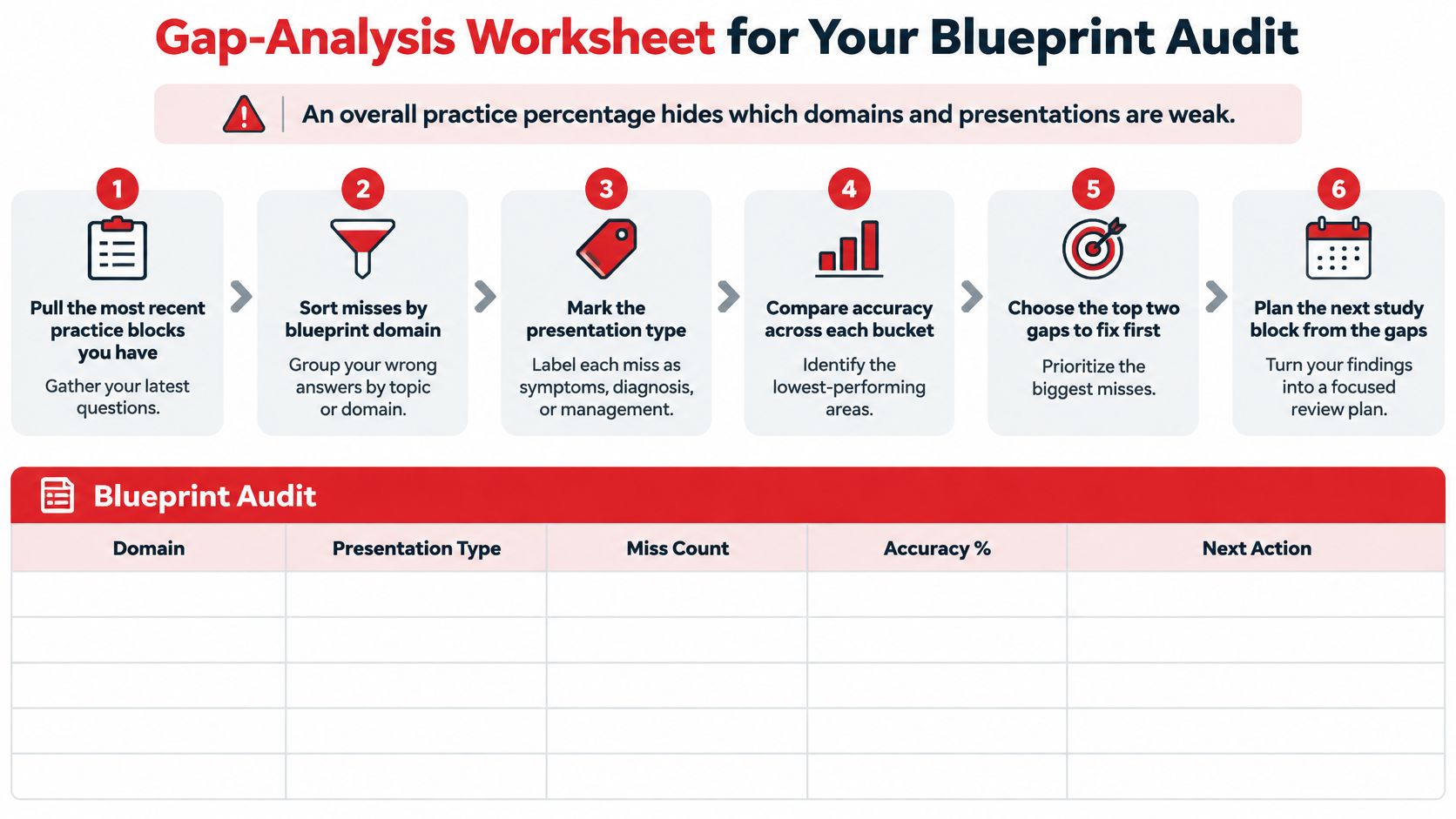
The worksheet below is the one-page version. Fill it in by hand or in a spreadsheet, and keep it from week to week.
| Domain | Blueprint weight | Items tagged | Accuracy | Gap flag |
|---|---|---|---|---|
| Osteopathic Patient Care and Procedural Skills | At least 30% | ___ | ___% | Yes or no |
| Application of Knowledge for Osteopathic Medical Practice | 26% | ___ | ___% | Yes or no |
| Osteopathic Principles, Practice, and Manipulative Treatment | At least 10% | ___ | ___% | Yes or no |
| Practice-Based Learning and Improvement | 7% | ___ | ___% | Yes or no |
| Professionalism | 7% | ___ | ___% | Yes or no |
| Interpersonal and Communication Skills | 5% | ___ | ___% | Yes or no |
| Systems-Based Practice | 5% | ___ | ___% | Yes or no |
A worked illustration, clearly hypothetical
Say a 40-item timed block produces 76% overall accuracy. Twelve of those items are tagged to Osteopathic Patient Care and Procedural Skills, and accuracy in that bucket is 58%. Every one of those twelve misses is a next-step decision rather than a definition. The numbers here are illustrative, invented to show the shape of a finding, not benchmarks to chase.
What would that student do next? Not reread a review book cover to cover. They'd run a block of management-heavy vignettes, review each miss for the reasoning step that broke, and re-tag. If a skills gap analysis tool helps you structure the same comparison outside medicine, the logic transfers: identify the specific sub-skill, measure it, then target it.
How the official profile fits in
After the exam, NBOME's performance profile compares your results with the mean performance of first-time test-takers who passed and reports across all seven competency domains and ten clinical presentations, as the 2024-2025 NBOME Bulletin of Information sets out. It's a diagnostic, and it carries the same ambiguity your practice tags do: a low musculoskeletal result can reflect diagnosis, patient care, foundational science, or OMT rather than one discrete subject.
That profile checks your audit after the fact. It doesn't replace tagging during prep, and it's most useful when you already read your own data in the same two dimensions. If you've been tracking a COMSAE result, a COMSAE to COMLEX conversion reference places the number on the reporting scale, while the worksheet tells you why the number moved.
Turning Gaps Into a Weekly Study Plan
Rank your flagged areas by two things together: how much of the exam they represent and how far below your cut-off they sit. A heavily weighted domain with weak accuracy goes to the front of the week. A lightly weighted domain with a single miss gets a note, not a day.
Prioritization rule: weight decides how much a gap can cost, accuracy decides how fast you can close it. Fix the intersection first.
Two failure modes show up again and again. The first is studying the topics you enjoy, which feel productive and change nothing. The second is the trap this blueprint sets.
The double-counting trap
If you allocate study hours against both a domain tag and a presentation tag, the same two hours appear twice in your plan. A week built that way looks full and delivers half. Schedule hours against the primary tag only, and keep secondary tags in a log as a cross-check, so a musculoskeletal block that also drills patient-care reasoning gets credited once.
Integrated case sets are the better use of a block than isolated technique drills. Osteopathic content on this exam tends to arrive inside a clinical decision, which means a case forces the same combination the item will.
A week that follows the audit
The template below assumes one flagged domain and one flagged presentation. Adjust which bucket fills each slot, not the structure.
| Day | Session focus | Work product |
|---|---|---|
| Monday | Concept review for the flagged domain | Tagged notes for that domain |
| Tuesday | Timed question block tagged by domain and presentation | Updated tag log |
| Wednesday | Integrated case set covering OMT and patient-care reasoning | Reasoning notes for missed items |
| Thursday | Error review from Tuesday and Wednesday | Error-type labels |
| Friday | Presentation-focused block for the lowest-accuracy category | Accuracy by presentation |
| Saturday | Mixed timed block with planned breaks | Pacing log |
| Sunday | Light review and blueprint recheck | Next week's priority list |
Set the hours per session yourself. Available time varies by rotation, commute and life, and a schedule you didn't choose is a schedule you'll abandon by Thursday.
Saturday deserves a note of its own. Take the breaks you plan to take on exam day, in the same order and roughly the same length, and log the minute a block starts to feel slow. Pacing data is part of the audit, not an afterthought, especially since the exam runs as two long timed sessions.
Then re-audit every few weeks with the same worksheet and the same categories. Comparing against yourself is the only comparison that shows movement, and it shows it faster than a fresh question bank does. For more on the clinical content side of this work, this guide to Level 2-CE clinical knowledge preparation pairs well with the audit.
Confirm Your Gaps Before Choosing Tutoring Support
One-on-one tutoring complements official NBOME materials, question banks and your own independent study. It doesn't replace them, and any provider that suggests otherwise is selling relief rather than preparation. The blueprint is the map; a tutor is someone who reads your map with you.
Ace Med Boards offers private online COMLEX tutoring across Level 1, Level 2-CE, and Level 3, including support for students working through a plateau or returning after an unsuccessful attempt. The COMLEX Level 2-CE tutoring uses clinical vignettes to practice diagnosis, next steps in management, and reasoning through competing answer choices, and the work covers content review, clinical reasoning, question approach, and pacing. A free COMLEX consultation is available to discuss your exam level and timeline. Details are on the COMLEX tutoring service page.
Here's where the worksheet earns its keep. A reader who walks into that conversation with a list of flagged domains and presentations, plus item counts and accuracy for each, gets a specific discussion about clinical decision-making under a particular presentation. A reader who arrives with "my scores are low" gets a generic one. The audit converts a vague worry into a starting point.
The current pricing page, reached from the site navigation, lists available hours, package prices, and eligible guarantees for the packages that carry them. Read the terms there rather than a summary, since eligibility conditions are specific and worth understanding before you commit.
Nothing about a weak practice block, a plateau, or a prior attempt closes a door. What closes the gap is knowing which of the two grids your misses live in, and then working that grid deliberately for a few weeks.
When you've filled in the worksheet and you know which competency domains and presentation categories are costing you points, Ace Med Boards can help you turn that list into sessions: private COMLEX-USA Level 2-CE tutoring built around clinical vignettes, next-step management decisions, and the reasoning behind competing answer choices, with content review and pacing folded in. A free consultation is a low-pressure way to talk through your exam level, your timeline, and what your audit found. Visit Ace Med Boards to set one up.