

COMLEX-USA Level 1 has no single annual test date. For 2026-2027, the first listed window is May 7-31, 2026, with scores targeted for June 30, 2026, and later windows continue through early 2027.
What if the date circled on a study calendar is not available? That gap between a preferred day and a confirmed seat is where most COMLEX Level 1 test dates planning goes wrong, and it is avoidable with a window-first approach.
COMLEX Level 1 Test Dates and Score Release Windows
COMLEX-USA Level 1, administered by the National Board of Osteopathic Medical Examiners (NBOME), has no single test date. Candidates choose a day inside a published testing window, and each window carries a targeted score-release date.
As of November 11, 2026, that distinction changes the practical answer. The windows from May through August 2026 have already closed, so a student booking now is not choosing from the full 2026-2027 list. The live question is narrower: which later 2026 windows through December 31, 2026 still have seats, and does the January 2-27, 2027 window fit school requirements?
Ace Med Boards Editorial Team prepared this snapshot from NBOME's testing window and registration pages. Dates, seat availability, and release targets must be rechecked before paying or booking, because a published target is a planned date, not a promise. A college of osteopathic medicine (COM) also controls eligibility, covered in detail later.
Published Windows for 2026-2027
The table lists every window in the NBOME summary used for this snapshot, with status marked for November 11, 2026. The NBOME testing windows and score release dates page lists the first 2026-2027 window as May 7 through May 31, 2026, with scores targeted for release on June 30, 2026, followed by later windows through early 2027.
| Testing window | Targeted score release | Status as of November 11, 2026 |
|---|---|---|
| May 7-31, 2026 | June 30, 2026 | Closed |
| June 1-13, 2026 | July 9, 2026 | Closed |
| June 14-27, 2026 | July 21, 2026 | Closed |
| June 28-July 28, 2026 | August 11, 2026 | Closed |
| July 29-August 27, 2026 | September 10, 2026 | Closed |
| Later 2026 windows through December 31, 2026 | Check NBOME | Upcoming or open, boundaries not listed in this summary, verify on NBOME |
| January 2-27, 2027 | February 9, 2027 | Upcoming, confirm on NBOME before booking |
Read the status column before counting study weeks. A closed window cannot anchor a plan, even if classmates tested then or an old calendar still shows that target. For later 2026, this summary does not list the individual window boundaries, so those exact start and end dates must be read on the NBOME page rather than assumed from the pattern of earlier windows.
Planning unit: Treat the testing window plus its targeted release as one unit. A single preferred weekday is not the plan until NBOME and the test center confirm it.
What a Targeted Release Means
Each release in the table is a target tied to the window, not a countdown from an individual's exact test day. Two candidates testing on different days inside the same window still plan around the same targeted release. That is why choosing the last day of one window instead of the first day of the next can matter for school deadlines, even when the two test days sit close together on a calendar.
Score-release dates can also change because of candidate scheduling conditions and testing-administration factors such as site closures or other operational limitations. Students shouldn't build a graduation, rotation, or application plan that only works if a target lands exactly as listed. A small buffer beside the target is a sensible, low-pressure safeguard.
The sections ahead move in booking order. Key takeaways come first, then score-release timing, school eligibility, a method for verifying dates on NBOME, seat limits and change rules, a worked January 2027 example, and a final booking checklist. The goal throughout is simple: a confirmed appointment in the NBOME Portal, matched to a realistic preparation timeline.
Key Takeaways
- Plan by window, not weekday: COMLEX Level 1 test dates sit inside published windows, and the window's targeted score release is the planning unit.
- School eligibility comes first: A COM must make a candidate eligible before any seat can be booked, including first-year completion and a dean's standing attestation.
- Book well ahead: Dates are generally offered up to six months ahead, and NBOME advises scheduling at least 120 days before the desired day.
- November 2026 changes the math: As of November 11, 2026, the 120-day target for January 2-27, 2027 has passed, so live seat availability matters most.
- Portal confirmation is the proof: A date is real only when it appears as an appointment in the NBOME Portal, not when it's written on a study calendar.
Why the Score Release Date Matters
The targeted score-release date often matters as much as test day. Coursework, school readiness or graduation requirements, dedicated board-preparation time, and residency-application timing can all attach to when a result arrives, not only to the morning a candidate sits for the exam.
Consider a simple backward count. Say a school needs a Level 1 result on file before a February rotation. The student looks first at the February 9, 2027 target for the January window, then works backward to decide when a study block must end and whether that release leaves enough room before the rotation starts. If it doesn't, an earlier window may fit better even though it allows fewer study days.
That arithmetic only works if the target is treated as a target. NBOME states release dates can change because of candidate scheduling conditions and administration factors such as site closures or operational limits. A plan that depends on a result arriving on one exact day, with no slack, is fragile.
A practical habit helps. Copy the chosen window and its targeted release into a personal planner, note the school deadline beside both, then verify the pair on NBOME before registering. Seat timing rules, including how far ahead to book, are covered in the seat-limits section.
School Eligibility Before a Date Is Real
A student can't independently pick a Level 1 day and expect the system to accept it. Eligibility sits between intention and appointment, and skipping that step is a common reason a preferred date disappears while paperwork catches up.
The sequence starts with an NBOME account and acceptance of the applicable terms. The candidate's COM must then make the candidate eligible before registration and testing. Without that school authorization, an open seat on a screen isn't bookable.
What Level 1 Eligibility Requires
The 2025-2026 NBOME Bulletin of Information identifies completion of the first year of study at an accredited college of osteopathic medicine and a Good Academic and Professional Standing Attestation from the college dean among Level 1 eligibility requirements. Students should check whether a 2026-2027 edition has replaced the 2025-2026 Bulletin cited here and follow the current edition.
In practical terms, ask the school three direct questions. When does the COM submit eligibility for the class? Is the dean's attestation already in process for the intended window? Does the school set its own readiness or deadline rules on top of NBOME eligibility? Written answers from the school prevent guesswork.
A date discussed with classmates, written on a study calendar, or seen as an open seat still isn't confirmed. Confirmation means the appointment appears in the NBOME Portal.
Two Gates, Not One
School validation and test-center capacity both decide whether a date exists. Testing dates are generally made available up to six months in advance, but eligibility timing determines whether a student can act when seats appear. A candidate who waits for attestation while a window fills may need a different day, center, or window.
As of November 11, 2026, timing is tighter for late-2026 and January 2027 plans. The windows through August 2026 have closed, so a student who still needs the attestation for an upcoming window should contact the COM now. That's not a reason for alarm. It is the correct order, since attestation is required before any seat can be booked.
Transfer or international situations deserve the same discipline, without invented exceptions. The school and the current Bulletin are the right sources for how eligibility applies in a specific enrollment situation. General background on the exam series is available in the COMLEX-USA overview, and weekly preparation belongs in the separate Ace study-schedule article once a window is chosen. Eligibility first keeps every later decision grounded.
How to Verify Dates on NBOME
Verification takes minutes and prevents weeks of planning around a stale date. The method below uses NBOME's own pages as the source of truth, because this article's table is a snapshot as of November 11, 2026.
A Six-Step Verification Method
- Open the testing windows page: Go to NBOME's COMLEX-USA testing windows and score release dates page and record each relevant window with its targeted release.
- Note the caveats: Write down the page's as-of context and any statement that release dates can change, so the planner reflects a target rather than a guarantee.
- Check registration rules: Open NBOME's registration and scheduling page and confirm current eligibility, terms, advance-booking guidance, and the five-day rule for Level 1.
- Confirm the Bulletin edition: Check the current NBOME Bulletin, since the eligibility requirements cited in this article come from the 2025-2026 edition.
- Compare portal seats to windows: Sign in to the NBOME Portal, compare visible seats with the recorded windows, and confirm any chosen day falls inside a verified window.
- Save a dated record: Keep a short written note of what was checked and when, including window, release target, center, and school deadline.
What to Do With Conflicts
If a screenshot from a classmate, an old advising handout, and the NBOME page disagree, NBOME wins. If the portal shows no seat inside a verified window, the window still exists but that center or day may be full. Those are different problems with different fixes.
A dated record makes later conversations easier. An advisor can see exactly which window was checked, which release was assumed, and when. That clarity matters if a school deadline shifts or a seat needs to change.
Seat Limits, Deadlines, and Rules for Changes
Seat rules explain why early, calm booking beats last-minute searching. The limits are not complicated, but they interact, and misunderstanding one of them can undo an otherwise sound study plan.
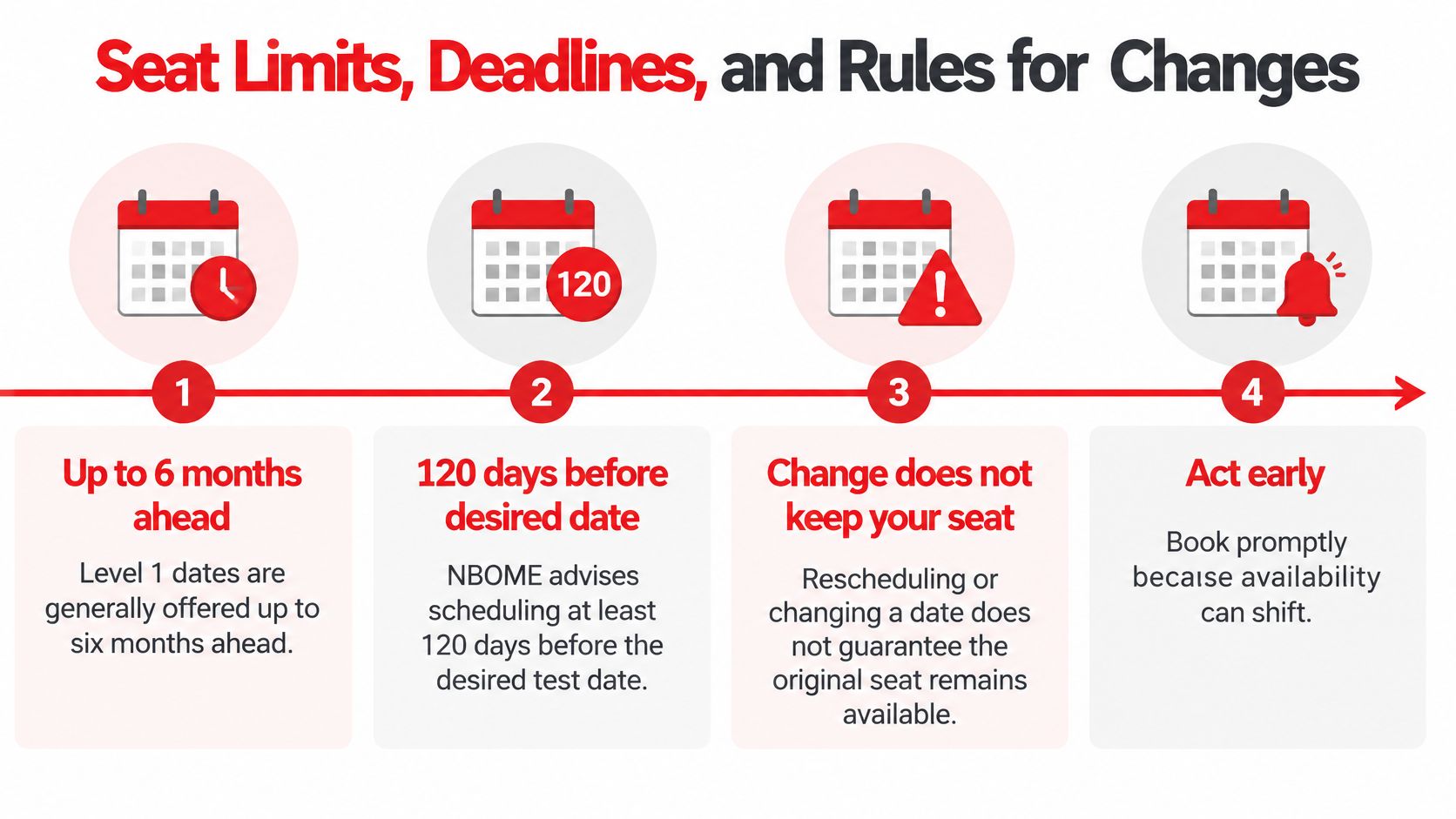
The NBOME examination format page reports that Level 1 testing dates are generally available up to six months in advance and advises candidates to attempt scheduling at least 120 days before the desired examination date because seats and dates are limited. The same source describes Level 1 as a one-day, computer-based examination in two 4-hour testing sessions, with sections 1-4 in Session A and sections 5-8 in Session B.
Separately, the NBOME registration and scheduling guidance recommends attempting to schedule at least 120 days before the desired date and states Level 1 candidates may not schedule an examination day fewer than five calendar days before the exam date. Candidates schedule through the NBOME Portal, while the appointment remains subject to location capacity.
Scheduling Limits at a Glance
| Rule | Timing | Planning use |
|---|---|---|
| Dates generally offered | Up to six months before the exam | Check live seats now for late-2026 and January 2027 windows |
| NBOME scheduling advice | At least 120 days before the desired date | For January 2-27, 2027, that mark was September 4, 2026 |
| Latest new appointment | Not fewer than five calendar days before the exam | Do not plan a last-week booking |
| Typical Level 1 cycle | May through March, verify on NBOME | Match the window to school and application milestones |
| Rescheduling or cancellation | Does not keep the original date or location | Confirm the replacement appointment appears in the portal |
| Exam day | One day, two 4-hour sessions, verify on NBOME | Block the full day, not a single morning |
The typical Level 1 cycle running from May through March helps students place a window beside academic milestones, but it should still be verified on NBOME for the relevant cycle. Likewise, the two-session format matters for planning travel, rest, and the full day, and candidates should confirm current format details on NBOME's exam-format page.
What a Change Does Not Keep
Rescheduling or cancellation does not preserve the original date or location. A replacement appointment depends on availability at the time of the change, and location capacity still applies. Candidates shouldn't release a workable seat on the assumption that the same center will have a better day later.
Before accepting any new seat, run four checks:
- Eligibility still valid: Confirm school authorization covers the new day.
- Acceptable window: Confirm the new day sits in a window whose release target still works.
- Realistic travel: Confirm the trip to the center is manageable on exam morning.
- School deadline intact: Confirm the COM deadline still works with the changed date.
Fees, refunds, and click-by-click change steps belong on the current NBOME registration page, not reconstructed from memory. Students weighing a change can also read the separate guidance on rescheduling a COMLEX exam. A change for readiness or illness is a scheduling decision, not a judgment about a candidate's future in medicine, and it should be made early enough to preserve real options.
Sample Plan for the January 2-27, 2027 Window
This illustration shows the counting method on a window that is still upcoming. It isn't a required schedule and it isn't anyone's result. The same arithmetic can be reused for any future window.

Say a student has a school expectation to complete Level 1 before a February 2027 rotation. The January 2-27, 2027 window looks suitable because its targeted score release is February 9, 2027. The student still checks whether that target leaves enough buffer before the rotation, rather than assuming February 9 is guaranteed.
Counting Backward From January 2
Six months before January 2, 2027 is July 2, 2026. That's roughly when dates for the start of this window would enter the six-month horizon. One hundred twenty days before January 2 is September 4, 2026, the point by which NBOME's scheduling advice says booking should already have been attempted.
As of November 11, 2026, both marks have passed. Waiting for them would be a mistake, and there's no benefit in dwelling on missed ideal timing. The useful first step now is checking the NBOME Portal for seats still open, keeping the rule that a new appointment can't be scheduled fewer than five calendar days before the chosen day.
Worked-example rule: When ideal booking marks have passed, live portal availability replaces calendar theory. Check seats first, then build study weeks around a confirmed day.
Five Steps for This Window
- Confirm account and eligibility: Verify the NBOME account is active and eligibility authorization is in place.
- Confirm the attestation: Ask the COM whether the dean's standing attestation is on file.
- Choose a primary date: Check open seats and select a day inside January 2-27, 2027.
- Save a contingency: Identify a second acceptable date in the same window before booking pressure builds.
- Have a fallback window: If no seat is open, check NBOME for later listed windows and compare release targets with the school deadline.
Readiness evidence can then be paced to the booked day. Students using practice assessments may find the explanation of COMSAE to COMLEX score conversion helpful for interpreting practice performance in context, without treating any conversion as a promise. Above all, no date in this example counts as confirmed until it appears as an appointment in the portal.
Checklist to Book a Confirmed Level 1 Seat
A booking checklist works best in order, with one action and one proof per line. Skipping ahead to seat selection before eligibility is settled creates avoidable rework.
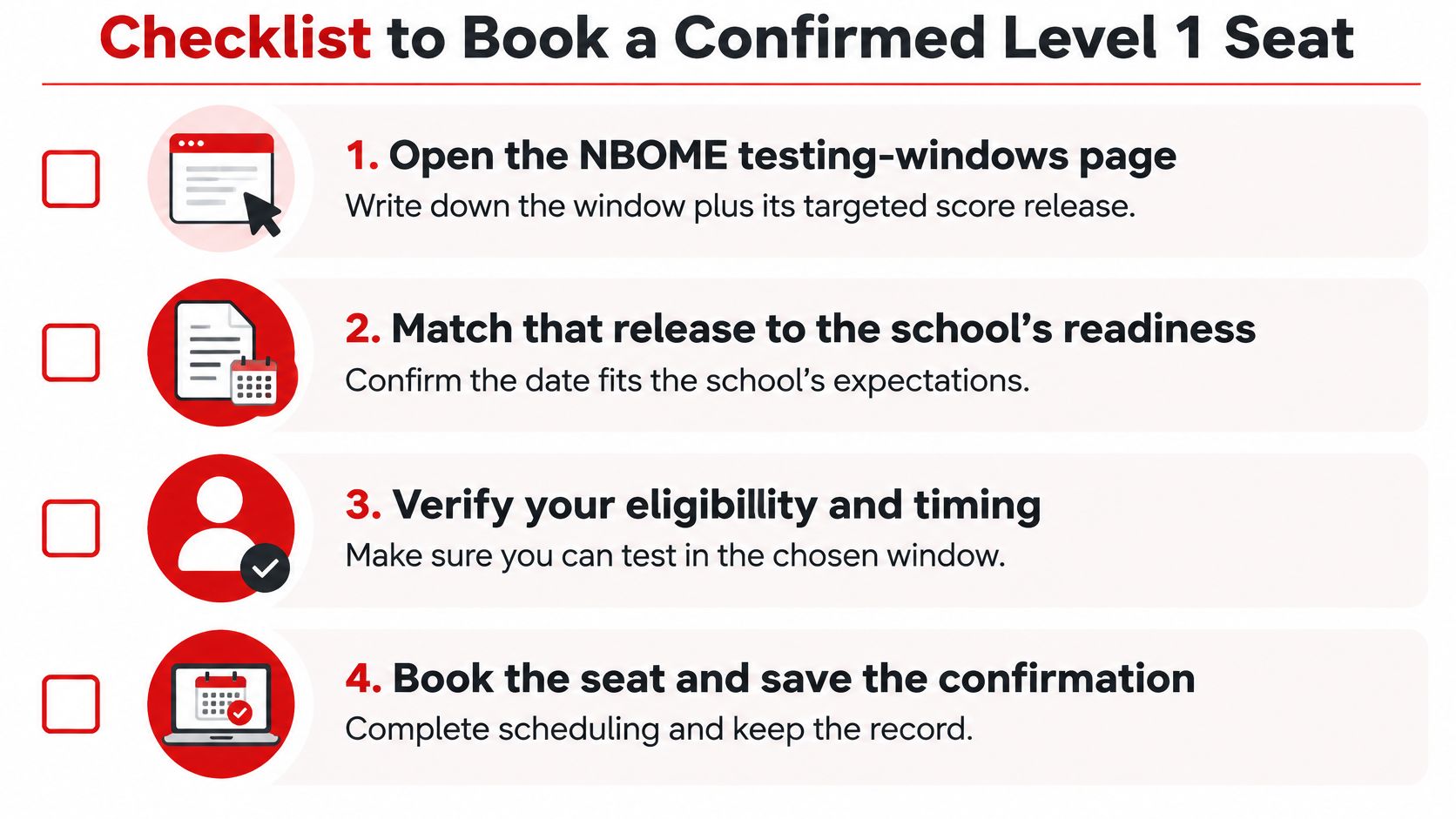
Ten Booking Checks in Order
- Record the window: Open the NBOME testing windows page and write down the window plus targeted score release.
- Match the school requirement: Compare that release with the school's readiness, rotation, or graduation requirement.
- Confirm the account: Verify the NBOME account exists and the terms have been accepted.
- Confirm school standing: Ask the COM whether first-year completion and the dean's good academic and professional standing attestation are on file.
- Watch the six-month horizon: Note when seats for the window are likely to appear.
- Set a 120-day target: Mark a personal booking deadline at least 120 days before the desired day.
- Book only when eligible: In the NBOME Portal, choose a center and primary date only if eligibility is active.
- Save a contingency: Keep a backup date in the same window.
- Verify the appointment: Confirm the appointment is visible in the portal and block the full one-day, two-session exam.
- Recheck the release: After booking, confirm the score-release target hasn't changed.
For the January 2-27, 2027 window, step 6 needs honest handling. As of November 11, 2026, its 120-day target fell on September 4, 2026, so that target has passed. For that window, check live seats immediately and treat the 120-day step as a planning rule for later windows, not a date that can still be met.
Three Common Failure Points
- Eligibility still pending: Contact the COM and ask what remains outstanding, rather than refreshing seat listings that can't yet be booked.
- Only open seat sits outside the needed window: Compare that window's release target with the school deadline before accepting, and discuss options with the school if it doesn't fit.
- Center requires unrealistic travel: Choose another listed day or center instead of assuming a closer seat will return.
Cost questions deserve current figures from official pages, and students comparing total expenses can review the breakdown of COMLEX costs alongside NBOME's current information. Once the seat is real, weekly planning belongs in the related study-schedule article. Optional one-on-one help from Ace Med Boards fits after that point, paced to a confirmed date rather than a hoped-for one.
Book the Seat, Then Match Prep to the Date
The decision sequence stays consistent. Check the live NBOME window, confirm school eligibility, book the earliest confirmed seat that fits, and keep a backup date in the same window. Once the portal shows the appointment, effort shifts from finding COMLEX Level 1 test dates to preparing at a pace the booked day allows.
Ace Med Boards offers one-on-one online COMLEX tutoring, and COMLEX tutoring supports students preparing for Level 1, Level 2-CE, and Level 3, including students facing a plateau or returning after an unsuccessful attempt. The current scope should be read on the COMLEX tutoring service page rather than assumed from this article. A free COMLEX consultation is offered to discuss the student's exam level and timeline.
Tutoring can cover content review, reasoning, question approach, and pacing. The session schedule depends on the student's exam date, practice performance, coursework or clinical responsibilities, and available study time, and is adjusted as preparation develops. It doesn't replace official NBOME materials or an independent question bank.
Package details, hours, and terms must be read on the current pricing or terms page, and any guarantee applies only as written there. Students building weekly structure can pair that review with the COMLEX Level 1 study schedule and, for general study habits beyond exam rules, evidence-based learning enhancement strategies from Tecton Ketones™. Fees, dates, and policies change, so official pages should be checked before any decision. Students who want help fitting prep to a booked date can schedule a free consultation without pressure.
Ace Med Boards provides one-on-one online COMLEX tutoring that can be paced around a confirmed Level 1 date, with attention to content review, question approach, and realistic weekly planning. Students ready to match preparation to a booked window can visit Ace Med Boards to request a free consultation and discuss exam level and timeline.