

A surgery clerkship can swallow the whole day before the first study block ever happens. Rounds start early, cases run long, and by the time the pager settles down, the idea of a normal evening of studying feels unrealistic. A workable surgery shelf exam study schedule has to fit into those gaps, not pretend they don't exist.
The cleanest approach is simple, anchor on the NBME Surgery blueprint, do daily spaced retrieval, and run timed question blocks wherever the day allows. That rhythm works for students who are trying to study between pre-rounds, the OR, clinic, and call recovery without burning out.
What a Realistic Surgery Shelf Study Schedule Looks Like
Surgery clerkship days are fragmented, so the schedule has to be fragmented too. A student who tries to protect a fake 3-hour block every day usually ends up frustrated, while the student who uses short, repeatable habits keeps moving. The goal isn't to build a perfect study day, it's to build a reliable one that survives the rotation.
A useful shape looks like this: 10 to 15 minutes of morning spaced retrieval, one timed question block sometime during the day, and 30 to 45 minutes of explanation review in the evening. That structure fits around pre-rounds, the OR, clinic, or sign-out because each piece is short enough to survive interruptions. It also keeps the student in contact with the material every day, which matters more than occasional marathon sessions.
Practical rule: if the day gets messy, keep the morning retrieval and the evening review even if the daytime block shrinks.
This exam is the NBME Clinical Science Subject Examination in Surgery, so the study schedule should point toward the way NBME asks questions, not toward perfect note-taking or memorizing every operative detail. The broad idea is to use clinical reasoning as the backbone of the plan, then let the day's free moments decide where questions and review land. For a general shelf framework that pairs well with this approach, the broader guide at How to Study for Shelf Exams is the right starting point.
The rest of the plan builds from that reality. It's less about “finding time” and more about deciding in advance what happens when the time is only 12 minutes between cases.
Reading the NBME Surgery Blueprint Like a Schedule
The blueprint is a time map, not a topic checklist. If a schedule gives every topic the same attention, it is already drifting away from the exam. A better approach is to let the blueprint decide where the highest-return study hours go.
The NBME Surgery Subject Exam gives 20% to 25% of questions to the gastrointestinal system, so GI should sit at the front of the line on any serious schedule NBME Surgery Subject Exam. Cardiovascular content is 10% to 15%, respiratory content is 8% to 12%, and multisystem processes and disorders is 5% to 10%. For a deeper walkthrough of the exam structure, see the guide to the NBME Shelf Exam. Those weights tell you where to start, and just as important, what not to overwork.
Organ system weight should drive weekly allocation
Use those percentages as study priorities. GI deserves the earliest blocks because abdominal pain, obstruction, bleeding, hepatobiliary disease, and postoperative complications show up often enough to shape the shelf. Cardiovascular and respiratory material still matters, but it should follow GI unless one of those areas is a clear weakness.
The physician-task breakdown matters just as much. Diagnosis makes up 50% to 60% of physician-task questions, while pharmacotherapy, intervention, and management make up 30% to 35% NBME Surgery Subject Exam. A student who studies anatomy in isolation is missing the center of gravity of the exam.
The shelf rewards the student who can move from presentation to workup to management without stalling.
A schedule that follows the blueprint usually gives more return per hour than one that spreads attention evenly across favorites and fears. It also keeps the student honest about what the exam asks, which is usually, what is this, what should happen next, and what complication comes after that?
Choosing Between a 2-Week 4-Week and 8-Week Schedule
Different clerkships force different timelines, so the schedule has to match the rotation instead of fighting it. A student on a short block, or one who has already seen this style of exam before, needs a very different structure from a student on a longer or longitudinal rotation. The right plan is the one that fits the calendar and the clinical load.
| Schedule Skeleton Comparison | |||
|---|---|---|---|
| Plan length | Best-fit clerkship | Phasing | Key timing decision |
| 2 weeks | Short block, prior shelf experience, intense clinical workload | Blueprint triage first, then timed practice quickly | Move into questions by the middle of the first week |
| 4 weeks | Typical clerkship block | Content coverage, timed blocks, mixed review | Save the final phase for consolidation, not new topics |
| 8 weeks | Longitudinal rotation, extended preparation window | Weekly retrieval, cumulative blocks, final intensive review | Preserve the last 10 to 14 days for mixed practice |
A 2-week plan has to be ruthless. It works best when the student spends the first few days identifying the highest-yield gaps, then shifts quickly into timed questions and explanation review. There isn't enough time for broad wandering, so the plan has to privilege recognition and management over broad reading.
A 4-week plan gives the most room for balance. It can support an early content pass, then timed blocks, then mixed review without forcing the student to choose between coverage and practice. This is the version that most closely matches a typical clerkship rhythm.
An 8-week or longitudinal plan works differently because retention is the key challenge. Weekly cumulative mixed blocks fit better than a late cram, and the final phase should be reserved for timed work and management algorithms rather than new material. Recent surgery-clerkship data found only a modest, non-significant difference between traditional-block students, whose average shelf score was 66, and longitudinal-clerkship students, whose average was 69, in a sample of 24 traditional and 20 longitudinal students Longitudinal versus traditional surgery clerkship study. That makes the point clearly, format alone doesn't guarantee the outcome.
A Daily and Weekly Template for Surgery Clerkship Days
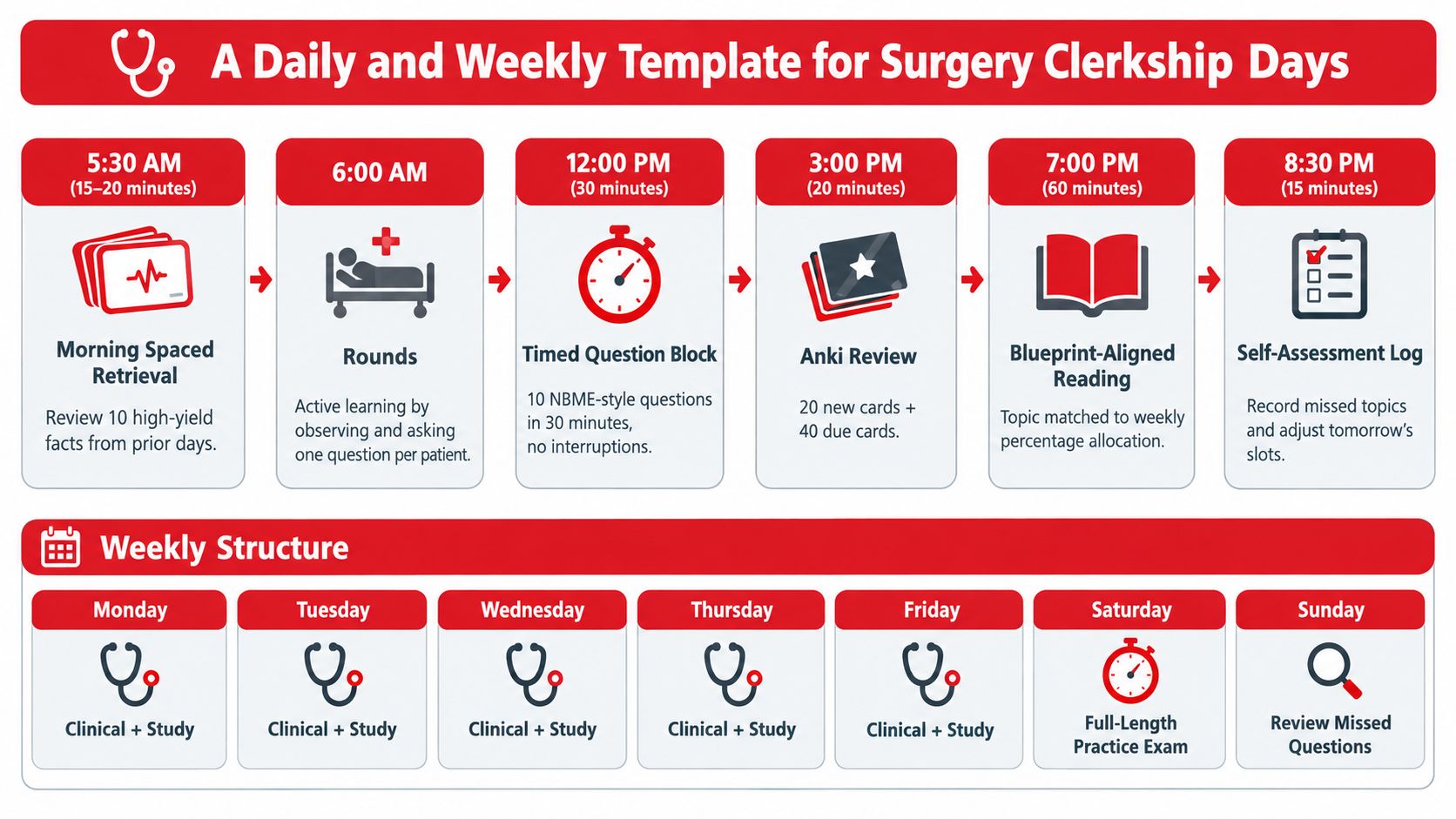
The best daily template is one the student can repeat even on a rough day. It should work before rounds, between cases, and after sign-out without demanding perfect conditions. The whole point is to make the schedule fit the day, not the other way around.
Morning, midday, and evening each have a job
The morning slot should be a 15 to 20 minute spaced-retrieval review before rounds. That's the slot for old missed questions, fast recall prompts, and a few high-yield facts the student wants ready before the clinical day starts. It's short because the point is activation, not completion.
The daytime block should be one timed question set, usually 20 to 40 questions depending on the day's reality. On a lighter day, the student can do the fuller block. On a brutal OR day, a smaller block still keeps the habit alive, and the review becomes the more important part.
The evening slot should be 45 to 60 minutes of explanation review. That's where the student checks why the answer was right, why the wrong choice was tempting, and whether the mistake belongs in a repeat card. The review is where the learning gets anchored, not the question count.
Clinical learning counts twice when it turns into a card the same day.
Weekly rhythm should change with the day
Elective-heavy days can carry the bigger content blocks, while OR-heavy days should lean lighter and more retrieval-focused. A Sunday cumulative mixed block keeps the week connected and prevents the student from living only in the last case seen. On call days, the first priority is recovery sleep, and the schedule should drop new content the next morning instead of pretending fatigue isn't real.
Ace Med Boards offers one-on-one shelf tutoring, including surgery shelf exam support, which can be useful for students who need their schedule tightened around clinical hours rather than rebuilt from scratch. For readers who want broader timing ideas, the page on medical student time management tips fits well alongside this template.
Allocating Questions and Reviewing Them Properly
Question banks do the heavy lifting only when they're used with discipline. A student can open a bank every day and still get poor return if the review is shallow, rushed, or scattered across too many resources. The aim is not just to complete questions, it's to extract patterns.
One bank, one notebook, one system
A student on a 4-week rotation can usually think in terms of three to four blocks per week, with the number rising as the rotation settles in. The exact count matters less than the rhythm, because a steady cadence prevents a late scramble. The student should finish one question bank during the clerkship rather than splitting attention across several.
That one-bank approach pairs best with a simple error log. Each missed question gets labeled by the issue that caused the miss, such as diagnosis, workup, postoperative complication, or management choice. Once the student sees the same issue twice, it earns a spaced-repetition card.
Re-reading a long explanation feels productive, but converting the miss into a repeatable prompt usually helps more.
The review workflow should be quick and specific
A clean workflow looks like this. First, answer the question under timed conditions. Next, check whether the error came from knowledge, pacing, or a misread stem. Then, write a short card only if the mistake is clinically useful enough to see again.
For a practical explanation workflow, the article on how to review UWorld questions faster pairs nicely with this section. Even when the question bank changes, the same habits still apply, read, label, and convert recurring misses into future retrieval.
A sample weekly pattern might look like this, one lighter weekday block after an easier clinical day, one midweek block on the most predictable afternoon gap, one weekend mixed block, and a short revisit of missed concepts the next day. That pattern keeps the question bank connected to clinical exposure rather than making it feel like a separate class.
Final Week and Exam Day Strategy
The final week should feel calmer, not more crowded. That's the point where many students make the mistake of adding another book, another video series, or another stack of notes. The smarter move is to stop adding material and start rehearsing performance.
The NBME Surgery Subject Exam uses 100 multiple-choice questions in 2.5 hours, which works out to roughly 1.5 minutes per question Columbia Surgery assessment guidance. That pace rewards forward motion, not perfection. If a question turns into a time sink, the student should move on and return only if time remains.
Readiness means one full timed run and a calm review
A strong final-week check is a full-length timed practice session under comparable conditions. After that, the student should review not only the questions that were wrong, but also the ones that were right by guessing. Correct-by-guess answers can hide weak reasoning.
The last review should focus on the highest-weighted areas and the management algorithms that tend to show up when the test gets harder. The student does not need a new resource this week. The student needs timing, stamina, and a clean last pass through the material already chosen.
For exam-day logistics, the article on exam day preparation is a useful companion. Bring what the testing center requires, arrive early enough to avoid a rushed start, and use break time to reset rather than to cram. The aim is to enter the block steady, not energized by panic.
Common Pitfalls and How to Adjust the Schedule
Surgery hours expose weak study systems fast. A plan that looks great on paper can still fail if it ignores fatigue, call days, or the fact that the exam cares more about reasoning than about visible effort. The fix is usually less dramatic than students think.
The common mistakes are predictable
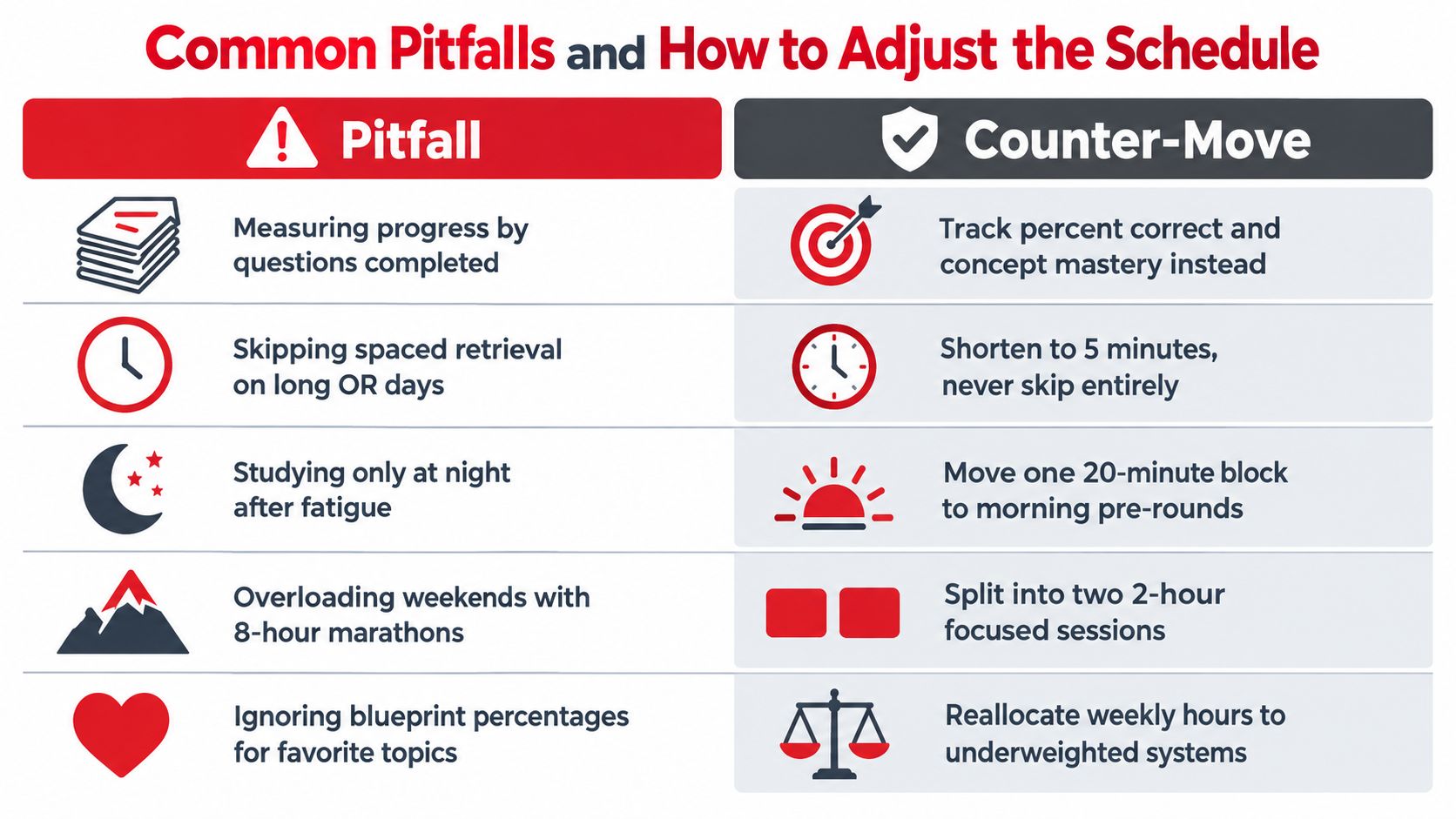
Measuring progress by questions completed is one of the easiest traps. A better metric is whether previously missed items are being answered correctly on revisit. That shift matters because it shows whether the student is fixing weak spots.
Skipping spaced retrieval on long OR days is another common failure. If the day collapses, the review can shrink to five minutes, but it shouldn't disappear. The habit is what preserves recall.
Studying only at night after fatigue also causes trouble. One short morning block before rounds usually gives a better return than a longer, exhausted session late in the day. Weekend marathons can be just as misleading, because they feel productive while leaving little memory behind.
Ignoring blueprint percentages for favorite topics creates another problem. GI deserves priority because the exam weights it heavily, while diagnosis and management deserve more attention than isolated anatomy. Students on longitudinal rotations, and students who have already sat through several demanding exams, also need the plan adjusted for their recovery patterns rather than copied from someone else.
Adjustments for COMLEX-oriented or international learners
Some osteopathic students prefer to pair surgery shelf prep with COMAT surgery practice when that fits their school's sequence. International and foreign medical graduates may also need a schedule that respects different prior testing histories and different exposure to U.S. clinical workflow. The plan itself stays the same, but the pacing and the starting point may need to be different.
A student with a shaky rotation calendar should protect recovery sleep, keep one question bank, and keep the morning retrieval habit even when the rest of the day goes sideways. That combination is usually more durable than any ambitious plan that assumes perfect conditions.
If a surgery clerkship schedule still feels impossible to hold together, Ace Med Boards can help shape the plan into something realistic around clinical hours and timed question work. A student who wants a focused shelf-exam approach can visit Ace Med Boards to look at tutoring options and decide whether a structured review would make the rotation easier to manage.