
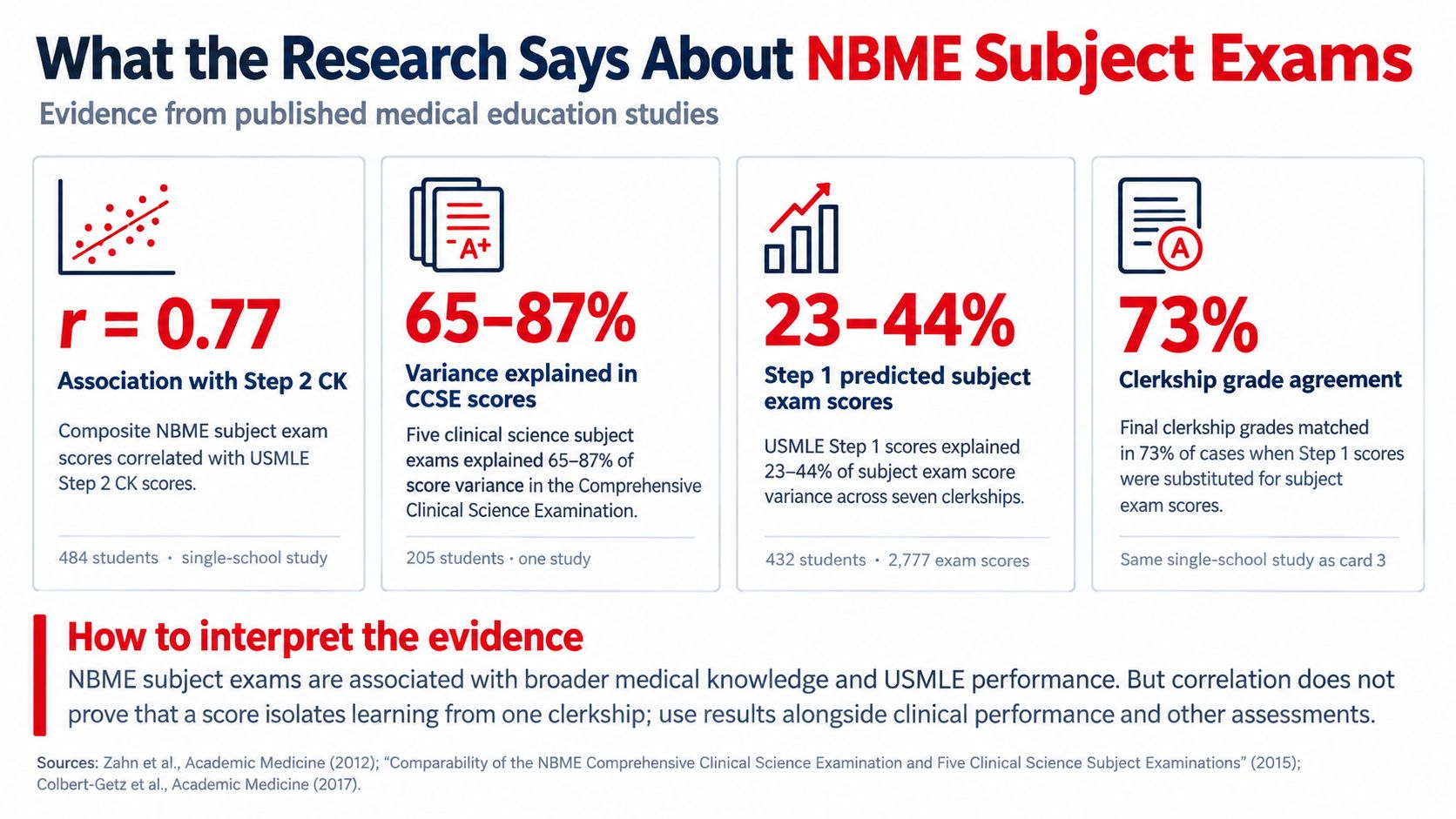
Composite shelf exam scores show a strong positive correlation with Step 2 CK performance, but a single shelf score is still an incomplete predictor. In practice, that means shelf exam step 2 correlation is useful for spotting knowledge gaps and readiness trends, not for converting one rotation score into a guaranteed board outcome.
Understanding the Shelf Exam Step 2 Correlation
Does a shelf exam tell the full Step 2 story, or only part of it? For a clerkship student, the honest answer is that it shows part of the picture, and sometimes a very useful part. A correlation means two things tend to move together in a group, but it does not mean one score can precisely forecast one person's next score.
That distinction matters because students often look for a neat conversion chart after a tough rotation. A composite of multiple shelves can be helpful, but an isolated result can be noisy, especially if the rotation was short, the exam form felt unfamiliar, or the study time was uneven. A more useful way to think about shelf performance is as a signal, not a verdict.
Practical rule: use a shelf exam to ask, “What does this reveal about clinical knowledge and question patterns?” not, “What exact Step 2 score is locked in?”
For a broader way to interpret shelf percentiles alongside your clerkship performance, the Shelf Exam Percentiles guide can help frame where an individual result sits in context. The point is not to chase certainty where there isn't any. The point is to notice whether the result points to a real content gap, a timing issue, or just one weak data point in a much larger trajectory.
What the Research Says About NBME Subject Exams
The strongest evidence supports composite performance across multiple NBME Subject Examinations, not a single shelf-to-Step 2 translation rule. In one study of more than 20,000 students, medicine NBME performance was associated with Step 2 CK, and every 5-point increase on the medicine subject exam corresponded to an estimated 4.65-point increase in Step 2 CK. After accounting for Step 1 and medicine Shelf performance, though, the total number of clinical subject exams completed was not associated with Step 2 CK performance study on NBME subject exam predictive value.
Which shelves matter most
A newer model found that neurology, psychiatry, and surgery NBME exams were especially predictive, while the set of studied subject exams together explained only 21.3% of Step 2 CK variability newer predictive model. That number is the key interpretive guardrail. If the model explains only part of the variation, then a shelf score is informative but incomplete.
Older work points in the same direction. One 2017 study found that an average based on four subject examinations correlated with Step 2 CK at r = 0.82 with p < 0.001, and an average of any three of five available subject examinations also showed strong correlations from r = 0.80 to 0.81 with p < 0.001 2017 NBME Subject Examination study. A national study also found that composite subject-exam scores correlated with Step 2 CK at r = 0.77, and models combining subject-exam results and GPA accounted for approximately 61% of the variance in Step 2 CK scores national study.
What that means for a student
The practical interpretation is straightforward. A cluster of strong shelves usually means the Step 2 foundation is already taking shape. A weak result in a high-predictive subject may deserve targeted remediation, but it still shouldn't be treated as destiny. For students who want structured question practice while they compare shelf patterns across rotations, the NBME shelf practice tests page is a natural companion resource.
Why One Low Shelf Score Does Not Predict Step 2 Failure
One disappointing shelf can feel louder than the rest of the record, especially when stress is already high. It's a mistake, though, to convert one poor score into a prediction about licensure readiness or residency potential. Real exam performance has variance, and variance gets bigger when fatigue, rotation demands, and uneven access to study time enter the picture.
Isolated results can mislead
A student may miss more questions after weeks of overnight call, a chaotic schedule, or a rotation with very narrow exposure to board-style cases. Another student may underperform because the test format emphasized a weak topic area that won't define Step 2 CK overall. That's why a single shelf should be interpreted alongside Step 1, cumulative shelf history, and broader academic performance rather than in isolation.
A low shelf score is information, not a sentence.
The strongest approach is to ask whether the low result is part of a pattern. If several exams cluster below expectation in a similar clinical domain, the signal is stronger. If one result stands out against otherwise solid shelves, the more likely issue is a local gap, a bad week, or an exam-specific mismatch rather than a collapse in board readiness.
For students who want a cleaner view of score trends over time, the progress tracking dashboard can support a more realistic interpretation than a single number ever could. The goal is to separate trend from noise so that one hard week doesn't become an exaggerated narrative.
Building a Step 2 CK Study Plan From Shelf Results
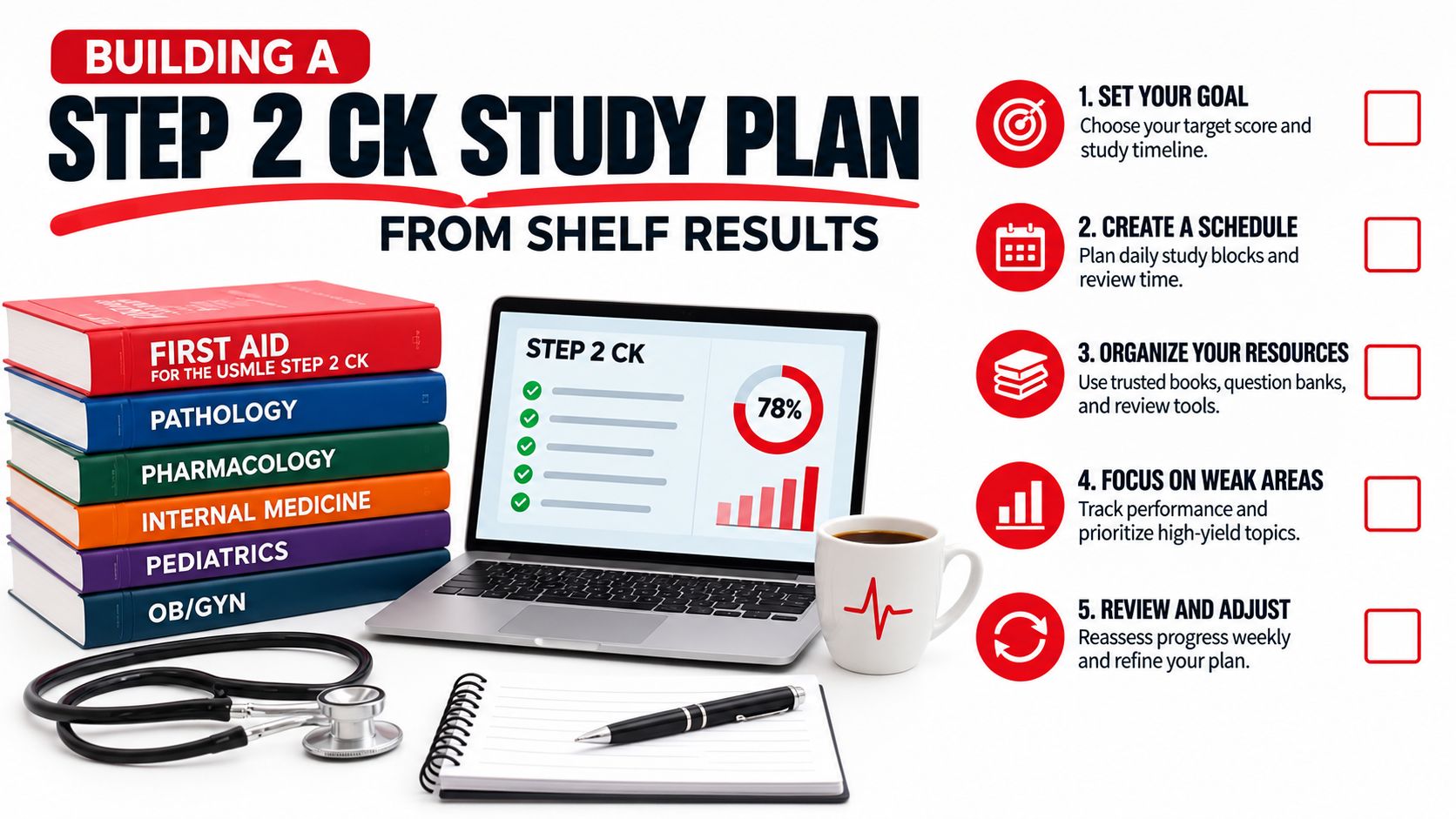
Shelf results become useful when they turn into a plan. The best plans don't ask, “What was the score?” They ask, “What clinical reasoning gap does that score point to, and what should change next?” That's a better transition from clerkships to dedicated Step 2 CK preparation.
A simple transition checklist
- Audit the pattern. Look across all shelves, not just the latest one. A repeated weakness in medicine-style management questions means something different from one isolated low result.
- Tag the missed domains. Map missed questions to content buckets like chest pain, antibiotic selection, trauma, or perioperative management.
- Rank what matters most. High-yield topics that recur across clerkships deserve more attention than low-frequency facts.
- Match the resource to the gap. Question-bank review helps with pattern recognition, while focused content review helps when the problem is foundational knowledge.
- Retest the weak area quickly. A short review cycle is more useful than waiting until the end of dedicated time to discover the same blind spot again.
A good Step 2 plan usually combines three things, content repair, question practice, and timing discipline. Students who learn best from repetition should build in regular mixed-question blocks. Students with unstable foundations may need a narrower content pass first, then broader practice once the weak area is less fragile.
The Step 2 CK study plan resource fits well here because it keeps the focus on structure rather than panic. For some students, one-on-one tutoring can also help convert a repeated shelf weakness into a targeted remediation plan, and Ace Med Boards' Shelf Exam tutoring page describes that kind of support in practical terms.
Overcoming Resource Gaps and Test Anxiety
Shelf scores do not always reflect the same amount of opportunity. Two students can study hard and still end up with very different results because one had more protected time, steadier access to question banks, or fewer outside obligations. An equity-aware interpretation of shelf exam step 2 correlation starts with that reality.
Why the same score can mean different things
A student balancing caregiving, a job, or financial pressure may have less uninterrupted study time than a classmate with fewer outside responsibilities. Limited access to premium question banks can also narrow the number of board-style questions a student sees before the shelf. Those differences don't erase effort, and they shouldn't be mistaken for a lack of ability.
The right response is not shame, it's resource matching. Free institutional materials, spaced review, and deliberate question review can still move the needle. When the issue is anxiety rather than knowledge, stress management matters too. For practical sleep and wind-down support, tips for stress and anxiety at night can be a useful external reference when exam stress starts leaking into sleep.
If the schedule is the barrier, fix the schedule. If the resource is the barrier, fix the resource mix. If the anxiety is the barrier, address the anxiety directly.
Students who need more support should also use school services early, not after the next setback. The test anxiety resource is relevant when the issue is freezing on question stems, not understanding medicine. Ace Med Boards can be one option for personalized shelf and Step 2 support when a student needs help identifying where the process is breaking down.
Common Questions About Shelf and Step 2 Prep
A common question is whether a shelf score should change the Step 2 study timeline. Usually, the answer is yes in terms of emphasis, not panic. A weak shelf suggests a topic area needs more attention, but it doesn't mean the whole plan has failed.
Another frequent concern is whether a student should retake a shelf if the school allows it. That decision depends on school policy, transcript implications, and how much the retake would improve the Step 2 picture. When the first score is clearly off-pattern, a retake can be useful only if it comes with a better preparation process, not just a second attempt.
Students also ask whether it makes sense to start Step 2 practice exams right after a shelf. It usually does, especially if the goal is to identify what carried over and what didn't. A practice assessment is most useful when it's treated as a diagnostic snapshot, not a prediction machine.
Finally, many clerkship students want to know how to balance clinical duties with board prep. The safest answer is to keep the work small but consistent, then use stronger shelves and clearer study blocks to build momentum. That approach is often more sustainable than trying to recover everything in one long scramble.
Ace Med Boards helps students turn shelf results into a clearer Step 2 plan with one-on-one tutoring, shelf support, and score-focused guidance that fits the realities of clerkship schedules. If a single shelf score has made the next step feel murky, Ace Med Boards can help organize the data into a practical study strategy and a calmer path forward.