An MCAT prep course is a structured system for preparing for a four-section, 230-question exam, and paid courses are often priced at roughly $1,200 to $3,600 according to recent industry coverage of MCAT prep trends and pricing (Student Doctor Network trend summary). The right format depends less on the label “course” and more on your baseline, your schedule, how well you self-correct, and whether you need outside accountability.
If you're reading this with twelve browser tabs open, a half-built Anki deck, and no clear answer to whether you need a course, you're in good company. Most students don't need more random resources. They need a way to decide which kind of support will change how they study.
Byline: Ace Med Boards Editorial Team
What an MCAT Prep Course Actually Is
A real MCAT prep course isn't just a pile of videos. It's a training system built around the actual exam: passage reasoning, timing, review discipline, and repeated diagnosis of weak spots.
The Medical College Admission Test, or MCAT, currently tests four scored sections: Chemical and Physical Foundations of Biological Systems, Critical Analysis and Reasoning Skills (CARS), Biological and Biochemical Foundations of Living Systems, and Psychological, Social, and Biological Foundations of Behavior (MCAT exam guide). That structure matters because your prep has to match it.
Why courses exist in the first place
Students often think the MCAT is mainly a content exam. It isn't. Content matters, but the exam asks you to use it inside passages, under time pressure, while sorting signal from noise.
That is why modern prep systems look the way they do. The MCAT has changed repeatedly over time. It began in 1928 as the Scholastic Aptitude Test for Medical Students, was renamed in 1948, moved to computer-based delivery in 2007, and had its biggest redesign in spring 2015 after a review process that started in 2008 (AAMC history). Every major revision forces prep providers to update content, question style, and strategy.
The four core modules a good course should include
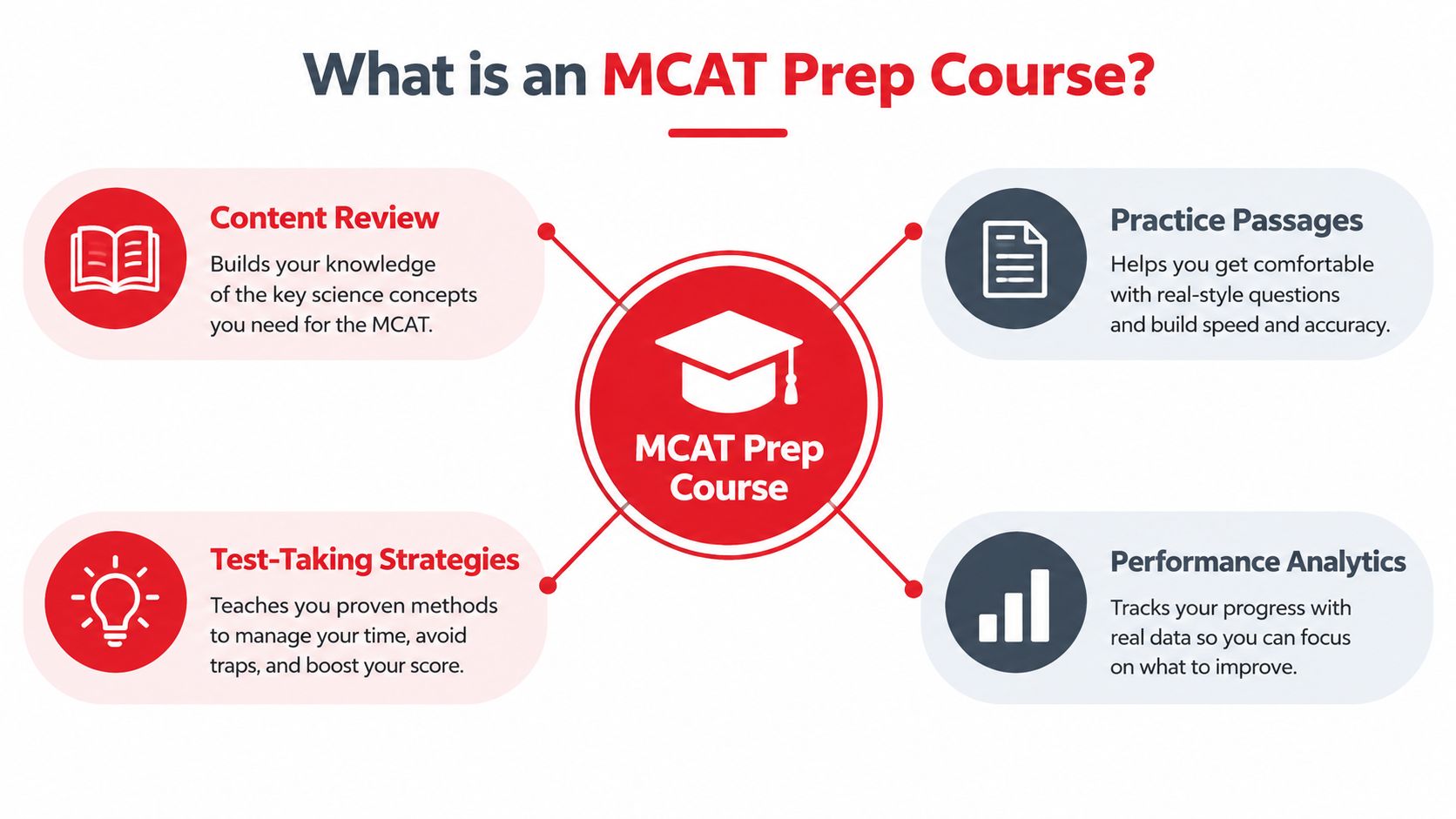
At minimum, an MCAT prep course syllabus should be built around the four official sections and teach students how to work through passages, not just memorize facts.
A practical course usually includes these components:
- Content review: Focused review of tested science and behavioral science topics tied to the AAMC content outline, not endless rereading.
- Passage reasoning: Practice turning background knowledge into decisions inside multi-paragraph passages.
- Timed work: Section drills and full-length sessions that train pacing, stamina, and recovery after hard questions.
- Review analytics: A method to classify misses by content gap, reasoning error, misread, or pacing problem.
A course is only useful if it helps you answer one hard question after every practice set: “Why did I miss this, and what will I do differently next time?”
Course versus self-study
A course is not the opposite of self-study. Even with a course, most of your score movement happens between sessions while you review, retrieve, and apply.
The AAMC's own guidance says to start with a baseline using the official unscored sample test, then use the score report to label areas as low, medium, or high confidence and build an active-learning cycle based on recall, practice, and reflection (AAMC study plan guidance). The same guidance says active learning is more than reading or watching videos.
That's why many students do well with a mostly independent plan, while others need scheduled accountability or individualized feedback. If you learn best with targeted correction rather than generic lectures, one-on-one tutoring benefits may matter more than the size of a course library.
Course Formats and Delivery Options
Not all MCAT prep courses solve the same problem. Some give you structure. Some give you flexibility. Some give you feedback.
The common mistake is buying the format that sounds most serious instead of the format that fixes your bottleneck.
The three main delivery models
Most students choose from three broad formats:
- Self-paced online courses
- Live group instruction, either virtual or in person
- One-on-one tutoring
Each can work. Each can fail. The question is what happens when you miss a passage. Do you know why? Do you know what to change the next day?
MCAT Prep Format Comparison
| Format | Cost Range | Best For | Key Benefit | Potential Drawback |
|---|---|---|---|---|
| Self-paced online course | Lower end of the roughly $1,200 to $3,600 paid-course range, depending on provider and add-ons (Student Doctor Network trend summary) | Independent students with irregular schedules | Maximum scheduling flexibility | Easy to confuse “consuming material” with real progress |
| Live group course | Within the roughly $1,200 to $3,600 range reported in recent coverage (Student Doctor Network trend summary) | Students who need external structure and deadlines | Built-in calendar and routine | Less personalized feedback |
| One-on-one tutoring | Often at the higher end once enough sessions are added, though exact pricing varies by provider | Students with uneven section performance, repeats, or specific bottlenecks | Direct diagnosis and tailored adjustments | Higher cost and quality depends on how well the plan is executed between sessions |
Self-paced works when you can self-diagnose
A self-paced course can be enough if you already know your weak points and you follow a schedule without much drift. This format works best when you can review a passage and say, with precision, “I changed my answer because I chased outside knowledge,” or “I missed the author's tone in CARS.”
It works poorly when your study habits are passive. Students often overestimate how much learning happens from watching explanations.
Live classes work when structure is the missing piece
Some students don't need more intelligence or more motivation. They need a calendar they'll obey.
A live course helps if you benefit from weekly checkpoints, assigned homework, and the mild pressure of showing up prepared. It's useful when your problem is inconsistency, not mystery.
Practical rule: If your biggest issue is “I know what to do, but I don't do it regularly,” a live schedule may help more than more content.
Tutoring works when the problem is specific
Tutoring is strongest when the issue is not broad lack of effort but poor calibration. Examples:
- You have lopsided sections: Strong science foundation, but CARS keeps sinking the composite.
- You've plateaued: Your scores stop moving even though you're putting in time.
- You review weakly: You mark questions wrong, read the explanation, and move on.
- You have a compressed timeline: You can't afford months of trial and error.
Ace Med Boards offers online MCAT prep course support in a one-on-one format for students who want individualized planning and diagnostic review, rather than only a generic recorded curriculum.
What to compare before you buy
Instead of asking “Which course is best,” ask these questions:
- Does it use official-style full-length practice?
- Does it teach passage review, not just content delivery?
- Will it help you classify errors by type?
- Can the format fit your real week, not your fantasy week?
- Will you still be using official AAMC material at the center of the plan?
If those answers are vague, the format probably isn't your issue. The system is.
How Top Scorers Actually Study
The strongest students don't necessarily use the most expensive setup. They usually use a sharper process.
That distinction matters because many MCAT pages still frame the decision as “course or no course,” when the better question is whether your prep method trains the behaviors that high scorers use.

What the recent data suggests
A 2025 study found that higher-scoring examinees more often used behaviors such as advisor or peer discussion, applying knowledge to practice questions, and using practice tests to judge readiness, while low-cost or free resources were also used disproportionately by top scorers (2025 study on MCAT prep strategies). That doesn't mean paid help never matters. It means the winning difference may be how you study, not what logo is on the course.
Independent reporting on 2024 to 2025 survey data also described a prep environment tilted toward self-study. It reported that 75% of respondents self-studied with official AAMC resources, 72.8% supplemented with free videos or courses, and 68.4% used daily-question or flashcard programs. It also reported flashcard use rising from 67.4% to 71.4%, while free flashcard program use rose from 37.3% to 50.2% (Student Doctor Network trend summary).
What those numbers mean in practice
Students often hear “top scorers use free resources” and take the wrong lesson. The point isn't that structure is useless. The point is that official materials, active recall, discussion, and repeated self-testing seem to matter more than collecting premium subscriptions.
The AAMC's official prep ecosystem itself is extensive. It includes four scored practice exams, one unscored practice exam, and hundreds of practice questions, plus free Khan Academy materials with 1,000 videos and 2,800 review questions (MCAT overview and official prep summary). That's enough to support serious preparation if you use it deliberately.
Here's what strong study behavior usually looks like:
- They test early: They don't wait until they “finish content” before seeing how they perform.
- They review thoroughly: They study why each answer choice wins or fails.
- They use outside discussion well: They check reasoning with advisors, peers, or tutors instead of studying in a bubble.
- They judge readiness with practice tests: They don't use vibes as a scheduling strategy.
Expensive help can be valuable. But no format can rescue passive review.
A common misunderstanding about content review
Many students keep rebuilding notes because it feels productive. It usually isn't the highest-yield move after basic familiarity is in place.
The AAMC says time between practice exams should be spent reviewing the content areas where mistakes occurred, and that active learning requires more than reading or watching videos, as noted earlier in its study-planning guidance. So the better loop is not “learn everything, then practice.” It is “practice, diagnose, patch, and retest.”
A helpful worked example is this. If you miss three biochemistry questions, the fix may not be “redo the whole chapter.” It may be:
- One targeted content rebuild on enzyme regulation
- A short set of fresh passage questions
- A written note about the reasoning trap you fell for
- A retest later in the week
This short video gives a useful lens for that kind of strategic adjustment.
For more practical methods, see these MCAT study strategies.
Building Your Personal Study Plan
Good plans begin with evidence, not optimism. If your current approach is “I'll do content for a month and see what happens,” you're making the exam harder than it needs to be.
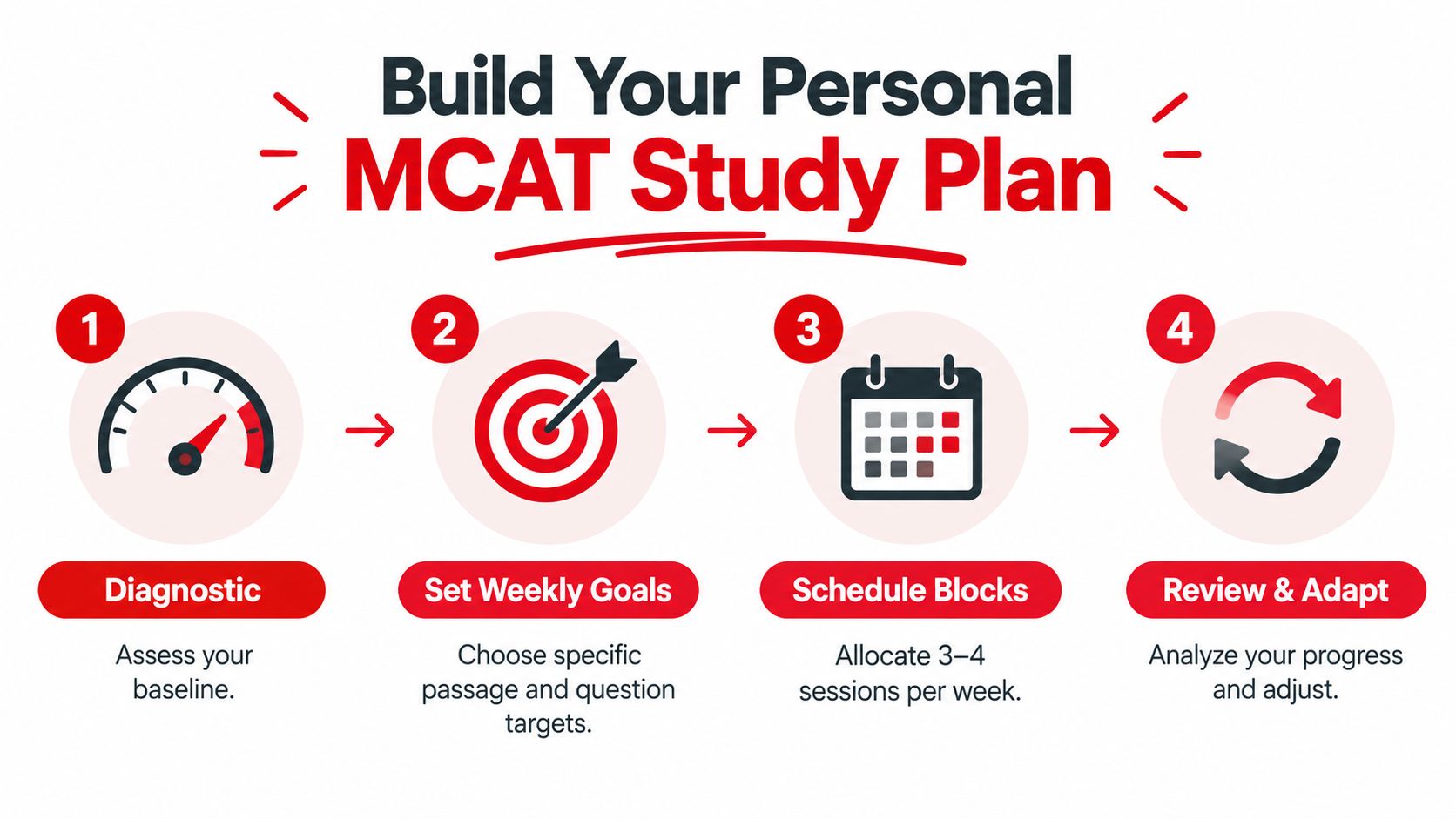
A useful MCAT prep course should tailor your workflow after an initial diagnostic in this sequence: start with an official-style diagnostic, map misses by content, reasoning, misread, and pacing, rebuild only the needed content, practice passages untimed and then timed, review every option, and retest on unseen full-length material under exam conditions.
Start with an official baseline
The AAMC recommends beginning with the official unscored sample test and using the score report's content and skills breakdown to rate your confidence levels and organize study priorities (AAMC study plan guidance). That gives you a starting map.
When you're ready for full-length benchmarking, the AAMC's official practice exam uses 230 questions drawn from previously administered MCAT exams and is designed to match the exam's look, feel, functionality, scaled score, and percentile ranking (AAMC planning and study resources). That makes it useful for pacing diagnosis, not just content review.
A simple weekly structure you can reuse
Use a repeatable rhythm instead of deciding from scratch every day.
Sample weekly study schedule
| Day | Main task | Secondary task | Review focus |
|---|---|---|---|
| Monday | One science content block | Untimed passage set | Mark content gaps and misreads |
| Tuesday | CARS practice | Flashcards or retrieval drills | Why the credited answer fits the passage |
| Wednesday | Mixed science passages timed | Short targeted content patch | Pacing and question triage |
| Thursday | Psych and social foundations review | Passage set | Distinguish knowledge gap from reasoning miss |
| Friday | Mixed question set | Error-log review | Rework missed items without looking |
| Saturday | Full or partial timed exam block | Light reflection | Endurance and section transitions |
| Sunday | Review day | Plan next week | Choose only the weakest priorities |
If you need a framework to customize that calendar, this MCAT study schedule guide is a useful companion.
Build a real passage-review sheet
Most students under-review. They check the right answer and move on. That wastes the hardest part of the work.
Use a passage-review sheet like this after each practice set.
Passage-review sheet template
| Field | What to write |
|---|---|
| Tested concept | The underlying science or reasoning concept |
| Task | What the question actually asked you to do |
| Evidence line | The line, figure, trend, or passage clue that should have driven the choice |
| Why the credited answer wins | The direct reason it matches the stem and passage |
| Why each distractor fails | One short reason each wrong option is wrong |
| Timing | Whether time pressure affected judgment |
| One transfer rule | A short generalizable lesson for future passages |
Worked example using original material
This is a hypothetical educational example, not an official or recalled MCAT item.
Passage summary: A researcher compares enzyme activity at different substrate concentrations and notes that a mutation lowers activity only when substrate levels are low.
Question task: Which interpretation best fits the result?
How to review it:
- Tested concept: Enzyme affinity versus maximal rate
- Task: Interpret a pattern from an experimental result
- Evidence line: Activity drops only at low substrate concentration
- Why the credited answer wins: A low-substrate problem points toward altered binding or affinity, not necessarily a lower maximal rate
- Why distractor A fails: It assumes complete loss of function, which the passage doesn't support
- Why distractor B fails: It focuses on high-substrate behavior, but the key difference happened at low substrate
- Why distractor C fails: It introduces inhibition not described in the passage
- Timing: Rushed because I recognized a familiar enzyme term and answered too quickly
- Transfer rule: When the passage compares low versus high substrate behavior, check whether the result points to binding, capacity, or regulation before picking a mechanism
When you review, don't ask only “What was the right answer?” Ask “What clue should have changed my mind sooner?”
What to track if you want honest feedback
You don't need an invented score-gain promise. You need useful metrics.
Track these instead:
- Section accuracy: Which section is consistently weakest
- Passage timing: Where you slow down or spiral
- Error categories: Content, reasoning, misread, or pacing
- Confidence calibration: Which wrong answers felt “certain”
- Full-length trends: Only under comparable conditions
That gives you a study plan that can adapt. It also keeps you from wasting two weeks “reviewing everything” when only one pattern is breaking your score.
Choosing the Right Path for You
By this point, the decision usually becomes clearer. Most students are not choosing between “serious prep” and “casual prep.” They're choosing which structure best matches their friction points.
Your MCAT Prep Decision Matrix
| If you… | Then consider… |
|---|---|
| Have a strong science base but struggle with consistency | A live group course or a rigid self-paced calendar |
| Learn well alone and can review mistakes precisely | A self-study plan centered on official materials |
| Keep missing the same question types without knowing why | One-on-one tutoring or targeted coaching |
| Have major section imbalance, especially with CARS or passage analysis | A format with individualized review and feedback |
| Work full time or have an irregular schedule | Self-paced study with scheduled checkpoints |
| Feel overwhelmed by too many resources | A narrower plan with official materials as the core |
| Tend to reread notes instead of doing retrieval practice | A system that forces timed work and passage review |
| Need a second opinion on whether your current plan is realistic | A structured consultation before buying more materials |
A short self-checklist
Ask yourself these questions and answer:
- Can I keep a schedule without someone checking on me?
- Do I know exactly why I miss questions?
- Am I mostly weak in content, or in applying content to passages?
- Do I need flexibility more than live accountability?
- Will I use a large course library, or do I need fewer tools with better review?
The best path is the one you'll execute consistently, not the one that looks most impressive on a comparison page.
If you want broad structure with individualized help, MCAT prep course options can make sense. If your plan is already solid and you mainly need disciplined execution, a simpler self-study stack may be enough.
FAQs
Do I need a paid MCAT prep course to do well?
Not always. Recent survey reporting and the 2025 study discussed earlier suggest many strong performers use official and lower-cost resources effectively. A paid course helps most when it fixes a problem you can't solve alone, such as accountability, weak review habits, or repeated plateaus.
What core modules should an MCAT prep course include?
Build MCAT preparation around the four official sections using passage reasoning, retrieval practice, timed work, and official AAMC materials. A useful course should also teach a repeatable review system, not just content delivery.
How should a course adapt after a diagnostic test?
Start with an official-style diagnostic. Then map misses by content, reasoning, misread, and pacing, rebuild only the needed content, practice passages untimed and then timed, review every answer option, and retest with unseen full-length material under exam conditions.
How do I know if tutoring is worth it for me?
Tutoring is usually worth considering when your score is not moving, your sections are uneven, your timeline is short, or your review process is weak. If your main problem is staying on schedule, a structured course may solve more than tutoring alone.
Next Steps and Getting Started
Start with one official baseline exam and one honest week of error tracking. If your review shows a clear, manageable pattern, build your own plan around official materials and active review. If the pattern is muddy, or your schedule keeps collapsing, get outside help before you buy more resources.
Keep logistics in view too. As of now, AAMC registration uses fixed 60-day, 30-day, and 10-day deadlines by test date, and registration for the 2027 testing year opens on Oct. 20 to 22, 2026 by testing-center location (AAMC MCAT calendar and deadlines). Registration happens through an AAMC account, and opening dates are staggered by region rather than released in one nationwide launch (AAMC registration page).
Sources
- AAMC history of the MCAT
- AAMC creating your MCAT exam study plan
- AAMC free planning and study resources
- 2025 study on MCAT prep strategies
- Student Doctor Network MCAT preparation trends summary
- AAMC MCAT calendar, scheduling deadlines, and score release dates
If you want help deciding whether you need self-study, a course, or one-on-one support, Ace Med Boards offers MCAT tutoring and study-plan guidance built around diagnostics, passage review, and official-practice-based preparation. A free consultation can help you audit your current plan and see whether your bottleneck is content, strategy, pacing, or accountability.