
A true average score on the MCAT depends on which group you mean. On the MCAT's 472 to 528 scale, 500 is the built-in midpoint and sits near the national testing average, while recent AAMC data place U.S. MD applicants around 506 and matriculants around 512.
That distinction matters more than most students realize. If you only hear “the average MCAT is 500,” you can walk away feeling either falsely reassured or unnecessarily discouraged. The number that matters for you depends on whether you're comparing yourself with all test-takers, with people who apply, or with people who enroll.
By Ace Med Boards Editorial Team. Updated September 2026.
The Three Averages Every Applicant Should Know
A gap of roughly 12 points separates the testing average from the recent matriculant average. On the MCAT scale, that is not a small shift. It is the difference between asking, “How did I do compared with everyone who sat for the exam?” and asking, “How did I do compared with students who entered medical school?”
That is why a single “average MCAT” number causes so much confusion. The AAMC reports averages for different groups because each one answers a different question. If you treat them as interchangeable, you can misread your score in either direction.
The national test-taker average
The broadest average is the one for all exam administrations. In the AAMC's official MCAT percentile table, the mean total score is 500.5, based on 305,494 exam administrations from 2023 through 2025. A separate AAMC score summary for the same testing period reports a nearly identical mean of 500.6.
Use this average as your population baseline. It works like the class average in a very large course. It shows where the middle of the national testing pool falls, but it does not tell you what kind of score is typical among applicants or accepted students.
The applicant average
The applicant average narrows the comparison group. As noted earlier from the AAMC applicant and matriculant table, U.S. MD applicants averaged 506.3 in the 2023 to 2024 cycle, after 506.5 in 2022 to 2023 and 505.9 in 2021 to 2022.
That number answers a more practical admissions question. It shows what the average score looks like among people who decided their application was strong enough to submit.
The matriculant average
The matriculant average is narrower still. In that same AAMC admissions dataset cited earlier, students who entered U.S. MD programs averaged 511.7 in 2023 to 2024, after 511.9 in both 2021 to 2022 and 2022 to 2023.
For many students, this is the number that stings. A score can be above the national testing average and still sit well below the matriculant average. That does not mean the score is unusable. It means the right comparison depends on your school list, GPA, residency status, and the rest of your application.
Three MCAT Averages at a Glance
| Population | What it helps you compare | Recent average |
|---|---|---|
| All test-takers | Your score versus the national testing pool | 500.5 to 500.6 |
| U.S. MD applicants | Your score versus people who applied | 506.3 |
| U.S. MD matriculants | Your score versus people who enrolled | 511.7 |
A quick example makes the difference clearer. A 504 is above the national testing average, below the recent applicant average, and well below the recent matriculant average. The same score can feel strong or weak depending on which reference point you choose.
That is the habit to build. Before reacting emotionally to your number, label the comparison group first. If you want a broader frame for where a result falls, this guide to MCAT score ranges can help you place it.
How the MCAT Scoring Scale Actually Works
The MCAT total score runs from 472 to 528, but that number is built from four separate section scores. If you only look at the total, you miss how the score was assembled.
Each section is scaled from 118 to 132, and those four scaled scores are added together for your total. If you want a quick refresher on the full range, this guide to what the MCAT is scored out of can help.
The four sections are:
- Chemical and Physical Foundations of Biological Systems
- Critical Analysis and Reasoning Skills
- Biological and Biochemical Foundations of Living Systems
- Psychological, Social, and Biological Foundations of Behavior
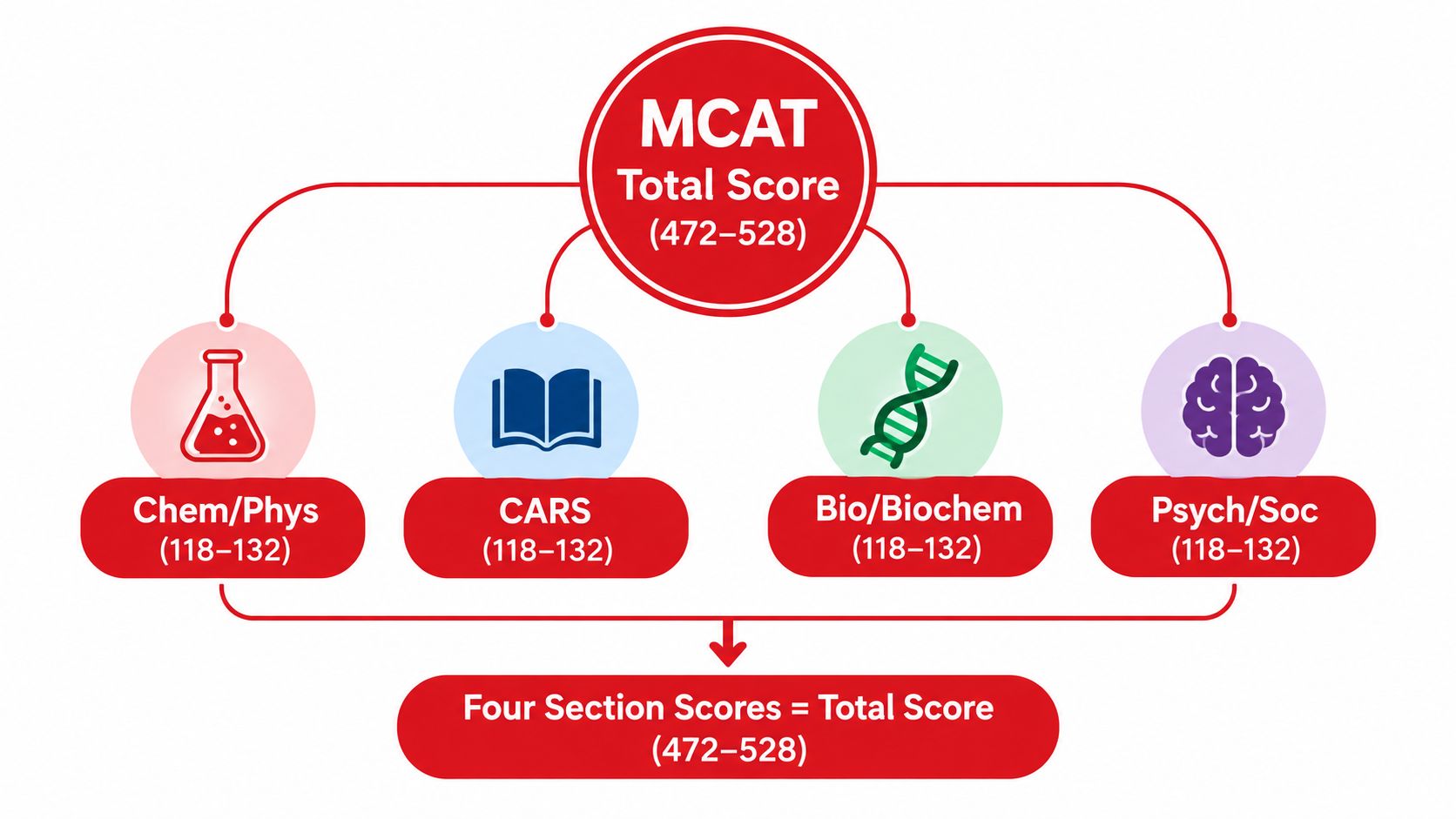
A useful way to read the scale is to picture a report card with four classes and one final GPA-like summary. The summary matters. Medical schools still see the underlying classes.
That is why section balance matters.
Two students can post the same total score and create different impressions. A balanced score profile suggests steady performance across science, reasoning, and behavioral content. A profile with one clear dip can raise a narrower question about reading accuracy, content gaps, or pacing in that section.
For example, a student with evenly clustered section scores often looks different from a student who reached the same total with one much lower subsection. Admissions readers may not react to those profiles the same way, especially if the lower section overlaps with the academic demands of the schools on that student's list.
So read your score report in two passes.
First, note the total. Then check whether the four section scores tell a consistent story about your readiness.
Another common point of confusion is how raw performance becomes a scaled score. The AAMC converts the number of questions answered correctly into scaled section scores so that scores from different test dates remain comparable. In plain terms, your reported score is designed to reflect performance fairly across exam forms, not just the exact set of questions you saw that day.
Score timing causes stress too. Official MCAT scores are typically released about a month after test day, and examinees can later view, release, retrieve, and electronically send scores through the AAMC score reporting system.
Reading Percentiles Without Misreading Them
A one-point MCAT change can shift your percentile more than many students expect. That surprises people because percentile and percent correct sound similar, but they answer completely different questions.
What a percentile actually tells you
Your MCAT score report includes a percentile rank. It shows where your scaled score sits compared with other recent test performances. It does not show how many questions you got right.
A useful way to read it is to treat the percentile as your place in line, not your test average. If 100 recent examinees stood in order by score, your percentile tells you how many you scored higher than. It does not mean you answered that same percentage of questions correctly.
That distinction matters because MCAT scores bunch together around the middle of the scale, as noted earlier. When many students cluster in the same scoring band, a small score increase can move your percentile more than your gut expects.
Why a few points can matter
Students often look at a score change of two or three points and dismiss it as minor. On the MCAT, that reaction can hide a real shift in context.
Near the center of the score scale, small changes can separate you from a large group of nearby test-takers. Picture a crowded airport security line. Moving forward three spots does not feel dramatic when the line is short. In a packed line, three spots can mean a noticeable difference in wait time. Percentiles work in a similar way when many scores sit close together.
That is why the average score on the MCAT is only the starting point. To interpret your result well, ask:
- What percentile does my score place me in nationally?
- How does that percentile compare with the score range for the schools I plan to apply to?
If you want a plain-English reference for that first question, this guide to MCAT percentile ranks and score ranges can help.
Percentiles are ranking tools. They help you judge how common or uncommon your score is. They do not predict an admissions decision by themselves.
One more caution. “Average” and “competitive” are different labels. A nationally average score may fit one school list and fall short for another. Use the percentile to understand your position. Then use your school list, academic record, and application strengths to decide what that position means for you.
Why Applicant and Matriculant Averages Differ
A score average for applicants and a score average for matriculants answer two different questions. One describes everyone who applied. The other describes the subset who earned a seat.
For applicants to U.S. MD programs in 2025 to 2026, the mean total MCAT score was 506.1, while matriculants averaged 511.7, according to the AAMC facts table for applicants and matriculants. That 5.6-point gap is one reason a single “average MCAT score” can mislead students who are trying to judge their own position.
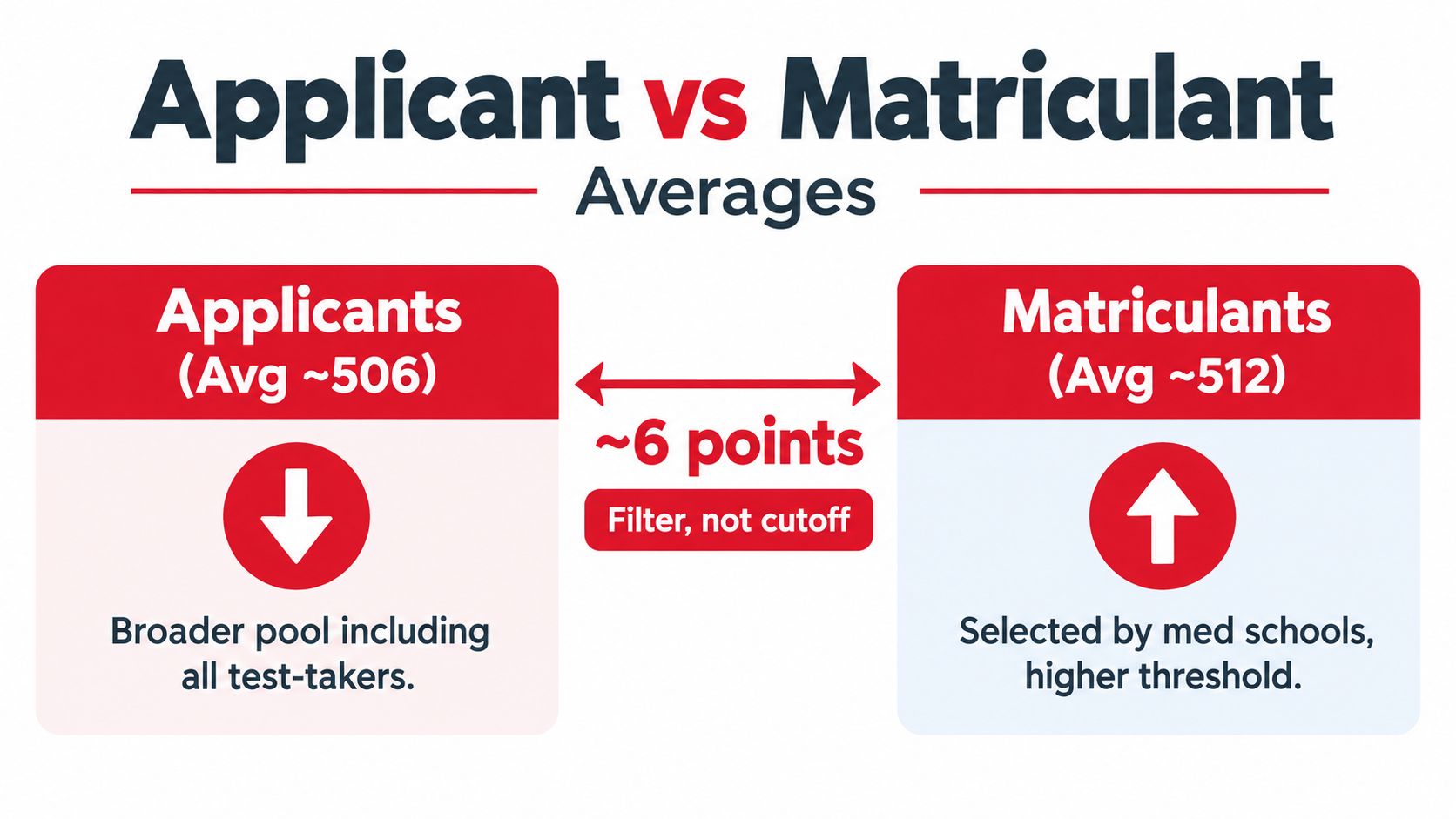
A practical way to read this gap is to compare it to a hiring funnel. The applicant average includes everyone who entered the process. The matriculant average reflects the group that remained after schools reviewed academics, experiences, fit, interviews, and school-specific priorities.
Several forces create that separation.
- Different applicant profiles: Some students apply with lower MCAT scores because they bring strong grades, meaningful clinical work, research, service, residency advantage, or a mission fit that matters to specific schools.
- Different school lists: A student applying mainly to in-state programs, newer schools, or schools whose ranges are closer to their numbers is operating in a different context from a student applying only to highly selective programs.
- Review after academic screening: MCAT score matters, but so do writing, letters, sustained service, and interview performance.
- Class building: Admissions committees are shaping a full class with many strengths, not sorting applicants by a single number.
The same AAMC dataset also shows matriculant section means clustered around 127.0 to 128.9. That matters because it suggests admitted students usually present a balanced academic profile, not just a total score that was carried by one unusually high section.
This is the part many students misread. A matriculant average is not a cutoff, and an applicant average is not a target. They are reference points.
If your score is closer to the applicant average than the matriculant average, that does not automatically mean “do not apply.” It usually means your school list, section balance, GPA, and the rest of your application need a more careful match. If your score is at or above the matriculant average, that helps, but it still does not guarantee an acceptance.
What Counts as a Competitive Score
A competitive MCAT score is not one national number. It is a match between your score profile and the schools you plan to target.
Students often want a single cutoff because it feels calmer than ambiguity. Admissions does not work that way. A 506 can be realistic for one school list and poorly matched for another. A 516 can strengthen one application and still leave questions if the sections are uneven or the rest of the academic record is shaky.
Start with fit, not folklore
The practical way to judge competitiveness is to place your score in three contexts at once. Compare your total score to the current percentile table. Compare your section scores to each other. Then compare both of those against the score ranges reported by the schools on your list through MSAR.
That three-part check matters because the MCAT is not just one number. It is more like a four-leg table. If one leg is much shorter, the table can wobble even when the surface looks high enough at first glance.
A school may view a balanced score differently from a total that was lifted by one very strong section and pulled down by one weak one. As noted earlier, the scoring process is built from four section scores plus a total, so section balance deserves its own look.
Competitive MCAT Score Ranges by Program Type and Specialty Aim
| Applicant Profile | Competitive MCAT Range | Typical Percentile | Notes |
|---|---|---|---|
| Broad school list, still building fit | Context-specific | Check current AAMC percentile table | Start with total, then review section balance and school-specific ranges |
| MD applicant targeting schools near national applicant norms | Context-specific | Check current AAMC percentile table | Compare with each school's current MSAR range rather than one national number |
| Applicant targeting schools with higher published medians | Context-specific | Check current AAMC percentile table | Higher-score schools may expect a stronger total and more even sections |
| Applicant with one weaker section | Context-specific | Check current AAMC percentile table | Review whether the imbalance changes retake decisions or school list strategy |
| DO or mission-driven school applicant | Context-specific | Check current AAMC percentile table | A balanced school list and overall application strength may matter as much as the total |
For a fuller explanation of score context, this guide on what counts as a good MCAT score can help.
A usable definition of competitive
A score is competitive when it clears three checks:
- School-list fit: Your total score falls within a reasonable range for the programs you plan to apply to.
- Section stability: No section creates a concern that is likely to stand out during review.
- Application fit: The score works with your GPA, course history, writing, experiences, and timing.
A simple example helps. If your total score sits near the middle of a target school's usual range, but one section is clearly lower than the others, your next question is not “Am I doomed?” It is “Does this school tend to care about subsection balance, and does the rest of my record offset that concern?” That is a much more useful question.
The same principle works in reverse. A very high total can still be less competitive than it looks if your school list is top-heavy, your timing is late, or your experiences are thin.
A 500 is not automatically weak, and a 520 is not automatically safe. Competitiveness depends on where you apply and how the full score report fits the rest of your file.
Use the average score on the MCAT as a reference point. Use your actual school list and section profile to decide whether your score is competitive for you.
Common Misconceptions About MCAT Averages
One number creates a lot of confusion. The problem is that applicants often treat any MCAT average as a verdict, when it is really just one reference point among several.
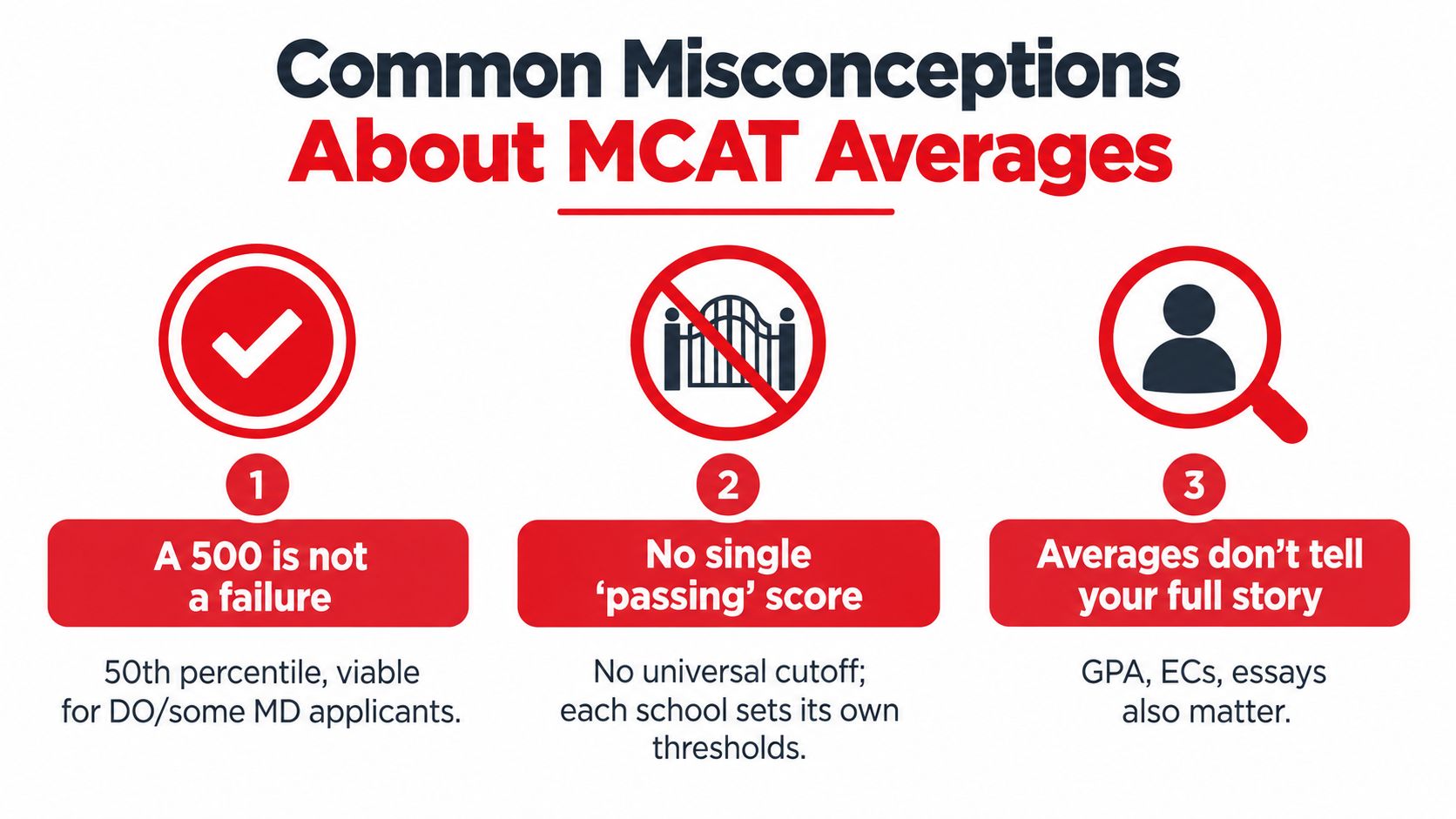
Myth one says 500 means failure
A 500 is the midpoint of the MCAT scoring scale, as noted earlier. That makes it a reference mark, not a red flag by itself.
A simple analogy helps here. A class average of 75 does not mean every student below 75 failed the course, and it does not mean every student above 75 is guaranteed an A. It gives context. MCAT averages work the same way.
The more useful question is, “Average for which group?” A score can sit close to the average for all test-takers and still land differently when you compare it with applicant averages, matriculant averages, and the schools on your list.
Myth two says there is a universal passing score
Medical schools do not use the MCAT the way a licensing board uses a pass-fail exam. There is no single cutoff that turns a score into a yes or no across every school.
That is why the phrase “passing MCAT score” causes so much stress. It sounds precise, but it hides the issue. Admissions committees review scores in context, alongside GPA, section balance, timing, school selectivity, and the rest of the file.
So if you are asking whether your score is “passing,” translate that into a better admissions question: “Is this score workable for the schools I plan to apply to?”
A short video can help clarify that mindset before you make a retake decision.
Myth three says one retake will automatically fix things
A retake can help, but only if something meaningful changes.
Students sometimes treat a second attempt like pressing refresh. Admissions does not work that way. Schools can review your testing history through the standard application process, so a retake should come from a specific plan: more preparation time, a different study method, stronger section targeting, or better test-day control.
Here is the practical rule. Retake because your score no longer matches your school list or your preparation did not reflect your real ability. Do not retake just because a forum made one average score sound fatal.
Myth four says the average score is the only average that matters
This is the misunderstanding behind many disappointing application cycles.
There is no single “the average score on the MCAT.” There are different averages for different groups, and each answers a different question. One helps you see where you stand among all examinees. Another reflects the applicant pool. Another reflects students who matriculated. If you mix those together, you can easily overestimate or underestimate where you stand.
That is why this article separates all three averages instead of stopping at one headline number. Your own score only becomes useful when you place it in the right comparison group.
Score Interpretation Worksheet and Next Steps
A score report is a snapshot, not your whole application. The useful question is what that snapshot means in context.
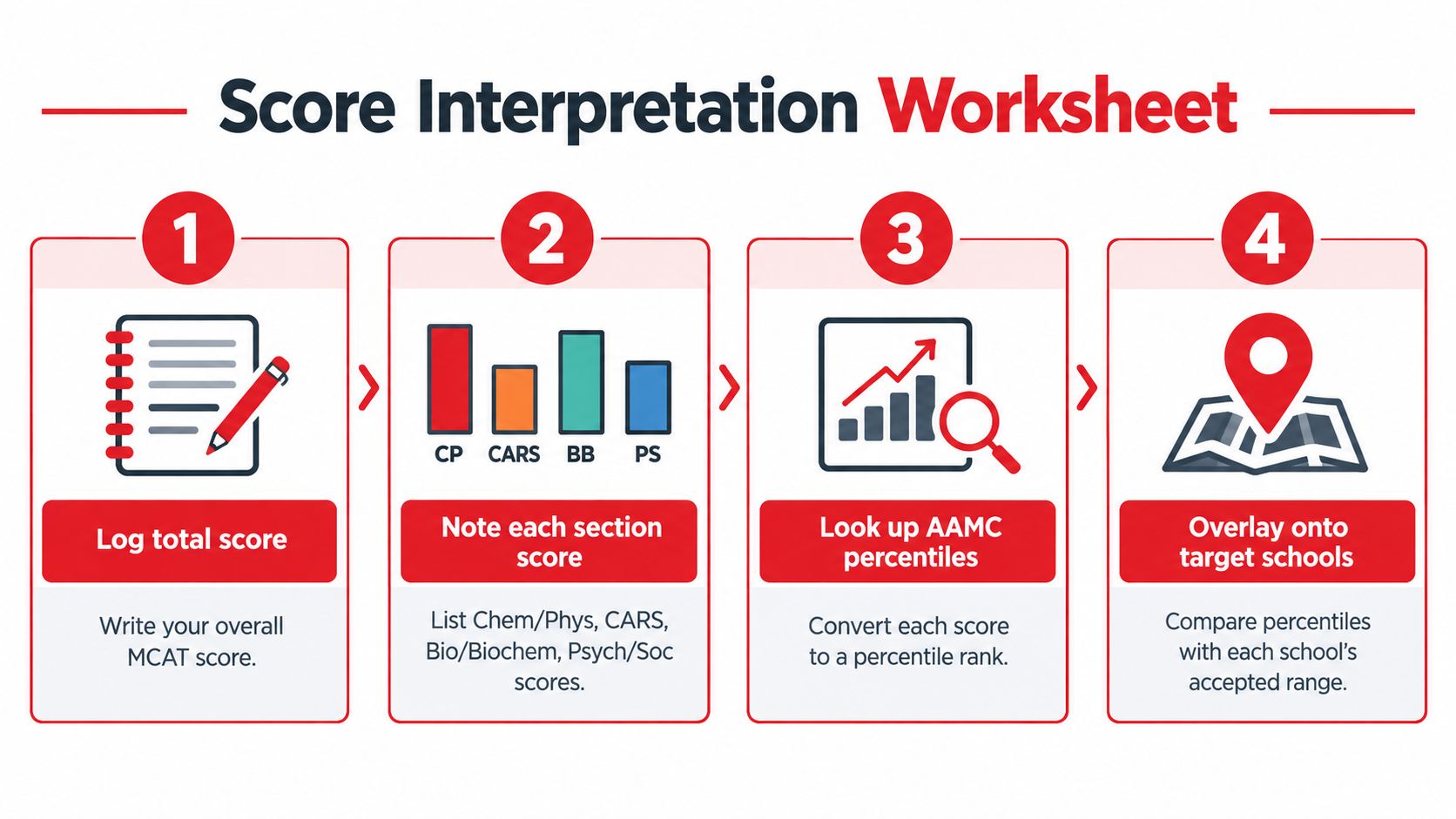
A four-step score reading process
Start by treating your score like a map coordinate. One number by itself does not tell you where you stand. It only becomes useful after you place it against the right reference points.
Record the full score report
Write down your total score and each section score. A balanced total and an uneven total can lead to different application decisions.Add the percentile shown on your report
The percentile gives rank, not percent correct. Put it next to the total score and next to any section that may need a closer look.Compare your score to the right average
Use the three averages from earlier in this article for three different questions. How do you compare with all test-takers? With applicants? With matriculants? Then check your school list so you are comparing yourself with the programs you may apply to.Choose an action that fits the whole file
Your next step might be apply now, retake later, revise the school list, or pause and strengthen the application. The right choice depends on the score pattern, GPA, timing, experiences, and writing.
If you are still waiting for results, plan around the usual score-release window rather than guessing. For a practical calendar, review this guide to MCAT score release dates and timing.
Reusable score-context worksheet
Copy this into a spreadsheet or notes app. The goal is simple. Turn a stressful number into a set of decisions you can make.
| Item | Current Value | Target School Range or Context | Gap or Concern | Action Notes |
|---|---|---|---|---|
| Total MCAT score | ||||
| Chem/Phys | ||||
| CARS | ||||
| Bio/Biochem | ||||
| Psych/Soc | ||||
| Current percentile | ||||
| All test-taker average | ||||
| Applicant average | ||||
| Matriculant average | ||||
| Target school one | ||||
| Target school two | ||||
| GPA and trend | ||||
| Clinical and service experiences | ||||
| Retake timing |
A hypothetical worked example
Here is a composite hypothetical, not a real student case.
A student earns a total score that seems respectable at first glance. Then the section breakdown changes the picture. One section sits well below the others, which is a bit like seeing a solid overall GPA with one prerequisite grade that keeps showing up in committee discussion. The total still matters, but the weak point matters too.
That student should ask:
- Does the low section fall below the usual range for the schools on the list?
- Is the problem tied to timing, reading pace, stamina, or content knowledge?
- Would a retake likely change the result based on practice tests, not hope?
- Does the application get stronger by applying later with a better score profile?
Those questions lead to a plan. They also lower panic, because they replace vague fear with specific choices.
A practical retake checklist
A retake makes sense when the reason is concrete.
- Did your practice tests support a higher score? If your full-length scores never reached your target range, more study time alone may not change much.
- Can you identify the weak area clearly? “I need to do better” is not a plan. “My CARS timing broke down after passage six” is a plan.
- Is the rest of the application ready? A stronger MCAT helps, but it does not replace school-list strategy, writing, service, or clinical exposure.
- Does the timeline still serve you? Test date, score release, and submission timing all affect how schools first see your file.
- What will be different this time? New resources, a revised schedule, targeted section work, or better test-day routines can all matter.
When support can help
Some students correct course on their own with better review habits and a more realistic schedule. Others need outside structure, especially after a plateau or a disappointing retake. In that situation, targeted MCAT preparation or admissions advising can help you review the score report, pressure-test the school list, and decide whether another exam is likely to help. Ace Med Boards is one example of a service that offers that kind of structured review.
Key Takeaways
- The average score on the MCAT is not one number. Your result makes more sense when you compare it with all test-takers, applicants, and matriculants separately.
- Section scores matter. An uneven profile can change how a total score is interpreted.
- Percentiles show rank. They do not show the percentage of questions you answered correctly.
- Retake decisions need evidence. Use practice data, section patterns, school fit, and timing.
- A worksheet beats a label. Your goal is to place your score accurately, then choose the next step.
FAQs
Is 500 a good MCAT score?
It is often described as a middle score on the MCAT scale. Whether it is competitive for you depends on your school list, section balance, GPA, and the rest of the application.
What is the current average MCAT score for applicants?
The exact figure changes by cycle. Use the current applicant average cited earlier in this article, then compare it with your own school list rather than treating it as a universal cutoff.
What is the current average MCAT score for matriculants?
The matriculant average is higher than the applicant average. That gap is one reason this article separates the three averages instead of collapsing everything into one headline number.
How long does it take to get MCAT scores back?
Scores are typically released about a month after the exam date. Use the published testing calendar to plan your application timing.
Do medical schools see all MCAT attempts?
Schools can review your testing history through the standard application process, so retakes should be planned with intention.
Sources
- AAMC materials cited earlier in this article for percentile tables, applicant and matriculant averages, score release timing, scoring process, and score reporting policy.
If you're trying to decide whether your score fits your school list or whether a retake makes sense, Ace Med Boards offers MCAT preparation and medical school admissions support built around that exact decision. You can use the worksheet above on your own, or bring it into a consultation to turn your score report into a practical plan.