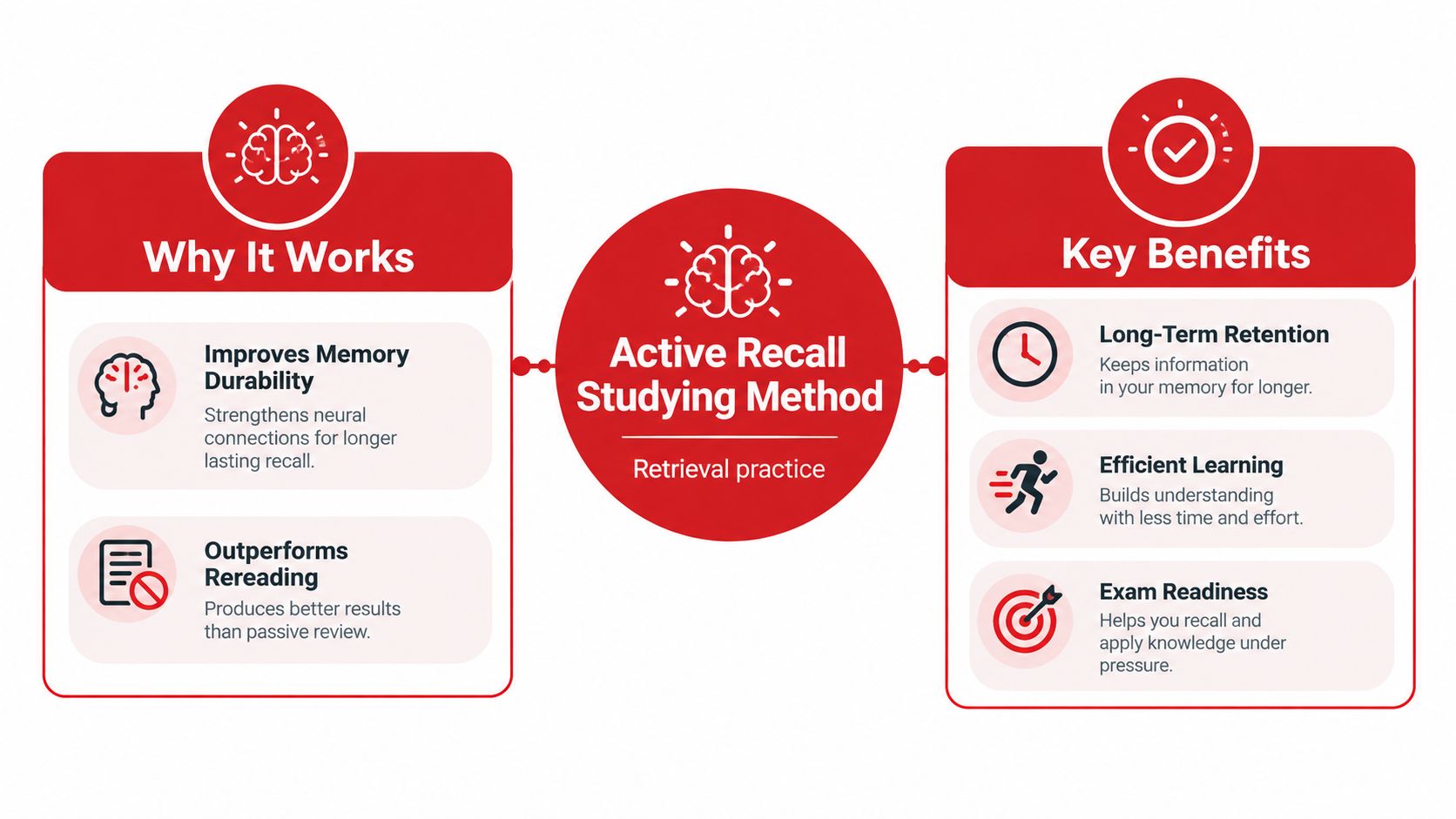
Active recall studying method is retrieval practice. It means pulling information from memory instead of just looking at it again, and it beats rereading for long-term retention. In a landmark study, students who reread retained about 40% after one week, while students who studied once and then took a free-recall test retained about 56%, a difference of roughly 16 percentage points and about 40% more retention relative to rereading (Notelyn summary of Roediger and Karpicke).
That's why active recall matters so much for the United States Medical Licensing Examination (USMLE) and Shelf exams. These tests don't reward vague familiarity. They reward durable recall, discrimination between similar diagnoses, and the ability to apply knowledge under time pressure. If you've ever spent hours rereading and still felt blank the next day, the problem usually isn't effort. It's that your study method didn't force retrieval.
Byline: Ace Med Boards Editorial Team
What the Active Recall Studying Method Is and Why It Works
More than 200 studies across over a century of learning research have shown a retrieval practice effect, with meta-analytic effect sizes for memory retention in the range of Hedges' g = 0.50 to 0.63 (National Research Council review summary). For a medical student, that finding matters because exams reward what you can bring to mind under pressure, not what looks familiar on the page.
Active recall studying method means you answer from memory before you look at the explanation. You might close your notes and explain nephrotic syndrome out loud, cover the answer choices and commit to a diagnosis, or turn a lecture page into two or three clinical questions and try them cold the next day. The common feature is retrieval.
Familiarity is not recall
Recognition and recall are different mental jobs. Recognition is seeing “minimal change disease” and feeling that it rings a bell. Recall is producing “child with edema, selective albumin loss, podocyte effacement, steroid responsive” when the vignette gives you clues but not the label.
A classic finding from the learning literature helps explain why this distinction matters. Repeated studying after learning did not improve delayed recall, while repeated testing produced a large positive effect (retrieval practice review from MIT-hosted paper). For USMLE and Shelf prep, that means a session should regularly ask you to produce something. A mechanism. A next best step. A differential. A short explanation that links symptoms to pathology.
One practical test helps many students. If your materials let you feel productive without forcing an answer, they are training recognition more than retrieval.
Why retrieval works for medical learners
Retrieval strengthens the path back to the information. A useful comparison is rounds. Reading an assessment written by someone else can make the plan seem obvious. Building the assessment yourself at the bedside is harder, but that harder step is what prepares you to do it again with a new patient.
The same principle applies to study notes. A page of endocrine facts becomes more useful when you convert it into prompts such as, “A postpartum patient cannot lactate after severe hemorrhage. What syndrome explains this?” or “Why does primary adrenal insufficiency cause hyperpigmentation?” Now your notes are no longer storage. They are a question source for retrieval.
That shift is the beginning of a system, not a study trick. For USMLE and Shelf learners, active recall works best when you turn notes into clinical application questions, revisit them on a weekly retrieval calendar, and record misses in an error log that asks, “What did I fail to retrieve, why did I miss it, and can I answer a new version correctly?” Progress is measured by transfer to unseen items, not by how many flashcards you cleared.
What active recall includes, and what it does not
Many medical students hear “active recall” and think only of flashcards. Flashcards can help, but they are only one format. Retrieval can also look like blank-page recall after a lecture, one-minute oral teaching, rebuilding a concept map from memory, or answering mixed clinical questions before reading explanations.
As noted earlier, medical education literature describes broad interest in active study methods and uneven instruction in how to use them well. That gap shows up in practice. Students often use tools labeled active while still studying passively because they reveal the answer too quickly or review completed material without another retrieval attempt.
If you want a related memory-focused overview, Ace's guide on how to improve memory retention for exam study is a useful companion.
It helps to define the method clearly.
It is not:
- Highlighting more aggressively
- Rereading until the page feels familiar
- Watching explanations before committing to an answer
- Reviewing completed question blocks without re-answering the missed concept
It is:
- Retrieving before you check
- Using feedback to correct the exact gap
- Turning notes into questions with clinical context
- Revisiting misses later to see whether the answer transfers to a new vignette
A missed question is useful data. In a strong retrieval system, each miss becomes the next question you need to answer correctly from memory.
How Retrieval Practice Spacing and Interleaving Build Durable Memory
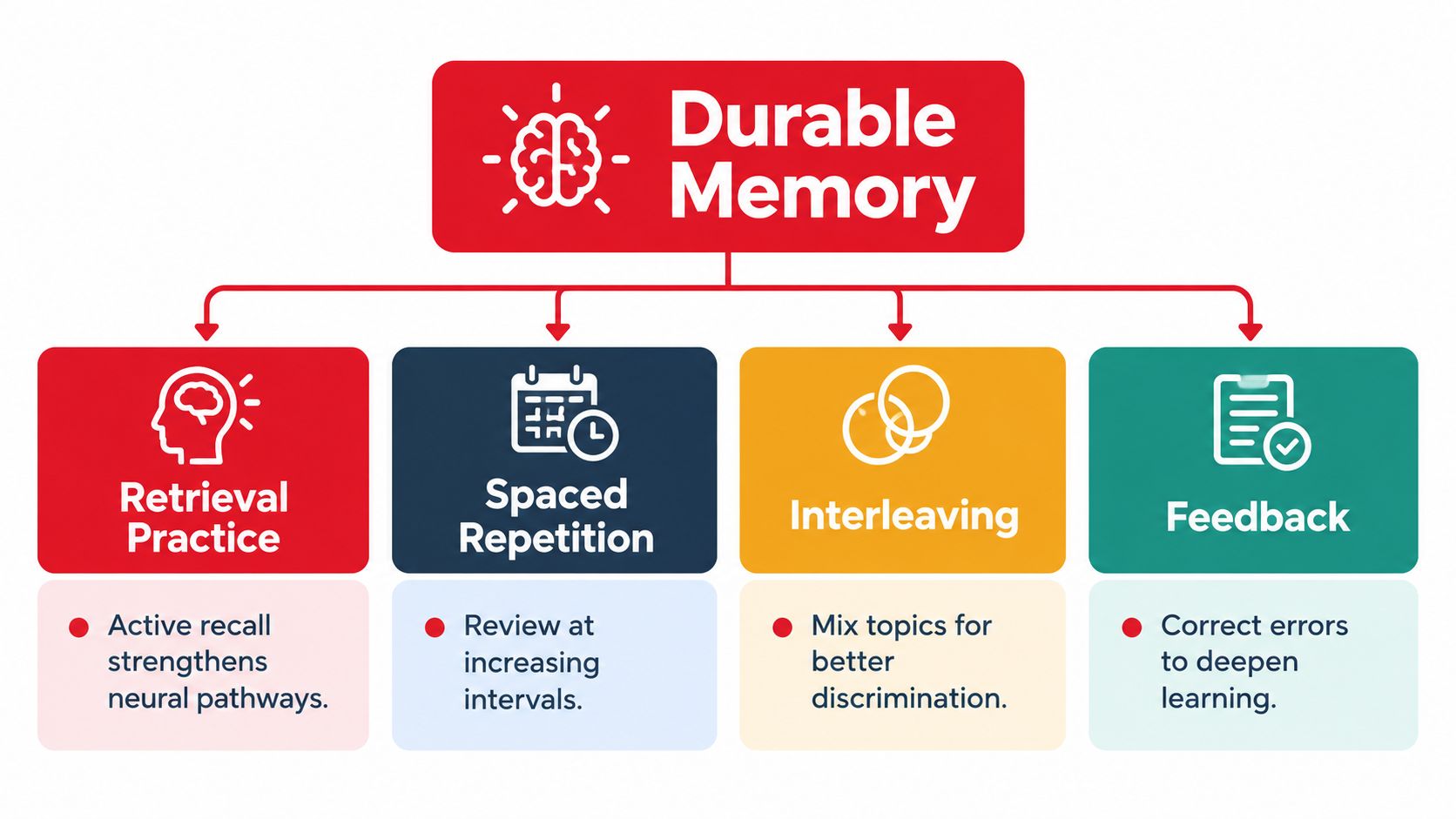
Retrieval works best as part of a system. The pieces are retrieval practice, spacing, interleaving, and feedback. If one is missing, your studying can drift back toward passive review.
Retrieval first, then feedback
The sequence matters. Answer first. Check second.
If you look too early, you're reviewing. If you commit to an answer before checking, you're training retrieval and exposing the exact gap. In health professions education, a 2023 systematic review reported that 5 of 8 studies found statistically significant performance differences between retrieval-based interventions and control groups on immediate or delayed exams (PubMed-indexed review summary).
That doesn't mean every prompt should be a flashcard. It means your study materials should regularly require an output:
- A diagnosis
- A mechanism
- A next step
- A differential
- A one-minute explanation aloud
Spacing and interleaving make recall stick
Spacing means you revisit material after time has passed. Interleaving means you mix related topics instead of studying one narrow type in isolation.
Later retrieval is harder, and that's useful. It forces the brain to reconstruct. Interleaving adds another exam-relevant demand. It makes you decide between similar choices, which is what clinical questions often require.
A 2021 systematic review of applied school and classroom research analyzed 49 effect sizes from 5,374 students, and 57% of those effects were medium or large, showing that active recall improves learning across ages, content areas, final-test delays, and feedback conditions (ERIC review).
Here's the practical model:
- Retrieval practice asks, “Can I produce it?”
- Spacing asks, “Can I still produce it later?”
- Interleaving asks, “Can I choose correctly among similar possibilities?”
- Feedback asks, “Do I know why I was right or wrong?”
For a simple overview of scheduling reviews, this ClassLecture.ai spaced repetition guide is a helpful supplementary read.
A short visual explanation can help if this still feels abstract:
Choose the representation that fits the material
“Learning styles” labels don't justify matching everything to a preferred sensory mode. Instead, choose the representation that fits the content.
Some topics are best recalled as short prompts. Others need diagrams, mechanism chains, or compare-and-contrast maps.
Use:
- Words for definitions, sequences, and management steps
- Useful diagrams for pathways, anatomy, and physiologic relationships
- Clinical prompts for application and discrimination
If you want a focused primer on building review intervals into your schedule, Ace's article on spaced repetition for exam prep fits well here.
A Step by Step Active Recall System for USMLE and Shelf Prep
For USMLE and Shelf prep, active recall works best when it's operationalized, not admired. You need a repeatable workflow that connects official exam content, retrieval, feedback, and weekly adjustment.
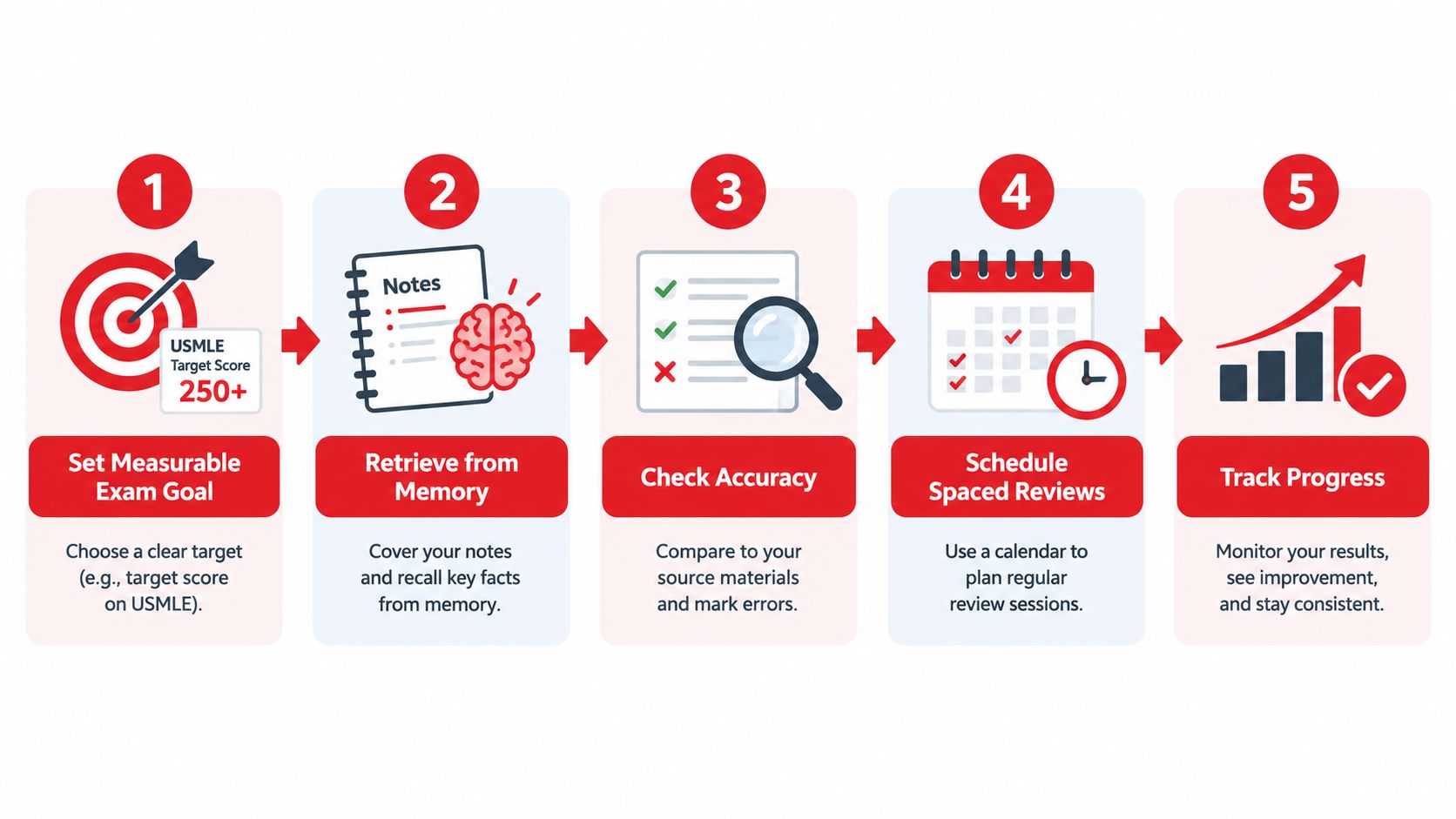
Use this sequence for each study block
Set a measurable exam goal
Define the exam and the target task. For example: improve performance on mixed internal medicine Shelf questions, or build stronger Step 2 CK recall in cardiology and infectious disease. “Study harder” isn't a plan.Run a diagnostic aligned to official content outlines
Use official exam frameworks to decide what belongs in your plan. For USMLE alignment, review the USMLE content outline pages. For Shelf alignment, use the relevant NBME subject examination information. Your diagnostic can be a mixed question set, a self-made recall sheet, or a blank-page attempt by topic.Tag every error by cause
Don't stop at right versus wrong. Identify why the miss happened. Was it a factual gap, misread stem, premature closure, weak mechanism, confusion between similar diagnoses, or poor pacing?Schedule spaced retrieval
Put missed or fragile material back into rotation. Short prompts can go into flashcards. Mechanisms can become concept maps. Clinical reasoning errors should become new case-style prompts.Practice mixed unseen questions
Transfer happens. If you only review your old mistakes in the same wording, you may improve familiarity without improving application.Adjust weekly using performance signals, not hours alone
Watch accuracy, retention after delay, pacing, and workload. A longer study day isn't automatically a better one.
Know when material is ready for closed-book retrieval
A common frustration is trying active recall too early. If the foundation is weak, fully closed-book testing can feel like random guessing.
Recent coverage aimed at medical learners notes that students should consider whether the material is “ready” for heavier recall before using it, because premature closed-book testing can waste time when foundational understanding is still thin (Ace Med Boards active recall article).
Use this readiness check:
- Ready now if you can explain the basic concept in simple language
- Almost ready if you recognize the topic but can't yet connect the mechanism
- Not ready if the vocabulary itself is unfamiliar
If it's not ready, start with a short guided review, then shift quickly into retrieval. Don't stay in rereading mode longer than needed.
Convert facts into exam-useful prompts
A weak prompt asks for a raw fact. A stronger prompt asks you to use the fact.
Compare these:
Weak prompt
“What are the side effects of drug X?”Stronger prompt
“A patient develops symptom Y after starting drug X. What mechanism explains it, and what alternative choice avoids the problem?”Even stronger for Shelf prep
“What finding would make you move drug X lower on the differential and choose another management step first?”
For rotation-specific planning, Ace's guide on how to study for Shelf exams can help you adapt this system to clerkship blocks.
If your prompt can be answered by pattern recognition alone, revise it until it requires reasoning, comparison, or application.
Integrating Anki Question Banks and Concept Maps Without Passive Review
Students often say they are "doing active recall" when they are really just spending time inside study tools. The tool is not the method. The method is retrieval, spacing, and feedback arranged so you can answer a new clinical question correctly a week later, not just clear today's review queue.
For USMLE and Shelf prep, it helps to assign each tool one job. Anki handles compact retrieval. Question banks test transfer under exam-like constraints. Concept maps expose whether you can connect mechanism to presentation, diagnosis, and management. Used together, they work like parts of the same clinical workup. History, exam, and labs each answer a different question. Your study tools should too.
Match the tool to the type of learning you need
| Material Type | Best Retrieval Format | Why It Works | When to Avoid |
|---|---|---|---|
| Isolated facts and associations | Flashcards in Anki | Fast retrieval, easy spacing, efficient for repeated exposure over time | Avoid when the topic requires explanation, prioritization, or differential diagnosis |
| Clinical reasoning and management | Timed question-bank blocks | Tests transfer to unfamiliar cases and forces decisions under constraints | Avoid turning review into answer memorization |
| Mechanisms and pathways | Concept maps from memory | Reveals missing links and causal gaps | Avoid if you only redraw from notes instead of reconstructing |
| Similar diagnoses | Compare-and-contrast tables made closed-book first | Improves discrimination between look-alike conditions | Avoid if the table becomes a copied summary |
| Communication-heavy topics | Oral teach-back | Exposes shallow understanding quickly | Avoid if you read while explaining |
A common mistake is asking one tool to do every job. Flashcards are good for "What receptor is blocked?" They are weaker for "Why did this patient with COPD, edema, and elevated JVP worsen after receiving fluids?" That second task needs reasoning across several steps. A Qbank item or a concept map built from memory is a better fit.
Use Anki to store decisions, not copied notes
Anki works best when each card asks for one retrieval decision. Keep the prompt narrow enough that you can tell exactly what you knew and what you missed.
Good cards often test one of four things:
- one clinical clue linked to one diagnosis
- one mechanism linked to one adverse effect
- one management rule linked to one scenario
- one distinction between two similar diseases
If a card contains a whole paragraph, it usually measures recognition more than recall. For a practical setup, Ace Med Boards has a guide on using Anki with spaced repetition for medical studying.
Use question banks to test transfer, not completion
Question banks answer a harder question than Anki does. Can you still retrieve and apply the idea after the wording changes, distractors appear, and the diagnosis is no longer announced for you?
Review blocks with a clinician's mindset. Start by naming what the item was testing: diagnosis, next best step, mechanism, prognostic factor, or contraindication. Then identify why you missed it. The error usually falls into one of three buckets. You lacked a fact, you misread the clinical pattern, or you chose the wrong test-taking strategy.
That distinction matters. "I forgot" is too vague to guide the next review.
Use concept maps to reveal broken links in understanding
Some topics fail when broken into tiny fragments. Acid-base disorders, shock states, murmurs, nephritic syndromes, and endocrine loops depend on relationships. A concept map built from memory shows whether those links are present.
Concept maps work like drawing the wiring diagram after looking away from the circuit. If the patient has septic shock, can you connect vasodilation, decreased SVR, warm extremities early on, rising lactate, and first-line management without opening your notes? If not, the weak point is visible. That gives you something specific to repair.
The key is reconstruction. Build the map closed-book, then compare it with your source. If you copy while looking, you are producing neat notes, not testing memory.
Turn every miss into the right follow-up task
A clean workflow keeps these tools from blending into passive review.
- Missed fact. Make one concise Anki card.
- Missed reasoning pattern. Add an error-log entry and write a new clinical application question.
- Missed mechanism chain. Schedule a concept map reconstruction from memory.
- Missed discrimination between similar diagnoses. Create a closed-book compare-and-contrast prompt.
This is how notes become usable. A page on nephrotic syndrome should not stay a page of notes. It should become prompts such as: "A patient with edema, heavy proteinuria, and renal vein thrombosis risk. Which pathology is most likely, and what feature would argue against minimal change disease?" That format prepares you for unseen items because it tests application, not visual familiarity.
Individual tutoring can support this process when a learner has trouble classifying errors or writing stronger prompts. Ace Med Boards provides individualized tutoring for USMLE Steps and selected Shelf exams, which can help students refine error tagging and retrieval workflows alongside question-bank practice.
Weekly Retrieval Calendar and Error Log You Can Reuse
A labeled composite learner often helps make the process concrete. This learner spends four hours rereading notes on a medicine block, feels productive that night, and can't retrieve the key points the next day. The fix isn't more rereading. The fix is converting material into prompts, spacing the retrieval, mixing related topics, and checking transfer one week later on unseen items.
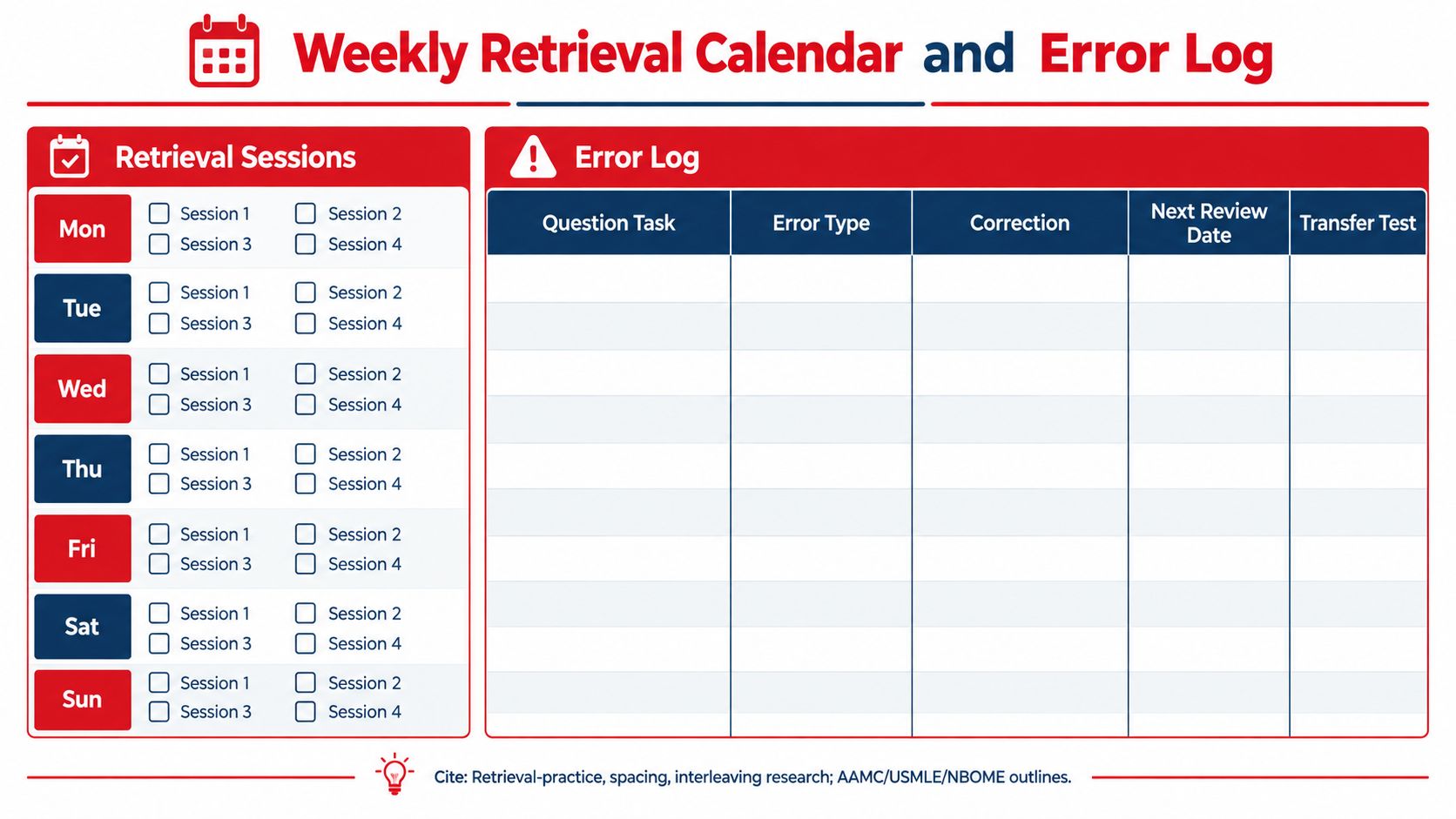
Reusable weekly retrieval calendar
You can copy this framework into a paper planner, spreadsheet, or dashboard.
| Day | Primary Retrieval Task | Secondary Task | Feedback Check |
|---|---|---|---|
| Monday | Diagnostic mixed block on current system | Build error log | Note accuracy, pacing, and major error types |
| Tuesday | Closed-book recall of missed concepts | Short concept map from memory | Compare to source and revise prompts |
| Wednesday | Mixed unseen questions from related topics | Targeted flashcard review | Mark which misses were repeated |
| Thursday | Oral teach-back of weak areas | Short timed mini-block | Check whether explanation improves question performance |
| Friday | Interleaved retrieval across old and new topics | Update next review dates | Look for delayed retention, not same-day comfort |
| Saturday | Transfer test on unseen items | Review only high-yield misses | Ask whether knowledge generalizes |
| Sunday | Weekly audit | Adjust next week's plan | Change workload based on retention and pacing |
Reusable error log template
The error log is where active recall becomes a system instead of a slogan.
| Question Task | Error Type | Correction | Next Review Dates | Transfer Test |
|---|---|---|---|---|
| Diagnose cause of chest pain | Premature closure | Compare the leading diagnosis against one dangerous alternative before choosing | 1 day, 3 days, 7 days | New vignette with overlapping symptoms but a different key clue |
| Explain mechanism of metabolic disturbance | Mechanism gap | Rebuild the pathway from memory in three linked steps | 1 day, 4 days, 7 days | New question asking for lab interpretation instead of the mechanism directly |
| Choose next best step | Management sequence confusion | State the stabilization step before the definitive step | 2 days, 5 days, 8 days | New case where the diagnosis is obvious but urgency changes management |
| Distinguish similar rashes | Pattern confusion | Write one discriminator for each likely option | 1 day, 3 days, 6 days | Unseen photo-free vignette requiring differentiation by history |
Your error log should track what the question asked you to do, not just what fact you forgot.
How the composite learner changes the week
At first, the composite learner says, “I reviewed this already.” The log reveals the problem. The learner reviewed the notes, not the retrieval.
After switching methods:
- Notes become questions
- Misses get tagged by cause
- Related topics get mixed together
- One week later, the learner checks transfer on unseen items instead of admiring completed cards
That last step matters. Completion is not the same as retention. A progress tool such as a study progress tracking dashboard can help you see whether a topic stays retrievable after delay.
Troubleshooting Pitfalls and Measuring Real Progress
The biggest myth about active recall is that more difficulty is always better. It isn't. If you start closed-book retrieval before you understand the basic language of the topic, you can waste energy on confusion rather than learning.
That's why timing matters. For early learning or concept-heavy material, start with a brief orienting pass. Then move into retrieval as soon as you can explain the core idea. Don't let “I need to understand it first” become a reason to reread indefinitely.
When active recall becomes inefficient
Use explanation or mapping first when:
- The vocabulary is brand new
- The topic depends on a chain of causation
- You can't yet state the central mechanism plainly
Shift to heavier retrieval when:
- You can summarize the concept without looking
- You can identify what the prompt is asking
- You're ready to discriminate between similar answer choices
Error-tracking checklist for weekly review
Use this checklist at the end of the week:
Accuracy on unseen mixed sets
Are you improving on questions that are new to you, not just repeated material?Retention after delay
Can you still retrieve the concept several days later?Pacing
Are you recognizing the task faster, or are you still spending too long untangling the stem?Workload balance
Is your schedule sustainable, or are you creating too many cards and too little transfer practice?Error type pattern
Are your misses mostly factual, interpretive, or strategic?
Key takeaways
- Active recall studying method means retrieval practice, and durable recall matters more than familiarity for USMLE and Shelf exams.
- Spacing, interleaving, and feedback make retrieval more effective than isolated self-quizzing.
- Flashcards are useful but limited. Pair them with unseen mixed questions and concept maps when the material requires explanation.
- Track error types, not just scores. The cause of the miss tells you what kind of review to schedule.
- Measure transfer by how well you handle new questions after a delay.
This article is for exam education only. It isn't medical advice or patient-care guidance.
If you want help turning this into a personalized USMLE or Shelf study system, Ace Med Boards offers one-on-one tutoring, strategy support, and Board Score Audit guidance built around question analysis, retrieval practice, and sustainable study planning. If you'd like a structured review of your current method, schedule a free consultation and bring your study calendar, question performance patterns, and error log.