
A competitive medical school application today is not just a high GPA and MCAT combination. It's a school-specific, competency-based portfolio built from the AAMC Premed Competencies and each school's verified admissions requirements, then submitted early through AMCAS, AACOMAS, or TMDSAS only when the file is ready.
That distinction matters because the pool is large and the process is crowded. In the United States, 54,699 applicants generated 1,066,896 total applications in the 2025 to 2026 cycle, averaging 19.5 applications per applicant, according to the AAMC's 2025 admissions update. A rushed application can disappear in that volume. A well-built, verified, school-fit application is easier for admissions committees to understand and harder to dismiss.
Byline: Ace Med Boards Editorial Team
What Makes a Competitive Medical School Application Today
Roughly 55,000 people apply to U.S. MD programs in a single cycle, and each applicant sends applications to many schools. In a pool that large, admissions committees are not asking one simple question such as, “Is this student smart enough?” They are asking whether your file shows the right preparation, the right professional qualities, and a believable fit with their program.
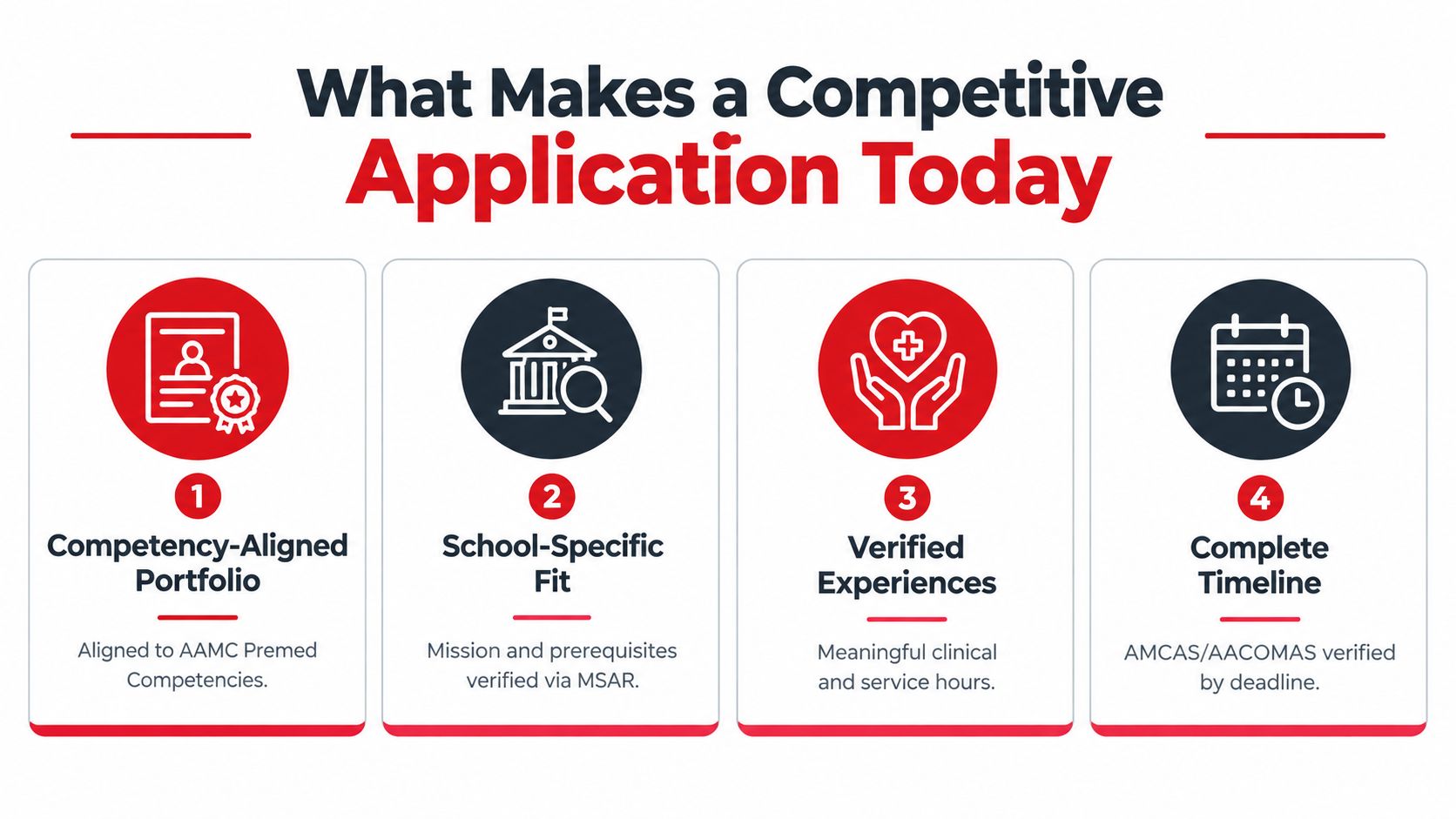
Competitiveness is a competency and fit audit
A strong application works like an academic audit plus a mission-match review. One part asks, “Have you shown the competencies expected of a future medical student?” The other asks, “Have you shown them in ways this school is likely to value?”
That is why GPA and MCAT scores matter, but they do not carry the whole file. Committees read for patterns. They look for academic readiness, sustained service, clinical exposure, teamwork, communication, ethical judgment, and evidence that you understand the work of medicine beyond the idea of medicine. The AAMC Premed Competencies give you a useful framework for this review, and each school's admissions website helps you test whether your record fits its priorities.
Students often get stuck here because “competitive” sounds like a national label. In practice, it is much closer to a school-by-school match process. A research-intensive school may expect stronger evidence of scholarly work. A community-focused program may care more about long-term service, local ties, or commitment to primary care. The same applicant can look well aligned at one school and out of place at another.
A practical starting point is to review what medical schools look for in applicants and then sort your own experiences into a simple matrix: competencies down the left side, schools across the top, and concrete evidence in each cell. That matrix becomes reusable. It helps you decide where to apply, what to emphasize in secondaries, and where you still have gaps.
Readiness beats speed by itself
“Submit early” is good advice only when the application is accurate, polished, and strategically built. Early submission with weak writing, rushed school selection, or preventable errors does not help much. It can make your file harder to repair later because the first impression is already on record.
A better rule is early and ready. If you are choosing between a slightly earlier date and a materially stronger application, the stronger application often serves you better, especially if the difference is measured in days rather than months. This is one of the clearest trade-offs in the process. Timing matters, but timing and quality work together.
The applicant pool is bigger, not simpler
More seats and larger class sizes have not made school selection simple. They have made fit even more important. Applicants are sorting through different missions, prerequisite rules, residency preferences, research expectations, and service values. Schools are doing the same in reverse.
That is why the strongest applicants do more than finish tasks. They verify requirements, compare schools carefully, and present evidence with purpose. If you remember one idea from this section, use this one: a competitive medical school application is a documented match between your competencies and a school's stated expectations.
Your Application Timeline and Key Milestones
AAMC guidance consistently shows that the application cycle opens months before many applicants feel ready, which is why timing problems usually begin long before submission day. A strong timeline is less like a to-do list and more like a course map. Each step depends on the one before it. If you draft secondaries before you know your school list, or request letters before clarifying your goals, you create rework.
Your calendar should answer two questions at the same time. What must be done by a certain date? What evidence do I still need to show that I fit the schools I plan to target?
Here's the visual overview first.
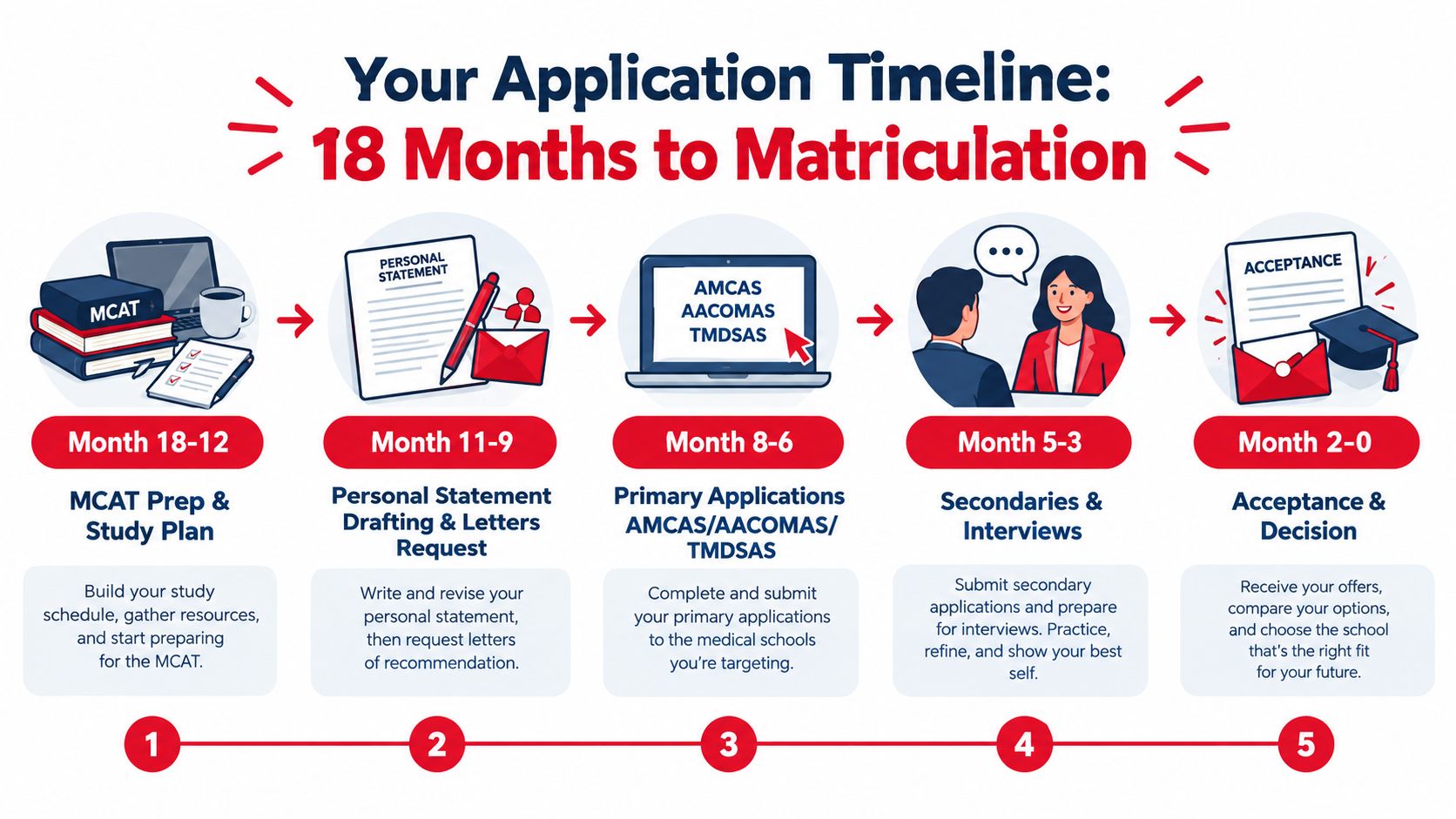
A reusable 18-month planning framework
Use this framework as a planning grid you can revisit every month. The left column tracks time. The middle column identifies the main job of that period. The right column should connect back to your school-fit matrix, so you are not only finishing tasks but also checking whether your academics, experiences, and writing support the kinds of schools you are choosing.
| Timing before matriculation | Priority | What to do |
|---|---|---|
| 18 to 12 months | Academic and MCAT readiness | Audit prerequisites, map MCAT study time, identify competency gaps, start school research |
| 11 to 9 months | Narrative and letters | Draft personal statement, build activity descriptions, request letters early |
| 8 to 6 months | Primary application assembly | Finalize school list, order transcripts, enter coursework, proofread everything |
| 5 to 3 months | Secondary and interview prep | Turn around secondaries promptly, prepare for traditional and MMI interviews |
| 2 to 0 months | Decision management | Track offers, financial planning, update schools if appropriate, prepare for transition |
What “submit early” means in real life
For AMCAS, the practical meaning of early is simple. Submit as soon as your application is accurate, polished, and complete enough to represent you well.
That usually means your MCAT plan is settled, your school list has been checked for fit, your personal statement has gone through serious revision, your letters are in motion, and your coursework entry has been reviewed carefully. A rushed primary can delay you in a different way. You may submit sooner, then spend weeks correcting preventable mistakes or sending a weaker first impression to schools.
The AAMC applicant guide explains the annual AMCAS workflow, including opening and submission timing, and the Early Decision Program deadline. Verify the current cycle before acting because dates can shift from year to year. If you want a practical calendar that turns those milestones into month-by-month tasks, this medical school application dates guide can help you map them.
Monthly milestones that prevent avoidable delays
Use this sequence as a working model rather than a rigid script:
- Winter before the cycle: Decide whether this is the right cycle to apply. Base that decision on evidence, not pressure. If your metrics, experiences, or school-fit matrix show major gaps, extra time may improve your odds more than a rushed submission.
- Early spring: Request letters of recommendation. Give each writer a résumé or CV, a draft of your statement, and a short note about the qualities you hope they can address.
- Spring: Revise your personal statement and activities entries. Reflection usually takes longer than applicants expect because strong writing depends on selection, specificity, and sequence.
- Late spring to early summer: Complete primary application data entry with care. Coursework classification, transcript matching, and school designations are detail-heavy tasks, and small errors can slow processing.
- Summer: Submit once the file is ready. If you have likely secondary themes identified, prewriting can shorten turnaround time, but only if your responses stay specific to each school's mission.
- Late summer through interview season: Practice answering questions by explaining how your experiences shaped your judgment, service ethic, and readiness for training. Schools are evaluating clarity and reflection, not memorized lines.
- After interviews: Track updates, deadlines, and financial aid steps in one place. Organization matters more here than applicants realize, especially if multiple schools request follow-up materials on different schedules.
One way to reduce stress is to treat each month as an audit checkpoint. Ask: what has been completed, what still needs evidence, and what could block me next month if I ignore it now?
This video can help orient you to the process at a high level before you build your own calendar.
Apply early only when the application is ready. Readiness beats panic every time.
A note for gap-year applicants
A gap year often works best when it has a clear purpose. If your school-fit audit shows weak clinical exposure, thin service work, incomplete prerequisites, or an MCAT timeline that is too compressed, more time can turn a scattered file into a coherent one.
The key question is not whether a gap year looks good or bad. The key question is whether the added time gives you stronger evidence for the schools you want to target.
Navigating AMCAS AACOMAS and TMDSAS Without Confusion
Applicants who treat AMCAS, AACOMAS, and TMDSAS as one generic “medical school application” often create avoidable delays. The forms may look similar on the surface, but they function more like three different operating systems. Each one sorts schools differently, collects information a little differently, and has its own rules for verification, transcripts, letters, and deadlines.
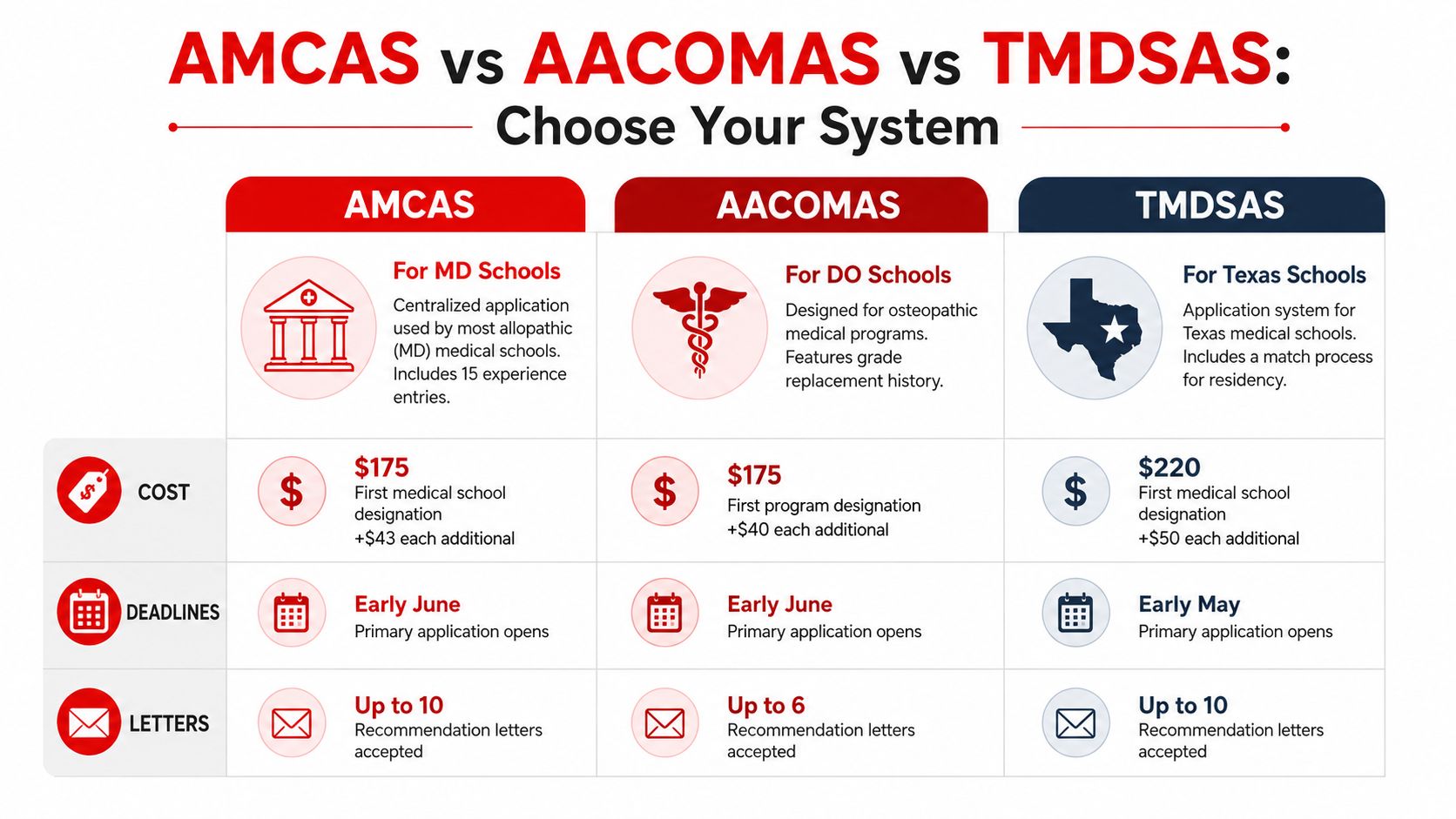
The simplest way to stay organized is to treat each platform as a separate competency and school-fit audit. Your job is not only to submit forms. Your job is to confirm that each school can clearly see the evidence it cares about, in the format that system requires.
Which applicants use which system
| System | Typical use | What to verify |
|---|---|---|
| AMCAS | Most U.S. MD programs | School deadlines, transcript rules, activity presentation, letters |
| AACOMAS | U.S. DO programs | Osteopathic school requirements, letters, prerequisites, school-specific policies |
| TMDSAS | Participating Texas schools | Residency rules, school participation, deadlines, school-specific requirements |
Your school-fit matrix should include a column for application system, not just mission fit, median metrics, and prerequisite match. A school may fit your goals well and still become a poor tactical choice if its requirements do not match your coursework, letter setup, or state residency status.
Students are often surprised by how much time the mechanics take.
If you are applying to DO programs, use AACOMAS instructions and each school's admissions page instead of assuming the MD process transfers neatly. For a practical walkthrough, this AACOMAS application overview can help you understand the platform before you build your school list around it.
Where applicants lose time
A strong applicant can still look disorganized if the file is messy. Admissions committees cannot review experiences that never reach a complete, verified application.
Common trouble spots include:
- Transcript mismatch: Different names, missing institutions, or delayed registrar processing can hold up verification.
- Coursework entry errors: Manual entry rewards patience. One rushed classification can create corrections that cost time later.
- Wrong assumptions across schools: Two schools in the same system may still differ on letters, prerequisites, or added assessments.
- Portal neglect: Submission is not the end of the process. School portals often reveal missing items faster than the primary application account does.
A useful rule is to separate content problems from process problems. Weak reflection is a content problem. An unreceived transcript is a process problem. You solve them differently, and both affect outcomes.
Keep the systems separate in your records
Use one tracking document for your overall school-fit matrix, then keep separate tabs or folders for AMCAS, AACOMAS, and TMDSAS. Include transcripts requested, letters assigned, coursework questions, deadlines, and school-specific follow-up items.
That structure reduces confusion because it matches how admissions offices review files. A committee at one school is not asking whether you were generally prepared. It is asking whether its own requirements were met, whether your competencies are documented, and whether your application fits that program.
As noted earlier from AAMC and AACOM guidance, the safest assumption is that each school has its own operational details until you verify them on the current admissions page.
Crafting Your Personal Statement Secondaries and Activities
Admissions readers often make decisions from patterns, not isolated lines. Your writing has to show a pattern of preparation, reflection, and fit across three places at once: the personal statement, the activities section, and secondaries.

A useful way to approach this is to treat your writing as a competency audit. The question is not just whether you can tell a moving story. The question is whether a school can verify, from your own examples, that you have the experiences and habits it values.
Your school-fit matrix helps here. If one school emphasizes service to underserved communities, another highlights research, and a third values primary care exposure, your writing should not become three different personalities. It should present the same applicant with different evidence brought forward for each audience. That is the difference between customized writing and inconsistent writing.
The activities section carries more weight than many applicants expect
Applicants often pour most of their energy into the personal statement and rush the activities list. That is a mistake. The activities section works like the lab data behind your clinical note. The personal statement may frame your interest in medicine, but the activities entries show whether the record supports that interpretation.
A strong entry usually answers three questions clearly:
- What did you do?
- What responsibility did you hold?
- What changed in your understanding or skills because of it?
That last question is where many entries flatten out. Students describe the setting but skip the learning. If you scribed, volunteered, worked as an MA, did bench research, or led a campus group, the committee does not need a diary. It needs evidence of judgment, reliability, communication, cultural awareness, teamwork, or resilience.
For drafting style, it can help to study strong examples of concise narrative structure. A non-medical but useful model for clear reflective writing is this sample essay from RewriteBar, especially if you struggle to move from description into meaning.
A practical structure for the personal statement
A solid personal statement usually develops in four parts.
Start with a real experience that shaped your interest in medicine.
Use a concrete scene or turning point, but do not build the whole essay around one dramatic moment if your preparation came from many smaller ones.Show sustained action.
Clinical work, service, research, employment, family responsibilities, or leadership should appear as evidence that you tested your interest rather than just announcing it.Explain your growth.
This is the part many applicants underwrite. Reflection means naming what became more complex in your understanding of patient care, teamwork, uncertainty, or responsibility.End with direction.
Explain why medical training is the logical next step from what you have already done and learned.
A good test is this: if you remove the phrase “I want to help people,” does the essay still make sense? Strong essays survive that test because they are built on observations, decisions, and responsibilities.
If you need process help, this personal statement guide for premeds can support revision and organization.
Secondaries should adapt the evidence, not invent a new message
Secondary essays are where applicants often lose coherence. One school asks about challenge, another asks about diversity, another asks why its program. Under deadline pressure, people start recycling paragraphs with only the school name changed.
Admissions committees notice.
Use your fit matrix before drafting. For each school, list the mission themes, the experiences from your record that support those themes, and the competencies those experiences demonstrate. Then draft from that sheet. This approach keeps you specific and honest.
For example, if a school stresses community partnership, a strong answer would focus on a longitudinal service role and what you learned about trust, continuity, or barriers to care. If a school emphasizes academic medicine or investigation, you might foreground research and explain how that work shaped your approach to evidence and uncertainty. Same applicant. Different slice of the file.
Composite example of a stronger revision
Consider a composite applicant with high research involvement, solid grades, and limited patient-facing experience. The weak version of this application tries to hide the gap by sounding broad and idealistic in every essay.
The stronger version does something more disciplined. The applicant names one sustained clinical or service role, explains what they observed over time, and connects those observations to the kind of training environments that fit them best. Then the activities section, personal statement, and secondaries all reinforce the same message.
That improves credibility because the writing matches the record.
Add experiences that give you clearer evidence, then write from that evidence.
Revision checks that actually improve quality
Read each component side by side, not one at a time.
- Specificity: Replace generic claims with duties, decisions, and observed moments.
- Consistency: Make sure your personal statement, activities, and secondaries describe the same development from different angles.
- Reflection: Name what you learned, what became harder, or what you understand differently now.
- Fit: Tie each secondary to the school's mission, curriculum, patient population, or training priorities that you already verified in your matrix.
- Proportion: Give more space to sustained, meaningful experiences than to short or scattered ones.
- Accuracy: Keep every description faithful to your actual role.
Good writing does not rescue a poor fit. It clarifies a strong one. That is why this part of the application works best as a school-fit and competency audit, not a last-minute essay exercise.
Choosing Schools Strategically With a Fit Matrix
A long school list can create the illusion of progress. A better list works like an audit. It checks whether your record matches a school's mission, academic expectations, and training environment closely enough to justify the time and cost of applying.
That shift matters because school selection is not just a task list. It is a school-fit and competency review. Use verified AAMC Premed Competencies, MSAR, AACOM and AACOMAS materials for DO programs, and each school's official admissions page to test fit the same way across every school.
School Fit Matrix Template for Medical School Selection
| School | Mission and Fit | Prerequisites and Competencies | MCAT GPA Context | In State Policy and Experiences | Letters Cost Deadlines and Source Date |
|---|---|---|---|---|---|
| School A | What populations or training goals does the school emphasize, and how does your background align | List required coursework and note any competency emphasis from admissions materials | Record only verified published context from official sources or MSAR | Note residency preference and whether your experiences support the mission | Track required letters, estimated application costs, deadlines, and the date you verified the page |
| School B | Repeat the same categories for consistency | Keep notes brief and factual | Avoid guessing cutoffs if none are published | Include whether your service, research, or clinical experiences match | Add source date so you know when to re-check |
| School C | Same framework | Same framework | Same framework | Same framework | Same framework |
How to use the matrix honestly
Start with mission fit. A school may emphasize rural care, a specific state or region, primary care, urban underserved communities, or research-intensive training. Your question is narrower than “Do I like this school?” Ask whether your experiences give you real evidence for that mission.
Then check requirements and context. Some schools publish firm baselines, while others share class profiles without hard cutoffs. Treat those as different kinds of information. A baseline tells you whether you can apply. A class profile helps you judge range and risk.
This process works like comparing courses before registration. If one class requires calculus and you have not taken it, interest alone does not solve the problem. Medical school selection works the same way.
What belongs in each column
Use the same categories every time so emotion does not crowd out judgment.
- Mission alignment: What does the school say it is trying to do, and which of your sustained experiences support that?
- Prerequisites and competencies: Which courses, labs, letters, or competency expectations are stated directly?
- Academic context: Does the school publish minimums, median ranges, or only general class information?
- Residency policy: Is there a clear in-state preference, regional focus, or public-service expectation?
- Experience match: Do your clinical, service, research, leadership, and community experiences support the school's priorities?
- Logistics: Can you meet the letter rules, fees, deadlines, and any state-specific requirements on time?
- Source date: When did you verify the page? This protects you from using outdated requirements.
That final column gets ignored too often. Admissions pages change. A matrix is only useful if you can trust when each entry was last checked.
A practical way to sort your list
After you fill in the matrix, sort schools into three groups.
Clear fit: Your mission alignment is credible, you meet the requirements, and the school's policies make sense for your profile.
Possible fit: You meet the requirements, but one area needs caution, such as weak mission alignment, heavy in-state preference, or limited evidence for the school's service or research focus.
Low-return option: You can submit, but the trade-off looks poor because of residency bias, missing prerequisites, weak alignment, or costs that are hard to justify.
This keeps you from building a list based on name recognition alone. It also helps you explain your decisions to an advisor, letter writer, or family member without sounding vague.
A note on national trends
Broader applicant trends can help you understand the size and shape of the pool, as noted earlier in the article's AAMC source. They should not decide your list for you. Admissions decisions are made school by school, with local priorities, state missions, and program-specific expectations.
A disciplined matrix gives you something better than optimism or fear. It gives you a reusable method. Each school earns its place on your list because the fit is documented, current, and based on evidence rather than guesswork.
Interviews Gap Years and Reapplicant Next Steps
Interview invitations change the task in front of you. At that point, committees have already seen your grades, scores, activities, and writing. The interview is a live test of fit and professional judgment. Schools are asking a practical question: if this applicant joins our class, do their communication style, self-awareness, and values match what we saw on paper?
That is why interview prep works best as an extension of your school-fit matrix, not as a separate task. Your matrix helped you choose schools by mission, curriculum, service focus, research opportunities, geography, and requirements. Now use it again to prepare. For each interview invite, review the school's format, revisit the reasons it landed in your clear-fit or possible-fit group, and practice explaining that fit in plain language.
Interview preparation that reflects how admissions actually works
Prepare for both traditional interviews and MMIs. They test related but different skills.
A traditional interview is closer to an academic conversation. The school wants to hear how you make sense of your experiences, why medicine is the right conclusion, and whether your answers are consistent with the application they already read.
An MMI works more like a series of short competency checks. One station may test ethical reasoning. Another may test teamwork, listening, or your ability to stay organized under time pressure. Memorized speeches usually break down here because the format rewards clear thinking in real time.
If you want a practical starting point, this medical school interview preparation guide can help you build a practice plan.
Before each mock interview, use a short audit:
- Re-read your application: Your spoken answers should match the record you submitted.
- Match examples to competencies: Have one or two real stories ready for service, teamwork, resilience, cultural awareness, and ethical judgment.
- Practice concise structure: Strong answers often follow a simple path. Context, action, reflection, relevance.
- Answer the question that was asked: Committees notice when an applicant pivots into a prepared speech instead of responding directly.
- Study the school, not just interviewing in general: If a program emphasizes primary care, community engagement, rural health, or research, be ready to explain your connection with evidence from your own record.
One common point of confusion is the difference between sounding polished and sounding rehearsed. Polished means your examples are organized and your reflections are specific. Rehearsed means the same answer appears no matter what the interviewer asks. Admissions readers can hear that difference quickly.
If you are taking a gap year
A good gap year has a job. It should solve a defined problem in your application, not just add time.
Use the same matrix logic from school selection, but turn it inward. Instead of rating schools, rate your own file against the competencies and expectations your target schools value most. If your clinical exposure was thin, more shadowing alone may not fix it. Ongoing patient-facing work often gives you better material for interviews and secondaries because you can describe responsibility, teamwork, and reflection. If your service history looked episodic, a year of consistent community work usually carries more weight than several short commitments stacked together.
Timelines matter here. A gap year helps most when the activity is sustained long enough to show growth before you submit again. Starting a new role a few weeks before applications open rarely changes how a file reads.
If you are reapplying
Reapplying successfully usually starts with an honest post-cycle audit. A reapplication is not a fresh coat of paint. It is a revised file with clearer evidence.
Look at four areas first:
- Competencies: Where was the evidence weak or uneven?
- School fit: Did your list reflect verified fit, or did cost, prestige, and hope drive too many choices?
- Timing: Were your primary, secondaries, letters, and MCAT timing working for you or against you?
- Narrative: Did your essays and interviews show mature reasons for medicine, or did they rely on broad statements that many applicants use?
Applicants sometimes assume a rejection means they are not capable of becoming a physician. That conclusion is usually too broad. A cycle can miss for many narrower reasons: poor school fit, late completion, thin service, weak interviewing, or a file that did not make the competencies easy to see. A school-fit and competency audit helps you separate correctable issues from fixed facts.
Key Takeaways
- Interviews test fit in real time. Use your school-fit matrix to prepare school-specific answers, not generic talking points.
- Traditional interviews and MMIs reward different habits. Prepare for reflection, ethical reasoning, listening, and concise structure.
- A gap year should address a clear weakness. The best plans create sustained evidence, not random activity.
- Reapplicants need a true audit. Review competencies, timing, school list quality, and narrative clarity before submitting again.
- One cycle is data, not a verdict. Use it to revise your strategy with more precision.
FAQs
How should I prepare for different interview formats
Start by identifying the format each school uses. For traditional interviews, focus on your story, reflection, and consistency with your written application. For MMIs, practice brief scenarios that require ethical reasoning, communication, and calm decision-making under time limits.
Is a gap year a red flag
No. A gap year is often neutral or helpful if it has a clear purpose. Committees usually care more about what you did with that time than whether you took the year itself.
What makes a reapplication look stronger
Visible improvement. That can mean stronger timing, a better school list, clearer writing, more mature reflection, stronger clinical or service experience, or better interview performance. The change should be easy for an admissions reader to notice.
How do I know whether to reapply this cycle or wait
Ask whether your weak areas will look meaningfully different by the time you submit. If the answer is no, waiting can be the better choice. More time helps only when it leads to evidence that changes how your file reads.
Sources
- AAMC news on 2025 to 2026 applicant volume and total applications
- AAMC press release on enrollment surpassing 100,000 students
- MedEdits overview of aggregated and school-level acceptance context
- Peer-reviewed study on first-time, first-generation, and low-income applicant acceptance outcomes
- AAMC AMCAS applicant guide with opening and Early Decision timing
- UNLV Kirk Kerkorian School of Medicine admissions requirements
- AAMC 2024 applicant and enrollment trends by applicant group
If you want help turning this into an actual school list, timeline, or application strategy, Ace Med Boards offers support for medical school admissions preparation, including planning around AMCAS or AACOMAS, personal statement revision, and interview preparation. If you'd like a second set of eyes on your school-fit matrix or application timeline, a free consultation is a reasonable next step.