A college sophomore may be asking a deceptively simple question: does the Doctor of Medicine, or MD, degree justify the years of education, examinations, supervised training, and delayed independence? The short answer is that an MD is a professional medical degree that prepares graduates to become physicians, but the degree alone doesn't authorize unrestricted practice.
The path includes undergraduate preparation, medical school, licensing examinations, residency, and sometimes fellowship. It also requires a careful choice between MD and DO education, because both lead to physician careers but differ in accreditation, curriculum, examination pathways, and institutional fit. This guide explains those distinctions, separates USMLE, COMLEX-USA, admissions, and residency decisions, and shows where structured academic support may fit.
What a Doctor of Medicine Really Means
A Doctor of Medicine is a professional graduate degree awarded by a medical school accredited by the Liaison Committee on Medical Education, or LCME, in the United States. The degree prepares graduates as physicians educated in allopathic medicine. It isn't the same as a PhD, which is a research doctorate, or an MBBS, which is the primary medical qualification used in many countries.
Accreditation matters because it connects the degree to the U.S. licensing system. An LCME review found that graduating from an LCME-accredited MD program satisfies the undergraduate medical education requirements used by physician licensing boards in all 50 U.S. states, as well as American Samoa, Puerto Rico, the District of Columbia, Guam, the Virgin Islands, and the Northern Mariana Islands. The same review explains that graduates meet the educational requirements to sit for U.S. licensing examinations, while still needing to pass those examinations and satisfy other jurisdictional requirements. Read the AAMC review of LCME accreditation and licensure for the specific licensing connection.
Core distinction: An MD is a medical education credential. A medical license is a separate legal authorization that follows examination and postgraduate requirements.
The modern degree rests on a long U.S. history. Formal medical education included institutions such as the New Jersey Medical Society, chartered in 1766. By 1810, the country had 650 medical students and 100 graduates, compared with 25,000 students and 5,200 graduates by 1900, according to a historical review in the National Library of Medicine. Johns Hopkins University School of Medicine, which opened in 1893, helped establish a research-based model of medical training.
For a practical explanation of what students study, review what you learn in medical school. The rest of the pathway depends on how those subjects become clinical reasoning, safe patient care, licensing eligibility, and supervised professional responsibility.
The U.S. MD Education and Training Timeline
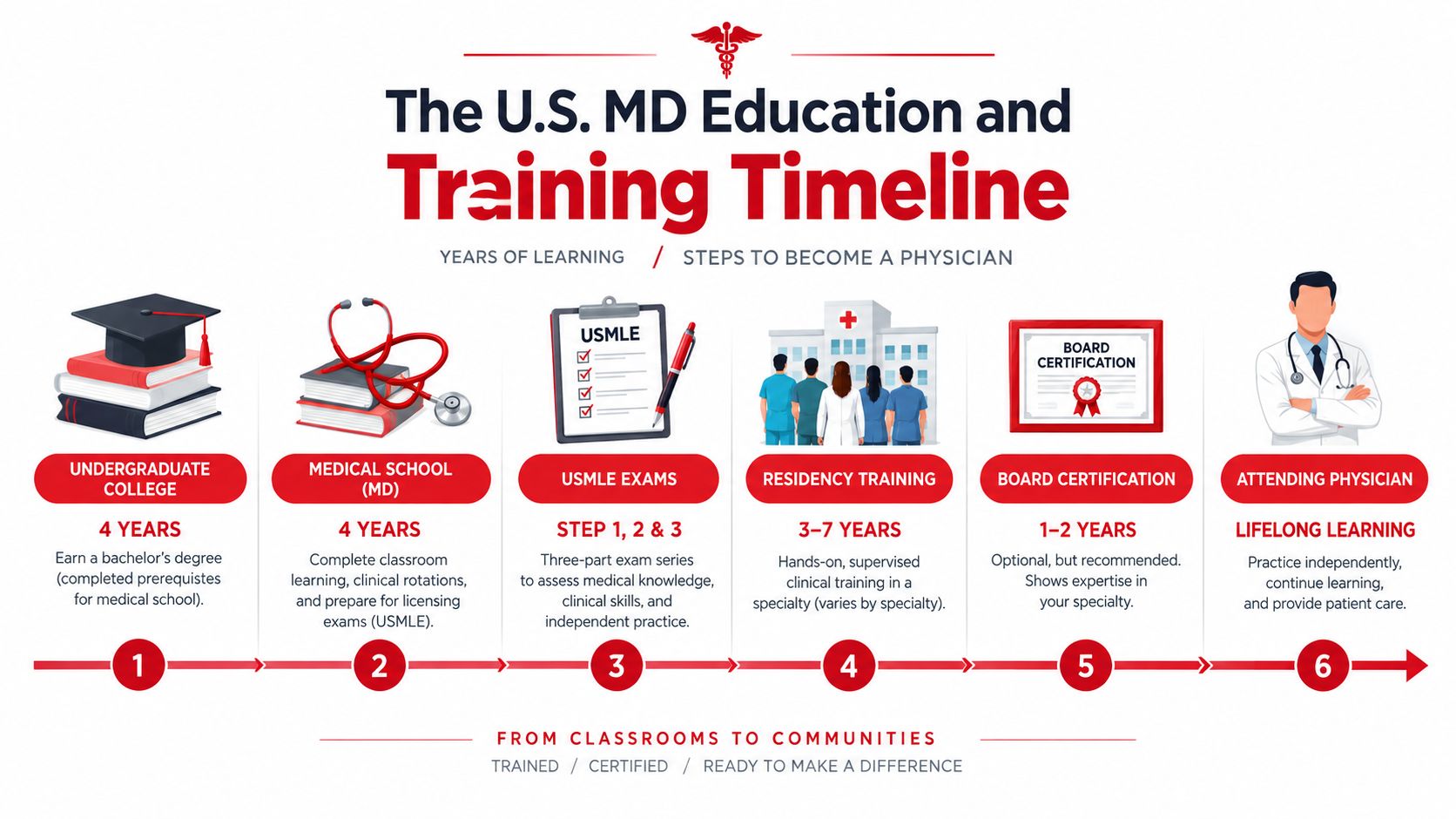
The U.S. MD pathway is best understood as a sequence of gates. Each stage produces a capability that the next stage assumes you have developed.
From undergraduate preparation to medical school
During undergraduate education, applicants complete prerequisite science coursework, prepare for the Medical College Admission Test, or MCAT, and build experiences that help them understand patient care, service, research, and teamwork. The exact admissions requirements vary by school, so applicants should verify them directly through the AAMC medical school admissions resources.
Medical school then moves from foundational science into supervised clinical exposure. A typical curriculum begins with anatomy, physiology, pathology, pharmacology, and related sciences before progressing into clerkships. One major MD curriculum includes two core clinical training years, while another divides the final clinical period into a clerkship year and a residency-preparation year with sub-internships and advanced electives, as described by the University of Melbourne MD structure. The exact U.S. curriculum differs by institution, but repeated patient-contact cycles help students develop diagnostic reasoning and choose specialties.
Examinations and supervised practice
The United States Medical Licensing Examination, or USMLE, generally includes Step 1, Step 2 Clinical Knowledge, and Step 3. Step 1 and Step 2 CK are taken during medical school according to the student's curriculum and eligibility rules. Step 3 is taken after graduation and postgraduate training eligibility is established. The USMLE program and its sponsoring organizations, the Federation of State Medical Boards and the National Board of Medical Examiners, publish current examination policies.
After medical school, graduates enter Accreditation Council for Graduate Medical Education, or ACGME, accredited residency training. Residency length varies by specialty. Some physicians later complete fellowship training for subspecialty practice. Board certification is a further professional step through a member board of the American Board of Medical Specialties.
Graduation ceremonies mark one transition, but they don't represent the end of training. Students interested in the symbolism behind the academic cap can also review this explanation of the tassel on a graduation cap. For a broader chronological overview, see how to become a physician.
MD vs DO, A Side-by-Side Decision Matrix
MD and DO graduates are fully licensed physicians when they meet the applicable licensing requirements. The meaningful comparison isn't whether one credential makes someone a “real” doctor. It is how each educational model fits your learning preferences, examination plan, financial situation, geography, and intended specialty.
MD schools are accredited by the LCME. DO schools are accredited by the Commission on Osteopathic College Accreditation, or COCA. Osteopathic medical education includes osteopathic principles and osteopathic manipulative medicine, or OMM. The AAMC overview of MD education and AACOM overview of osteopathic medicine provide institutionally relevant background.
| Factor | MD, allopathic | DO, osteopathic |
|---|---|---|
| Accreditation | LCME accreditation | COCA accreditation |
| Curriculum | Allopathic medical education, with biomedical and clinical training | Medical education that includes osteopathic principles alongside biomedical and clinical training |
| OMM | Not a defining curricular requirement | OMM and osteopathic manipulative medicine are part of the educational model |
| Primary examination pathway | USMLE | COMLEX-USA, with USMLE also possible for some students and programs |
| Residency system | Graduates enter the single ACGME accreditation system | Graduates also enter the single ACGME accreditation system |
| Clinical rotations | School-specific hospitals, clinics, and affiliated sites | School-specific hospitals, clinics, and affiliated sites |
| Residency support | Depends on advising, clinical opportunities, letters, research, and program preparation | Depends on advising, clinical opportunities, letters, research, and program preparation |
| Cost | Varies substantially by institution, residency status, aid, and living expenses | Varies substantially by institution, residency status, aid, and living expenses |
| Geography | School locations and affiliated networks differ widely | School locations and affiliated networks differ widely |
| Personal fit | May suit students seeking an allopathic curriculum without required OMM | May suit students who value osteopathic principles and are willing to learn OMM |
A DO student takes COMLEX-USA, administered through the National Board of Osteopathic Medical Examiners, and may also take USMLE depending on goals and program expectations. The NBOME examination information and USMLE information for osteopathic students should guide current decisions.
Don't select a degree based only on perceived prestige or an assumption that one route is easier. Compare specific schools, their rotation networks, advising structure, total cost, geographic fit, and specialty support. Osteopathic medicine tutoring and education context can help clarify where COMLEX-focused preparation differs from USMLE-focused preparation.
Licensure and the USMLE Sequence
U.S. licensure is a sequence, not a single graduation event. An LCME-accredited MD degree establishes the educational foundation, but a graduate must still complete the required examinations, postgraduate training, and state-specific application steps.
The examination sequence
Step 1 now reports as pass or fail rather than a three-digit score. That change makes performance in other parts of the application, particularly Step 2 CK, clinical evaluations, letters, personal statements, and specialty-specific experiences, more consequential in residency planning. The exact timing depends on the medical school's curriculum and the student's eligibility.
| Step | Typical timing | What it tests | Licensure role |
|---|---|---|---|
| USMLE Step 1 | During medical school after foundational science preparation | Foundational biomedical science and its application to medicine | A required examination component for the U.S. physician licensing sequence |
| USMLE Step 2 CK | During the clinical phase or near graduation | Clinical knowledge and clinical decision-making | A required examination component that helps demonstrate readiness for supervised postgraduate training |
| USMLE Step 3 | After medical school and postgraduate eligibility | Medical knowledge and clinical management in the context of independent responsibility | The final USMLE examination in the sequence, subject to eligibility and state requirements |
The USMLE Content Outline can help students organize study topics, but it shouldn't replace the current policies published by the FSMB and NBME. State medical boards retain authority over licensing requirements, application procedures, postgraduate training, examination timing, and re-entry rules.
MD and DO students shouldn't treat the examinations as interchangeable by default. MD students generally follow the USMLE pathway. DO students must plan around COMLEX-USA and then determine whether taking USMLE adds value for their intended residency strategy. That decision should be based on current program expectations and individual advising, not internet assumptions.
An MD degree alone also doesn't confer unrestricted practice rights. In many systems, including the United States, graduates complete supervised postgraduate training before independent practice. The broader principle is consistent internationally. For example, Jamaica requires a 12-month internship with rotations in Obstetrics and Gynecology, Internal Medicine, General Surgery, and Pediatrics, while Australian graduates commonly complete a one-year internship with at least 47 weeks of structured hospital training before general registration, according to the Jamaican Ministry of Health internship guidance.
Residency Match, Specialties, and Career Paths
The National Resident Matching Program, or NRMP, uses a mathematical algorithm to place applicants into residency and fellowship positions. Applicants submit rank lists, programs submit rank lists, and the algorithm processes preferences and available positions. It isn't a first-come process or a simple system in which an applicant chooses any open program.
In the 2026 Main Residency Match, programs offered 44,344 training positions, and 41,482 filled, producing a 93.5% fill rate when the algorithm was processed, according to the NRMP's 2026 Match reports.
Keep applicant tracks separate
A U.S. MD senior, a U.S. DO senior, and an international medical graduate, or IMG, don't enter the Match with identical documentation, eligibility, or advising needs. Their specialty competitiveness, clinical experience, examination history, letters, visa considerations, and certification requirements can differ.
The same NRMP reporting shows that U.S. DO seniors had 8,503 active applicants, a 93.2% PGY-1 match rate, and a 98.5% overall placement rate in the 2026 Match. More than three-quarters, specifically 76.4%, matched to one of their top three ranked programs. These are group-level outcomes, not guarantees for any individual applicant.
| Applicant type | 2026 outcome | SOAP participation | Key consideration |
|---|---|---|---|
| U.S. MD seniors | Use current NRMP applicant-specific reports rather than applying DO or IMG figures | SOAP may be relevant if an applicant remains unmatched | Evaluate specialty fit, clinical record, letters, and rank-list strategy |
| U.S. DO seniors | PGY-1 match rate 93.2%, overall placement rate 98.5% | SOAP may be relevant if an applicant remains unmatched | Plan COMLEX-USA, possible USMLE, specialty selection, and program research together |
| IMGs | Outcome varies by applicant type, certification, specialty, visa, and application profile | SOAP may be relevant if eligible and unmatched | Confirm ECFMG certification, examination requirements, documents, and program eligibility |
NRMP also distinguishes physician reserved, or R, positions, which are PGY-2 positions reserved for applicants with prior graduate medical education and unavailable to senior medical students. Applicants changing specialties or seeking re-entry need to read position eligibility carefully.
Specialty planning should begin before applications. Primary care routes include family medicine, internal medicine, and pediatrics. Surgical, hospital-based, and fellowship-dependent careers require different preparation. A student pursuing cardiology or oncology should understand the internal medicine pathway before fellowship, while a student pursuing a surgical subspecialty should research the relevant residency and fellowship structure.
Leadership and communication matter outside medicine too. A student moving into a clinical leadership role may find a neutral resource such as questions for nurse manager roles useful for practicing behavioral responses, but residency interviews and physician leadership conversations must remain grounded in the applicant's own experiences.
A Composite Applicant Chooses Between MD and DO
Composite scenario, not a real student story: Maya has strong undergraduate grades and substantial clinical exposure. Her MCAT performance is lower than she hoped, and she values whole-person care, rural medicine, and a learning environment that treats hands-on assessment seriously. She isn't sure whether she wants to learn OMM.
Maya shouldn't ask which degree is universally superior. She should compare actual schools and ask whether each program supports the physician she wants to become.
Maya's decision worksheet
| Question | What Maya should investigate |
|---|---|
| OMM exposure | Does she respect the osteopathic framework enough to engage seriously with OMM, even if she doesn't plan to use every technique in practice? |
| School culture | How do students describe advising, remediation, clinical teaching, and support after a difficult examination? |
| Geography | Can she see herself living in the school's region and completing rotations through its clinical network? |
| Total cost | What will tuition, fees, living expenses, transportation, and lost income look like after available aid? |
| Examination burden | Will the COMLEX-USA pathway meet her goals, or might her specialty plans make an additional USMLE strategy relevant? |
| Clinical training | Where do students complete core clerkships, and how much direct patient responsibility do they receive under supervision? |
| Residency support | Does the school provide specialty advising, research access, application review, and realistic rank-list guidance? |
Maya's lower MCAT result shouldn't be treated as a final judgment about her potential. It is one part of an application, and her next step is to audit the full record rather than reacting to one number. She can compare MD and DO schools that fit her academic profile, mission, location, support systems, and finances.
DO graduates can pursue ACGME-accredited residency, just as MD graduates can. The historical differences in residency placement have narrowed within the single accreditation system, but specialty access still depends on the applicant's full record, school resources, examinations, clinical performance, letters, and program fit.
The practical question is not “MD or DO?” It is “Which educational environment will I engage with fully, and which examination and residency strategy can I sustain?” Tutoring can support preparation after that decision, but it can't substitute for researching schools or choosing a path deliberately.
How Targeted Tutoring Fits Each Stage
Academic support should match the learner's actual stage. A pre-med student preparing for the MCAT needs a different plan from an MD student preparing for Step 1, and neither should be given a generic residency application checklist.
| Stage | Focus area | Typical deliverable |
|---|---|---|
| Pre-med preparation | MCAT content review, CARS reasoning, pacing, and admissions planning | A study calendar, diagnostic review, and application-readiness checklist |
| MD foundational sciences | USMLE Step 1 integration after organ-system blocks | A topic-priority map, question-review workflow, and spaced-repetition plan |
| Clinical MD training | Step 2 CK reasoning and Shelf alignment | A clerkship-specific plan linking patient encounters, questions, and missed concepts |
| Osteopathic medical training | COMLEX Level 1 and Level 2 preparation, with USMLE planning when relevant | A dual-examination decision framework and subject-by-subject remediation plan |
| Clerkships | NBME subject examinations and COMAT review | A rotation schedule that connects daily cases to tested content |
| Residency application | ERAS materials, personal statement development, program research, and signaling strategy | A document review plan and specialty-specific application timeline |
| Unmatched or re-entry applicants | Residency-match consulting and application diagnosis | A structured audit of prior application materials, eligibility, experiences, and next-cycle priorities |
For a question-bank review, the tutor shouldn't merely reveal the correct answer. A useful workflow identifies the tested task, the decisive clue, the student's reasoning error, the missing knowledge, and the next action. The same process works for an NBME-style subject examination, COMAT preparation, or a USMLE block, although the content and format must remain specific to the examination.
One-on-one tutoring may include weak-topic remediation, study-plan accountability, oral reasoning practice, and review of self-generated notes. It shouldn't imply access to recalled or live examination content. Sample clinical cases must be original and educational, not copied from copyrighted question banks.
Ace Med Boards offers one-on-one online support for USMLE, COMLEX-USA, selected Shelf examinations, MCAT preparation, admissions consulting, and residency-match planning. The relevant service depends on the learner's stage, so students should identify the examination or application problem before selecting support. The benefits of one-on-one tutoring are most relevant when the learner needs individualized diagnosis rather than another general resource.
A practical first audit asks:
- Stage: Which exam, clerkship, or application phase are you in?
- Evidence: What do practice questions, course assessments, or application materials show?
- Pattern: Are errors caused by knowledge gaps, interpretation, timing, anxiety, or inconsistent review?
- Plan: What will change during the next study cycle?
- Check-in: How will you determine whether the adjustment helped?
FAQs and Next Steps for MD Aspirants
Does an MD guarantee a specific income?
No. Earnings vary by specialty, practice setting, geography, workload, experience, and contract structure. A recent physician compensation report described compensation growth of about 3% in 2025, while a 26% gender pay gap persisted in that report, unchanged from 2024. The same report identified ophthalmology, radiology, and orthopedics among specialties with the strongest gains. Review the Doximity 2026 physician compensation report, and treat compensation figures as market-specific rather than promises.
Are MD and DO graduates equally positioned for residency?
Both MDs and DOs can enter the single ACGME residency accreditation system. Group outcomes differ by applicant population and specialty, and an individual applicant's result depends on examinations, clinical performance, letters, research, school support, application strategy, and program eligibility. U.S. DO seniors had the 2026 outcomes described earlier, but those figures shouldn't be applied to every DO student or used to predict an individual Match result.
What should IMGs understand before pursuing U.S. residency?
An IMG needs to separate medical school graduation from U.S. eligibility. ECFMG certification, examination requirements, documentation, clinical experience, visa questions, and program-specific policies all require current verification through ECFMG and the programs being considered. An IMG shouldn't assume that a passing examination result alone resolves certification or Match eligibility.
What does the MD credential add beyond medical school?
The degree confirms completion of an accredited medical education program. It doesn't by itself establish unrestricted independent practice, specialty competence, or board certification. Residency adds prolonged supervised training in a chosen field, and fellowship adds deeper subspecialty preparation when required or desired.
How should students prepare for changing clinical expectations?
Medical practice is evolving through tools such as AI-supported diagnostics, GLP-1 therapies, and remote monitoring. A 2026 U.S. News expert panel ranked GLP-1 medications as the top health trend, with 52% placing them first, as reported by Top Doctor Magazine's summary of physician health trends. For learners, the useful response isn't chasing every trend. It is building durable clinical reasoning while becoming comfortable evaluating technology, evidence, limitations, and patient context.
Before seeking external support, complete the MD versus DO matrix, identify your applicant track, and name the exact bottleneck. A focused question, such as Step 1 study design, COMLEX planning, Step 2 CK reasoning, Shelf preparation, or residency application review, leads to a more responsible consultation than a broad promise about becoming a doctor.
If you know which stage is creating the most uncertainty, visit Ace Med Boards to review its available one-on-one tutoring and residency consulting options. Use the initial conversation to clarify your examination, application, or planning need and decide whether individualized support fits your situation.