

The 2026 U.S. MCAT testing season runs from January 9 through September 12, 2026, with 31 U.S. test dates and no October, November, or December administrations. Registration opened October 21 through October 23, 2025, with the opening date varying by testing-center location.
If you're choosing among MCAT test dates 2026 while juggling coursework, transcripts, AMCAS, and application preparation, don't treat the calendar as a simple list. Your test date determines when your score becomes available, how much preparation time you have, and whether your application can be reviewed when you want it reviewed. The AAMC calendar is the controlling source, so check it directly before making any booking or travel decision. This guide is date-stamped for August 27, 2026, where the remaining U.S. dates are discussed.
What the 2026 MCAT Calendar Looks Like
The 2026 U.S. MCAT calendar creates an application-timeline puzzle, not just a list of testing appointments. The first published U.S. administration is January 9, 2026, and the last is September 12, 2026. It includes 31 U.S. test dates, with no U.S. administrations in October, November, or December. Use The AAMC U.S. MCAT calendar to confirm each date, deadline, and score-release date before you book.
Registration opened by testing-center location across October 21 through October 23, 2025, rather than at one universal time. That difference mattered for applicants competing for the same convenient center. If a preferred site or date was unavailable, local capacity may have been the issue, not poor planning. AAMC's registration guidance explains the location-based opening schedule.
| Metric | Detail |
|---|---|
| U.S. testing window | January 9 through September 12, 2026 |
| U.S. test dates | 31 |
| U.S. fall availability | No October, November, or December administrations |
| Registration opening | October 21 through October 23, 2025, by testing-center location |
| Score planning | Use the official release date attached to your selected administration |
| International planning | Check the separate calendar for your territory or country |
The missing fall dates create a real decision for reapplicants. A September score may fit a later application cycle, while waiting for January means planning around a new testing season and a later score. Set the MCAT date against AMCAS verification and secondary timing before choosing the center or study schedule.
MCAT Test Dates by Time of Year
A January test date can protect your spring application work, while a September score may arrive after many schools have begun reviewing files. Choose the administration by working backward from AMCAS verification, secondary completion, and the date schools will see your score, not by choosing the earliest open seat.
| Test Window | 2026 Dates | Score-Release Planning | Best For |
|---|---|---|---|
| January | January 9 through January 30 | A January 9 tester should expect a score around mid-February | Applicants ready early and students preserving spring flexibility |
| Spring | March through May | March, April, and May testers should plan for scores about a month after their selected administration | Applicants building an early or middle-cycle application |
| Summer | June through August | Summer scores generally arrive during the application buildout, with the exact release set by the administration | Students who need additional preparation time |
| Late summer | September dates through September 12 | A September tester receives a score after testing season, which may place it later in the application review cycle | Applicants accepting a later score for the relevant cycle |
January and spring administrations
January works when your diagnostic results show genuine readiness and your coursework will not weaken your preparation. An early score leaves room to adjust your spring schedule, complete AMCAS materials, and handle secondaries with less calendar pressure. Do not choose January because it is the first month available.
Spring dates often give applicants the clearest balance between preparation and application timing. March, April, and May can support transcript collection, personal-statement drafting, and primary application preparation, but check the specific score-release date before committing. If your score will not be available when you plan to submit or when schools begin evaluating files, the date may work against your timeline.
Summer and September administrations
June through August makes sense when more study time is necessary. The trade-off is direct: your score arrives later, so you may submit the primary application or complete secondaries before the result is available. That can affect when schools evaluate your file and whether your application is complete for their preferred review window.
Use the published release date, not a rough month estimate, when coordinating AMCAS verification and secondaries. The date tied to your administration determines when schools can consider the MCAT portion of your file.
As of August 27, 2026, the remaining published U.S. dates are September 3, September 4, September 11, and September 12. AAMC has announced that 2027 registration is scheduled to open October 20 through October 22, 2026, with timing determined by testing-center location. Applicants considering a future cycle should compare that schedule with their application plan instead of treating the final 2026 seats as automatically preferable.
Registration Deadlines and Fee Tiers
AAMC uses deadline zones that affect registration, rescheduling, and cancellation. The calendar consequences are more important than memorizing labels, because waiting can limit your choices and increase the amount you pay.
Under the supplied 2026 policy details, the Gold Zone closes 60 days before testing and uses the $340 standard registration fee. The Silver Zone covers 30 to 59 days before testing and adds a $55 late fee, making the stated total $395. The Bronze Zone covers 10 to 29 days before testing and adds a $110 late fee, making the stated total $450. After the 10-day cutoff, registration and rescheduling close.
International examinees should also check the location-specific surcharge. The supplied AAMC information identifies an additional $120 international fee. Because fees and policies can change, verify the current terms in AAMC's official MCAT registration information before paying.
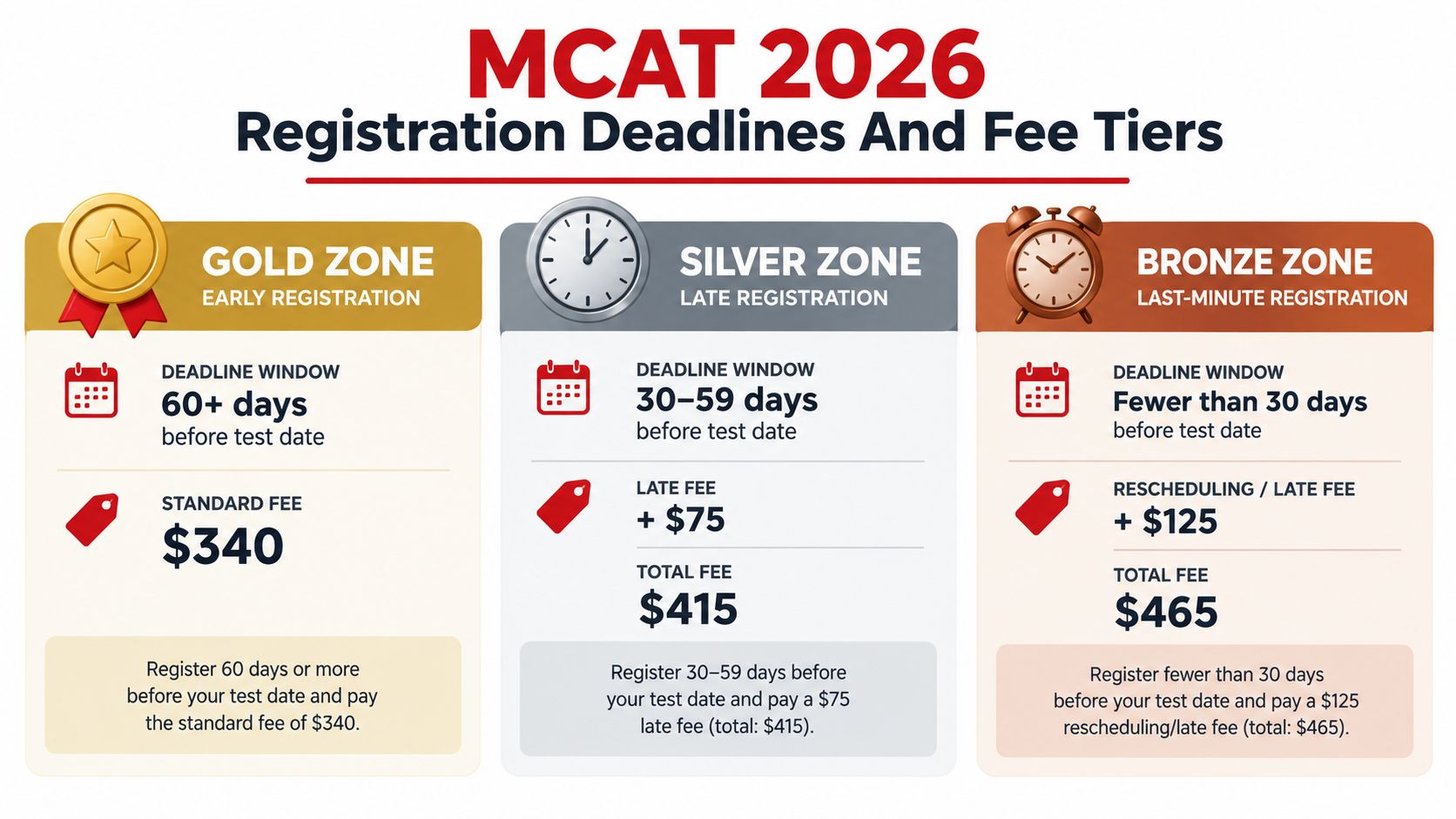
For concrete planning, the January 9 administration has a Gold Zone deadline of November 10, 2025, while the September 12 administration has a Gold Zone deadline of July 14, 2026. Those dates come from the supplied calendar data. For a broader explanation of exam costs, see how much the MCAT exam costs, then confirm the live AAMC amount before registration.
How AAMC Registration Works
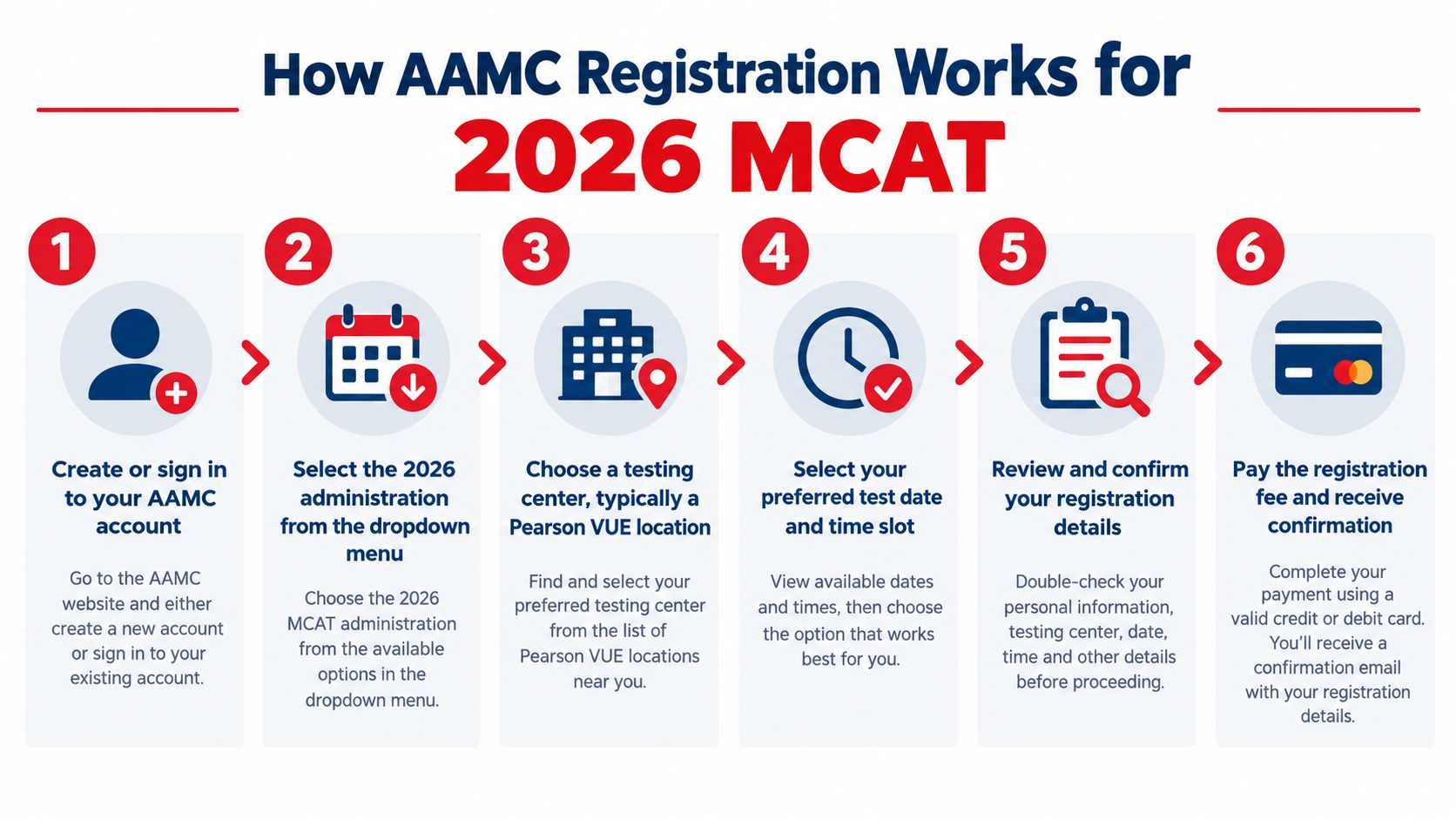
Registration is a sequence, not a single click. Prepare your account, identification details, location preferences, and accommodations information before you begin so you aren't making high-consequence decisions while seats are moving.
Follow this order
- Create or sign in to your AAMC account. Use an account you can access reliably and keep your information consistent.
- Select the 2026 administration. Confirm that you're viewing the correct testing year before choosing a date.
- Search testing centers. U.S. administrations generally use Pearson VUE locations. Compare more than one location if your first choice has no suitable seat.
- Choose the date and time. Check the local center details, not just the date displayed in the search results.
- Review your information. Your legal name should match your government-issued identification exactly enough for test-day verification.
- Pay and save the confirmation. Keep the confirmation email, reservation details, date, time, and center address.
The 2026 opening took place across October 21 through October 23, 2025, by testing-center location rather than through one worldwide release. That means students should think in terms of a preferred date and a preferred location, with a backup combination ready. This AAMC registration walkthrough can supplement the official instructions, but AAMC remains the authority for current registration rules.
Review eligibility and accommodations before booking. If you need testing accommodations, don't assume you can solve the issue after selecting a seat. Use the current AAMC process and submit the required request and documentation early enough for a decision before your planned administration.
U.S. Versus International Test Dates
The U.S. calendar and the international calendar aren't interchangeable. The United States has 31 published U.S. test dates from January 9 through September 12, 2026, while AAMC publishes separate location-based date sets for territories and international sites. The international schedule can follow a different cadence, with dates such as January 9, February 13, March 20, April 10, May 8, June 12, July 24, August 21, and September 3 appearing for some locations. The AAMC international and territories calendar is the correct source for your site.
| Region | 2026 Date Count | Testing Window | Surcharge | Booking Pressure |
|---|---|---|---|---|
| United States | 31 | January 9 through September 12 | Check current AAMC terms | Depends on center and date |
| International and territories | Varies by location | Site-specific | Check current AAMC terms, including applicable international charges | Often constrained by local availability |
International applicants should verify the exact site, entry requirements, travel documents, and local testing logistics before committing. Don't book an international date based on a U.S. calendar summary. A date that exists in one region may not be offered at your intended center.
The same application principle applies everywhere: score release and application timing must be planned together. Add travel risk to that calculation, especially when reaching the test center requires a border crossing, a visa, or a long-distance itinerary.
Matching a Test Date to Your Application Timeline
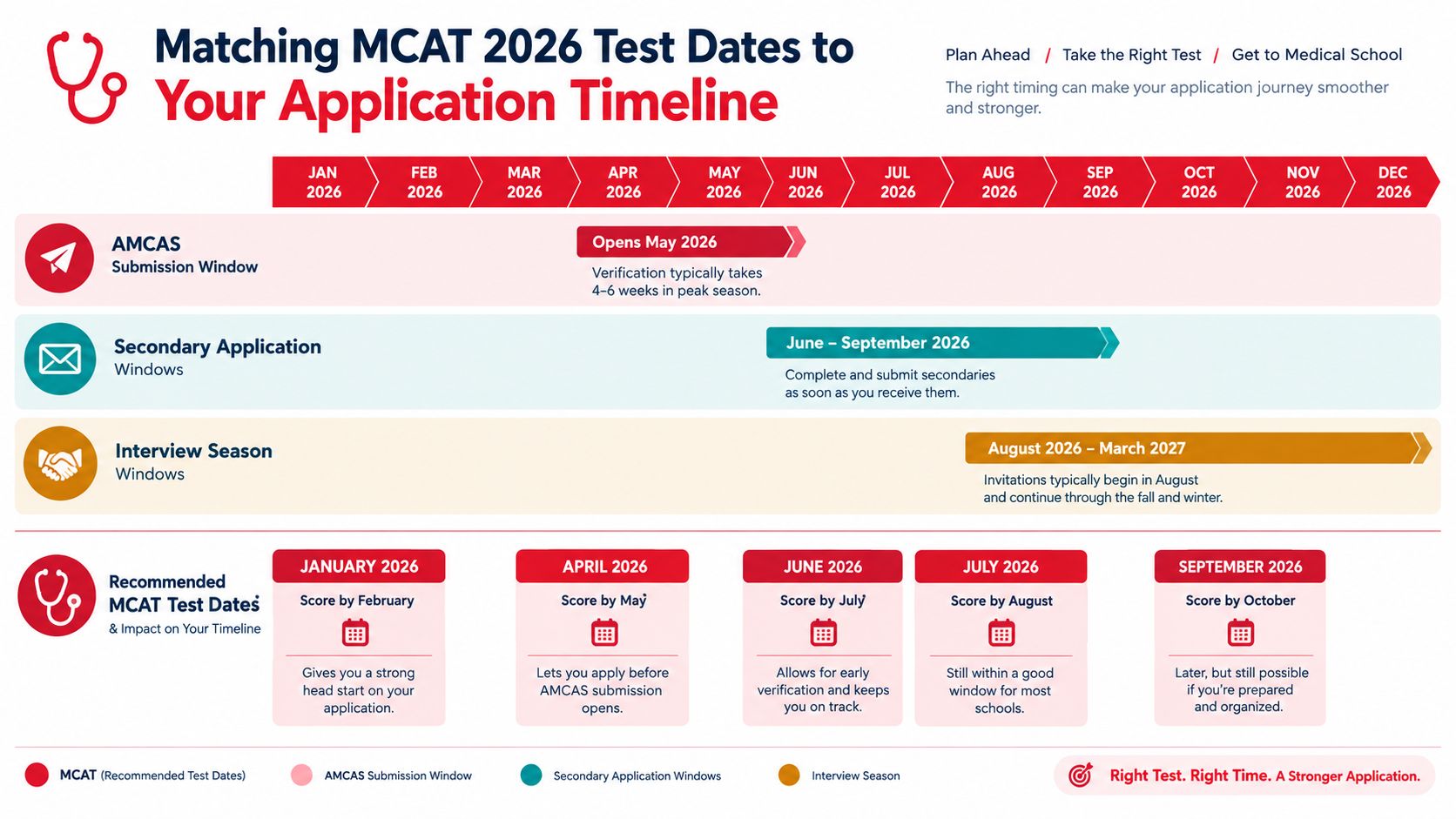
Date selection should run backward from the application plan. Start with the point at which your target schools need a usable MCAT score, then account for score release, AMCAS processing, secondary applications, and your own preparation needs.
The American Medical College Application Service, or AMCAS, handles the primary application process for participating medical schools. AMCAS verification timing can expand during the busiest part of the cycle, and secondary applications often arrive after schools receive the primary. Because those steps depend on the school and cycle, don't use a generic date as a guarantee of review timing.
Use this decision framework
- Choose an earlier date if you can prepare without sacrificing readiness and you want more time for application tasks after score release.
- Choose a spring date if you need a balanced runway and want the score available before much of the application work accelerates.
- Choose an early-summer date if your academic schedule requires more preparation but you can manage a later score.
- Choose a late-summer date only after confirming that your target schools accept the resulting score in the cycle you intend to enter.
- Choose a later cycle if the final 2026 date would force you to test before you're ready or would create an application timeline you can't execute well.
Planning rule: A test date is also a score-release date. Evaluate the pair, not the test day alone.
Typical interview windows can extend well after primary submission, but schools differ in review order, deadlines, and expectations. Use each school's official admissions page for its latest accepted MCAT timing. The MCAT score-release planning guide can help you organize the calendar, but it doesn't replace school-specific instructions.
Pre-Registration Checklist for 2026 Applicants
Use this checklist before you open the booking screen. It prevents the common mistake of finding a seat first and discovering later that the date, identification, accommodations, or travel plan doesn't work.
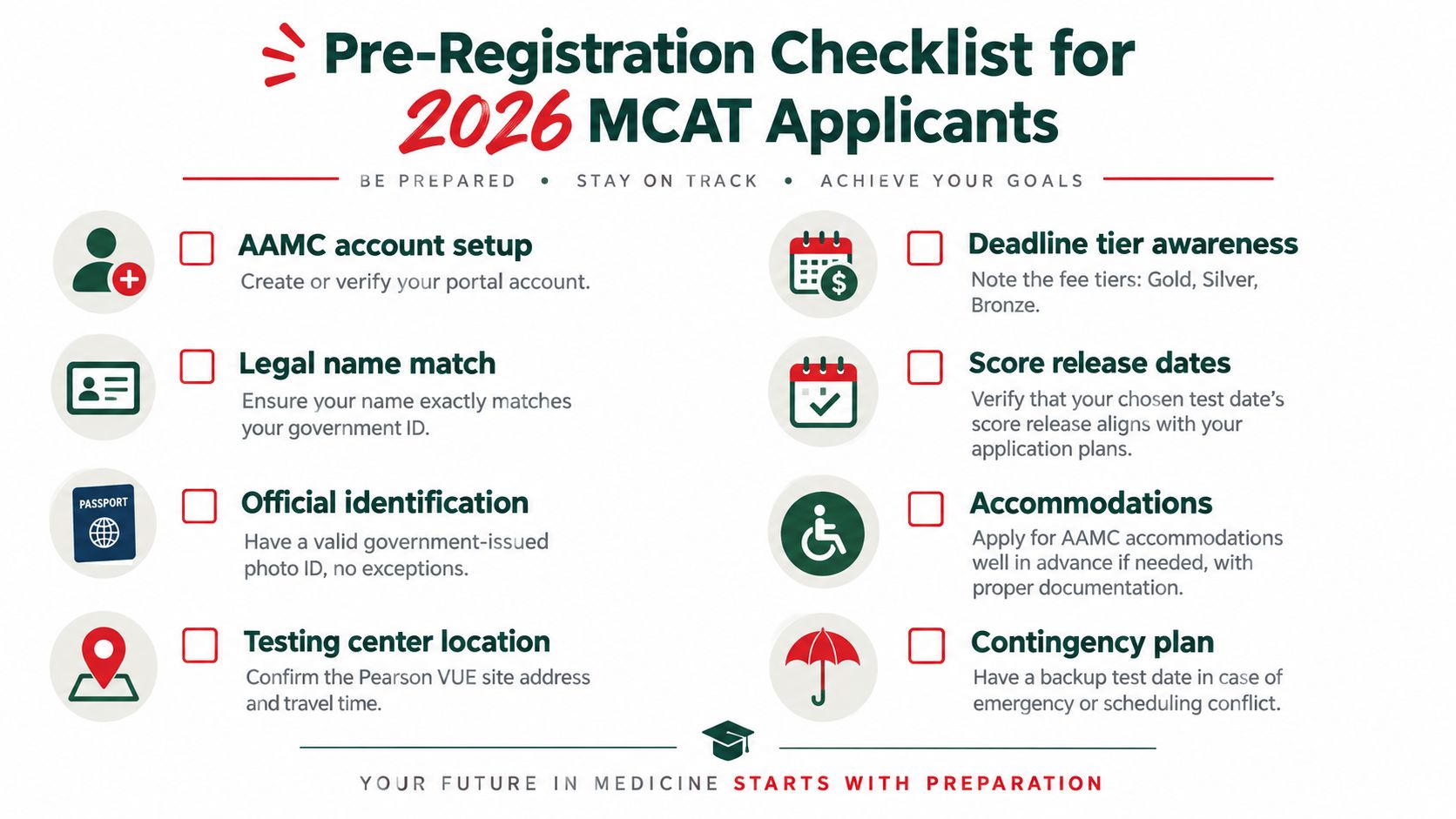
- Account setup: Confirm that your AAMC account is active and that you can access the email associated with it.
- Legal name: Match the name in your account to your government-issued identification.
- Identification: Check the current AAMC identification requirements before test day.
- Eligibility: Confirm that your applicant status and intended testing region permit registration.
- Accommodations: If you need accommodations, begin the AAMC request process early and gather the required documentation.
- Location: Compare two or three possible centers, including travel time, parking, public transit, and the possibility of an overnight stay.
- Deadline reminders: Record the 60-day, 30-day, and 10-day dates for your selected administration.
- Score release: Confirm that the official release date fits your application plan.
- Contingency plan: Identify another acceptable date or center before you pay.
- Confirmation review: Re-read the email and verify the date, start time, time zone, center address, and reservation details.
A center farther from home isn't automatically better. Choose it only if the additional travel is manageable and the environment meaningfully improves your ability to arrive rested and on time. For exam-day logistics, review the MCAT test time breakdown alongside the current AAMC instructions.
A Composite Applicant Walks Through Date Selection
Hypothetical composite, not a real student: Maya is a junior who wants to apply in the 2026 cycle. She initially prefers the earliest seat she can find, but she hasn't completed a diagnostic or established whether her coursework leaves enough preparation time. Instead of treating availability as evidence of readiness, she works backward from her intended application plan.
Maya identifies the latest score-release point her target schools will accept, then allows time for AMCAS processing and her own secondary responses. She compares March and April administrations, checks the official score-release dates, reviews the applicable registration deadlines, and selects the date that leaves enough time for preparation without pushing the score beyond her application plan. She keeps the confirmation email and adds deadline reminders to her calendar.
Jordan's situation differs. Jordan is a nontraditional applicant who needs the spring and early summer to finish prerequisites. A June or July administration may fit better, but Jordan accepts that secondaries and school review could occur later. The decision isn't about which month is universally superior. It's about whether the chosen score-release timing, preparation quality, travel plan, and school-specific policies fit together.
Changing a date during preparation can be reasonable when the original choice no longer reflects readiness or application timing. It shouldn't be driven by panic alone, and it shouldn't happen without checking the current AAMC change deadlines.
Rescheduling, Cancellations, and No-Shows
The financial consequences increase as the test date approaches. Under the supplied 2026 policy details, the Gold Zone is at least 60 days before the exam, the Silver Zone is 30 to 59 days before it, and the Bronze Zone is 10 to 29 days before it. After the 10-day cutoff, registration and rescheduling close.
| Deadline Window | Reschedule Fee | Cancellation Refund |
|---|---|---|
| 60 or more days before testing | Standard policy applies | Check current AAMC terms |
| 30 to 59 days before testing | Standard fee plus the applicable late charge | Check current AAMC terms |
| 10 to 29 days before testing | Standard fee plus the applicable late charge | Check current AAMC terms |
| Fewer than 10 days before testing | Rescheduling closes | No refund under the supplied policy summary |
A cancellation inside the 10-day window receives no refund under the supplied information. Missing the appointment is a no-show and carries the same practical financial consequence. An emergency doesn't automatically create an exception, so contact AAMC promptly and review its documentation requirements for eligible medical or military circumstances.
After a reschedule, re-check the center, seat assignment, start time, and travel plan. A new date can mean a different location or availability. The strongest reason to register early is not to avoid a late fee. It's to choose a date you can realistically prepare for before the change window becomes expensive or closes.
A 12-Week Study Framework Tied to Test Date
Once you lock a date, count backward from test morning. A 12-week plan should create enough repetition to expose weak areas, convert content into passage performance, and leave time to review full-length exams rather than take them.
Weeks 12 through 10
Begin with a diagnostic and an honest content inventory. During this first phase, organize biology, biochemistry, chemistry, physics, psychology, sociology, and Critical Analysis and Reasoning Skills work according to actual misses, not just perceived discomfort.
Weeks 9 through 7
Move from broad review into passage-based practice. Review every missed or guessed question, identify whether the problem was knowledge, interpretation, timing, or careless execution, and write a corrective rule in your own words. Aim to complete core content review by the end of week 6 of the backward plan.
Weeks 6 through 4
Start the full-length cycle. Use one diagnostic early, then schedule two to three scored full-length exams in the final month, with enough time between them to review every section. Place AAMC official practice material late enough that it reflects your developed skills, while leaving adequate time to analyze it.
Weeks 3 through 1
Finish the remaining official practice material by the last Friday before the exam if that schedule is realistic for you. The final week is for error-log review, pacing decisions, identification checks, sleep consistency, and logistical preparation. Don't add major new content in the final 72 hours.
Readiness check: If a planned full-length result is below the score range your school list requires, don't respond by cramming randomly. Audit the misses, reassess the score-release timeline, and decide whether the date still supports a responsible application.
For a longer runway, compare this framework with a six-month MCAT study schedule. Your plan should fit your course load, employment, caregiving responsibilities, and accommodations needs. Consistency matters, but a schedule that ignores your real life won't remain consistent.
Quick Reference Summary
Keep this compact reference beside your calendar:
| Item | 2026 planning fact |
|---|---|
| U.S. testing window | January 9 through September 12, 2026 |
| U.S. administrations | 31 |
| U.S. fall dates | None in October, November, or December |
| Score release | Use the official date assigned to the administration, generally planned as roughly 30 to 35 days |
| Deadline tiers | 60-day Gold, 30-day Silver, 10-day Bronze |
| Standard fee | $340 under the supplied 2026 fee information |
| International surcharge | $120 under the supplied information |
| Registration opening | October 21 through October 23, 2025, by testing-center location |
| Remaining U.S. dates as of August 27, 2026 | September 3, September 4, September 11, and September 12 |
| 2027 registration opening | October 20 through October 22, 2026, by testing-center location |
Use the AAMC registration portal and the official calendar for live availability, deadlines, accommodations requirements, fees, and score releases. Those details are time-sensitive, and a third-party summary shouldn't override the organization administering the exam.
Ace Med Boards offers MCAT tutoring for applicants who want structured preparation, help analyzing practice performance, or targeted support in a weaker section. Tutoring should complement official AAMC materials and independent work, not replace them.
If you want help turning your selected MCAT date into a realistic preparation calendar, Ace Med Boards offers individualized MCAT tutoring focused on study structure, question review, and targeted content support. Review your date, score-release timing, and current readiness before scheduling a free consultation.