
The MCAT is offered multiple times from January through September, with no administrations in October, November, or December. Registration for January through September 2027 exam dates opens October 20 through October 22, 2026, by testing-center location.
You may be staring at a calendar, a medical school application timeline, and a preparation plan that don't quite fit together. The right MCAT date isn't just the first available Saturday or the month your friends selected. It must account for readiness, regional seat availability, registration deadlines, score release, travel, identification, accommodations, and application timing.
This guide reflects AAMC information available as of August 27, 2026. Always confirm the current date, deadline, fee, accommodation, and score-release information in the official AAMC calendar before registering.
Navigating the MCAT Testing Calendar
The Medical College Admission Test, or MCAT, follows a finite annual schedule. The Association of American Medical Colleges, or AAMC, offers the exam multiple times from January through September at test sites in the United States, Canada, and other locations around the world. It isn't a year-round exam, and it isn't a single annual event. It's a structured sequence of administrations, registration windows, and scheduled score releases (AAMC U.S. MCAT calendar).
That seasonal structure changes how you should plan. If you hope to test late in the year, you can't assume another administration will appear after September. The AAMC's 2026 schedule expressly lists no MCAT administrations in October, November, or December 2026 (AAMC 2026 schedule PDF). A student who postpones a September exam may need to move into the next testing year rather than choose a convenient autumn date.
The calendar is more than exam day
Every administration is connected to fixed checkpoints before the test and a score release afterward. Registration decisions affect travel, preparation time, application planning, and the cost of changing course. Treat the date as the center of a timeline, not as an isolated appointment.
Your first planning question should be:
What score-release window supports my application plan without forcing me to test before I'm ready?
That question is more useful than asking which month produces the highest improvement. No verified Ace Med Boards internal average or score-gain analysis has been supplied showing that spring or fall testing produces better outcomes. Choose based on preparation milestones and application timing, not an unsupported month-based assumption.
United States Testing Windows and Seasonal Cutoffs
A September seat can be the last practical U.S. option for an application cycle. The 2026 AAMC calendar lists final U.S. administrations on September 3, September 4, September 11, and September 12 (AAMC U.S. MCAT calendar). Seat availability also varies by testing center, so compare nearby locations before committing to one date.
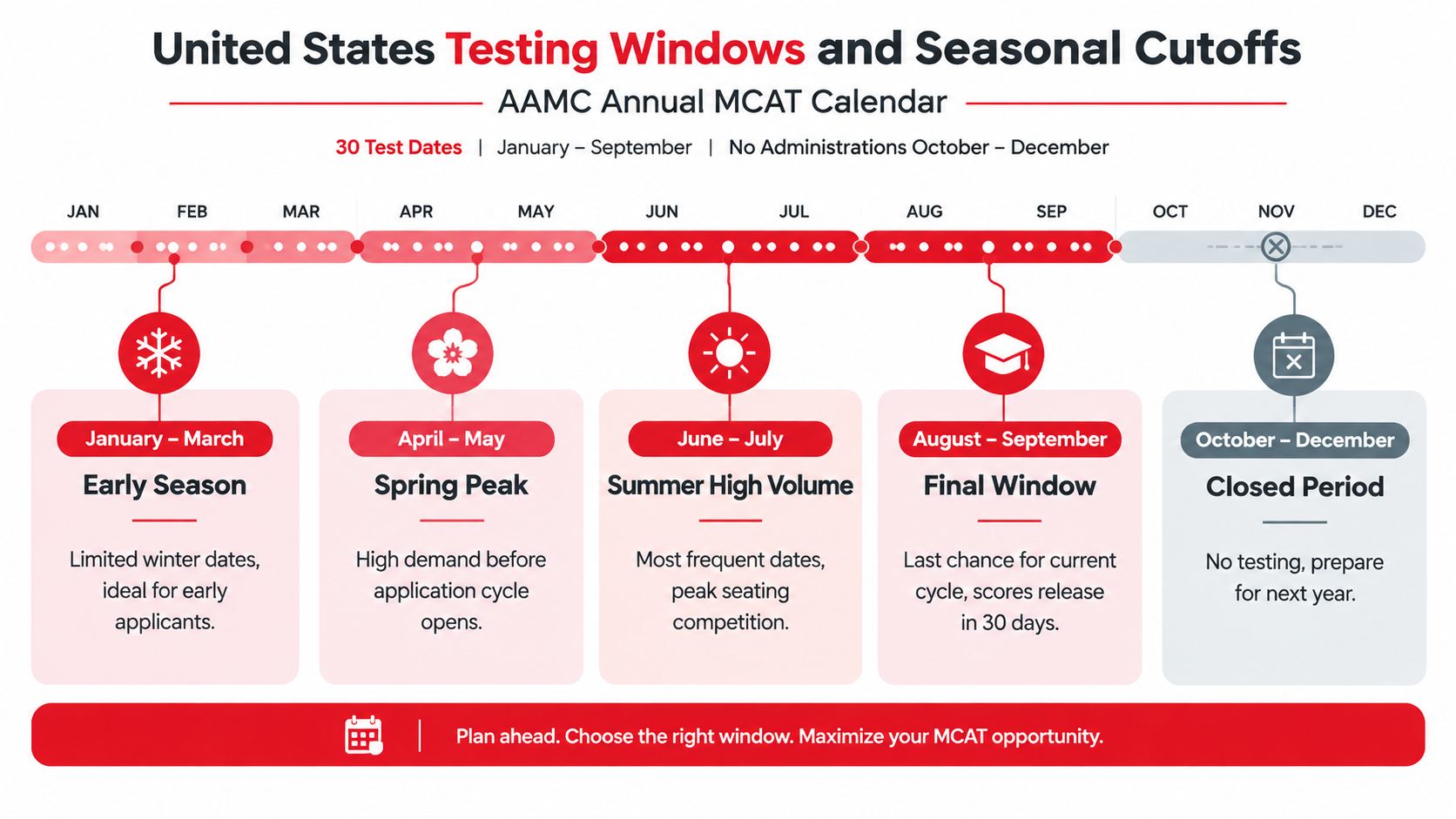
The hidden scheduling risk is missing an AAMC deadline tier. Each administration has checkpoints 60 days, 30 days, and 10 days before the exam, followed by a score release date. These deadlines control when you can register, change your appointment, or cancel with a refund. The AAMC identifies 10 days before exam day as the final day to schedule an MCAT exam (AAMC scheduling fees).
Build a deadline calendar
For each date under consideration, record:
- Exam date: Copy the date from the official AAMC calendar.
- 60-day checkpoint: Complete major registration or rescheduling decisions before this deadline.
- 30-day checkpoint: Confirm the location, travel arrangements, preparation status, and backup plan.
- 10-day cutoff: Treat it as the final scheduling boundary.
- Score release: Add the official release date to your application calendar.
Registration for January through September 2027 MCAT dates opens October 20 through October 22, 2026, with opening dates organized by testing-center location. If you plan to test early in 2027, verify your account, legal identification, preferred centers, and accommodation needs before registration opens.
Use this rule: plan around deadline tiers and score release, not only seat availability. A nearby appointment is a poor choice if its preparation timeline leaves you unready or its score release misses your application plan.
International and Canadian Schedule Variations
A date that appears open on the U.S. calendar may not exist in Toronto, Vancouver, Calgary, or an overseas testing center. The AAMC international and U.S. territory schedule lists nine 2026 exam dates for many non-U.S. locations: January 9, February 13, March 20, April 10, May 8, June 12, July 24, August 21, and September 3 (AAMC international and U.S. territory schedule).
Canada uses a separate city-based calendar. Its published schedule includes January 30 in Toronto and Vancouver, July 9 in Calgary, Ottawa, Toronto, and Vancouver, and August 28 in those same Canadian cities. Availability can change by country, city, and testing center, so choose the location before committing to a month.
Compare location before choosing a month
| Applicant situation | Scheduling concern | Recommended approach |
|---|---|---|
| U.S. applicant near several testing centers | Local seats may differ by center | Compare multiple nearby locations before registration opens |
| Canadian applicant in a major metro area | A date may be available in one city but not another | Search the city-specific AAMC calendar and prepare a travel option |
| International applicant | The testing calendar may be more limited by location | Select the date only after confirming the exact country and center |
| Applicant traveling internationally | Travel adds identification, transportation, and contingency concerns | Build a documented travel plan and verify the international fee |
Examinees testing outside the United States, Canada, or U.S. Territories pay a $130 international fee in addition to the base registration fee. Confirm the current charge through the AAMC's official scheduling fee information, then budget for the practical costs as well. Verify the center's address, arrival route, accepted identification, travel requirements, and a backup plan if transportation fails.
Regional seat scarcity can force a choice between a distant center and a later exam date. Check several cities early, especially if your score must arrive before an application deadline. Your final authority should be the AAMC calendar and your registration confirmation, not a third-party schedule.
Understanding Registration and Rescheduling Fees
A student who changes an MCAT date late can lose both money and scheduling flexibility. For standard registration, the published rescheduling fees are $55, $110, and $210 across the AAMC's three change windows. Cancellation refunds are $175, $175, and $0 in those same windows, according to the AAMC 2026 scheduling fee policy.
| Deadline Window | Rescheduling Fee | Cancellation Refund |
|---|---|---|
| 60 or more days before the exam | $55 | $175 |
| 30 to 59 days before the exam | $110 | $175 |
| 10 to 29 days before the exam | $210 | $0 |
Use the earlier section's deadline tiers as fixed decision points, not reminders to repeat the full 60-day, 30-day, and 10-day framework.
The table should guide registration choices without pushing you into an exam before you are ready. A fee may be frustrating, but an underprepared score can create a larger academic and application problem. If your readiness remains uncertain, review your full-length scores, content-review progress, and remaining study time before the next change window closes.
Regional seat scarcity makes late changes harder. A preferred center may have no replacement date, leaving you to choose between a distant location and a later exam. Check nearby centers early, and keep your application timeline in view before committing to a date.
Use Ace Med Boards' MCAT registration guidance to organize administrative steps, then verify the current rules in your AAMC account. Save the registration confirmation and review it after every change. A screenshot or old planning document is not sufficient proof of your active appointment.
Aligning Test Dates with Application Timelines
Your MCAT date and score-release date are one decision. The AAMC publishes a score release date for each administration, so work backward from the point when your application needs a usable score rather than forward from the day you expect to finish content review (AAMC U.S. MCAT calendar).
A late-summer test can still be appropriate when it matches your preparation and application plan. It may be a poor choice if you expect to submit an application while waiting for the score, especially when you also need time for application verification, secondary essays, and school-specific requirements. The relevant question isn't whether a late date is automatically wrong. It's whether the resulting score-release timing leaves you enough room to submit a complete, thoughtful application.
Work backward in four checkpoints
- Application target: Identify when you want your primary application submitted and when you need it to be complete.
- Score receipt: Find the official score-release date attached to each candidate MCAT administration.
- Preparation endpoint: Reserve enough time for full-length practice, review, and recovery before exam day.
- Registration deadline: Calendar the AAMC's 60-day, 30-day, and 10-day checkpoints.
For applicants considering both allopathic and osteopathic medical schools, keep the application services and school requirements separate. The MCAT calendar is the same planning constraint, but your application submission, verification, and school-specific timelines may differ. Don't let a generic “apply early” slogan replace an actual calendar.
Use a dedicated MCAT score-release planning guide to map the official release date to your own application milestones. Then confirm every date against the current AAMC calendar before you commit.
Application rule: A test date is viable only when its score-release timing, preparation window, and application plan all work together.
The Date Selection and Registration Checklist
A registration mistake can cost a preferred seat, create avoidable travel problems, or push your score release past an application deadline. Before booking, put the exam date, testing center, score release, deadline checkpoints, identification, accommodations, travel, and backup option in one planning document.
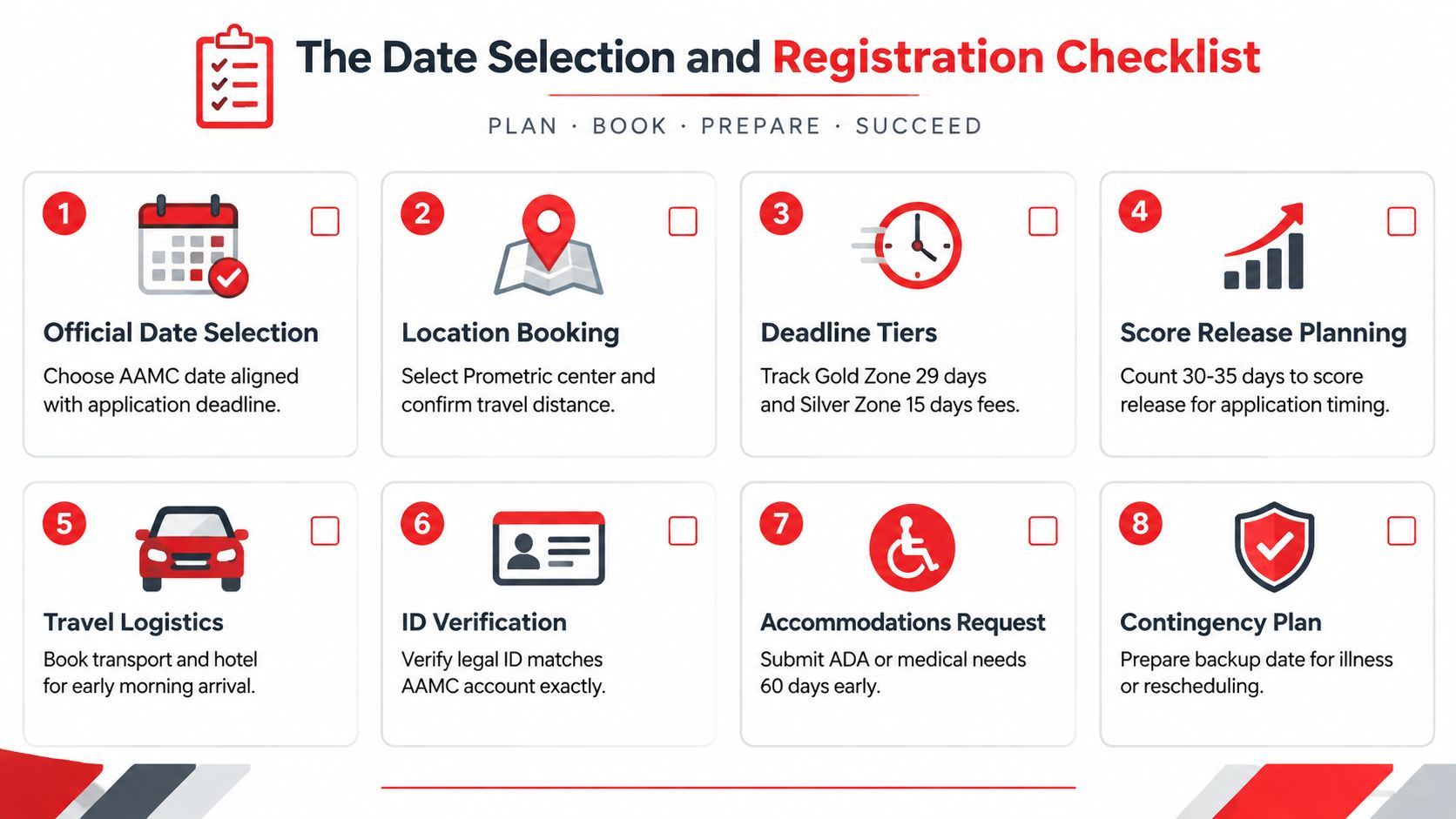
Complete this checklist before booking
- AAMC account: Create or verify your account before registration opens.
- Legal identification: Make sure your name and identifying details match your accepted ID exactly.
- Eligibility review: Confirm the current requirements for your testing situation.
- Accommodations: Review the process early, since a late request may not be completed before your chosen administration.
- Official date: Choose an AAMC-published date that fits your preparation and application schedule.
- Exact location: Compare centers by city, distance, transportation, and arrival logistics. Regional seat scarcity can make a nearby alternative worth checking early.
- Deadline tiers: Add the 60-day, 30-day, and 10-day checkpoints to your calendar.
- Score release: Record the official release date beside the exam date.
- Travel plan: Decide how you will reach the center and where you will stay if early arrival is necessary.
- Contingency plan: Identify a realistic later date or alternate center before your first choice disappears.
- Confirmation record: Save the registration confirmation email and review every detail after booking.
Treat the 10-day checkpoint as the final point for scheduling changes or registration actions allowed under the applicable rules. Do not use it as a backup strategy. Review the current requirements before making a late change.
A simple planning table keeps the administrative details visible:
| Item | Your record |
|---|---|
| Official exam date | __________________ |
| Testing center and city | __________________ |
| 60-day checkpoint | __________________ |
| 30-day checkpoint | __________________ |
| 10-day cutoff | __________________ |
| Official score release | __________________ |
| ID verified | Yes / No |
| Accommodations reviewed | Yes / No |
| Travel plan confirmed | Yes / No |
| Contingency option | __________________ |
Use this AAMC registration resource to organize the registration process, then confirm the final details in your AAMC account. For a visual walkthrough of the planning workflow, use the following educational video.
Balancing Study Readiness with Seat Availability
You shouldn't register for an early date solely because a nearby seat is open. You also shouldn't wait indefinitely for a feeling of perfect readiness while local seats disappear. The sound decision uses objective preparation milestones, application timing, and actual seat availability.
Full-length practice exams can help you judge whether your current preparation supports the date. Review more than the total score. Look for repeated content gaps, timing problems, careless errors, weak passage interpretation, and performance that collapses under full-day conditions. Your review should produce a specific correction plan, not just a reaction to the number.
Use a two-axis decision framework
| Readiness evidence | Seat and application situation | Decision |
|---|---|---|
| Practice performance is stable and review is targeted | Local seat fits score-release needs | Keep the date |
| Practice performance is inconsistent and major content gaps remain | A later date still supports the application | Move later before fees increase |
| Readiness is strong but local seats are unavailable | Another center is practical to reach | Consider travel after checking logistics |
| Readiness is uncertain and the date is near | No workable contingency exists | Don't rely on optimism alone |
Your study calendar should include dedicated review of full-length exams. A date isn't justified because your content review is “mostly done.” It's justified when your practice process shows that the remaining work is defined and manageable.
The six-month MCAT study schedule can serve as a planning framework, but adapt it to your coursework, work obligations, and application cycle. If your schedule no longer supports meaningful practice and review, changing the date early is usually more controllable than waiting until the closest deadline tier.
How Targeted Tutoring Supports Your Testing Timeline
A fixed exam date can expose weaknesses in a study plan that looked reasonable on paper. A student may understand the broad content categories but lose time on passages, review practice questions passively, or spend too long revisiting familiar material. Targeted academic support can turn those observations into a prioritized weekly plan.
A useful tutoring process starts with an audit. The student and tutor identify the date, application constraints, practice performance patterns, subject gaps, passage approach, and available study hours. They then set checkpoints before the AAMC's registration change windows, leaving time to decide whether the date still makes sense.
What focused support can address
- Content prioritization: Separate recurring knowledge gaps from isolated mistakes.
- Question review: Classify errors as knowledge, reasoning, timing, or execution problems.
- Schedule control: Assign weekly work that fits the actual time available.
- Readiness review: Use practice evidence to support a date decision.
- Accountability: Create regular checkpoints before a rescheduling choice becomes expensive.
Ace Med Boards offers one-on-one tutoring for MCAT preparation as one option for students who want individualized academic support. Tutoring doesn't replace official AAMC materials, independent practice, or the student's responsibility to verify registration policies. It can complement those resources by helping organize the work around a chosen testing timeline.
The purpose is not to force an earlier exam. A responsible plan should make it easier to recognize when you're on track and when a later date deserves serious consideration.
Frequently Asked Questions About MCAT Scheduling
Which MCAT month produces the highest score improvement?
No single month reliably produces higher scores. Choose the month that gives you adequate preparation time and a score-release date compatible with your application. A convenient seat is not a good choice if your practice results show that you are not ready.
What should I do if I need accommodations late in the process?
Review the current AAMC accommodations procedures as soon as you begin planning. Do not register first and assume the request will be resolved before exam day. If the timing is uncertain, contact the AAMC through its official channels and decide whether the selected administration remains workable.
What happens if a testing center closes unexpectedly?
Follow the AAMC instructions and check your registration account for official updates. Do not rely on a third-party calendar or change travel plans before confirming the administration status. Keep your confirmation email and travel records available.
Should I cancel if I feel unprepared on test day?
Use practice evidence and the applicable AAMC policy, not test-day panic. Review your score trends, unresolved weaknesses, score-release needs, and the financial consequences of the deadline window. If the date no longer fits your readiness or application plan, make the decision before the final scheduling cutoff. Do not assume you can change the appointment afterward.
How early should I plan for 2027?
Start the administrative work before registration opens. The AAMC says registration for January through September 2027 dates opens October 20 through October 22, 2026, organized by testing-center location. Verify your account, legal identification, preferred centers, accommodation needs, application timeline, and backup option before your location's registration window.
Sources
- AAMC U.S. MCAT calendar, scheduling deadlines, and score releases
- AAMC Canadian and international MCAT calendar
- AAMC 2026 MCAT schedule PDF
- AAMC MCAT scheduling fees
- AAMC 2026 scheduling fee policy
If you need help matching preparation milestones to MCAT test dates, Ace Med Boards offers individualized MCAT tutoring and planning support. Visit Ace Med Boards to review the available support and request a consultation.