
You're staring at several COMLEX-USA resources, hearing different advice about OMM, USMLE, question banks, and residency applications, and still wondering what matters for your level. COMLEX-USA is a three-level licensing examination series for osteopathic physicians, administered by the National Board of Osteopathic Medical Examiners, or NBOME. This guide explains who takes it, how the levels differ, how scoring works, and how to build preparation around the NBOME's two-dimensional blueprint instead of studying as if COMLEX-USA were a generic medical board exam.
What COMLEX-USA Is and Who Takes It
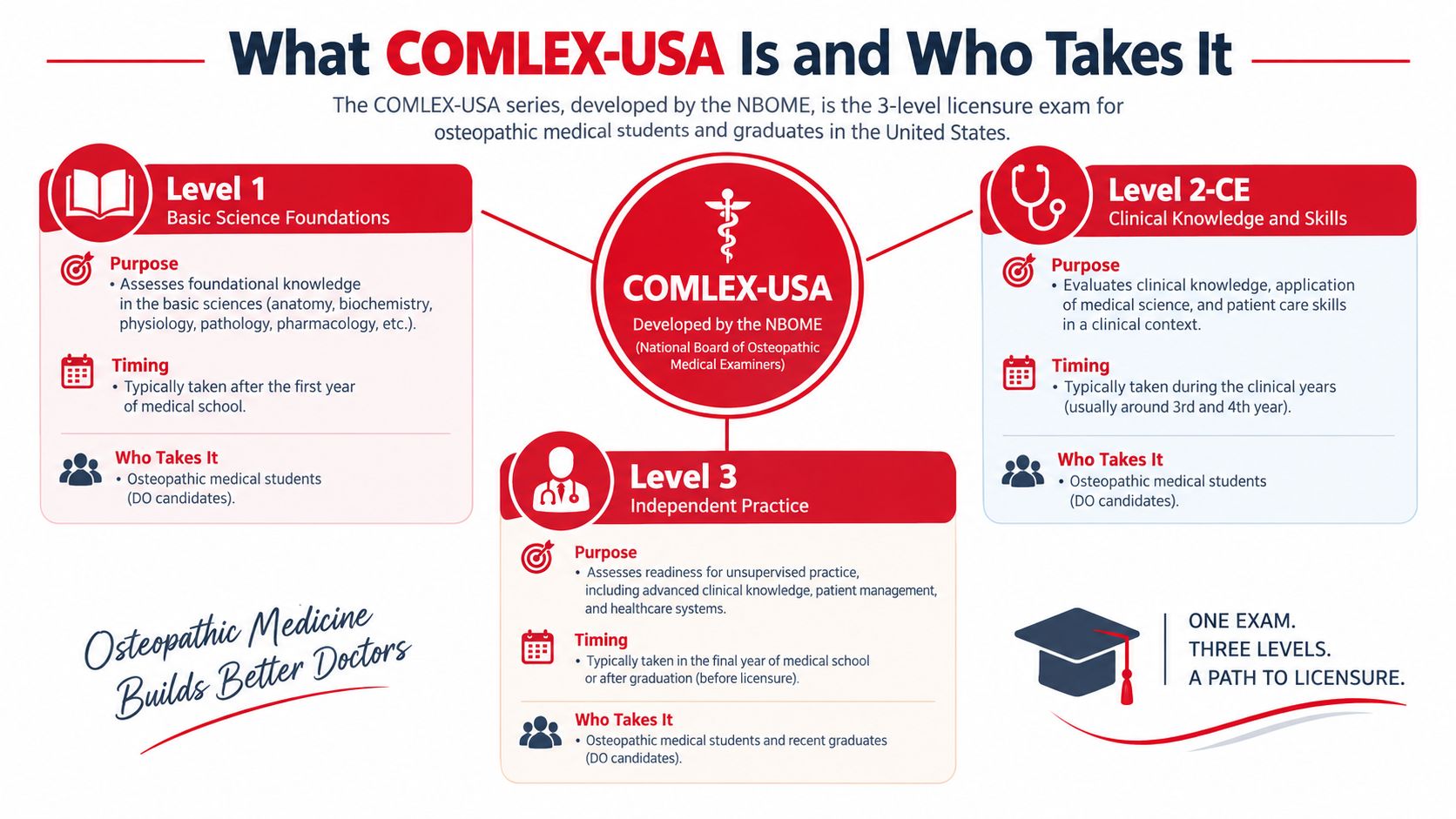
COMLEX-USA, the Osteopathic Medical Licensing Examination of the United States, is a three-level national examination series used in osteopathic medical education and physician licensure. The NBOME describes the series as an assessment of osteopathic medical knowledge, clinical reasoning, knowledge fluency, and other competencies needed for practice as an osteopathic generalist physician. It also functions as a graduation and residency progression requirement for students at U.S. colleges of osteopathic medicine. The NBOME's COMLEX-USA examination overview provides the current official framework.
The primary candidates are students enrolled at accredited colleges of osteopathic medicine, osteopathic graduates completing licensure requirements, and residents progressing toward independent practice. International and foreign medical graduates should verify their individual eligibility directly with the NBOME and applicable licensing authorities, because eligibility pathways can differ from the standard U.S. osteopathic student pathway.
COMLEX-USA supports a progression through medical training. Level 1 emphasizes foundational biomedical and osteopathic knowledge. Level 2-CE emphasizes clinical application. Level 3 evaluates readiness for broader clinical decision-making and independent practice. The examination series remains a major national pathway. In 2024, NBOME reported 10,165 Level 1 administrations, 9,399 Level 2 administrations, and 8,399 Level 3 administrations in its examination performance data.
The blueprint is two-dimensional
The most useful way to understand COMLEX-USA is through its two-dimensional blueprint:
- Competency domains describe what a physician must know and be able to do.
- Clinical presentations describe how patients, populations, or communities present in practice.
A question might therefore test pharmacology, diagnosis, communication, or osteopathic reasoning within a presentation such as chest pain, weakness, trauma, or preventive care. This pairing explains why memorizing isolated subjects isn't enough. You need to recognize the clinical problem, identify the competency being tested, and select the safest answer using osteopathic principles when they are relevant.
For a broader explanation of osteopathic training and board preparation, see Ace Med Boards' osteopathic medicine resources. Use that material alongside your school's requirements and the current NBOME documents for your specific level.
The Three Levels of COMLEX-USA
A student moving from classroom study to residency faces three different exams, not three versions of one test. Each level changes the clinical setting, the decisions expected, and the way the two-dimensional blueprint should guide preparation.
| Level | Format | Timing in Training | Purpose |
|---|---|---|---|
| Level 1 | Computer-based examination focused on foundational knowledge, clinical reasoning, and osteopathic content | Commonly after the preclinical phase | Demonstrates foundational competency for progression in osteopathic medical education |
| Level 2-CE | Computer-based clinical examination using multiple-choice clinical encounters | Commonly during or after core clinical rotations | Assesses application of medical and osteopathic knowledge in clinical settings |
| Level 3 | Computer-based examination combining multiple-choice questions with clinical decision-making cases | Usually during residency | Assesses readiness for broader, less supervised generalist practice |
Level 1 usually follows completion of the school's preclinical requirements. Its clinical scenarios connect biomedical science with diagnosis, management, and osteopathic reasoning. OMM findings and treatment choices appear within patient problems, so preparation should review them in context rather than isolate them from general clinical reasoning.
Level 2-CE, or Cognitive Evaluation, comes after students gain experience in clerkships. The task shifts from explaining mechanisms to applying knowledge to patients. Clinical rotations, COMAT preparation, and question-bank practice can reinforce one another, while COMLEX-style questions still require deliberate attention to osteopathic integration.
The former Level 2-PE, or Performance Evaluation, was formally discontinued in June 2022. Current candidates should separate Level 2-CE from that discontinued hands-on assessment and rely on current NBOME eligibility and examination notices instead of older preparation guides.
Level 3 follows graduation and is generally taken during residency. It combines multiple-choice questions with clinical decision-making cases. You may need to choose what information to gather, which diagnosis to investigate, how to treat the patient, and what follow-up is appropriate. The exam therefore tests prioritization under clinical responsibility, not only recognition of facts.
Across all three levels, the blueprint pairs a competency domain with a clinical presentation. A question may assess diagnosis, communication, pharmacology, or osteopathic practice through a patient presentation such as chest pain, weakness, trauma, or preventive care. Use that pairing for error review: identify the presentation first, then determine which competency your reasoning missed.
Level-specific timing, content weights, and administration details can change. Read the current bulletin and blueprint before scheduling, then confirm the testing window and score-release calendar with your school or program. For residency-focused preparation, review this COMLEX Level 3 guide for advanced clinical practice.
Eligibility, Registration, and Attempt Limits
A student may be ready to study for an exam but still unable to schedule it. Registration begins with eligibility verification. Ask your dean's office which curricular requirements must be completed, whether the school has certified eligibility, and whether the proposed testing window fits academic obligations.
Use this sequence:
- Confirm level eligibility with your college or program. Level 1 generally follows completion of preclinical requirements. Level 2-CE depends on Level 1 passage and school requirements. Level 3 requires post-graduation eligibility and additional program or residency documentation.
- Use the NBOME Portal. Candidate account access, examination purchase, scheduling, and rescheduling occur through the NBOME system. If an older school handbook conflicts with current instructions, follow the COMLEX-USA eligibility policy.
- Schedule through the designated testing system. After purchasing an examination, select an available appointment through the testing-center pathway shown in the portal.
- Check identification details. Your registration name and government identification must match. Resolve any name change before examination day.
- Plan for administrative deadlines. Rescheduling or cancellation is free online more than 30 days before the test date. Earlier review of these rules can prevent an avoidable forfeiture.
| Days before test | Level 1 / Level 2-CE fee | Level 3 fee |
|---|---|---|
| More than 30 | Free | Free |
| 6 to 30 | $85 | $170 |
| 1 to 5 | $250 | $350 |
These amounts follow under NBOME's registration and scheduling policy.
Attempt limits require early planning
Candidates have four scored attempts per examination level. A level also cannot be taken more than four times within any 12-month period. Incomplete or voided attempts count toward that 12-month limit, according to the COMLEX-USA eligibility policy.
That rule makes the timing of a retake an academic decision, not a scheduling task. After a failed attempt, collect the score report, identify content and reasoning patterns, meet with your dean or program, and allow time for targeted remediation and score release before registering again.
Accommodations should start early
NBOME states that candidates may apply for Americans with Disabilities Act, or ADA, accommodations after completing one year of medical school. Application may occur before the school has declared a candidate eligible for Level 1, a detail that generic board-preparation advice can overlook, as described in the current COMLEX-USA Bulletin of Information.
Submit documentation well before your preferred date. A pending request does not automatically convert a standard appointment into an accommodated appointment. Confirm the process with NBOME Test Accommodations and your school.
Scoring Standards and How to Read Your Results
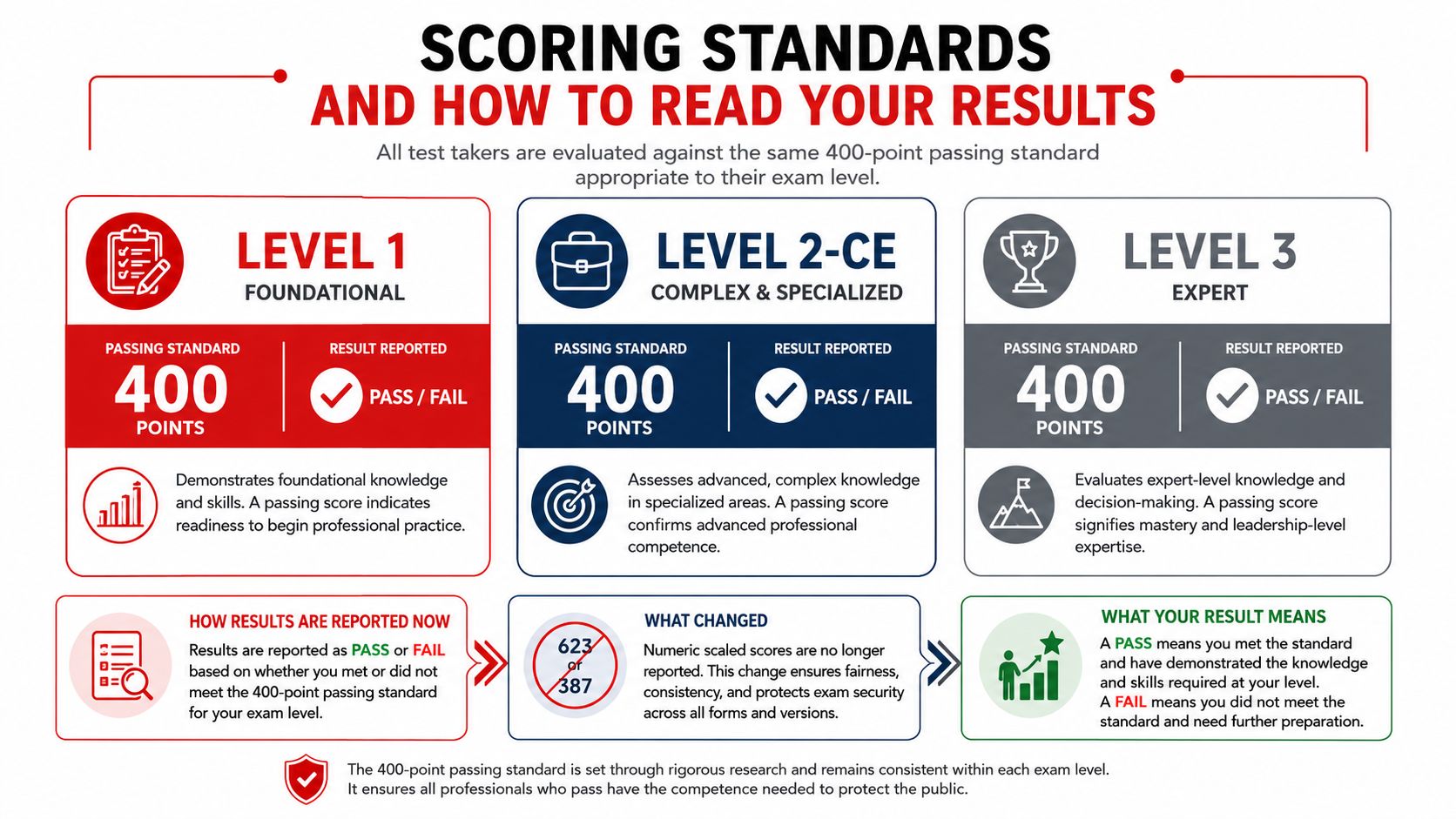
COMLEX-USA uses a criterion-based passing standard, meaning the pass decision isn't determined by a fixed percentage of candidates passing. Raw performance is converted to a standardized score for examinations that report a numeric result. The published passing standards are 400 for Level 1, 400 for Level 2-CE, and 350 for Level 3 in the current NBOME bulletin.
Level 1 is currently reported as pass or fail, so candidates no longer receive a numeric Level 1 score. Level 2-CE also uses a passing standard of 400, while Level 3 has a 350 passing standard and reports a three-digit score. A three-digit score isn't a percentage of questions answered correctly, and it shouldn't be treated as a raw item count.
Treat the performance profile as a map
A Level 1 report can include a formative performance profile showing relative strengths and weaknesses related to the blueprint. That profile is useful for deciding what to revisit, but it isn't a percentile and shouldn't be used to infer that one domain alone determines the overall outcome. NBOME cautions that content-area profiles aren't additive and may be based on fewer questions than the total examination, so interpret them as directional evidence rather than precise subscores.
For Level 2-CE and Level 3, the report includes the pass or fail outcome, a three-digit standard score, and a formative profile. If you need help distinguishing a reported score from a percentile conversion, review this COMLEX score percentile explanation, then return to the official report for the decision that matters.
Score release timing is level-specific and may change by testing cycle. Check the NBOME score-release calendar rather than relying on a forum post or an old student schedule. If you fail, the result becomes part of your examination history, but it doesn't define your clinical potential or eliminate the possibility of thoughtful remediation.
COMLEX-USA vs USMLE for DO Students
COMLEX-USA and the United States Medical Licensing Examination, or USMLE, are different examination systems with different sponsors, purposes, and content emphases. COMLEX-USA is administered by NBOME and is the osteopathic licensing pathway. USMLE is sponsored by the Federation of State Medical Boards and the National Board of Medical Examiners and is used in the allopathic licensing pathway.
| Dimension | COMLEX-USA | USMLE |
|---|---|---|
| Primary population | Osteopathic medical students and graduates | Students and graduates pursuing the allopathic licensing pathway |
| Osteopathic content | Integrates osteopathic principles, OPP, and OMT | Doesn't serve as an osteopathic licensure examination |
| Blueprint | Uses competency domains paired with clinical presentations | Uses its own official content and competency framework |
| Scoring | Level 1 and Level 2-CE are pass/fail; Level 3 reports a numeric score | Step 1 is pass/fail; Step 2 CK remains numeric |
| Residency use | Accepted by residency programs, with specialty and program policies to verify | Often requested or valued by particular programs and specialties |
For a DO student, COMLEX-USA isn't optional if it is required for the degree or licensure pathway. The more difficult decision is whether to add USMLE, often to support applications to programs that explicitly request or prefer USMLE results. That decision should be based on specialty, target programs, school guidance, preparation capacity, and the risk that a second exam could dilute performance on the required osteopathic examination.
Residency acceptance isn't uniform across every specialty or program. In August 2026, NBOME reported growing momentum across surgical specialties for COMLEX-USA acceptance for DO applicants, including an Association of Program Directors in Surgery statement supporting COMLEX-USA as equivalent to USMLE for DOs applying to General Surgery in its surgical-specialty update. Because policies can vary, read each program's published requirements and contact programs when the language is unclear.
Decision rule: Take an additional examination only when it serves a defined application objective and you can prepare for it without compromising the examination required for your osteopathic pathway.
Use official exam materials for both systems. A comparison article can help organize questions, but your school advisor and target residency programs should guide the final decision. This COMLEX-USA versus USMLE comparison can serve as a starting framework, not a substitute for current program-specific requirements.
Study Timeline and High-Yield Prep Strategy
A strong COMLEX-USA plan starts with the NBOME blueprint, not with a generic list of organ systems. The blueprint asks you to connect competency domains with clinical presentations, while osteopathic reasoning adds another layer to your review. For Level 1, the largest blueprint allocation is Application of Knowledge for Osteopathic Medical Practice at 60%. Osteopathic Principles, Practice, and Manipulative Treatment accounts for at least 12%, and Osteopathic Patient Care and Procedural Skills accounts for at least 6% in the NBOME Level 1 blueprint.
That distribution supports a balanced strategy. Broad biomedical mastery carries substantial weight, but OPP and OMT aren't a small elective topic you can postpone indefinitely.
A three-phase runway
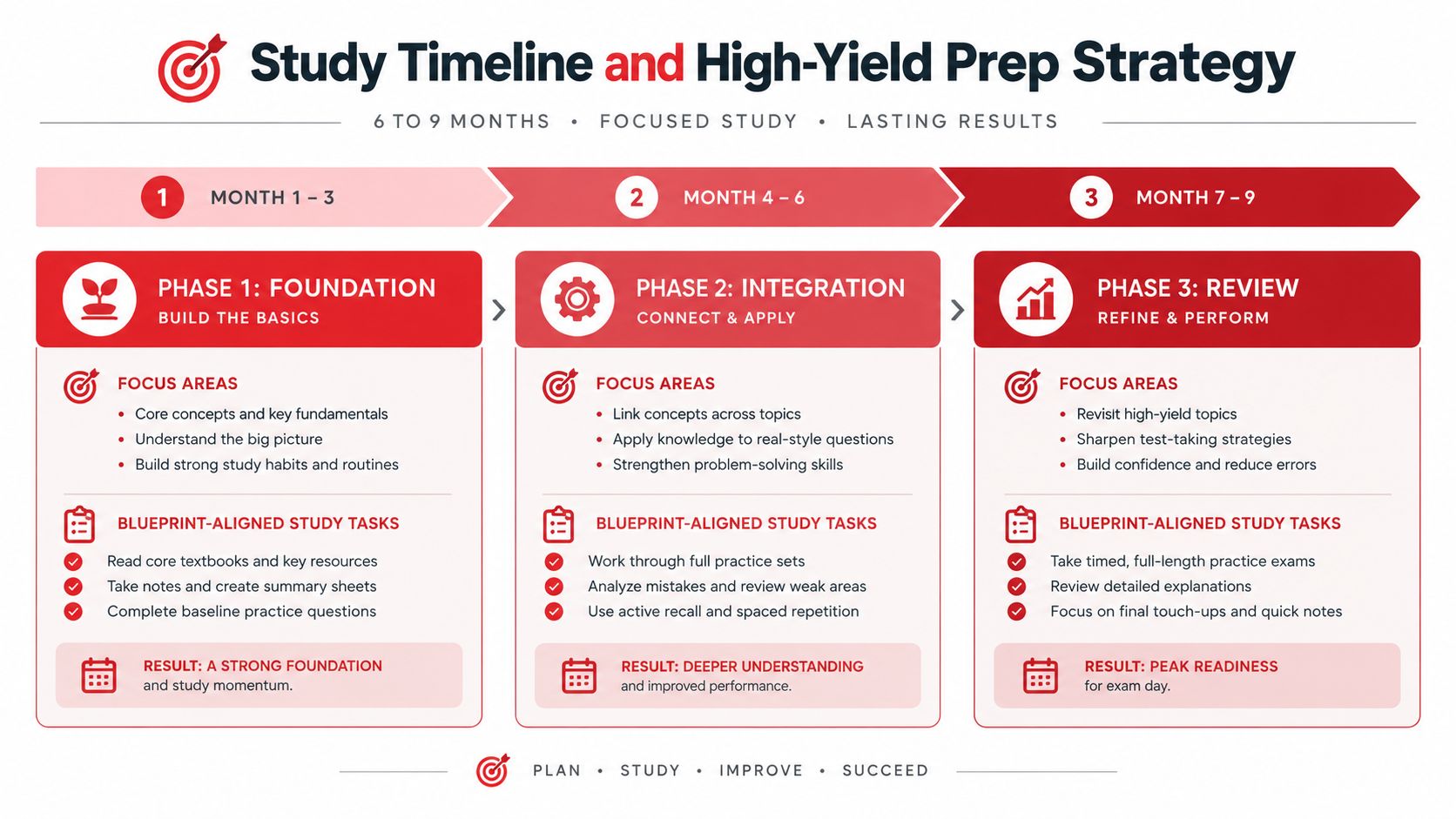
A six- to nine-month runway can be organized into three practical phases for a first-time Level 1 candidate. The exact duration should reflect your curriculum, baseline, accommodations, and school schedule.
- Foundation: Build reliable knowledge in physiology, pathology, pharmacology, microbiology, immunology, anatomy, and behavioral science. Start a daily OPP or OMM retrieval block, even if it is short.
- Integration: Shift toward timed, unseen questions. For every miss, record the competency domain, clinical presentation, osteopathic relevance, and reasoning error.
- Performance simulation: Rehearse sustained question-solving, review recurring errors, and use official NBOME practice resources as one part of a broader readiness judgment. Official NBOME practice resources can help you become familiar with question style and self-assessment.
A daily OPP/OMM block of 30 to 45 minutes is a reasonable planning target for many students, but it isn't a guarantee of readiness. Use active retrieval, mechanism-based explanations, and original practice questions. Don't rely on passive video watching alone.
The blueprint tracker
Create a spreadsheet with one row for each missed or uncertain question and these columns:
| Competency domain | Clinical presentation | OPP or OMT relevance | Reasoning error | Corrective action |
|---|---|---|---|---|
| Application of knowledge | Original presentation, such as acute low back pain | Somatic dysfunction may alter the reasoning pathway | Chose a familiar diagnosis before identifying the task | Review the presentation and complete new questions |
| Osteopathic patient care | Original presentation, such as regional pain after injury | Consider whether an osteopathic examination or treatment principle is being tested | Recognized the diagnosis but ignored the osteopathic finding | Perform short OPP retrieval and revisit indications |
| Professionalism and communication | Original counseling scenario | Osteopathic care remains patient-centered | Selected a technically correct but poorly timed response | Review communication principles and practice prioritization |
This is more useful than writing “missed cardiology” or “weak OMM.” It tells you what the question demanded and why your answer failed.
A labeled composite week
Labeled composite example, not a real student case: A DO student knows organ-system facts but repeatedly misses questions requiring osteopathic integration. The student tags each miss by competency and clinical presentation, adds short daily OPP retrieval, and measures transfer on new, unseen practice items instead of counting repeated exposure to familiar questions.
A workable week might include content review early in the day, a timed question block later, and error analysis before finishing. Reserve one session for cumulative OPP review and another for a longer simulation. If patient communication or clinical presentation wording creates difficulty, a resource such as doctor communication training may complement, but not replace, medical reasoning practice.
For Level 2-CE, connect question practice to third-year rotations and review the blueprint presentations that recur across clinical care. For Level 3, prioritize management sequencing, follow-up decisions, clinical decision-making cases, and a focused biostatistics refresh. The COMLEX Level 1 study schedule can help you turn the framework into a calendar.
Key Takeaways, FAQs, and Next Steps
Key takeaways
- COMLEX-USA has three levels administered by NBOME for osteopathic licensure and progression through training.
- The two-dimensional blueprint matters. Review each competency domain through its clinical presentations, then use the same two labels to analyze missed questions. This shows whether the gap involves knowledge, clinical application, or osteopathic reasoning.
- Level 1 is pass/fail, with a published passing standard of 400. Level 2-CE also uses 400, while Level 3 uses 350 as its published passing standard.
- OMM and osteopathic reasoning need continuous practice. General medical knowledge covers much of the blueprint, but osteopathic content should remain part of regular study.
- A failed attempt calls for analysis and support, not shame. Combine the score profile with school resources and a deliberate retake plan.
Frequently asked questions
Can I retake COMLEX-USA after failing?
Yes, subject to NBOME eligibility rules, attempt limits, scheduling requirements, and your school or residency program's policies. Candidates have four total attempts per level, and an incomplete or voided attempt can affect the 12-month limit. Before registering again, review the score profile, label the dominant errors by competency and clinical presentation, and seek guidance from your COM or program. The NBOME eligibility policy discussed earlier should guide the administrative steps.
Is Level 2-CE accepted for ACGME residency applications?
Acceptance varies by program and specialty. Some programs accept COMLEX-USA for DO applicants, while others may request USMLE results or publish additional requirements. Read each program's application information before deciding whether another examination is necessary.
How much of COMLEX-USA is OMM?
For Level 1, osteopathic content receives a defined portion of the blueprint, as reflected in the Level 1 blueprint figures covered earlier. Its allocation is smaller than the broad Application of Knowledge domain, so daily study should pair OMM retrieval with general medical questions rather than replace medical review with osteopathic topics. On practice items, ask which competency and clinical presentation the osteopathic finding is testing, then record whether the error came from recognition, technique, or application.
Can I request ADA accommodations?
Yes. NBOME allows candidates to apply for accommodations after completing one year of medical school, including before their school makes them eligible for Level 1. Apply early, provide the required documentation, and confirm how an approved accommodation must be attached to your appointment in the current COMLEX-USA bulletin.
A useful next step is a Board Score Audit or free consultation that maps current weaknesses to the competency and clinical-presentation blueprint before you set a calendar. The review should identify your level, baseline performance, OPP or OMT needs, question-analysis habits, and official readiness resources.
Ace Med Boards offers private one-on-one tutoring for COMLEX-USA Level 1, Level 2-CE, and Level 3, with planning centered on osteopathic content, OMM, question reasoning, and blueprint-aligned review. Visit Ace Med Boards to explore a free consultation.