

You're trying to register for the MCAT while balancing final exams, application planning, and the uncomfortable question of whether you'll be ready on your preferred date. For MCAT registration 2026, the right move is to choose backward from your application and score-release needs, then secure a seat through the official AAMC system. As of August 27, 2026, the remaining published U.S. dates are September 3, 4, 11, and 12. The AAMC says registration for the 2027 testing year opens October 20–22, 2026, with access determined by testing-center location. Verify every date, deadline, fee, accommodation rule, and score release on the official AAMC MCAT calendar before you pay.
Locking In the Right Test Date First
Maya, a composite applicant targeting MD matriculation in fall 2027, is deciding between a May and June MCAT date. The May seat looks attractive because it produces an earlier score, but her final exams leave little study time. June gives her more preparation runway, yet it could compress the application timeline. Her decision shouldn't be “Which open seat comes first?” It should be “Which date gives me a credible readiness window and a usable score for my application plan?”
The 2026 MCAT testing year runs from January 9 through September 12 and includes 31 test dates, according to the AAMC 2026 testing calendar. Registration for U.S. and Canadian locations opened in a staggered window from October 21–23, 2025, with access times based on testing-center location. The system stays open for scheduling throughout the testing year, but popular seats can fill quickly, so waiting without a clear reason is a poor strategy.
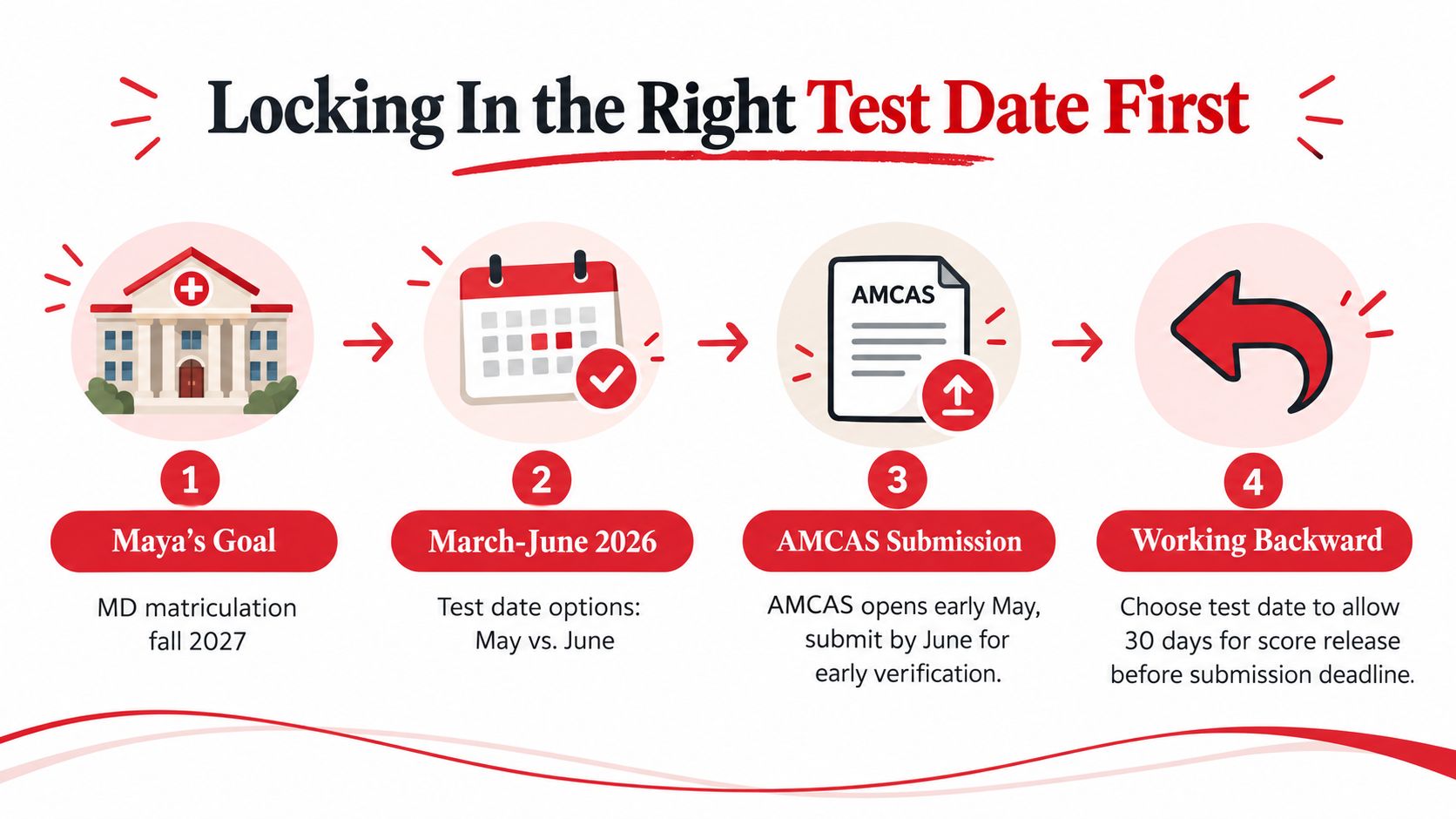
Use three date-lock questions
When must your application be verified? Identify the submission window you're targeting, then allow time for your score to be available when schools evaluate your file. Don't assume submitting an application and receiving a score are interchangeable milestones.
Which application round are you pursuing? A date that works for an early primary submission may not work for a later cycle. If the score arrives too late for your intended review window, an earlier exam can be more useful even if it leaves less study time.
How much study runway remains after finals? Count the weeks you can realistically protect for content review, passage practice, and full-length exams. A theoretically early date is not an advantage if your preparation remains incomplete.
Use the official MCAT test-date planning information to map your intended administration against school deadlines. Earlier testing creates more room for a retake; later testing can improve readiness but narrows the application cushion. Choose the date that balances both, not the date that merely appears first on the calendar.
Creating Your AAMC Account and Verifying Your ID
Your account should be ready before you start comparing seats. Begin by creating or verifying your AAMC ID, confirm your email address, and enter your profile information in the MCAT Registration System. The official AAMC registration guidance recommends completing the account and identity steps first, then selecting an available date and location before checkout.
The most preventable registration failure involves your legal name. Your first and last names must match the government-issued identification you'll present at the test center exactly. A nickname, shortened middle name, missing hyphen, or altered accent can create a check-in problem even when every other part of your registration is correct.

Follow the registration sequence
- Create or verify your AAMC ID: Use an email account you'll monitor through the application cycle.
- Confirm your identity fields: Compare every name field with the unexpired government ID you intend to use.
- Review eligibility information: Answer the registration questions carefully and use the official requirements rather than relying on a prior testing experience.
- Enter the scheduling system: Select the test date and center only after confirming the location, travel plan, and readiness window.
- Complete checkout: Review the confirmation screen before closing the browser and retain the confirmation email.
Don't register with a nickname and plan to “fix it later.” If your account information needs correction, contact AAMC before scheduling rather than risking a mismatch at check-in. You can also use the Ace Med Boards MCAT preparation hub to organize your preparation around the date you ultimately select.
Choosing a Test Center and Date
Your preferred MCAT date is available, but the only open seat requires a long drive and an unfamiliar check-in location. Before clicking Schedule, compare the center's address, route, parking or transit options, local start time, and a backup transportation plan. A nearby center is often the better choice when it protects your arrival time and exam-day focus.
Use the official 2026 AAMC calendar to match the test date with your application plan. Work backward from your medical-school deadlines and the score-release date. A composite applicant, for example, might choose an administration that leaves enough time for the score to arrive before submitting an application, rather than selecting the earliest visible seat without checking the full timeline. Review when the MCAT is offered before committing to a distant center or date.
International applicants and foreign medical graduates must check the calendar and identification rules for the specific testing region. A center in another country may have different administrations, documentation requirements, travel demands, and local timing than a U.S. center.
Compare the practical trade-offs
| Region | ID Accepted | Surcharge | Date Availability | Seat Refresh Notes |
|---|---|---|---|---|
| United States | Use the accepted unexpired government ID listed in the current AAMC materials | Review the U.S. fee schedule at checkout | Follow the official U.S. administration calendar | Recheck nearby U.S. centers if your first choice is full |
| Canada | Confirm the identification rules for the Canadian location and bring the required document | Review charges listed for the Canadian appointment | Check the Canadian location calendar, since dates may differ by site | Compare Canadian centers before abandoning your target administration |
| International locations | Plan to use a passport if required, and verify location-specific rules with AAMC | Check the charge for the selected country before payment | Availability varies by country and administration | Add time for travel, border requirements, and time-zone changes |
Practical rule: Choose the center you can reach reliably, not the one with the first visible opening.
A cross-country or cross-border appointment demands more planning than a local one. Confirm transportation, lodging if needed, and the arrival window before paying. The appointment time is listed in local time, so account for time-zone changes when planning the day.
If your first choice is full, check the registration system periodically. Seats can appear as other examinees change plans, so treat the first search result as a snapshot rather than a final answer. Schedule early once the date, score-release timing, and travel plan all fit.
Fees, Payment, and Fee Assistance
A composite applicant, Maya, plans to test in spring, receive her score before submitting medical-school applications, and avoid paying for a seat she may later move. She checks the MCAT Essentials for Testing Year 2026 and the official registration system immediately before checkout, because registration fees, international charges, fee-assistance benefits, and change policies can be updated.
The standard MCAT registration fee is $355 for U.S. and Canadian testing. International appointments add an international fee, so use the MCAT exam cost guide for a planning checklist, then confirm the exact total in AAMC checkout. The checkout amount and current AAMC policy control.
Use this fee-review table
| Fee Type | U.S./Canada | International | Notes |
|---|---|---|---|
| Base registration | $355 | $355 | Confirm the total on the final checkout screen |
| International charge | Not applicable | $120 | Verify the charge and refund rule before paying |
| Rescheduling | $55, $110, or $165, depending on the deadline tier | $55, $110, or $165, plus any international charge that applies | Review the appointment-specific rule before changing dates |
| Cancellation | Refund depends on the current deadline tier | Refund depends on the current deadline tier | Save the cancellation policy with your confirmation |
| Fee Assistance Program | Benefits depend on current AAMC award terms | Benefits depend on current AAMC award terms | Apply and receive approval before scheduling if you need the benefit |
Handle the AAMC Fee Assistance Program before scheduling if you may qualify. Benefits are not retroactive, and approval for another application service does not automatically mean you have redeemed an MCAT benefit. Read the current eligibility and redemption instructions before choosing a date.
Pay with a card whose billing address matches the issuer's records and your AAMC account. International cards may require additional verification. Test your payment method before a high-demand registration window, not while a preferred seat is waiting in your cart.
Before submitting payment, confirm the total charge, billing address, legal name, test date, score-release timing, and active Fee Assistance status. Save the confirmation and the applicable change policy. This backwards check helps Maya protect both her testing budget and her application timeline.
Requesting Accommodations Before You Register
If you need testing accommodations, start with the AAMC Accommodations Online Request System before booking a standard seat. Registration first and accommodation planning later can create an avoidable rebooking problem, particularly if your preferred center has limited availability.
Open the request, complete the personal statement, and attach supporting documentation that explains the functional need. Depending on the request, documentation may include a psychoeducational evaluation, medical records, an individualized education program, or a 504 plan. Submit a complete packet, because missing documents can delay review.
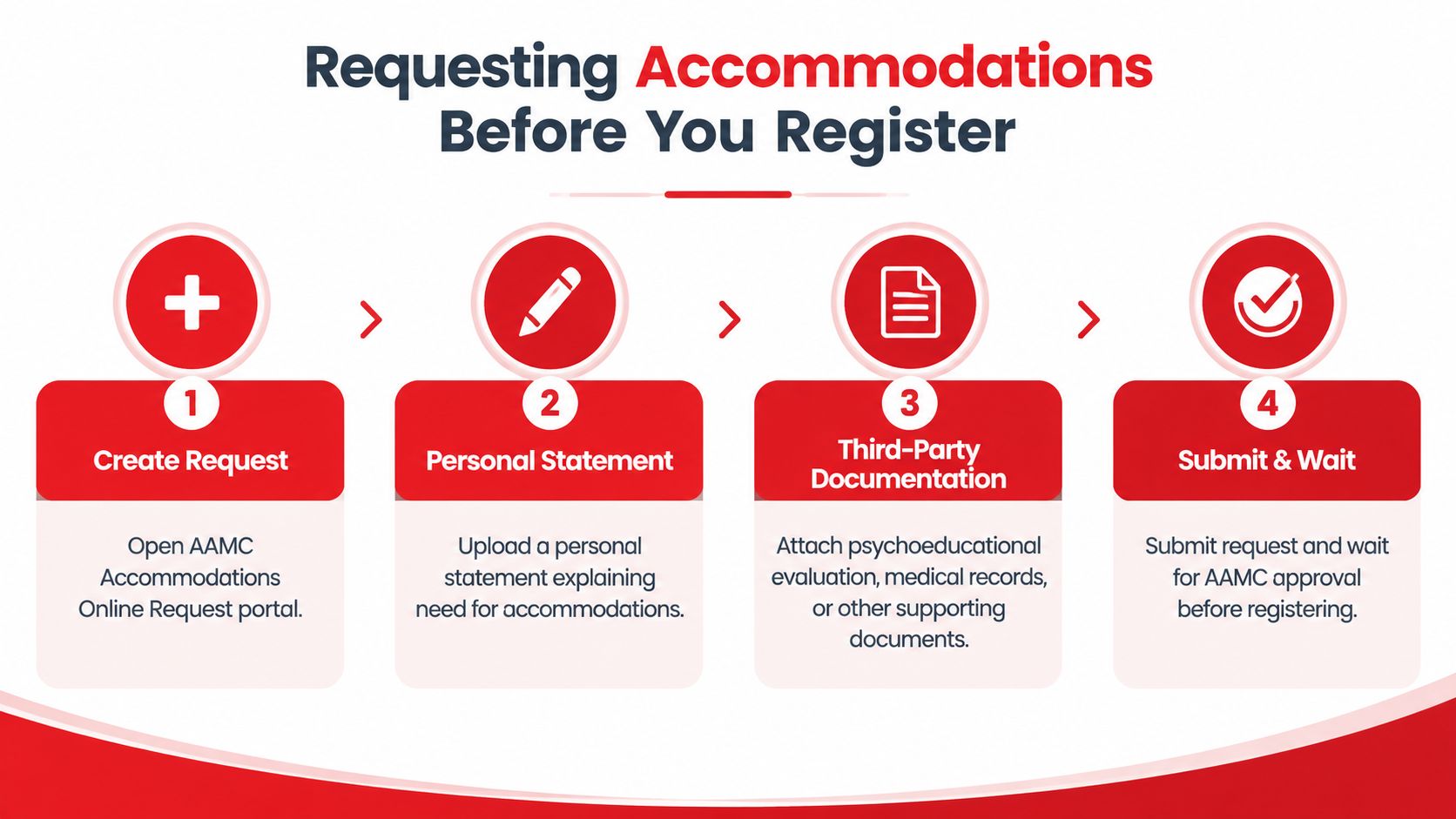
Protect your scheduling options
- Create the request: Use the AAMC accommodations portal and identify the exam cycle you're planning to enter.
- Write the personal statement: Explain how the condition affects standardized testing and what support you're requesting.
- Attach third-party records: Upload clear, current documentation and check that each file is readable.
- Submit and monitor: Keep the submission record and respond promptly if AAMC requests clarification.
Wait for the decision before standard registration when possible. If the accommodation is approved before registration, the approved support can be incorporated into the appropriate scheduling process. If you already booked a regular seat, you may need to release it and rebook through the accommodations process. That change can affect your preferred date or center, so accommodations should be part of the initial timeline rather than an afterthought.
Use the current AAMC accommodations guidance for review windows and documentation requirements. Policies can change, and incomplete files don't receive the same treatment as complete submissions.
Reschedules, Cancellations, and the Waitlist
The AAMC calendar organizes each appointment around 60-day, 30-day, and 10-day scheduling deadlines. Treat those checkpoints as decision gates. Put them on your calendar as soon as you register, then decide well before each one whether your readiness, application timing, health, and travel plan still support the appointment.
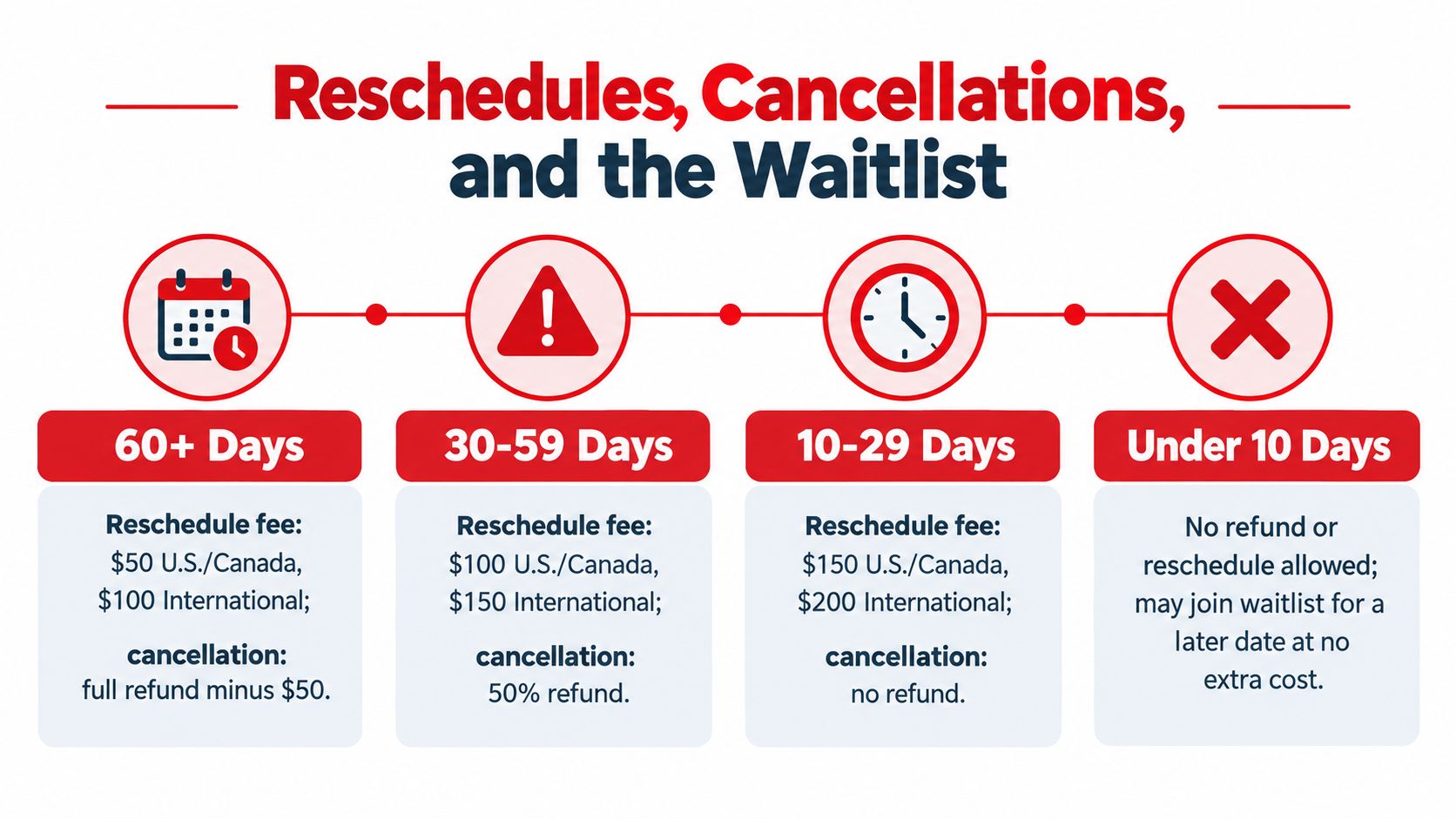
The current calendar and MCAT Essentials for Testing Year 2026 should determine the applicable fee or refund. Don't rely on a general rule copied from a prior testing year. A date change can also affect score release and your application plan, so evaluate both the financial and timeline consequences before submitting it.
Save the confirmation details
When your appointment is confirmed, check all of the following:
- Legal name: Verify spelling and every name field against your test-day ID.
- Center address: Copy the full address into your travel plan and confirm the route.
- Start time: Record the appointment in the center's local time zone.
- Accommodation information: Confirm that any approved accommodation appears correctly.
- Change link: Save the appointment reschedule or cancellation path before closing the browser.
- Confirmation email: Keep the message in a searchable folder and retain any scheduling document provided by AAMC.
A waitlist or newly released seat can help when your first choice disappears, but it isn't a substitute for a contingency plan. Check the system when you can, keep alternative centers in mind, and don't abandon a workable appointment while waiting for a perfect one. Any notification or response window must be verified in the current AAMC instructions.
Score Release Timing and Your Pre-Registration Checklist
A September test date can look attractive until its score arrives after your target application window. Before you register, match the administration date to the month you plan to submit and the point when schools will review your MCAT result. Use the official MCAT score-release information to verify the release date tied to your appointment, then review the MCAT score release schedule as a second planning reference.
Work backward from the application milestone that controls your decision. A spring administration can preserve time to respond to an unsatisfactory result. A later administration gives you more preparation time, but it can leave less room before primary application review. Choose based on readiness, score availability, and the submission window you are targeting.
Build the timeline backward
| Planning point | What to complete |
|---|---|
| About a year before the intended application cycle | Gather transcripts, prerequisite records, and a realistic list of remaining coursework |
| Several months before the exam | Choose a readiness-based date, register, and begin structured content review |
| The preparation runway | Combine content review, passage work, and full-length practice under realistic conditions |
| 60 days before the exam | Recheck the appointment, travel route, legal ID, and accommodation status |
| 30 days before the exam | Review the applicable scheduling deadline and decide whether the date still fits |
| 10 days before the exam | Treat the appointment as a final administrative commitment and confirm the current AAMC rule |
The 2026 calendar includes 31 test dates from January 9 through September 12, allowing applicants to compare administrations instead of choosing the first open seat. For the remaining 2026 U.S. cycle, the published dates are September 3, September 4, September 11, and September 12, as of August 27, 2026. Applicants planning beyond that cycle should track the AAMC announcement that 2027 registration opens October 20–22, 2026 by testing-center location.
A composite decision example
Composite applicant: Jordan plans to submit an application in June and wants an MCAT score available for that submission. A diagnostic score shows that Jordan needs substantial preparation, so a September administration would arrive too late for the target month and leaves no practical retest option before submission. Jordan chooses a spring administration instead, accepting the earlier preparation deadline in exchange for score availability and time to reassess the application plan.
That decision requires more than selecting an early date. Jordan checks the score-release date, confirms the center and travel route, matches the account name to the government ID, submits any accommodation request before booking, and records the applicable change deadlines. The chosen appointment must support both preparation quality and the application calendar.
Before you register, complete this checklist:
- Date: Confirm the official test date and associated score-release date.
- Location: Compare the center address, transportation, local time, and an alternate route.
- Deadlines: Calendar the 60-day, 30-day, and 10-day checkpoints shown for the appointment.
- Score use: Confirm how the release fits your AMCAS submission and verification plan.
- Identity: Match the account name to the unexpired government ID.
- Accommodations: Submit and monitor any request before booking when possible.
- Contingency: Decide what you will do if readiness, health, travel, or seat availability changes.
- Records: Retain the AAMC confirmation email and any scheduling permit PDF.
Ace Med Boards can help organize your date, preparation runway, and application timing. Use that planning support alongside AAMC's official registration rules, not in place of them. The AAMC MCAT registration page and the AAMC MCAT Registration System overview provide the registration guidance to verify before submitting your appointment.
Sources
- AAMC 2026 U.S. MCAT calendar, scheduling deadlines, and score release dates
- AAMC MCAT registration page
- AAMC MCAT Registration System overview
Ace Med Boards offers individualized MCAT preparation and planning support for applicants connecting study schedules with registration and application milestones. Its guidance can help you review a test-date decision and preparation needs.