You open your first MCAT practice exam expecting a score. Instead, you get a confusing mix of missed questions, rushed guesses, unfinished passages, and concepts you thought you knew. The most useful MCAT prep test isn't a verdict on whether you belong in medicine. It's a diagnostic tool that shows which problems are costing you points and what kind of practice should come next.
The MCAT has four scored sections, Chemical and Physical Foundations of Biological Systems, Critical Analysis and Reasoning Skills (CARS), Biological and Biochemical Foundations of Living Systems, and Psychological, Social, and Biological Foundations of Behavior. AAMC reports four section scores and one total score, with section scores from 118 to 132 and total scores from 472 to 528. Learn more about the official MCAT score scale and percentile reporting before treating any practice result as meaningful.
What an MCAT Prep Test Actually Does
You begin a passage confident about the content, then face an unfamiliar experiment, a time decision, and several questions that depend on careful reading. By the final section, concentration can matter as much as recall. An MCAT prep test is a timed, full-length simulation that shows how content knowledge, reasoning, pacing, and stamina work together.
Its main function is diagnosis. A baseline attempt may reveal a content gap, difficulty extracting evidence from passages, inefficient calculations, slow pacing, or fatigue that short question sets conceal. AAMC recommends using its free Unscored Sample Test early, then reviewing the report by section to establish a starting point and shape a study plan through its official study-planning workflow.
Use each exam to answer one question
A first diagnostic is a map, not a forecast. Record what happened so later exams can test a specific change:
- CARS pacing: Do you reach the final passage with enough time to reason carefully?
- Biochemistry application: Can you interpret an experiment rather than recall a pathway?
- Psychology and sociology: Do unfamiliar terms cause misses, or does rushed reading?
- Stamina: Does accuracy decline after several sections?
- Review quality: Did the last study block reduce a recurring error?
Create a reusable passage-review sheet for every missed or guessed question. Record the passage's central idea, the evidence you overlooked, the reason for your original choice, the correct reasoning, and the next action. Label the error as content, interpretation, timing, calculation, or endurance. This turns a score report into decisions you can repeat across exams.
Keep checkpoint exams strictly timed and use consistent conditions. Log sleep, breaks, interruptions, and confidence, because an AAMC score deserves more weight when the administration resembles test day. A third-party score is more useful for timing, stamina, and recurring error patterns than for predicting your final scaled result, especially when its passages, difficulty, or scoring conversion differ from AAMC materials.
Practical rule: The score records what happened. The review sheet explains why.
Students waste full-lengths when they collect scores without choosing a next action. Use this MCAT practice-test resource to organize testing strategy, while treating each exam as feedback data rather than a judgment of your future.
Official AAMC Materials and Major Third-Party Options
Not every practice exam serves the same purpose. Official AAMC materials are the closest available reference for the exam's content emphasis, passage logic, question construction, and score interpretation. Third-party exams can add valuable volume, but their difficulty, writing style, and scoring conversions may differ.
AAMC's official preparation collection includes five low-cost full-length practice exams and two free practice exams, and the comparison page identifies Practice Exams 1 through 4 as containing 230 questions each and simulating the actual MCAT exam. Review the AAMC full-length practice exam options before spending official material to obtain an early baseline.
| Source | Main Offerings | Strengths | Limitations |
|---|---|---|---|
| AAMC | Official full-lengths, Section Bank, Question Packs, Sample Test | Closest match to official style and score reporting | Limited supply, so careless early use can reduce later calibration value |
| Khan Academy | Free explanatory lessons and practice passages | Useful for low-pressure concept review and early passage work | Not a substitute for official full-length calibration |
| Blueprint | Third-party full-lengths, question practice, analytics | Adds repetition, timing practice, and stamina work | Scores may run lower than AAMC equivalents |
| Kaplan | Third-party full-lengths and structured preparation materials | Broad content reinforcement and additional timed practice | Passage style and score conversion can differ from AAMC |
| Princeton Review | Third-party exams and preparation materials | Extra practice and structured review | Treat scores as diagnostic estimates, not official benchmarks |
Match the resource to the decision
Use AAMC exams when the decision carries weight, such as evaluating readiness near the actual test date or considering whether a retake is sensible. Use third-party exams earlier when you need more opportunities to practice timing, endurance, and unfamiliar passages. Khan Academy materials can support early learning and explanation, especially when a missed question reveals a concept you can't yet explain in plain language.
Independent comparisons have found that Blueprint full-length scores often run about two to five points lower than AAMC full-length scores, which indicates score deflation rather than true equivalence. A rising Blueprint score can still show improving readiness, but confirm important decisions with AAMC materials and avoid treating a single third-party number as a precise forecast. See the comparison of Blueprint and AAMC difficulty for the limitation behind that adjustment.
Reserve your most decision-relevant AAMC exams for checkpoints when you can review them thoroughly. A practice test you take without analyzing missed, guessed, and slow questions gives you less value than a third-party exam that produces a clear adjustment to your study plan.
For a practical way to combine official calibration with additional online practice, review AAMC full-length planning without assuming that more tests automatically mean better preparation.
Replicating Real Test-Day Conditions
A practice exam produces useful information only when the conditions make the result interpretable. If you pause whenever a passage feels difficult, check messages during breaks, or take an entire afternoon away from the scheduled structure, the score reflects those choices as much as it reflects MCAT readiness.
The exam uses a sequence of timed sections and scheduled transitions. Follow the current timing and break instructions in MCAT Essentials and the official materials you're using, because testing policies can change. For a realistic rehearsal, preserve the expected section timing, the break between sections, and the optional lunch period rather than improvising a schedule that feels easier.
Control the room
Choose a quiet space where nobody will interrupt you. Keep your phone sealed away, use an approved scratch surface, and place a timer where you can see it without repeatedly checking it. Use the same computer setup, desk arrangement, food, and water plan whenever possible.
The purpose isn't to create discomfort for its own sake. It's to distinguish a knowledge problem from an environment problem. If you lose concentration because of notifications, noise, or an unpredictable break, your review should record that context instead of labeling the result as a content failure.
Record mental load
Sleep, caffeine, meals, anxiety, and the post-lunch energy dip can affect how you read and reason. Don't try to eliminate every normal variable, but do record it. After the test, write down:
- Start conditions: Sleep quality, wake time, food, and caffeine.
- Environment: Noise, interruptions, computer problems, and room temperature.
- Break behavior: Restroom, water, food, scrolling, or score checking.
- Section experience: Where concentration dropped and where timing changed.
- Confidence: Questions you guessed on, even when the answer was correct.
Use the online MCAT practice-test option to support a consistent routine, but remember that the platform can't make an inconsistent environment realistic. Your log helps you identify whether a score change reflects better preparation or a disrupted simulation.
Interpreting Scores and Adjusting Your Study Plan
A practice score can look reassuring or alarming before you know what produced it. Read it like a diagnostic report: the total shows the result, while the missed questions reveal which part of your preparation needs attention.
The MCAT total score uses a 472 to 528 scale, with a midpoint of 500. Each section ranges from 118 to 132, with a midpoint of 125. AAMC percentile ranks indicate the percentage of test takers who earned the same score or lower, and AAMC updates its published rankings annually using the most recent three testing years. In the 2025 to 2026 percentile table, the dataset included 293,882 MCAT scores, and AAMC reported that 74% of total scores were at or below 508 across the combined 2022 to 2024 testing years. Use the AAMC score-range guidance alongside the current official scale information, rather than treating one percentile as a universal admissions cutoff.
AAMC also reports that the mean total score across 305,494 exams administered in 2023, 2024, and 2025 was 500.6, close to the scale midpoint. That average provides context, but it cannot define a “good” score for every applicant. Your target depends on your application context, school list, academic record, and readiness across the entire exam.
Review misses by cause
Start with the questions you missed, guessed, or answered slowly. A reusable passage-review sheet keeps the review concrete. For each item, record the section, passage topic, question task, chosen answer, correct answer, confidence, and primary cause:
- Content gap: You could not explain the tested concept without looking it up.
- Reasoning error: You knew the content but misread a relationship, graph, experiment, or question task.
- Misread: You overlooked a qualifier, reversed the question, or answered a different task.
- Timing failure: You rushed, guessed late, or left the item incomplete.
Then add one sentence: “I should have noticed…” This turns a wrong answer into a repeatable warning sign. Review correct answers marked uncertain as well, because a lucky choice can hide weak reasoning.
Count each category by section, then match the study action to the largest avoidable category. A content gap may require retrieval practice and a short review block. A reasoning error usually calls for passage-based questions and written justification. A timing failure needs timed drills and pacing checks, not another passive content lecture.
Third-party scores deserve a narrower role. Use them to detect recurring weaknesses, compare pacing, and test whether a study change helped. Their scale and passage style may differ from the actual exam, so avoid treating their totals as precise predictions. Give greater weight to AAMC scored exams when judging readiness, especially after you have reviewed the underlying errors and completed them under consistent conditions.
| Score Range | Percentile | Readiness Signal | Suggested Adjustment |
|---|---|---|---|
| 472 to 499 | Interpret using the current AAMC table | Broad gaps or an unstable test-taking process may be present | Establish a baseline, map errors, and prioritize foundational review |
| 500 to 508 | Interpret using the current AAMC table | Mixed readiness, with section patterns more useful than the total alone | Target the largest error categories and retest under controlled conditions |
| 509 to 518 | Interpret using the current AAMC table | Stronger general foundation, but consistency and school-specific goals still matter | Refine passage reasoning, pacing, and remaining section weaknesses |
| 519 to 528 | Interpret using the current AAMC table | High official performance, though one exam does not prove stable readiness | Confirm consistency, review flagged guesses, and protect stamina |
These ranges are planning bands, not admissions guarantees or official readiness cutoffs. Use the score as a starting signal, then let the error record determine your next study block.
A Worked Example of a Practice-Test Diagnosis
Consider this labeled hypothetical learner, Maya. On her first AAMC scored practice exam, she earns a 506 total, with 128 in Chemical and Physical Foundations, 127 in CARS, 125 in Biological and Biochemical Foundations, and 126 in Psychological, Social, and Biological Foundations. The useful information isn't only that one section is lower. It's the pattern inside the missed questions.
Maya reviews every wrong answer and every correct answer she marked as uncertain. She labels each item by content, reasoning, misread, or pacing. Her Biological and Biochemical errors cluster in amino acid metabolism and genetics passages, especially when she must connect an experimental result to a pathway. Her Psychology and Sociology misses appear mostly in the final passages, where she rushes, rather than in questions testing unfamiliar terms.
The revision
Maya doesn't restart all content review. She makes a narrower plan for the next two weeks:
- Biology and biochemistry: One study day focuses on metabolism and genetics, followed by passage-based application rather than only flashcards.
- CARS: She adds a focused daily practice block built around identifying paragraph function, the author's position, and textual support.
- Psychology and sociology: She completes a timing-only half-length to test whether late-section rushing is the cause.
- Review: She records why each credited answer wins and why each distractor fails.
Her passage-review sheet looks like this:
| Field | Maya's entry |
|---|---|
| Tested concept | Original genetics passage about how a changed regulatory signal affects gene expression |
| Task | Infer the result supported by the described experiment |
| Evidence line | The sentence describing increased expression after the regulatory change |
| Why the credited answer wins | It follows the experiment's stated direction without adding an untested mechanism |
| Why each distractor fails | One reverses the result, one introduces outside information, and one answers a different question |
| Timing | Recorded as slow because she reread the methods paragraph |
| One transfer rule | State the experimental result in plain language before evaluating choices |
This is the kind of written analysis encouraged by distractor-analysis guidance. Maya's next scored exam should test whether the revised behaviors work on unseen material, not whether she remembers the original passages. If the same error tags remain, she needs a different intervention. If they decline while a new issue appears, the plan should follow the new evidence.
Common Pitfalls That Distort Practice-Test Signals
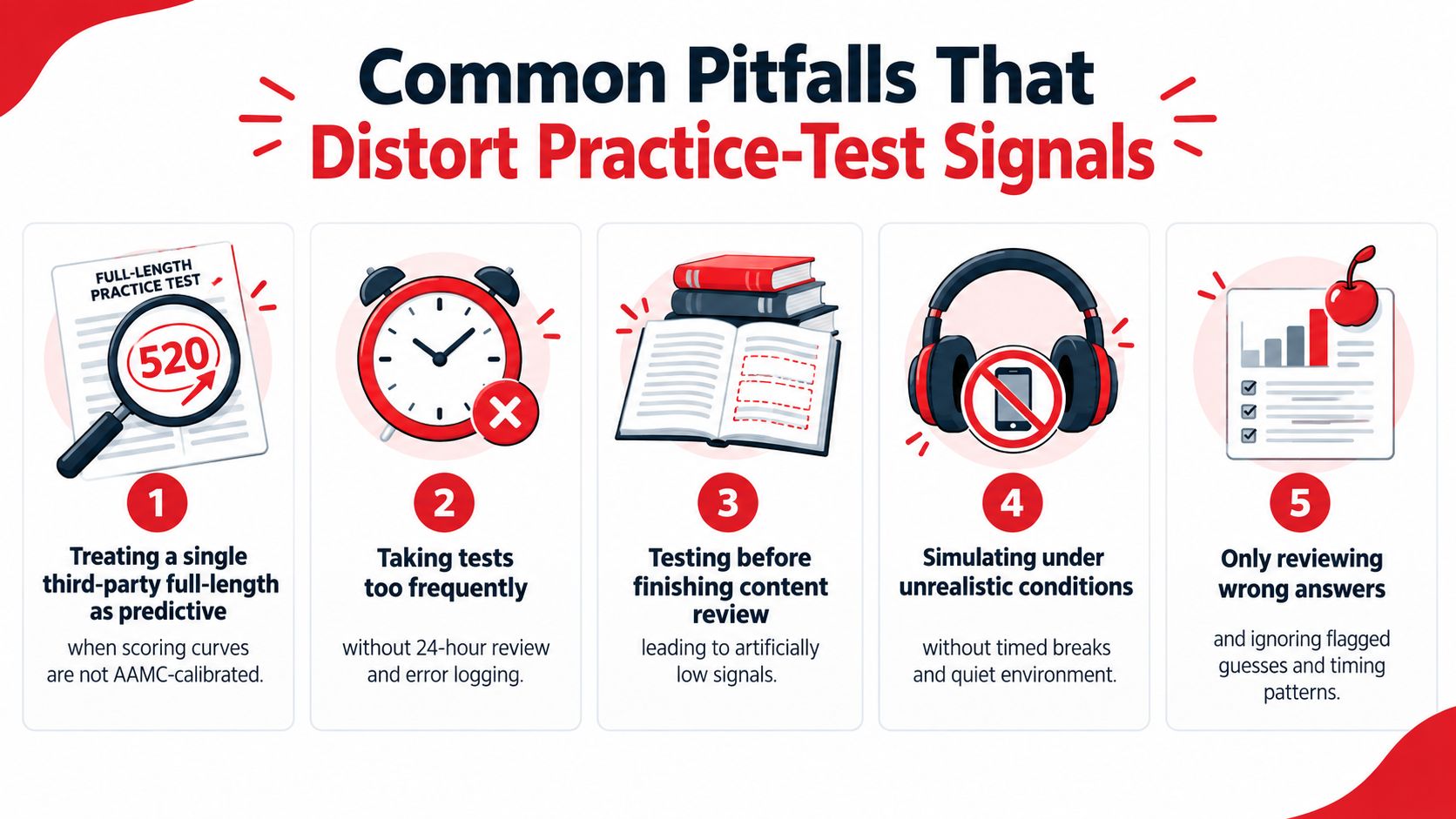
A practice score becomes misleading when the testing process changes from one exam to the next. Students often blame content first, but the distortion may come from a harsh third-party conversion, incomplete review, relaxed timing, or fatigue created by testing too frequently.
Five errors to avoid
- Trusting one third-party score: A different scoring curve can make a result look lower or higher than an equivalent AAMC performance. Use the number to locate patterns, then confirm readiness with official material.
- Testing without deep review: A full-length consumes substantial mental energy. If you take another exam before understanding the first one, you collect fatigue instead of learning.
- Testing before the foundation is ready: An early diagnostic can be useful, but repeated low scores during unfinished content review may encourage you to study every topic at once.
- Simulating loosely: Extra breaks, phone access, background noise, and untimed passages weaken the connection between practice and test-day behavior.
- Reviewing only wrong answers: Correct guesses and slow answers can reveal unstable reasoning. Log them alongside missed questions.
A particularly costly mistake is assuming that an unfamiliar third-party passage style proves a content weakness. Before opening a textbook, compare the question type, evidence requirement, timing, and answer-choice logic. If the problem appears only with one provider, treat it cautiously. If it appears across official and third-party materials, prioritize it.
Sample Schedule and Readiness Checklist
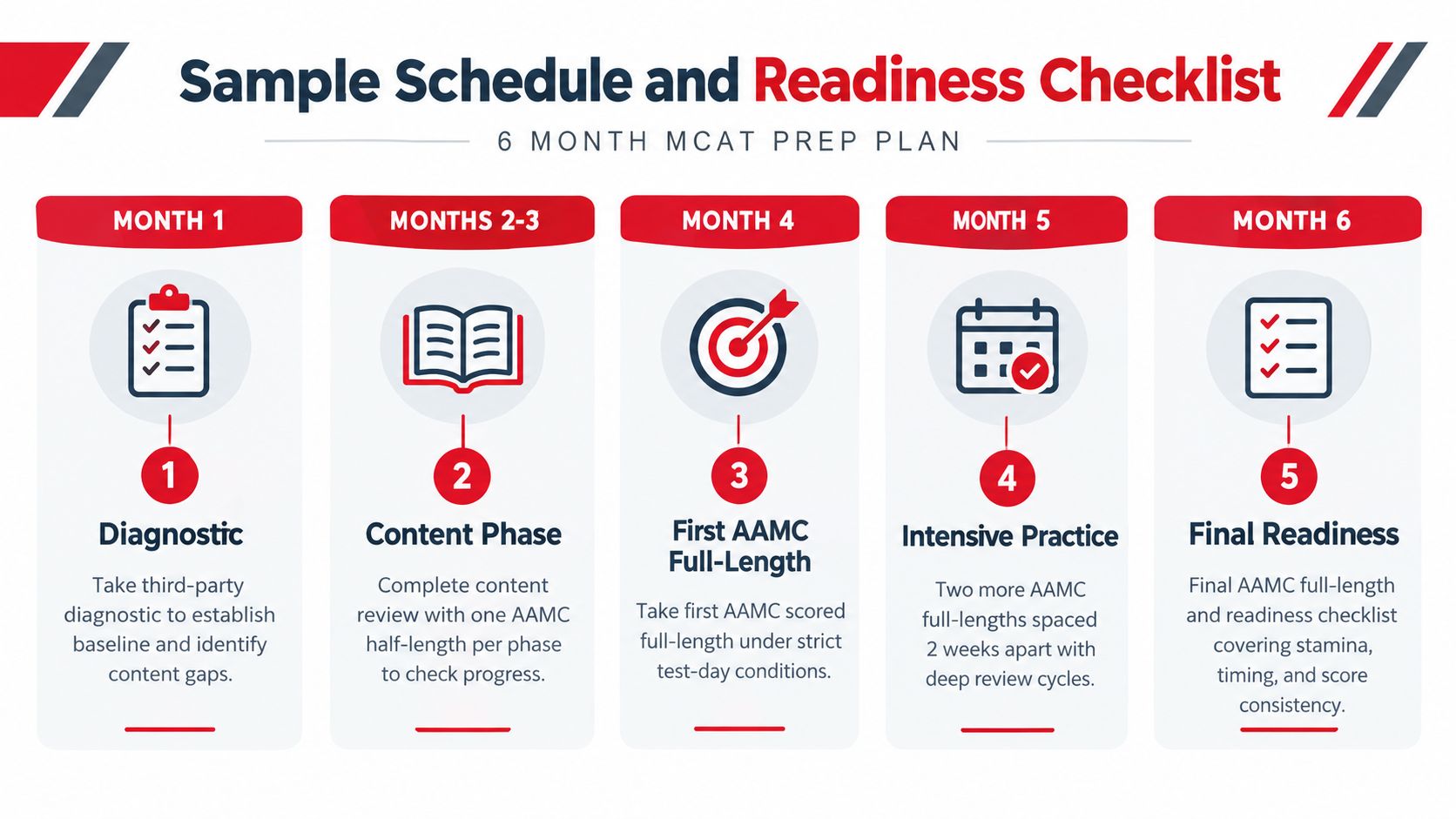
A six-month plan works best when practice exams appear at deliberate checkpoints rather than filling every available weekend. AAMC's official study-planning guidance supports beginning with the free Unscored Sample Test, reviewing section-level performance, and building the plan around what that baseline reveals.
A six-month framework
| Phase | Practice focus | Study purpose |
|---|---|---|
| Month 1 | Take a third-party diagnostic, then review it carefully | Establish a baseline and identify content, reasoning, misread, and pacing patterns |
| Months 2 to 3 | Complete content review with an AAMC half-length during each content phase | Check whether learning transfers into passage work |
| Month 4 | Take the first AAMC scored full-length under strict conditions | Establish an official-style checkpoint |
| Month 5 | Use additional AAMC full-lengths with deep review between attempts | Test whether specific interventions reduce recurring errors |
| Month 6 | Complete a final official-style checkpoint and readiness review | Confirm stamina, pacing, consistency, and a practical test-day routine |
The exact spacing should reflect your baseline and life commitments. A student with substantial content gaps may need to extend the review phase instead of accelerating full-length frequency. A student whose content is strong but whose pacing is unstable may need more timed passage work before another full-length produces useful information.
Readiness checklist
Two weeks before the exam, ask:
- Official consistency: Are your recent AAMC full-length results stable or rising?
- Target alignment: Is your predicted performance within the range you need for your application plan?
- Timing control: Can you complete every section without relying on an emergency final sprint?
- Error resolution: Have the major content gaps from your last reviews been addressed?
- Routine rehearsal: Do you know how you'll handle breaks, lunch, water, food, and concentration dips?
- Review confidence: Can you explain why credited answers win and why distractors fail?
No checklist can guarantee a result. It can, however, expose a decision that needs more evidence before you commit to an exam date.
Using Practice Tests as a Feedback Loop
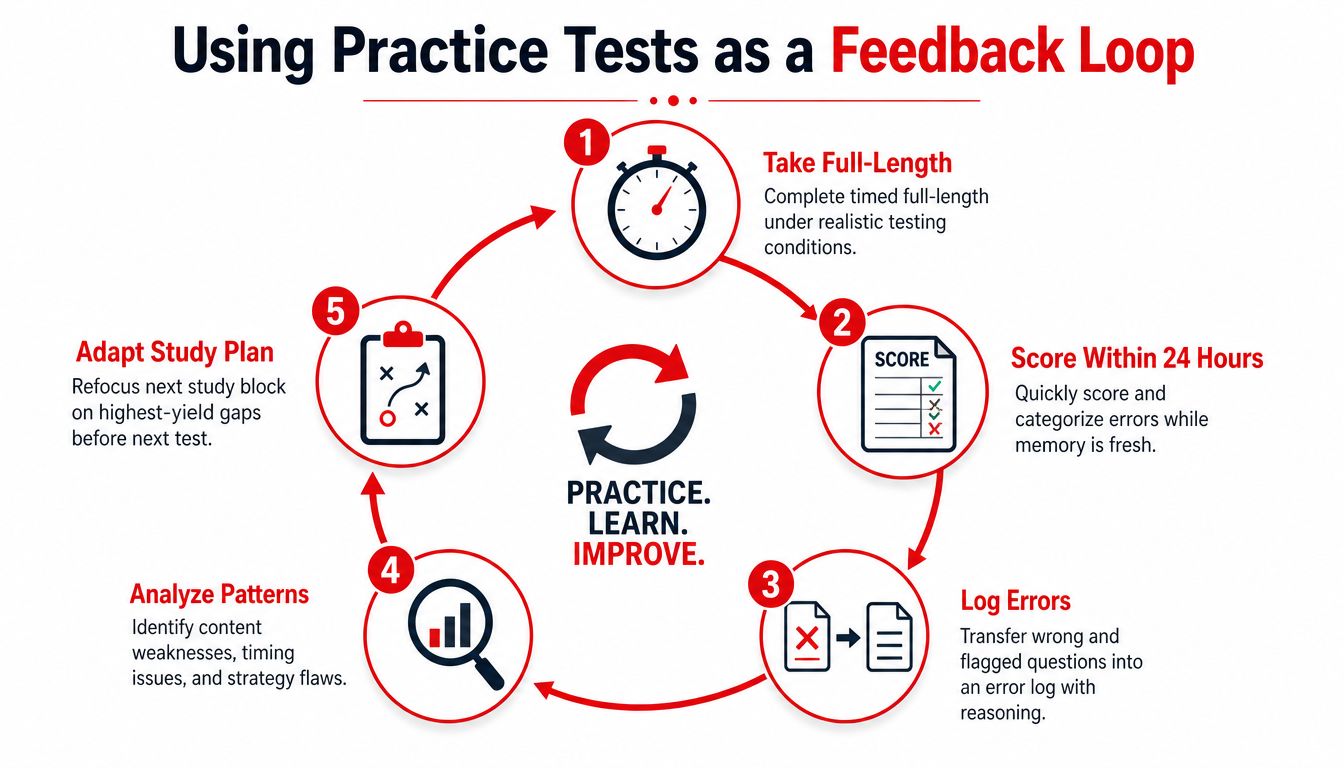
A full-length should begin a cycle, not end one. Complete the exam under realistic conditions, score it within twenty-four hours while your reasoning is still accessible, and transfer wrong and flagged questions to a passage-review sheet.
Your sheet should include:
| Review field | What to write |
|---|---|
| Tested concept | The specific science, behavioral science, or reading skill involved |
| Task | What the question actually asked you to do |
| Evidence line | The passage detail, graph feature, or wording that controls the answer |
| Why the credited answer wins | The reasoning that connects evidence to choice |
| Why each distractor fails | The contradiction, unsupported assumption, or task mismatch |
| Timing | Whether you answered efficiently, slowly, or under rushed conditions |
| One transfer rule | A concise rule to apply to a new passage |
Identify the two most common tags, then convert them into concrete weekly actions. For example, a reasoning tag might become a passage-mapping exercise, while a content tag might become retrieval practice followed by official-style questions. The next full-length then tests whether those actions changed behavior.
The following video can supplement your review process:
One-on-one MCAT tutoring can be useful if you can identify patterns but aren't sure how to prioritize them. Ace Med Boards offers individualized online MCAT preparation, including support with diagnostic review and practice-exam strategy, without replacing official AAMC materials or independent practice.
For additional context on the modern exam, AAMC's validity research describes a research program that ran from 2014 to 2023, including the revised MCAT's introduction in 2015 and its first use in selecting the 2016 entering class. AAMC's current guidance also indicates that the exam's sections, time limits, scoring scale, and core science prerequisites remain unchanged for 2026, so preparation should emphasize passage reasoning and feedback rather than rumor-driven format changes. Review the discussion of the 2026 MCAT changes and the passage-heavy reasoning trend commentary for current preparation context.
If you want help turning your MCAT practice results into a focused study plan, visit Ace Med Boards to learn about one-on-one online MCAT tutoring and discuss how an advisor could help you review passage errors, pacing patterns, and resource choices. A consultation can help you decide whether your next step should be targeted self-study, more official practice, or individualized support.