An MCAT online practice test is a computer-based simulation of the exam's four sections and roughly 7.5 hours of seated time. The highest-value versions are the official AAMC practice exams because they most closely predict actual MCAT scores.
You may be about three months from test day, exhausted from content review, and staring at an unscored diagnostic that tells you almost nothing about your readiness. That experience is common for a simple reason: taking a test and learning from a test are different activities.
A useful practice exam measures more than recalled facts. It shows whether you can read a dense passage, identify the task, choose evidence, manage time, and switch from CARS reasoning to science-based retrieval without losing focus. Used in sequence, online tests become a study instrument rather than a collection of intimidating numbers.
What an MCAT Online Practice Test Is and Why It Matters
A computer-based MCAT practice test recreates the structure and working conditions of the Medical College Admission Test. The current exam has four multiple-choice sections, with about 7 hours and 30 minutes of total seated time, according to the AAMC's official preparation resources. The experience is therefore closer to a full rehearsal than to a conventional content quiz.
The four sections are:
- Chemical and Physical Foundations of Biological Systems
- Critical Analysis and Reasoning Skills, or CARS
- Biological and Biochemical Foundations of Living Systems
- Psychological, Social, and Biological Foundations of Behavior
A full-length test matters because performance changes under pressure. You may know a concept during untimed review but miss it after several hours of reading. You may solve science questions accurately yet lose time because you reread every passage. CARS also requires a different mental approach from the science sections, so the test trains you to change reasoning modes repeatedly.
A test is not the same as a question set
A section quiz samples one area. A question bank lets you isolate a topic or skill. A content diagnostic may reveal what you remember before serious preparation begins. A full-length online practice test combines content, passage reasoning, timing, navigation, stamina, and score reporting in one setting.
That distinction changes how you interpret the result. A low diagnostic score isn't a verdict on your future application. It may reflect unfamiliar timing, weak passage mapping, incomplete coursework, or fatigue. Your job is to identify which factor caused the miss.
Practical rule: Treat every practice test as an instrument. First use it to measure performance, then use the evidence to choose what to study next.
The AAMC's history helps explain why this format is central. The MCAT became exclusively computer-based in January 2007, making digital simulation a core part of preparation rather than an optional convenience, as described in the AAMC history of the exam. A good online test should therefore reproduce the decisions you'll make on test day, not merely display questions on a screen.
Types of MCAT Online Practice Tests You Can Use
A practice test should answer a specific question about your preparation. Before choosing one, check its source authority, scoring fidelity, format fidelity, and place in your study plan. A test may be useful for training without being reliable for score prediction.
| Test Type | Source | Scoring | Format | Best Use Phase |
|---|---|---|---|---|
| AAMC scored full-length | Official AAMC | Scaled score and percentile rank | Full four-section simulation | Benchmarking and late preparation |
| AAMC sample test | Official AAMC | Unscored | Full interface and exam-length experience | Early orientation and baseline |
| Third-party full-length | Commercial preparation provider | Provider-specific diagnostic or scaled estimate | Usually full-length, with varying interface fidelity | Volume, pacing, and endurance |
| Free diagnostic | Commercial or educational provider | Usually diagnostic | Often shortened or adapted | First-week orientation |
| Sectional practice | AAMC or third party | Usually raw accuracy or diagnostic reporting | Focused section or topic set | Remediation and skill drilling |
Each format has a different job. The AAMC sample test introduces the digital interface and full exam rhythm without using a scored benchmark. A scored AAMC full-length provides the clearest reference for performance. Third-party full-lengths add passages, pacing practice, and endurance work. Free diagnostics can establish an initial baseline, while sectional sets isolate a weakness for targeted repair.
Official full-length exams deserve greater weight because they come from the organization that designs the MCAT. An independent analysis in the peer-reviewed comparison of MCAT practice tests describes typical prediction error for official tests as about ±2 to 3 points. Third-party tests are generally less accurate and may underpredict by roughly 2 to 4 or more points. Use those reports as directional evidence, not as interchangeable score anchors.
Sequence tests instead of collecting scores
Start with the sample test or a free diagnostic to learn your starting conditions. Use third-party exams for additional timed practice, then reserve official scored exams for meaningful checkpoints. Sectional practice belongs between full-lengths, where it can address a specific content or reasoning problem.
After every test, create an original passage-review sheet. Record the section, passage topic, question type, error cause, and the next action. Then connect each weakness to an AAMC-aligned question set or explanation before retesting it. This turns a score report into a remediation loop rather than a collection of numbers.
The best MCAT practice tests guide can help compare sources and sequence materials. For tutoring programs, test prep center software may organize assignments and learner progress, but it does not replace official content, careful review, or accurate score interpretation.
Inside the Official AAMC Online Practice Ecosystem
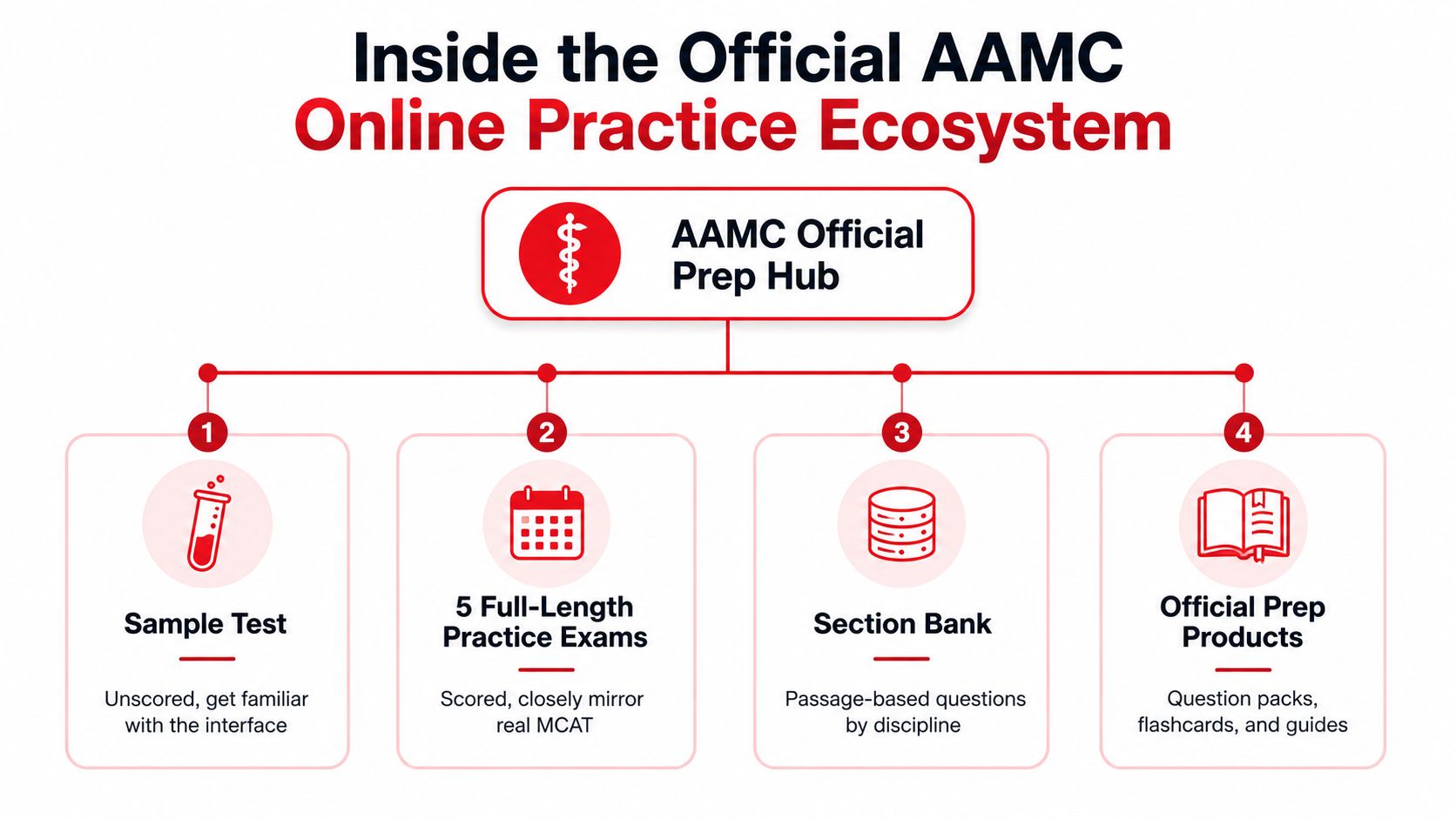
A student who opens every AAMC resource at once can mistake access for progress. The official online system works better as a sequence: learn the interface, establish a baseline, practice specific skills, then use scored exams as readiness checkpoints. It includes a free, full-length 230-question unscored sample test, five low-cost official full-length practice exams, and two free practice exams, as documented in the AAMC's official low-cost practice products.
Begin with familiarity, then add score anchors
Use the unscored sample test as an interface rehearsal. It will not produce a scaled score or percentile rank, but it can show how highlighting, passage layout, navigation, and timing feel before a score carries interpretive weight.
The AAMC sample question guide includes 12 questions total, with three questions in each section. The same items appear in the Official Prep Hub's Practice with Exam Features tool, as explained in the AAMC sample question guide. Treat these questions like a short driving lesson: they teach controls and display features, while a full diagnostic reveals how you perform under sustained pressure.
Scored full-length exams provide scaled scores and percentile ranks, making them useful for tracking readiness. The 300-question Section Bank and 120-question online guide set add passage-based and section-focused work between full-length exams. They are practice instruments for repairing a weakness, not replacements for complete simulations.
After each official set, create an original passage-review sheet. Record the section, passage topic, question type, error cause, and next action. For each missed or guessed item, connect the problem to the relevant AAMC content outline before retesting it. The AAMC MCAT full-length practice exams can help organize the official full-length sequence. When a question tests a named concept, review that concept directly rather than automatically rereading an entire textbook chapter.
How to Simulate Test Day at Home Step by Step
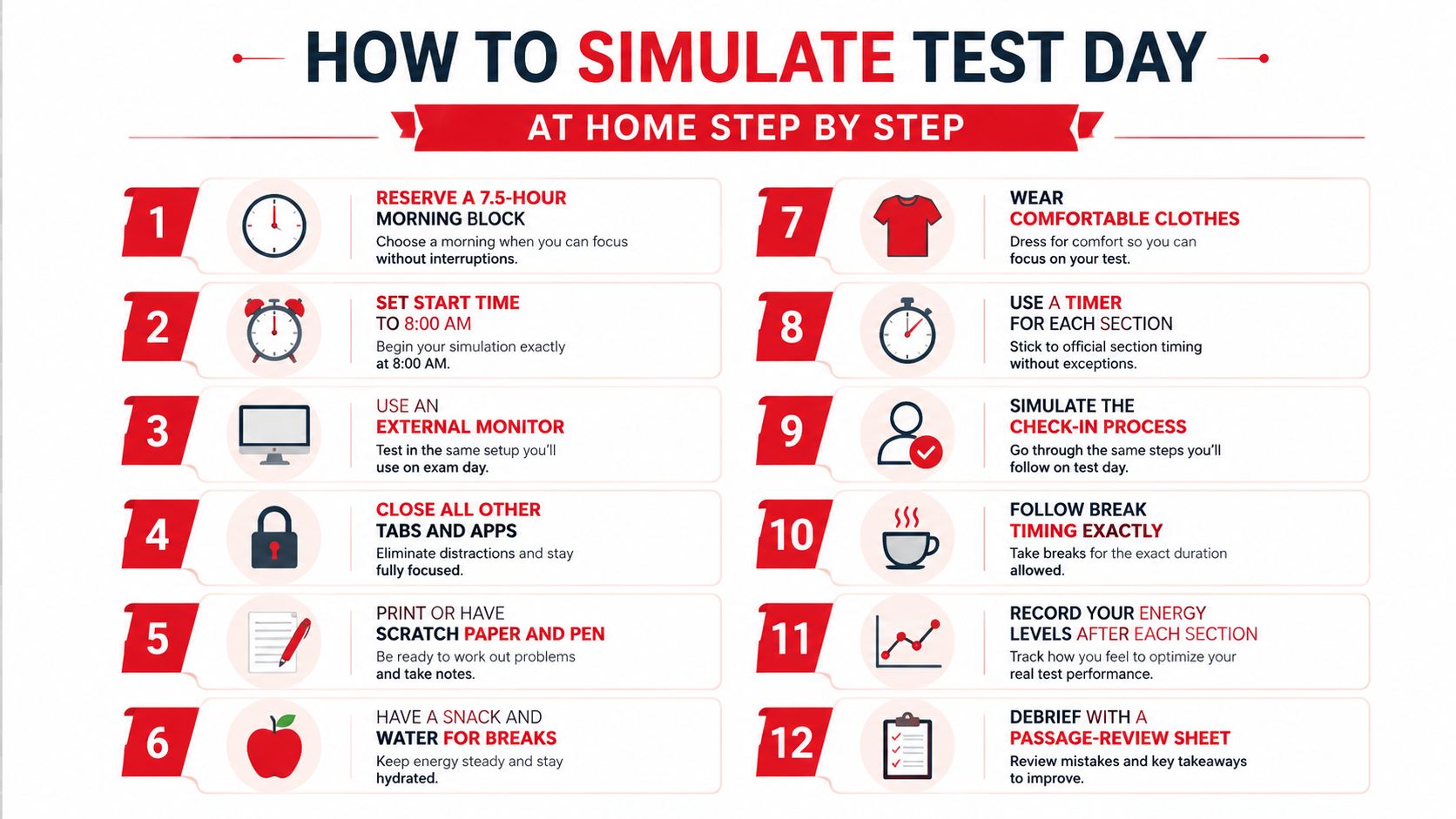
A home simulation works only when you remove avoidable choices. Reserve a morning block of about 7.5 hours, start at 8:00 a.m., and use the same broad sequence you expect on test day. The point isn't to create an artificial ritual. It's to expose where decision fatigue changes your reading, guessing, and pacing.
Use the AAMC sample test the night before as an interface dry run. Check highlighting, strikethrough, flagging, navigation, and calculator access for Chemical and Physical Foundations. You should know how each feature works before the timed session begins.
Use this home protocol
- Reserve the block: Protect the entire morning and early afternoon from appointments, errands, and study interruptions.
- Set the start time: Begin at 8:00 a.m. so your attention must activate at the same time each time you rehearse.
- Prepare the screen: Use an external monitor if it resembles the setup you'll use for practice, but prioritize the official interface over extra equipment.
- Close other applications: Disable notifications and shut down unrelated tabs, messaging tools, and background alerts.
- Prepare materials: Have permitted scratch paper and writing tools ready before the test begins.
- Pre-measure food and water: Prepare two snacks so you aren't deciding what to eat during breaks.
- Control comfort: Choose comfortable clothing and keep the room temperature consistent, ideally between 68 and 72°F for your rehearsal.
- Follow section timing: Use only the time provided by the test interface. Don't pause to look up formulas or review notes.
- Rehearse check-in behavior: Keep your workspace clear and practice sitting down without last-minute searching for supplies.
- Honor the breaks: Take only the permitted break time. Start the next section immediately when the break ends.
- Record energy: Screenshot or record the timing screen for each section and write down your energy level afterward.
- Debrief: Spend 15 minutes identifying the section where stamina, pacing, or concentration fell most sharply.
The MCAT practice test strategy guide can help you turn this rehearsal into a repeatable routine. A one-time simulation may reveal a problem. Repeated simulations show whether the adjustment worked.
The three features that make an online platform feel most like exam are official four-section structure, authentic passage reasoning, and disciplined timing inside the digital interface. Retrieval practice strengthens recall, timed work exposes pacing, and official AAMC materials calibrate the experience. No platform should reproduce recalled or copyrighted live questions.
A Reusable Passage Review Workflow After Every Test
The score report tells you where performance landed. The review sheet explains why. Complete it within 48 hours while you still remember what you noticed, assumed, skipped, or changed.
Use one row for every missed question and every question you guessed on. A correct answer earned through weak reasoning deserves review too, because a lucky result can hide the same future error.
| Section & Question | Tested Concept | Task Type | Evidence Line | My Trap | Transfer Rule |
|---|---|---|---|---|---|
| CARS, Q14 | Author's position | Reasoning | Passage sentence that limits the claim | Chose the answer with familiar wording | Prefer the choice supported by the author's whole argument |
| Biology, Q31 | Renal tubular reabsorption | Application | Passage data showing movement across the tubule | Recalled a related fact but ignored the experiment | Use the experiment's variables before applying background knowledge |
Fill the sheet in order
Start with the tested concept, such as renal tubular reabsorption or an author's central claim. Then label the task as recall, application, reasoning, or synthesis. This prevents you from treating every miss as a content gap.
Next, write the evidence line. For CARS, that may be the sentence that limits the author's position. For science, it may be a result, comparison, or variable in the passage. If you can't identify evidence, you may have selected an answer from memory rather than from the information provided.
Then name your trap. Did you misread the stem, overlook a qualifier, use an unrelated fact, or run out of time? Finish with one transfer rule that would help on a new question. “Review kidney physiology” is too broad. “Before choosing a mechanism, identify which variable the experiment changed” is actionable.
Apply the same sheet to Section Bank items and sectional practice. The distractor analysis guide offers a related method for examining why tempting options fail, but your sheet should remain grounded in the AAMC's four-section structure and content outlines.
Interpreting Scores and Turning Results Into a Fix Plan
A scored AAMC practice exam gives you a scaled score and a percentile rank. The AAMC's official information on scaled scores and percentile ranks explains how these measures differ. The scaled score reports performance on the exam's score scale. The percentile rank shows how that result compares with the relevant score distribution. Use both, because they answer separate questions.
Interpret the result in context. Official AAMC exams provide the closest practice comparison to the actual exam because they are produced by the organization responsible for it. Third-party tests may differ in passage difficulty, question style, and scoring. A total score is a signpost, not a diagnosis. The missed-question patterns underneath it provide the material for your plan.
Use this decision path
- Locate the pattern: Sort missed and guessed questions by section and AAMC foundational concept.
- Classify the cause: Mark each item as content, reasoning, misread, or pacing.
- Count meaningful clusters: Give repeated errors across passages more weight than one unfamiliar detail.
- Choose the smallest effective fix: Review only the needed content, then return to passage practice.
- Write a transfer rule: Add a rule to your original passage-review sheet and apply it to unseen questions.
- Retest the skill: Check improvement with new material, not just a familiar explanation.
Suppose a student earns 502 on AAMC FL1, misses 11 CARS items, 6 biology items, and 4 psychology and sociology items, with scattered errors elsewhere. The useful conclusion is not to study harder. The pattern points toward CARS passage reasoning and pacing work, while biology and psychology and sociology need topic-level classification before remediation begins.
Those counts do not justify prescribing a fixed six-week plan. First identify whether the CARS errors involve inference, main idea, or timing. For biology, determine whether the problem is missing content or weak use of experimental evidence. Then build a focused loop: practice original CARS passages, review biology against the AAMC outline, record each error on the sheet, and retest the same skill with new questions. The MCAT score improvement guide can supplement that audit without promising a particular outcome.
Placing Practice Tests Inside a Study Schedule
A strong calendar separates diagnosis, rebuilding, rehearsal, and tapering. The exact pace depends on your coursework, work obligations, test date, and starting point, but the sequence should remain stable.
During the first week, take a short diagnostic or the unscored AAMC sample test after learning the interface. Record section accuracy, timing, guessed answers, and stamina. Don't spend the next several weeks taking full-length tests without reviewing this baseline.
A flexible three-phase calendar
- Phase one, early preparation: Establish a baseline, identify missing prerequisite content, and practice passages without time pressure before adding strict timing.
- Phase two, middle preparation: Use sectional practice and Section Bank work to repair recurring weaknesses. Add a scored AAMC exam at regular intervals, leaving enough time afterward for a complete review cycle.
- Phase three, final preparation: Prioritize official score anchors, full test-day simulations, pacing, and recovery. Keep the final scored practice exam sufficiently ahead of the exam to leave room for light review rather than panic-driven cramming.
Use a plateau as a prompt to inspect your process, not as proof that you can't improve. If two consecutive exams show a similar pattern, pause the automatic full-length cycle and review the underlying misses. If a later result improves, use that evidence to add more timed CARS work or another stamina rehearsal only when the review shows the relevant skill is ready.
One-on-one tutoring can complement independent study when the same passage-mapping error persists, when you can't distinguish content gaps from reasoning gaps, or when timing collapses despite adequate knowledge. Tutoring should clarify the method and assign focused practice. It shouldn't replace doing the questions, reviewing every option, or learning to work independently inside the official interface.
Key Takeaways Frequently Asked Questions and Next Steps
The central idea is simple: an MCAT online practice test is a sequenced learning tool. Use the AAMC sample test for orientation, official scored exams for your most meaningful score anchors, third-party tests for additional practice, and a passage-review sheet to convert every result into a specific adjustment.
Key takeaways
- Simulate the whole task: Rehearse four sections, timing, breaks, interface actions, and stamina.
- Protect score interpretation: Give greater weight to official AAMC scored exams than to third-party estimates.
- Review more than misses: Analyze guessed and correct answers that lacked a clear evidence-based method.
- Remediate narrowly: Map each error to content, reasoning, misread, or pacing before choosing a resource.
- Keep ownership of the process: Coaching can guide decisions, but independent practice remains essential.
Frequently asked questions
How many online practice tests should I take?
Take enough full-length exams to establish a baseline, measure progress, and rehearse test day without allowing tests to replace review. The AAMC provides a free unscored sample test, two free practice exams, and five low-cost official full-length exams, so your schedule can prioritize official anchors while using third-party tests selectively for extra volume.
When should I start taking full-length tests?
Start with an early orientation or diagnostic once you understand the interface. A full-length test is most useful when you can review it carefully afterward. Taking one before every content area is familiar may produce a long list of gaps without showing which weaknesses matter most under timed conditions.
Can third-party exams hurt my preparation?
They can confuse score interpretation if you treat their estimates as equivalent to AAMC scores. Used as practice, they can provide additional passages, timing work, and endurance training. Record the source beside every score so you don't compare unlike scales without context.
Should I retake the same AAMC exam?
A retake can help you evaluate whether you learned a reasoning method, but the score may be influenced by memory. Use the review sheet and compare performance on unseen questions before concluding that a retake reflects new readiness.
Are sectional retakes useful?
Yes, when they answer a focused question. A timed CARS set can test pacing, while a science section can reveal whether a content repair transferred to passage work. A sectional retake isn't a replacement for a full simulation because it doesn't reproduce the same cumulative fatigue.
If you want help separating content gaps from passage-reasoning or pacing problems, Ace Med Boards can discuss an MCAT study plan through a free consultation or Board Score Audit. The service is best viewed as a complement to disciplined independent work, official AAMC materials, and careful review.
Sources
- AAMC free planning and study resources
- AAMC history of the MCAT
- AAMC official low-cost practice products
- AAMC sample question guide
- Peer-reviewed analysis of MCAT practice-test score prediction
Visit Ace Med Boards to explore MCAT preparation support focused on passage analysis, practice-test review, and targeted study planning. You can request a free consultation or Board Score Audit to identify the next practical step without treating tutoring as a substitute for your own official-materials review.