You're in the middle of a question, the stem is long, and one detail feels louder than the others. Your brain wants to lock onto the first plausible diagnosis and move on, especially when the answer choices look familiar. That's cognitive bias, and for medical students it's not a personality flaw, it's a predictable decision error that shows up on USMLE, COMLEX-USA, and Shelf exams.
At a practical level, cognitive bias means a shortcut in judgment that can push you toward the wrong answer before you've finished weighing the evidence. The good news is that the most exam-relevant bias patterns are learnable, and so is the habit of catching them during question review. If you're looking for a structured way to improve your reasoning, the problem-based approach in improve critical thinking with Zemith pairs well with the kind of self-checking medical students already need, and the broader reasoning framework at Ace Med Boards critical thinking resources fits the same goal.
Why Cognitive Bias Matters for Medical Students
The most common test-day mistake is simple. You read the first striking clue, your mind grabs a familiar pattern, and the rest of the stem becomes background noise. That's how a borderline lab value, a common symptom, or a memorable prior case can steer you away from the answer the exam wants.
For medical learners, this matters because the same mental shortcut can distort both an exam stem and a bedside differential. On multiple-choice questions, it narrows your view of the vignette. In clinical work, it can narrow the list of diagnoses you're willing to consider.
The useful way to think about cognitive bias is as a repeatable pattern, not a random lapse. The original heuristics-and-biases research showed that people use a small number of mental shortcuts under uncertainty, and those shortcuts can produce systematic errors rather than noise Tversky and Kahneman's landmark 1974 paper. For exam preparation, that means bias recognition is trainable, especially if you practice naming the cue, the mistaken pull, and the safer re-read before you commit.
A useful starting point is to treat each missed question as a reasoning sample, not just a content gap. That's the mindset behind tutor-style review, and it's why students often get more out of a structured debrief than from rereading explanations alone.
Practical rule: if the first clue feels unusually convincing, pause and ask what else the stem could support before you choose.
How the Science of Cognitive Bias Began
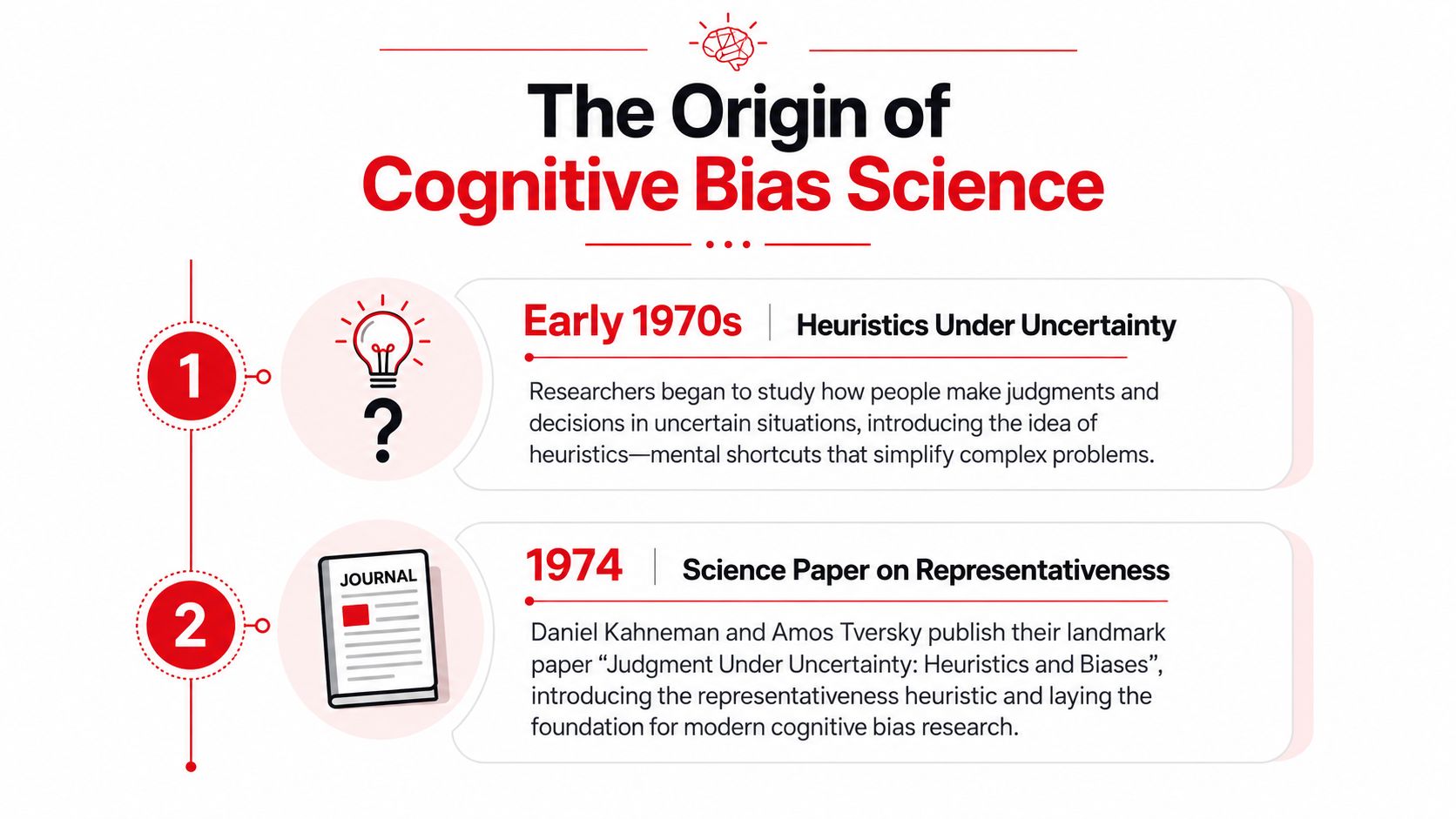
A student reads a vignette, notices one familiar clue, and the rest of the stem starts to blur. That same mental habit helped launch the modern study of cognitive bias. In the early 1970s, Amos Tversky and Daniel Kahneman turned everyday judgment errors into a formal research program, and the original heuristics-and-biases framework described how people rely on representativeness, availability, and anchoring-and-adjustment under uncertainty the original 1974 heuristics-and-biases framework. A later PubMed summary of the 1974 framework treats that work as a foundation for the field.
Why the early work still matters in medicine
The core insight was not that people are careless. It was that efficient shortcuts often work, then produce systematic and predictable mistakes when probability is hard to judge. For exam prep, that distinction matters. A repeatable error can be trained against, while a random slip usually cannot be studied in the same way.
Medicine adopted these ideas because diagnosis happens under uncertainty, with limited time and incomplete data. In that setting, bias is not a moral failure. It is the shadow side of shortcuts that are often useful, especially when a question stem is designed to reward the first plausible answer.
That is why tutor-style review works so well. You are not only checking whether the fact was known. You are also checking which clue got priority, which alternative was ignored, and whether the final choice came from reasoning or from a quick mental grab.
A related issue is workload. When working memory is crowded, it is harder to compare options carefully, and shortcuts tend to dominate. A resource on cognitive load and course engagement is helpful here because it reinforces the same idea in learning terms, heavy mental load makes close reading and deliberate comparison harder.
Six Biases That Show Up on Every Exam
A clean way to study bias is to memorize the pattern, then attach one clinical image to each pattern. On medical exams, the same six show up again and again because they map neatly onto common stem design.
| Bias | One-Line Definition | Medical Example |
|---|---|---|
| Anchoring | Fixing on the first number, symptom, or diagnosis and not updating enough | A borderline calcium value pulls you away from hyperparathyroidism even when the rest of the stem fits |
| Availability | Judging likelihood by how vivid or recent a case feels | A recent pneumonia case makes shortness of breath feel infectious before you've checked the rest of the stem |
| Confirmation bias | Seeking clues that support your first idea and ignoring disconfirming data | You keep collecting data that fits your leading diagnosis and underweight the red flags that don't |
| Framing effect | Letting the wording or presentation of the choices change your judgment | The same risk sounds different when it's described with relative terms rather than plain clinical language |
| Hindsight bias | Seeing a resolved case as obvious after the answer is known | After reading the explanation, the diagnosis feels inevitable even though it wasn't obvious in real time |
| Premature closure | Stopping the diagnostic process too early | You accept a diagnosis before asking what dangerous alternative still needs to be ruled out |
The exam value of naming the bias
Once you can name the bias, you can also name the fix. Anchoring asks for a deliberate re-read of the first clue. Availability asks whether the case feels familiar because it's recent, not because it's likely. Confirmation bias asks what would disprove your leading idea.
Framing and hindsight are more subtle, but they still matter on test day. Framing can make you prefer one option because the wording feels safer, while hindsight can fool you during review by making the right answer seem obvious in retrospect. Premature closure is the one that usually feels efficient in the moment and costly later.
Quick memory aid: if your reasoning feels fast, tidy, and too confident, check whether the question gave you just enough data to stop too early.
How Bias Distorts Exam Question Interpretation
USMLE-style and COMLEX-style stems are built to reward careful reading, not fast pattern matching. That means the bias usually starts with one cue, then pulls you toward a distractor that looks right because it matches the cue, not the whole story. The fix is to slow the mental rewrite, not the whole exam.
Five common stem traps
- Anchoring trap: A chest pain vignette gives a borderline biomarker early. Your brain jumps to acute coronary syndrome, even though the rest of the stem points elsewhere. The corrective rewrite is, “What diagnosis still explains the full picture, not just the first number?”
- Availability trap: A pediatric fever case reminds you of a vivid meningitis question you saw recently. The wrong answer feels urgent because it's memorable. The rewrite is, “Am I choosing this because it's common here, or because it's vivid in my memory?”
- Framing trap: The answer choices are written in a way that makes one option sound safer or more aggressive. The rewrite is, “What is the stem asking for, diagnosis, next step, mechanism, or disposition?”
- Confirmation trap: A lab pattern supports your first guess, so you stop checking whether a key finding is missing. The rewrite is, “What single finding would make my leading diagnosis less likely?”
- Hindsight trap: A postoperative scenario seems obvious after the explanation, but the stem itself gave only partial warning. The rewrite is, “What would I have done with this information before the outcome was known?”
A useful question-review resource for this kind of thinking is the distractor analysis guide, because the skill isn't just knowing the content, it's seeing why a wrong choice felt attractive in the first place.
When you train this way, distractors stop looking random. They become bait for a specific bias, and that makes them much easier to resist on later questions.
The best review question is often not “Why did I miss this?” but “What did the stem tempt me to do too early?”
When Bias Turns Into a Clinical Decision Error
The same shortcuts that cost points on an exam can also distort a real diagnostic decision. In clinical work, the risk is that a clinician stops searching after the first plausible explanation, especially when the case feels familiar. That's why cognitive bias belongs in both exam prep and clinical reasoning.
Three bedside patterns that mirror test-day errors
Anchoring is easy to see when a clinician attaches too strongly to a known diagnosis and misses new symptoms that don't fit. In a busy setting, that can narrow the differential before the full picture is assembled. Premature closure is similar, but the error comes from stopping the evaluation too soon, often after one reassuring data point.
Overconfidence shows up when pattern recognition feels like expertise. A clinician sees a rare autoimmune mimic, recognizes a fragment of the pattern, and assumes the rest will fall into place. That confidence can be efficient in obvious cases, but in ambiguous ones it can cut off better alternatives.
The diagnostic-error literature treats these patterns as serious because they're tied to real harm. Diagnostic errors in healthcare are commonly estimated at 10% to 15%, and one review states that roughly 75% of diagnostic errors associated with adverse outcomes are related to cognitive errors by clinicians involved in the diagnostic process diagnostic error review. A surgical review also found that overconfidence, anchoring, and confirmation bias were among the most common bias types, and anchoring and confirmation bias were associated with actual patient harm, including never events surgical systematic review.
For students, the lesson is not to become fearful of making decisions. It's to notice where the first answer feels too comfortable. The same habit that protects a patient at the bedside also protects your score on a vignette.
If you want a clinical-language overview of how reasoning fails in practice, what is clinical reasoning is a useful companion read because it keeps the focus on process, not blame.
Evidence-Based Debiasing Techniques You Can Practice
Debiasing works best when it becomes part of your question workflow, not a slogan you remember after the block. The strongest interventions are usually simple and procedural, because they interrupt the moment when the mind wants to close the case.
Five habits worth rehearsing
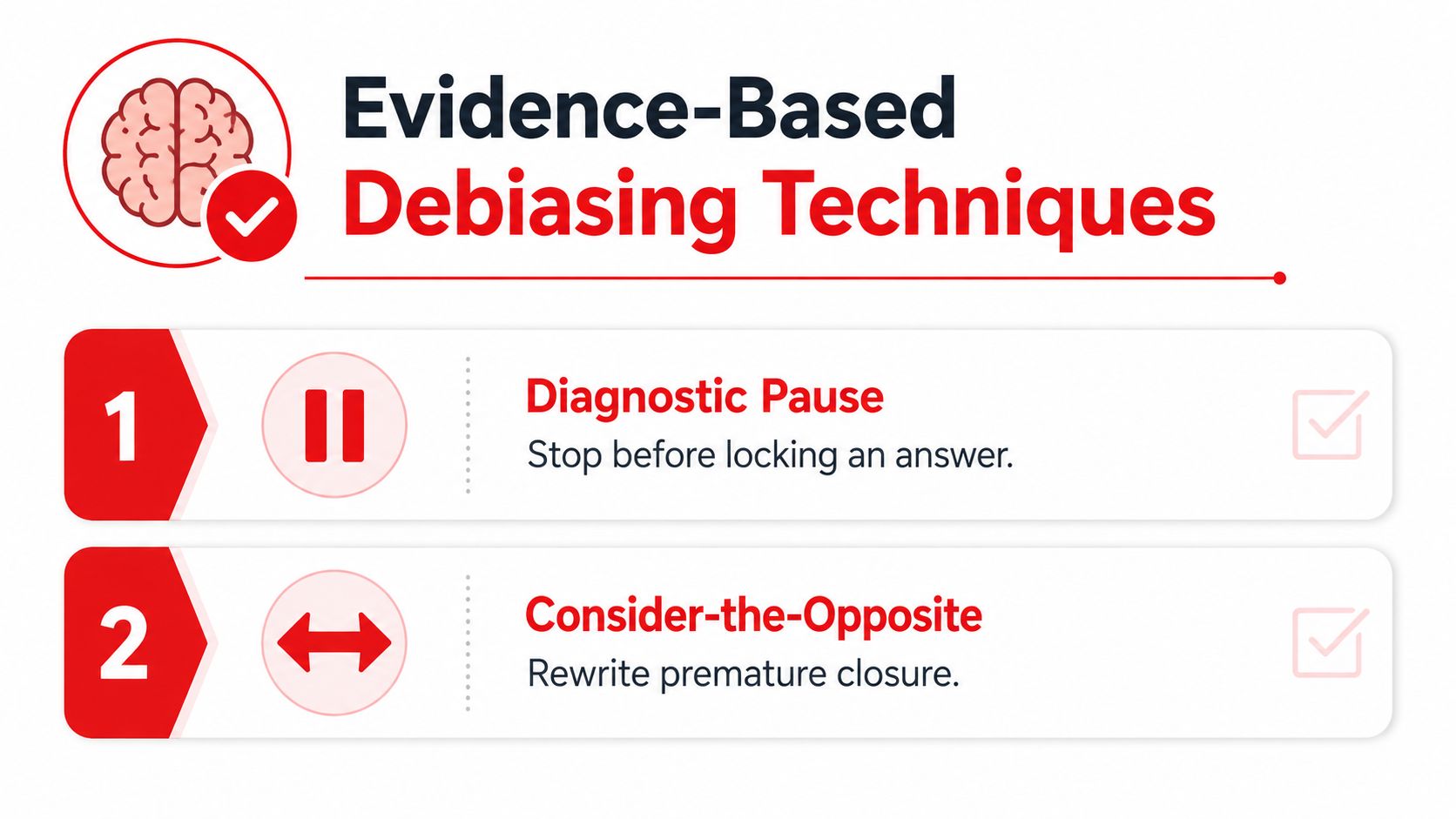
- Diagnostic pause. Stop before locking in your answer and ask what else the stem could support. This is especially useful when the first clue feels unusually neat.
- Consider-the-opposite. Write one sentence that would make your leading diagnosis less likely. That small rewrite is a direct antidote to premature closure.
- Structured differential checklist. For common presentations like chest pain, abdominal pain, fever, or dyspnea, force yourself to ask what life-threatening diagnosis you still have to exclude.
- Five-minute reflection. After a high-stakes item, spend a short block reviewing why the chosen option won or lost. This matters more when the answer felt obvious.
- Confidence calibration. After each question set, mark whether your confidence matched your accuracy. The goal is not perfect certainty, it's better self-monitoring.
Useful script: “What would I need to see for my first answer to be wrong?”
That kind of prompt fits best with metacognitive practice. A helpful companion resource is metacognitive awareness, because bias training works better when students learn to observe their own thinking while they're still thinking.
The evidence base for debiasing is encouraging but not magical. A 2026 systematic review and meta-analysis of 54 randomized controlled trials with 10,941 participants found only a small overall benefit from debiasing education, and it noted that most studies use isolated tasks in classroom-like settings rather than real-world decision-making 2026 meta-analysis. That's why these techniques should be practiced as habits, not treated as guarantees.
A short video reminder can help anchor the routine when you're studying between question blocks.
A Question Review Workflow and Case-Based Practice Plan
A good review workflow turns bias from a vague concept into something you can catch in real time. Start before you even look at the options. Write your first answer, then list two plausible alternatives, because that forces you to see whether you were about to close the case too early.
A tutor-style review sequence
- Read the scenario first. Separate objective data from risk factors, context, and your own assumptions.
- Write your initial next step. Put down the diagnosis, workup, or management move you'd pick before looking at choices.
- List two alternatives. You challenge anchoring and availability here.
- Select and justify. Use stem evidence, not memory, to defend the option you choose.
- Tag the miss. If you're wrong, label the reason as knowledge gap, misread qualifier, anchoring, availability, framing, or premature closure.
That kind of review is easier when you practice cases in a case-based format. The case-based learning medicine approach fits this well because it rewards comparison, not just recall. It also helps to rehearse with a tutor who briefly withholds the answer, because uncertainty is exactly where premature closure tends to appear.
A simple weekly practice structure
One useful rhythm is to study one bias at a time in a block of questions, then revisit the same reasoning after a short delay. When you come back later, ask whether the answer still makes sense without the emotional pull of the original mistake. That delayed review is often where the lesson sticks.
For exams like USMLE, COMLEX-USA, and Shelf questions, finish each item by identifying the task the exam is asking for, diagnosis, next step, mechanism, adverse effect, or disposition. That habit keeps you from answering a different question than the one on the screen.
If you want one plain-English way to track progress, keep a running log with three columns, what cue pulled you, what alternative you ignored, and what you'll check first next time.
Self-Audit Prompts and Further Reading
Before you click an answer, run a short self-audit. Ask, “What is the first clue I noticed?” to test for anchoring. Ask, “Am I choosing this because it feels familiar or because it fits?” to check availability.
Then ask, “Which finding would disconfirm my leading diagnosis?” for confirmation bias, and “Would I still choose this if the question were framed differently?” for framing. Finish with, “Am I stopping before I've considered the most dangerous alternative?” to catch premature closure. Also check whether you've identified the question's time frame, severity, and requested action, because those details often decide the answer more than raw familiarity.
Those prompts support medical knowledge, they don't replace it. A student still needs the disease framework, the probability thinking, and the ability to interpret exam wording correctly. Bias training makes error-producing thought patterns visible, which is useful, but it can't guarantee a correct answer or eliminate all mistakes.
For deeper reading, start with Tversky and Kahneman's original work on judgment under uncertainty, then move to Thinking, Fast and Slow for accessible background and How Doctors Think for clinical stories that feel familiar to medical learners. For evidence-based diagnosis and diagnostic safety, the Society to Improve Diagnosis in Medicine is a strong place to explore further resources.
If you want help turning missed questions into cleaner reasoning, Ace Med Boards works with medical students on USMLE and COMLEX-style thinking, including how to spot anchoring, confirmation bias, and premature closure in stem-based questions. Visit Ace Med Boards to see how a structured review session or free consultation can help you build a more reliable question-review process.