
More hours and more resources don't guarantee better performance on a medical board exam. A stronger system starts with retrieval practice, spacing, interleaving, feedback, and transfer to unseen questions, then measures whether you can recall and apply information later, not whether you spent another hour rereading it.
A practical answer to the question, “What's the best strategy for studying a new USMLE topic?” is simple: first retrieve the core concepts, then schedule them across spaced reviews, then test them in mixed, unfamiliar questions and analyze every error. That approach fits the evidence from cognitive science and the way board-style exams require learners to recognize, reason through, and transfer knowledge.
Why More Hours and More Resources Don't Guarantee Higher Scores
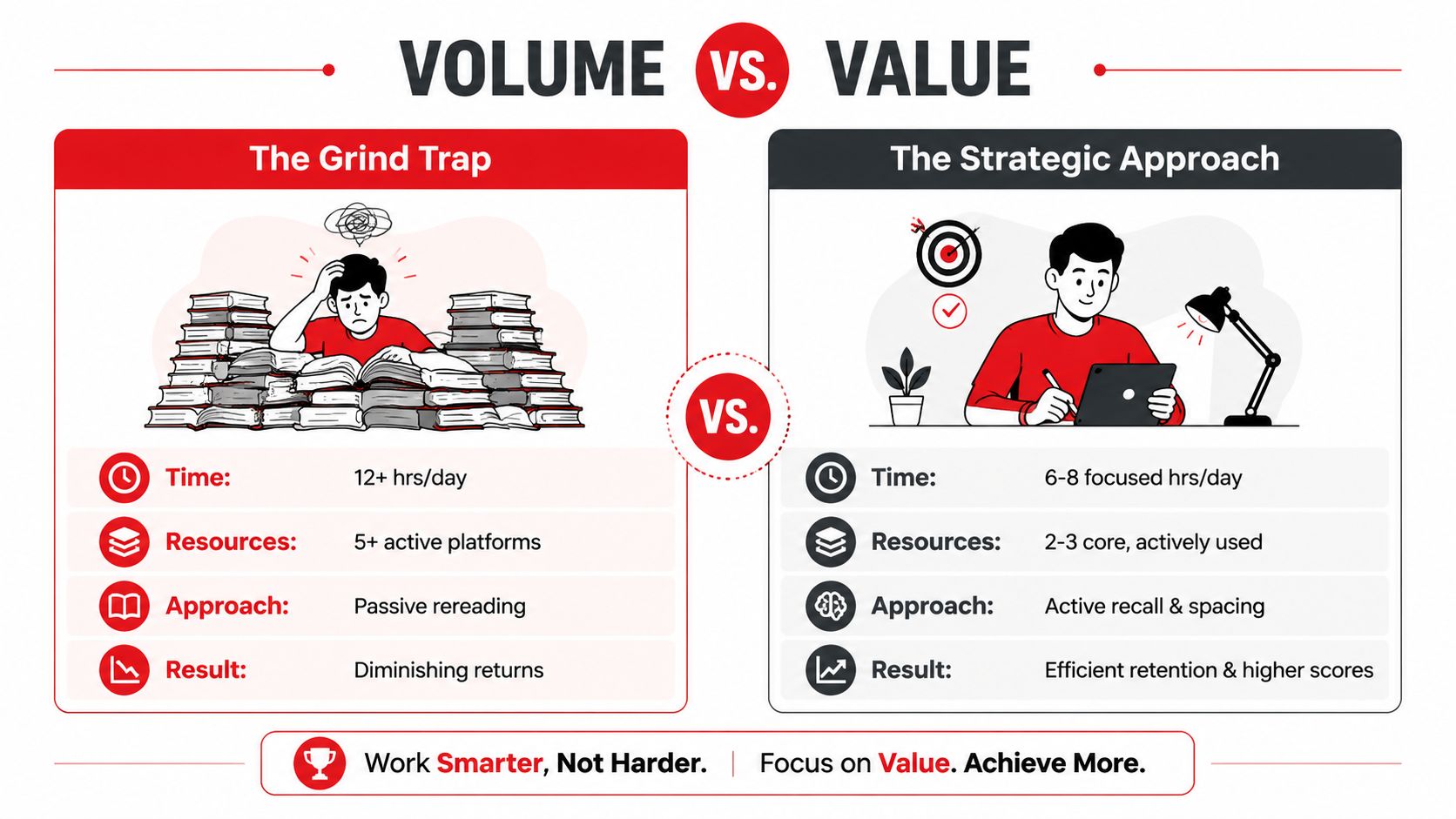
Long study days and crowded resource lists can produce the feeling of progress without improving exam performance. Time spent with information isn't the same as information you can retrieve under pressure. Rereading notes feels smooth because the material looks familiar, yet that familiarity may disappear when a question presents the same concept through a different clinical frame.
The stronger measure is what you can produce without looking. Research comparing study methods identifies retrieval practice and spacing as well-supported strategies in cognitive science. One review reported a large advantage for spaced retrieval over massed retrieval, while broader reviews found meaningful benefits for spaced practice and retrieval-based learning (review of retrieval and spacing research).
Passive volume versus useful difficulty
A learner can spend a full day moving between lectures, videos, flashcards, and question banks without creating a reliable feedback loop. Another learner may use fewer tools but repeatedly answer questions from memory, revisit missed concepts, and check delayed recall. The second routine often feels harder because it exposes uncertainty instead of hiding it.
That difficulty becomes useful when it leads to correction. After each question, record whether the error came from a knowledge gap, a missed clue, faulty reasoning, or careless execution. Then write the smallest correction that would prevent the same mistake. Your log becomes a map of recurring weaknesses, not a scrapbook of everything you have read.
Practical rule: Count completed retrieval tasks, corrected errors, delayed recalls, and transfer tests. Don't use hours alone as your definition of progress.
Resource overload creates a related problem. Evidence on Step 2 Clinical Knowledge preparation found that students used an average of 4.4 resources, while the authors recommended emphasizing active learning with only 1–2 question banks and using other materials judiciously (medical education study on Step 2 Clinical Knowledge resources). More material can fragment attention and reduce the number of times you revisit previously missed concepts.
Set up a small core: an official exam outline, a primary question bank, a review tool, and an error log. Place those items on a weekly calendar, assigning new questions, error review, and delayed retrieval to specific days. If you're deciding how to treat preparation as an educational investment rather than a collection of purchases, review this guide to investing in your medical education. The objective is durable recall, accurate reasoning, and consistent correction.
Setting a Measurable Exam Goal and Running a Diagnostic
More study hours do not automatically produce readiness. Before building a calendar, define the outcome you are preparing for and the evidence that will show you are ready. For Step 1, the United States Medical Licensing Examination reports pass/fail for exams administered on or after January 26, 2022. Exams taken on or before January 25, 2022 retained a three-digit score and pass/fail status, as described in the USMLE common questions. Current Step 1 planning should therefore center on competency and reliable performance, not chasing a numeric score.
For scored exams such as Step 2 Clinical Knowledge, COMLEX-USA, or the Medical College Admission Test, use the current official score-reporting information and outline for your specific test. A forum target or a single practice result cannot define readiness by itself. State the exam, testing window, desired outcome, and performance evidence you will accept.
Run a diagnostic before you study harder
Begin with a timed, mixed diagnostic that resembles the reasoning demands of the exam. Follow the current official blueprint and practice-material guidance from the responsible organization, such as the USMLE examination content outlines or NBOME COMLEX-USA examination information. Do not pause to search for facts or turn the attempt into a teaching session. The purpose is to measure your starting point under realistic conditions.
Classify every missed or uncertain item by cause. A wrong answer identifies the result, not the reason. Your error tag should lead directly to a correction.
| Error Tag | Definition | Corrective Action Example |
|---|---|---|
| Content gap | You did not know or could not recall the tested concept. | Write a concise question and answer, then schedule delayed retrieval. |
| Misread | You knew the concept but missed a qualifier, timeframe, or key finding. | Re-read the stem and check qualifiers deliberately before choosing. |
| Reasoning flaw | You recalled facts but connected them incorrectly or chose an unsupported distractor. | Explain why the correct answer fits and why each distractor fails. |
Record the topic, question task, error type, correction, and planned review date. Add a fourth tag, careless execution, when the concept and reasoning were sound but pacing, attention, or answer transfer caused the miss. This turns the diagnostic into a control panel for your week: each error becomes a scheduled action rather than another page to reread. For help converting a baseline into trackable objectives, use this measurable performance-goals framework.
Turn the goal into weekly evidence
Choose evidence you can inspect at the end of each week:
- Delayed recall: Can you answer reviewed prompts without cues?
- Timed accuracy: Are you choosing correctly at realistic speed?
- Recurring error tags: Which causes continue to appear?
- Completion: Were the scheduled tasks realistic enough to finish?
- Transfer: Can you solve a new question instead of repeating the original explanation?
USMLE-focused research among international medical graduates found that some study volumes and schedules were associated with higher mean scores, yet specific habits were not significantly related to passing Step 1 or reaching the national average Step 2 Clinical Knowledge score (USMLE self-study research). Volume can support preparation. Diagnosis, retrieval, and targeted correction determine whether that effort changes performance.
Building Retrieval Practice and Spacing Into Your Daily Routine
Retrieval practice means forcing your brain to produce an answer before you look at the explanation. A flashcard, blank-page brain dump, oral explanation, or question block can qualify when it requires recall rather than recognition. Reading an answer and thinking “that makes sense” is review, not a reliable retrieval test.
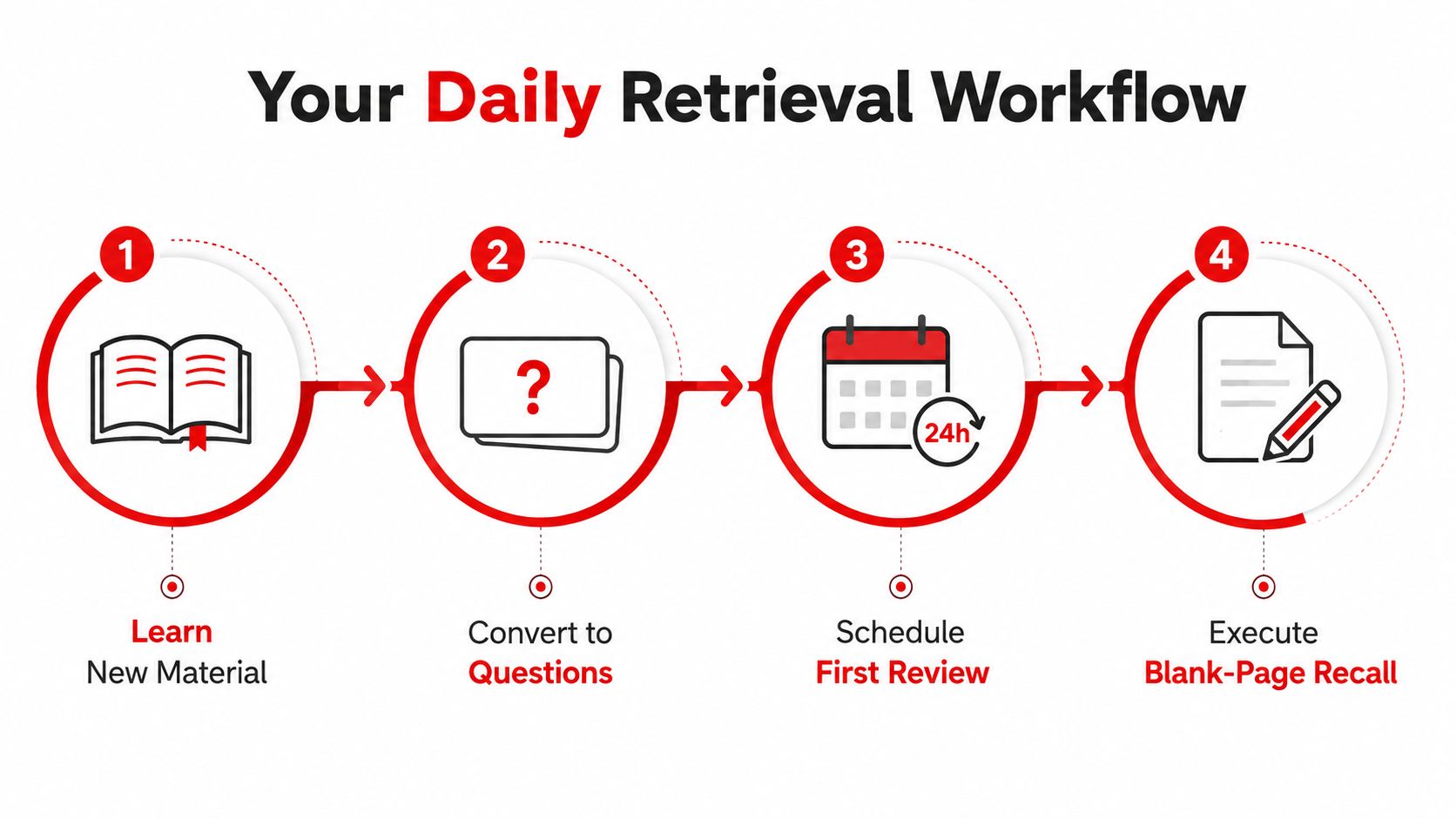
A new topic can follow a three-part workflow:
- Build a compact representation. Use words, pathways, tables, or a useful diagram that fits the material. “Learning styles” labels don't justify matching instruction to a preferred sensory mode. Choose the representation that makes the physiology, pathology, pharmacology, or clinical relationship clear, and combine words with diagrams when the diagram adds information.
- Convert the representation into prompts. Ask questions that require a specific answer, such as mechanism, distinguishing finding, next reasoning step, or explanation of a distractor. Keep prompts narrow enough that you can identify exactly what you forgot.
- Transfer the concept. Use mixed, unseen questions after initial review. The aim is not to memorize the wording of a source item. It's to recognize the underlying task when the presentation changes.
Use spacing and interleaving deliberately
A practical starting schedule is to revisit a prompt after 1, 3, 7, and 14 days, then lengthen or shorten the interval based on performance. These intervals are a planning model, not a universal law. If you miss an item, bring it back sooner. If you recall it confidently and explain it accurately, move it farther out.
Interleaving means mixing related but distinct topics instead of completing one large massed block. A session might combine renal physiology, acid-base interpretation, diuretic mechanisms, and an unrelated infectious-disease task. The mixture makes recognition less automatic and forces you to decide which framework applies.
A labeled composite learner spends four hours rereading but can't retrieve facts the next day. The plan converts notes into questions, schedules reviews at expanding intervals, mixes related topics, and checks retention one week later on unseen items. The learner doesn't need a more elaborate collection of resources. The learner needs a visible cycle from question, to recall, to feedback, to delayed transfer.
A second-pass explanation can use deepen learning with the Feynman method, provided you use it as an explanation check rather than a substitute for testing. For official alignment, compare your prompts with the current USMLE content outline and preparation materials. You can also use a dedicated spaced-repetition study approach to keep review intervals visible.
Using Question Banks Strategically Without Resource Overload
A question bank should function as a diagnostic instrument and reasoning exercise, not as another textbook. Before opening a block, assign it one job: teach a new approach, measure current performance, or rehearse pacing. That label gives your results meaning. A teaching block can reveal how to reason through unfamiliar material, while an assessment block shows whether you can retrieve and apply that reasoning without help.
Use tutor mode while building a framework and reviewing feedback immediately. Use timed mode to examine pacing, stamina, and independent decisions. Switching modes without recording the purpose can make a score look better or worse for reasons unrelated to learning.
Review questions by task
Every missed or uncertain item should produce a small entry in your error log:
- The task: What did the question require you to identify, calculate, compare, or predict?
- The error type: Was the problem a content gap, a misread, or a reasoning flaw?
- The correction: What single rule, relationship, or reading habit would prevent the mistake?
- The transfer test: What new prompt will show that the correction holds?
Write a retrieval prompt, not a transcript of the explanation. For example, ask yourself to explain why a physiologic change shifts a laboratory pattern, without copying a recalled or copyrighted examination item. The prompt should force you to reconstruct the reasoning later, like rebuilding a pathway from landmarks rather than rereading a map.
Re-test selected errors after a delayed interval, such as 7–14 days. Record both accuracy and explanation quality. Recognizing familiar wording is weaker evidence than explaining why each distractor fails and applying the concept to a different presentation.
Audit your resource stack
A lean resource stack protects the review time that turns questions into learning. Keep a primary question bank for regular reasoning and assessment, then add another only when it supplies unfamiliar transfer practice. A recent Step 2 Clinical Knowledge resource study supports prioritizing active learning and 1–2 question banks rather than collecting a broad set of overlapping materials.
| Resource | Primary Role | Weekly Time Cost | Error-Log Integration | Keep or Cut? |
|---|---|---|---|---|
| Primary question bank | Main reasoning and assessment tool | Record actual time | Every missed or uncertain task enters the log | Keep if reviewed deeply |
| Second question bank | Additional unfamiliar transfer practice | Record separately | Add only errors that reveal a new gap | Keep selectively |
| Video or text reference | Clarify one unresolved concept | Limit to targeted use | Link the explanation to a prompt | Cut if used for passive rereading |
| Flashcard system | Delayed retrieval | Track review burden | Tag prompts by error cause | Keep if reviews remain manageable |
For a focused comparison of how question banks may fit a Step 1 plan, review these USMLE Step 1 question-bank considerations. A resource earns its place by improving recall, reasoning, feedback, or transfer. If it repeats another source and leaves too little time for error-log review, remove it. Your calendar should show questions, correction, and later retrieval, not an ever-growing pile of unfinished material.
Running Weekly Adjustment Cycles Based on Real Data
A study plan earns revision when your results expose a mismatch. Set one review time each week and examine accuracy, retention, pacing, workload, and error patterns together. Logged hours add context, but they cannot decide your next schedule alone.
Use a four-part weekly dashboard
Record these measures in a spreadsheet, study app, or progress-tracking dashboard:
- Accuracy: Compare timed performance with tutor-mode performance. A gap suggests that knowledge may be present, but retrieval or decision-making slows under exam conditions.
- Retention: Revisit previously missed concepts at the planned interval and record whether you can recall the reasoning without reopening the explanation.
- Pacing: Note whether you finish blocks steadily or rush the final questions. Repeated late rushing points to a timing problem, not merely a content gap.
- Workload: Rate the week's cognitive burden using the same scale each time. A high rating calls for schedule review, not self-criticism.
Match the adjustment to the pattern. Flat accuracy with declining delayed recall calls for less new material and a repaired review schedule. Rising accuracy with slow pacing calls for timed, mixed blocks. If the workload remains unsustainable for two consecutive weeks, protect a recovery day and remove low-value tasks.
Let errors choose the next topic
A Step 2 Clinical Knowledge learner may find cardiovascular questions comfortable while renal questions repeatedly trigger reasoning errors. More cardiovascular review would feel productive, but it would leave the recurring weakness untouched. Shift time toward renal physiology, fluid disorders, and related clinical reasoning. Then test those skills in mixed questions so improvement transfers beyond an isolated topic block.
The medical education study on evidence-based strategies supports giving active methods a central role. Its findings do not identify one schedule for every learner. They support a practical rule: judge study methods by the quality of retrieval, feedback, and application they produce.
A 2026 medical education meta-analysis found that spaced repetition outperformed standard studying across the reviewed learners. The review also noted that intervention design and delivery need further study. Use spacing as a working system, then adjust its intervals and workload when your retention data shows a problem.
Write down the reason for every change. That record separates a planned response to recurring evidence from an emotional reaction to one difficult question block, keeping the next week focused on the errors most likely to affect exam performance.
Your Weekly Retrieval Calendar and Error Log Framework
A calendar becomes useful when each day has a cognitive purpose. The template below separates new learning, first retrieval, mixed transfer, delayed retrieval, assessment, and planning. Adapt the time blocks to your clinical schedule, but preserve the order of retrieval and feedback.
7-day retrieval calendar
| Day | Primary Task | Retrieval Method | Time Block | Focus Area |
|---|---|---|---|---|
| Monday | Encode new material | Blank-page recall after study | Morning and afternoon blocks | Topic cluster identified from diagnostic |
| Tuesday | Add new material and test Monday's concepts | Question prompts and short free recall | Two focused blocks | Second topic cluster plus Monday review |
| Wednesday | First delayed retrieval pass | Flashcards, cloze prompts, and oral explanation | One review block | Monday and Tuesday material |
| Thursday | Mixed transfer practice | Timed, unseen questions | One or two blocks | Interleaved organ systems and disciplines |
| Friday | Second delayed retrieval pass | Error-log prompts and distractor explanations | Review block | Missed concepts from earlier days |
| Saturday | Cumulative assessment | Timed mixed block, followed by analysis | Assessment plus review | Broad exam-aligned coverage |
| Sunday | Review and planning | Delayed recall, error audit, schedule adjustment | Short review and planning blocks | Recurring errors and next week's priorities |
Don't fill every available space with new content. A calendar that schedules review but never protects time to complete it will create a growing backlog and reduce the value of spacing.
Error log template
Use one spreadsheet row per question task. Include the original question-bank identifier without copying the question text.
| Question Task | Error Type | Correction | Next Review Dates | Transfer Test |
|---|---|---|---|---|
| Identify the mechanism behind an acid-base pattern | Content gap | Write one mechanism prompt and answer it from memory | 1, 3, 7, and 14 days | Explain the pattern in a new clinical context |
| Select the key qualifier in a vignette | Misread | Mark timeframe, severity, and negative findings before answering | 3 and 7 days | Complete a timed item with a different presentation |
| Distinguish two similar diagnoses | Reasoning flaw | Compare the decisive findings and reject each distractor | 1, 7, and 14 days | Explain why the leading alternative is less likely |
Color-code entries by status, not emotion. For example, use one status for awaiting first review, another for recalled accurately, and another for recurring errors. Archive a problem only after you've passed its transfer test. If the same error returns, reopen it with a new corrective action rather than merely marking it complete.
Exam Day Tactics and Next Steps for Your Preparation
Exam day rewards reliable retrieval, not last-minute accumulation. Your task is to access practiced knowledge, control pacing, and prevent one difficult item from affecting the next block.
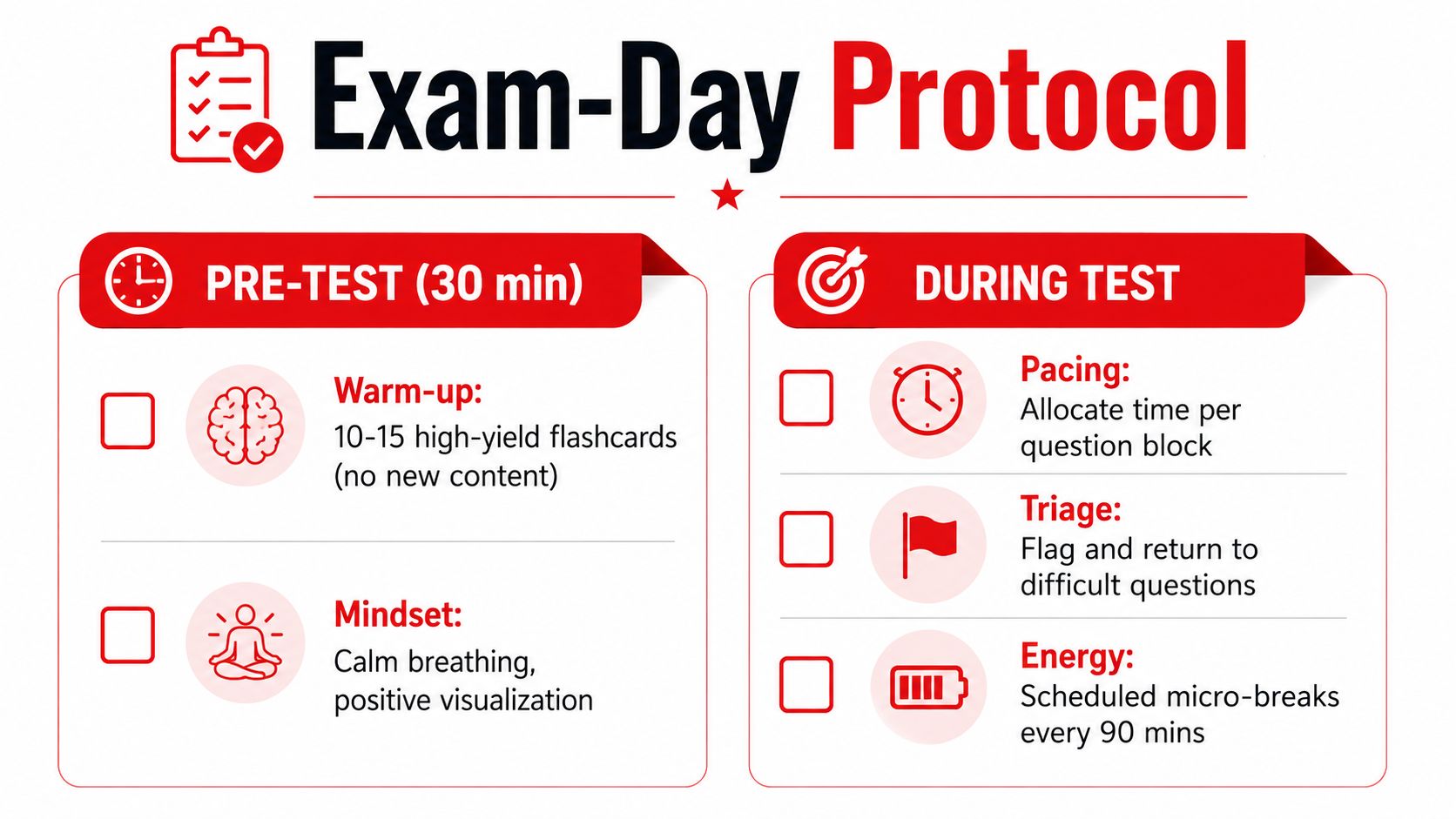
Use the final 30 minutes before testing for a brief warm-up of 10–15 high-yield flashcards, with no new material. Select familiar prompts that activate retrieval without triggering a rush to learn more. Confirm the current instructions from the organization administering your exam, since break rules, identification requirements, and testing procedures can change.
Use a simple decision rule
If a question consumes too much time, choose the best-supported answer, flag it, and continue. A 90-second flagging rule can protect the rest of a block, but set it against the official timing and format of your examination.
During breaks, hydrate, use a small planned source of energy if it suits you, and complete a brief breathing reset. Avoid reconstructing every previous question with other examinees or changing answers because anxiety makes the first choice feel uncertain. Change an answer when you find a concrete misread or a clear contradiction in your reasoning.
Your preparation system should produce observable checkpoints: delayed recall, timed accuracy, recurring error tags, completion, and the ability to explain why distractors are wrong. These measures give you something controllable when a score or outcome remains uncertain.
A learner who spends four hours rereading but cannot retrieve facts the next day needs a different workflow, not more study time. If you are plateaued, unsure how to interpret an NBME or AAMC practice result, or unable to turn an error log into a workable calendar, a free Board Score Audit can help organize the problem. Ace Med Boards offers one-on-one online tutoring and study-strategy guidance for medical board preparation, including structured schedules, practice-question analysis, active recall, and spaced repetition.
Visit Ace Med Boards to discuss your current preparation, error log, and next study decisions through a free consultation. Bring recent practice information and the areas where your plan keeps breaking down, so the discussion can focus on a workable retrieval-based system rather than adding hours without measurement.