
You probably don't need another generic “take more practice tests” pep talk. If your MCAT practice test scores are bouncing around, the problem is usually calibration, not effort. The fix is to use official AAMC material as your anchor, treat third-party scores cautiously, and review every exam like data, not as a grade.
Key Takeaways
- Official AAMC full-lengths should anchor your prep because they match the MCAT blueprint, timing, interface, and scoring logic most closely.
- More tests without better review is wasted effort. Every missed or guessed question needs an error label.
- Use third-party tests for volume, not final calibration. Their scores can be useful, but they don't replace official practice exams.
- Your last two AAMC full-lengths matter more than one isolated score. Read them as a range and look for stable trends.
- A good practice cycle ends with a readiness checkpoint, not blind optimism.
Why Your MCAT Practice Test Strategy Matters More Than Volume
A student can grind through six full-lengths and still have a flat score if every exam is treated like a receipt instead of a diagnostic. A MCAT practice test should show two things, where you stand and what you need to fix next. If it only gives you a number, you are wasting the best part of the exercise.
The MCAT is a standardized, computer-based exam with four sections, Chemical and Physical Foundations of Biological Systems, Critical Analysis and Reasoning Skills, Biological and Biochemical Foundations of Living Systems, and Psychological, Social, and Biological Foundations of Behavior AAMC exam overview. Scoring runs from 118 to 132 per section, with a total score from 472 to 528, and there is no penalty for guessing because scoring is scaled and equated across test dates AAMC score explanation. That means your practice has to train accuracy, timing, and decision-making, not just content recall.
Start with a same-condition baseline
Your first full-length should happen under real conditions. Use timed sections, official timing, and a quiet setup that matches test day as closely as possible. The point is not comfort. The point is truth.
Practical rule: If the practice environment is sloppy, the score is sloppy too.
Once you have that baseline, sort every miss into three buckets. Content weakness means you did not know the material. Reasoning weakness means you knew the topic but chose the wrong path. Pacing weakness means the question was beatable, but time control failed.
A score that looks “fine” while repeat errors keep showing up is a trap, not progress.
That workflow gives you a clear error taxonomy, and it keeps you honest about calibration gaps between third-party exams and official AAMC material. Use it every time, not only when a score disappoints you. If you want a structured primer on MCAT prep habits, the MCAT preparation tips guide helps reinforce that baseline-first approach.
Official AAMC Exams Versus Third-Party Practice Tests
A poor score interpretation usually starts with using the wrong yardstick. Official AAMC exams are the benchmark. AAMC's current prep suite includes two free full-length exams, five low-cost full-length exams, and the unscored sample, all built with test-day-like timing and functionality AAMC official prep hub. The MCAT's scoring, format, and percentile references are all AAMC-controlled, and the percentile tables are updated over time AAMC percentile ranks.
Commercial tests still have a place, but they are not equal predictors. Independent prep analyses report that commercial practice scores can differ from official AAMC practice materials by about 4 to 8 points on average, while AAMC full-lengths are typically the tightest predictor band at roughly ±2 to ±3 points Bootcamp score calculator. That gap matters. A student who treats a third-party 510 like an AAMC 510 can make a bad call about readiness.
Use each type for a different job
Official exams are for calibration. Third-party tests are for stamina, content volume, and repetition. If you reverse those roles, you will trust the wrong signal.
| Criteria | Official AAMC Exams | Third-Party Tests |
|---|---|---|
| Content alignment | Closest match to the actual MCAT blueprint | Useful, but variable |
| Difficulty calibration | Best available benchmark | Can run easier or harder than official material |
| Explanation quality | Strong official structure, especially for review | Often stronger on volume than on precision |
| Best use case | Late-stage verification and score interpretation | Early and middle-phase practice volume |
AAMC's own prep materials give you the official full-length set, but they do not tell you how to use it intelligently AAMC official prep hub. Use the official exams when you need a real answer about readiness. Use commercial exams when you need more reps, then translate the score through the calibration gap instead of taking it at face value.
The right question is not which test feels hardest. The right question is whether your score is close enough to the official benchmark to trust your decision. If the gap is wide, you are still guessing. If you want a clean reference point for official full-length usage, the AAMC MCAT full-length resource page lays out the options clearly.
Building a Phased Practice Test Schedule
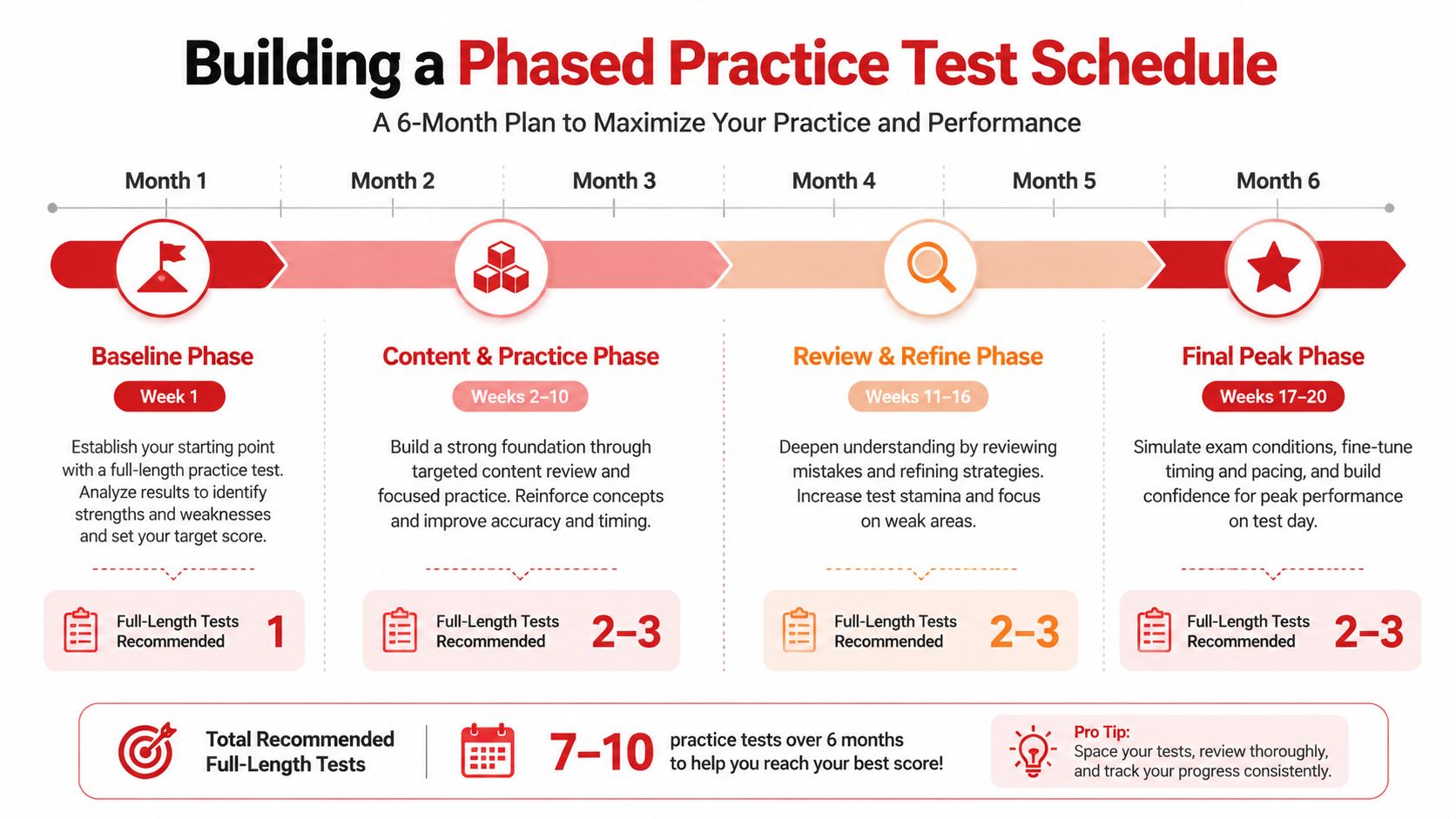
A full-length every week is the wrong starting point. Begin with a baseline, move into targeted work, then finish with verification under test-like pressure. That order keeps you from burning through exams before your habits are good enough to make the scores useful.
The AAMC says the current MCAT redesign launched in April 2015, and the exam has used a modern, computer-based format since 2007 MCAT format history. That setup is why practice tests need to feel like a real simulation, not a casual quiz.
A phased schedule built for results
Use this order:
- Baseline phase. Take one official AAMC sample or scored exam under exact test conditions. Treat it as a diagnostic for timing, endurance, and raw gaps.
- Targeted-drill phase. Spend your weeks on content review, active recall, and timed mixed sets. A full-length belongs later, after the biggest misses are patched.
- Verification phase. Use official AAMC full-lengths to check whether your fixes survive real pacing and passage pressure.
- Final peak phase. Keep the last stretch focused on consistency, recovery, and clean decision-making. Do not turn it into panic review.
Here's a weekly rhythm that holds up:
- Monday: Review the last test, update the error log, and redo missed concepts.
- Tuesday: Targeted content review and short timed sets.
- Wednesday: Mixed practice, section drills, and passage analysis.
- Thursday: Light review and pacing work.
- Friday: Full-length or a high-intensity timed block, depending on the phase.
- Saturday: Deep review of misses and guesses.
- Sunday: Recovery, flashcards, and low-pressure retrieval.
The 6-month MCAT study schedule is a useful companion if you want to map this into a broader timeline.
If you want a clean way to place these phases on the calendar, use this 6-month MCAT study schedule as the framework and slot your official exams into the verification and final peak stages.
Know when to reschedule
Two consecutive official assessments with wide score swings are not a stable readiness signal. The same is true if your error log keeps showing the same weak areas, especially in high-yield material. In that case, postpone the test. Guessing is expensive, and a rushed date does not fix a broken pattern.
The Post-Test Review Protocol That Drives Improvement
A practice test without review is expensive entertainment. The score matters less than the pattern underneath it, because the pattern tells you what to fix before the next exam. That is where most students waste time.
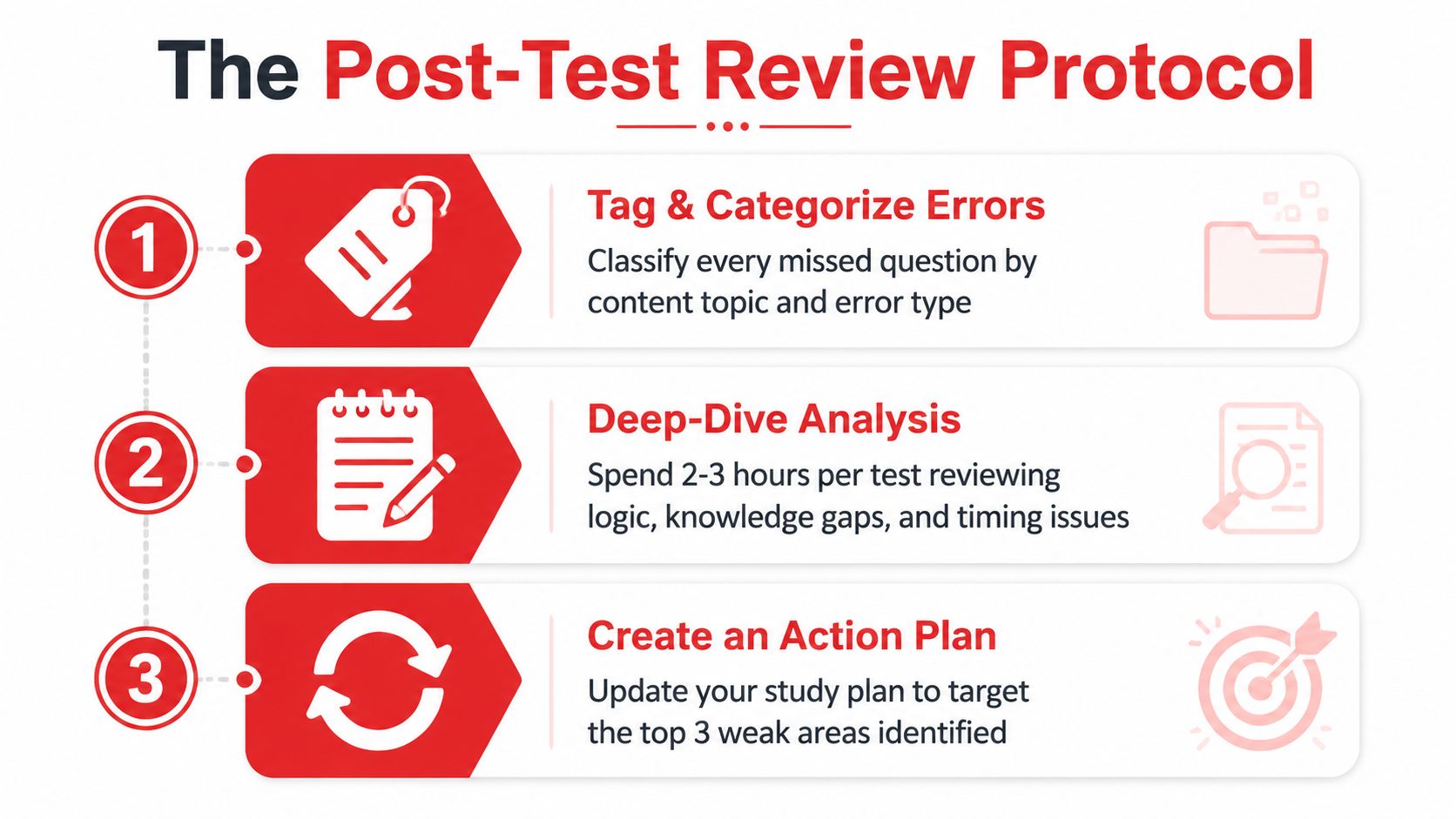
Build a section-level error log for every miss and every shaky correct answer. Record the topic, then name the cause. Keep the system simple enough that you use it.
Use a four-category error taxonomy
Tag each item as one of these:
- Knowledge gap. You did not know the fact, definition, pathway, equation, or concept.
- Reasoning error. You had the content, but the logic broke.
- Misread. You missed a qualifier, changed the meaning, or misunderstood the prompt.
- Pacing issue. You knew enough, but time pressure pushed you into a rushed choice.
That distinction matters because each error type needs a different fix. A knowledge gap needs re-study. A reasoning error needs question analysis. A misread needs slower parsing and tighter annotation. A pacing issue needs timed reps, not more flashcards.
The distractor analysis guide helps when wrong answer choices keep pulling you off track. Use it on real misses, not as abstract theory.
Turn the review into an action plan
End every review session with three decisions.
- Identify the top three recurring patterns. Do not chase ten small problems at once.
- Assign each pattern to one fix. Re-study, timed set, or reasoning drill.
- Schedule the fix before the next full-length. If it is not on the calendar, it will not happen.
A clean review checklist keeps you honest:
- Did I miss this because I did not know it, or because I used the wrong method?
- Did I get the right answer for the wrong reason?
- Did I lose points early in the section and then rush the rest?
- Would I miss a similar question again without prompting?
Use the AAMC historical percentile ranks only as a checkpoint, not as a crutch. They help you compare performance to the exam's expectations, but they do not tell you whether your weak spots are fixed. That calibration gap between third-party exams and official AAMC tests is the part most students ignore.
If your review shows a pattern that keeps repeating, the score is telling you to stop and correct it. Pair that pattern with question-level error analysis, then test again under stricter conditions. If the same mistake survives the retest, it is not a one-off. It is a real weakness that still needs work.
Integrating Practice Test Data with Tutoring and Study Plans
The best tutoring sessions start with evidence, not vibes. Bring your error log, your score trend, and your timing notes, and you'll get a much sharper session than if you just say, “I'm bad at CARS.” A tutor can't fix a vague complaint, but they can absolutely help you decode a repeat pattern.
One useful option for students who want that kind of support is Ace Med Boards, which offers one-on-one tutoring and study-plan guidance for MCAT prep one-on-one tutoring benefits. I'm mentioning it here as one tool in a larger process, not as a shortcut. The value still comes from what you bring into the session.
Use test data to direct your study time
If one section keeps slipping while another is stable, stop giving both sections equal attention. That's inefficient. Your calendar should reflect the difference between a section that needs rescue and one that just needs maintenance.
Practical rule: Protect strength, but don't feed it at the expense of your weakest section.
When you meet with a tutor or adjust your own plan, discuss three things clearly. First, where the error happened. Second, what kind of error it was. Third, whether the same problem appears under time pressure or only in untimed review.
A clean summary helps:
- What I missed.
- Why I missed it.
- What I changed afterward.
That structure keeps tutoring sessions from turning into a generic content lecture. It also helps you avoid the common trap of spending more time on comfortable material because it feels productive.
Your Readiness Checkpoint and Final Verification Plan
One solid full-length does not mean you are ready. Readiness comes from the pattern across your last two AAMC full-lengths, then comparing that range with the score you need. AAMC percentile tables shift over time, so score interpretation depends on the reporting window, not on one universal cutoff.
One concrete anchor from the current file, 74% of total MCAT scores were at or below 508 across 2022, 2023, and 2024 combined. That does not predict your score. It does show why a single practice result can mislead you if you ignore the distribution behind it.
Use this final verification checklist
- Consistent score target. You have hit your goal across multiple official tests, not just one lucky day.
- Downward error trend. Your weak areas are shrinking, not repeating.
- Completed AAMC materials. The official prep set is built into your workflow, not sitting unused.
- Simulated full days. You have already handled the mental load of an exam-length day under real conditions.
Keep the final week light and deliberate. Do not cram in a huge new content push at the end. Use a short timed set, review your error log, and protect sleep and focus.
If your last two AAMC exams still show a wide spread, or your error log keeps exposing the same high-yield misses, move the date. Postponing is a sign of strategic judgment, not weakness.