
What if the most important question in the DO degree vs MD decision isn't which curriculum is “better,” but where the difference becomes consequential during residency selection? Both degrees lead to physician licensure in the United States and comparable scope of practice. The practical distinction emerges more sharply when you consider specialty competitiveness, program type, examination strategy, geography, and your own academic goals.
What the DO Degree vs MD Question Means for You
Could the degree matter less than the specialty you plan to enter? For applicants, MD and DO are parallel routes to becoming a licensed U.S. physician, yet residency programs may interpret the two credentials differently. That difference is most visible in highly competitive specialties and academic programs, not as a fixed limit on a physician's career.
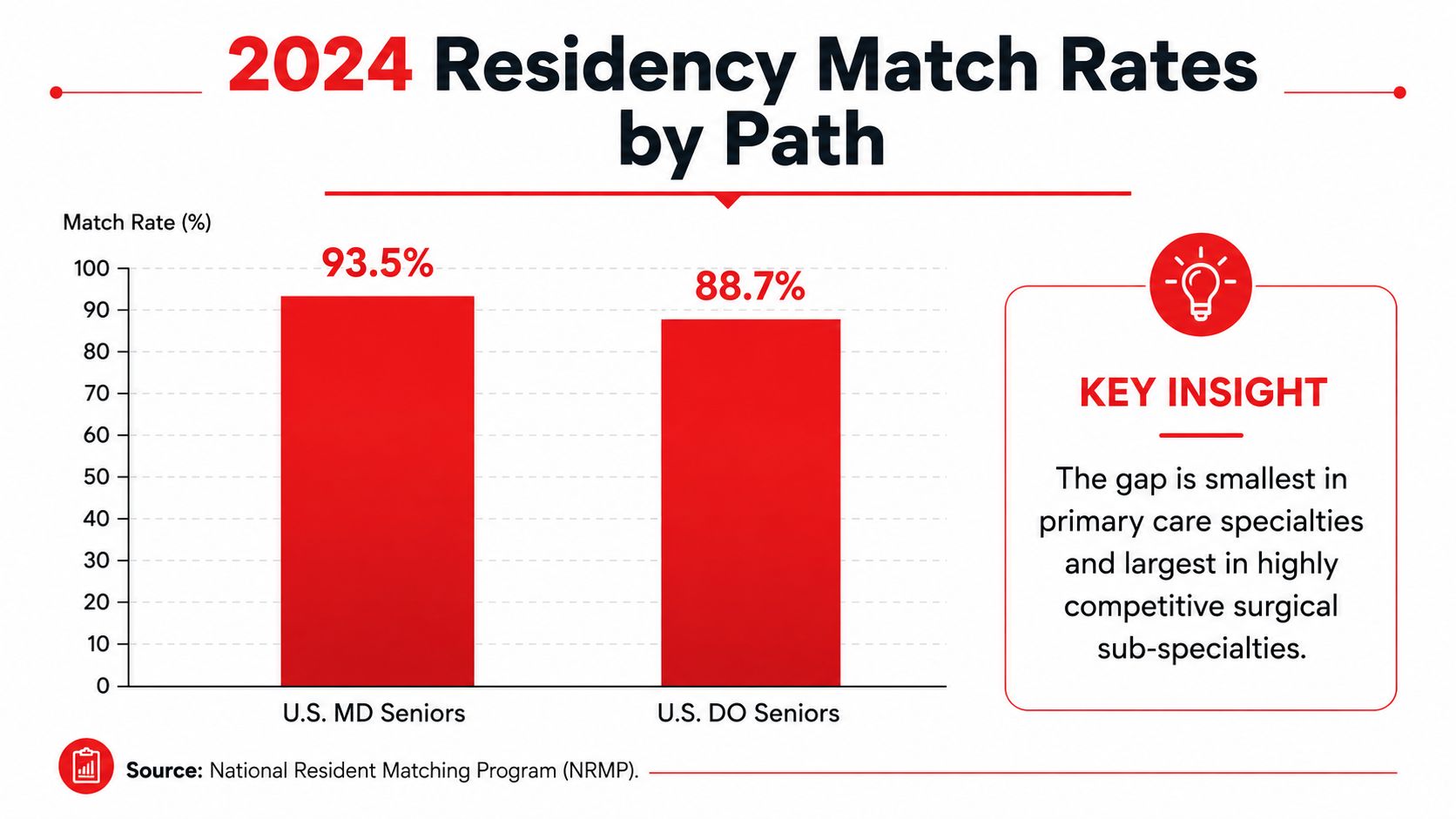
The broad residency picture is relatively close. In the 2024 NRMP Main Residency Match, U.S. allopathic seniors matched at 93.5%, compared with 92.3% for U.S. DO seniors (NRMP match coverage from the AMA). These national figures describe overall placement, however, and can conceal substantial variation by specialty.
Specialty tier changes the comparison
Applicants pursuing family medicine, internal medicine, pediatrics, or another field with broader program availability may encounter a different degree-related effect than those targeting orthopaedic surgery or another selective surgical subspecialty. The useful question is not whether a DO can become a physician. The answer is yes. It is which specialty, program group, examination record, clinical performance, research portfolio, and letters will shape the application.
A peer-reviewed analysis illustrates the concentration of the difference. Across selected higher-demand surgical subspecialties in 2023, summed match rates were 52.89% for DO applicants versus 73.61% for MD applicants. That comparison should not be generalized to every specialty, but it shows why an overall match percentage can provide an incomplete planning signal.
Practical rule: Treat degree type as one application variable, not as a verdict on your potential.
What this guide will help you decide
Premedical applicants can compare school fit, curriculum, location, research access, and examination expectations. Medical students can use those factors to plan COMLEX-USA and USMLE decisions, clerkships, letters, research, and specialty applications. International and foreign medical graduates should review the licensing and residency material carefully because their eligibility and certification requirements differ.
A failed attempt, academic gap, or difficult application cycle calls for a strategic response rather than a conclusion that a medical career has ended. The central planning issue is specialty-level match dispersion: the DO versus MD trade-off becomes more consequential as applicants move toward narrower, more competitive specialty tiers, while broad national outcomes can make the pathways appear nearly interchangeable.
Origins, Accreditation, and the Structural Convergence of Both Degrees
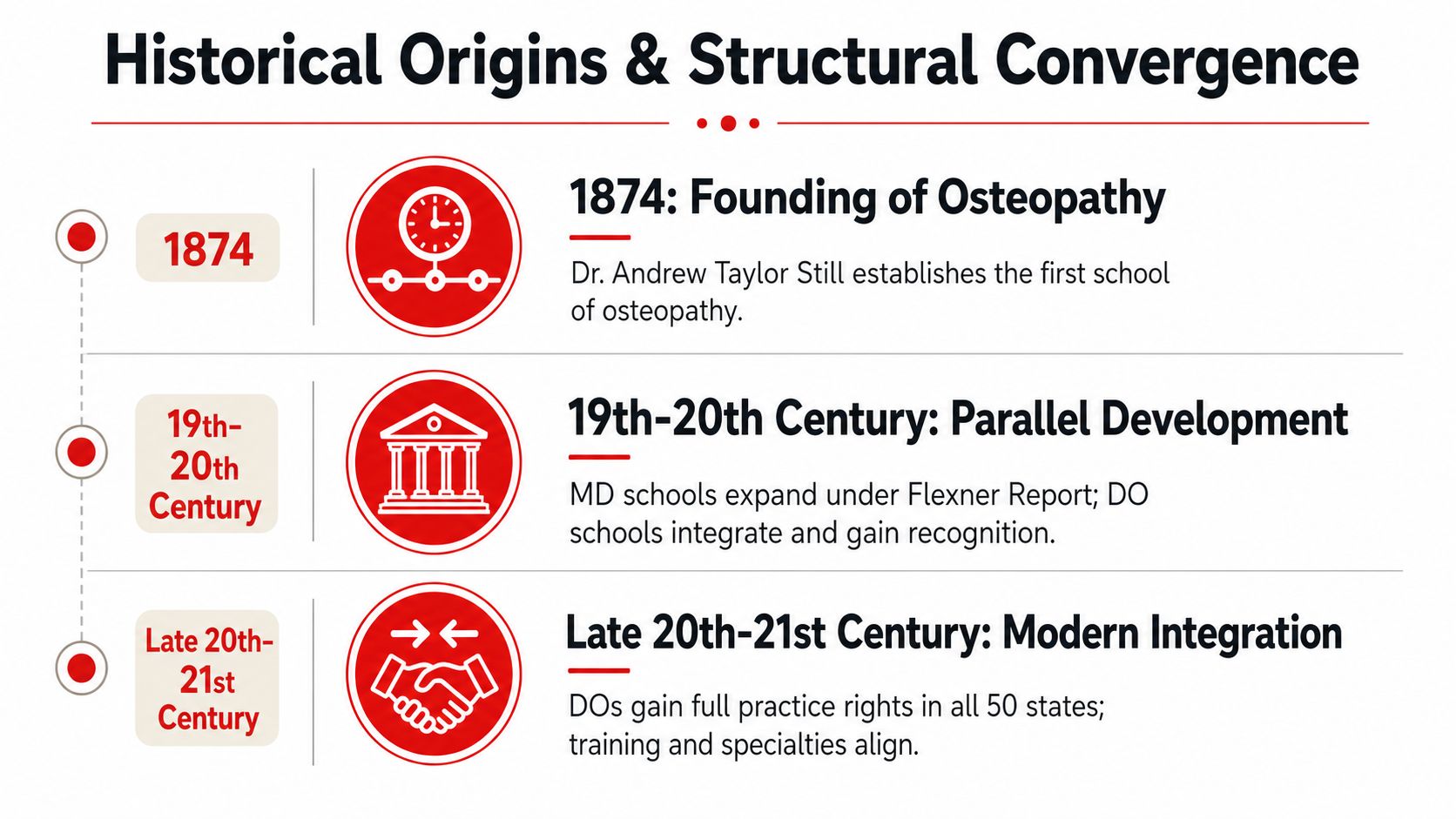
Does the DO versus MD distinction still describe two separate routes to physician training? Its origins are distinct, but the modern comparison is shaped more by institutional alignment and specialty-specific competitiveness than by a simple difference in degree quality.
Osteopathy began in 1874, and the first osteopathic medical school was founded in 1892 (history and workforce overview). The profession grew from a relatively small pathway into a substantial part of the U.S. physician workforce. That expansion helps explain why applicants now encounter DO physicians across nearly every area of medicine.
By 2022, more than 178,000 DOs and medical students were in the United States, representing nearly a 240% increase over the prior two decades. AOA reporting also records growth from 30,990 osteopathic physicians in 1990 to 148,829 in 2023. Together, these figures describe a profession that has expanded considerably, not a marginal alternative to the MD pathway.
Separate communities, increasingly aligned training
The American Osteopathic Association historically served as a central accrediting and professional body for osteopathic education and training. A major structural change followed the single accreditation agreement among the Accreditation Council for Graduate Medical Education, the AOA, and the AACOM. It placed residency and fellowship accreditation within one ACGME system, allowing MD and DO graduates to train in the same accredited framework (unified graduate medical education system).
The shared system reduced an institutional barrier, yet it did not make application signals identical. DO students still take COMLEX-USA, and many use USMLE results to present a more familiar examination record to programs. Specialty directors can also evaluate research access, clinical networks, letters, and school reputation differently. The practical effect is concentration-dependent: structural convergence matters broadly, while remaining differences become more visible in narrower, highly competitive specialty tiers.
What osteopathic philosophy means in practice
Osteopathic education adds a framework connecting body structure, function, prevention, and the patient as a whole. It includes instruction in osteopathic manipulative medicine and musculoskeletal examination. That content supplements biomedical science, pharmacology, pathology, surgery, and evidence-based clinical reasoning.
OMT is an additional clinical skill set, not a definition of every DO graduate's practice. Its later relevance depends on student interests, training environment, specialty, and career plans. Applicants comparing schools should review curriculum documents, clinical partnerships, research opportunities, and graduate outcomes rather than assume that every DO or MD program provides the same experience. The medical school admissions requirements guide can help organize that school-by-school review.
Curricula, OMT, and Clinical Training Differences
The daily academic experience at an MD or DO school is more similar than many applicants expect. Both pathways require rigorous study of foundational sciences, organ systems, clinical reasoning, and supervised patient care. Students in both systems prepare for demanding licensing examinations and complete core clinical rotations.
The clearest curricular distinction is that DO programs add osteopathic principles and osteopathic manipulative treatment, often called OMT. That additional instruction can give students more structured exposure to musculoskeletal assessment and hands-on techniques. It isn't a substitute for the biomedical curriculum, and the extent to which students use it later depends on their interests and specialty.
DO vs MD at a glance
| Dimension | DO | MD |
|---|---|---|
| Degree title | Doctor of Osteopathic Medicine | Doctor of Medicine |
| Foundational sciences | Biomedical sciences, organ systems, pathology, pharmacology, and clinical reasoning | Biomedical sciences, organ systems, pathology, pharmacology, and clinical reasoning |
| Distinctive curricular element | Osteopathic principles and OMT | Allopathic medical education without required OMT training |
| Clinical education | Core clerkships and advanced rotations, with site distribution varying by school | Core clerkships and advanced rotations, with site distribution varying by school |
| Licensing examination pathway | COMLEX-USA is required for DO licensure; some students also take USMLE | USMLE is the principal allopathic licensing examination pathway |
| Residency accreditation | Graduates apply to ACGME-accredited programs within the single accreditation system | Graduates apply to ACGME-accredited programs within the single accreditation system |
| Research environment | Varies substantially by institution, campus, affiliated hospitals, and student opportunities | Varies substantially by institution, campus, affiliated hospitals, and student opportunities |
| Scope after licensure | Physician practice scope is comparable to MDs, subject to state law, credentialing, and training | Physician practice scope is comparable to DOs, subject to state law, credentialing, and training |
Program-specific variation matters more than the letters
A research-intensive DO school may offer more scholarly infrastructure than an MD school with a different institutional mission. The reverse can also be true. Clinical rotation quality, hospital ownership, patient volume, elective access, and specialty mentorship often vary more between individual schools than between the two degree categories.
The same applies to primary care emphasis. A school may encourage community medicine, rural training, or prevention regardless of whether it awards an MD or DO. Applicants should inspect the actual curriculum and affiliated clinical sites instead of relying on broad assumptions.
Students curious about the hands-on component can review Ace Med Boards' educational material on osteopathic manipulative medicine, while recognizing that tutoring content doesn't replace a school's formal laboratory or clinical instruction.
A useful comparison question
Ask each school what students can access:
- Research access: Are faculty mentors available in your intended specialty?
- Clinical placement: Do core sites support your preferred geographic and specialty goals?
- Electives: Can you obtain relevant away rotations or advanced clinical experiences?
- Academic support: What resources exist after a low practice performance or failed examination attempt?
- Student fit: Does the teaching style support how you learn and manage stress?
Those answers are more actionable than assuming one degree automatically provides a stronger education.
Licensing Exams and the COMLEX vs USMLE Decision
For osteopathic students, the examination decision has both a legal and a strategic dimension. COMLEX-USA is required for DO licensure, while some DO applicants also take the USMLE because residency programs may interpret USMLE performance more readily across MD and DO applicant pools. The exams serve related but distinct purposes, so applicants shouldn't treat them as interchangeable tests.
There is no official COMLEX-to-USMLE conversion formula, and testing bodies discourage direct numeric comparisons (COMLEX and USMLE comparison discussion). A score-conversion chart found online shouldn't become the foundation of an application plan.
Separate the requirements from the strategy
The basic distinction is useful:
- COMLEX-USA: The osteopathic licensing examination sequence for DO candidates.
- USMLE: The allopathic licensing examination sequence used by MD candidates and also taken by many DO candidates.
- Residency signaling: Program directors may use examination results as one part of a broader application review, with preferences varying by specialty and institution.
A dual-exam strategy can therefore make sense for a DO student targeting competitive programs. COMLEX supports licensure compliance, while USMLE may provide a score signal that programs already understand across applicant types. That doesn't mean every DO student needs both exams. The appropriate decision depends on specialty, school policy, preparation capacity, finances, test-taking history, and current program requirements.
Step 1 and preparation sequencing
USMLE Step 1 uses pass-fail reporting, so students should verify current examination policies, eligibility rules, registration requirements, and score-reporting details directly with the USMLE program. COMLEX policies should likewise be checked with NBOME, because examination rules can change.
Preparation becomes more complicated when a student is studying for two examinations with overlapping but nonidentical content and emphasis. A practical plan starts with the licensing requirement, then asks whether the target specialty and programs justify an additional examination. Students should also protect preparation time for clinical responsibilities, because an extra exam can create opportunity costs.
Exam planning principle: Don't choose between COMLEX and USMLE by comparing raw scores. Choose by licensing need, specialty expectations, program transparency, and your ability to prepare safely.
International and foreign medical graduates should keep their pathway distinct from the DO decision. Graduates of non-U.S. and non-Canadian medical schools generally need to review the ECFMG certification pathway and current residency eligibility requirements rather than assuming that DO examination strategy applies to them. For a structured overview of the two examination systems, applicants can consult this COMLEX vs USMLE comparison for DO students.
Residency Match Outcomes and Where the Gap Shows Up
Does a national match rate show how difficult each specialty is for DO and MD applicants? The 2024 NRMP Main Residency Match placed U.S. allopathic seniors at 93.5% and U.S. DO seniors at 92.3% (NRMP match reporting through the AMA). These results suggest near-parity in broad access to residency positions, but they do not describe every applicant's options.
The larger distinction appears after specialties are separated by competitiveness. In selected higher-demand surgical subspecialties in 2023, a peer-reviewed analysis reported summed match rates of 52.89% for DO applicants versus 73.61% for MD applicants (peer-reviewed specialty match analysis). In orthopaedic surgery, data from 2019 to 2023 showed a 74.5% MD match rate compared with 59.9% for DO applicants. The same degree comparison therefore produces different practical results across specialty tiers.
Why specialty-tier analysis is more useful
Aggregate figures combine applicants across many fields. Surgical specialties represent a narrower applicant market, where research, home-program relationships, letters, examination signaling, and institutional reputation may carry greater practical weight. Applicants can review a specialty-level residency match statistics analysis alongside national results to identify where the difference is concentrated.
The practical conclusion is the DO versus MD trade-off is concentration-dependent. Degree type tends to matter more when applicants compete for a small number of highly selective positions. The gap is generally smaller in primary care and many mid-tier fields, although individual programs set their own standards.
A failed match isn't a degree diagnosis
An unsuccessful match can reflect specialty selection, geographic restrictions, application volume, interview performance, examination history, clinical evaluations, letters, visa considerations, timing, or other factors. It does not establish that either degree made residency success impossible.
Applicants entering the Supplemental Offer and Acceptance Program, participating in the Couples Match, or reapplying after an unsuccessful cycle need a targeted audit. Review the programs selected, application timing, personal statement, letters, examination record, clinical performance, and interview preparation. National figures provide context, while an individualized application review identifies the modifiable problems.
A student with a low score, failed attempt, academic gap, or interrupted training may need a different timeline and stronger documentation. That is a planning challenge, not a declaration that a medical career is over.
Career, Cost, and Geographic Considerations After Training
After residency, the MD or DO letters usually matter less than the physician's specialty, training, practice setting, location, experience, and professional role. Compensation therefore varies primarily with those factors rather than with the degree alone. A physician comparing like-for-like careers should evaluate specialty economics and employment conditions instead of assuming that the degree creates a fixed income difference.
Both MDs and DOs hold physician licenses with broad practice authority in the United States. They can pursue medical and surgical specialties, prescribe within applicable law, and perform procedures allowed by their training, credentialing, and state requirements. A DO's scope is not limited because the degree is osteopathic.
Location can affect the practical experience
State licensing rules, hospital credentialing processes, institutional policies, and local physician supply can shape an individual's experience. Those administrative details deserve direct review when you're comparing a school or planning a move. The same degree can lead to different professional opportunities depending on residency training, fellowship completion, local demand, and the physician's chosen practice model.
Geographic flexibility also matters before residency. A student who restricts applications to one region may face a different set of options than a student willing to consider multiple states. Clinical affiliations and school networks can influence exposure to particular hospitals and specialties, so applicants should examine those relationships rather than rely only on the degree title.
International applicants need a separate analysis
A U.S. DO or MD degree isn't the same as a foreign medical credential. International and foreign medical graduates should review ECFMG certification, examination eligibility, visa considerations, and program-specific requirements through the responsible organizations. Their residency strategy shouldn't be copied directly from that of a U.S. MD or DO student.
For a broader discussion of how specialty and work setting influence physician earnings, see the doctor pay per hour analysis. Treat any compensation information as context, not as a promise tied to a degree.
Choosing Your Path With a Practical Decision Framework
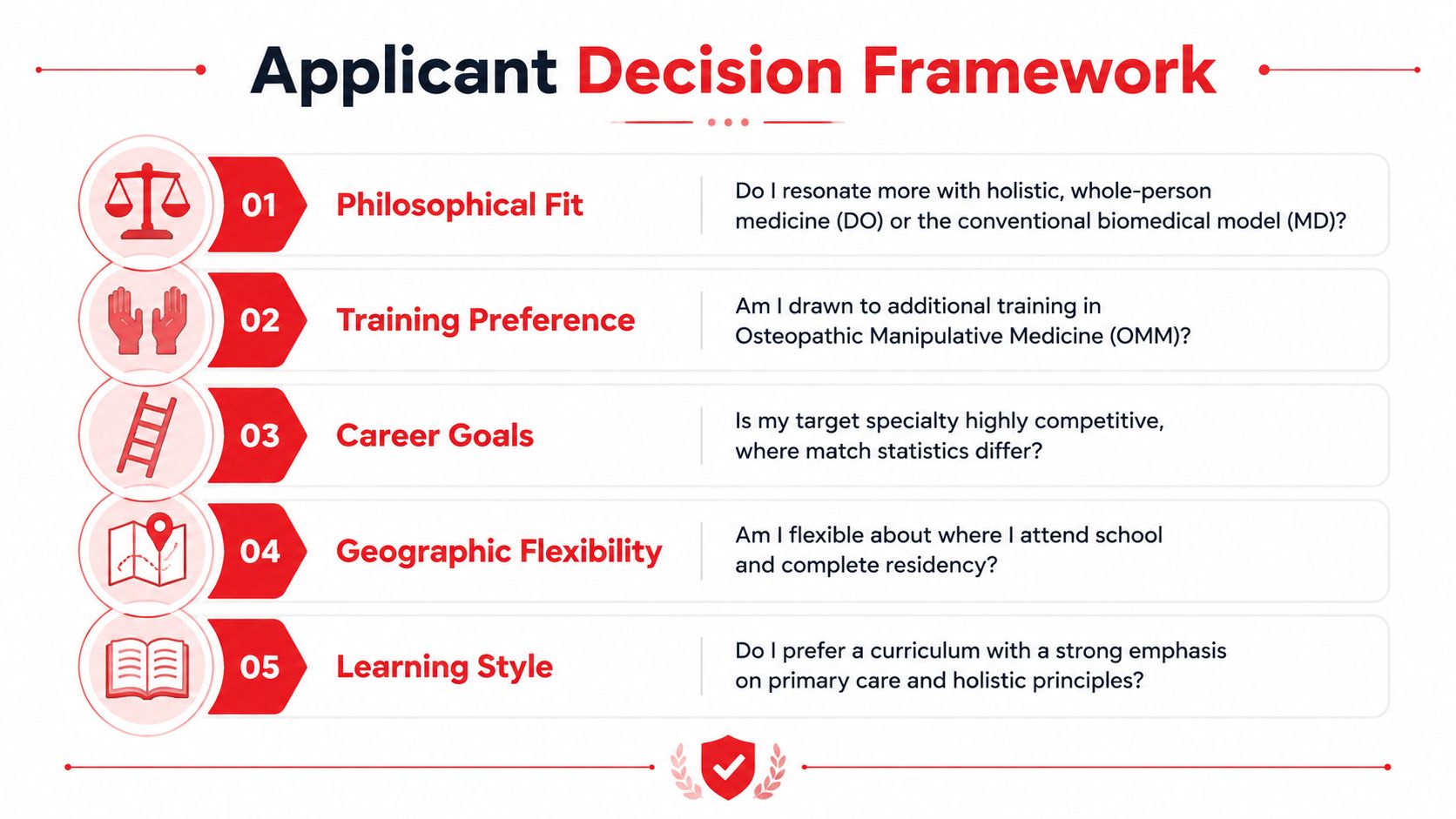
A sound decision begins with your intended career, not with a stereotype about either degree. Use the checklist below before choosing a school or deciding whether to add an examination.
Applicant decision checklist
Specialty ambition: If you're targeting a highly competitive surgical specialty, compare the actual programs you may pursue. Review their application requirements, examination preferences, research expectations, and treatment of DO applicants.
Educational fit: Examine whether you want formal training in osteopathic principles and OMT. Don't choose based on the assumption that an MD program lacks whole-person care or that every DO program has the same clinical emphasis.
School resources: Compare research mentors, affiliated hospitals, rotation sites, elective access, academic support, and residency advising. These features can vary substantially among schools awarding the same degree.
Geographic flexibility: Identify how willing you are to attend school or residency outside your preferred region. A narrower geographic plan can reduce practical options, regardless of degree.
Examination capacity: For DO students, determine whether COMLEX alone fits the intended specialty strategy or whether USMLE preparation is also appropriate. Account for preparation time, previous attempts, test anxiety, and clinical workload.
Turn the checklist into a decision matrix
| Your situation | Questions to prioritize |
|---|---|
| Broad specialty interests | Which school offers the strongest overall fit, support, clinical access, and location? |
| Highly competitive specialty goal | How will the school support research, letters, mentorship, examination planning, and away rotations? |
| Strong interest in OMT | Does the program's osteopathic curriculum match how you want to learn and practice? |
| Academic gap or prior setback | What remediation, advising, and realistic timeline does the school or coaching plan provide? |
| International or foreign graduate pathway | Which ECFMG, examination, visa, and program requirements apply to your specific credential? |
A low score or failed attempt calls for an audit of knowledge gaps, timing, test-day factors, and application strategy. It doesn't erase your ability to progress. Personalized diagnostic tutoring can help students identify priorities for COMLEX-USA, USMLE, COMAT, or Shelf examinations, but it should complement official practice materials and independent study rather than replace them.
For anxious applicants: A careful plan can convert a setback into specific next steps. Your timeline may change, but one difficult result doesn't decide the rest of your career.
Ace Med Boards offers diagnostic tutoring and personalized study-plan support for applicants comparing COMLEX-USA and USMLE preparation needs, including students rebuilding after an unsuccessful attempt. Visit Ace Med Boards to review the available support and schedule a free consultation or Board Score Audit if individualized planning would be useful.