You're in dedicated study, surrounded by lecture notes, review books, flashcards, and a question bank, yet you still can't tell whether you're ready for Step 1. The most useful answer is to make USMLE Step 1 practice questions the diagnostic engine of your preparation. Questions show what you can retrieve, how you reason under time pressure, and which errors deserve your next study block.
Why Practice Questions Drive Step 1 Readiness
Passive review can create a convincing sense of familiarity. You recognize a pathway in a textbook, follow a lecture explanation, and feel comfortable until a vignette asks you to apply the same concept in an unfamiliar setting. Practice questions expose that difference between recognition and usable knowledge.
The United States Medical Licensing Examination, or USMLE, Step 1 uses an integrated content outline that organizes foundational science across broad cross-system areas and individual organ systems. The current outline groups assessed material into 18 major areas (USMLE Step 1 content outline and specifications). That structure makes random question completion less useful than deliberate coverage. Your blocks should reveal whether you're repeatedly avoiding certain systems, confusing related mechanisms, or missing integrated questions that connect physiology, pathology, pharmacology, and microbiology.
Step 1 is now reported as pass/fail only, and external exam-preparation coverage describes an exam with up to 280 multiple-choice questions (Step 1 testing overview). The practical consequence isn't that performance no longer matters. It's that your preparation should emphasize item interpretation, pacing, sustained concentration, and dependable reasoning, rather than chasing a numeric score that the exam no longer reports.
Practical rule: A practice block is valuable even when the percentage is disappointing, provided you can identify why the errors occurred and change what you do next.
A published survey of 164 students found that users of a major question bank scored higher on average, 229 versus 215, and another analysis found a positive association between the number of practice questions completed and Step 1 scores, with r = 0.38 (PubMed study on question-bank use and Step 1 performance). Those findings don't guarantee an outcome for any individual student. They support a more durable principle: active retrieval followed by careful error analysis is more informative than passive exposure alone.
Use USMLE practice exams as a structured part of preparation, not as a replacement for foundational learning. A question should answer three diagnostic questions: what did I know, what did I fail to recognize, and what will I do differently when the concept appears again?
Choosing the Right Question Banks and Resources
A student can finish a large question block and still have little usable learning if the resource does not support careful review. Choose materials by the job they perform during each phase of preparation. Official resources clarify the exam's writing style and interface. Commercial question banks offer repeated exposure and detailed explanations. Free or topic-specific sets can address a defined weakness, but collecting them without a remediation plan adds review time without a clear return.
Compare resources by job, not reputation
| Resource Category | Best Phase of Study | Typical Use Case |
|---|---|---|
| Official USMLE sample questions and interactive materials | Early orientation and final interface familiarization | Learn the exam-writing style, use the testing tools, and assess how official items feel |
| Large commercial question banks | Main learning and application phase | Practice foundational science and organ-system integration, then review explanations |
| Free or topic-specific question resources | Targeted remediation | Reinforce a narrow weakness identified in the error log |
| Self-assessment materials | Readiness checks and planning decisions | Examine performance patterns and decide which content or test-taking behaviors need attention |
Students comparing options can use this USMLE Step 1 question bank guide to compare study phase, explanation depth, and the review time each resource requires. A primary bank should be one you can complete and analyze consistently. Add another resource only when it serves a defined purpose, such as targeted remediation or interface familiarity.
Item style fidelity should guide the initial choice. A bank may teach the tested science well without matching official wording or interface behavior. Use official materials to calibrate expectations, then judge the commercial bank by how well its explanations expose reasoning errors.
Explanation quality determines whether a missed item becomes a useful lesson. Look for explanations that identify the tested mechanism, explain why each distractor fails, and show which clue should have redirected your reasoning. Length alone does not indicate quality.
Interface and pacing practice require separate attention. Reading questions in a PDF can support content review, but it does not reproduce interactive navigation or the demands of timed work. Cost also matters when two resources cover the same ground. Select a primary bank you can review thoroughly, then use supplementary materials only for gaps recorded in your error log.
The aim is a system in which each completed item strengthens recall, improves reasoning, or creates a clear remediation target. That standard turns question banks from content libraries into a diagnostic engine for deciding what to study next.
Building a Question-Based Daily Study Schedule
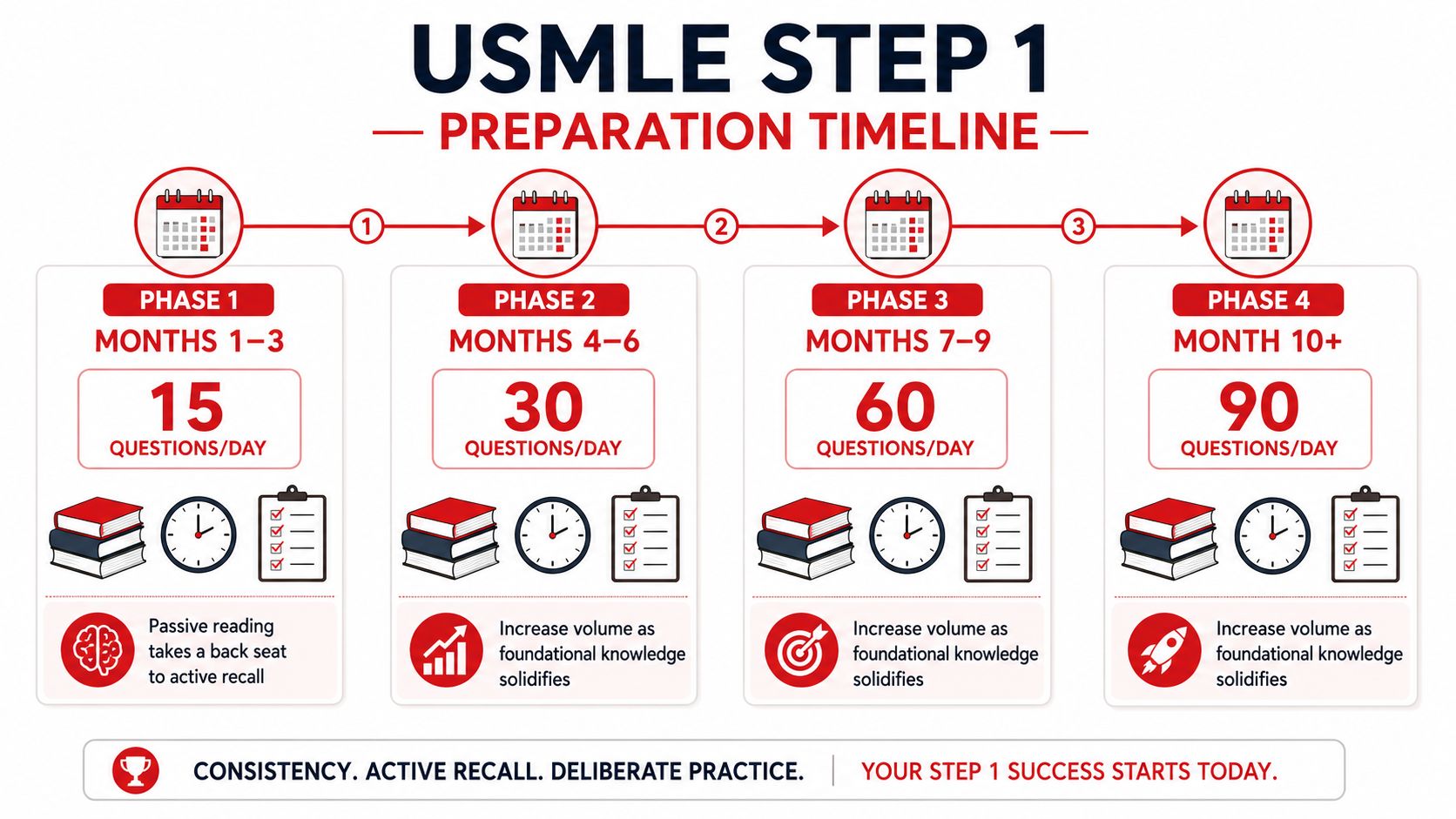
A student can finish a large question block and still make little progress if explanation review is rushed. Build the day around the time required to answer, analyze, log, and revisit items. The schedule should measure usable learning time, not an aspirational question count.
The timeline below is a planning illustration, not a universal prescription. Some students need more foundational review before increasing volume, while others can begin mixed timed blocks earlier.
Use four phases
- Foundation phase: Start with topic-focused questions after learning a subject. Use untimed or tutor-mode work when the immediate goal is understanding the reasoning process.
- Integration phase: Mix subjects within a study day. Keep a content review block, but let missed questions determine what you revisit.
- Timed application phase: Introduce timed mixed blocks and practice moving between systems without relying on topic labels.
- Simulation phase: Use realistic pacing and full-day stamina practice. Review the resulting error patterns rather than treating one result as a permanent judgment.
A workable week might look like this:
| Day | Main question work | Review and remediation |
|---|---|---|
| Monday | New questions in a focused subject block | Explanation review and error-log entries |
| Tuesday | New mixed questions | Revisit Monday's highest-impact errors |
| Wednesday | Timed mixed block | Analyze pacing, distractors, and reasoning failures |
| Thursday | Targeted questions from the error log | Short foundational review for persistent gaps |
| Friday | New mixed block | Immediate explanation review, then spaced recall |
| Saturday | Longer simulation or assessment activity | Identify patterns across systems and question types |
| Sunday | No heavy new-question target, or a lighter review day | Consolidate the error log and plan the next week |
Review in the right order
For each block, record more than the percentage correct. Note whether you changed answers, ran out of time, guessed between two choices, or missed a clue because you read too quickly. Classify each important error as a knowledge gap, reasoning gap, interpretation error, or execution error. These categories turn random scores into decisions about what to study next.
A student who misses a renal physiology mechanism because the concept is unfamiliar needs focused teaching and retrieval practice. A student who knows the mechanism but selects a distractor after ignoring a key laboratory clue needs a different intervention. Someone who understands the item but spends too long on early questions needs pacing practice rather than another chapter of content review.
Set a daily ceiling that leaves enough time for explanation review. If review repeatedly carries into the next day, reduce new-item volume before adding more hours. That trade-off usually produces a clearer error log and better retention than accumulating unfinished questions.
Build your own schedule with the Step 1 study calendar resource, then adjust it according to review capacity. The schedule is working when questions guide the next study decision and the calendar reflects realistic review capacity rather than an impressive number of completed items.
The Question Review Workflow That Actually Builds Retention
A question bank becomes useful only after you review it with enough structure to identify the error beneath the answer choice. “I got it wrong because I didn't know it” is often incomplete. You may have known the disease but missed the age, misunderstood the physiology, selected a familiar distractor, or changed a correct answer without justification.
Four steps for every meaningful block
Setup. Silence notifications, set the timer, prepare scratch paper, and decide whether the block is intended for learning or simulation. Don't shift modes halfway through without recording the change.
Answer. Read the stem for the clinical task, identify the decisive clues, eliminate choices that conflict with the mechanism, and commit to an answer. Flag uncertainty, but don't let a difficult item consume the block.
Review. Read the full explanation, including the incorrect options. Ask what clue made the correct answer preferable and which assumption led you toward the wrong choice. Reviewing only the correct answer leaves the original reasoning error intact.
Log. Write a compact entry that can be tested later. Include the topic, error category, decisive clue, corrected reasoning, and a specific retrieval prompt.
A hypothetical worked example
Composite hypothetical example, fictional and not a real student: A student preparing during a six-week dedicated period completes a timed mixed block. In an original educational vignette, a patient has proximal muscle weakness, high muscle enzymes, and a new medication exposure. The student chooses an inflammatory muscle disorder because the symptom pattern feels familiar, but misses the medication clue and the temporal relationship.
A weak log entry would say, “Review medication-induced muscle injury.” A stronger entry would read:
- Topic: Medication-associated muscle injury
- Error bucket: Misread decisive clue, then used pattern recognition too early
- Missed clue: Symptoms began after the medication exposure
- Correct reasoning: The exposure and timing support an adverse drug effect before a primary inflammatory diagnosis
- Retrieval prompt: “When weakness and muscle injury follow a new drug, what exposure and timing questions should I ask first?”
The student should then review the mechanism, answer a small targeted set, and revisit the prompt later without looking at the explanation. This is question analysis, not memorization of a single vignette.
Use distractor analysis for Step 1 questions to sharpen the distinction between a plausible option and the option best supported by the stem. A knowledge gap calls for teaching and retrieval. A reasoning gap calls for explaining the pathway aloud. A test-taking error calls for deliberate pacing or reading practice. Each category needs a different response.
The purpose of an error log isn't to document failure. It's to tell you exactly what to practice next.
For a six-week dedicated schedule, a composite learner might begin with focused blocks, move toward timed mixed blocks as review becomes more reliable, and place self-assessment activities where the results can still change the study plan. The exact sequence depends on prior preparation, available time, and performance patterns. Results vary, and no hypothetical schedule predicts an individual outcome.
Timed Blocks and NBME Self-Assessment Simulations
Timing should develop in stages. Untimed tutor mode helps while you are learning unfamiliar reasoning, but prolonged use can conceal pacing problems. Start with focused learning blocks, progress to timed subject blocks, then use mixed timed blocks that require rapid switching between organ systems and task types.
On test day, read the question before committing to a pathway, avoid reopening settled items repeatedly, flag uncertainty without abandoning your pace, and use breaks deliberately. Review the official interface materials early so navigation does not consume attention during practice.
Use assessments as decisions, not verdicts
NBME self-assessments fit best after you have established a review routine. Take them under conditions that resemble the intended testing experience, then examine:
- Content distribution: Which organ systems or foundational categories produced avoidable errors?
- Reasoning quality: Did knowledge, interpretation, or execution cause the misses?
- Stamina and pacing: Did accuracy deteriorate later in the session?
- Remediation value: Can the result change what you study next?
Under pass/fail reporting, an assessment should guide readiness discussions and remediation. Examine how you reached each answer alongside the score. A favorable result with unstable pacing still requires attention. A concerning result may identify a manageable set of gaps rather than define your ability.
Use NBME preparation for Step 1 to structure the assessment process and decide how results will affect your study plan.
Schedule a full-length simulation before exam day when your preparation allows it. Plan the review before starting: reserve time to classify errors, identify recurring concepts, and revise the following study days. The simulation becomes useful when its findings produce specific changes, such as timed mixed blocks for pacing problems or targeted review for a recurring content gap. Without that follow-through, a score remains a snapshot rather than a preparation decision.
Tracking Three Metrics That Show Real Readiness
Question volume is easy to count, which makes it tempting to use as the main measure of progress. It's also incomplete. Readiness becomes clearer when you track performance quality across time, repeated errors, and content categories.
The three-metric audit
Rolling accuracy on timed mixed blocks shows how you perform when topics aren't announced in advance. Calculate it on a weekly basis using comparable blocks, and record timing conditions alongside the result. A single block can be noisy, so look for the direction and consistency of the pattern.
Repeat-error reduction measures whether your error log is changing behavior. Mark concepts or error types that recur, then review whether the same mistake appears after remediation. If the same reasoning failure keeps returning, rereading may not be enough. Try verbal explanation, targeted questions, or supervised analysis.
Stability across organ-system categories reveals whether overall performance conceals a weak area. Compare categories across the week, then ask whether low performance reflects missing knowledge, unfamiliar integration, or poor pacing. Stable weakness calls for targeted remediation. Wide fluctuation calls for broader mixed practice and closer review of question interpretation.
Composite hypothetical example, fictional: A learner has acceptable mixed-block performance but repeatedly misreads pharmacology timing and loses accuracy in later blocks. The corrective plan would combine medication-mechanism review, deliberate stem reading, and a stamina-focused simulation. Results vary for every learner, so these metrics should guide individualized decisions rather than serve as universal cutoffs.
Three strong metrics beat one impressive-looking number when the goal is dependable reasoning.
The Most Common Mistake Students Make With Practice Questions
The most common mistake is treating question volume as proof of learning. A student can complete thousands of items, recognize familiar explanations, and still repeat the same errors because no one has closed the loop between performance and remediation.
Composite hypothetical example, fictional: A learner finishes a large number of questions but records only the correct answer and topic. During the next week, the learner repeats misreading errors and confuses related mechanisms. Adding a short error-log review, targeted retrieval, and a second look at recurring distractors makes the practice more diagnostic. Results vary, and this example isn't a promise of any particular change.
The corrective framework is simple: answer under an intentional mode, review the full reasoning, classify the error, remediate the cause, and test the concept again later. One-on-one tutoring can complement official materials and independent question-bank work when you need structured accountability or help distinguishing a content gap from a reasoning problem.
Ace Med Boards offers one-on-one USMLE tutoring that can include personalized planning, question analysis, and accountability around your practice-question workflow. Visit Ace Med Boards to learn about the service and decide whether a free consultation fits your preparation needs.