You're staring at a long exam calendar, a stack of lecture notes, and a question bank that keeps exposing the same weak spots. Spaced repetition gives you a way to stop rereading and start remembering, because it pairs active recall with timed reviews that expand when you do well and tighten when you miss something. For medical boards, that matters because the content is huge, the timeline is long, and forgetting one mechanism at the wrong time can snowball into more review later.
What Spaced Repetition Actually Is
Spaced repetition is not just “flashcards at intervals.” It's a system built on two parts working together, retrieval practice and adaptive spacing. Retrieval practice means you try to answer from memory before you look, and adaptive spacing means the gap between reviews gets longer when recall is strong and shorter after a miss.
A simple way to explain it to yourself is this, spaced repetition tests memory right before you're about to lose it, then changes the next review based on how you did. That's why the method feels demanding at first but efficient over time. Easy items move out of the queue, while weak items stay close to the front.
The forgetting curve is the reason cramming feels productive and then disappears. You can think you know a topic after rereading it, but recognition isn't the same as recall. If you want the material to stay available for USMLE, COMLEX, or shelf exams, you need to pull it out of memory repeatedly, not just see it again.
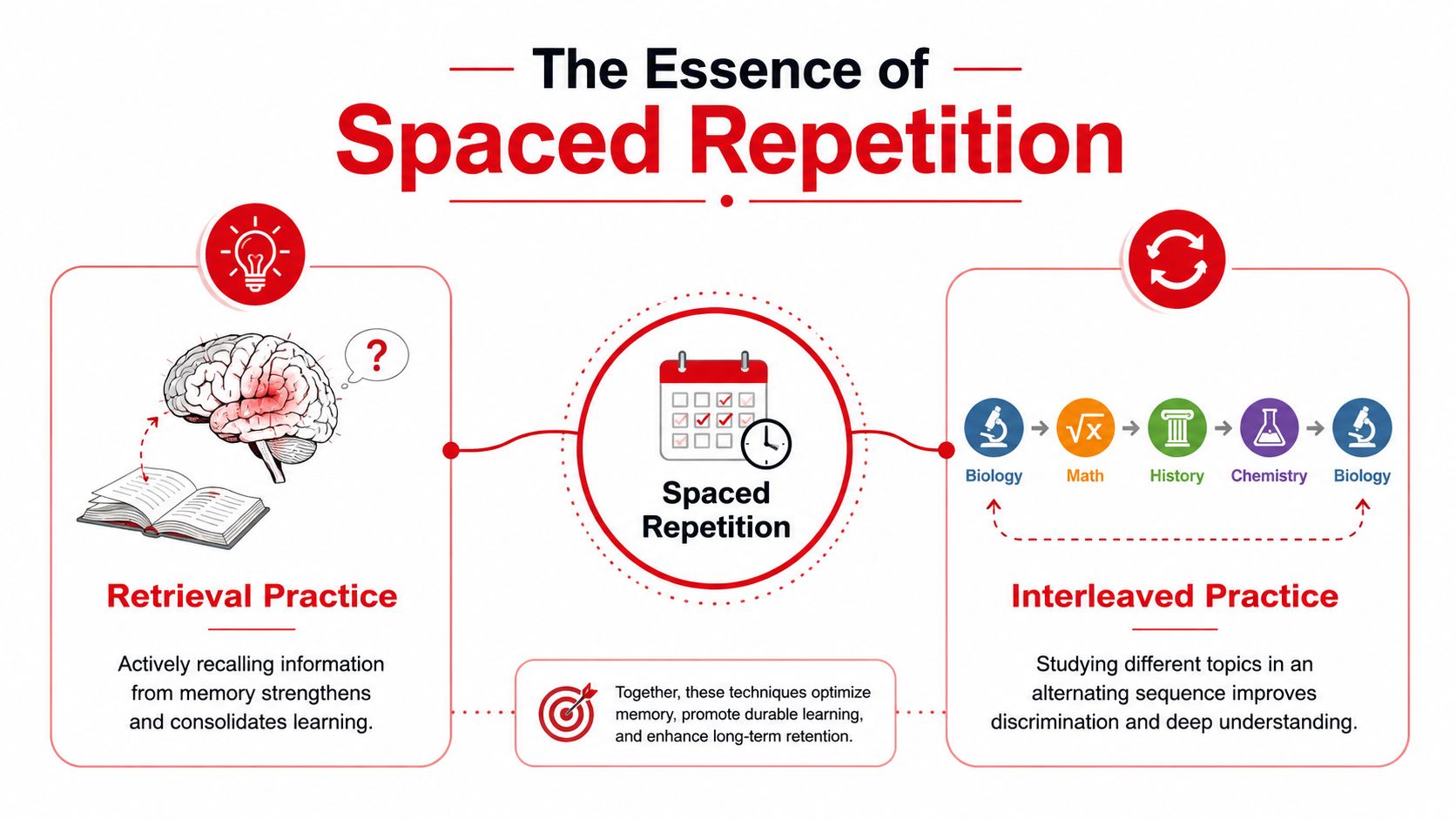
A technically sound workflow uses an adaptive interval algorithm. In Anki-style systems, the default ease factor is about 2.5, so a 2-day interval can expand to roughly 5 days, then 12, then 30 if you keep recalling it well, and the system stays efficient because easy items quickly leave the review queue while difficult ones remain near the front (HelloNabu). A 2006 quantitative synthesis found a medium-to-large benefit for distributed practice, with an overall effect size of d = 0.71 across 254 articles and 317 experiments, and it reported that the most effective spacing is usually about 10% to 20% of the desired retention interval (sathee.iitk.ac.in).
Practical rule: if you're just rereading the card, you're not really using spaced repetition yet. The retrieval attempt is the point.
For medical learners, that distinction matters because board prep is built on layered knowledge. A card that asks for one enzyme, one contraindication, or one next step is easier to schedule than a page of notes, and the spacing effect scales better when the cards are atomic. If you want a clean companion definition of the active recall side of the method, this overview of active recall fits neatly with the workflow here.
The other piece people miss is that spacing doesn't work if the learner never proves the memory is there. That's why understanding teaching styles can help, not because the learning style debate solves studying, but because it reminds you that retrieval is a different action from reading. You're training memory strength, not collecting exposure.
Choosing Your Spaced Repetition Tool
The right tool is the one you'll still tolerate three months from now. For most medical students, that means choosing based on deck size, device syncing, image handling, and how much setup time you can realistically protect during rotations. A beautiful system you abandon after a week is still a failed system.
| Tool | Algorithm | Best For | Trade-off |
|---|---|---|---|
| Anki | SM-2 style scheduling | Heavy board prep, large decks, image occlusion, long timelines | Setup takes time, and the interface feels plain |
| RemNote | Built-in spacing and outlining | Students who want notes and cards in one place | Less minimal than paper, and habits matter more |
| Quizlet | Light review and low-friction study | Quick memorization, smaller sets, casual use | Weaker fit for large, high-stakes review loads |
| Paper or handwritten cards | Manual spacing | Learners who remember better while writing by hand | Hard to scale, easy to mismanage over months |
| Browser-based tools | Varies by platform | Simple access on shared computers or quick drills | Often limited for advanced scheduling and visual cards |
Anki is the default for a reason. Its scheduling is built around the kind of adaptive review medical students need, and it handles thousands of cards without forcing you to reinvent the system every week. It also supports image occlusion, which is useful for anatomy, histology, and imaging where the answer is visual rather than verbal.
If your study life is mostly question banks, short bursts between clerkship duties, and long exam arcs, pick the tool that reduces friction, not the one with the most features.
RemNote can work well if you like notes and cards living together, especially when your biggest problem is turning lecture material into review items. Quizlet is easier to start, but it's usually better for short-term review than for a six-month board schedule. Paper cards still help some learners, but they're harder to maintain when the deck grows and your time shrinks.
If you want a broader strategy for matching a tool to your workload, personalized learning strategies is the kind of framework that makes the decision less emotional. One practical rule helps most students: if you're building a long exam deck and need reliable scheduling, use Anki; if your priority is light review or note integration, choose something simpler and accept the trade-off.
Writing Cards That Build Clinical Reasoning
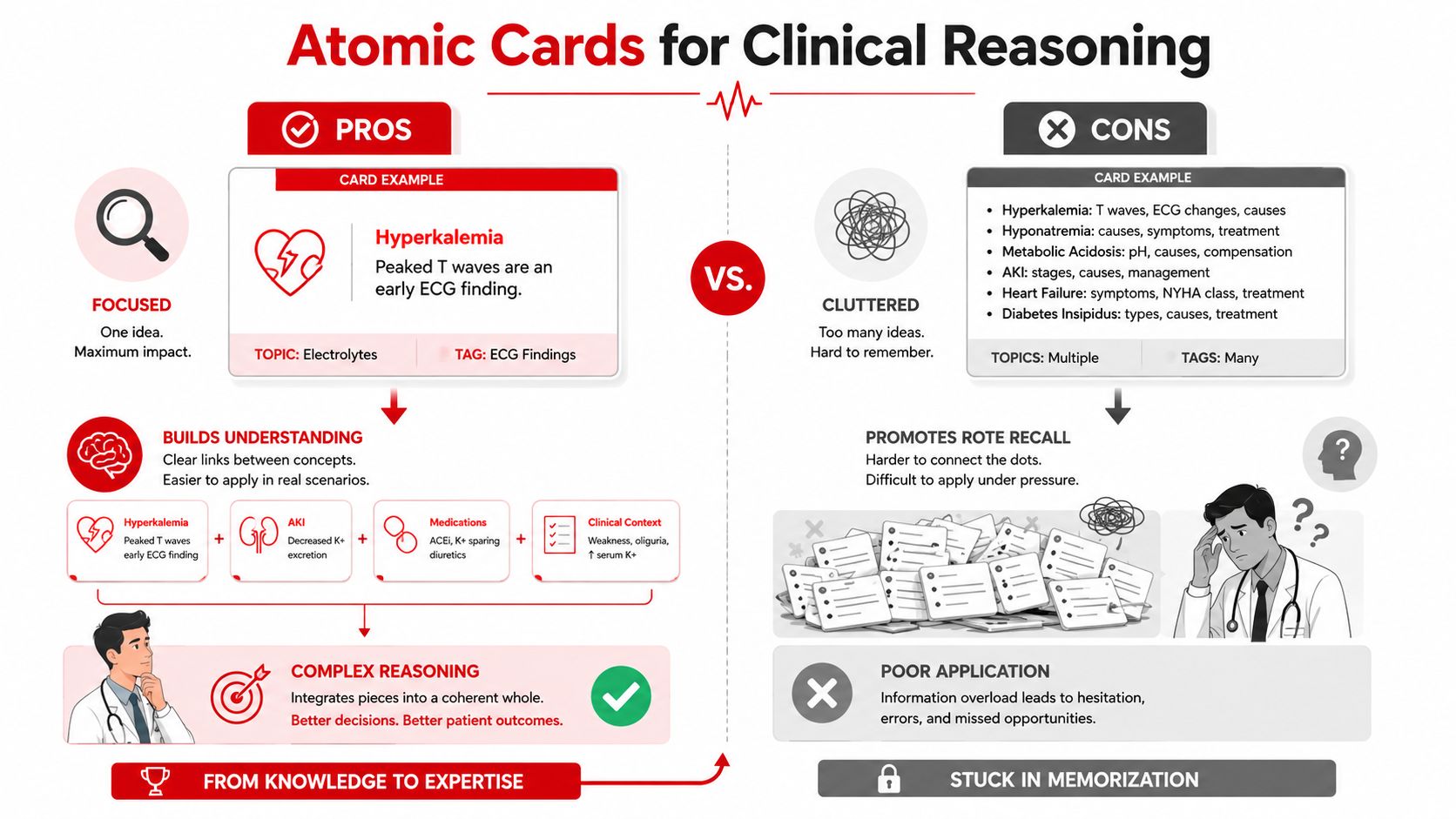
The strongest cards are small enough to answer cleanly and specific enough to teach something real. Atomic cards follow one fact, one mechanism, or one decision rule per prompt. That keeps each review focused and makes the failure meaningful, because you know exactly what broke.
Three card families that actually help
A factual recall card asks for a single answer. For example, “What is the first-line treatment for community-acquired pneumonia in a stable outpatient adult?” That card is useful because it targets one decision rule instead of dragging in the whole guideline.
A mechanism card pushes you one step deeper. “If pancreatic lipase is blocked, what happens to fat absorption?” forces you to connect a process to an outcome, which is much closer to the way boards phrase basic science. The goal isn't to write a mini-lecture, it's to create a prompt that makes you retrieve the relationship.
A clinical reasoning card uses a one-line vignette. “A 24-year-old has episodic wheezing, eczema, and allergic rhinitis. What diagnosis fits best?” works better than a paragraph of clues because it asks you to sort pattern recognition, differential thinking, and next-step judgment in one move. That's the kind of card that protects you from the shallow-recall trap.
The bad versions are easy to spot. Long paragraphs hide the answer, multi-answer prompts encourage guessing, and definition-only cards often test nothing beyond recognition. If you can answer by skimming, you've made a reading exercise, not a memory exercise.
A useful self-check is simple. Before you flip the card, ask yourself whether you can give the answer out loud. If you can't, the card is doing its job. If you can, but only because the wording gave you away, tighten it.
For a deeper explanation of how these prompts support higher-order thinking, clinical reasoning is the right companion concept. And if you want a quick example of how even screen-recording and lesson-capture workflows can be adjusted for cleaner teaching assets, why switch from Screen Studio to Screen is a useful comparison of how cleaner output can support clearer study material.
Organizing Decks Across a Long Exam Timeline
A deck gets messy fast when every topic, exam, and priority level lives in one pile. Medical students need structure that survives clerkships, dedicated study, and the slow drift from one exam to the next. Tags usually work better than rigid sub-decks when you want one card to belong to several categories at once.
A simple tagging structure
Use tags for system, exam, and priority. A cardiology card can carry a system tag, a Step 1 tag, and a high-yield or weak-area tag without needing duplicate copies. That makes searching easier and stops the deck from fragmenting.
Sub-decks make more sense when you need separate review queues, such as different courses or a shelf rotation with very different pacing. If you overuse sub-decks, you can accidentally break spacing quality by reviewing one pile in isolation. Tags keep the deck flexible, while sub-decks should stay reserved for clear scheduling differences.
Shared decks can save time, but only if you mine them actively. Don't just inherit a deck and trust the structure. Edit cards so they match your course, suspend weak items that aren't relevant, and cap how many new cards you let in each day so the review load stays believable during busy weeks.
Maintenance rule: if a card keeps failing, the problem is often the card, not your memory. Rewrite it before you blame yourself.
Image occlusion is especially valuable in anatomy, histology, and imaging because visual recall is part of board prep, not an extra. Hidden labels force you to retrieve structure, relationship, and location instead of just recognizing a polished slide. That's one of the few times a visual tool changes how you study.
A weekly cleanup session keeps the system sharp. Prune leeches, suspend cards that don't earn their place, and check what's accumulating rather than assuming the deck is healthy because it looks busy. This exam preparation planner is a practical place to map the deck structure onto your calendar so the organization stays tied to the test date.
Building a Daily and Weekly Review Workflow
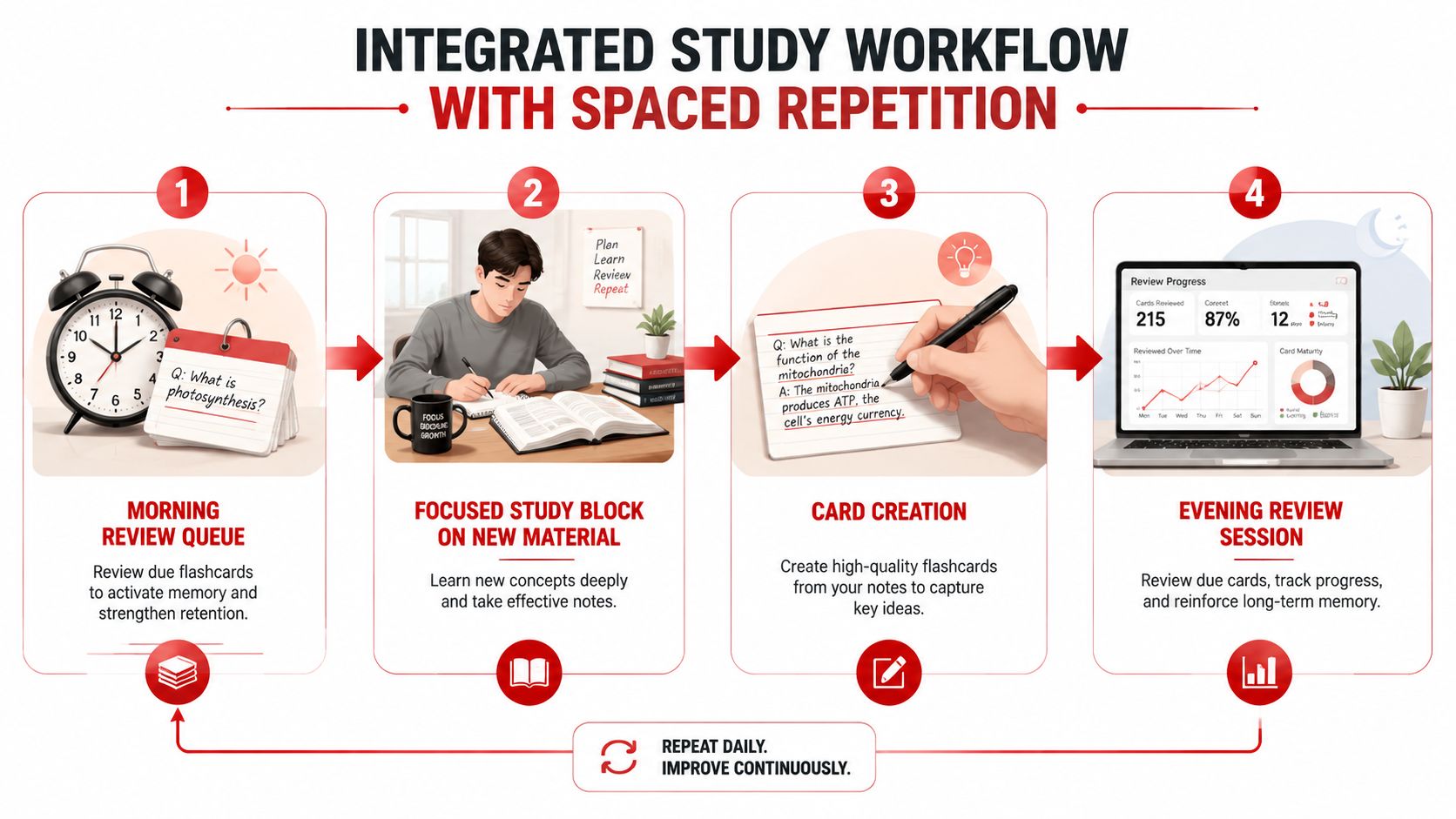
Spaced repetition works best when it sits inside the day instead of trying to replace the day. The most sustainable pattern is usually review first, new material second, and question-bank work after that. Missed questions then become new cards before the day ends, so the same concept doesn't keep surprising you.
A sample dedicated-study day
Start with the morning review queue while your attention is fresh. Then move into a focused study block on new material, and write only the cards that capture the point you need later. Save the question bank for the afternoon, when you can turn misses into new prompts before fatigue makes the lesson fuzzy.
A workable dedicated-day rhythm looks like this:
- Morning review queue: clear the due cards before starting anything new.
- New content block: study one topic thoroughly, then make atomic cards from it.
- Question-bank block: complete timed sets, review misses, and convert gaps into cards.
- Evening cleanup: suspend weak cards that need rewriting and preview tomorrow's load.
A sample clerkship week
During a clerkship week, keep reviews short and predictable. The review queue can happen before rounds, between cases, or after dinner, but the point is consistency, not heroic volume. If the week is intense, use shorter intervals for fragile cards and keep new-card intake low enough that you can finish the day without dread.
One sensible weekly pattern is a longer maintenance session once a week, a check against your study plan, and one honest review of what you keep missing. That's especially important during shelf rotations, where cards from one service can crowd cards for the next if you don't tag and suspend carefully. You want a living deck, not a deck that competes with your clinical responsibilities.
The biggest scheduling mistake is trying to force one pace onto every rotation. Some weeks can support heavier review, while others need strict triage. The right workflow is the one you can repeat without missing rounds, ignoring questions, or burning out.
Metrics That Actually Predict Readiness
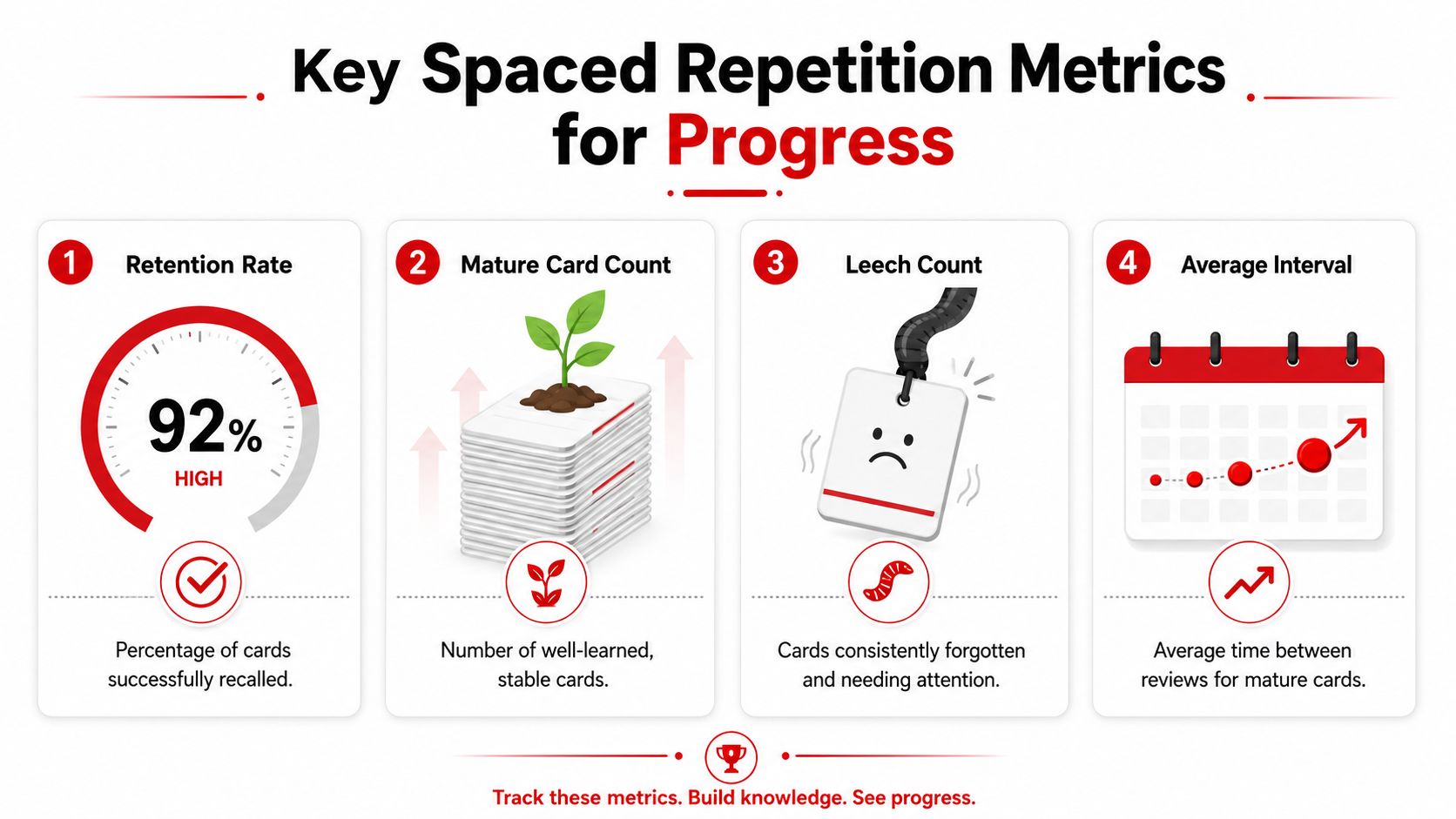
Numbers help when they tell you what to fix, not when they become another way to panic. The most useful spaced-repetition metrics are retention rate, mature card count, leech count, and average interval. Those numbers only matter if you connect them to your question bank performance and your actual test timeline.
How to read the signals
A healthy retention rate usually looks stable enough that you're not constantly relearning the same material. If retention drops while question-bank scores stay steady, the cards are probably stale or badly written. If retention drops and question-bank scores drop too, you likely have a real content gap.
Mature card count matters because it shows whether enough material has moved from fragile to stable memory. A flat mature-card plateau can feel discouraging, but it doesn't always mean you're failing. Sometimes it just means your system has reached a steadier phase and the next gain has to come from new material, not more reviews.
Leech count tells you how much repeated forgetting is piling up. A few leeches are normal, but cards that keep failing deserve rewriting or suspension, not silent burial. Average interval shows how far your stronger cards are spreading out, which is useful for judging whether your deck is becoming more efficient or just more crowded.
The progress tracking dashboard is a useful concept here because it pushes you to look at trends, not one bad day. A card system should feel like it's filtering your effort, not multiplying it.
Practical interpretation: a metric is usually describing a scheduling problem if the card is weak in isolation, and a knowledge problem if multiple review formats and question banks point to the same gap.
Sample Study Plans and Common Pitfalls
Different exams call for different pacing, but the same logic applies. A Step 1 or Step 2 CK deck usually benefits from daily reviews plus steady new-card creation from question misses, while a shelf rotation deck needs tighter topic filtering so one service doesn't swallow the others. Step 3 and residency-focused study often demand even more discipline around pruning because the timeline is long and fatigue is real.
A few workable templates
For Step 1, keep the deck tightly aligned with foundational mechanisms and high-yield facts, then let missed questions generate the next layer of cards. For Step 2 CK, lean harder into clinical reasoning prompts and next-best-step decisions, because that exam rewards application under time pressure. For Step 3, the deck should stay lean and decision-focused so you're not carrying a bloated review queue into a clinical schedule.
A shelf rotation deck works best when it's tied to the service you're on right now. Keep cards small, service-specific, and searchable by rotation so you can suspend anything that won't matter until later. That protects your attention when the clinical workload is already demanding.
Common failure patterns and fixes
- Passive review: If you're reading the back of the card before trying to answer, the card is no longer doing spaced repetition work. Fix it by forcing a real recall attempt, then rewriting the prompt if the wording keeps giving away the answer.
- Ignored leeches: If the same cards keep failing and nothing changes, the deck is asking you to memorize a broken prompt. Fix it by rewriting, splitting, or suspending those cards instead of letting them drain time.
- Bloated decks: If the number of cards keeps climbing and nothing feels stable, you're probably adding faster than you're learning. Fix it by capping new cards, suspending low-value items, and mining question misses more selectively.
- Intervals stretched too early: If recall collapses after you make the gaps too long, the schedule is outrunning memory. Fix it by shortening intervals on fragile cards and letting the algorithm earn the longer gaps.
- Overmixed topics: If every deck feels like a random pile, spacing quality falls apart. Fix it by sorting cards by system, exam, and priority so the retrieval context stays clean.
Consistency beats heroic cramming, especially for medical boards where the workload keeps returning in new forms. If you want help building a cleaner deck, setting a realistic schedule, or deciding what to suspend, Ace Med Boards offers one-on-one tutoring and board strategy support that can be adapted to your exam timeline and study habits.
If you're trying to turn a scattered study routine into a review system that holds up during exams, Ace Med Boards can help you build that structure around your real schedule. A free consultation can clarify which cards, question-bank habits, and study blocks deserve your time, and it can help you stop carrying a deck that's bigger than your bandwidth.