The night before Step 1, COMLEX, or a Shelf exam can feel strangely split in two. Your notes look solid, your practice questions were decent, and yet your body acts like you're walking into danger. Test anxiety is that evaluative response, it shows up as worry, physiological arousal, and avoidance, and it can measurably interfere with performance, which is different from ordinary stress or general burnout.
A lot of medical students describe the same pattern. They're not panicking because they didn't study, they're stuck because their mind won't stop replaying worst-case outcomes, their body feels revved up, and sleep won't come. If that sounds familiar, you're not failing at medicine, you're dealing with a specific, nameable response to high-stakes evaluation.
Practical rule: if the feeling spikes mainly around exams, and it comes with racing thoughts, physical activation, or avoidance, you're probably looking at test anxiety rather than a vague “bad week.”
What Test Anxiety Actually Feels Like
The easiest way to miss test anxiety is to call it “stress” and leave it there. Stress is broad, but test anxiety is tied to evaluation, and it often shows up as increased heart rate, sweating, negative thoughts, fear of failure, and avoidance behaviors. Medical students may also notice sleep disturbances and other mental and physical symptoms before, during, and after exams, which is why the experience can feel so all-consuming (medical student symptom profile).
A student can know the content and still lie awake at 2 a.m. mentally checking every missed question from the last week. Another student walks into the testing center with a full review schedule completed, then suddenly feels their chest tighten the moment the timer starts. That's not laziness or lack of discipline, it's the exam context triggering a predictable response.
Three clusters usually show up:
- Cognitive: intrusive thoughts, fear of failure, and “I'm blanking” moments.
- Physiological: heart pounding, sweating, shakiness, or an adrenaline surge.
- Behavioral: procrastination, avoidance, sleep disruption, and post-test rumination.
If you want a quick checkpoint for the cognitive side, the phrasing used by a number of med students is simple, “I can study all day, but my brain still talks me out of trusting myself.” That's often the first clue that the problem isn't content alone. For a cleaner look at how this kind of worry fits into broader symptom patterns, see Ace Med Boards' mind-is-blank guide.
How Common Test Anxiety Is in Medical Training
A student can look prepared on paper, keep up with lectures, and still feel their stomach drop when an exam shows up on the calendar. That pattern is common enough that it should change how we talk about the problem. In a broad review of educational assessment, high levels of test anxiety affected 12%–18% of students in most studies, which the authors translated to about 5 students in a class of 30. Other reviews place the broader prevalence higher, commonly 25%–40%, and newer analyses have reported even higher rates in some university settings, especially for moderate-to-severe symptoms (literature review).
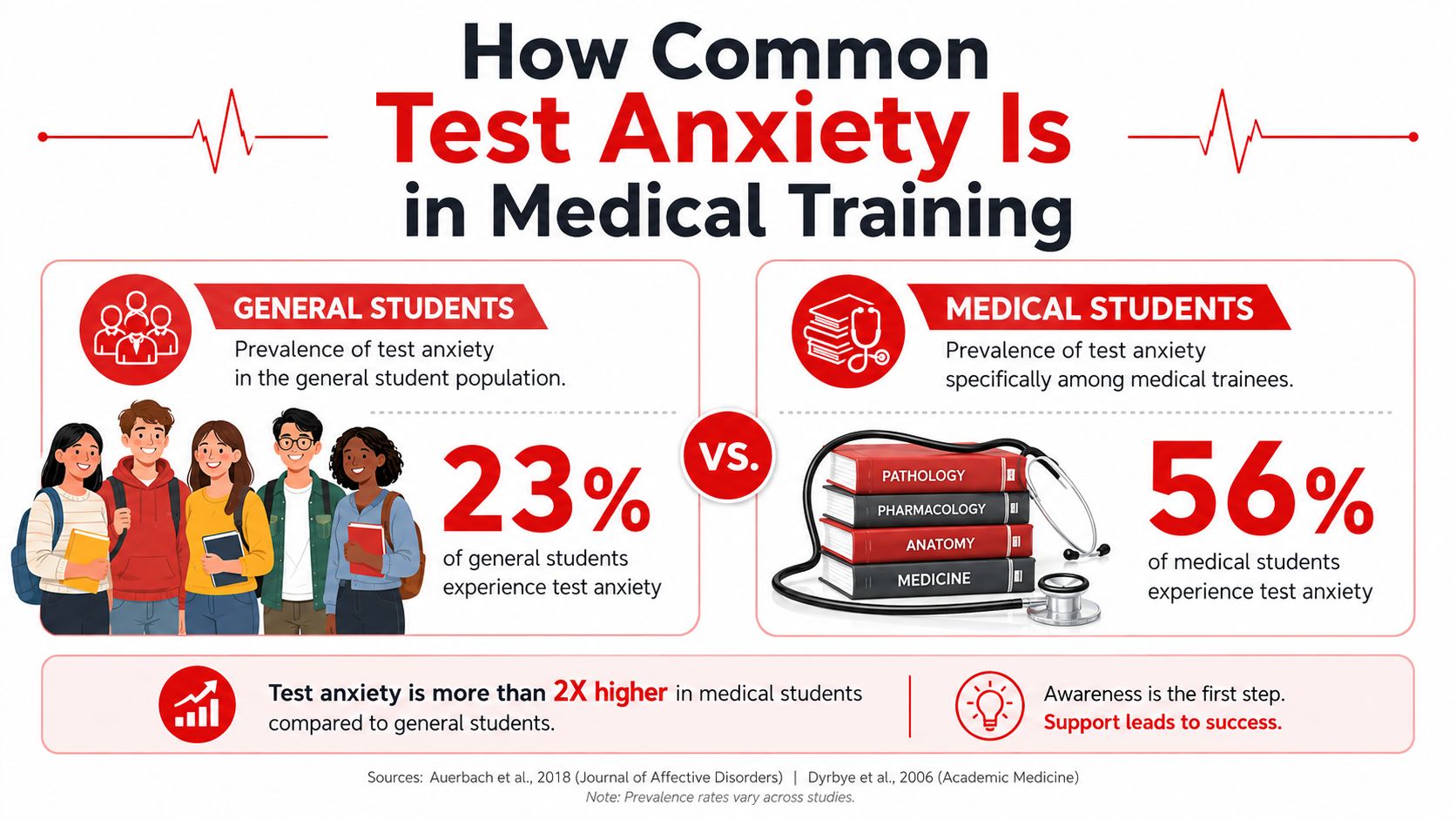
Medical and health science training often sits at the higher end of that range because the feedback loops are sharper, the consequences feel more visible, and students are asked to perform under constant evaluation. A 2019 study of undergraduate medical students found 52.3% had problematic test anxiety, and a 2020 study of first-year health science students found 54.7% with test anxiety, while a first-year medical-student study found about half showed pronounced test anxiety in at least one dimension over time (medical trainee prevalence study). A cross-sectional university study reported 82.6% overall, which shows how high the burden can run in some settings.
That pattern matters because it changes the interpretation. If a large share of a demanding training group is wrestling with the same response, the issue is usually not a lack of commitment or intelligence. It is a common reaction to high-stakes evaluation in a system that rewards precision, speed, and recall under pressure.
Large international survey data point in the same direction. The OECD PISA report found that, on average, 59% of students worry about taking a test, 66% worry about getting poor grades, 55% worry even when well prepared, and 37% feel tense when studying for a test. That is one reason a student may feel fully capable during regular coursework and then become much more reactive once an exam date gets close.
For students who want a grounded look at the emotional load of rigorous training, Ace Med Boards' medical student mental health resource is a useful place to start.
The Three Symptom Clusters You Can Self-Identify
A useful first step is to sort your experience by the loudest mechanism, not by how dramatic it feels. Some students mainly deal with cognitive symptoms, where worry, doubt, or mental blanks take over. Others feel physiological symptoms, where the body goes into a stress state and concentration gets harder. A third group shows behavioral symptoms, where anxiety changes what they do before, during, or after studying and testing.
Cognitive cluster
This cluster shows up when the inner commentary gets so active that it starts competing with the question in front of you. A student may read a stem and immediately think, “I am behind,” “I am going to miss something obvious,” or “This score will show I am not ready,” even before looking at the answer choices. The pattern can also look like repeated rereading, second-guessing correct instincts, or a sudden blank feeling that is more about worry than knowledge.
A quick self-check helps here. If your main problem is that your mind keeps forecasting failure, replaying old mistakes, or treating one hard item like proof that the whole exam is going badly, the cognitive cluster is probably the one to target first. That matters because a strategy for body tension will not fix a thought loop that keeps hijacking attention.
Physiological cluster
This cluster is more body-driven. The heart rate climbs, the hands feel sweaty, the stomach tightens, breathing becomes shallow, or the body feels keyed up before the exam has even started. Some students also notice jaw clenching, leg bouncing, or a sudden sense that they need to move even while sitting still.
A simple way to identify this pattern is to ask whether the physical state is the first thing that changes. If the body feels activated before the thoughts become chaotic, the stress response is probably the main issue. In that case, the problem is not lack of effort or preparation, it is that the nervous system is acting as if the test is an immediate threat.
Behavioral cluster
This cluster shows up in what you start doing, or avoiding, around the exam. A student may delay question blocks, skip review after a rough practice set, keep checking score reports more than needed, or stay up late because they cannot stop thinking about the test. Some students also notice post-exam spiraling, where they replay every missed item and lose the rest of the day to it.
If your anxiety mainly changes habits, the self-check is usually pretty concrete. Ask whether your response is pulling you away from normal study routines, sleep, or recovery after a test. When that is the main pattern, the problem is often less about what you know and more about how anxiety is steering your behavior.
For a broader clinical frame on how these symptom patterns are classified, Ace Med Boards' anxiety disorders classification resource is a useful companion.
Why Anxiety Reduces Exam Performance
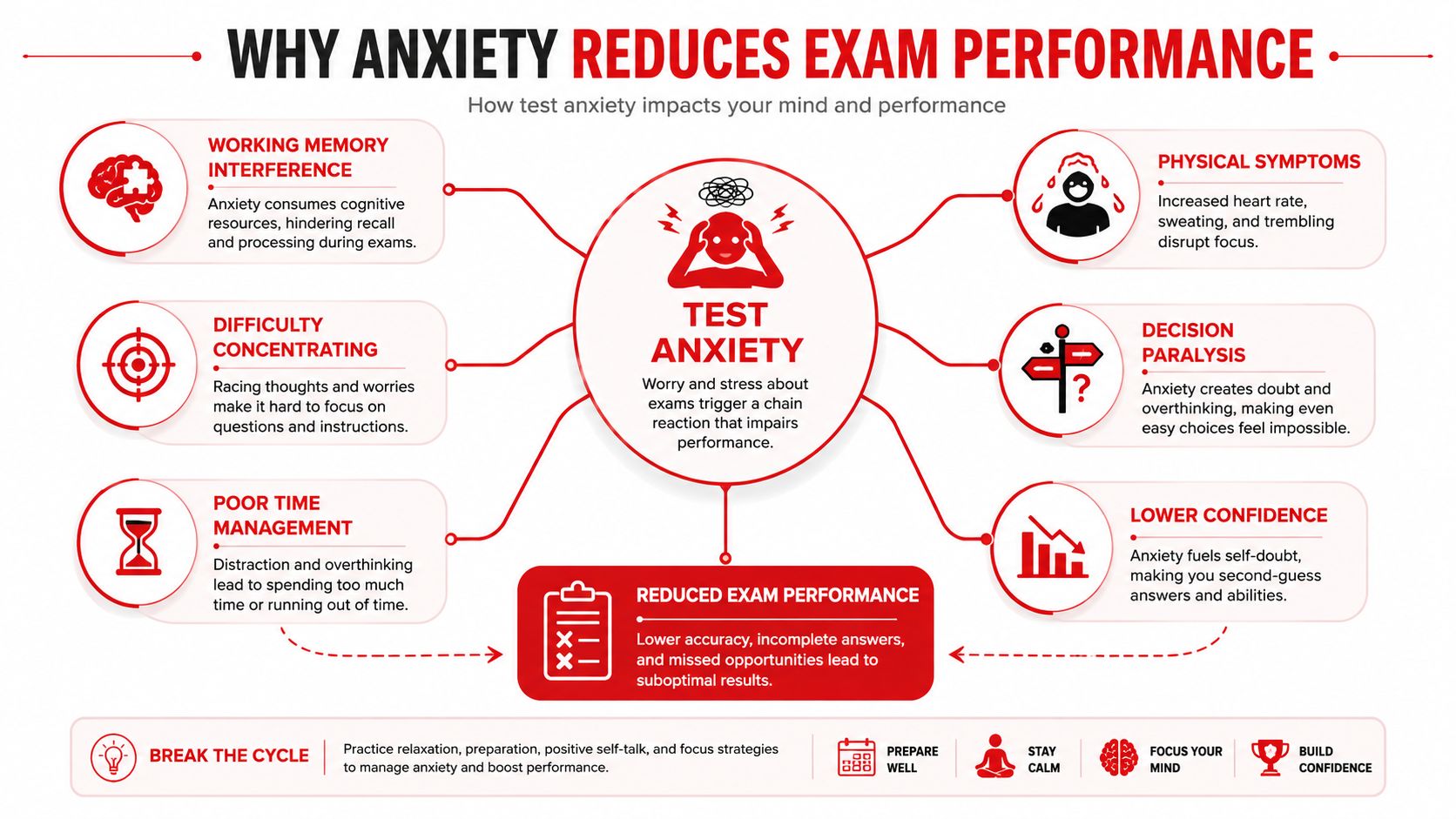
The main reason test anxiety hurts scores is working-memory interference. Working memory is the mental space you use to hold facts, compare choices, track key clues, and reason through a question at the same time. When worry and intrusive thoughts take up part of that space, there's less left for the task in front of you, and the effect is strongest when the item is complex or time-limited (learning scientists review).
That mechanism explains why a student can miss easy questions on a timed shelf exam but answer similar material correctly in untimed review. The content didn't disappear, the mental bandwidth did.
The body also matters
Test anxiety isn't only “in your head.” High test-anxious individuals show increased sympathetic nervous system activity and decreased parasympathetic activity under evaluative stress, along with larger cardiovascular reactions, including higher heart rate and blood pressure, than low test-anxious peers (physiological stress response review). That's why a student may feel shaky, hot, or keyed up before the first question is even read.
The point isn't that the body response is dangerous by itself. It's that it can amplify the cognitive problem. When your physiology is already active, it becomes harder to slow down, inspect the question, and think in sequence.
A useful reality check comes from older course-exam data. In one study, cognitive test anxiety accounted for about 7% to 8% of the variance in performance on actual course exams (Cassady and Johnson 2004). That's enough to matter, but it's not destiny.
For students who want a pressure-performance lens, Ace Med Boards' performance under pressure guide fits well here.
Coping Strategies Matched to Your Mechanism
A student can do “all the right things” and still feel stuck if the wrong problem is being treated. The evidence points toward multiple coping strategies rather than a single fix, and targeted interventions can reduce test anxiety even in low-resource settings, which supports a multi-component, personalized approach (targeted intervention review). That means the first job is to identify whether the main issue is cognitive worry, physiological arousal, or a skill deficit.
Matching Strategies to Your Symptom Cluster
| Symptom Cluster | Best-Fit Strategies | Why It Works |
|---|---|---|
| Cognitive worry | Thought records, cognitive restructuring, timed question review, practice blocks under realistic conditions | It reduces intrusive predictions and trains your brain to stay on the question instead of on the fear |
| Physiological arousal | Box breathing, brief body scans, sleep protection, regular meals, light movement before study | It lowers the body's stress signal so attention has a chance to settle |
| Behavioral avoidance | Small start targets, scheduled review blocks, accountability check-ins, end-of-day shutdown routine | It breaks the avoidance loop and makes the next task easier to begin |
If the main problem is cognitive worry, use the tools that interrupt it directly. Write the prediction before a practice block, such as “I'm going to blank,” then compare it with what happened on recent question sets. That is a CBT-style move, and if you want a clinician-facing overview of how that approach is used, the therapist guide to CBT 2026 gives a helpful reference point. The goal is not to argue with yourself endlessly, it is to separate a fear story from performance evidence.
If the main problem is skill uncertainty, timed practice matters more than reassurance. A full block under realistic conditions shows whether the issue is knowledge retrieval, pacing, or overthinking answer choices. Structured review then turns a vague fear into a set of fixable gaps, which is much easier to work with than a general sense that “I just freeze.” For some students, that process is also where one-on-one tutoring becomes useful, because it can isolate whether the barrier is content, strategy, or exam stamina.
If the main problem is physiological arousal, start with stabilization instead of trying to force confidence. A brief breathing exercise, a predictable bedtime, and steadier meal patterns will not erase every exam fear, but they can keep the nervous system from taking over the study day. Sleep and nutrition are support tools here, not moral tests, and they work best when they are consistent rather than dramatic. Light movement before studying can also help discharge some of that physical tension so your mind has a better chance to settle.
Behavioral avoidance needs a different response again. If starting is the hardest part, shrinking the first step often works better than waiting to feel motivated. Set a small target, begin with one block, and use an end-of-day shutdown routine so the work has a clear stopping point. That structure reduces the friction of returning tomorrow, which matters for anxious students who spend a lot of energy on getting started.
Exam-Day Tactics for the 24 Hours Before and During the Test
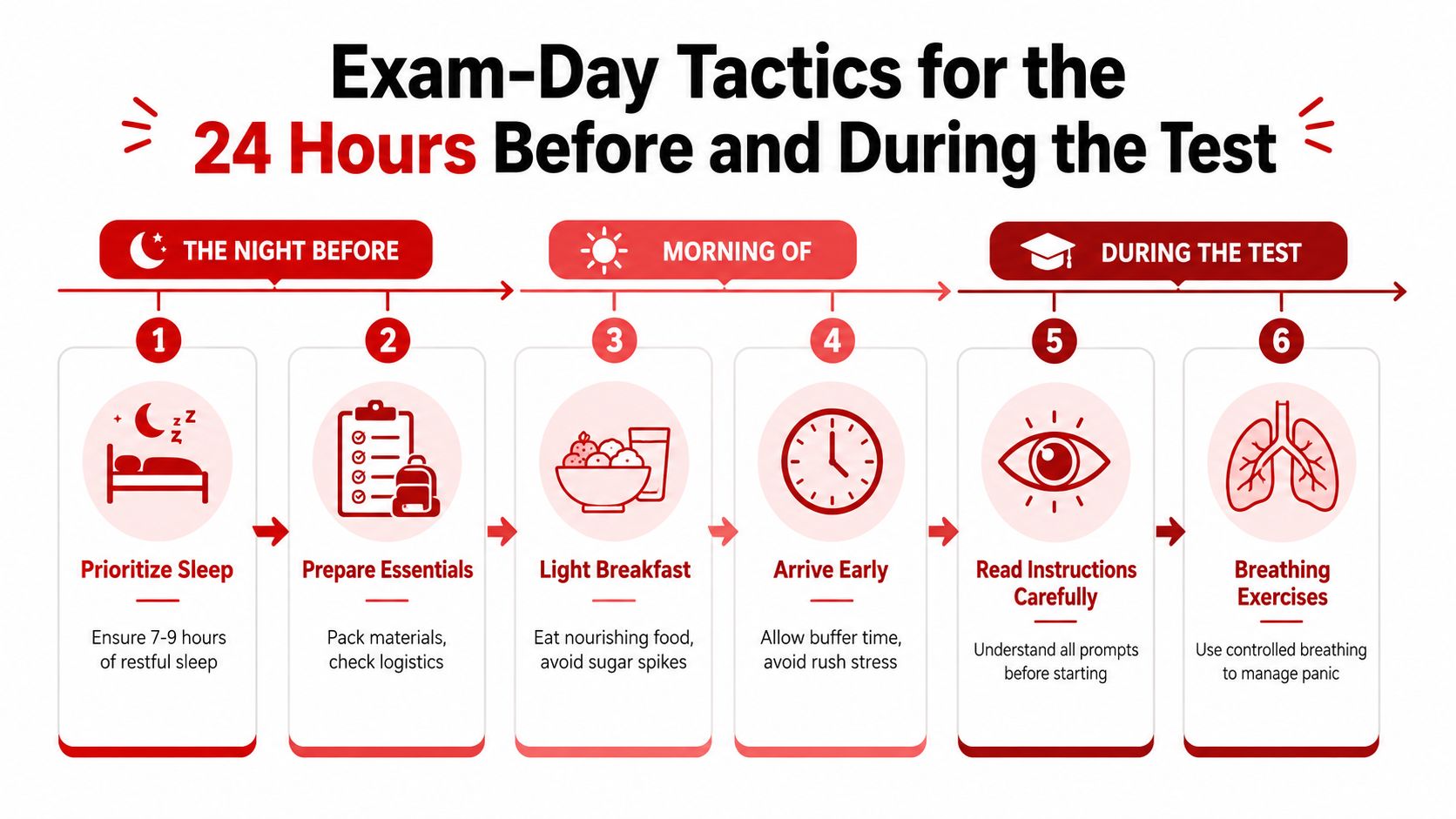
The day before a major exam should feel boring, not heroic. The goal is to protect attention and keep the stress response from escalating before test day even starts.
The night before and the morning of
Keep review light and familiar the night before, then stop. Pack your bag, check the route, and remove the last-minute decision points that create avoidable stress. On the morning of the exam, eat something that sits well for you, hydrate, and give yourself enough time to arrive without rushing.
The first minutes matter
The first 10 minutes set the tone. Read instructions carefully, take one controlled breath cycle, and begin with the first question without trying to “feel ready” first. Starting is often the hardest part, especially for students who freeze when the task feels oversized.
If starting is your biggest problem, the issue may look like test anxiety but behave like task paralysis. Lumas' guide to task paralysis is a useful adjacent resource when the primary barrier is initiation rather than content.
Between blocks and after the exam
Between blocks, reset posture, loosen the neck and shoulders, and keep the next recovery action small. If catastrophizing starts, a short thought record works better than replaying the entire test in your head. After the exam, don't conduct a full forensic analysis in the parking lot. That rumination usually makes the next block, or the next attempt, harder to enter calmly.
When to Seek Professional Help and What Accommodations Look Like
Some amount of nerves before a high-stakes exam is normal. Professional support becomes a better fit when the pattern is persistent, disruptive, or spreading into daily life. That includes panic-level symptoms, avoidance that keeps growing, sleep disruption that lasts for weeks, intrusive thoughts that interfere with studying, or coexisting depression or substance use.
A 30-year review found test anxiety is consistently linked to lower performance and is shaped by poor prior academic achievement, low self-efficacy, and anxiety sensitivity, which supports formal evaluation when symptoms persist (30-year review). That doesn't mean every worried student needs treatment. It does mean that repeated impairment deserves a real assessment instead of more self-blame.
Who can help
Primary care clinicians, psychologists, psychiatrists, and campus counseling centers all play a role. A psychologist can help with CBT, a psychiatrist can evaluate whether medication is appropriate in the short term, and counseling services can support coping skills and exam planning. The right entry point is usually the one you can access fastest.
What accommodations look like
For USMLE and COMLEX, accommodations have to go through the official channels, and documentation matters. The practical goal is to show how the condition affects testing, what has been tried, and why the requested adjustment is tied to that impairment. If you think accommodations may be relevant, start early enough that paperwork doesn't become another source of stress near the exam date.
If the anxiety is changing how you study, sleep, or function outside the exam room, that's a good reason to ask for a formal evaluation.
For students who want a clinician-based view of anxiety treatment options, a local provider such as Vernon therapist for anxiety can be a useful example of the kind of support many students seek.
How Targeted Tutoring Reduces Anxiety and Improves Scores
A student can spend hours studying and still feel unsteady right before an exam. That usually means the problem is not just “being nervous.” It may be cognitive worry, physiological arousal, or a skill deficit in content recall, question parsing, or pacing. Once you identify which part is breaking down, the next step becomes much clearer.

Why structure helps
Targeted tutoring makes the weak point visible. A tutor can listen to how you answer questions, watch where you slow down, and separate recall problems from timing problems or from the kind of self-doubt that appears after a few misses. That clarity often lowers anxiety because the fear stops feeling like a cloud and starts looking like a specific pattern.
One-on-one support can also sit beside your question bank work and school materials without replacing them. It helps you read what your practice is showing, then turn that into a study plan that fits the actual problem instead of the one you fear you have.
Question review is a good example. A student who says, “I keep getting nervous,” may be missing the clue in the stem, rushing through a differential, or changing a correct first answer because of doubt. A tutor can separate those possibilities and choose the right fix, which is usually more useful than adding another generic breathing drill that does not match the mechanism.
For students who want a structured format, Ace Med Boards provides one-on-one tutoring benefits as part of a broader prep plan. Used well, tutoring can make study time feel less scattered and more diagnostic, which is often what anxious high performers need most.
If you're at the point where your studying feels scattered, your confidence keeps dropping, or you want a clearer read on what is holding your score back, schedule a free consultation or Board Score Audit with Ace Med Boards. You can get a practical conversation about whether the main issue is cognitive worry, physiological arousal, or a real skill gap, and what to do next without having to guess alone.
If you want help turning test anxiety into a concrete plan for Step 1, COMLEX, or Shelf prep, Ace Med Boards offers one-on-one tutoring that focuses on question analysis, timed practice, and targeted skill gaps. Visit Ace Med Boards to see whether a free consultation or Board Score Audit makes sense for where you are right now.