You're staring at the AACOMAS portal, the transcript requests are still sitting in your inbox, and you already know this cycle won't reward people who “get to it later.” The AACOMAS application is the centralized primary application for osteopathic medical schools, and the applicants who start early, verify cleanly, and submit with a coherent DO narrative are the ones who give themselves a real shot.
AACOMAS is the single submission system for DO programs. You enter your core information once, AACOMAS verifies it, then transmits that application to the schools you select, which is exactly why timing, transcript collection, and narrative consistency matter so much more than applicants expect. The process is competitive at the school level, and the application itself is built to reward organized people who understand the pipeline rather than people who assume they can improvise at the end.
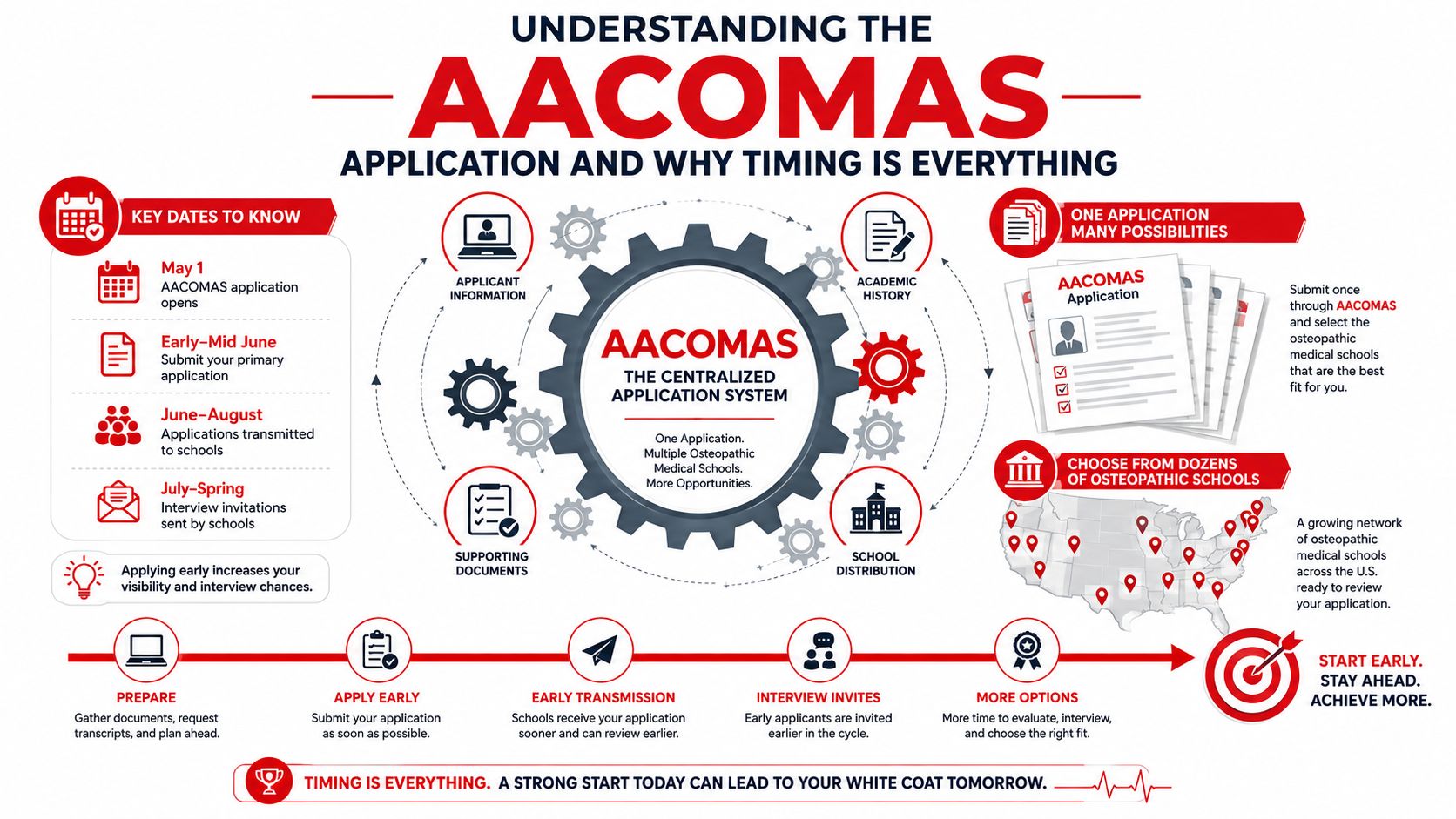
Understanding the AACOMAS Application and Why Timing Is Everything
AACOMAS is not a school-by-school primary form. It's a centralized application service for osteopathic medical schools, so you build one primary application, designate your DO programs, and AACOMAS verifies and sends the file onward to those schools. That structure is why the aacomas application is really a multi-step process, not a single submit button.
The competitive reality is straightforward. AACOM's 2022 Applicant and Matriculant Report shows 23,488 applicants submitted 216,198 individual school applications, while 8,636 matriculants submitted 92,911 applications. That works out to a mean of 9.20 school applications per applicant and 10.77 per matriculant, and the average school saw 5,028 applicants but only 202 matriculants, with an average matriculant share of 4.3%. Those numbers tell you what experienced applicants already know, DO applicants apply broadly, and schools are reviewing large stacks of files. AACOM's 2022 Applicant and Matriculant Report
Start backward from the deadline
AACOMAS recommends building your timeline in reverse. Their own guidance says to create your account and complete core setup at least 3 months before the deadline, request transcripts 10 to 12 weeks before, and submit the final application 6 to 8 weeks before the deadline to reduce verification delays. That's not overkill, it's the way you avoid watching a fixable delay turn into a missed verification window. AACOMAS Quick Start Guide
Practical rule: If your plan only works when every transcript arrives quickly and every recommender responds immediately, your plan isn't solid yet.
The right mindset is simple. Start early enough that your application can survive a slow registrar, a busy recommender, or a typo you catch on review. If you wait until the deadline feels close, you're not “efficient,” you're gambling with verification.
For a school-by-school planning lens, keep your deadlines mapped against the broader cycle using Ace Med Boards' medical school application deadlines guide.
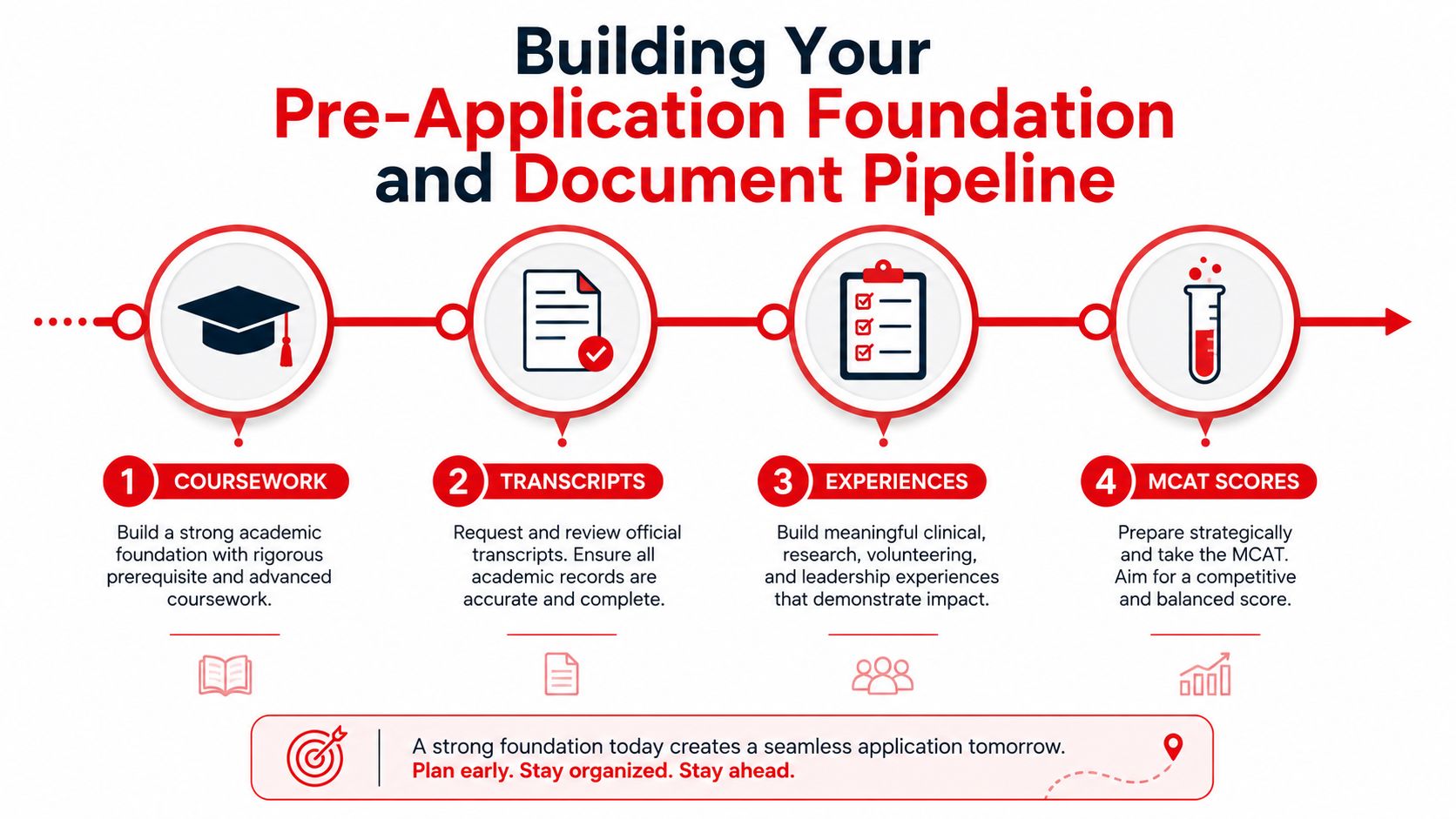
Building Your Pre-Application Foundation and Document Pipeline
Before you touch the main form, get the paperwork moving. AACOMAS requires every college-level institution you attended to be reported, including community college, postbaccalaureate work, graduate or doctoral study, study abroad, military coursework, and even college coursework taken in high school. It also requires one complete set of official transcripts directly from each institution, which means uploads from your own files don't count. AACOMAS application process
Your document pipeline should start before the portal does
The biggest mistake applicants make is thinking the transcript step is administrative busywork. It isn't. Transcript collection is a verification bottleneck, and if one school is slow, your whole file slows down. Request every transcript early, confirm each institution knows where to send it, and keep a simple log of what has been ordered, sent, and received.
You also need to treat your academic history as a data entry project, not a memory exercise. AACOMAS asks you to self-report coursework exactly as it appears on the transcript, including repeated, failed, and withdrawn courses, and to report standardized tests in the Academic History section. MCAT scores must be released to AACOMAS, and the application instructions used in current walkthrough materials also note that prior test scores and dates may need to be entered carefully. AACOMAS application walkthrough
What to prepare before you open the application
Use this as your working checklist:
- Transcript inventory: List every institution, then confirm the official transcript request process for each one.
- Course history file: Build a spreadsheet that mirrors transcript wording exactly, including repeated or withdrawn coursework.
- Test record: Gather MCAT release details and any prior test dates you'll need to enter.
- Activity archive: Write down dates, supervisors, hours, and the exact roles you held while the details are still fresh.
- Personal statement draft: Don't wait for the portal to inspire you. Draft first, edit later.
A good pre-application file saves you from scrambling once the portal opens. The students who look “organized” on paper are usually the ones who did this unglamorous work early. That's the advantage.
For a cleaner way to organize your materials, use Ace Med Boards' medical school CV guide as a practical reference point.
One more point deserves emphasis. The AACOMAS system verifies what you report against what your schools send, so mismatches create delays. Accuracy is not optional here.
Navigating Each Section of the AACOMAS Application
The primary application is where applicants either look polished or expose sloppy habits. Every field has a purpose, and the schools reviewing your file notice when your entries are precise, consistent, and easy to verify. The goal isn't to fill every box, it's to make your file read like someone who understands how admissions systems work.
Academic history must match the transcript exactly
AACOMAS wants your coursework entered exactly as it appears on the official transcript. That includes repeats, fails, and withdrawals, which means the application is built around transparency, not interpretation. If you round off details or try to “clean up” an old grade, you're creating a verification problem that could have been avoided in ten minutes.
This is also why you should double-check course titles, term names, and institutional credits before you submit. A single mismatch can trigger back-and-forth with verification staff, and back-and-forth costs time. Precision here protects the rest of your cycle.
Experiences should do more than list titles
The experiences section is where applicants often waste space. Don't just name an activity and move on. Give the reader enough context to understand what you did, what changed because you were there, and what the experience reveals about your fit for medicine.
Use your strongest entries to show pattern, not noise. Clinical work, research, service, employment, and leadership all matter, but they should feel connected to one another. A scattered list of unrelated activities reads weaker than a smaller number of entries that clearly show responsibility, maturity, and commitment.
Test reporting and the personal statement need discipline
AACOMAS also expects standardized test reporting in the Academic History section. That means you need your MCAT release details squared away before you submit, not after. Don't assume the score will magically appear at the right time without your active attention.
The personal statement should answer a simple question, why medicine, and it should do that without drifting into vague biography. If you're tempted to overload it with every activity you've ever done, stop. The statement should frame your motivation, not repeat your resume.
Your job is not to tell admissions everything. Your job is to tell them the right things in a way they can verify quickly.
For a structured approach to draft, revise, and tighten that statement, use Ace Med Boards' personal statement outline.
Crafting a Credible DO-Specific Personal Statement and Experience Narrative
Generic premed writing fails osteopathic applicants more often than they realize. Saying you like “whole-person care” isn't enough, because that phrase is everywhere and says almost nothing by itself. Admissions committees want credible specificity, a real reason your path points toward DO medicine rather than a recycled paragraph that could fit any applicant.
DO commitment has to sound earned, not borrowed
The strongest AACOMAS narratives usually include a small number of vivid osteopathic encounters, then connect them to service, access, or a patient population that made the philosophy feel real. That's much better than trying to sound maximally “osteopathic” by stuffing the essay with buzzwords. A few concrete experiences beat a pile of vague enthusiasm every time.
Shadowing matters, but only if it taught you something. If your only DO exposure is one afternoon and a line in your statement saying you admire osteopathic medicine, that's thin. If your exposure helped you understand how a physician approaches underserved patients, rural access, or continuity of care, now you have a story with substance.
Weak writing versus strong writing
A weak approach sounds like this. “I value care and want to use OMM to treat the whole patient.” That tells me you know the vocabulary, not that you've earned the insight.
A stronger approach sounds like this. “My DO shadowing made me pay attention to how the physician connected musculoskeletal complaints to work, family stress, and barriers to follow-up, then adjusted the plan around what the patient could realistically do.” That's specific, believable, and useful. It shows observation, not branding.
School secondaries raise the stakes even more, because many osteopathic programs ask about community service, underserved populations, rural medicine, and mission fit. If your primary statement says one thing and your secondary essays wander in another direction, you look unfocused. Align your narrative now so you aren't rewriting your identity school by school later.
AACOMAS applicants also need to think about how many DO encounters are enough. There's no magic number in the verified data, so the better question is whether your exposure gave you a real understanding of the profession. One shallow shadowing day won't carry a narrative. A few meaningful encounters can, if you connect them to service and patient care.
Managing Letters of Recommendation and Evaluation Logistics
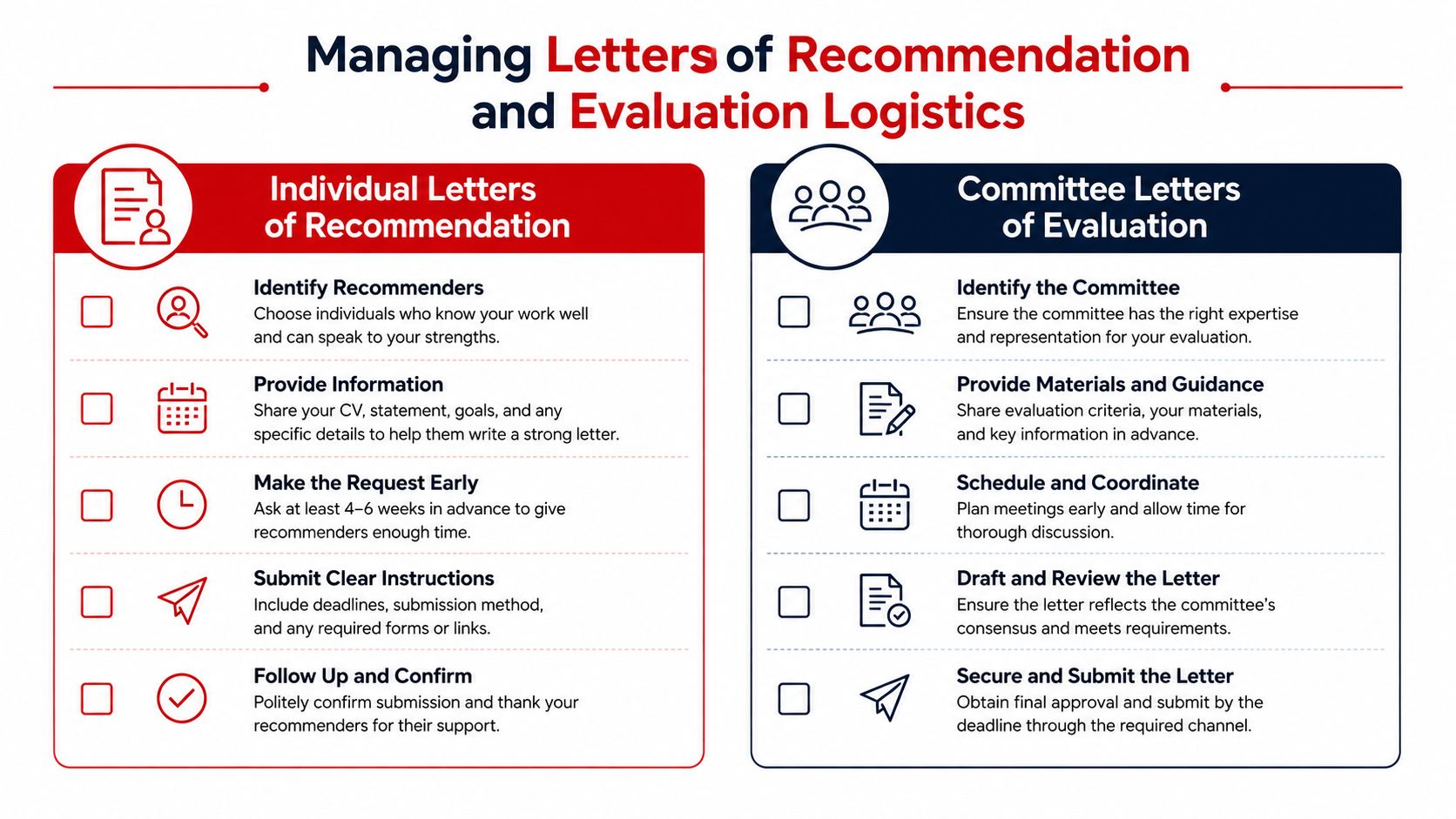
Letters are where strong applicants lose weeks because they treat recommenders like a formality. Don't do that. Choose people who know your work, brief them on what DO schools value, and give them enough lead time that they aren't writing your letter at the last second.
AACOMAS supports the submission of letters through its portal, and schools may prefer different formats, including individual letters, committee letters, or letter packets. Your job is to figure out what each target school wants, then build your letter strategy around that reality. A great letter in the wrong format can still create friction.
Pick recommenders for substance, not prestige
A recommender who can speak clearly about your judgment, reliability, and osteopathic commitment is more useful than a famous name who barely knows you. That's especially true for nontraditional applicants, career changers, and international medical graduates who may not have access to a premed committee. If a committee letter isn't available, strong individual letters can still carry weight when they're specific and credible.
Tell your writers what matters. They don't need your entire life story, they need reminders of the interactions, projects, or clinical moments that show who you are. If you leave them guessing, you're asking for generic letters.
Timing and follow-up matter more than etiquette anxiety
Request letters early, confirm submission instructions, and follow up politely if the deadline is approaching. A delay in one letter can leave your application incomplete, and incomplete files don't help you. Keep a simple tracking sheet with the recommender's name, due date, submission method, and status.
For school-specific expectations, review Ace Med Boards' guide to how many letters of recommendation medical schools usually expect.
Practical rule: If you can't explain why each letter exists, you probably have too many letters or the wrong ones.
Avoiding Costly Post-Submission Mistakes and Managing Verification
Submitting the application is not the finish line. It's the point where you switch from building the file to protecting it. If you go silent after submission, you can miss verification updates, secondary deadlines, or opportunities to correct a new issue before it becomes a problem.
AACOMAS verifies the primary application before transmitting it to the schools you selected, which is why the quality of your initial data entry matters so much. Any inconsistency between the primary and what you later say in secondaries can raise questions. The safer habit is to keep one master version of your academic and experience details and reuse it carefully.
Keep your secondaries moving
Once schools send secondary prompts, the process speeds up fast. Some schools use short deadlines, and applicants who wait too long usually end up rushing the best essays of their cycle. Schools also look for fit, so your secondary answers should be specific to each mission, not recycled from the personal statement.
If a school emphasizes rural care or underserved communities, answer in that language with your own evidence. Don't force the same story into every prompt. Repetition reads lazy, and AACOMAS schools can tell when an applicant is leaning on one generic narrative.
Know the fee structure before you submit
AACOMAS charges $198 for the first program and $60 for each additional program. Liaison's fee guidance also says that applicants classified as dependents on a parent or guardian's filed 2025 federal tax return are treated as Dependent Applicants, which matters for fee-waiver rules and related eligibility decisions. AACOMAS application fees and fee waivers
If your coursework changes after submission, update the application as directed and notify schools when appropriate. Don't assume the system will sort out every change on its own. It won't.
One practical note. If you're still waiting on verification, keep preparing for interviews and secondaries anyway. A passive applicant loses momentum fast, and momentum matters in a rolling admissions environment.
Your Complete AACOMAS Application Timeline and Readiness Checklist
The safest AACOMAS strategy is boring, disciplined, and early. That's the strategy that keeps you from discovering missing transcripts, weak letters, or a mismatched course entry after the cycle is already moving. The broader osteopathic field has grown substantially over time, with first-year enrollment rising from 1,163 students in 1977–78 to 11,590 in 2025–26, a long-term increase AACOM describes as nearly 900%. AACOM enrollment and graduates report
A working timeline you can actually use
- 12 months out: Start shaping your school list and building your narrative around DO fit.
- 9 to 6 months out: Request transcripts, line up recommenders, and draft your personal statement.
- 3 months out: Open the AACOMAS account, enter coursework carefully, and verify every institution is listed.
- 6 to 8 weeks before your deadline: Submit if your file is ready, or you're already late in practice.
- After submission: Track verification, secondary invitations, and interview readiness at the same time.
Readiness checklist before you hit submit
- Transcript completeness: Every institution is accounted for and officially sent.
- Course accuracy: Repeats, withdrawals, and failed courses match the transcript exactly.
- Test reporting: MCAT release details are confirmed.
- Narrative consistency: Primary statement, activities, and secondaries point in the same direction.
- School list strategy: Every school on your list fits your goals, not just your hopes.
- Letter logistics: Each recommender knows the process and the deadline.
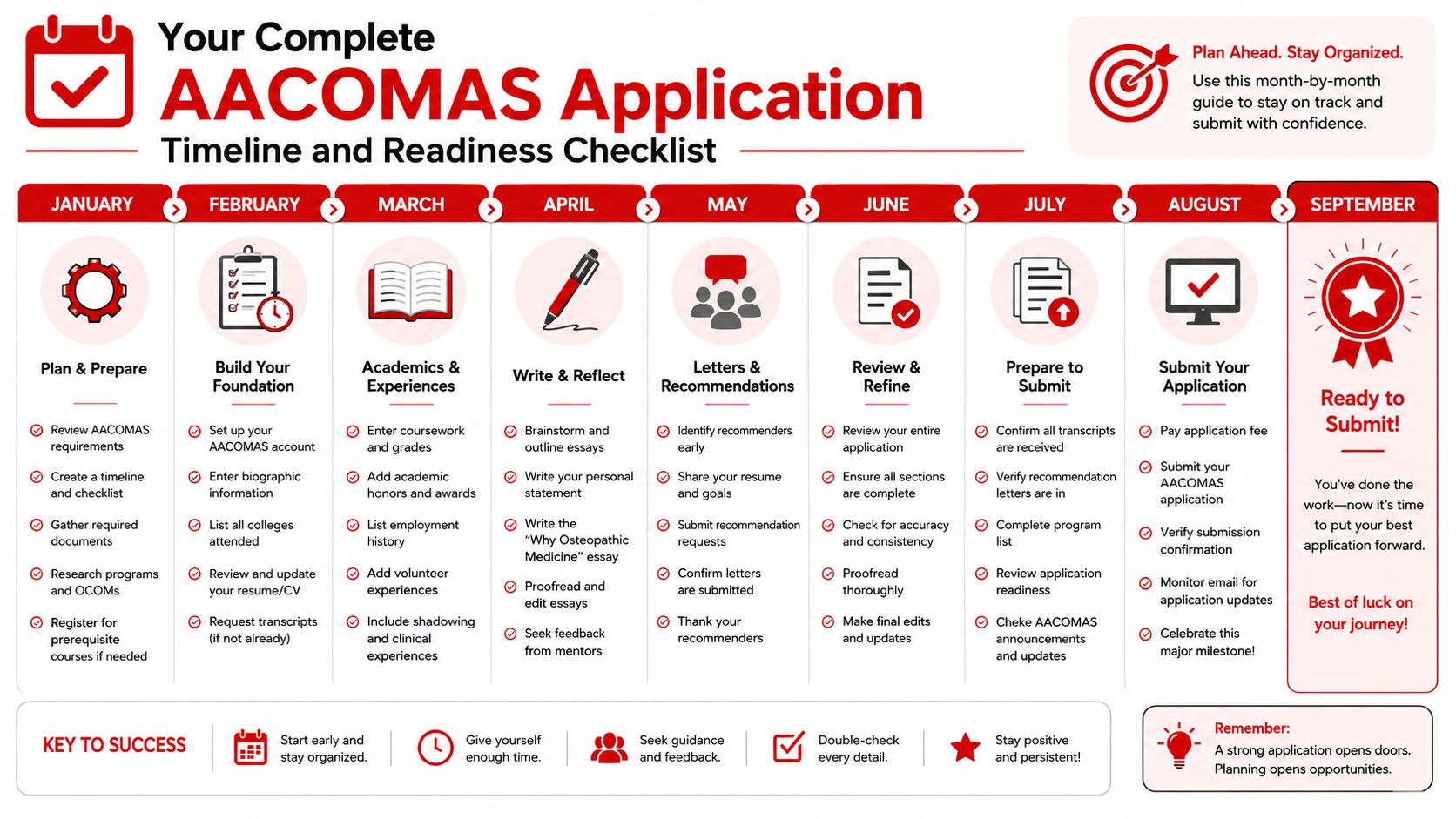
If you're ready to tighten the file, use Ace Med Boards' medical school application checklist as a last-pass audit before you submit.
Ace Med Boards works with applicants who want their AACOMAS materials reviewed for clarity, consistency, and school-fit strategy. If you want a structured read on your application narrative, visit Ace Med Boards and use the free consultation to see where your file is strong and where it needs work.