

You're staring at the AAMC portal, your test window is approaching, and you're realizing registration isn't just “pick a date and move on.” MCAT registration is a scheduling system with deadlines, seat limits, identity checks, and different rules for international testers and students who need accommodations. If you treat it like a simple form, you'll miss something expensive or time-sensitive.
The smart move is to register with the same care you'd use for the exam itself. AAMC account setup, date selection, fee timing, and ID matching all matter, and the order matters too. If you're preparing alongside a broader admissions plan, a structured resource like software for standardized test tutoring can help you keep the logistics and prep calendar aligned, but the registration steps themselves still need to be handled correctly the first time.
What MCAT Registration Actually Involves
The first mistake students make is assuming they can “just sign up” when they feel ready. They're not ready if they don't already know their exact legal name, government ID details, preferred test city, and a backup date. Registration is a scheduling decision, not a casual form fill, and the system punishes hesitation because seats disappear fast.
Start with the pieces you need before opening the portal
You'll create an AAMC account, then enter the MCAT Registration System, fill in identity and background fields, choose a test date and location, pay online, and wait for confirmation. AAMC's own data show the exam is a serious gatekeeper, with 96,061 examinees in 2025 and a mean total score of 500.6 across 305,494 exams in the 2023 to 2025 testing period, so it's not a test people take casually (AAMC MCAT exam data). The registration process exists to control who gets into which seat on which day.
Practical rule: Don't open the registration portal until your ID, payment method, and preferred date list are already in front of you.
The other thing first-timers miss is that the standard U.S. path isn't the only path. International testers and candidates seeking accommodations do not move through the system the same way, and that changes the timing game completely. If you want a simple planning companion while you map out your own calendar, keep your testing timeline separate from prep logistics and check your exam date options on Ace Med Boards' MCAT test dates guide.
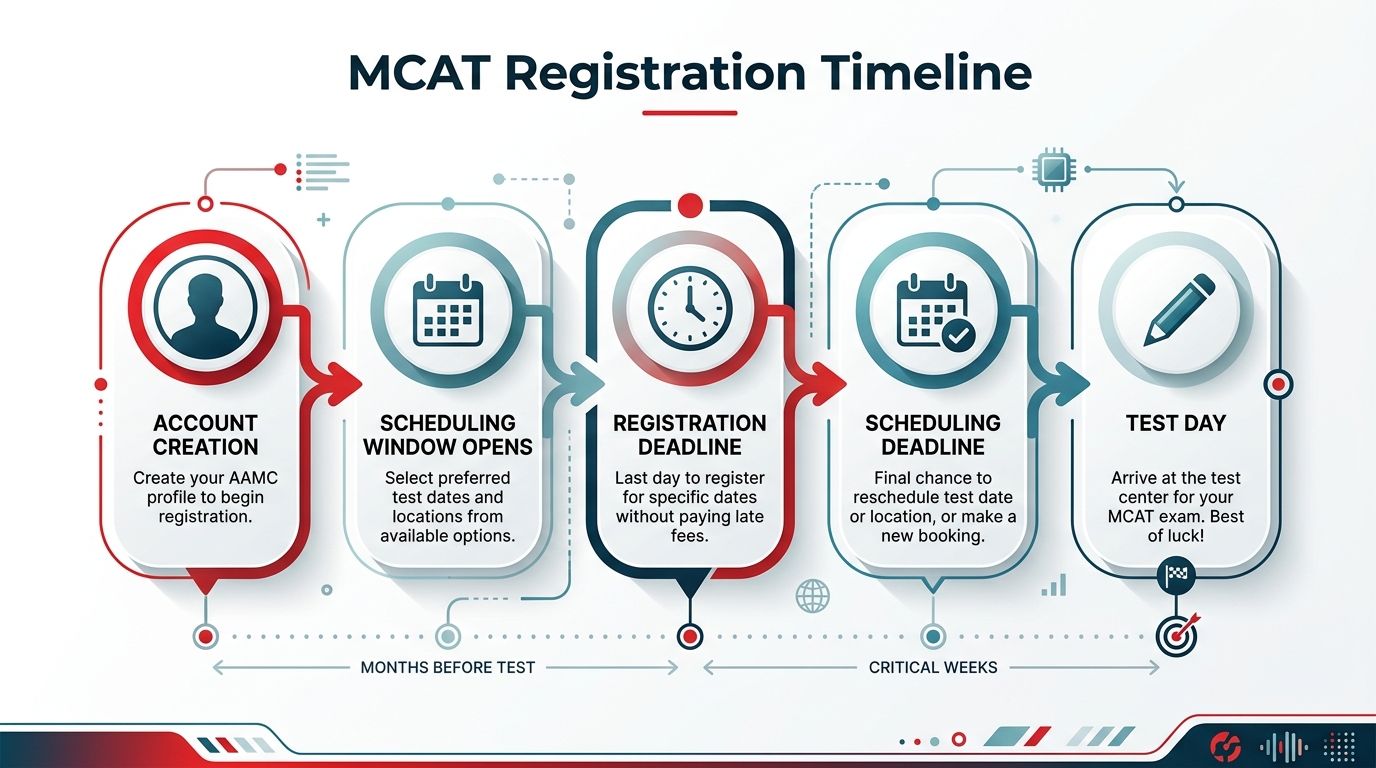
The registration system also cares about name matching. If the name in your AAMC account doesn't match your government-issued ID exactly, you're setting yourself up for a problem at check-in. That's not a minor typo issue, it's a test-day admission issue.
Creating Your AAMC Account the Right Way
Build the account like your test-day entry depends on it, because it does. Use a username and password you'll remember months later, since many students register early and then need the login again for score release, rescheduling, or account review. A clean account now saves you from avoidable panic later.
Enter legal information exactly as it appears on your ID
The AAMC registration flow asks for accurate personal and academic information, and the name on the account should match the government-issued ID you'll present on test day. The Princeton Review's registration guide also notes that you need an AAMC account, a valid ID, and a payment method before you can finish registration (Princeton Review MCAT registration guide). Use your legal name, not your nickname, not a preferred name, and not a different spelling order.
If your ID says one thing and your account says another, fix it before you submit. Don't assume the test center will “figure it out.”
Be precise with biographical and academic fields too. AAMC uses those fields to build a record tied to your registration, and vague or inconsistent entries can slow down later changes. The account also includes agreement screens, and you should read the MCAT Examinee Agreement before you click through it, because you're still accountable for the terms after the click.
A lot of students try to create the account from memory after a long day and then wonder why details don't line up. Don't do that. Put your full legal name, birth date, ID type, and payment card next to your laptop before you start, then compare every screen to that document set.
If you're also managing an admissions file, keep your registration login separate from prep resources like the Ace Med Boards MCAT prep hub. Mixing exam logistics with study materials is how people lose track of deadlines.
Choosing Test Dates and Centers in the AAMC System
Once your account exists, the work begins. The MCAT portal isn't just a calendar, it's a seat map tied to deadlines. AAMC's schedule is built around registration windows and deadline zones, so the right date is the one you can hold, not the one that looks ideal on paper.
Read the calendar like a seat inventory, not a wish list
AAMC has separate timing for different testing periods, and popular centers fill quickly when registration opens. The system shows test dates, locations, and availability, and you need to decide fast if your preferred center is open. That's especially true for high-demand dates and convenient locations, which go first.
The Gold Zone matters because it's the cleanest window for changes, and candidates who wait too long lose flexibility. If you need a backup plan, pick it before you submit, not after the original choice disappears. International testers should also pay attention to the fact that their registration logistics are separate from the standard U.S. path, so don't assume the same centers, release timing, or change options apply everywhere.
| MCAT Registration Zones and Typical Deadlines | |||
|---|---|---|---|
| Zone | Fee Tier | Typical Deadline Before Test Date | Reschedule Window |
| Gold Zone | Lower-fee timing tier | About 60 to 30 days before the test date, depending on the published date grid | Widest flexibility |
| Standard Zone | Mid-tier timing tier | About 29 to 15 days before the test date | More limited flexibility |
| Late Zone | Least flexible timing tier | Within about 14 days of the test date | Tightest, often costly or unavailable |
The table above is the practical way to think about it. If you delay, you're not just risking your first-choice seat, you're shrinking your options for changes later. That's why the safest approach is to decide on a primary test date and a backup date before you even enter the system.
If you want a planning tool that keeps the date search organized, use the AAMC calendar and compare it against the Ace Med Boards MCAT test dates page. That keeps your prep plan and registration plan aligned instead of drifting apart.
Requesting Accommodations Without Losing Your Date
Accommodations follow a parallel track, and students get burned when they try to force that process into the standard registration flow. You do not register first and “sort out accommodations later.” You secure approval first, then you schedule through the approved accommodations process. That sequencing is nonnegotiable.
Approval comes before scheduling
AAMC's current accommodation process says examinees approved for accommodations must first secure approval, then complete the registration tabs, and then contact Pearson VUE to schedule. The approval needs to be in place at least 15 days before the preferred exam date (AAMC accommodations update). That deadline is the trap, because students often assume the regular date selection screen will hold a seat while paperwork is pending.

Here's the right sequence:
- Review the accommodation category that fits your need.
- Gather the required documentation.
- Submit the request well in advance.
- Wait for the approval letter.
- Contact Pearson VUE directly to schedule.
- Confirm the seat, date, and accommodation details in writing.
If the request is partially approved, don't guess your next move. Read the approval carefully and schedule only for the accommodation you were granted. A partial approval can still require you to adjust test-day planning, and you should not assume the original plan survived unchanged.
Practical rule: Until the approval letter is in hand, your test date is not really yours.
Students managing accessibility planning can also use Ace Med Boards' online learning accessibility page as a reminder to keep accessibility needs visible in every part of the process, not just on test day. The key is to treat accommodations as a routing problem, not a side note.
MCAT Fees, Payments, and Reschedule or Cancel Windows
Money is where bad timing becomes expensive. The fee structure and refund logic reward early decisions and punish late ones, and there's no reason to pretend otherwise. If you know you might move your date, price that risk before you commit.
What you pay depends on where and when you register
The AAMC data brief confirms that the mean MCAT score was 500.6 across the 2023 to 2025 period, and the admissions pipeline remains highly competitive, with 51,946 applicants and 23,156 enrolled in U.S. MD programs in the 2024 to 2025 cycle, which is a 44.6% matriculation rate (AAMC applicants and matriculants data). I'm including that here for context, because students often underbudget the exam while overfocusing on the prep books. The registration fee matters, and so does what happens if you need to change plans.
The standard MCAT fee, the international site surcharge, and the Fee Assistance Program reduction all change the economics of registration. You should know your cost before you click submit, not after a schedule change forces another charge.
| MCAT Fee and Refund Scenarios at a Glance | ||||
|---|---|---|---|---|
| Action | Standard Zone | Gold Zone | International Site | FAP Reduced |
| Initial registration | Standard registration fee applies | Standard registration fee applies | Standard fee plus international surcharge applies | Reduced registration fee applies |
| Reschedule | Refund or change fee depends on timing | More favorable than late changes | Same change logic plus international rules | Reduced change fee applies where offered |
| Cancellation | Partial refund if done early enough | Better refund outcome than late cancellation | Standard refund may not include the international surcharge | Reduced cancellation outcome applies where offered |
AAMC's Fee Assistance Program is the only clearly documented route to reduced MCAT costs in the brief, and you should use it if you're eligible. Don't stretch the facts beyond that. If you qualify, the reduced fee eases the hit; if you don't, plan on the standard cost structure and don't assume the system will discount anything automatically.
If you want a plain-English walk-through of the cost side, compare your plan to Ace Med Boards' MCAT cost guide. Then decide whether you're registering once or leaving room for a backup date.
Test Day ID Requirements and Check-In Logistics
Registration doesn't end when you click submit. It ends when the test center admits you with the same identity you used online. Pearson VUE check-in is strict, and the staff at the desk are not there to negotiate identity mismatch or late arrival problems.
Bring the right ID and nothing questionable
Your government-issued ID has to match the name in the AAMC system. That is the core rule, and it's the one that matters most if anything gets messy at check-in. A confirmation email is useful too, but your ID is the gatekeeper.
You should expect security screening, locker storage for belongings, and a controlled entry process before the exam starts. Keep watches, snacks, bottles, and other personal items out of the testing room unless the testing center explicitly allows them. Don't assume the center will make exceptions because you “just forgot” something.
The safest routine is simple. Arrive early, check your pockets before you enter, and treat the check-in line like a formal verification process rather than a casual desk stop. If your ID is wrong, expired, or inconsistent with your account details, the problem is on you, not the center.
Arrive early enough that a long line doesn't become a late arrival. The check-in window is part of the exam day, not an optional buffer.
Common Registration Errors and How to Fix Them
Most registration failures come from predictable mistakes, not bad luck. The first is a name mismatch between the AAMC account and the ID. The second is missing an accommodation deadline. The third is misunderstanding the zone you registered in and discovering too late that your change option is weaker than you expected.
Troubleshoot fast and act on the actual problem
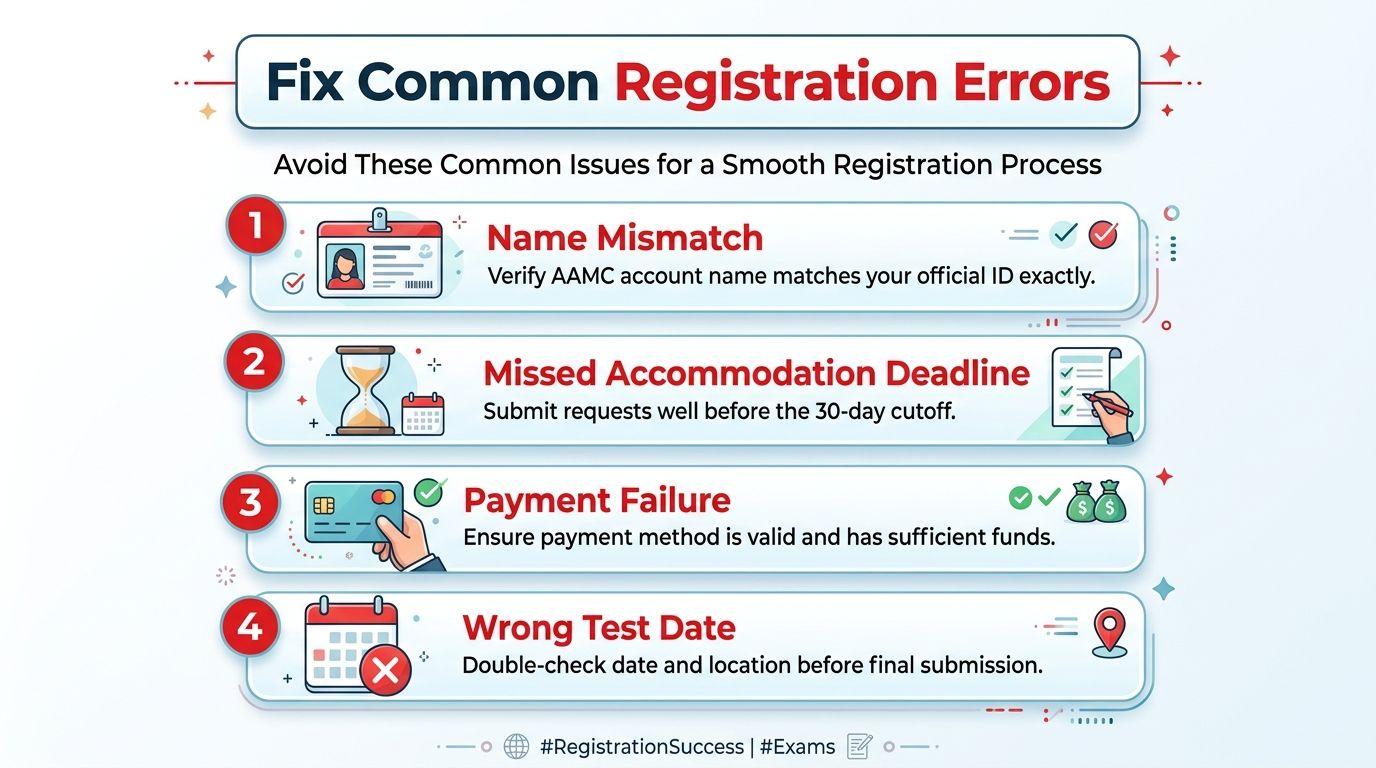
- Name mismatch: Compare your AAMC profile and your ID character for character. If they differ, request a correction immediately and don't wait for test day.
- Missed accommodation deadline: Stop trying to force the standard registration path. Contact the accommodations process and adjust to the next workable date.
- Payment failure: Verify that your card is valid, enabled for online payment, and has enough available funds before submitting.
- Wrong test date or site: If you accidentally selected the wrong center, act immediately and check the change options tied to your registration timing.
- Zone confusion: Re-read the deadline tied to your own date, not someone else's example. Your fee and flexibility depend on the actual date you picked.
The biggest habit to break is last-minute optimism. If a deadline has passed, it has passed. Move to the next available date instead of building a plan around an option the system no longer offers.
If you're still unsure whether your registration choice fits your prep timeline, book a free consultation with Ace Med Boards and bring your target date, current study plan, and any accommodation or rescheduling concerns. A short review now is a lot better than discovering a registration mistake after the seat is gone.