

Roughly two-thirds of applicants never come close to the median MCAT of an incoming med school class, and the gap is bigger than most realize: in the 2025–2026 cycle, applicants averaged 506.3 on the MCAT with a 3.57 GPA, while the students who matriculated averaged 512.1 and 3.81. That spread means a below-510 score isn't rare or disqualifying — it's close to the norm among people who apply. What separates a rejected applicant from an accepted one is rarely the score alone; it's how strategically the school list matches the rest of the profile.
This guide does two things. First, it now includes context on average GPA and MCAT scores for medical schools nationally, so you can benchmark where you stand instead of guessing. Second, it walks through seven vetted resources — from the AAMC's official MSAR database to curated lists of low MCAT medical schools — that turn a subjective panic into a data-driven application plan. We have used most of these ourselves while working with students, and we flag where each one falls short.
Decision Aid: Which Resource Fits Your Situation?
Before reading seven reviews, ask what you need right now:
- Need raw, verified numbers for MD schools? → AAMC MSAR ($28/year subscription).
- Want a fast, free GPA/MCAT table covering MD and DO programs? → Shemmassian's national data table.
- Applying to DO programs specifically? → AACOM's Choose Do Explorer (free, official).
- Unsure whether your score is even low? → Start with the national benchmark cited in the intro; the 2025–2026 applicant mean was 506.3.
- Need to raise the score itself before retaking? → Ace Med Boards, for 1-on-1 targeted prep.
You do not need all seven resources. Most applicants need two: one official database and one curated shortlist. The rest are situational.
1. Ace Med Boards
For students concerned about their MCAT score, the path to medical school can feel narrow. Ace Med Boards offers a different approach, moving beyond simple content review to provide intensive, one-on-one tutoring that directly addresses a student's specific weaknesses. While not a medical school itself, it functions as a critical support system designed to strengthen an applicant's entire profile, starting with the MCAT. This makes it a useful resource for anyone looking to overcome a lower score and become a competitive candidate for programs that consider applicants across multiple factors, including those known as low mcat medical schools.
The platform's strength is its personalized methodology. Instead of a one-size-fits-all curriculum, every student begins with a free consultation to build a custom study plan. Tutors focus on high-yield content, but their real value lies in teaching advanced test-taking mechanics, such as expert question analysis and case-based reasoning. This strategic focus is designed for rapid and measurable improvement, a claim backed by numerous student testimonials citing significant score jumps in a matter of weeks.
Why It Stands Out for MCAT Improvement
What separates Ace Med Boards is its scope and focus on results. It's not just an MCAT prep service; it's an end-to-end medical career partner. The same tutors who can help you dissect a difficult CARS passage can later guide you through USMLE Step 1, Shelf exams, and even residency match consulting. This continuity provides a coherent, long-term support structure.
For the pre-med with a lower-than-desired MCAT score, this means the support doesn't stop on exam day. Their tutors double as admissions consultants, helping you frame your application to highlight your strengths—a high GPA, compelling research, or a powerful personal story—to offset the metric. They provide actionable guidance on school selection, personal statement writing, and interview preparation, ensuring your application gets a fair look from admissions committees.
Key Insight: The true advantage of Ace Med Boards is its dual-pronged approach. It directly targets raising your MCAT score through expert strategy while simultaneously helping you build a compelling application narrative that shines even if your score remains below the median.
In our own review, the most useful part of the engagement wasn't the tutoring itself — it was the school-list discussion, where tutors pushed students away from prestige schools they had no statistical shot at and toward programs where their profile fit the mission.
Practical Tips for Using Ace Med Boards
- Prepare for Your Free Consultation: Before your initial meeting, take several practice MCAT sections and identify your weakest areas. Come prepared with specific questions to get the most out of your customized plan.
- Trust the Process: The tutors emphasize specific techniques for analyzing question stems and answer choices. Fully commit to this methodology, even if it feels different from your usual study habits, as it is designed to build pattern recognition.
- Integrate Tutoring with Other Resources: Use your tutoring sessions to troubleshoot difficult concepts you encounter in AAMC materials or other prep books. Your tutor is your expert guide, not your sole source of content.
- Discuss Your Entire Application: Don't limit conversations to the MCAT. Use your tutor's expertise to strategize about your school list, activities section, and personal statement. This support is a core part of their service.
Platform Details & Access
Ace Med Boards offers a fully online tutoring experience, providing the flexibility to schedule sessions from anywhere. This is particularly useful for busy students balancing work, school, and MCAT prep.
| Feature | Details |
|---|---|
| Service Model | 1-on-1 personalized online tutoring. |
| Primary Offerings | MCAT, USMLE, COMLEX, Shelf Exams, Admissions Consulting, Residency Match. |
| Pricing | Not listed publicly. A free consultation is required to receive a customized quote based on your needs and goals. |
| Key Differentiator | Focus on rapid, verifiable score improvement and long-term student support from pre-med through residency. |
| Access | Visit Ace Med Boards to schedule a free consultation. |
While the lack of transparent pricing may require an extra step, the initial consultation ensures that any package you consider is built specifically for your situation. The platform's validation comes from a strong record of student success stories, making it a formidable tool for applicants determined to strengthen their candidacy for medical school.
2. AAMC MSAR (Medical School Admission Requirements)
Your journey to find the right low MCAT medical schools begins with data, and the most authoritative source for U.S. MD programs is the AAMC's Medical School Admission Requirements (MSAR) database. Think of MSAR not as a list of schools but as a powerful search tool that empowers you to build a realistic and strategic school list based on your specific metrics. It is the official, primary source for every LCME-accredited medical school in the U.S. and Canada.
The core value of MSAR for an applicant with a lower MCAT score lies in its detailed statistical breakdowns. Instead of just showing a single median MCAT score, it provides the full 10th to 90th percentile range for both matriculants and accepted applicants. This allows you to see if your score, while below the median, still falls within the accepted range for a particular school.
Why MSAR is Essential for Your Search
MSAR stands apart because its data comes directly from the medical schools themselves. This is not third-party information or crowdsourced data; it's the official word. For a yearly subscription fee of approximately $28 (and complimentary access for AAMC Fee Assistance Program recipients), you gain access to a wealth of information for a targeted application strategy.
Key Features Include:
- Detailed MCAT & GPA Ranges: View the 10th, 25th, 50th (median), 75th, and 90th percentile scores for accepted students.
- Admissions Policies: Find specifics on the latest MCAT test date a school will accept, prerequisite coursework, and letters of recommendation requirements. This is critical information that can make or break an application.
- In-State vs. Out-of-State Data: See the exact number of in-state and out-of-state applicants, interviewees, and matriculants. This instantly reveals a school's preference for state residents.
- Mission Statements & Program Focus: Read each school's mission to see if it aligns with your experiences, such as a focus on rural health, primary care, or serving underserved populations.
How to Use MSAR to Find Low MCAT Medical Schools
The interface can feel dense at first, but a methodical approach yields the best results. Start by filtering schools based on your GPA and MCAT score, but don't immediately discard schools where you fall below the median. Instead, dig deeper into the profiles of schools where your score is within the 10th-25th percentile range.
When I worked through MSAR profiles for a student scoring 504, the useful filter wasn't the median — it was the 10th percentile. Schools with a 10th-percentile MCAT at or below 500 were worth considering; schools with a 10th percentile of 507 were not, no matter how their mission statements read. That distinction is invisible on most free lists.
Look for other factors that might make you a competitive applicant there. Do you have strong ties to the state? Does your clinical experience align perfectly with their mission? Answering these questions can help you identify programs that take a broad view of applicants and may be more forgiving of a lower MCAT. Understanding all the components of your application is a key first step, and you can learn more about general medical school admissions requirements to see how your profile stacks up. While MSAR is an indispensable tool, remember its main limitation: it only covers MD programs, so you will need to consult other resources for DO programs.
Website: AAMC Medical School Admission Requirements (MSAR)
For the national context behind these per-school numbers, review the AAMC's applicant and matriculant data summary, which reports how school-specific averages fit into the broader applicant pool.
3. AACOM Choose DO Explorer
If you are exploring low MCAT medical schools, your search must include osteopathic (DO) programs, which often provide more opportunities for applicants with non-traditional stats. The official resource for this is the AACOM Choose DO Explorer, the osteopathic equivalent to the AAMC's MSAR. It is the definitive directory for all colleges of osteopathic medicine (COMs) in the United States, offering a direct line to each school's admissions data.
The primary value of the Choose DO Explorer for an applicant with a lower MCAT score is its focus on programs known for considering applicants more broadly. While MD programs are increasingly adopting this approach, it has long been a core principle of osteopathic medicine. The Explorer allows you to quickly identify DO schools where your MCAT and GPA are competitive, often with average scores that are more accessible than many MD counterparts.
Why the Choose DO Explorer is Essential for Your Search
The Choose DO Explorer consolidates official data from every accredited DO school into one free, easy-to-use platform. This is a critical advantage, as it saves you from the time-consuming process of visiting dozens of individual school websites to find key statistics. Unlike MSAR, the Choose DO Explorer is completely free to access, removing any financial barrier to this information.
Key Features Include:
- Mean MCAT & GPA Data: Provides the average (mean) MCAT score and GPA for the most recent entering class, giving you a clear benchmark for your own stats.
- Admissions Criteria & Deadlines: Details specific prerequisites, letter of recommendation requirements, and application deadlines for each COM.
- Program Filters: Allows you to filter schools by location, public/private status, dual-degree offerings (like DO/MPH or DO/PhD), and specific campus settings.
- Mission & Special Programs: Highlights each school's mission, helping you identify programs with a focus on primary care, rural medicine, or serving underserved communities that may align with your background.
How to Use the Choose DO Explorer to Find Low MCAT Medical Schools
Using the Choose DO Explorer is straightforward. Start by navigating the map or list view to get a sense of the programs available. Pay close attention to the "Academic Profile" for each school, which lists the mean MCAT and GPA. A good strategy is to create a list of schools where your score is at or above the mean, as well as a secondary list where you fall slightly below but still within a reasonable range.
For schools where your MCAT is on the lower end, investigate their mission statement and class profile. Do they explicitly state a preference for students with significant life experience, a commitment to osteopathic principles, or strong ties to their state or region? These factors can make you a compelling candidate even if your stats are not stellar. Always cross-reference the data on the Explorer with the school's official admissions website, as the Explorer's data is school-submitted and may not be instantly updated. For a broader view of how DO admissions fit into osteopathic medicine overall, AACOM's insights on osteopathic medicine explain the education pathway and review philosophy in depth.
Website: AACOM Choose DO Explorer
4. Med School Insiders: “Lowest MCAT Medical Schools: Where Can You Get In?”
While data tools like MSAR provide the raw numbers, curated editorial content can give you a much-needed starting point. Med School Insiders, a prominent advising company, offers a regularly updated article that lists U.S. MD programs with the lowest median MCAT scores. Think of this not as a primary source, but as a “cheat sheet” to quickly identify potential schools for your list before you dive into the granular data.
This free online article serves as an excellent orientation tool. It compiles schools that are known to be more friendly to applicants with lower stats and provides brief but important commentary on why they make the list. For an applicant feeling overwhelmed by the sheer number of medical schools, this curated list can make the search for low MCAT medical schools feel much more manageable.

Why This Article is a Helpful Starting Point
The main value of the Med School Insiders list is its accessibility and context. It's free and presents a ranked list based on recent data, and it adds qualitative notes. This context helps you avoid common application mistakes, like applying to a low-MCAT school that accepts almost no out-of-state students. It's a great first stop to build a preliminary list of schools to investigate further.
Key Features Include:
- Curated MD School List: Provides a list of MD programs with some of the lowest published median MCAT scores, giving you an immediate list to research.
- Contextual Commentary: Offers notes on factors like strong in-state preference, mission focus (e.g., primary care, rural health), or comprehensive review practices.
- MD vs. DO Perspective: The article often distinguishes between MD and DO competitiveness, helping applicants understand the wider range of medical education options.
- Free and Accessible: Unlike subscription databases, this information is available to anyone with an internet connection, making it an equitable resource.
How to Use This Resource Effectively
Use the Med School Insiders article as a discovery tool, not a definitive guide. Identify 5-10 schools from their list that seem interesting. Then, take that list directly to the AAMC MSAR and the individual school websites to verify every single data point. The numbers in third-party articles can become outdated, and admissions policies change yearly.
Pay close attention to the commentary about state residency. If a school on their list has a median MCAT of 508 but only accepts 5% of its class from out-of-state, it's not a viable option for a non-resident applicant, regardless of your score. Also, use this list to find schools whose missions align with your background. If your MCAT is on the lower end, a powerful story and mission fit are your greatest assets. If your score is still a major concern, it may be time to learn more about how to improve your MCAT score for a future application cycle.
Website: Med School Insiders: Lowest MCAT Medical Schools
5. Shemmassian Academic Consulting: “Average GPA and MCAT Score for Every Medical School (2026)”
For a quick, high-level overview of medical school admissions, a well-curated data table can be an excellent starting point. The “Average GPA and MCAT Score” list from Shemmassian Academic Consulting offers a clean, scannable resource that aggregates key stats for U.S. MD and many DO programs onto a single page. It serves as a rapid-fire way to build a preliminary list of schools where your metrics might be competitive.

Unlike the dense, feature-rich MSAR database, this tool's strength is its simplicity. It presents median MCAT and GPA scores in a straightforward table, allowing you to quickly sort and identify programs whose numbers align with your own. This is especially helpful for finding low MCAT medical schools early in your research process before you commit to deeper, more time-intensive investigation.
Why This List is a Helpful First Step
Shemmassian's list stands out because it combines MD and DO programs and is completely free to access, removing barriers to initial research. While it is third-party data and should always be cross-referenced with official sources, it provides a valuable bird's-eye view that is difficult to find elsewhere. It helps you see the forest before you start examining the individual trees.
Key Features Include:
- Combined MD & DO Data: A significant advantage is the inclusion of numerous osteopathic (DO) medical schools, which often have lower average MCAT scores than their allopathic (MD) counterparts.
- Simple, Sortable Table: The data is presented in a clear table format, making it easy to identify schools within a specific statistical range.
- Regular Updates: The page is updated to reflect the most recent application cycle data, though it's important to check the date of the last update.
- Cost-Free Access: There is no subscription or fee required to view this information, making it accessible to all applicants.
How to Use This List for Your School Search
The best way to use this resource is for initial brainstorming. Start by scanning the list for schools where your MCAT score is at or near the listed median. Pay special attention to the DO programs if your score is below the typical MD average. This process can help you build a “long list” of potential schools to investigate further.
Once you have this list, your next step is to verify everything. Use the list to identify programs, then go to MSAR for MD schools and individual DO school websites to confirm the statistics and understand the full admissions picture. Remember that a median score is just one data point; understanding the full range of scores for accepted students is essential. To get a better grasp of where your score fits in the broader context, you can learn more about the average MCAT score nationally and what it means for your application. For the most current national benchmarks behind this table, the AAMC's admissions data report shows how applicant averages compare with matriculant averages, a two-point GPA and nearly six-point MCAT spread that school tables won't surface on their own.
Website: Shemmassian Consulting – Average GPA and MCAT Score for Every Medical School
6. Accepted.com: Medical School Selectivity Index
While raw data from MSAR and Choose DO is fundamental, interpreting it can be challenging. Accepted.com's Medical School Selectivity Index adds a valuable layer of analysis by synthesizing key metrics into a single, sortable list. It's a free, interactive tool that gauges the relative competitiveness of MD programs by combining a school's acceptance rate, average MCAT score, and average GPA into a proprietary “selectivity score.”
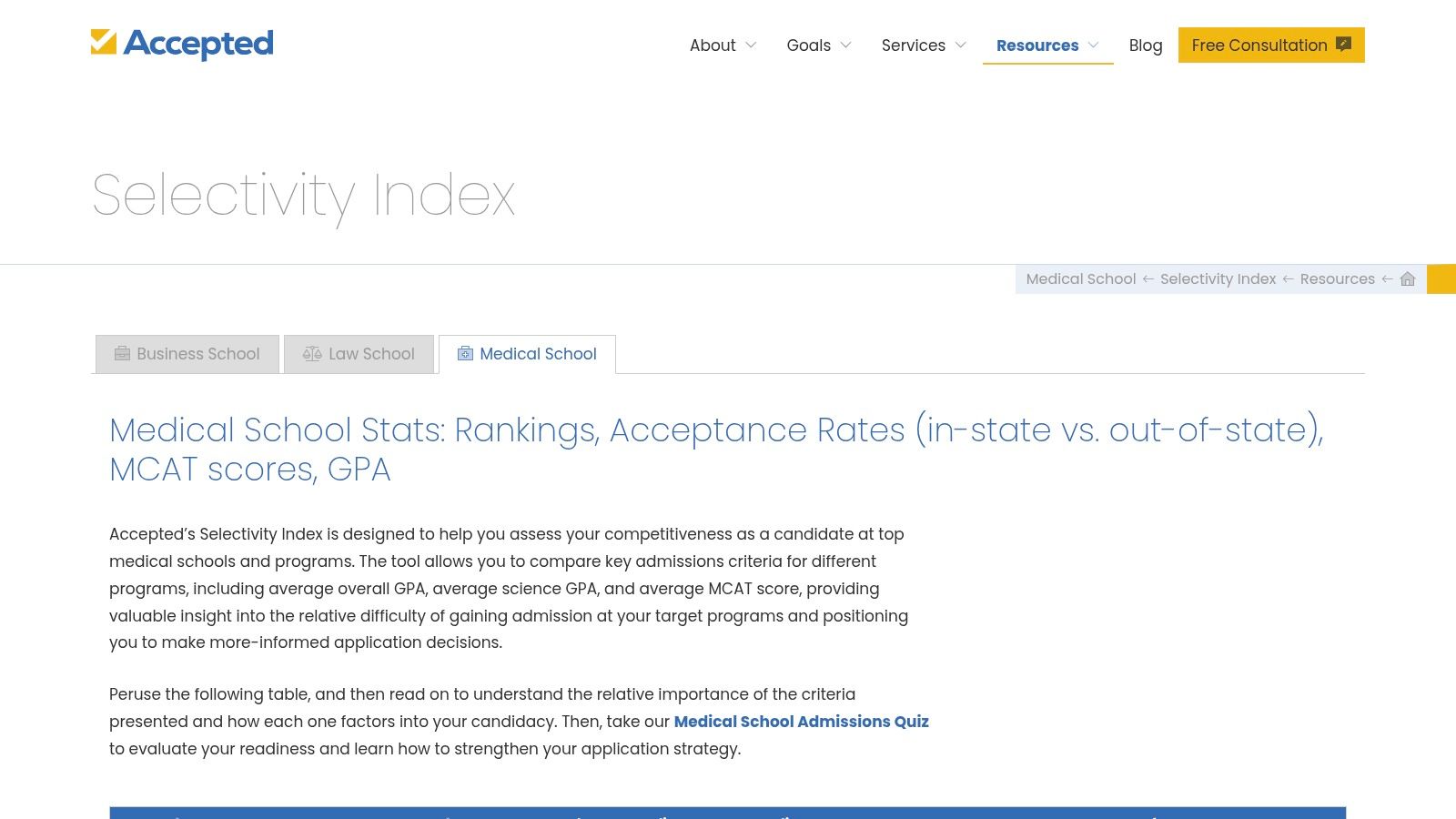
The primary benefit for applicants searching for low MCAT medical schools is the ability to quickly visualize where schools stand in the competitive hierarchy. Instead of juggling three different data points for dozens of schools, this index offers a snapshot comparison, helping you identify programs that might be statistically more approachable. It's a great starting point for finding schools to research further using official sources.
Why the Selectivity Index is Essential for Your Search
Accepted.com's tool stands out by providing context. It answers the question, “How hard is it to get into this school compared to others?” by blending statistics that are often considered in isolation. The index, along with accompanying blog posts, is completely free to use, making it an accessible resource for all applicants trying to build a balanced and strategic school list. It complements, rather than replaces, official databases.
Key Features Include:
- Sortable Selectivity Index: Instantly rank U.S. MD schools by their combined selectivity score, acceptance rate, average MCAT, or average GPA.
- Interactive Visualization: The tool allows you to see how schools stack up against one another in a clear, comparative format.
- Accompanying Guidance: Accepted.com provides articles and advice on how to use this data to inform your application strategy, preventing you from applying too broadly or too narrowly.
- Quick Identification: It's a fast way to generate a preliminary list of schools where your stats might be more competitive before diving into the granular details on MSAR.
How to Use the Selectivity Index to Find Low MCAT Medical Schools
Begin by sorting the list by “Average MCAT” from lowest to highest. This will immediately show you the programs with the most forgiving median scores. From there, cross-reference this with the acceptance rate and overall selectivity score. A school with a lower-than-average MCAT but a very low acceptance rate might still be a significant reach, possibly due to a strong in-state preference or a mission-specific focus.
Use the schools you identify here as a starting point for more detailed research. If a school looks promising on the index, your next step is to visit its MSAR profile and official website. Confirm the full 10th-90th percentile data ranges and investigate the school's mission. A strong performance in the interview is critical for all applicants, and knowing a school's mission is key; you can find more guidance on how to succeed with our medical school interview tips. Remember, the Selectivity Index is a third-party tool with a proprietary formula, so always verify its findings with official data sources before finalizing your school list. When we tested the index side by side with MSAR profiles, the biggest divergence came from mission-driven schools whose selectivity formulas underweight their real in-state bias — another reason the official database stays the final word.
Website: Accepted.com Medical School Selectivity Index
7. Inspira Advantage: “What’s the Lowest MCAT Score Accepted Into Med School?”
Beyond databases, well-researched articles from reputable admissions consulting groups can provide a curated starting point for your school list. The Inspira Advantage guide, “What’s the Lowest MCAT Score Accepted Into Med School?”, acts as a strategic summary, consolidating key data points into an accessible format. It helps you quickly identify specific low MCAT medical schools for both MD and DO pathways that you can then investigate further.
This guide is not a primary data source like MSAR, but rather an editorial compilation designed to jumpstart your research. It gathers examples of schools with lower MCAT medians or known minimums, presenting them in clear tables. This approach is especially useful for applicants with scores below the 506 mark who need to find programs where their application has a realistic chance of being reviewed.
Why This Guide is Essential for Your Search
The main benefit of this article is its efficiency. Instead of you spending hours sifting through raw data, it presents a pre-filtered list of potential schools, complete with context. Because it is free to access, it serves as a no-cost first step to see what kind of programs might be within reach, including a look at DO schools, which are often a better fit for lower-stat applicants.
Key Features Include:
- Tables of MD & DO Programs: Provides lists of specific medical schools known to have lower average MCAT scores for matriculants, saving you initial search time.
- Notes on Special Programs: Highlights schools with MCAT-optional policies, waiver scenarios, or special pathway programs that may de-emphasize the MCAT score.
- Strategic Application Guidance: Offers advice on how to strengthen other parts of your application to compensate for a lower MCAT, which is critical for a successful review of your application.
- Coverage of DO Schools: Unlike MD-only resources, this guide gives equal weight to osteopathic programs, which are a vital and often more accessible option for many applicants.
How to Use This Guide to Find Low MCAT Medical Schools
Use this guide to build a preliminary list of schools. Read through the tables of MD and DO programs and note any that seem like a potential fit based on their reported MCAT averages. It is critical, however, to treat this as a starting point. Always cross-reference the information with the school's official admissions website and MSAR or ChooseDO Explorer to verify the most current statistics and policies.
Pay close attention to the context provided for each school. A lower median MCAT might be tied to a strong preference for in-state residents, a mission focused on rural health, or a unique student population. Understanding these nuances is just as important as the score itself. Remember that a low MCAT often needs to be balanced by a strong GPA and other experiences; you can explore strategies for applicants with a low GPA to see how these factors intersect.
Website: Inspira Advantage: “What’s the Lowest MCAT Score Accepted Into Med School?”
Low-MCAT Medical Schools: 7-Source Comparison
| Item | Implementation complexity 🔄 | Resource requirements ⚡ | Expected outcomes ⭐📊 | Ideal use cases 💡 | Key advantages |
|---|---|---|---|---|---|
| Ace Med Boards | 🔄 Moderate — requires booking consult and ongoing 1:1 sessions | ⚡ Moderate–High — paid tutoring packages, time commitment, reliable internet | ⭐ High potential — reported rapid, measurable score gains (varies by student) | 💡 Students needing targeted, fast score improvement for USMLE/COMLEX/MCAT or residency prep | Personalized 1:1 tutoring; flexible scheduling; case-based, score-focused coaching |
| AAMC MSAR (Medical School Admission Requirements) | 🔄 Low — searchable database, subscription access | ⚡ Low — low-cost annual subscription (~$28) | ⭐ Very high — authoritative school statistics and policy details | 💡 Applicants building realistic MD school lists and verifying policy nuances | Official, primary source for MD program stats and admissions policies |
| AACOM Choose DO Explorer | 🔄 Low — web directory with filters | ⚡ Very low — free to use | ⭐ High for DO data — per-school MCAT/GPA and requirements (school-submitted) | 💡 Applicants considering DO programs or with lower MCATs | Official DO directory; filters by mission, location, deadlines |
| Med School Insiders: “Lowest MCAT Medical Schools” | 🔄 Very low — read editorial list | ⚡ Very low — free article | ⭐ Moderate — curated starting list and context (not official) | 💡 Quick orientation for low-MCAT applicants before official validation | Curated ranking and contextual notes on state/residency effects |
| Shemmassian Consulting: “Average GPA and MCAT…” | 🔄 Low — single-page table for fast comparison | ⚡ Very low — free and regularly updated | ⭐ Moderate — fast cross-school comparisons including many DOs | 💡 Efficient shortlisting and spotting schools matching your scores | Comprehensive, easy-to-scan national table including MD and many DO programs |
| Accepted.com: Medical School Selectivity Index | 🔄 Low–Moderate — interactive tool with proprietary methodology | ⚡ Low — free interactive visualization | ⭐ Moderate — visual competitiveness snapshot (methodology proprietary) | 💡 Comparing relative selectivity when balancing lists | Combines acceptance rate, MCAT, GPA into a sortable competitiveness index |
| Inspira Advantage: “What’s the Lowest MCAT Score Accepted…” | 🔄 Very low — article with examples and guidance | ⚡ Very low — free resource | ⭐ Moderate — consolidated examples of low thresholds and pathways | 💡 Applicants with sub-506 MCAT seeking broadened options and MCAT-optional info | Covers MCAT-optional/waiver programs and special pathways, practical examples |
Frequently Asked Questions
What MCAT score is considered low for medical school?
Against the 2025–2026 matriculant average of 512.1, anything below 506 sits beneath the national applicant mean, and a score under 500 puts you outside most MD schools' 10th percentile. "Low" is therefore a shorthand, not a cutoff — some mission-driven state schools admit students in the high 490s, while top MD programs rarely interview below 510.
Do DO schools accept lower MCAT scores?
Generally yes, though the gap is narrower than it used to be. DO matriculant averages typically run several points below MD matriculant averages, and osteopathic schools' long tradition of considering applicants' full backgrounds means life experience and mission fit can offset a lower score more readily. The AACOM Choose Do Explorer publishes each school's current mean so you can compare directly.
How important is GPA compared to the MCAT?
They matter together, not separately. National 2025–2026 data show matriculants averaged a 3.81 GPA alongside a 512.1 MCAT, versus 3.57 and 506.3 among all applicants — a combined academic record matters more than either metric alone. A low MCAT with a high GPA reads differently than a low MCAT with a low GPA; the second pattern usually demands a retake or post-bacc proof of academic ability.
Can I get into medical school with a 500 MCAT?
Yes, but your list has to be built for it. A 500 is below the applicant mean of 506.3, so competitive options narrow mostly to DO programs, mission-driven MD schools with accessible 10th percentiles, and in-state programs where residency preference works in your favor. Pair it with a strong GPA and deep clinical experience, and verify each school's accepted range in MSAR before applying.
Have MCAT and GPA averages been rising?
Slightly every cycle. Longitudinal enrollment data show matriculant MCAT means climbing from 511.8 in 2024–2025 to 512.1 in 2025–2026, and matriculant GPA rising from 3.73 to 3.81 over the past five cycles. The drift is modest, but it means a score that was mid-pack three years ago may now be a point below the curve.
Should I retake a 505 MCAT?
Only if you have concrete evidence you can improve. If your practice tests were consistently higher than 505, the exam underperformed your ability and a retake makes sense. If 505 was at the ceiling of your practice range, the stronger move is usually a targeted school list — DO programs, in-state options, and mission-aligned MD schools — rather than another cycle of test prep.
From Strategy to Acceptance: Your Next Steps
Building a successful medical school application with a lower-than-average MCAT score is possible; many successful physicians have followed this path. It calls for a focused, deliberate, and strategic approach. Use tools and resources to identify programs where your unique application can stand out. Finding the schools is only the first step. The work lies in crafting a narrative that persuades admissions committees you are more than a single test score. Every other component of your application must work in concert to demonstrate your resilience, passion, and fitness for a career in medicine.
The journey from a “low MCAT” applicant to an accepted medical student is paved with intention. A lower score does not disqualify you, but it does require you to be more methodical in how you present your candidacy.
Your Action Plan: Turning Data into an Acceptance
Information without action is useless. Now that you have the tools, it's time to implement a clear, step-by-step plan and transform from a passive applicant into a proactive candidate.
Build a Smart, Balanced School List: Your goal is not to apply to every school with a low median MCAT. Your goal is to apply to the right schools. Use MSAR and Choose DO Explorer to create a list of 20-30 programs. Focus on schools where your score falls comfortably within their accepted student range, ideally above the 10th percentile. Pay extremely close attention to in-state vs. out-of-state acceptance rates and mission alignment. If a school's mission is rural primary care and your entire experience is in urban academic research, it's a poor fit, regardless of the MCAT median.
Conduct an Honest MCAT Retake Analysis: Before you proceed, you must be brutally honest with yourself. Was your MCAT score the result of a single bad day, or does it point to a genuine gap in content knowledge or test-taking strategy? If you believe you can achieve a significant improvement (a jump of 5 points or more), a retake could be a powerful move. We have watched this decision play out dozens of times: retakes motivated by panic rather than evidence almost always reproduce the original range.
Amplify Your Application's Narrative: If you decide a retake is not in the cards, your essays, activities descriptions, and letters of recommendation must do the heavy lifting. They are no longer just supporting documents; they are your primary argument. Your personal statement must tell a compelling story about your journey, your “why,” and your dedication. Your secondary essays need to be written specifically for each school, directly answering the prompt while connecting your experiences to their specific mission and values.
Key Insight: A lower MCAT score shifts the burden of proof to your qualitative components. Every word in your essays must work to paint a picture of a mature, capable, and mission-driven applicant who will be an asset to their class.
Seriously Consider Alternative Pathways: Do not dismiss post-baccalaureate or Special Master's Programs (SMPs). Excelling in a rigorous, graduate-level science curriculum is a direct and powerful way to prove to admissions committees that you can handle the academic demands of medical school, effectively mitigating concerns from a lower MCAT score. Similarly, the Doctor of Osteopathic Medicine (D.O.) pathway is an outstanding option. D.O. schools have a long-standing tradition of a broader review process, often placing greater weight on your life experiences and commitment to patient-centered care.
Your journey to medical school might look different from someone else's, but a detour is not a dead end. By using these resources strategically and focusing on building a compelling, authentic application, you can turn a perceived weakness into a powerful story of perseverance. You can and will earn that white coat.
Navigating the application process with a lower MCAT can feel daunting, but you don't have to do it alone. The experts at Ace Med Boards specialize in helping students strengthen their profiles, whether it's through targeted MCAT prep or crafting a standout application. Schedule a free consultation to develop a personalized plan that turns your medical school dream into a reality.