
Think of a USMLE practice exam as the single most important diagnostic tool in your entire board preparation journey. It’s not just a quiz; it’s a full-dress rehearsal for the real thing. Its core purpose is to give you a brutally honest look at where you stand right now.
Your First Step in USMLE Preparation
This initial feedback is the bedrock of any intelligent study plan. It shines a spotlight on your specific strengths and, more importantly, your weaknesses across every medical discipline. Once you understand how to read this data, you can stop studying generically and start focusing on targeted, high-yield preparation.
This guide will show you exactly how to turn those practice exam scores into a personalized roadmap for success. For more great advice, check out our guide on essential USMLE study tips.
As you get started, it's also helpful to look at the bigger picture of exam prep. For some broader insights, these four foolproof ways to prepare for medical certification exams can help ensure every hour you spend studying is as effective as possible.
Navigating Official vs. Third-Party Practice Exams
When it comes to USMLE prep, not all practice exams are created equal. Knowing the difference between the official stuff and third-party options is a game-changer for your study plan.
Think of it this way: official NBME exams are the full dress rehearsal. They are the single best tool for predicting your score and getting a feel for the real test's pacing, style, and software. Nothing else comes closer to the real thing.
Third-party Qbanks, on the other hand, are your daily sparring sessions. Tools like UWorld and Amboss are where you build your knowledge base, drill specific concepts, and sharpen your test-taking skills in a lower-stakes setting. They're for learning and practice, not prediction.
We’ve put together a comprehensive breakdown of official vs. third-party USMLE practice tests to help you build a more balanced and effective strategy.
Comparing Official and Third-Party USMLE Practice Exams
Understanding the unique strengths and weaknesses of each resource type helps you integrate them strategically into your study schedule. Here’s a side-by-side look:
| Feature | Official NBME/USMLE Exams | Third-Party Q-Banks (e.g., UWorld) |
|---|---|---|
| Primary Purpose | Score prediction and simulating test day. | Learning content and building a knowledge base. |
| Question Style | Identical to the real exam; sometimes seen as more vague or representative of actual test questions. | Often longer, more detailed questions designed to teach concepts thoroughly. |
| Explanations | Minimal to none. The focus is on assessment, not teaching. | Extremely detailed explanations with diagrams and charts are the main value. |
| Score Prediction | Highly predictive. The Free 120 and NBME Self-Assessments are the gold standard for gauging readiness. | Less predictive. UWorld Self-Assessments (UWSAs) are helpful but can be less accurate than official NBMEs. |
| Cost | Generally lower cost per exam (e.g., Free 120 is free, others are around $60). | Higher overall cost for a subscription (hundreds of dollars), but provides thousands of questions. |
| Best Use Case | Use periodically throughout your dedicated study period (every 1-2 weeks) to track progress and readiness. | Use daily for content review, identifying weak areas, and active learning. |
Ultimately, you need both. Official exams tell you where you stand, while third-party question banks are the tools you use to improve your standing.
This flowchart illustrates how to build a cycle of assessment and planning using these tools. You start with a practice test, dive deep into the results, and then adjust your study plan accordingly.
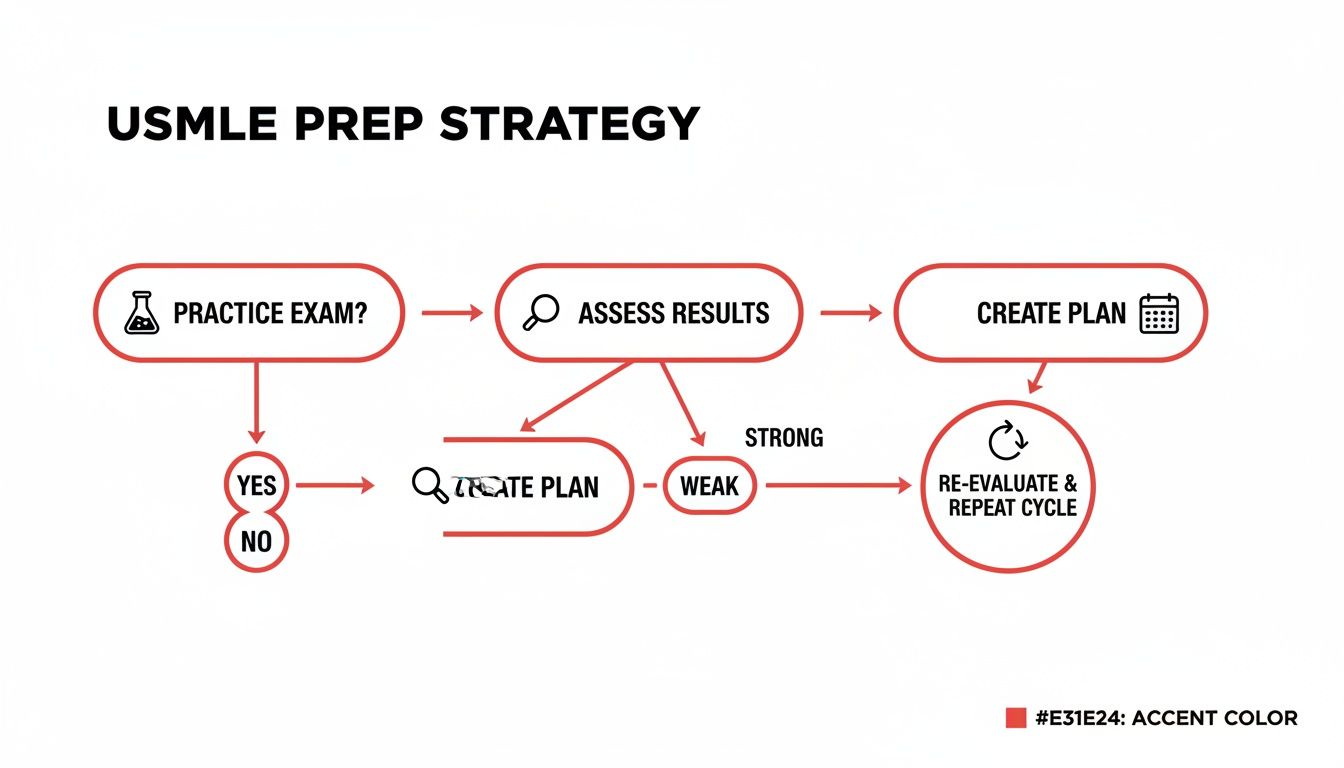
As you can see, taking a USMLE practice exam isn't a one-and-done event. It’s the starting pistol for a focused cycle of analysis, targeted review, and smarter planning.
How to Decode Your Practice Exam Results
Getting your score report back is a huge milestone, but it's just the starting line. The real gold is buried in the data, waiting for you to dig it out and turn it into a concrete plan of attack.
Think of it this way: your overall score is like knowing you lost a game. A deep dive into your performance report is like watching the game tape to see why you lost. Were you consistently missing pharmacology questions? Or maybe you nailed the basic science but struggled to connect it to clinical vignettes.
This is where the magic happens. A thorough analysis transforms a simple score into a personalized roadmap for improvement. Beyond just looking at the raw numbers, digging into your performance patterns—much like analyzing student engagement statistics and analytics—reveals exactly where your time is best spent.
Official NBME exams give you a “Total Equated Percent Correct Score” and a probability of passing. If you find yourself in the “low pass” range, treat that as a serious warning sign. It means you’re right on the edge of the passing standard with almost no room for error, signaling an urgent need for more focused, strategic studying.
For a more detailed breakdown of what all those numbers mean, check out our guide on the USMLE Step 1 score predictor. It’ll help you translate those percentages into actionable steps.
Creating Your High-Impact Study Schedule

A successful USMLE journey is built on a smart, strategic schedule—not just brute-force cramming. The goal is to weave each USMLE practice exam into your prep with a clear purpose, turning it from a simple test into a powerful learning tool.
Kick off your dedicated study period with a baseline exam. Think of this as a diagnostic tool that shines a light on your specific weaknesses from day one. This initial assessment gives you a roadmap for your content review.
From there, you can use subject-specific question blocks to solidify your knowledge as you study. It's crucial to space out your full-length practice exams, taking one every 1-2 weeks. This cadence gives you enough breathing room to meticulously review your results, patch up your weak areas, and see genuine improvement before your next big assessment.
Of course, the best plans are the ones that can adapt. Learn more about building a responsive study schedule for medical students that evolves with your performance.
Simulating Test Day the Right Way

Your performance on the actual USMLE is about more than just knowing the material. It's an endurance sport. You have to train for the mental marathon of focusing under intense pressure for hours on end, and a realistic USMLE practice exam simulation is your training ground.
This means doing everything exactly as you would on the real day. Wake up at the same time. Eat the same breakfast. Adhere strictly to the block timing and the break schedule you’ve planned.
The whole point is to troubleshoot problems before they can derail you when it counts. You need to discover how fatigue hits you, where your timing goes wrong, and what distractions throw you off your game. This is how you build the mental resilience needed for an all-day exam.
Don't underestimate how much this matters. Recent USMLE performance statistics show a massive 27-percentage-point performance gap between first-time takers (88% pass rate) and repeat examinees (61% pass rate). Being fully prepared the first time is critical.
By replicating the environment down to the smallest detail, you systematically reduce anxiety and build unshakable confidence. If you haven't already, take a look at a USMLE Step 1 sample exam to get a feel for the official format and interface.
Turning Your Practice Results Into Real Score Gains
Seeing your weaknesses on a practice exam score report is one thing. Actually fixing them is another game entirely. It’s easy to fall into the trap of just re-reading the topics you missed, but a generic study plan rarely addresses the subtle error patterns that are really holding you back.
This is where a deep dive into your performance becomes so critical. Instead of just seeing a list of wrong answers, you start to uncover the why behind them—hidden knowledge gaps, flawed reasoning, or even test-taking anxiety. Structuring your review around these specific findings lets you build a hyper-focused, high-yield study plan that tackles the root cause of your mistakes.
This targeted approach makes a huge difference. First-time USMLE test-takers from US schools have a 96-97% pass rate, but that number can plummet for those who have to repeat the exam. You can see the full breakdown in the latest USMLE Step 1 pass rate statistics.
Frequently Asked Questions
Let's tackle some of the most common questions students have when navigating their USMLE prep. Think of this as a quick reference to reinforce the key strategies we've covered.
How Many USMLE Practice Exams Should I Take?
The sweet spot for most students is between four to six full-length practice exams during their dedicated study period. This range is usually enough to gather solid progress data without tipping into full-blown testing burnout.
Think of it as a tiered approach. Your first test is a baseline—it shows you where you're starting. From there, plan to take one every one to two weeks to track your improvement and make smart adjustments to your study plan.
Crucially, make sure at least two or three of these are official NBME exams. Save one for the final week before your test, as it will give you the most accurate prediction of how you'll perform when it really counts.
Remember, quality always beats quantity. One practice exam that you review inside and out is infinitely more valuable than three you barely glance at.
What Is a Good Score on a USMLE Practice Exam?
This is a great question, and the answer depends on which Step you're taking.
For the pass/fail Step 1, "good" means having a very high probability of passing. When you look at your official NBME score report, you want to see that probability number sitting comfortably above 95%. That's the confidence booster you're looking for.
For the scored Step 2 CK exam, a good score is all about your career goals. You need to look up the average scores for matched applicants in your dream specialty. As a rule of thumb, consistently scoring 5-10 points above that average puts you in a strong position. Generally speaking, any score above a 240 is considered competitive for a wide range of specialties.
What Should I Do If My Practice Scores Are Not Improving?
Hitting a score plateau is frustrating, but it's also an incredibly common part of the USMLE journey. Almost everyone experiences it. When it happens, the first move is to go deeper in your review process.
Don't just look at what you got wrong; figure out why you got it wrong. Are you consistently misreading question stems? Are you talking yourself out of the right answer?
Next, it might be time to revisit the fundamentals in your weakest areas. A score plateau often signals a crack in your foundational knowledge that needs patching up. If you've tried all that and you're still stuck, it might be time to bring in an expert. A great tutor can dive into your performance data and spot subtle error patterns or knowledge gaps that you're too close to see.
When Is the Best Time to Take My First Practice Exam?
Take your first diagnostic USMLE practice exam right at the beginning of your dedicated study period. It’s so tempting to wait until you feel more "ready," but that completely defeats the purpose of getting a baseline.
This first test isn't about getting a great score; it's about creating a roadmap for your prep. The results will give you an objective, data-driven picture of your strengths and weaknesses across every single subject. This allows you to build a targeted, efficient study plan from day one, ensuring you're spending time where it will actually make a difference.
If you're stuck on a score plateau or just want to build a truly personalized study plan from your practice exam results, Ace Med Boards is here to help. Our expert tutors specialize in turning performance data into actionable strategies that get real results. Book your free consultation today and start preparing with confidence.

