Why do some medical students study for hours, finish every video, and still feel unprepared when practice scores stall? The missing piece is often not effort, it's how the effort is directed. Strength based learning shifts the question from “What am I bad at?” to “What already works, and how do I use it better under exam pressure?”
That matters in medicine because the stakes are concrete. Nearly 1 in 5 students, 19%, enrolled in four-year institutions in 2022 to 2023 did not return for their second year, and a 2024 Gallup meta-analysis found strengths-based interventions were associated with a Cohen's d of 0.43 for retention, which Gallup translates to a 4.73 percentage-point drop in attrition and about a 25% lower likelihood of discontinuing enrollment between freshman and sophomore year (Gallup's summary of the meta-analysis). That's not a board-exam score, but it is the same underlying problem, persistence under pressure.
For USMLE Step 1, Step 2, MCAT, and COMLEX, this guide translates the framework into study blocks, question-bank review, tutoring structure, and measurable tracking. It also shows where the approach helps, where it doesn't replace remediation, and how to use it without turning it into empty motivation talk.
Why Studying Harder Is Not the Same as Studying Better
Medical training rewards endurance, so most students assume more hours should produce better outcomes. Then they hit a wall. They reread First Aid, grind UWorld, sit through long lecture playlists, and still miss the same kinds of questions because the study plan rewards exposure, not transfer.
That mismatch is where strength based learning helps. Instead of treating every weakness as a personal flaw, it starts with the skills you already use well, then builds your study system around them. If you think clearly through patterns, structure your review around patterns. If you remember stories better than isolated facts, use case-based recall instead of trying to force raw memorization.
Practical rule: If your current system takes more time than attention, and more attention than retention, it's time to redesign the method, not just add more hours.
The distinction matters for Step 1, Step 2, MCAT, and COMLEX because each exam punishes passive effort. A student can feel busy and still fail to improve because the work isn't matched to how that student learns, processes error, or remembers information. That's why this guide focuses on translating a strengths-first approach into actual board prep choices.
If you're looking for a broader overview of how people choose study methods, this study technique guide can sit beside the ideas here. The difference is that this article doesn't just rank techniques, it helps you decide which ones fit your brain and your exam.
What Strength-Based Learning Means
A medical student can know every term in a chapter and still study in a way that fights their own mind. A strengths-based approach fixes that mismatch by starting with the skill the student already uses best, then building the study routine around it. If a learner spots patterns quickly, the study plan should use pattern recognition. If a learner remembers stories better than isolated facts, the plan should turn facts into cases, vignettes, and recall cues.
A simple definition
In plain English, strength based learning means you assess, develop, and apply your strengths on purpose. The formal education model describes it as assessing, teaching, and designing learning activities so students can identify, develop, and use their talents, with impact checked through pre/post measures and, when possible, a comparison group (Villanova's strengths-based student development guide). That structure matters because it gives a tutoring session something concrete to work with, rather than leaving the idea as motivational language.
A useful way to see the difference is to compare two study conferences. In a deficit-first session, the tutor keeps saying, “You missed renal tubular acidosis, so go back and reread the chapter.” In a strengths-first session, the tutor asks what the student did well on the missed question, then uses that strength to shape the next attempt. If the student noticed the acid-base pattern but froze on the details, the tutor can build a question-bank routine that starts with pattern identification, then adds the missing mechanism, then ends with a one-sentence teach-back.
That is the practical meaning for Step 1, Step 2, MCAT, and COMLEX prep. A student who thinks in systems may do better with pathway maps and organism clusters. A student who learns through verbal explanation may retain more by teaching the material out loud after each block of questions. A student who is strong under time pressure may need timed sets earlier, while a student who is accurate but slow may need smaller timed bursts before full-length work. The study method changes because the student's strengths change the route to the same exam goal.
The roots of the model sit in positive psychology and educational research from the mid-2000s, when scholars began comparing strengths-focused and deficit-focused strategies. A randomized experimental study in 2015 found that strength-based strategies improved students' perceived competence, intrinsic motivation, and effort intentions relative to deficit-based self-regulated learning strategies, across two randomized experiments (study in PMC). For medical learners, that matters because confidence and effort are not abstract feelings, they affect whether a student can keep showing up for another question block, another review session, or another correction cycle.
What it is not
Strength based learning is not “just be positive.” It does not mean ignoring weak subjects, skipping hard pathology, or pretending a student does not need remediation. A learner can have a strong visual memory and still need more work on endocrine physiology. The difference is that remediation is delivered through a method the student can use well, not through a method that slows the student down before the content even has a chance to stick.
It also does not mean the tutor avoids difficult material. A student who keeps missing valvular lesions on practice questions still needs direct correction, but the correction can be framed through the student's strengths. For example, a student who remembers clinical stories can attach each murmur to a bedside presentation, then sort the lesions by what is heard, what is felt, and what appears on the echo stem. That keeps the work honest while making the path more usable.
One sentence captures the idea cleanly, strength based learning uses what already works to make hard work more efficient.
The Evidence That Strengths Boost Real Outcomes
Why should a medical student care about strengths-based learning if the boards are still looming and the question bank is still full of weak spots? Because the framework has been studied against outcomes that matter, not just motivation buzzwords. The evidence is strongest when you look at persistence, confidence, and the ability to keep studying after a rough block.
A 2024 meta-analysis summarized by Gallup found that strengths-based interventions in higher education were associated with a Cohen's d of 0.43 for college student retention, which Gallup translates to a 4.73 percentage-point drop in attrition and about a 25% lower likelihood of discontinuing enrollment between freshman and sophomore year (Gallup). That same summary reports that 19% of students in four-year institutions in 2022 to 2023 did not return for their second year, which shows that persistence is a real problem before you even get to board prep.
For a medical learner, the point is not that strengths-based study replaces content review. It helps you stay engaged long enough for content review to do its job. A small-to-moderate effect size may sound modest, but in Step 1, Step 2, MCAT, and COMLEX preparation, modest gains in follow-through can decide whether a plan survives the first bad week or falls apart after it.
There is also a finding that speaks directly to how students respond after mistakes. A peer-reviewed study summarized in the same Gallup piece linked strengths-based teaching practices with higher general self-efficacy, meaning students felt more able to handle difficult tasks. In tutoring sessions, that difference is easy to see. One learner treats a missed endocrine item as proof they are behind, while another treats it as a signal to change the next review pass, redo the stem, and test the concept again the following day.
A stronger way to judge that kind of evidence is to ask what outcome it changes and how believable the study design is. A research appraisal guide is useful here, because strengths-based learning should be reviewed the same way you would review any medical education claim. The question is not whether the idea sounds nice. The question is whether it helps students persist, retain material, and answer more questions correctly when the exam pressure rises.
Five Components That Make Strength Based Learning Operational
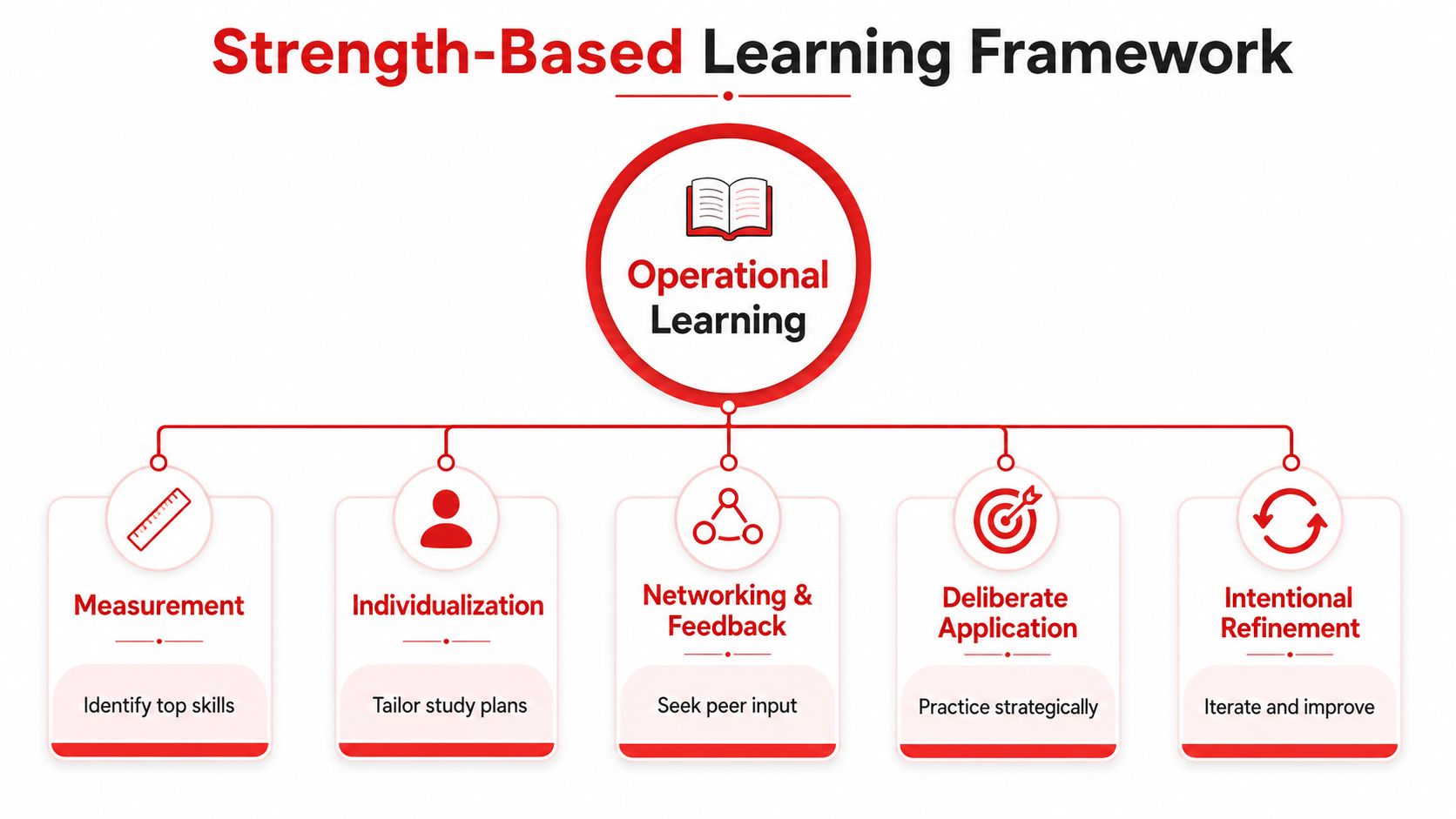
A useful model has five parts, and each one can be built into a tutoring session or solo study routine. The key is to move from vague self-knowledge to visible study behavior. That means you're not just saying “I'm a visual learner,” you're changing how you review questions, schedule blocks, and check whether the system is working.
| Component | What It Means | Medical Prep Example |
|---|---|---|
| Measurement | Identify strengths and outcomes | Take a strengths inventory, then compare the profile with NBME or AAMC practice trends |
| Individualization | Match the plan to the learner | Use more diagram-based review for anatomy-heavy topics if visual processing is a strength |
| Networking and Feedback | Use outside eyes | Review missed questions with a peer or tutor who can spot patterns you miss |
| Deliberate Application | Practice the strength on purpose | Turn a strong skill, like pattern recognition, into faster question triage in timed blocks |
| Intentional Refinement | Adjust the plan based on results | Rework your weekly schedule after a full-length exam instead of repeating the same block setup |
The five-component model is especially useful because it gives a tutor a session structure. Start with a measurement question, such as what kinds of questions the student misses most. Then individualize the next study block, get feedback on one narrow error pattern, and finish with a deliberate practice task that forces the student to use a strength under pressure.
A simple example works well in medical prep. A student who thinks in clinical narratives may do best when case stems are summarized out loud before looking at answer choices. Another student who notices visual hierarchy quickly may use annotated flowcharts for biochem or renal physiology. The method changes, but the content stays the same.
For measurable learning outcomes, this guide to measurable learning outcomes fits naturally with the framework, because strengths-based learning only matters if it produces observable change. The point is not to collect labels, it's to build a study system that can be reviewed, corrected, and repeated.
Applying Strengths to Question Banks and Retention Techniques
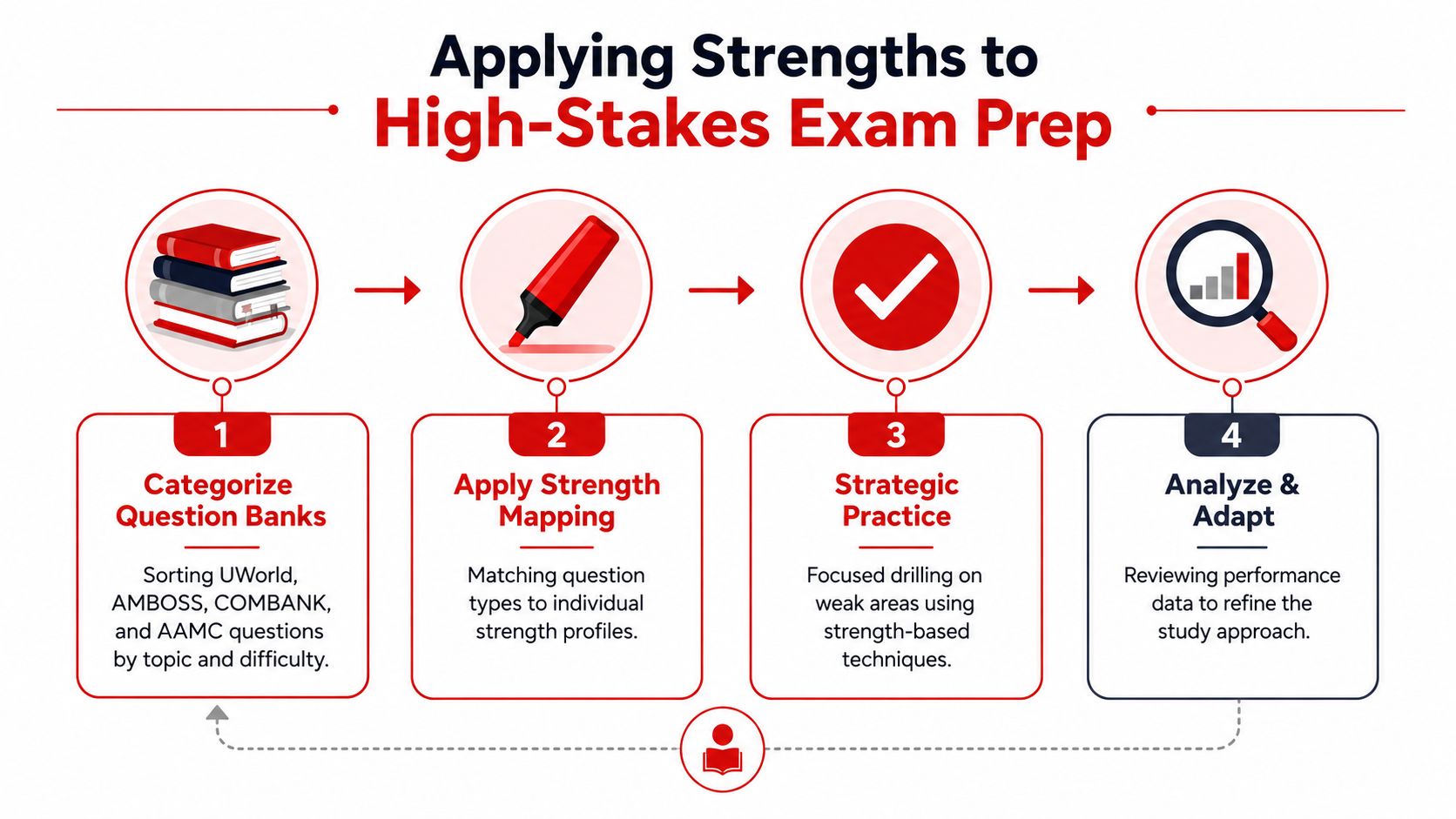
Question banks are where strengths based learning becomes concrete. UWorld, AMBOSS, COMBANK, and AAMC items all test more than content recall, they test how you approach a stem, how you hold details in working memory, and how you recover after being wrong. So the first move is to sort misses by the skill they exposed, not just by subject.
Match the question type to the learner's strength
A student strong in visual organization can turn a missed renal question into a flowchart, while a student strong in verbal reasoning may rewrite the same miss as a short explanation in their own words. That's not coddling, it's efficient encoding. The same topic gets converted into the format the student is most likely to remember under pressure.
Spaced repetition still matters, and Anki is still useful, but the card format should reflect the learner's strengths. A person who remembers sequences well can build cards with stepwise explanations, while a person who recognizes patterns quickly may prefer cloze deletions that force rapid retrieval. If you want a review system built around that idea, this spaced repetition and Anki guide is a practical companion.
Use the exam format itself as a training tool
For USMLE-style blocks, a set of 80 questions can become a tracking sheet for how you work under fatigue. For MCAT science sections, the pace and density of passages make it smart to test whether a strength helps you read, triage, or eliminate distractors faster. COMLEX students can use the same logic, but should pay special attention to question wording and the way clinical reasoning is tested.
A question bank is not just a score report. It is a map of how you think when the clock is running.
The simplest workflow is this, categorize, apply, practice, then review. Categorize the missed item by skill, apply the study method that matches the student, practice a similar item set, and review whether the error pattern changed. That loop keeps retention tied to action instead of memory of the answer key.
Balancing Strengths With Weak Spots Without Losing Either
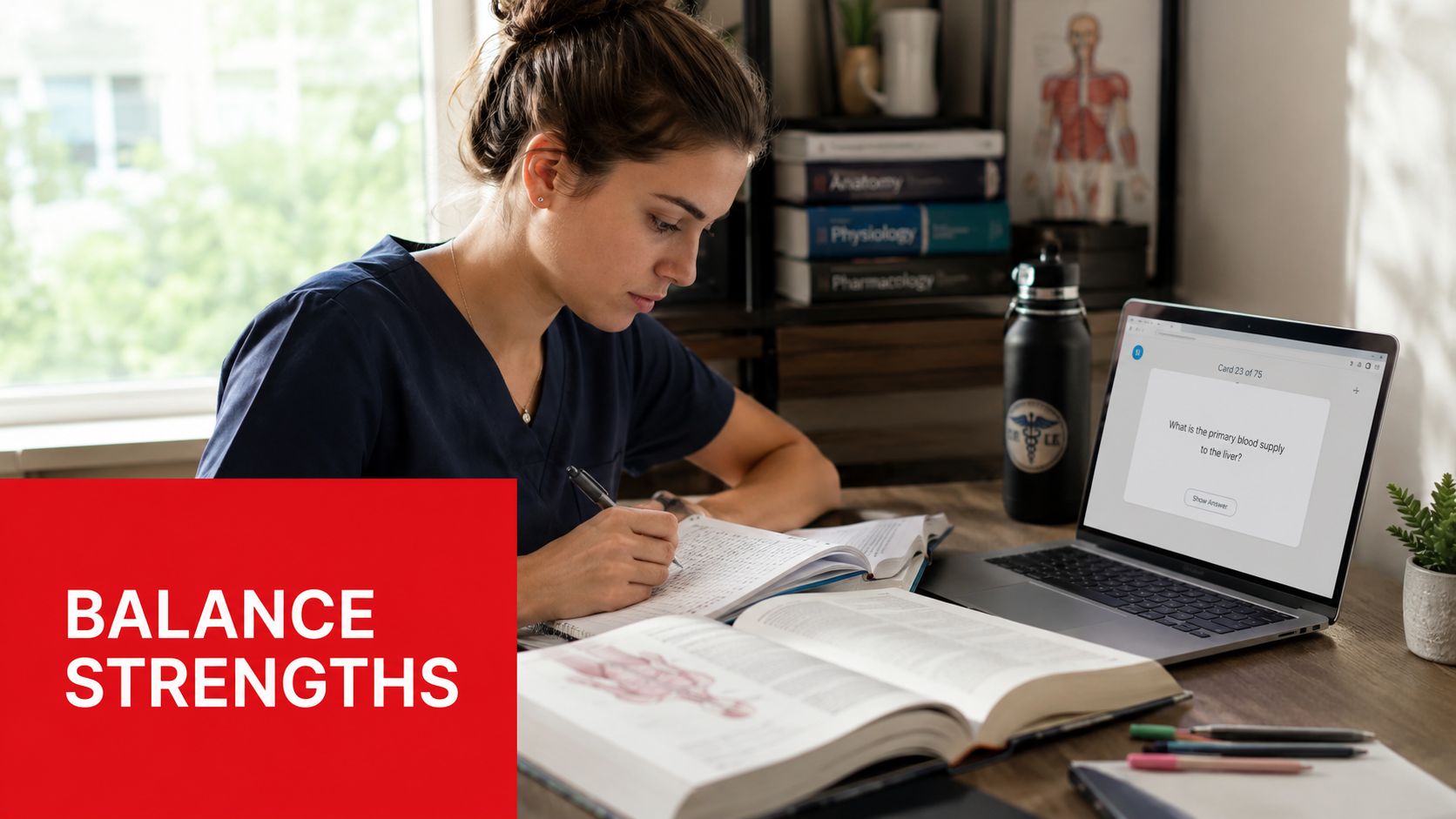
The biggest objection from serious board-prep students is fair. If you spend too much time on strengths, won't you avoid the weak areas that lower your score? The answer is no, if you use strengths as a route into remediation instead of a substitute for it.
A decision rule that works in practice
Use your strengths when the task is learning, organizing, remembering, or regaining momentum. Use direct remediation when the task is safety-critical, repeatedly wrong, or low-hanging content loss. In other words, strengths help you get traction, but weak spots still need direct repair when the exam keeps punishing you for them.
That balance is where implementation quality matters. Strengths-based learning is not automatically equitable or complete, because learners bring different backgrounds, languages, and educational histories. The approach works best when it is culturally responsive and adapts to the learner, not when it assumes everyone's strengths will look the same. That matters for international medical graduates, osteopathic students, and students returning to the match cycle, because a superficial “focus on strengths” message can miss the barriers they face.
What to look at first
A good starting point is your NBME or content self-assessment. If the miss pattern is broad but the process is sound, lean on strengths to improve execution. If a specific topic keeps collapsing, like acid-base interpretation or murmurs, target that topic directly and keep the strengths-based structure only around how you review it.
The cleanest version is this. Strengths decide the method, weak spots decide the target. That lets you keep remediation honest without turning every study session into a correction session.
Two Case Studies From Realistic Study Scenarios
A second-year student preparing for Step 1 came in with strong pattern recognition and a habit of spotting what belonged together on a page. Her problem was that her schedule had swallowed that strength. She was doing long, passive review days, and every block felt like an endurance contest rather than a learning system.
Her pivot started with a strengths inventory, then weekly NBME tracking. Once her tutor saw that she learned best through visual grouping, her study blocks changed. Instead of rereading every page of a review book, she built short concept maps, reworked missed questions into visual patterns, and reserved question review for explaining why the wrong answers were tempting.
A non-traditional premed studying for the MCAT while working full-time needed a different plan. He had strong narrative reasoning, which meant he remembered information better when it lived inside a story. That helped most in CARS, where he practiced summarizing each passage as a short sequence of motives, conflicts, and claims before touching the answer choices.
He didn't eliminate hard work. He cut waste. The study plan fit the hours he had, and that made consistency possible.
Those two cases show the same principle in different forms. One student needed to stop fighting a visual strength. The other needed to use verbal structure to survive a limited schedule. In both cases, the framework reduced friction without lowering the academic bar.
Your 30-Day Starter Plan and Common Questions Answered
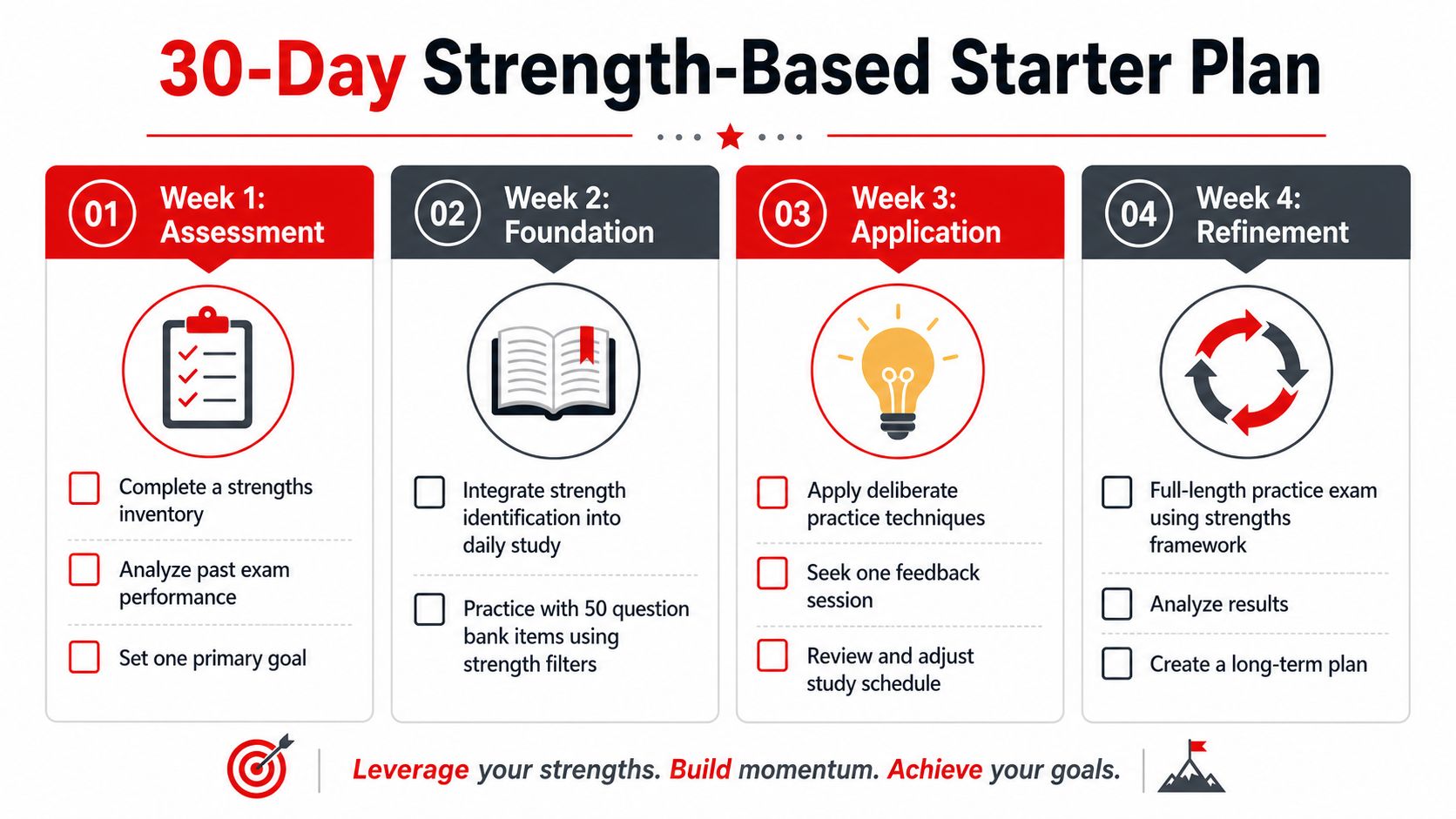
A month is enough time to test whether this approach changes how you study. The point is not to rebuild your entire life, it's to make one plan more efficient and more honest.
Use this schedule:
- Week 1, Assessment: Complete a strengths inventory, review past practice exams, and choose one primary goal.
- Week 2, Foundation: Build strengths into daily study, then test the idea with a small question set. If you want a scheduling structure, this study schedule planner can help you anchor the week.
- Week 3, Application: Use deliberate practice on one weak topic, ask for one feedback session, and adjust your block timing.
- Week 4, Refinement: Take a full-length practice exam, review the errors, and rewrite the next month's plan around what changed.
FAQ, is this evidence based enough for board prep
Yes, if you treat it as a learning framework and track outcomes. The evidence base is strongest in higher education and related learning contexts, including the Gallup meta-analysis on retention and the peer-reviewed self-efficacy link cited earlier. For board prep, the question is whether the framework helps you persist, encode material, and review mistakes more effectively.
FAQ, can it help if I've already failed a board exam
It can, because a failed exam often means the current system is not matching the learner. Strength based learning helps you identify the part of the process that still works, which can be especially useful when a student has lost confidence and needs a more sustainable routine.
FAQ, does this work better with a tutor or on your own
Both, but tutoring makes the feedback loop faster. A tutor can spot whether you're using your strengths to avoid content, or using them to make hard content more learnable. Self-study works too if you keep a clear record of what you changed and what happened afterward.
If you want help turning your own strengths into a board-prep plan that fits Step 1, Step 2, MCAT, or COMLEX demands, start a conversation with Ace Med Boards and visit Ace Med Boards to book a free consultation and build a study strategy around the way you learn best.