You're staring at a stack of tuition bills, exam prep, and clinical responsibilities, and the idea of finding a scholarship opportunity can feel like one more task you don't have time for. For medical students and pre-med applicants, the problem usually isn't whether aid exists, it's whether you can find the right awards, match them to your profile, and submit before the deadline with everything in place.
A scholarship opportunity is worth treating like a funding pipeline, not a lucky break. In the U.S., over 1.7 million scholarships are awarded annually, yet only about 11% to 12.5% of college students receive one and just 1.5% receive a full scholarship, while total scholarship and grant aid exceeds $100 billion a year when government sources are included (ThinkImpact scholarship statistics). That gap is exactly why medical-pathway applicants need a system, not scattered hope. If you're also thinking about the broader cost of training, the team at Ace Med Boards frames education as an investment that needs a plan, and that mindset applies here too. For students comparing flexible financial aid models, UGC-entitled program financial aid is another useful example of how scholarship structures can vary by provider.
Why Scholarship Opportunity Matters for Med Students
A med student can have the grades, the test scores, and the clinical drive, then still run into a funding gap that makes every term feel tighter than it should. Tuition, prep materials, exam fees, rotations, and interview travel all compete for the same dollars, so a scholarship opportunity is not just helpful, it changes how much pressure sits on the rest of the training plan. The core issue is access. Awards may be available, but many students never reach the ones that fit their background, their mission, or their timeline.
The numbers show why that gap stays wide. Over 1.7 million scholarships are awarded annually in the U.S., but only about 11% to 12.5% of college students receive one and just 1.5% receive a full scholarship (ThinkImpact scholarship statistics). Scholarship and grant aid in the U.S. exceeds $100 billion annually when government sources are included. One estimate places total scholarship funding at about $46 billion. The pool is large, but the share that reaches any one applicant is still limited.
What that means for med and pre-med applicants
Medical students often wait for a perfect award, then apply to only a few obvious options. That usually misses the mark because selection committees reward fit, specificity, and persistence more than broad enthusiasm. A scholarship opportunity is rarely won by the applicant who likes the program most. It is usually won by the applicant whose story already lines up with the sponsor's mission.
Practical rule: build your scholarship search like you would build a clinical differential. Start broad, keep track of what fits, and do not assume one strong application will cover the whole cycle.
This is also where a tracker matters. I have seen students waste weeks on awards that were outside their profile, while smaller local and specialty-based awards sat untouched because no one had organized the search well. The better workflow is simple: sort by mission fit, eligibility, deadline, and required materials, then apply where your background makes a clear case. That approach matters even more if you are comparing scholarship planning with other education-cost decisions, because the medical education funding perspective from Ace Med Boards treats training costs as a planning problem, not a one-time event.
A scholarship opportunity works best when you treat it as part of a funding pipeline. That framing keeps you focused on the trade-offs that matter, where your profile is strongest, which awards are realistic, and where the effort will return value.
Finding Scholarship Opportunities Through Targeted Search
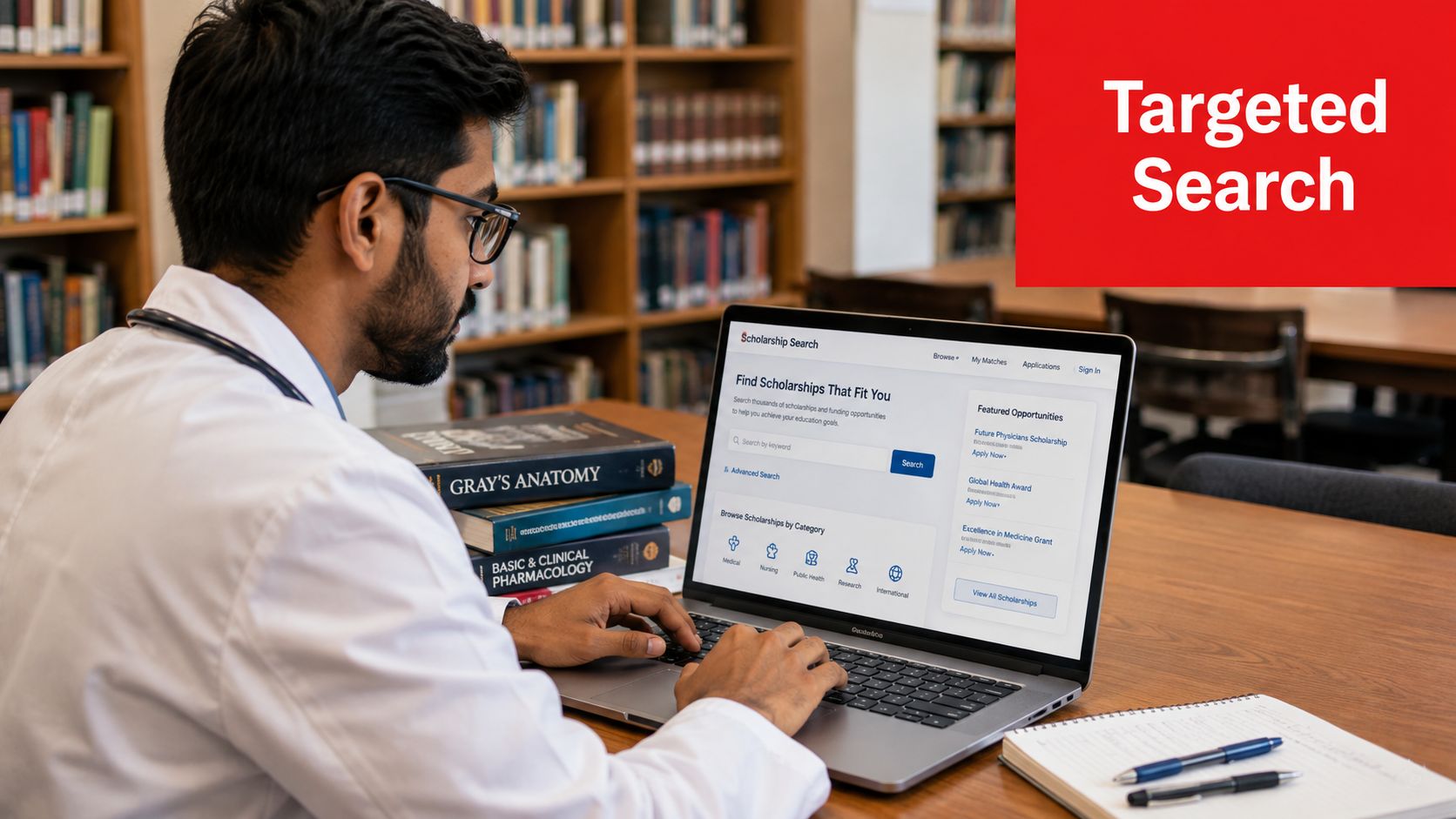
The biggest mistake students make is searching only the places that are easiest to remember. General scholarship lists are useful, but they're not enough for medical-pathway applicants who need specialty fit, location fit, and mission fit. The better approach is to build a search map that includes professional associations, hospital foundations, diversity programs, school-specific aid, and curated databases.
The reason this matters is simple. Millions of dollars in scholarship funds go unclaimed each year because students do not know the awards exist or can't meet the requirements in time, and low-income and first-generation students are often blocked by complex forms and limited guidance (Edvisors on underserved students). If you've ever found an award after the deadline, or realized you were eligible only after the cycle closed, you've already seen the access problem in action.
Build a search map instead of a random list
Start with four buckets. School-based aid belongs in your admissions or financial aid portal, because medical schools and undergraduate institutions often hide relevant opportunities in plain sight. Professional and specialty groups matter because they tend to support students whose interests match a discipline, population, or service mission. Hospital and community foundations can be especially useful if your background, hometown, or volunteer work aligns with their local priorities. Diversity and access programs deserve their own folder, because they often serve students who are underrepresented, first-generation, or navigating a less direct path.
The student who wins isn't always the one who found the most awards. It's often the one who built a system for checking the right places before the deadlines moved.
A good working example is the first-generation student who qualifies for several awards but misses them because the listings are scattered across different sites, each with different document requirements. That student wasn't unqualified, just under-informed and under-organized. A targeted search map fixes that by giving every award a home, a status, and a next action.
If you want a practical model for organizing school-specific awards, the medical school scholarship resource from Ace Med Boards fits neatly into a broader search system. Use it as one reference point, not the only one, and keep your own list current.
The most effective search habit is simple. Review the same sources weekly, because scholarship opportunity windows open and close fast, and what matters is not just discovery but timing.
Screening Eligibility and Mission Alignment
A scholarship opportunity can look open on paper and still be a poor fit in practice. Two students may both meet the basic requirements, yet the one whose background, service record, and goals line up with the sponsor's mission usually has the cleaner path forward. Screening should move beyond age, GPA, residency, or program level and examine whether your profile matches what the award is trying to support.
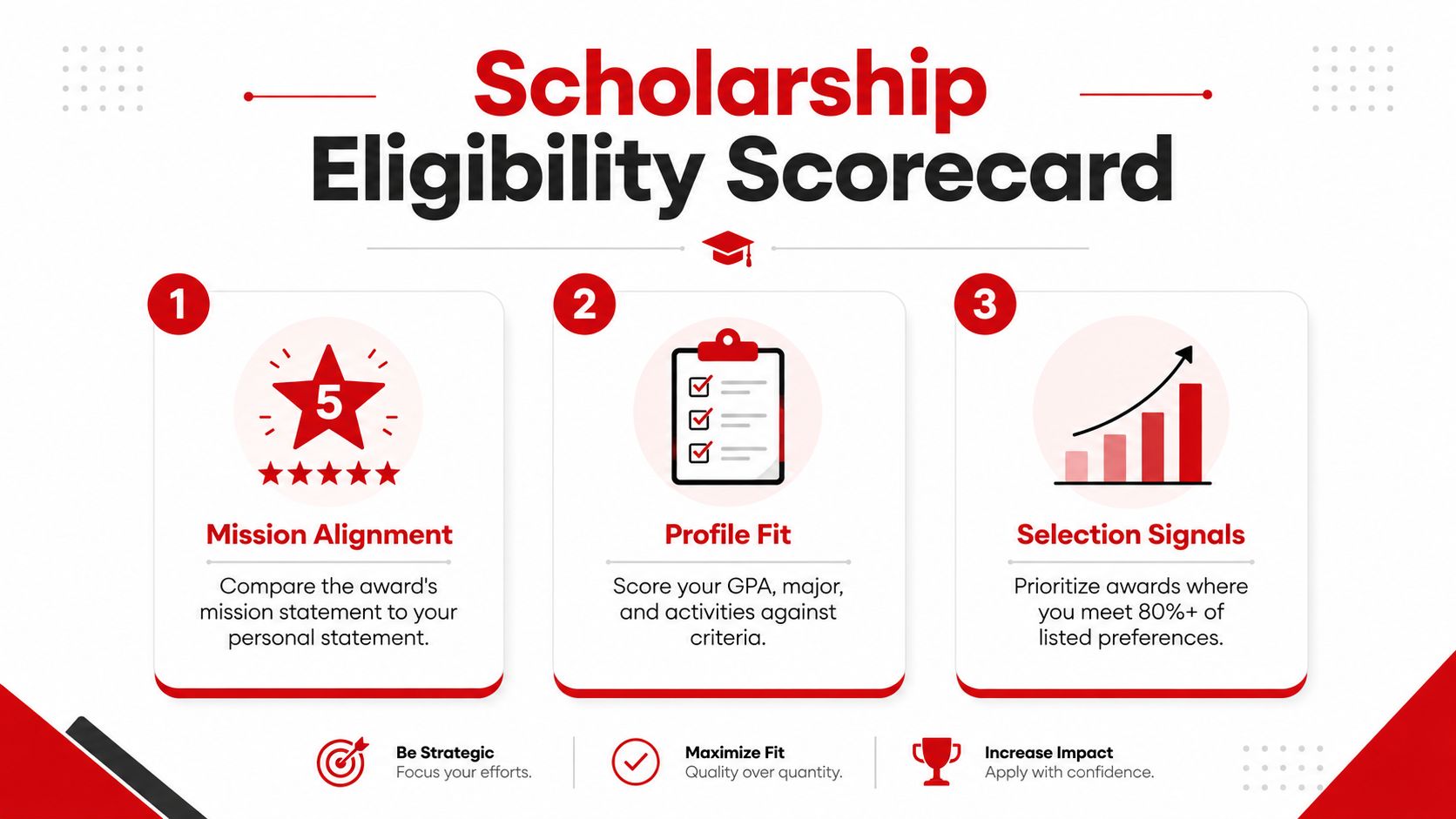
Mission alignment tends to carry the most weight in major scholarship pipelines, often more than academic standing alone. Selection also leans on the strength of the personal statement or proposal, recommendation quality, leadership, and the clarity of your fit with the sponsor's priorities, as noted in the Scholarship success rates review. That ranking matters because it tells you what deserves attention first and what should not be overpolished at the expense of relevance.
Score fit before you draft anything
A quick rubric works better than intuition. Read the mission statement, then test whether your background, service interests, and career goals support it in a clear way. Compare your academic profile and activities with the published criteria, then note whether the award seems to reward service, research, leadership, hardship, or demographic background.
Use this rule: if the scholarship story and your own story sound unrelated, the fit is probably weak even if you technically qualify.
That judgment becomes even more important for medical-pathway applicants, where the access gap is real and the best opportunities are often concentrated in mission-driven programs. The diversity in medicine resource from Ace Med Boards is a useful companion point for applicants whose experiences reflect service, equity, or widening participation. In practical terms, those awards favor applicants who can show clear narrative alignment, not just eligibility on a checklist.
A smaller number of well-matched applications can outperform a scattered pile of weak ones. If you apply only to awards that fit, the odds of earning at least one offer improve because you are spending your time where the sponsor is already looking for someone like you, much like a founder who must prove traction before raising capital. Chasing every opportunity without screening for fit usually drains time on essays that never had a real chance.
A practical way to rank awards is to tag each one as high, medium, or low fit. High-fit awards move to the front of the queue. Medium-fit awards stay only if you have time and a strong angle. Low-fit awards come off the list unless there is a specific reason to keep them.
Mapping Your Application Timeline
Once the right awards are identified, the process turns operational. Many students lose scholarship opportunity at this stage because deadlines, transcripts, recommendation letters, and essays all sit in separate folders until the last minute. A tracker solves that problem because it turns vague intent into weekly action.
Applicants who submit only 5 to 10 applications have about a 12.5% win rate, while those who submit 20 to 30 well-matched applications can approach a 33% success rate, which shows that volume only helps when the applications are still a fit (How hard is it to win a scholarship). The point isn't to blast out more forms. The point is to create enough well-matched submissions that one or two wins are realistic.
Build one tracker and use it every week
Your tracker should include award name, deadline, eligibility rules, required documents, status, and notes. Add a weekly review block so nothing sits untouched for more than seven days. That simple habit catches missing transcripts, late recommenders, and essays that still need tailoring.
Tracker rule: if an application can't be explained in one row, it's too hard to manage.
A practical timeline helps too. Start researching roughly six months before the cycle you care about. Begin drafting several months out so you can tailor essays without panic. Ask recommenders early enough that they can respond thoughtfully, then submit before the final rush so you still have room to fix problems.
For students who like a strategy analogy, the logic is similar to the idea behind proving traction before raising capital. You don't wait until the last minute and hope the pitch works, you show evidence, organize the ask, and remove friction before the decision point. Scholarship applications work the same way.
The best schedule is the one you can keep. If your tracker only gets checked when you feel stressed, it won't protect you. If it becomes part of your weekly routine, it will.
Writing Strong Scholarship Essays
A strong essay does more than tell your story. It connects your background to the scholarship mission in a way the reader can verify, remember, and support. For medical-pathway applicants, that usually means linking service, resilience, clinical exposure, or academic discipline to the sponsor's priorities without sounding generic.
A weak essay says, “I've always wanted to help people.” A stronger version anchors that ambition in a real moment, such as a patient interaction, community clinic experience, or a time when you learned how to keep going through board prep or a difficult semester. The difference is specificity. Scholarship readers need to see why your application belongs in their pool, not just why medicine matters to you.
Write for mission alignment, not self-congratulation
Your opening should establish context fast. If the award supports service, start with service. If it supports leadership, start with a leadership moment. If it supports first-generation persistence, connect the essay to the concrete realities that shaped your path.
One useful method is to draft a core statement, then adapt it for each award. That lets you keep the underlying story consistent while changing the emphasis to match the mission. The personal statement outline from Ace Med Boards can help you structure that draft so the essay has a clear beginning, middle, and close.
Keep the paragraphs tight and purposeful
Use short paragraphs that each do one job. One paragraph can show the challenge, another can show the response, and a final one can show the future impact. If you mention clinical work, make sure it supports the award's theme instead of just listing your experiences.
Best practice: don't try to impress with breadth when the sponsor is looking for fit. A focused story usually beats a crowded one.
You can also improve efficiency by building one strong base draft and then customizing the opening and closing paragraphs. That keeps your workload manageable while still making each application feel personal. It also helps you avoid the mistake of recycling a generic essay that sounds polished but doesn't match the award's purpose.
The strongest essays read like evidence, not decoration. They prove that you understand the scholarship opportunity, you're qualified for it, and you'll use it for something specific.
Securing Recommendations and Follow-Up Tips
Letters of recommendation are not a formality. They're a managed part of the application, and if you treat them like an afterthought, they can weaken an otherwise strong scholarship opportunity. The safest approach is to brief recommenders early, give them the right context, and follow up without being awkward or passive.
Ask at least two months ahead when possible. That gives the recommender enough time to write a detailed letter instead of rushing through a generic endorsement. Share the scholarship mission, your tracker entry, the deadline, and a short note about the qualities you want highlighted. The cleaner the brief, the stronger the letter usually is.
Make follow-up part of the process
After submission, confirm receipt if the system allows it. Save the confirmation email or screenshot in your tracker, then note whether anything still needs attention. If an interview is listed, log it immediately so you don't miss a scheduling window.
A lost letter usually isn't a mystery. It's often a communication problem that early check-ins could've prevented.
That's why recommenders should be treated like collaborators, not favors. They're helping you present a complete file, and they can only do that if you make the process easy to support. If a letter disappears or an upload fails, a respectful follow-up within the deadline can save the application.
If you need a practical framework for the ask itself, the letter-of-recommendation guide from Ace Med Boards is a useful reference for how to approach the request clearly. Use it to shape your outreach, then return to your tracker and keep the process moving.
The best follow-up habit is simple. Don't assume silence means completion. Check, confirm, and document everything. Scholarship opportunity pipelines reward applicants who manage details like professionals.

Submission Checklist and Your Next Steps
A complete application is only useful if it gets submitted with the right materials attached. Before you send anything, verify the basics in your tracker, confirm that every required document is current, and make sure names, dates, and file versions match the award instructions. This is the final place where simple errors create unnecessary rejection.
For first-generation scholarship seekers, the funding gap is often the bigger story. Average annual tuition is $23,519 versus average annual aid of $11,986, which leaves an $11,533 gap, and that's why stacking aid and planning for renewal risk are essential (Bold.org first-generation scholarships). A scholarship opportunity may cover part of the problem, but not always the whole bill. That reality matters in medicine, where many students need a blended plan.
Use a final pre-submit checklist
Before you click send, check these items:
- Eligibility confirmed: Make sure your current status still matches the award rules.
- Documents attached: Transcript, essays, recommendations, and any supplemental forms should be present and readable.
- Deadlines verified: Confirm time zone, portal close time, and any hidden submission steps.
- Renewal terms reviewed: If the award can continue, know what you must maintain.
- Tracker updated: Mark the application as submitted and record the confirmation.
The second piece is what you do after the submission. If the award is renewable, build reminders for future requirements now, not later. If you didn't win, keep the application notes, because some essays and proof points can be reused with smarter tailoring next cycle. If you did win, update your funding plan so the remaining gap is still covered.
The right view of scholarship opportunity is realistic, not pessimistic. You're not hunting a one-time rescue, you're building a funding stack that can support your training over time. That approach is more stable, and it's the one I've seen work for medical students who stay organized long enough to let the system work for them.
If you want help turning this into a real application system, visit Ace Med Boards and use its scholarship planning tools alongside your exam and admissions prep. The same discipline that helps you manage boards, personal statements, and recommendation letters can also help you win and keep the aid you need.