If you're staring at your phone during Match Week, checking email, refreshing the R3 system, and trying to stay calm in front of everyone around you, you're already in the right headspace for residency Match Day. It's the scheduled day when the NRMP releases placement results, not a random draw, and the difference between matched and where you matched matters more than most students expect. Knowing that split ahead of time makes the week feel much less mysterious.
For many fourth-years, the hardest part isn't the ceremony itself. It's the waiting, the uncertainty, and the pressure to understand SOAP, rank lists, and backup planning all at once. A clear plan helps, especially when the week turns into a two-stage decision system, first whether you matched, then where you'll train.
What Residency Match Day Is
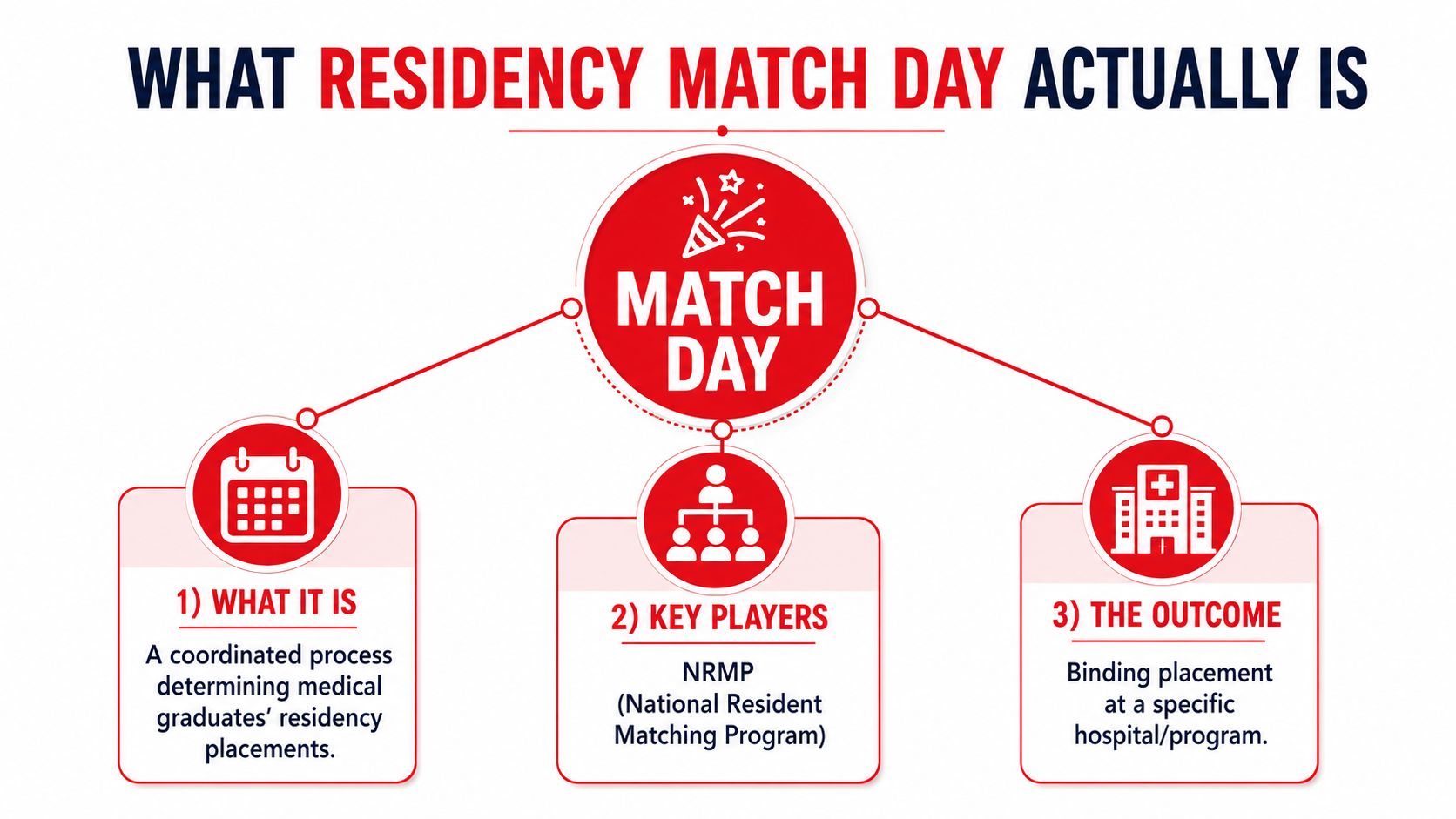
Residency Match Day is the day the NRMP Main Residency Match releases official placement results for medical students and other applicants in the Match system. It marks the scheduled result of a matching process that pairs applicants and programs from mutually submitted rank-order lists. The result shows both whether an applicant matched and, if so, where the position is.
The ceremony you see at U.S. schools reflects that release. Students gather at the same time because the notification arrives nationwide all at once, and that shared timing makes the day feel collective even though every outcome is personal. Schools also use the moment to mark the move from student to resident in a visible, human way.
That distinction matters because people often use “residency match” as a broad phrase for several systems. The NRMP is the main U.S. process, but some applicants also encounter other pathways such as osteopathic, military, or Canadian matching systems. If you are trying to understand your own process, start by identifying which system you are in before you worry about timelines or terminology. A clear starting point is the how residency works overview.
Practical rule: if you know your matching organization, you can stop guessing about dates, emails, and portals and focus on the exact rules that apply to you.
A lot of students feel the emotional weight of the week long before the envelope opens. If that sounds familiar, a calm pre-week reset can help, and a practical anxiety checklist may be useful if you want a simple way to organize what is in your control. The point is not to remove nerves. It is to keep them from running the week.
How the Match Algorithm Decides Your Placement
The NRMP uses an applicant-proposing stable matching algorithm. That means the process begins with applicants' rank lists, compares them with program rank lists, and then builds pairings that remain stable, so no applicant-program pair would both prefer each other over their assigned outcomes. Stanford's explanation of the algorithm makes the key point clearly, the system is built around mutual rankings, not guesswork or gaming the list. Stanford Medicine's overview of the algorithm is a useful plain-language reference.
A coffee shop analogy makes the logic easier to picture. One person ranks cafés from most wanted to least wanted, and each café keeps its own list of preferred regulars. The final pairing is based on which matches can hold up without leaving both sides with a better option they would rather choose instead.
That is why honest ranking matters. If a program is acceptable to you, rank it where you prefer it, not where you think the algorithm wants it. The algorithm already handles the matching logic, and trying to place “clever” options near the bottom does not create an advantage. What matters is a complete, sincere order of places you would attend.
The practical takeaway is straightforward.
- Rank your preferences: Put programs in the order you prefer.
- Include acceptable options: If you would go there, it belongs on the list.
- Do not try to outsmart the system: The algorithm is already designed to find stable pairs from the applicant side.
- Check completeness carefully: A program cannot match with an applicant it did not rank, and vice versa.
Rank every program you would truly attend, in the order you want them, and stop there.
For applicants who want a closer look at building their order, the rank residency programs guide can help you sort your preferences without turning the process into a guessing game.
Match Week Timeline From Monday to Friday
A residency applicant often hears two different questions in the same week, and they are not the same question. Monday answers whether you matched, while Friday answers where you matched. That split is why the week can feel like a traffic light changing in stages, first green or red on status, then a later reveal on the actual placement.
| Day | Time (ET) | What NRMP Releases | Applicant Action |
|---|---|---|---|
| Monday | 10:00 a.m. | Match status, matched or unmatched | Check both email and R3, then contact your advisor or support team |
| Tuesday | Varies by SOAP schedule | SOAP access and round activity for eligible applicants | Prepare documents, respond fast, and stay available |
| Wednesday | Varies by SOAP schedule | Ongoing SOAP offers and acceptances | Keep communication tight and follow instructions exactly |
| Thursday | Varies by SOAP schedule | Final SOAP rounds close | Confirm outcomes and prepare for next steps |
| Friday | 12:00 p.m. | Program and location assignment | Open the result, share news, and start transition planning |
The NRMP sends results through email and the R3 system, so you can confirm your status in more than one place. That matters on a morning when inbox delays are common and every minute feels longer than it should. The official Match Week page lays out the Monday and Friday timing clearly. NRMP Match Week timing is the clearest source for the week's structure.
The Friday ceremony causes a lot of confusion. Schools celebrate then because it is the moment the exact program is revealed, not because the matching decision happens on Friday. Some schools also tell students earlier in the week whether they matched, but the location stays sealed until Friday at noon.
A simple way to plan the week is to separate status from destination. Monday is for checking whether you matched and telling the right people. Tuesday through Thursday are for staying ready if SOAP applies. Friday is the day to open the final result, make calls, and start the next steps with a clear head.
SOAP and What Happens If You Did Not Match
SOAP, the Supplemental Offer and Acceptance Program, is the structured fallback for applicants who are eligible after Match Week's first disclosure. It runs in the compressed Tuesday through Thursday window, which is why people talk about it with such urgency. You are not just waiting for news, you're moving through a tight sequence of offers, responses, and decisions.
Eligibility is narrow. SOAP is for unmatched applicants, and in some cases partially matched applicants from the Main Residency Match who meet the NRMP's credential rules. The important thing is that SOAP is not a separate, casual application pool. It's a controlled process tied to verified status and time-sensitive documents.
The easiest way to think about SOAP is as a series of rapid rounds. Programs with unfilled positions make offers, eligible applicants respond, and the process continues until the available spots and the rounds are exhausted. Because the window is so short, the applicants who are prepared in advance have a major advantage in practical terms, even though the process itself is governed by rules rather than speed alone.
A SOAP-ready file usually means your materials are already organized, your contact information is current, and your communication plan is clear.
- Documents ready: ERAS materials, personal statement, and supporting files should already be easy to send.
- Communication fast: You need a plan for answering calls, checking email, and updating your advisor.
- Interview readiness: Be prepared to speak clearly about why a program fits you and what you can contribute.
- Backup thinking: Know in advance whether you would SOAP, delay graduation, pivot specialties, or reapply.
SOAP rewards preparation more than panic control. The applicants who can move quickly through the 72-hour window usually have already decided what they'll do if the first outcome isn't the one they wanted.
If you want a more detailed walk-through of the mechanics, the SOAP guide for unmatched medical students is a useful companion to the official NRMP rules.
Guidance for Unmatched Applicants and IMGs
An unmatched result can feel abrupt, but it doesn't define a career. For U.S. MD and DO graduates, the next step is usually a careful review of the full application, not just the final result. Look at the whole file, including letters, specialty choice, interview performance, and how well your rank list matched your actual preferences.
For a reapply cycle, the best move is to separate what you can fix quickly from what takes time. Some applicants need a stronger personal statement or a cleaner CV. Others need a more realistic specialty strategy, better interview practice, or additional clinical exposure that fits the field they're targeting. If you're a DO student, a targeted COMLEX-USA score review can also help you decide whether a retake, a different specialty mix, or a broader geographic strategy makes sense.
International medical graduates, including IMGs and FMGs, often have to plan earlier and more deliberately. Visa timing, fewer interview invitations, and narrower geographic flexibility can shape the whole cycle, so the application has to do more work in fewer chances. That doesn't mean the path is closed. It means the path needs sharper coordination across test scores, credentials, observerships, and specialty choice.
The practical next-cycle checklist is straightforward.
- Audit the application: Identify where the file was strong and where it was thin.
- Strengthen clinical evidence: Add observerships, research, or new experience only if it clearly supports the specialty.
- Rebuild interview confidence: Practice with realistic questions, not just broad advice.
- Plan logistics early: IMGs should review visa and document timing long before the next cycle opens.
For applicants in this category, residency guidance for IMGs can be helpful when you need to think through strategy without assuming one outcome closes every door. The same is true for anyone reapplying after an unsuccessful cycle. A careful reset is not a failure. It's a planning step.
Match Day Emotions, Celebrations, and Next Steps
When the result finally lands, the emotional response can be immediate. Some students are in a ballroom, some are at home with family, and some are refreshing email alone before heading to school. However it happens, the first response is usually human before it is logistical, and that's normal.
If you matched, the next few minutes often belong to the people who supported you through third year, interviews, and rank list season. Call your family, text your mentors, and let yourself enjoy the moment before you start worrying about moving, housing, or onboarding. If your school has a ceremony, it gives everyone a shared place to process the news together.
If you didn't match, the day can still hold dignity. Give yourself room to feel disappointed without turning that feeling into a conclusion about your future. The same classmates who celebrate on Friday may later be the people who help you think through SOAP, reapplication, or a specialty pivot.
A hard result is still information, not a final verdict.
After the emotion settles, the paperwork starts. New residents usually need to move quickly on onboarding forms, licensing steps, background checks, and housing decisions. Those tasks are easier when you begin them the same week, because residency programs move fast once the match is final.
A Pre-Match Prep Checklist and How Ace Med Boards Can Help
Match Week is easier to handle when the work is already sorted before Monday arrives. That preparation starts with a simple idea: first make sure you are eligible to move through the process, then make sure your placement materials are ready if you match, or if you need SOAP. Students who are also juggling test prep, specialty choices, and uncertainty about their next step benefit most from a clear checklist, because each piece affects the next one.
A practical sequence looks like this.
- Check test readiness first. If you are still preparing for USMLE or COMLEX, make sure your score plan fits the specialty you are aiming for.
- Polish the ERAS file. Your personal statement, CV, and supporting experiences should tell one clear story.
- Practice interviews early. Common questions become easier when you have said them out loud and gotten feedback.
- Review the rank list carefully. The list should reflect your true order, not a guessed strategy.
- Prepare SOAP materials in advance. Even if you never use them, having them ready lowers panic if Monday does not bring a match.
Ace Med Boards can help students who want structure while they get these pieces in order. The support can include application review, interview practice, rank-list discussion, and SOAP readiness planning, while the official Match rules still come from the NRMP and related bodies. If you want a place to start, these residency application tips can help you review the basics, and a mock interview guide can give you a clear format for practice before your next session.
A short review before Match Week can also help you see where the gaps are. A free consultation can give you a clearer sense of whether you need help with test preparation, application review, or a backup plan for SOAP. If you are unsure what kind of support fits your timeline, that conversation can give you a practical next step.
Frequently Asked Questions About Match Day
When do Match Day results arrive?
For the NRMP Main Residency Match, applicants learn whether they matched at 10:00 a.m. ET on Monday of Match Week, and they learn where they matched at 12:00 p.m. ET on Friday. The status update comes through email and the R3 system, so it helps to know where to check before the day arrives. The official NRMP Match Week page is the place to verify the timing for your cycle.
Who is eligible for SOAP?
SOAP is for unmatched applicants and, in some cases, partially matched Main Residency Match applicants who meet NRMP credential requirements. It is a structured process, not an open-ended scramble. If you think SOAP might apply to you, have your documents ready before Monday so you are not trying to assemble them during the Tuesday through Thursday window.
How realistic is matching for IMGs?
IMGs can and do match, but they often work through a process that looks different from the one U.S. graduates follow. Visa timing, interview access, and specialty competitiveness can shape the path, so early planning matters. The strongest approach is to build an application file that is clear, well documented, and aligned with the specialty you want.
How should I reapply if I went unmatched?
Start with a calm review of the application, then address the highest-impact gaps first. That may mean strengthening letters, changing specialty strategy, improving interview performance, or adding relevant clinical work. If you are unsure where to begin, a meeting with a mentor, advisor, or residency consultant can help you break the next cycle into manageable pieces.
This is educational guidance, not medical advice. If you are dealing with a health issue while preparing for Match Week, follow your clinical team's instructions and your program's policies.
If you want help turning your Match Week plan into something concrete, Ace Med Boards can help you organize test readiness, interview practice, and residency-match planning in one place. Visit Ace Med Boards to look at support options and decide whether a free consultation makes sense for your timeline.