
You're staring at the AAMC portal, and the first question is simple: how do you finish MCAT registration without making a mistake that costs you time, money, or a test seat? The short answer is that registration is a multi-step workflow, not a single form, and the details matter more after you click pay than most guides admit.
A careful registration keeps you from the most common problems, like a name mismatch, a missed scheduling window, or choosing a test center before you've checked whether the seat is really available. The process is manageable, though, if you slow down and treat each tab as a separate checkpoint.
What MCAT Registration Actually Involves
The AAMC does not treat MCAT registration like a quick checkout screen. It's a sequence of decisions, and each one affects the next, which is why students who rush often end up fixing avoidable errors later. The AAMC's workflow asks you to create an account, enter personal and background details, choose a test date and center, review policies, and pay before you receive confirmation. That structure matters because registration and scheduling a seat aren't quite the same thing, even though many public guides blur them together. The AAMC's own registration guidance lays out the process and the separation between the tabs and the final seat selection step AAMC MCAT registration guidance.
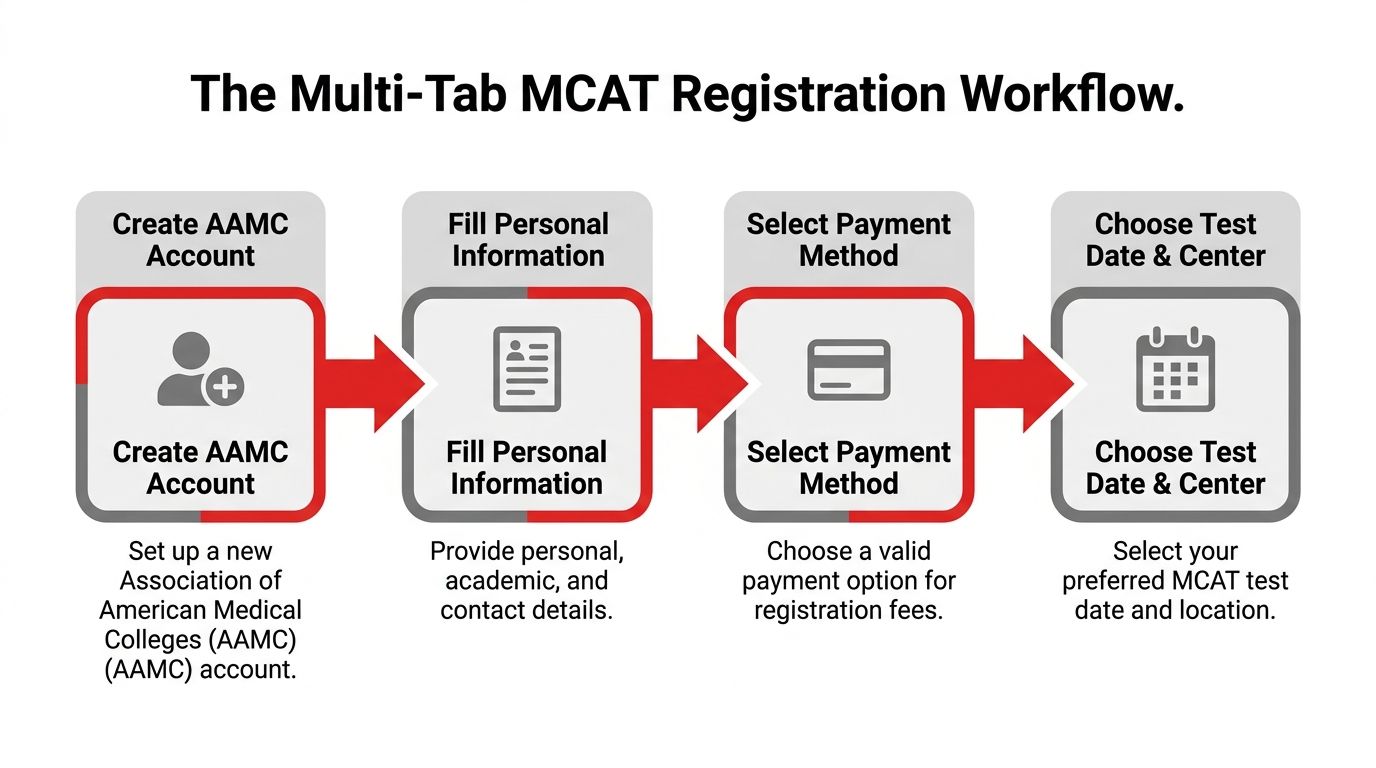
For a first-time applicant, the most useful way to think about the portal is as a sequence of gates. You can move through the early tabs without committing to a seat right away, but once you lock in a date and center, the rest of the process becomes about protecting that choice. If you're looking for a plain-language overview of the exam itself, the Ace Med Boards MCAT exam overview can help you connect registration to the bigger test picture.
Practical rule: slow down at the point where the portal asks you to choose a seat, because that's where the process stops being administrative and starts becoming competitive.
The rest of the registration process is about reducing friction. If your account details are clean, your email is current, and your test-day plan is realistic, the portal usually feels much less stressful than students expect.
Creating Your AAMC Account and Entering Your Details
Start with the account itself, because everything else depends on it. The AAMC asks you to create a login, and the most important choice you make here is not the password, it's the identity information you enter. The name on your account has to match the government-issued ID you'll bring on test day, character for character, so this is the place to be painfully careful AAMC registration guidance. A middle initial, a hyphen, or a spacing issue can turn into a check-in problem later.
The details that deserve a second look
The portal asks for more than a name and email. Independent registration guidance notes that the system may request academic history, demographic information, and agreement to AAMC policies as part of the sign-up flow, which means the account is built to verify who you are, not just collect a payment Kaptest MCAT registration guidance. That's why it helps to gather your documents before you start typing.
A few habits make the process easier:
- Use a recoverable email address. If you lose access, you don't want your registration confirmations trapped in an inbox you can't open.
- Copy your legal name exactly. Match the ID you'll carry on test day, not the nickname everyone uses.
- Enter academic information carefully. If the portal asks about school history or background details, answer cleanly the first time.
- Save your login somewhere secure. You may need the account again for rescheduling or confirmation checks.
Common slip-up: a small name mismatch is easier to prevent than to unwind. If your ID and account don't match, fix that before you choose a seat.
If you're the type who likes to keep application tasks organized in one place, it can help to pair registration with a prep dashboard or login hub such as the Ace Med Boards MCAT prep hub. Use it as a home base for tracking documents, dates, and reminders, not as a substitute for the AAMC portal itself.
The goal here is accuracy, not speed. A clean account saves you from the annoying back-and-forth that comes when customer service has to compare your registration details with your ID.
Choosing a Test Date and Center That Actually Work for You
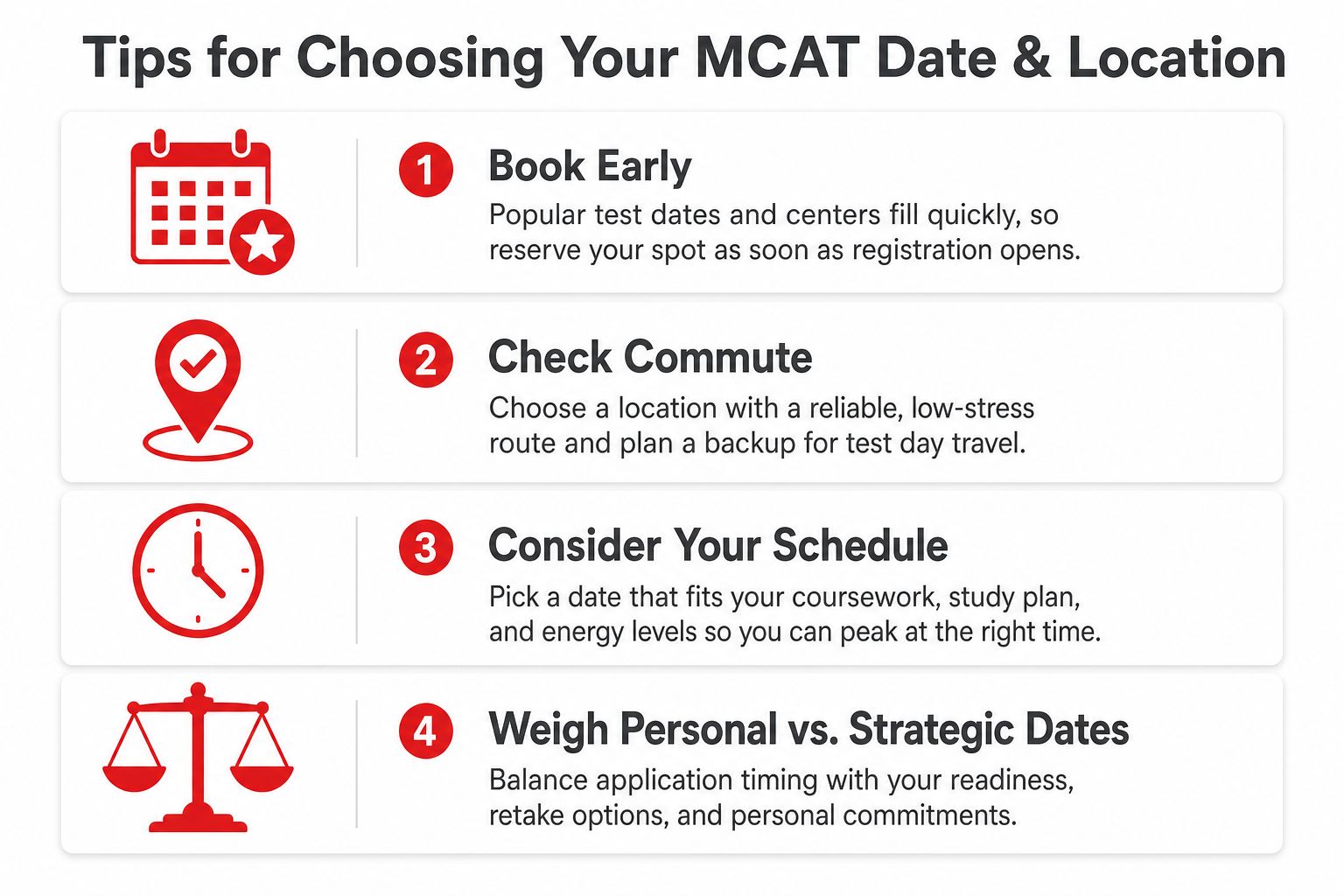
The hardest part of registration is usually the seat, not the form. The AAMC's own guidance makes clear that you're not just clicking a date, you're trying to secure an actual place in a system where availability can change quickly and popular options still fill fast AAMC MCAT registration guidance. That's why your first choice should be a date, your second choice should be a backup center, and your third choice should be a realistic fallback if your ideal site disappears.
What to compare before you click
Think about the test day the way you'd think about any high-stakes appointment. The right center is not always the closest one, and the right date is not always the earliest one. Some students need more time to finish content review, while others need a date that fits a school calendar, travel plan, or job schedule.
A useful way to sort your options is to compare them on three practical questions:
| Choice factor | What to ask yourself | Why it matters |
|---|---|---|
| Date | Am I ready to test on this day, not just hoping I'll be ready? | A convenient date can become a bad date if prep is rushed. |
| Center | Can I get there easily and calmly on test morning? | Travel stress makes check-in harder than it needs to be. |
| Backup option | If this seat is gone, do I have a second acceptable center? | The best-prepared students usually register with alternatives in mind. |
International candidates and accommodations applicants should plan even earlier, because their routing can be narrower and their scheduling path is often less flexible. The AAMC notes that some seats open even if you don't sit on launch day, but popular seats can still disappear quickly, which is why waiting for a perfect moment is usually a bad strategy AAMC registration guidance.
A simple workflow helps: pick your target date, name three acceptable centers, and check for changes regularly. That's more reliable than refreshing one site obsessively and hoping luck solves the problem.
For a calendar-based approach to planning around deadlines and fixed commitments, own your workday with better calendar habits offers a useful framework. It's not about MCAT content, it's about reducing the kind of scheduling chaos that makes registration more stressful than it should be.
The Ace Med Boards MCAT test dates guide is also useful if you want a planning reference alongside the official AAMC page. Use it to organize your thinking, then confirm final availability in the AAMC system.
When you're choosing a seat, don't ask only, “What date do I want?” Ask, “What date and center can I still defend if my first choice disappears?”
Here's a short video refresher that can help you think through timing and location before you commit.
Understanding MCAT Fees and the Fee Assistance Program
Money surprises people because the cost is not just the registration fee. The AAMC's process includes the main exam fee, possible changes in center or date, and separate rules for refund timing, so the amount you lose depends on when you act. The current AAMC fee structure also includes the Fee Assistance Program, which can reduce the cost burden for eligible applicants and provide additional prep benefits AAMC MCAT registration guidance.
MCAT Registration Costs at a Glance
| Fee Type | Standard Cost | Notes |
|---|---|---|
| Registration fee | The AAMC published fee structure for 2025 and 2026 is listed in its registration materials | Check the current AAMC page before you submit payment |
| Reschedule or center change | Depends on timing | The closer you get to test day, the less flexible the change becomes |
| Cancellation | Depends on timing | Refunds and forfeitures vary by registration window |
| International testing surcharge | Applies where relevant | Confirm the current amount in the AAMC materials if you're testing outside the standard U.S. pathway |
| Fee Assistance Program | Reduced-cost pathway for eligible students | Approval should come before registration |
The main point is not to memorize a number from a secondary guide and call it done. It's to verify the current fee page before you pay, because the AAMC updates policy details over time AAMC MCAT registration guidance. The Ace Med Boards MCAT fee overview can help you organize the categories, but the final check should always happen in the official portal.
The Fee Assistance Program matters because it changes the financial equation for students who qualify. If you think you may be eligible, apply early enough that approval is in hand before you finish registration. That prevents the awkward situation where you've selected a date but still need to sort out whether your fee status is active.
Testing centers and registration platforms used by schools and prep programs often build workflows around deadlines, and that's where test prep center software becomes relevant as an operational example. For students, the lesson is simpler, keep the fee page, refund rules, and confirmation email together so you can check them quickly if plans change.
A smart approach is to treat payment like a commitment, not a placeholder. If you're still unsure about your readiness or schedule, don't assume you can adjust later without a cost.
Requesting Test Accommodations Through the AAMC
If you need accommodations, the path is separate and slower, so it deserves its own plan. The AAMC requires documentation review before the scheduling step can be finalized, which means accommodations applicants should not wait until the last minute and hope everything lines up AAMC registration guidance. The practical lesson is simple, the more complex your request, the more time you should leave before your preferred window.
What to gather before you submit
The AAMC's documentation review exists to verify that the request is complete, so incomplete paperwork is the enemy here. If you're assembling a request, organize your materials before you enter the portal, and keep copies of everything you submit. International candidates may also need to confirm how their approved accommodations translate at a testing center outside the standard U.S. pathway.
A calm way to handle the process is to work in this order:
- Review the AAMC accommodations process.
- Collect the documentation you'll need.
- Submit the request early enough to allow review time.
- Wait for approval before you finalize a seat.
- Save all confirmation emails and decision notices.
That sequence protects you from the most frustrating mistake, which is assuming a test date is locked before the accommodations file is complete. It isn't. If the request is still pending, your scheduling options may still be constrained.
Practical rule: don't build your study calendar around a test date you haven't fully secured.
If you're trying to estimate timing, a safe margin is to start the process several months before the test window you want. That gives you room to resolve missing paperwork, clarifying questions, or center-specific issues without turning registration into a crisis.
The key is patience. Accommodations review is not a reflection of your effort, and a slower process doesn't mean a worse outcome. It just means the scheduling timeline has to start earlier than it would for a standard registration.
Rescheduling, Canceling, and Recovering from a Mistake
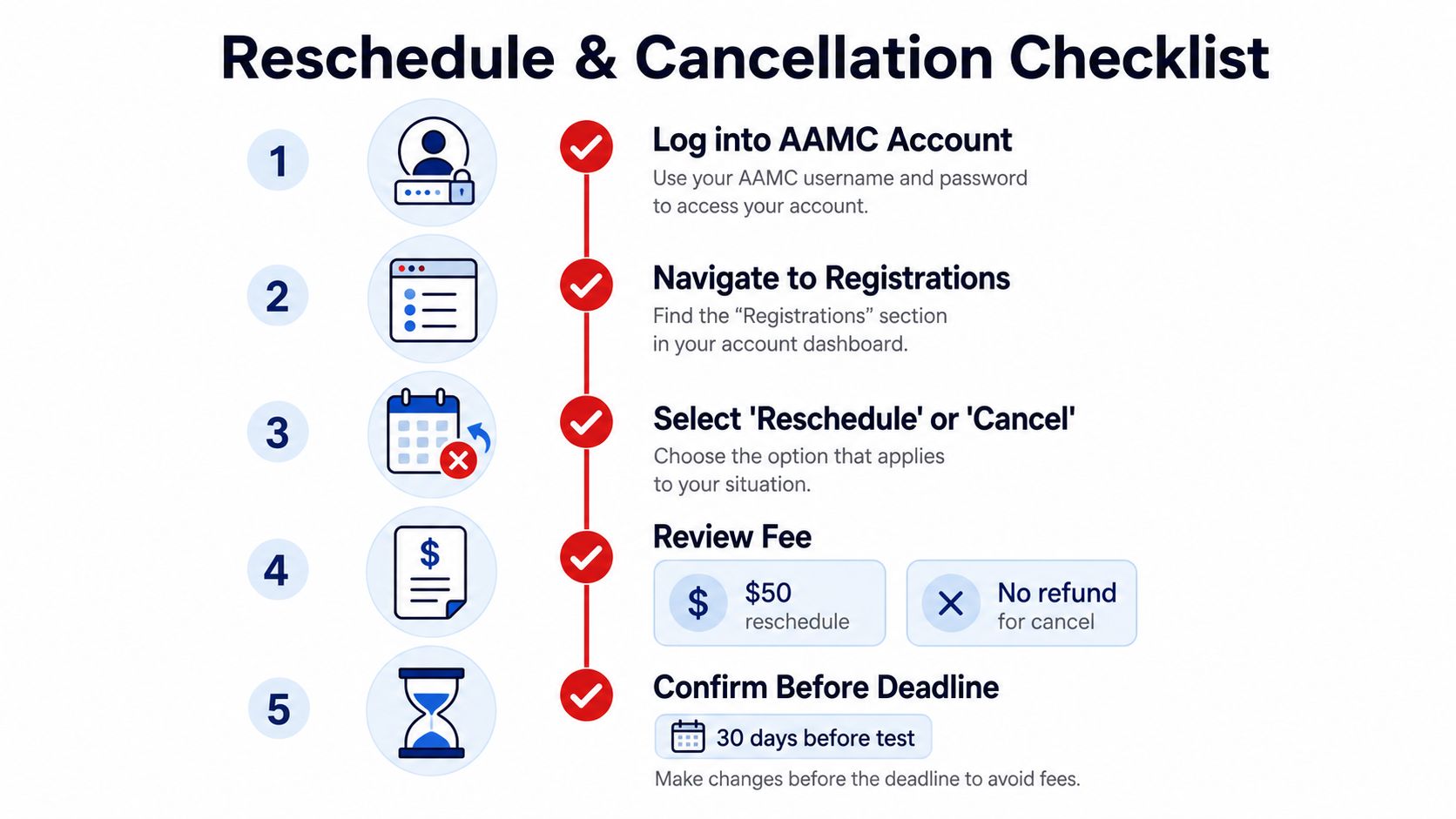
The common assumption is that registration is flexible until test day. It isn't. Once you've paid, every change carries timing rules, and those rules decide whether you get partial relief, a full loss, or no meaningful option at all. The AAMC's registration guidance separates changing a seat from editing a form, so if your plans shift, you need to move fast and use the official account tools AAMC registration guidance.
The errors people usually discover too late
Some mistakes happen before the exam day, and some happen at the desk. The good news is that most of them are administrative, not catastrophic, if you catch them early.
- Duplicate account: log into the account you used for the registration and compare the confirmation email.
- Name mismatch: stop and fix the profile details before test day, because the ID must match the registration name exactly.
- Missed payment window: go back into the portal and confirm whether the seat is still active or whether you need to start over.
- Forgotten confirmation email: search your inbox, then check the AAMC account history rather than assuming the registration vanished.
If you catch a mistake early, contact the AAMC directly and document every step you take.
The fastest recovery often starts with the confirmation record. If you can't find the email, that doesn't mean your registration didn't go through, it usually means you need to verify the account trail more carefully. If you need to move a date or center, do it through the official pathway rather than trying to work around the system informally.
Your best defense is to save the registration receipt, keep the name on your ID consistent, and make sure your calendar reminder is attached to the actual test date, not the date you originally hoped for. That sounds obvious, but most costly mistakes are simple oversights that happen when people assume they'll remember later.
ID Requirements, Test-Day Rules, and Common Errors to Avoid
Registration is only half the job, because the door check on test day is where small inconsistencies can become real problems. The AAMC requires the name on your account to match your government-issued ID, and that same identity check follows you into the testing center AAMC registration guidance. If the information doesn't match, the staff can't just “let it slide,” because they're enforcing a standardized check-in process.
What to bring, and what to leave alone
The safest way to think about test-day logistics is to keep everything minimal. Your ID matters most, your confirmation matters second, and everything else should be stored or left out of the room. AAMC guidance and independent registration resources both make clear that the process includes identity verification, policy agreement, and a structured check-in flow, not a loose arrival window Kaptest MCAT registration guidance.
A simple morning checklist helps:
- Bring the exact ID you used for registration.
- Keep your confirmation email accessible.
- Arrive with enough time to handle check-in calmly.
- Use the same name format across your account and your ID.
- Save any accommodation approval documents if they apply to you.
The point of the checklist is not to create stress. It's to keep you from having to solve identity problems while the clock is already running. If your ID is expired, your name has changed, or you aren't sure what the testing center expects, resolve that before exam day.
The AAMC's exam page also ties into broader planning, including how long the exam day runs and why timing matters once you're inside the center Ace Med Boards MCAT length guide. That context can help you plan your arrival time, snacks, and mental pacing without making assumptions about the room.
| Common test-day problem | Immediate action |
|---|---|
| Wrong ID | Stop and verify whether you have an acceptable government-issued ID before leaving home. |
| Name doesn't match registration | Contact the AAMC as soon as possible and correct the account details. |
| Late arrival | Go straight to the testing center staff and follow their instructions. |
| Missing confirmation | Check your email and AAMC account history before assuming the registration is lost. |
| Accommodations paperwork not in hand | Keep the approval documents with your test-day materials. |
Calm rule for the morning of the exam: if something looks off, don't improvise. Check the account, check the email, and ask the test center staff to confirm the process.
One last way to keep the day smooth is to think in layers. First, identity. Second, confirmation. Third, logistics. If all three are ready, you've handled the part of registration MCAT most likely to go wrong.
For students who want support turning logistics into a study plan, Ace Med Boards offers MCAT preparation and admissions support, and you can start by reviewing Ace Med Boards. If you want a calm second set of eyes on your registration timeline, a free consultation can help you map the dates, documents, and next steps without guesswork.