
You're probably reading this with a question bank open, a psych block half-finished, and a vague sense that Freud is both important and annoyingly slippery. That reaction is normal. Board exams love psychoanalytic concepts because they turn abstract theory into recognizable patient behavior, especially defense mechanisms, developmental fixations, transference, and conflicts between impulse and control.
The easiest way to study the psychoanalytic view of personality is to stop treating it like philosophy and start treating it like a clinical decoding system. When a vignette shows a patient acting in a way that seems irrational, overcontrolled, morally harsh, oddly symbolic, or unconsciously self-defeating, Freud's framework often gives you the test writer's intended answer.
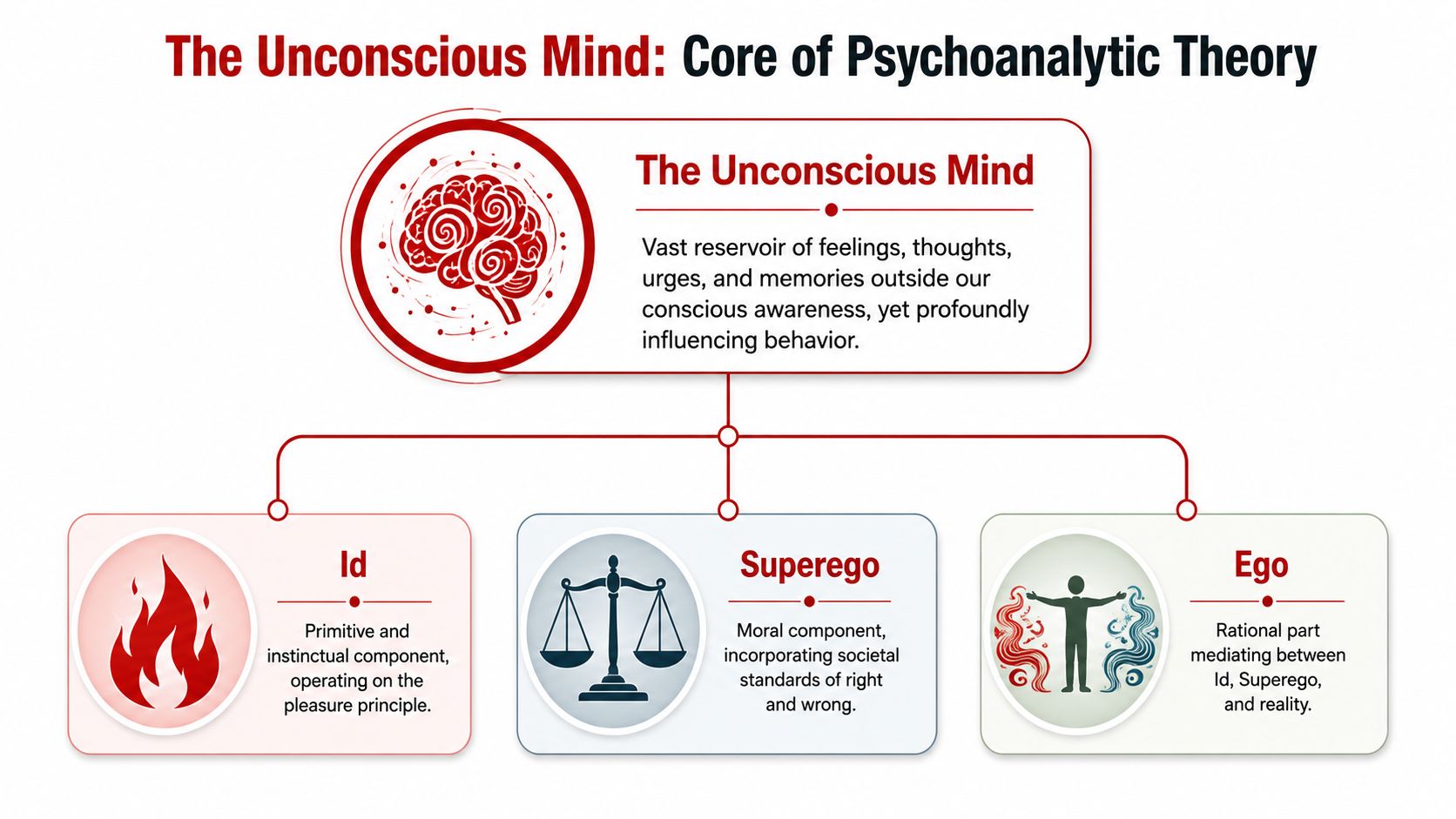
The Unconscious Mind The Core of Psychoanalytic Theory
Freud's central claim was simple and radical. Most of the mind isn't directly available to awareness. In the psychoanalytic view of personality, approximately 90% of behavior is driven by unconscious factors, while about 10% comes from conscious awareness, a model often taught as the iceberg metaphor in which only the tip is visible above water (Freud and the psychodynamic perspective).
That idea matters for exams because it changes how you read behavior. A patient doesn't just “choose” every symptom in a fully transparent way. A person may insist they're calm while their actions show fear, guilt, anger, or wish fulfillment operating underneath awareness.
The iceberg model in board-friendly terms
Freud divided mental life into three levels:
- Conscious: what you're aware of right now
- Preconscious: material you can retrieve with effort
- Unconscious: wishes, fears, memories, and conflicts outside awareness that still influence behavior
A classic exam move is to give you a patient who cannot explain their own behavior. They may say, “I don't know why I keep doing this.” In psychodynamic language, that doesn't mean there is no cause. It means the cause may be unconscious.
Practical rule: If the vignette shows behavior that seems disproportionate, symbolic, repetitive, or self-sabotaging, ask what hidden conflict the question writer wants you to notice.
Why students get confused here
Many students think “unconscious” means mystical or unscientific. On exams, it usually means something more practical. The patient is influenced by mental content that isn't fully verbalized or accessible.
That's also why dreams became so important in psychoanalysis. Freud treated them as clues to disguised wishes and conflicts. If you want a modern, accessible way to think about symbolic dream themes while studying that tradition, tools offering personalized dream interpretations can help you practice the habit of asking, “What might this image represent rather than its manifest meaning?”
High-yield way to remember it
Use ICE:
- Invisible motives
- Conscious mind is limited
- Early experiences leave deep patterns
If a board stem feels like it's testing the hidden reason behind visible behavior, you're already inside the psychoanalytic frame.
Decoding the Structure of Personality Id Ego and Superego
The structural model is one of the most testable parts of Freud. Personality consists of the id, ego, and superego, which interact and compete for finite psychological energy. The id is present at birth and follows the pleasure principle. The ego mediates through the reality principle. The superego internalizes moral rules and standards.

A memory hook that actually sticks
Think of a hospital call room at 3 a.m.
- The id says, “Eat the entire box of donuts now.”
- The superego says, “That's weak, unhealthy, and embarrassing.”
- The ego says, “Have one, drink water, and get back to work.”
That's the whole model. The id wants discharge of tension. The superego judges. The ego negotiates.
What each structure looks like in a vignette
Id
This is the impulsive, instinct-driven part. It seeks immediate gratification and doesn't care much about rules, timing, or consequences.
A board stem may hint at the id when a patient acts on raw aggression, sexual impulse, hunger, or rage without delay.
Ego
This is the organizer and mediator. It tries to satisfy drives in a realistic, socially workable way.
When you see adaptation, compromise, planning, delay of gratification, or defense mechanisms, you're often seeing the ego at work.
Superego
This is the internal moral authority. It represents conscience, ideals, and prohibitions.
A very punitive, guilt-ridden patient with harsh self-criticism often sounds superego-heavy.
When a question asks why a patient feels intense guilt after a minor mistake, think beyond mood symptoms. A severe superego may be the psychodynamic clue.
One clinical analogy
Use the toddler, referee, judge model:
- Toddler = id
- Referee = ego
- Judge = superego
The toddler wants. The judge condemns. The referee tries to keep the game from collapsing.
Students often mix up ego and superego. Here's the easiest distinction:
| Structure | Main job | Core principle | Common exam feel |
|---|---|---|---|
| Id | Demand gratification | Pleasure principle | Impulsive |
| Ego | Mediate with reality | Reality principle | Practical |
| Superego | Enforce ideals and guilt | Moral principle | Critical |
If you're reviewing personality pathology more broadly, this kind of internal conflict thinking also helps when you study maladaptive interpersonal styles in personality disorder assessment.
A short explainer can help if you want to hear the model described aloud before drilling questions:
What boards usually test
They rarely ask, “Define the id.” They ask it indirectly.
Look for:
- Immediate impulse pointing to the id
- Conflict management pointing to the ego
- Harsh guilt or moral condemnation pointing to the superego
The stem may describe behavior. Your task is to identify the hidden structure.
Anxiety and Defense Mechanisms The Ego's Toolkit
Defense mechanisms are high-yield because they convert a vague psych theory question into a pattern-recognition question. In psychoanalytic thinking, the ego uses defenses unconsciously to reduce anxiety, especially when internal wishes and moral demands collide.
The biggest mistake students make is memorizing names without learning the emotional logic. Ask one question first: What feeling is the person trying not to experience directly? Then ask how the mind is rerouting it.
Fast way to sort defenses
A practical split helps:
- Refuse reality: denial
- Forget or bury it: repression
- Put it on someone else: projection
- Move it to a safer target: displacement
- Turn it into the opposite: reaction formation
- Channel it into something acceptable: sublimation
- Explain it away: rationalization
High-Yield Defense Mechanisms for Board Exams
| Defense Mechanism | Definition | Clinical Example |
|---|---|---|
| Repression | Unconsciously blocking distressing thoughts or memories from awareness | A patient can't recall a highly upsetting event but shows anxiety around related situations |
| Denial | Refusing to accept an external reality that is too painful | A patient with clear substance-related consequences insists there is no problem |
| Projection | Attributing one's own unacceptable feeling to someone else | A hostile patient says the staff hates him |
| Displacement | Redirecting emotion from a threatening target to a safer one | A resident criticized by an attending goes home and snaps at a sibling |
| Reaction formation | Replacing an unacceptable impulse with its opposite | A person with strong hostility behaves in an exaggeratedly sweet manner |
| Rationalization | Creating a seemingly logical explanation for behavior driven by less acceptable motives | A student who didn't study says the exam was unfair anyway |
| Sublimation | Channeling an unacceptable impulse into a socially valued activity | A person with aggressive drive becomes highly engaged in competitive sport or surgery |
Distinctions students mix up
Projection vs displacement
Projection changes ownership.
Displacement changes target.
Reaction formation vs sublimation
Reaction formation flips the feeling into its opposite.
Sublimation redirects the energy into a healthier outlet.
Repression vs denial
Repression keeps internal material out of awareness.
Denial rejects external facts.
Exam shortcut: If the patient still has the feeling but mislabels who owns it, that's projection. If the patient has the feeling and dumps it somewhere safer, that's displacement.
If you're pairing psychodynamic material with symptom-based psychiatry review, it helps to contrast these patterns with formal diagnoses in anxiety disorders classification.
A mini-vignette drill
A medical student feels intense envy toward a classmate who matched into a top program. He then says, “She's obviously jealous of me.”
That's projection.
A patient feels anger toward a controlling parent but becomes unusually polite and affectionate around them.
That's reaction formation.
A surgeon with strong aggressive drives thrives in a demanding procedural field.
That's sublimation.
Boards reward that level of precision.
Mapping Personality Through Psychosexual Stages
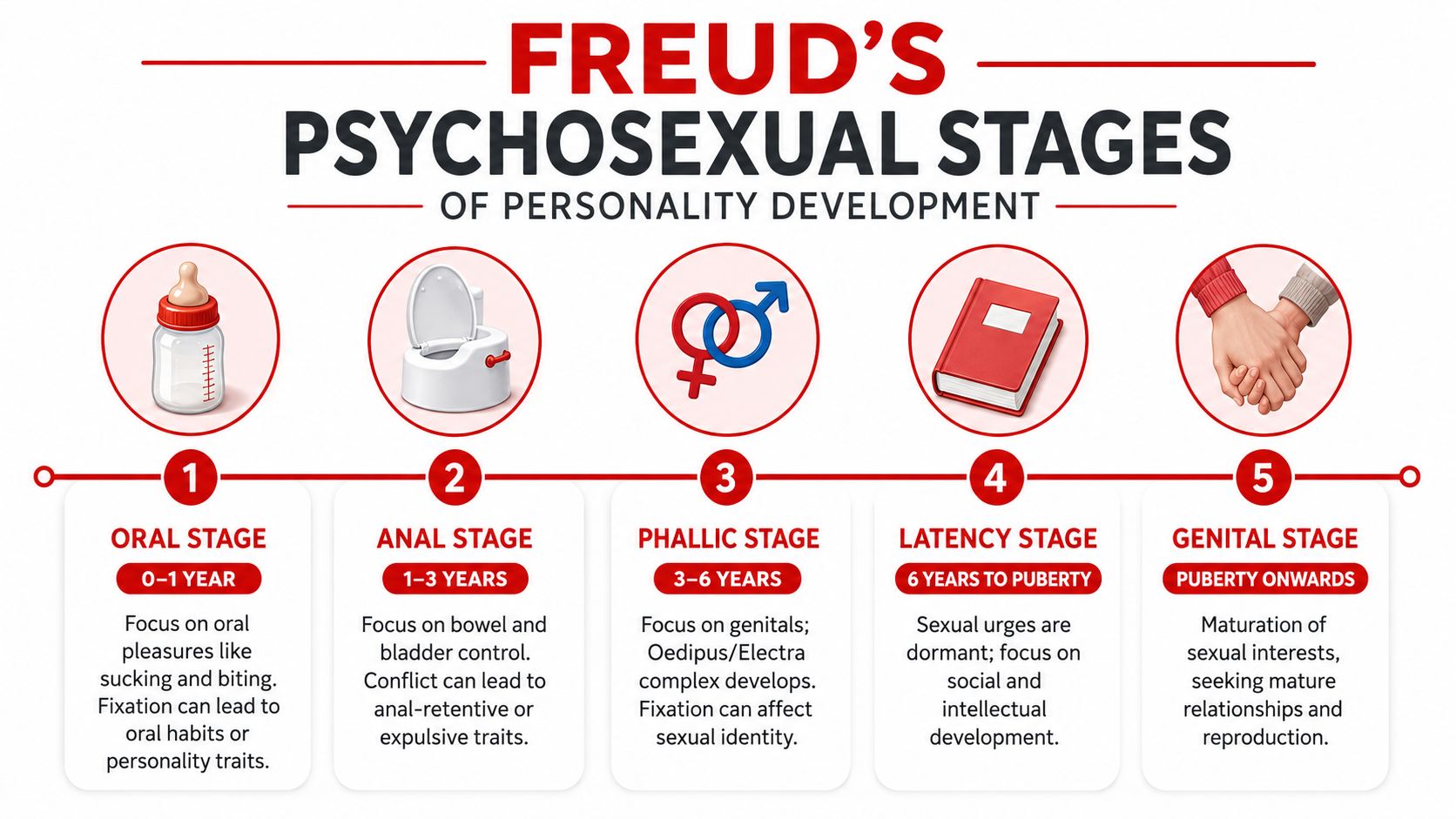
Freud argued that personality develops through childhood conflicts, and that behavior follows psychic determinism, meaning it has an identifiable cause rooted in conscious or unconscious mental life. He also held that personality emerges from early developmental experience across stages, with later symptoms reflecting how those conflicts were handled (psychic determinism and developmental stages).
For board purposes, don't get lost in every historical detail. Learn the sequence, the body focus, and the fixation style.
The sequence as a story
A child first experiences the world through the mouth, then control, then identity and rivalry, then a quieter period of learning, then mature sexuality. Freud saw each stage as carrying a central conflict. If the conflict isn't resolved, some part of personality can remain “stuck” there.
Use the mnemonic Old Age Prefers Late Growth:
- Oral
- Anal
- Phallic
- Latency
- Genital
The stages that show up on exams
Oral stage
This stage centers on feeding, sucking, and oral gratification. Freud linked fixation here to dependency, clinginess, or oral habits.
In a vignette, think about a person who seems heavily reliant on soothing through intake or mouth-based behavior.
Anal stage
This stage centers on bowel and bladder control, classically linked to issues of order, control, autonomy, and stubbornness.
Exams may hint at either overcontrol or messy defiance. The phrase “anal-retentive” is old-fashioned but still testable shorthand for rigidity, neatness, and control.
Phallic stage
This stage involves awareness of genitals, early identity conflicts, and the classic Oedipal framework. You don't need to endorse the theory to answer a board-style item on it.
Students often overcomplicate this one. The testable point is usually that conflict around desire, rivalry, and identification can influence later personality patterns.
Latency
Sexual drives become less prominent, and energy shifts into school, social roles, and skill building.
This stage matters mostly because it's the “quiet” one.
Genital
This marks mature sexuality and adult relational capacity.
A person who maintains a balance between intimacy and work would be viewed as developing toward this stage.
How to make it clinically useful
A lot of learners wonder whether any of this matters outside theory. It does when a vignette asks you to connect adult style to childhood conflict. Modern therapeutic work often still engages with childhood themes, family patterns, and old emotional scripts. If you're curious how contemporary clinicians think about addressing childhood experiences with therapy, that gives a more modern bridge from Freud's developmental emphasis to present-day practice.
“If adulthood seems irrational, look for the childhood pattern the question stem is quietly pointing toward.”
Psychoanalytic Concepts in Modern Clinical Practice
Freud's original model evolved into modern psychodynamic practice, but the core idea remained useful. Patients bring hidden expectations, old relationship patterns, and unconscious biases into the exam room. Clinicians do too.
That's why this material isn't just board trivia. It helps explain why a patient reacts strongly to a neutral comment, why a clinician feels unusually irritated or protective, and why some diagnostic mistakes aren't purely knowledge problems.
Where the theory still matters clinically
Psychodynamic clinicians often use tools such as:
- Free association to let themes emerge with less censorship
- Dream interpretation to explore symbolic meaning
- Transference analysis to understand how old relational patterns replay with the clinician
- Countertransference awareness to notice the clinician's own emotional reactions
For exams, the big pair is transference and countertransference.
- Transference: the patient redirects feelings from past important relationships onto the clinician
- Countertransference: the clinician's emotional response to the patient, which may be informative or distorting
Why this matters for diagnosis
The modern relevance becomes especially clear in high-stakes clinical reasoning. Recent 2025 meta-analyses reported that psychodynamic self-reflection in clinical reasoning training reduced diagnostic errors by 22% in simulation studies, while 60% of medical errors stem from cognitive biases linked to unconscious impulses (psychodynamic self-reflection and diagnostic error).
That's a strong board-style reminder that unconscious processes aren't just a patient issue. They affect the physician's thinking too.
A medical example
A student sees a confident patient with a prior benign workup and quickly assumes the new complaint is also harmless. If the student is unconsciously pulled by reassurance, authority bias, or dislike of ambiguity, the “mistake” may reflect more than poor recall. It may reflect unexamined internal pressure.
A broader review of integrated behavioral care can make that connection easier when you're thinking about psychiatry in real systems of practice, especially in behavioral health integration.
Clinical pearl: Psychodynamic thinking becomes practical the moment you ask, “What is this interaction making both people feel, and how might that shape judgment?”
High-yield test angle
If a question mentions:
- unusual emotional reactions toward a clinician
- repeated relational patterns
- symbolic meaning
- hidden motives affecting decision-making
You should at least consider a psychodynamic answer choice.
Major Criticisms and Enduring Legacy
Freud's theory draws criticism for good reasons. Many ideas are hard to test directly, some concepts overemphasize sexuality and early childhood, and parts of the model reflect historical and cultural biases. On exams, you should be able to recognize those limitations without throwing away the entire framework.

The criticism side
A fair critique usually includes points like these:
- Limited falsifiability: some claims are difficult to disprove scientifically
- Heavy developmental emphasis: the model may place too much weight on early childhood
- Historical bias: some formulations reflect older assumptions about gender and development
That critical reading skill matters in medical education. If you want a structured way to practice evaluating evidence instead of memorizing conclusions, spend time with guides on how to critically appraise research.
Why Freud still shows up everywhere
Even with those criticisms, the legacy is durable. Modern meta-analyses found effect sizes between 0.78 and 1.46 for symptom improvement in psychoanalytic therapy, and one landmark review reported 0.78 at treatment termination rising to 0.94 at follow-up for long-term psychoanalytic psychotherapy (efficacy of psychodynamic psychotherapy). That pattern matters because it suggests change can persist and deepen after treatment ends.
The broader influence goes beyond therapy outcomes. Terms like unconscious conflict, defense mechanism, and childhood patterning are now embedded in mainstream psychology and everyday language. Freud's model also created a contrast point for later trait-based approaches. If you want to compare deep-dynamic theories with modern dimensional models, a quick overview of the Five Factor personality test is useful because it shows how contemporary personality science often describes traits rather than hidden conflicts.
Freud got many things wrong or overstated. He also changed how clinicians think about motive, symptom meaning, and the emotional life beneath conscious explanation.
High-Yield Takeaways for Your Board Exams
Keep this as your last-pass sheet before questions.
Unconscious mind: In the psychoanalytic view of personality, much behavior is driven by material outside awareness. If a patient's behavior seems irrational but patterned, think unconscious conflict.
Id: pleasure principle, immediate impulse.
Ego: reality principle, mediator, home of defense mechanisms.
Superego: conscience, guilt, internalized rules.
Defense mechanisms most often tested
- Projection: “They hate me” when the patient's own hostility is the issue
- Displacement: anger shifted to a safer target
- Reaction formation: acting opposite to the true impulse
- Rationalization: polished excuse after the fact
- Sublimation: impulse redirected into acceptable work or activity
- Denial: refusal to accept reality
- Repression: distressing material kept out of awareness
Psychosexual stages mnemonic: Old Age Prefers Late Growth
- Oral
- Anal
- Phallic
- Latency
- Genital
Classic exam clue
- Harsh guilt suggests superego pressure
- Impulsive gratification suggests id dominance
- Compromise and symptom management suggest ego function
Modern application: transference, countertransference, and unconscious bias still matter in clinical settings.
For focused review on how these concepts appear in high-stakes psychiatry questions, targeted psychiatry board preparation is worth prioritizing over passive rereading.
If you want expert help turning dense psychiatry theory into board-style pattern recognition, Ace Med Boards offers personalized tutoring for USMLE, COMLEX, Shelf exams, and broader medical training milestones. It's a practical option when you need structure, accountability, and high-yield teaching that matches the way these concepts are tested.