
You're three months into USMLE prep, moving through question banks, and a vignette about a patient's “strange” reaction suddenly asks you to identify a defense mechanism. The stem feels familiar, but the answer choices blur together because psychoanalytic theory can sound abstract until it's tied to a real case. That's exactly why the psychoanalytic view of personality still shows up on board exams, it gives exam writers a way to test whether you can recognize hidden motivation, conflict, and patterned behavior in clinical language.
For medical students, this topic isn't just history. It anchors how you think about unconscious processes, defense mechanisms, personality pathology, and psychodynamic formulation, all of which can surface in Step 1, Step 2, COMLEX, and shelf questions. A quick way to organize your studying is to pair theory with question practice and tools that force active recall, including resources like Rooy Development's learning tools list and a board-focused review plan such as Ace Med Boards' psychiatry board preparation.
Practical rule: If a question stem shows a mismatch between what a patient says and what the pattern of behavior suggests, think psychodynamicly before you think diagnostically.
Why the Psychoanalytic View of Personality Matters for Board Exams
The first time this topic hits hard is usually in a mixed psychiatry block. You see a vignette about a patient who insists everything is fine, yet the stem describes repeated conflict, avoidance, or symbolic behavior, and the answer choice asks for a psychoanalytic concept. The trap is that board questions rarely ask for textbook definitions alone, they ask whether you can read the behavior underneath the explanation.
That's why the psychoanalytic view of personality keeps coming back. It trained generations of clinicians to look for meaning in symptoms, and exam writers still use that logic to test your grasp of personality development, defense mechanisms, and maladaptive coping. In other words, this is not just Freud trivia. It's a language for interpreting why a patient's story and the patient's behavior don't line up.
A strong study habit here is to treat each vignette like a short consultation note. Ask, what's the conflict, what's being defended against, and what would an ego under pressure do? That same framework helps with psychodynamic therapy questions, where the test often rewards pattern recognition more than memorization.
If you're building a psychiatry review stack, keep this topic in the rotation alongside personality disorders, mood disorders, and trauma questions. Board prep becomes much easier when you can identify the hidden structure of a stem instead of chasing every symptom separately.
Origins and Key Figures of Psychoanalytic Theory
Freud formalized the psychoanalytic view of personality in the late 19th and early 20th centuries, and his ideas still shape how students learn this material today. The historical milestone every board examinee should know is 1900, when Freud published The Interpretation of Dreams and made dream analysis central to psychoanalytic theory, linking dreams to latent unconscious wishes.
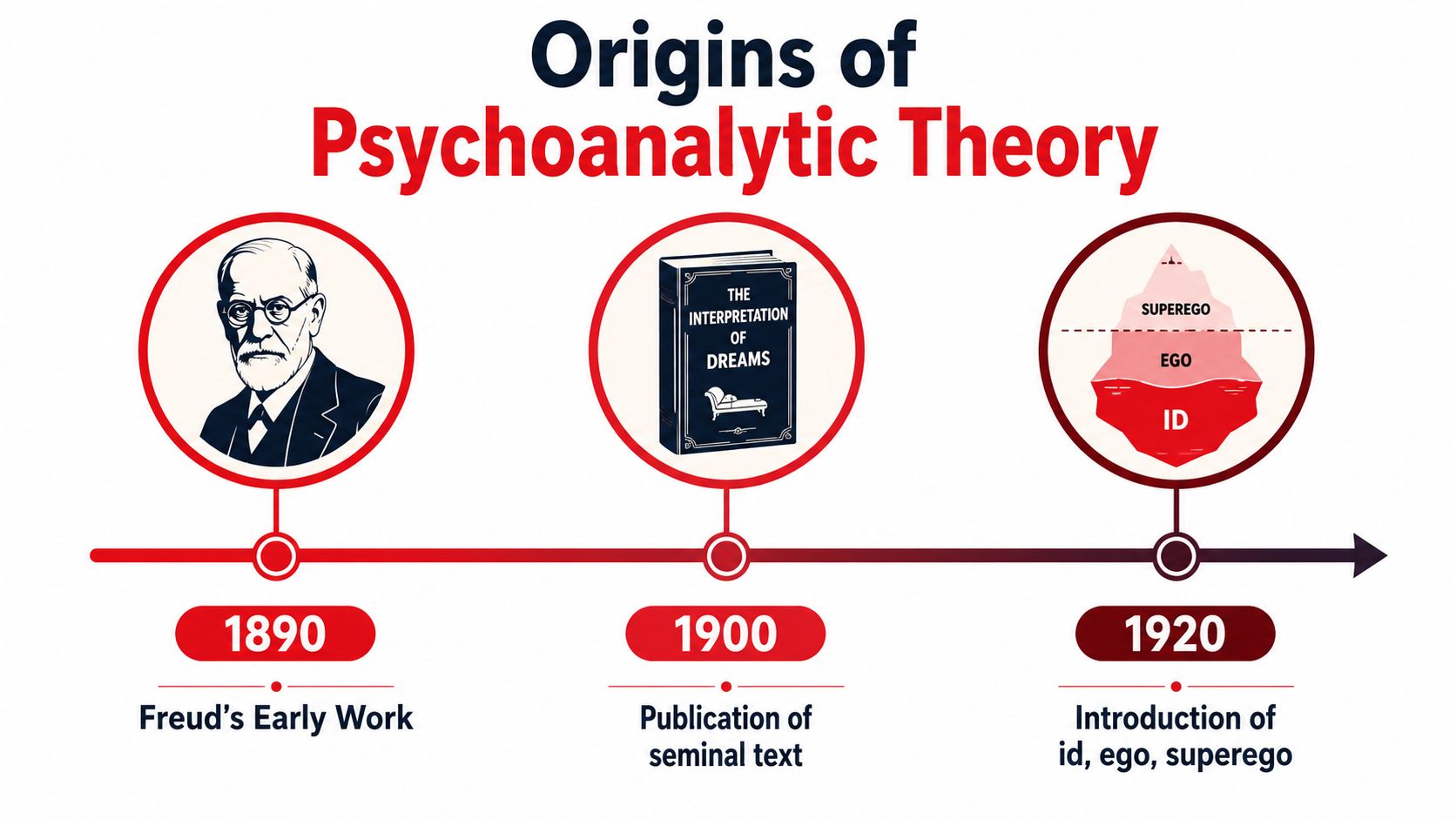
Freud's basic framework
Freud's contribution wasn't just one idea, it was a whole system. He tied personality to unconscious conflict, early childhood experience, and internal forces such as the id, ego, and superego, while also describing consciousness in layers, conscious, preconscious, and unconscious mental activity. That structure matters on exams because many stems use indirect clues, not explicit definitions.
Freud also proposed five psychosexual stages of development, oral, anal, phallic, latency, and genital. Even if modern psychology critiques the model, it remains one of the most recognizable board facts because it links early developmental conflict to later personality patterns.
Why the historical names still matter
Jung and Adler are often mentioned in the broader history of psychoanalytic thought, but Freud remains the core reference point for exam questions. In practice, that means you should know Freud's model first, then recognize where later thinkers branched away from it. A good memory hook is simple, Freud built the house, later theorists remodeled it.
Freud's work is most testable when you translate history into behavior, because board questions rarely reward dates alone.
For a compact refresher on classic personality theory vocabulary, book psychology tag can be useful as a supplementary reading trail when you want to revisit the language of older theorists.
Core Constructs The Structure of Personality
A patient says, “I know this behavior is irrational, but I keep doing it anyway.” That kind of conflict is exactly what the psychoanalytic view is built to explain. Personality is not one unified voice, it is a negotiation among the id, ego, and superego, and the behavior you see is the result of how those forces are handled under pressure.
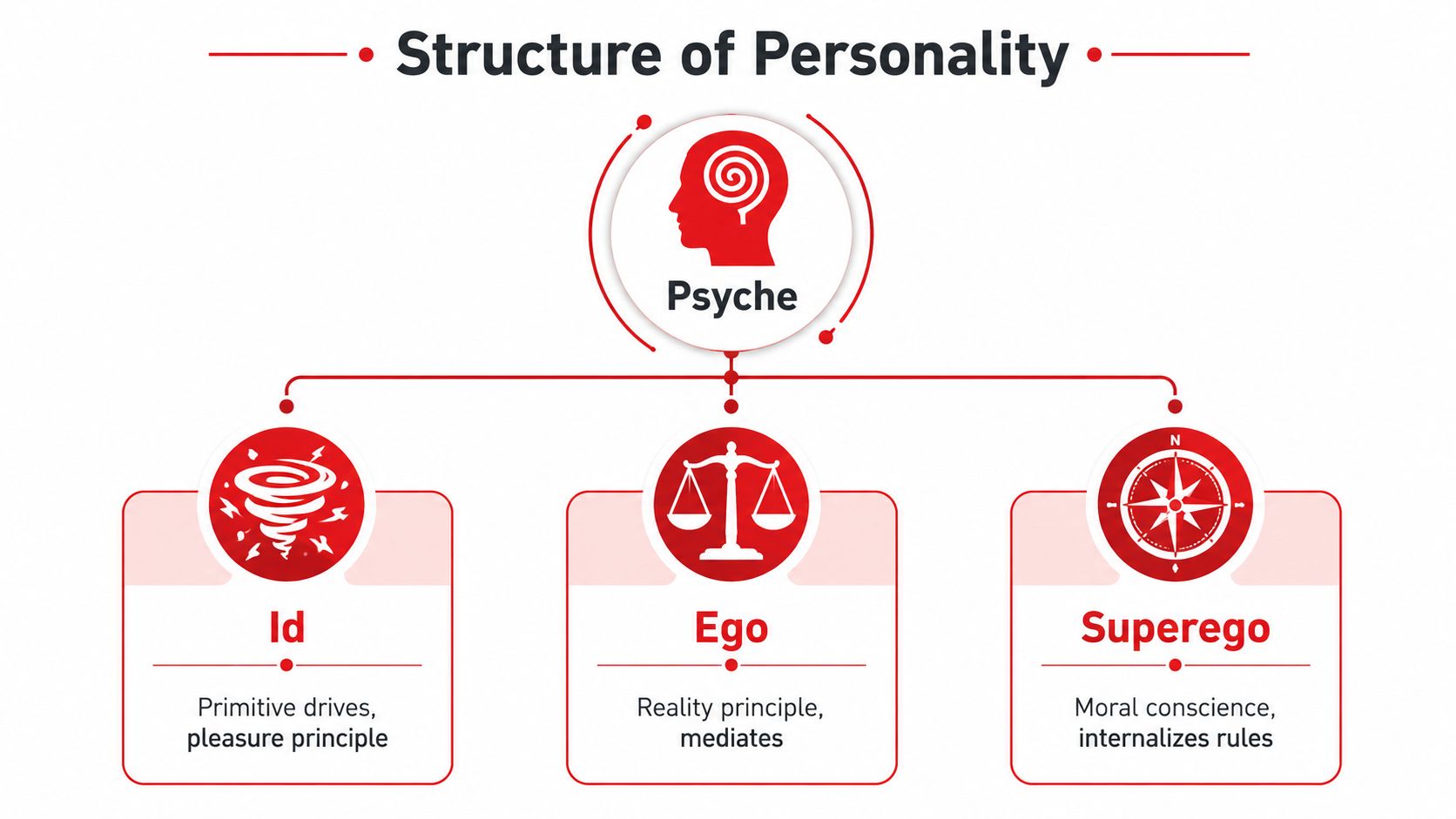
The three-system model
The id is the primitive drive system. It wants immediate gratification, without waiting and without compromise. The ego serves as the reality-based mediator, the part that negotiates with the world and decides what can be done. The superego internalizes moral rules and can produce guilt, self-criticism, or rigid standards when it becomes overactive.
A board-style way to keep the three straight is to picture a car with competing passengers. The id presses the gas, the superego keeps warning about the rules, and the ego has to steer without crashing. If the ego cannot keep both sides in balance, behavior may look anxious, defensive, or poorly regulated. That clinical logic is the point of the model, it explains symptoms as dynamic outcomes of intrapsychic conflict rather than isolated traits. For a compact refresher on classic personality theory vocabulary, book psychology tag can be useful as a supplementary reading trail when you want to revisit the language of older theorists.
Conscious and unconscious mental life
Freud also paired the structural model with a topographical model of consciousness. He divided mental activity into conscious, preconscious, and unconscious levels, and the classic iceberg metaphor captures why most mental life stays out of direct awareness while still shaping behavior. On exam questions, that means a patient's explanation may be sincere and still leave out the motive that matters most.
The memory distinction here is the same one tested in many psychiatry and neurology stems, surface recall versus material that is not immediately available. Ace Med Boards' implicit vs explicit memory guide fits this topic because it helps separate what can be stated directly from what only shows up indirectly in behavior. Use ICE as a quick cue, Invisible conflict, Conscious only at the tip, Expressive through symptoms. That is not Freud's original acronym, but it fits the way boards ask the concept.
The Unconscious and What Drives Behavior
A common board-style vignette starts with a patient who gives a polished explanation, yet the behavior tells a different story. Freud's claim that most behavior is driven by unconscious processes explains that gap. The patient is not necessarily hiding the truth on purpose. The issue is that some motives are out of reach of direct awareness, so they surface indirectly through symptoms, choices, slips of the tongue, dreams, and repeated relationship patterns.
How the unconscious shows up
In psychoanalytic reasoning, symptoms often work like indirect signals from a hidden system. A patient may describe a conflict in calm, rational language, but the stem reveals repeated avoidance, self-sabotage, or strong reactions that do not fit the stated intention. That mismatch is the clue exam writers want you to notice.
The practical move is to look for recurring themes, affective triggers, and defense mechanisms. If a person keeps having the same conflict with authority figures, the question may be pointing to displaced anger, projection, or an unresolved early pattern rather than ordinary stress. The same idea appears in implicit and explicit memory: some material can be stated directly, while other material shows up only through behavior.
What to do with a confusing vignette
When the answer choices feel too broad, use three questions.
- What keeps repeating? Repetition usually points to an unconscious pattern rather than a one-time reaction.
- What emotion is hard to face directly? That emotion often gets defended against.
- What's the safest outlet the psyche has chosen? That outlet may be the defense mechanism the question wants.
A patient who keeps choosing the same harmful relationship, or a student who reacts to every small criticism as if it were an attack, may be showing unconscious conflict rather than simple poor judgment. The board exam often asks you to identify that hidden motive from the pattern, not from the patient's surface explanation.
The key takeaway is simple. The unconscious does not speak in plain language. It leaks out through behavior, and exam questions are built around that leak.
Defense Mechanisms and Developmental Stages
Defense mechanisms are high-yield because they let exam writers test both psychology and pattern recognition in one stem. The core idea is that the ego protects itself from distress by distorting, redirecting, or masking threatening material. Freud's original model treated this as normal human functioning, not a sign of weakness.
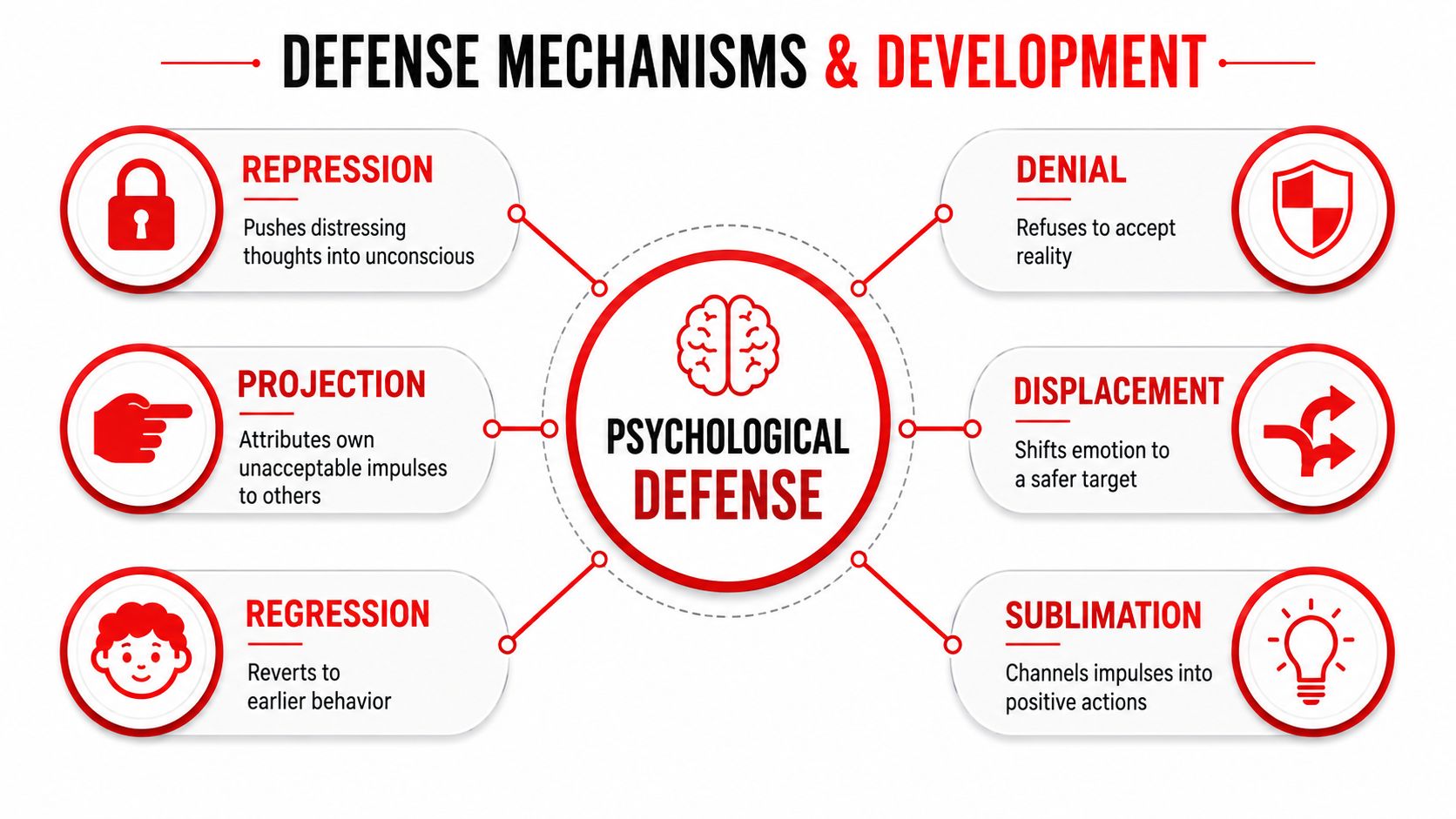
The defenses that show up most often
Repression pushes distressing thoughts out of awareness. A student who “can't remember” a traumatic event may be using repression rather than forgetting.
Denial refuses to accept reality. A patient who insists a diagnosis must be wrong despite clear evidence is the classic setup.
Projection attributes one's own unacceptable impulses to someone else. If a hostile resident says everyone else is angry at them, projection should be on your radar.
Displacement shifts emotion to a safer target. Someone furious at a supervisor goes home and snaps at a family member.
Regression returns to an earlier developmental behavior under stress. Adults may become clingy, tearful, or childlike when overwhelmed.
Sublimation channels an impulse into a socially useful outlet. Aggressive energy turned into competitive sports is the standard example.
Exam rule: If the emotion stays the same but the target changes, think displacement. If the unwanted feeling is credited to someone else, think projection.
Psychosexual stages and fixation
Freud's five psychosexual stages are oral, anal, phallic, latency, and genital. The board-relevant concept is fixation, meaning unresolved conflict at one stage can shape later personality style. Oral themes are often linked to dependence or oral habits, anal themes to control and order, and the later stages are usually tested less for the details of behavior and more for whether you know the sequence.
A quick mnemonic for the order is OAPLG, oral, anal, phallic, latency, genital. It's clunky, but it's enough to keep the sequence straight under pressure.
For a clinically oriented way to think about these patterns in assessment questions, Ace Med Boards' personality disorder assessment guide is a useful companion resource.
Clinical Applications Psychodynamic Therapy and Assessment
A patient keeps describing the same conflict in every relationship, then reacts strongly to a neutral comment from the examiner. That kind of pattern is exactly where psychodynamic thinking becomes clinically useful. The clinician is listening for repeated themes, emotional blind spots, and the way the patient relates to the therapist, because the therapy relationship can expose conflict that the patient does not recognize directly. In exam language, transference and countertransference are the terms to know.
The therapy room often works like a live sample of the patient's usual relational style. A patient who idealizes, mistrusts, or devalues the therapist may be repeating older patterns rather than reacting only to the present moment. Psychodynamic assessment therefore pays close attention to narrative consistency, shifts in affect, and the material the patient avoids. These clues matter because the avoided topic is often where the conflict sits.
What modern outcome research adds
Psychoanalytic therapy has not stayed fixed in the past. Modern reviews report psychotherapy outcome studies with effect sizes of 0.73 to 0.85, and one rigorous meta-analysis found an overall effect of 0.97 for general symptom improvement with psychoanalytic therapy (The scientific standing of psychoanalysis). The same source reports longer-term psychoanalytic psychotherapy at 0.78 at termination and 0.94 at follow-up, while psychoanalysis proper reached 0.87 at termination and 1.18 at follow-up.
Those numbers matter for exam prep because they explain why psychodynamic ideas still appear in evidence-based discussions. The theory is old, but it has also been examined in modern psychotherapy research and linked with durable post-treatment gains. That combination of historical depth and ongoing study is what makes it fair game for boards.
How to think about it clinically
A useful board-style question is whether the vignette is describing a symptom, or a pattern that keeps repeating across settings. Psychoanalytic thinking is strongest when the stem points to persistent interpersonal themes, unconscious defenses, or symptoms that seem symbolically tied to conflict. It is less useful when the question asks for rapid diagnostic labeling without any relational context.
One practical study habit is to read a therapy vignette twice. First, identify the diagnosis. Then, look for the interpersonal pattern. If the second reading changes the answer, the question is probably testing psychodynamic formulation rather than a surface symptom list.
For a broader clinical integration lens, Ace Med Boards' behavioral health integration resource fits well with this style of reasoning. It helps connect psychodynamic ideas to the way behavioral health concepts show up in real clinical settings, which is the same bridge board questions often ask you to cross.
A brief teaching video can also help lock in the relational tone of psychodynamic work.
Common Criticisms of the Psychoanalytic View
The biggest criticism of Freud's model is that many of its ideas are hard to test cleanly. Concepts like unconscious conflict, dream symbolism, and id-ego-superego dynamics are clinically useful as frameworks, but they don't always translate into measurable, falsifiable predictions. That's one reason modern psychology often treats the theory as foundational history rather than a primary explanatory model.
Culture is another major limit. Freud built his ideas from a narrow historical context, largely from Victorian-era Austrian case material, so exam writers may expect you to recognize that the theory can overgeneralize from one cultural setting. The same caution applies to claims about development, since personality formation looks different across cultures, family systems, trauma contexts, and adult life stages.
What to remember for tests
The right answer on an exam usually isn't “psychoanalysis is useless.” It's more nuanced than that. Psychoanalytic theory remains valuable for recognizing defenses, unconscious motivation, and relationship patterns, but it has to be applied carefully and with awareness of its limits.
A few high-yield boundaries help:
- Testability matters: If an answer choice relies on an idea that can't be reasonably observed or measured, be cautious.
- Context matters: A concept built from one historical and cultural setting may not generalize cleanly.
- Development isn't frozen in childhood: Adult personality continues to evolve through relationships and ongoing experience, which is why more nuanced psychodynamic scholarship goes beyond the original psychosexual stages.
If you want a broader framework for thinking about cultural limits in clinical interpretation, Ace Med Boards' cultural competency healthcare resource is a sensible companion to this topic.
Conclusion Key Takeaways for Your Exam
A patient in a vignette keeps repeating the same self-defeating relationship pattern, denies anger, and then develops a physical complaint after a conflict. That kind of stem is pointing you toward the psychoanalytic view of personality. For board exams, the key idea is simple, unconscious conflict, id, ego, superego, and behavior shaped by defenses rather than direct intent. Freud's 1900 publication of The Interpretation of Dreams placed dream analysis at the center of the theory, and his five psychosexual stages remain a common test target because they anchor developmental thinking. The practical habit is to notice repetition first, then ask what feeling or wish the mind is trying to keep out of awareness.
For quick recall, use a sequence instead of a jumble of terms. Structure means id, ego, superego. Topography means conscious, preconscious, unconscious. Defenses mean the ego protecting itself from anxiety. Stages mean oral, anal, phallic, latency, genital. Therapy means pattern recognition and the idea that psychodynamic approaches can still produce durable gains, as noted in modern review literature.
When an exam question feels vague, return to the behavior in the stem. Ask what is repeated, what is being defended against, and which answer choice matches the conflict better than the surface story. That is how a difficult psychoanalytic question becomes manageable on test day.
Ace Med Boards helps medical students work through high-yield psychiatry topics with one-on-one tutoring, question analysis, and exam-focused strategy. If psychoanalytic theory still feels tangled after reading this, visit Ace Med Boards to see how targeted board prep can make these concepts easier to recognize on test day.