You've probably had some version of this thought already: everyone else seems to know how to “do pre-med,” and you're trying to figure out whether you're behind.
Maybe your friends have parents in medicine. Maybe someone on campus already has a research position, physician shadowing lined up, and a spreadsheet for med school requirements. Meanwhile, you're trying to decode prerequisites, protect your GPA, find clinical experience, and decide whether one advising appointment per semester is enough.
That uncertainty is exactly why pre medical advising matters. Good advising doesn't remove the hard work, but it does turn confusion into a plan. And if your school doesn't offer much support, you're not doomed. You just need a more intentional way to build guidance around yourself.
What Is Pre Medical Advising and Why It Matters
Pre medical advising is ongoing guidance for the full path to medical school, not just a one-time appointment about course registration. At its best, it helps you connect four moving parts: academics, experiences, testing, and your eventual application story.

A lot of students think advising is mainly about asking, “What classes do I need?” That's part of it, but it's far too small a view. Strong advising also helps you ask better questions: Which opportunities fit your schedule and strengths? When should you add research versus service? Are you building a record that makes sense as a whole, or just collecting disconnected activities?
If you're still sorting out the basics, this overview of what pre-med means can help clarify the path before you start making long-term decisions.
Advising is a navigation system
Medical school admissions can feel gatekept because the rules are spread across many places. One office talks about prerequisites. Another mentions committee letters. Students hear different advice from professors, upperclassmen, and online forums. What you need is a way to organize all of that into decisions that fit your own timeline.
That's where advising earns its value. A good advisor helps you move from vague ambition to a sequence of concrete choices, such as:
- Course timing: taking foundational sciences in an order that supports later classes and test prep
- Experience planning: choosing clinical, service, and research commitments you can sustain
- Reality checks: spotting weak areas early, before they become application-season problems
- Narrative building: understanding how your activities reflect your motivation for medicine
Good pre medical advising doesn't just tell you what boxes exist. It helps you decide which boxes matter most for your specific situation.
It answers the question students rarely say out loud
Most pre-med stress gets translated into one quiet question: Am I doing enough?
That question gets tricky because “enough” isn't just about doing more. More clubs, more shadowing, more random commitments, more stress. Students often burn energy on activity accumulation when what they really need is direction.
Useful advising helps you replace panic with a sharper set of questions:
- What's missing from my academic plan?
- What am I doing only because other students are doing it?
- What evidence do I have that medicine is the right fit for me?
- What should I prioritize now, not someday?
When you think about pre medical advising this way, it stops being a campus service you hope is helpful. It becomes part of your decision-making system. And if your school provides only limited support, that system can still be built. It just may not come from one office alone.
The Pre Med Advising Landscape Who Are the Key Players
Some students picture “the pre-med advisor” as a single expert with all the answers. On many campuses, that person either doesn't exist or has far too many students to serve individually. A better model is to think of advising as your personal board of directors. Different people can help with different parts of the process.
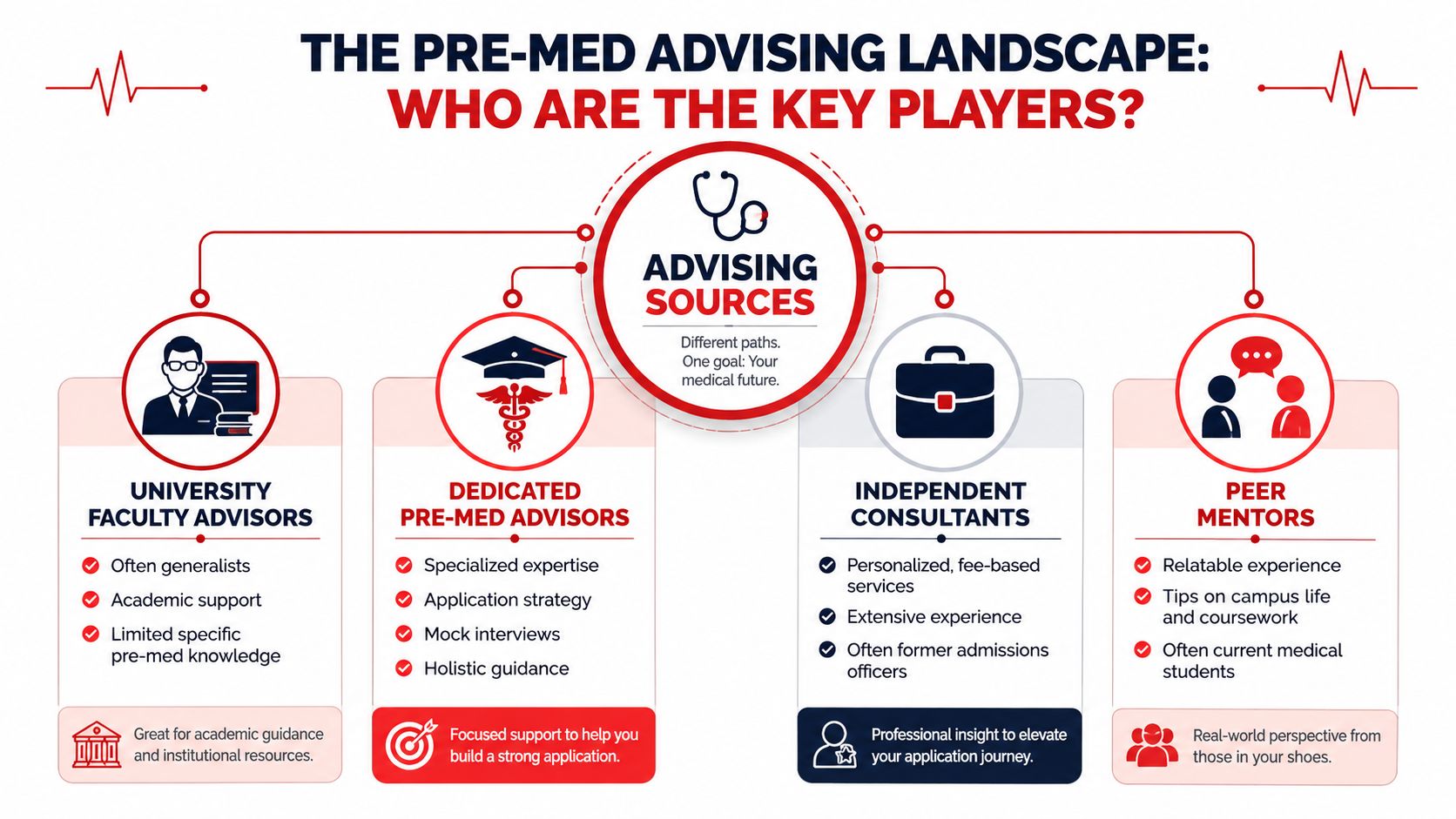
If you want a broader look at options, this guide to pre-med advisors shows how students often combine multiple sources of guidance rather than relying on one person.
The common advising sources
Here's how these roles usually differ in practice:
| Advising source | What they often help with | Where they may fall short |
|---|---|---|
| Faculty advisor | Course planning, campus policies, academic habits | May not know current medical school application details |
| Dedicated pre-health advisor | Prerequisites, timelines, letters, application strategy | Access may be limited or inconsistent |
| Peer mentor | Practical student perspective, campus-specific tips, emotional reassurance | Advice can be uneven or anecdotal |
| Independent consultant | Personalized feedback, essay review, application positioning | Not always accessible or necessary for every student |
A confused student often gets into trouble by treating all advice as equally authoritative. A peer may know which professor explains physics clearly. A faculty member may know your academic strengths well. A specialized advisor may understand how your record fits med school expectations. These are different kinds of help.
The inequity students feel is real
Students at under-resourced schools are not imagining the gap. Advising access differs sharply across institutions. One analysis found that California State University campuses averaged 1 full-time equivalent advisor for every 24,620 graduates, compared with 1:4,526 at University of California campuses and 1:1,794 at private institutions. In that comparison, CSU students had 5.4 times less access than UC students and 13.7 times less than students at private schools (study on advising access disparities).
That matters because advising delays aren't minor inconveniences. They affect when students learn about prerequisites, when they correct weak spots, and whether they build a coherent application plan early enough.
If you attend a school with limited advising, your struggle is not a personal failure. It's often a structural access problem.
Build your own advising team
If campus support is thin, don't wait for the perfect advisor to appear. Build a small network instead.
- Choose one academic anchor: a professor, department advisor, or mentor who knows your coursework and can speak candidly about your academic trends.
- Find one process guide: someone familiar with pre-health logistics, such as committee letters, timelines, and application expectations.
- Add one near-peer voice: a recent applicant or current medical student who remembers what it felt like to do this without insider knowledge.
- Use office hours strategically: not every conversation needs to be with a formal pre-med advisor. Science faculty, research supervisors, and clinicians can all answer focused questions.
Students at schools with fewer formal resources often succeed by becoming organized question-askers. That skill matters in medicine anyway. Pre medical advising becomes stronger when you stop looking for one gatekeeper and start building a team.
Core Services What a Good Advisor Actually Does
Not all advising is equally useful. Some meetings stay at the level of vague encouragement. Good advising produces decisions. You leave knowing what to do next, why it matters, and what evidence you need before the next check-in.
One of the clearest benchmarks for productive advising is preparation. The strongest model uses a structured signature portfolio. Students bring their current GPA, science GPA, a four-year course map, and a verified list of clinical hours, research, and shadowing before the meeting. That kind of preparation lets an advisor identify missing prerequisites and planning gaps quickly (description of the signature portfolio approach).
Academic planning
A good advisor helps you build a realistic academic path, not an impressive-looking one that collapses under pressure. That includes prerequisite sequencing, semester load, and decisions about when to protect your GPA versus when to stretch.
Students often get confused here because they think rigor always means taking the maximum science load possible. It doesn't. Medical schools want evidence that you can handle demanding material, but they also see the grades you earn.
Experience curation
You do not need every possible activity. You do need a set of experiences that help you understand patients, service, teamwork, and the daily realities of medicine.
Advising should become selective. If you're already balancing heavy coursework, adding another superficial commitment may weaken more than it helps. Instead, a strong advisor helps you ask whether an activity gives you sustained responsibility, reflection material, and genuine exposure to healthcare.
If you're still looking for hands-on options, this guide to clinical experience for pre-med students can help you sort through common paths.
Practical rule: Choose fewer commitments that you can describe with depth, responsibility, and reflection.
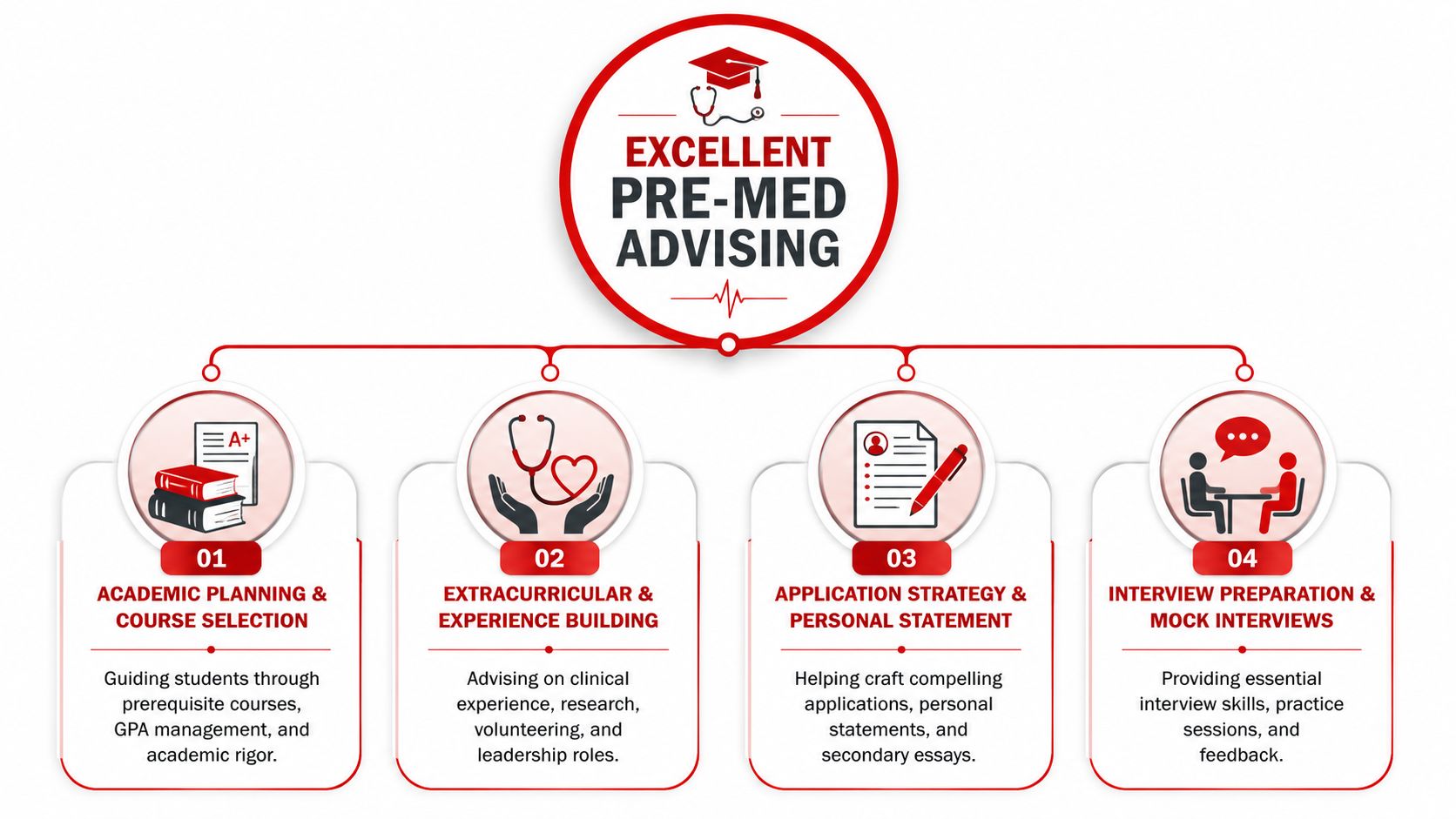
A short visual overview can make these pillars easier to remember:
Testing and application support
MCAT planning should never appear suddenly in junior year as a crisis. Good advising ties coursework to later MCAT content and helps you decide when your academic foundation is ready. Just as important, advising should push you to examine trends in your performance. Are you consistently weak in one subject area? Are your study methods too passive? Are you rushing the timeline because others are applying?
Application support is where many students expect the most help, but it should come after the groundwork above. A useful advisor helps you shape your personal statement around real experiences and decisions, not generic phrases about wanting to help people.
A strong advisor should be able to help you with all four of these functions:
- Academic sequencing: planning classes so prerequisites and workload make sense together
- Experience selection: deciding what to pursue, drop, or deepen
- MCAT readiness: evaluating timing, not just encouraging you to “start studying”
- Application positioning: presenting a record that sounds like a real person, not a checklist
If your advisor can only help with one of those areas, that's still useful. You'll just need other people to fill the remaining gaps.
How to Maximize Your Advising Relationship
The most helpful shift you can make is this one: stop acting like a passive advisee. You're not there to receive wisdom. You're there to run a planning meeting about your future.
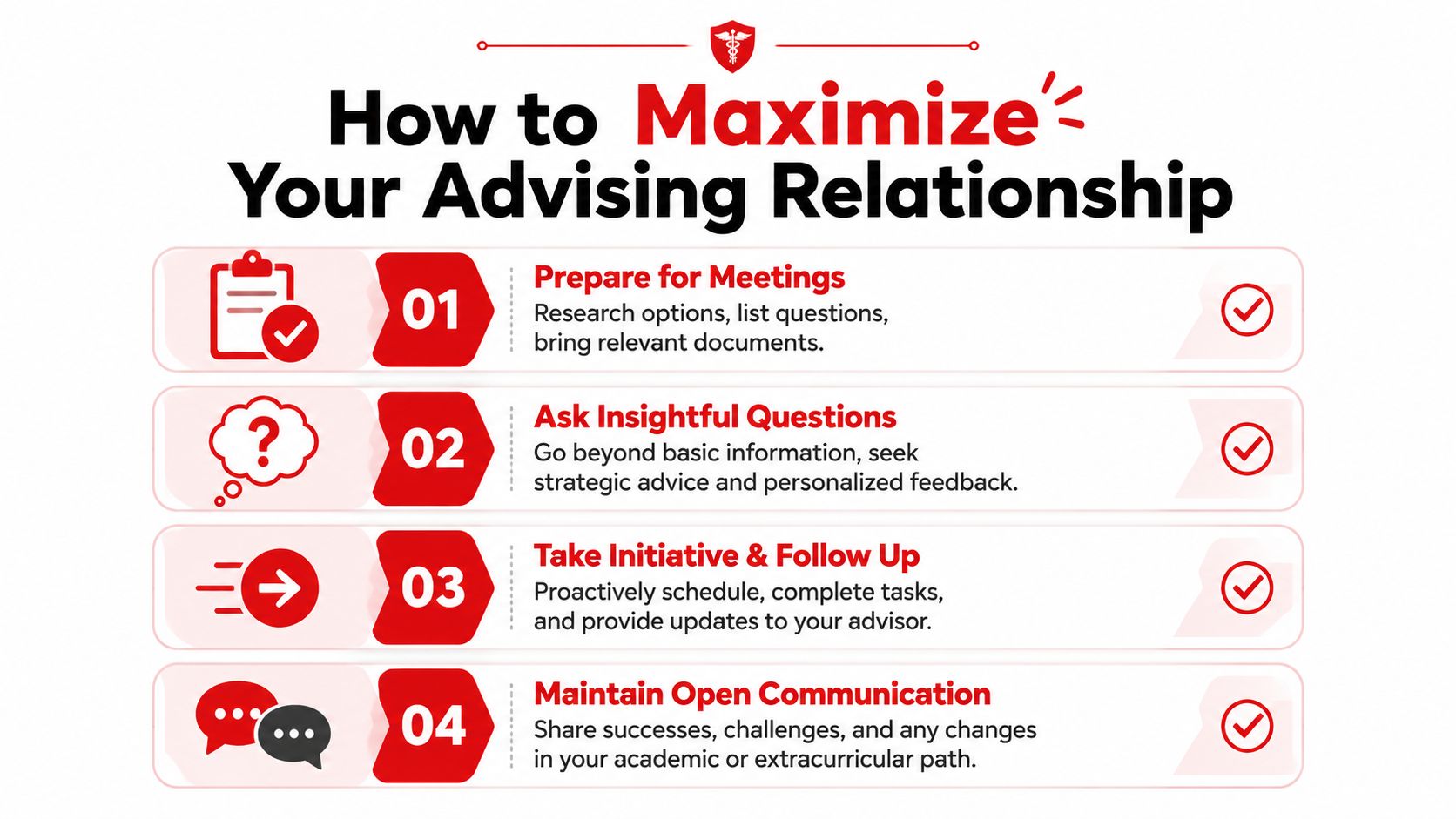
When students say an advising meeting “wasn't helpful,” the problem is often one of two things. Either the advisor gave shallow guidance, or the student arrived with broad questions and no usable context. You can control the second problem every time.
Before the meeting
Bring structure. Advising conversations get better when you make them concrete.
- Prepare a one-page snapshot: list your GPA, science GPA, completed courses, current semester, major, and expected timeline.
- Inventory your experiences: note clinical exposure, service, shadowing, research, leadership, and anything still in progress.
- Write focused questions: ask “What gap do you see in my current plan?” instead of “Do I look competitive?”
- Define your decision points: know whether you need help with course load, MCAT timing, letters, or whether to take a gap year.
During the meeting
Take the lead politely. If the conversation stays vague, narrow it.
Try questions like these:
- “What concerns would you have if I applied on my current timeline?”
- “Which part of my record needs the most attention right now?”
- “What should I finish before our next meeting so we can make a stronger decision?”
- “Do you think my activities show depth, or do they still look scattered?”
Ask for prioritization, not just information. Most students don't need more advice. They need help deciding what matters first.
After the meeting
The follow-through is where advising either compounds or evaporates.
- Send a short summary: confirm what you understood and what actions you'll take.
- Track recommendations: keep a simple document with advice received, deadlines, and your own observations.
- Notice patterns: if several mentors flag the same issue, treat it seriously.
- Reassess the fit: if an advisor consistently dismisses your questions or gives generic responses, keep the relationship professional but build support elsewhere.
Disagreement doesn't mean disrespect. If advice doesn't fit your situation, ask for the reasoning behind it. You might say, “I want to understand why you recommend delaying the MCAT,” or “Can you help me compare that option with applying after more clinical experience?” That keeps the conversation constructive.
Pre medical advising works best when you treat yourself as the manager of the process. The advisor brings perspective. You bring the data, the context, and the follow-through.
A Sample Pre Med Timeline From Freshman to Applicant
Students often want a perfect timeline. There isn't one. There is only a timeline that makes sense for your coursework, your obligations, and your readiness. The sample below works best as a planning template, not a rulebook.
One reason this helps is that it reduces false urgency. Not everything has to happen immediately. Some tasks matter early because they build foundations. Others matter later because they depend on that foundation being solid first.
Pre-Med year-by-year milestone checklist
| Year | Academic Focus | Extracurricular Goal | MCAT & Application Prep |
|---|---|---|---|
| Freshman | Learn how to study well in college science courses. Map prerequisites and protect your GPA. | Explore a few settings thoughtfully, such as service, a student organization, or early clinical exposure. | Start a simple tracking document for courses, activities, and reflections. |
| Sophomore | Continue core sciences and review whether your course load is sustainable. | Commit more deeply to one or two experiences rather than sampling everything. | Begin noticing which subjects may later require more MCAT review. |
| Junior | Finish key prerequisites and watch for burnout. | Take on responsibility in an activity you already care about. | Decide whether your timeline points to applying soon or after more preparation. Gather letter writers early. |
| Senior or gap year | Complete remaining coursework strongly and address weak areas honestly. | Deepen clinical, service, research, or work experience in a sustained way. | Finalize application materials, refine your personal narrative, and prepare for interviews. |
Freshman and sophomore years
Your first job is adjustment. Students get hurt early when they chase résumé lines before they've built academic stability. Learn how you study best, which professors and office hours help you, and whether your current semester structure is realistic.
By sophomore year, your choices should start narrowing. You're not trying to become the busiest person on campus. You're trying to become a student with a coherent record and dependable habits.
- Audit your schedule: if your grades slip when you overpack semesters, believe that evidence.
- Start a reflection file: after service, shadowing, or clinical shifts, jot down what you noticed and how it affected your thinking.
- Look for consistency: sustained service or clinical work usually gives you stronger insight than scattered short-term commitments.
Junior year and beyond
Junior year is when many students feel the pressure spike. This is often when MCAT timing, letters of recommendation, and application readiness start to become real decisions rather than abstract future plans.
If you're considering a gap year, don't treat it as a backup plan by default. For many students, it's the right move when they need more time to strengthen academics, deepen experiences, or prepare with less chaos.
Money also belongs in your planning, even before medical school starts. Thinking ahead about borrowing and long-term training costs can reduce panic later. These tips for physician debt are worth reading early, especially if finances affect how you're weighing gap years, work, or school choices.
If you're unsure which classes are commonly part of the path, this breakdown of pre-med courses can help you compare your academic plan against standard expectations.
A timeline should calm you down, not shame you. If your path takes longer, that may reflect maturity and planning, not weakness.
When University Advising Is Not Enough
Some students have excellent campus advisors and still need outside help. Others never had enough institutional support to begin with. Both situations are common.
The key point is this: advising can guide your choices, but it can't substitute for the factors admissions committees weigh most heavily. One study found that participation in pre-health advising activities such as workshops and appointments was not significantly associated with medical school acceptance. The stronger predictors were MCAT total score, undergraduate GPA, and PREview total score (research on advising and acceptance predictors).
That finding doesn't make advising useless. It sharpens its purpose. Advising helps you organize the path, catch mistakes early, and make better decisions. But if your grades are struggling, your test prep is unfocused, or your application materials are weak, encouragement alone won't solve those problems.
Signs you may need supplemental support
External help may make sense if:
- Your advising meetings stay generic: you leave with broad reassurance but no clear next steps.
- You need specialized feedback: especially for MCAT prep, school list strategy, essays, or interviews.
- Your campus office is overloaded: long wait times and short appointments can make careful planning difficult.
- You're making a high-stakes decision: such as whether to delay applying, retake the MCAT, or address a major weakness in your record.
Some students also want a second opinion because the process feels too important to handle through one channel. That's reasonable. The point isn't to replace your university advisor. It's to fill gaps thoughtfully.
If you're looking for specialized application support beyond what a campus office can provide, medical school admissions consulting is one example of the kind of supplemental resource students use when they need more individualized strategy.
Pre Medical Advising FAQs
Is it too late to become pre-med as a sophomore or junior?
Not necessarily. The more important question is whether you can build a realistic academic and experiential plan from where you are now. Start by mapping remaining prerequisites, checking your GPA trends, and identifying what you can pursue consistently. Late starts require more intention, not automatic abandonment.
How should I talk with an advisor about a low GPA or MCAT score?
Bring the numbers, but don't stop there. Show what happened, what changed, and what evidence suggests improvement is possible. A productive conversation includes your trends, study methods, current obligations, and specific questions such as whether your timeline still makes sense or what should be fixed first.
Be honest without being fatalistic. Advisors can help most when you present the problem clearly and stay open to hard feedback.
What if I disagree with my advisor's advice?
Ask for the reasoning behind it. Then compare that reasoning with your own goals, constraints, and performance history. If the disagreement involves something major, such as application timing or an MCAT retake, seek another informed opinion. You don't need to argue. You do need to understand why two people see the situation differently.
How many advising appointments should I have each year?
There's no universal number that fits everyone. A student making major decisions may need more frequent check-ins than someone on a stable path. What matters is rhythm and purpose. Meet when you have meaningful updates, questions, or decisions to make. Don't wait until a crisis if you already sense something is off.
What if my school barely offers pre medical advising?
Build your own advising team. Use faculty office hours, peer mentors, clinicians, research supervisors, and carefully chosen external resources. Keep records of your coursework, experiences, and questions so each conversation becomes more useful. Students at under-resourced schools often do best when they become highly organized self-advocates.
If you want more structured support for the high-stakes parts of the journey, Ace Med Boards offers help with MCAT preparation, admissions consulting, and exam-focused tutoring. For students who need more personalized guidance than their campus can provide, that kind of targeted support can make the process feel clearer, more manageable, and far less isolating.