You're doing a question block, moving fast, and then a stem stops you cold. A machine operator has cough, dyspnea, and exposure to a mixed chemical environment. Another answer choice mentions an OSHA ceiling limit. A third asks which worker is fit for duty, fit with restrictions, or temporarily unfit. You know the pieces, but they don't feel connected.
That's where occupational health becomes tricky on USMLE and COMLEX. It sits at the intersection of medicine, public health, toxicology, and regulation. If you study each piece in isolation, questions feel random. If you build one framework, they become much easier to decode.
An occupational health review is that framework. It helps you organize workplace exposures, understand how clinicians assess causation, and apply legal rules when a vignette adds regulatory detail. If you want a broader map of tested subjects, the USMLE content outline is a useful place to anchor where occupational medicine fits.
Introduction to Occupational Health Review
Occupational health questions often test whether you can connect a job task to a disease mechanism. That sounds simple until the stem adds timing, mixed exposures, privacy rules, or work clearance language.
The reason this topic matters is that workplace disease is common enough to show up across internal medicine, pulmonology, toxicology, ethics, and preventive medicine. A 2024 systematic review reported that the incidence of occupational disease ranges from 1.71 to 1,387 cases per 100,000 employees annually, and it also noted major underreporting of the true burden in official records, especially when workers fear job consequences (systematic review on global occupational disease reporting).
For board prep, think of an occupational health review as a clinical audit with a workplace lens. You're not only asking, “What disease does this patient have?” You're also asking:
- What exposure matters most
- Which part of the job caused it
- Whether the worker can safely keep working
- Whether a regulatory threshold changes management
That's why these questions reward stepwise thinking. First identify the hazard. Then link it to symptoms. Then decide what functional recommendation follows.
Understanding Core Occupational Health Concepts
Occupational medicine gets easier once you sort exposures into a few stable buckets. Most stems can be decoded by asking what the worker is exposed to, how that exposure enters the body, and what organ system is most likely to show injury first.
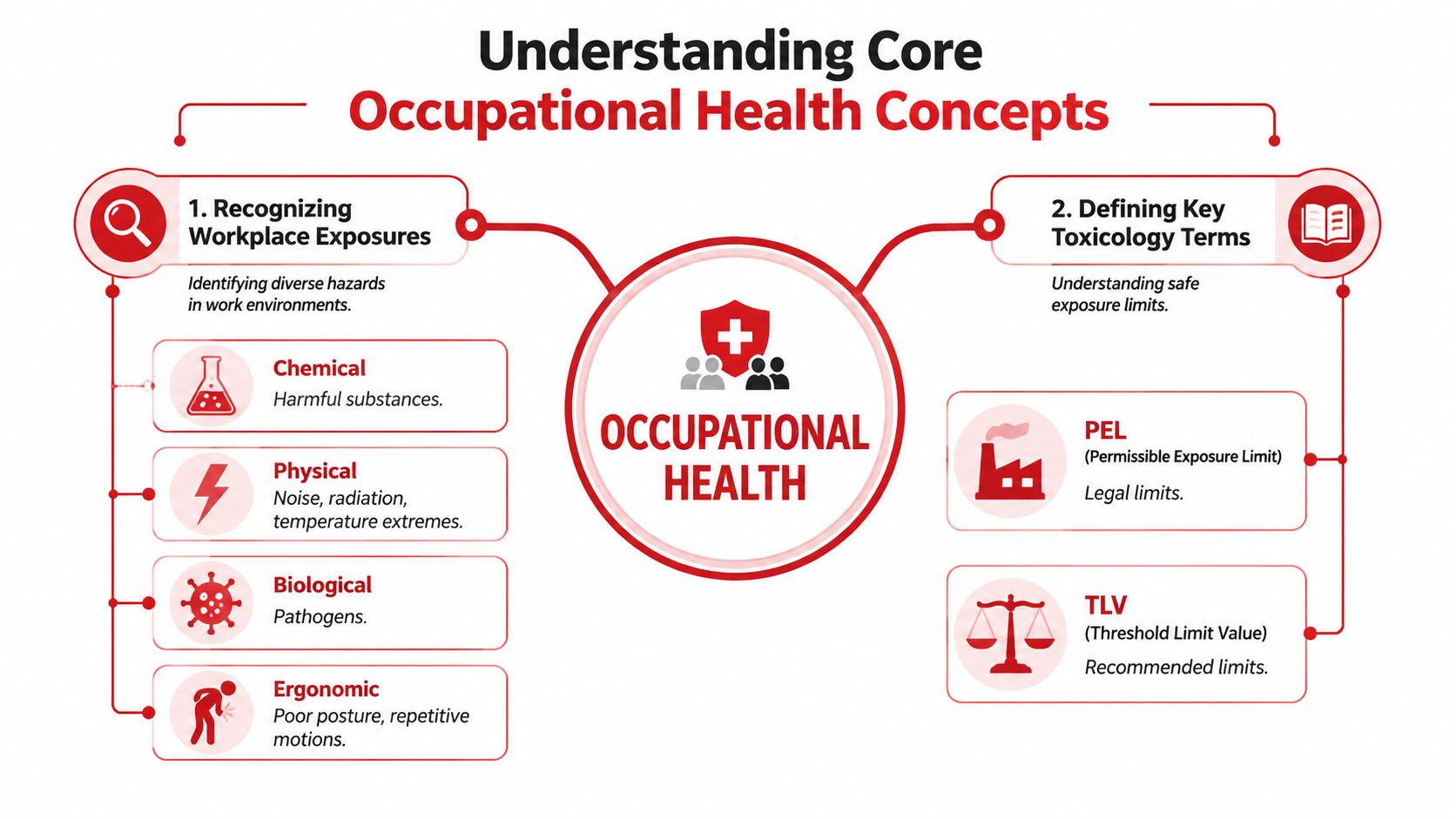
The four hazard families
Start with these four groups.
- Chemical hazards involve solvents, metals, dusts, fumes, vapors, and mixtures. These often show up in factory, lab, painting, or agricultural stems.
- Physical hazards include noise, heat, cold, radiation, and vibration.
- Biological hazards include pathogens in healthcare, lab, and agricultural settings. If you're reviewing infectious risk in worker exposures, this primer on infection control protocols helps connect workplace transmission to exam-style reasoning.
- Ergonomic hazards involve posture, repetition, force, lifting, and workstation design.
A quick shortcut helps. If the stem names a substance, think chemical. If it names an environment, think physical. If it names an organism, think biological. If it describes motion or position, think ergonomic.
Why respiratory disease shows up so often
When students miss occupational medicine questions, the problem is often route of exposure. Many exposures don't need ingestion or skin contact to cause disease. Inhalation alone can drive the presentation.
That matches the literature. A 2024 global review of 51 studies found that 27 studies, or 52%, focused on occupational-related respiratory issues, which highlights how dominant inhalation hazards are in workplace health research (global review of occupational health and safety literature).
Practical rule: If a worker has cough, wheeze, chest tightness, progressive dyspnea, or symptom flares during shifts, move inhalation exposure high on your differential early.
This is why exam writers love stems involving dust, smoke, aerosolized chemicals, confined spaces, and poorly ventilated work areas. Respiratory clues often matter more than the exact job title.
Exposure limit language that confuses people
Students often mix up recommendations and legal standards. Keep the broad distinction simple.
- PEL means Permissible Exposure Limit. On boards, this is the legal-style threshold you should recognize when OSHA language appears.
- TLV means Threshold Limit Value. Think of this as guidance language rather than the main legal answer when the question explicitly asks for OSHA regulation.
- Ceiling limit is the one people forget. It means the exposure must not be exceeded during a specified short interval.
A useful analogy is traffic control.
| Term | Easy analogy | Exam implication |
|---|---|---|
| PEL | Speed limit sign | Legal benchmark in workplace regulation questions |
| TLV | Recommended safe driving speed in bad weather | Helpful concept, but not usually the legal best answer |
| Ceiling limit | Red light | You cannot cross it, even briefly in the defined period |
When a stem emphasizes a short burst exposure or asks what level cannot be exceeded, that's your clue to think ceiling limit.
The clinical side of occupational history
A good occupational history is more detailed than “What do you do for work?” That question alone is too broad and often hides the mechanism.
Ask yourself these board-relevant follow-ups:
What tasks does the person perform
“Factory worker” is vague. “Mixes solvents in an enclosed area” is useful.When do symptoms occur
During shifts, after shifts, only on weekdays, or after years of exposure.What controls exist
Ventilation, respirators, gloves, isolation, or none.Who else is affected
Coworkers with similar symptoms strongly support a workplace source.What changes when the worker is away
Improvement on weekends or vacation can be a high-yield clue.
A practical legal explainer can also help you understand how workplace injury narratives are built outside the exam room. The overview of workers' compensation claims from Scher, Bassett & Hames is useful because it shows why details about tasks, timing, and causation matter so much.
Occupational medicine rewards specificity. “Warehouse employee with pain” is weak. “Warehouse employee lifting overhead boxes all shift and developing numbness after repetitive work” gives you something to reason from.
Navigating Occupational Health Laws and Regulations
Regulation questions feel intimidating because students assume they need to memorize a legal textbook. Usually, they don't. You need a small set of rules and the ability to apply them when the stem gives a concrete exposure.
The high-yield legal idea
For board purposes, focus on this pattern. If the stem involves multiple chemicals in the same family, combined exposure may matter more than each chemical alone. If the stem names a ceiling limit, even a brief exceedance matters.
The cleanest tested example from the source material involves thiols. OSHA requires chemical mixtures containing thiols to be assessed using the additive formula in 29 CFR 1910.1000(d)(2)(i), and benzenethiol has an OSHA ceiling limit of 0.5 mg/m3 (0.1 ppm) over any 15-minute period (CDC document summarizing OSHA exposure framework).
That gives you two exam hooks:
- Mixed related chemicals may require a combined calculation
- A named ceiling limit can override any temptation to “average out” a dangerous short exposure
Sample OSHA Permissible Exposure Limits
| Substance | Limit | Time Period |
|---|---|---|
| Benzenethiol | 0.5 mg/m3 (0.1 ppm) | 15-minute ceiling |
That's the only specific table entry you can safely memorize from the verified data here, and it's enough to train the concept.
How to reason through a regulation stem
Try this sequence:
First ask whether the stem names one substance or a mixture
If it's a mixture of relevant chemicals, think additive formula.Then ask whether the limit is an average or a ceiling
If the stem says the level must not be exceeded in a short interval, ceiling language controls.Finally ask what the question really wants
Sometimes it's not asking for diagnosis. It's asking whether the workplace is in compliance.
Students also forget that occupational safety law isn't limited to chemicals. Falls, ladders, machine guarding, and similar hazards can show up in preventive medicine style questions. If you want a concrete legal example outside toxicology, this overview of preventing ladder fall injuries gives a practical sense of how OSHA rules turn into real workplace violations. The same prevention mindset also overlaps with broader patient safety principles that boards test in hospital systems questions.
A mnemonic for agencies
Use O-N-E.
- O for OSHA. Occupational standards and enforceable limits.
- N for NIOSH. National research and recommendations.
- E for EPA. Environmental regulation context.
It's simplified, but it works under time pressure. If the stem asks for the enforceable workplace exposure framework, OSHA is usually the key player.
Clinical Vignettes in Occupational Health
Clinical vignettes are where everything finally clicks. The disease, the job, the timeline, and the clearance decision all have to line up.
Vignette one with progressive dyspnea
A factory worker develops gradually worsening cough and shortness of breath. Symptoms are worse near the end of shifts and somewhat better on days away from work.
The key move is to tie symptoms to an inhaled exposure, not just to “lung disease” in the abstract. Ask what materials the patient handles, whether dust or fumes are present, and what ventilation exists. For boards, the work history is part of the diagnosis.
Vignette two with hand weakness and sensory symptoms
A painter presents with fatigue, abdominal discomfort, and distal neuropathic complaints.
This stem tests pattern recognition. You still need the occupational history, but the exam may also be probing whether you remember that a job title can signal a toxic exposure. The best next step is usually a targeted exposure history plus confirmatory testing based on the suspected agent.
Don't let the job title answer the whole question for you. The boards still want mechanism, timing, and functional consequence.
Vignette three with repetitive strain
An office employee reports neck pain, wrist discomfort, and worsening symptoms after long stretches at a poorly arranged workstation.
This is classic ergonomic reasoning. There may be no dramatic toxin and no lab abnormality. The challenge is recognizing that occupational illness includes cumulative strain, not only poisonings and pneumoconioses.
Vignette four with solvent exposure in a lab
A lab technician develops headache, dizziness, and mucosal irritation after working with volatile compounds in a poorly ventilated area.
This kind of stem often asks for the next best action rather than the final diagnosis. Remove from exposure, assess the environment, and determine whether the worker can safely return.
The framework exam writers want
The occupational health review process follows the Deming cycle of Plan, Do, Check, Act, and the clinical outcome ends with a functional classification of fit for duty, fit with restrictions, or temporarily unfit (ILO guidance on occupational health review process).
That matters more than many students realize. Some stems are really asking, “Can this person safely perform the job right now?”
Use this quick frame:
| Step | What you do in a vignette |
|---|---|
| Plan | Define the health problem and likely workplace cause |
| Do | Gather history, exam findings, and exposure details |
| Check | Compare findings with job demands and safety risks |
| Act | Recommend fit, fit with restrictions, or temporarily unfit |
If you like learning through worked examples, case-based learning in medicine is a strong study method for this exact topic because it forces you to connect exposure, diagnosis, and job function in one pass.
Mastering Mnemonics for Occupational Health
Mnemonics work best when they compress a decision process, not when they become random word art. In occupational medicine, the good ones help you scan a stem quickly.
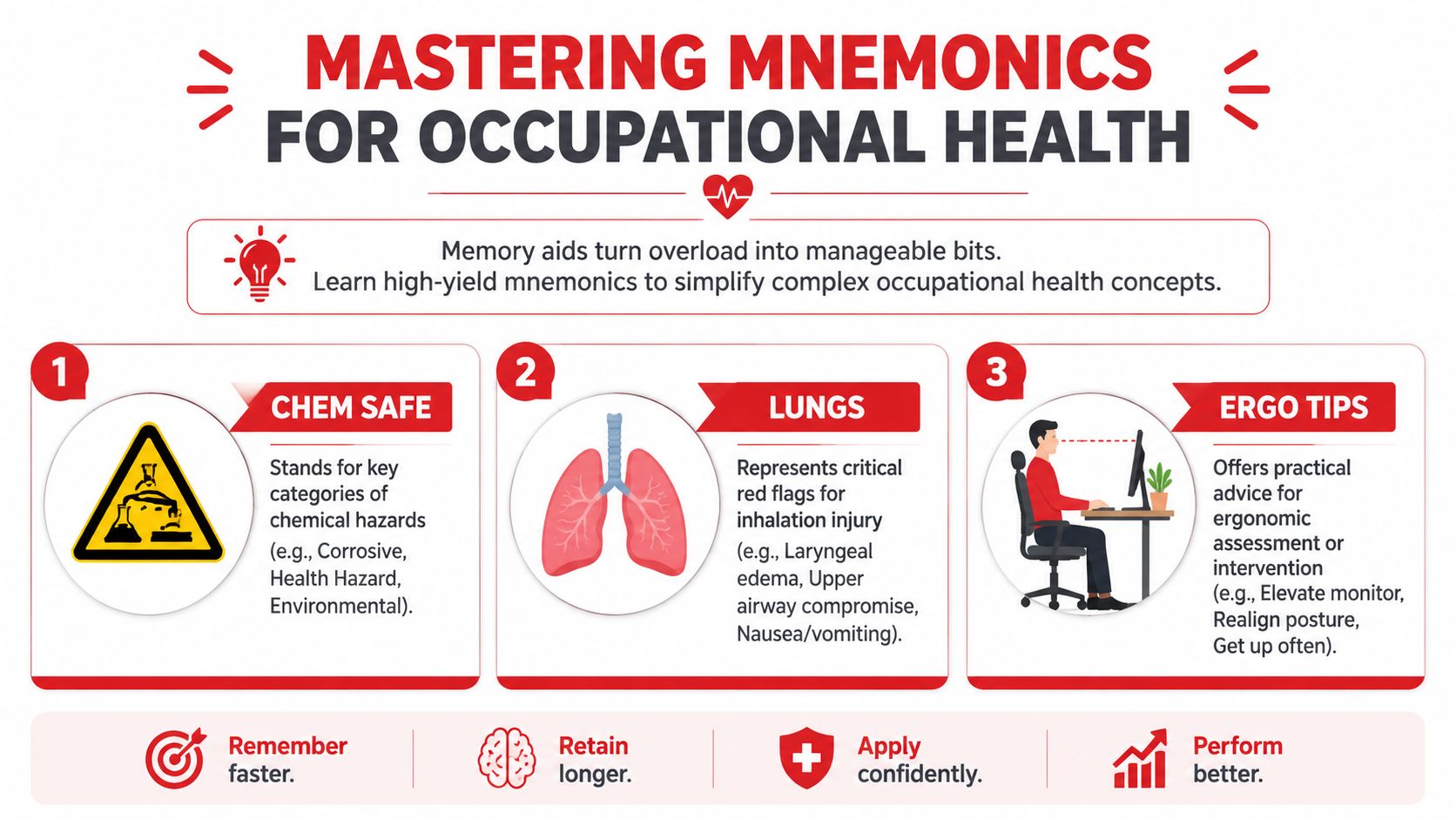
CHEM SAFE
Use CHEM SAFE for chemical exposure review.
- C for contact route
- H for history of task
- E for environment
- M for mixture possibility
- S for symptom timing
- A for acute versus chronic
- F for functional impact
- E for exposure controls
This one is helpful because it pushes you beyond naming the toxin. You're also asking how it entered the body, where the person worked, whether multiple chemicals were present, and whether the patient can still perform the job safely.
LUNGS
Use LUNGS when a stem points toward inhalation injury.
- L for location of exposure
- U for upper versus lower airway symptoms
- N for new work process or poor ventilation
- G for group effect in coworkers
- S for symptom improvement away from work
That last letter is especially useful. Improvement away from work is a powerful occupational clue.
A short video review can make these cues stick better than text alone:
ERGO TIPS
Use ERGO TIPS for workstation and repetitive strain stems.
- E raise the monitor
- R realign posture
- G get up often
- O organize the workspace
- T track repetitive tasks
- I identify force and awkward position
- P protect neutral joint alignment
- S shorten uninterrupted strain time
A good mnemonic should help you answer in under a minute. If it takes longer to remember the mnemonic than to solve the vignette, it isn't helping.
If recall under pressure is a weak point for you, these broader strategies for improving memory retention pair well with occupational health flashcards and mixed-vignette review.
Sample Questions and Answers
Question one
A worker is exposed to several thiol-containing chemicals during a shift. The stem asks how combined exposure should be assessed under OSHA.
Answer: Use the additive formula for mixtures under 29 CFR 1910.1000(d)(2)(i).
Why: The clue is that this is a mixture, not an isolated single-agent exposure. The question is testing regulatory application, not diagnosis.
Question two
A lab worker has a brief spike in benzenethiol exposure above the allowed threshold during a short sampling period. The stem asks what type of limit was exceeded.
Answer: A ceiling limit.
Why: Benzenethiol has an OSHA ceiling limit that must not be exceeded during the defined short interval. If you see “must not be exceeded,” think ceiling.
Question three
A nurse develops symptoms that reliably worsen during shifts and improve away from work. The exam asks which hazard category best fits the exposure risk.
Answer: Biological hazard is high on the list if the stem points to pathogen exposure.
Why: This is a categorization question. Identify the work setting first, then the likely exposure family.
Question four
A manufacturing employee with respiratory symptoms works around airborne contaminants. The vignette asks which organ system should move to the top of your occupational differential.
Answer: The respiratory system.
Why: In occupational medicine, inhalation matters a lot. When airborne exposure is central, pulmonary consequences often dominate your first-pass reasoning.
Question five
A worker is evaluated after a workplace-related illness. The clinician concludes the employee can return only if certain duties are modified. What is the correct functional category?
Answer: Fit with restrictions.
Why: Occupational assessment is about function, not just diagnosis. “Fit with restrictions” means the worker can return, but only with specific adjustments.
Question six
A stem asks which sequence best reflects the occupational health review cycle used in safety management.
Answer: Plan, Do, Check, Act.
Why: This is the Deming cycle. It shows up in systems, quality improvement, and occupational medicine questions.
Common traps
Confusing diagnosis with regulation
Some stems want the legal rule, not the disease.Ignoring task detail
“Works in construction” is less useful than the exact duty.Forgetting function
The endpoint may be work clearance rather than treatment.
Strategic Study Techniques for Exam Prep
Most students over-study rare toxins and under-study reasoning structure. That's backward. Occupational health review gets easier when you build a repeatable system.
Build your study around patterns
Use three folders or decks.
- Exposure deck for chemicals, physical hazards, biological risks, and ergonomics
- Regulation deck for terms like PEL, ceiling limit, and mixture rules
- Vignette deck for patient stories that force you to connect job task to disease
This approach works because the boards don't present facts in isolation. They wrap them inside cases.
Use real-world style signals to choose what to review
One important gap in existing guidance is the lack of practical teaching on how to use real-time exposure measurements and department-specific absenteeism trends to prioritize hazards during occupational reviews (ILO discussion of practical data integration gaps).
That idea is useful for exam prep too. In plain language, study what would create the strongest signal in a workplace.
For example:
- If a unit has repeated respiratory complaints, review inhalation hazards and airborne infection control.
- If a department has recurring strain-related absences, review ergonomics and functional work restrictions.
- If a case mentions changing tasks or a new process, review exposure history and hazard identification before memorizing obscure details.
A simple four-week approach
| Week | Main focus | Secondary focus |
|---|---|---|
| One | Hazard categories | Basic occupational history |
| Two | Toxicology and regulation | Short daily flashcards |
| Three | Clinical vignettes | Functional classification |
| Four | Mixed question sets | Error log review |
Study occupational medicine like a translator. Each stem starts in the language of work, then you convert it into the language of pathology, risk, and function.
If you do that consistently, this topic stops feeling niche and starts feeling predictable.
Conclusion and Next Steps
Occupational health review becomes manageable when you stop treating it as a pile of unrelated facts. The core moves are stable. Identify the hazard. Link it to the organ system. Clarify the job task. Decide whether a regulation changes the answer. Then finish with function, not just diagnosis.
Keep your review practical. Rehearse mixed vignettes, memorize a few high-yield legal rules, and use mnemonics only if they speed up recall. The students who score well on these questions usually aren't guessing better. They're organizing better.
If you want structured help turning topics like occupational health into board-ready pattern recognition, Ace Med Boards offers personalized tutoring for USMLE, COMLEX, Shelf exams, MCAT prep, and broader medical training milestones. Their one-on-one approach is especially useful if you learn best through case breakdowns, targeted feedback, and a study plan built around your weak spots.