
More than 90% of formal medical terminology comes from Latin and Greek, with one guide estimating approximately 60% from Latin and 30% from Ancient Greek (medical terminology origins). That history gives medical students a practical advantage: unfamiliar terms often become understandable when you recognize their prefix, root, and suffix instead of memorizing the entire word.
For USMLE, COMLEX-USA, and Shelf exam preparation, medical terms and terminology are therefore more than vocabulary. They're a decoding system. The method below shows how to break down complex terms, avoid look-alike traps, and convert terminology review into a short, repeatable part of your study plan.
Why Medical Terminology Matters for Board Exams
Medical language has a stable structure because its foundations reach back to ancient Greek medicine. The oldest written Western medical sources are the Hippocratic writings from the 5th and 4th centuries BC, and one source estimates that approximately 75% of present-day medical English can be traced to Greek associated with Hippocrates and the Alexandrian school (National Library of Medicine historical review). Roman and Renaissance scholarship preserved and expanded this vocabulary, leaving modern anatomy, pathology, pharmacology, and procedure terms with recurring linguistic patterns.
That pattern matters during board preparation. A learner who memorizes isolated definitions may recognize familiar words but struggle when a vignette introduces an unfamiliar condition. A learner who can identify -itis, -ectomy, hypo-, or cardi/o has another route to meaning. The term may not provide the complete diagnosis, but it can reveal the relevant organ, process, location, or procedure.
Decode before you memorize
Use this sequence when a term appears in a question stem:
- Find the suffix. It often identifies a condition, disease, test, or procedure.
- Locate the root or combining form. This usually identifies the body part or organ.
- Check the prefix. It may indicate location, timing, quantity, direction, or intensity.
- Rebuild the meaning. Translate the components into plain language.
- Confirm with the clinical context. Symptoms, laboratory findings, imaging, and anatomy determine whether your interpretation fits.
For example, cholecystectomy contains cholecyst, referring to the gallbladder, and -ectomy, meaning surgical removal. Hematochezia combines hemato-, blood, with a term referring to passage through the gastrointestinal tract. The word parts orient you, while the vignette determines the clinical significance.
Exam habit: Don't treat word-part analysis as a substitute for medicine. Use it to reduce the number of plausible interpretations before applying physiology, pathology, and clinical reasoning.
Terminology fluency also helps with distractors. Exam writers can place similar-looking terms near one another, such as dysphagia and dysphasia, or use a prefix that reverses the meaning of a familiar root. A quick morphological analysis can prevent a careless selection when the surrounding clinical details are demanding.
Terminology review should support, not replace, question practice and content review. When you audit performance using a medical board exam score review, separate missed questions caused by knowledge gaps from those caused by misreading a term. That distinction tells you whether to revisit a disease mechanism, build a root-word card, or practice reading more deliberately under time pressure.
The Building Blocks of Medical Language
A fully built medical term most often follows the order prefix + root + suffix. The prefix appears at the beginning, the root carries the central body-part meaning, and the suffix usually identifies a procedure, condition, disease, or descriptive state (NCBI medical terminology guide).
Start at the end. The suffix-first rule gives you the grammatical action before you interpret the anatomy.
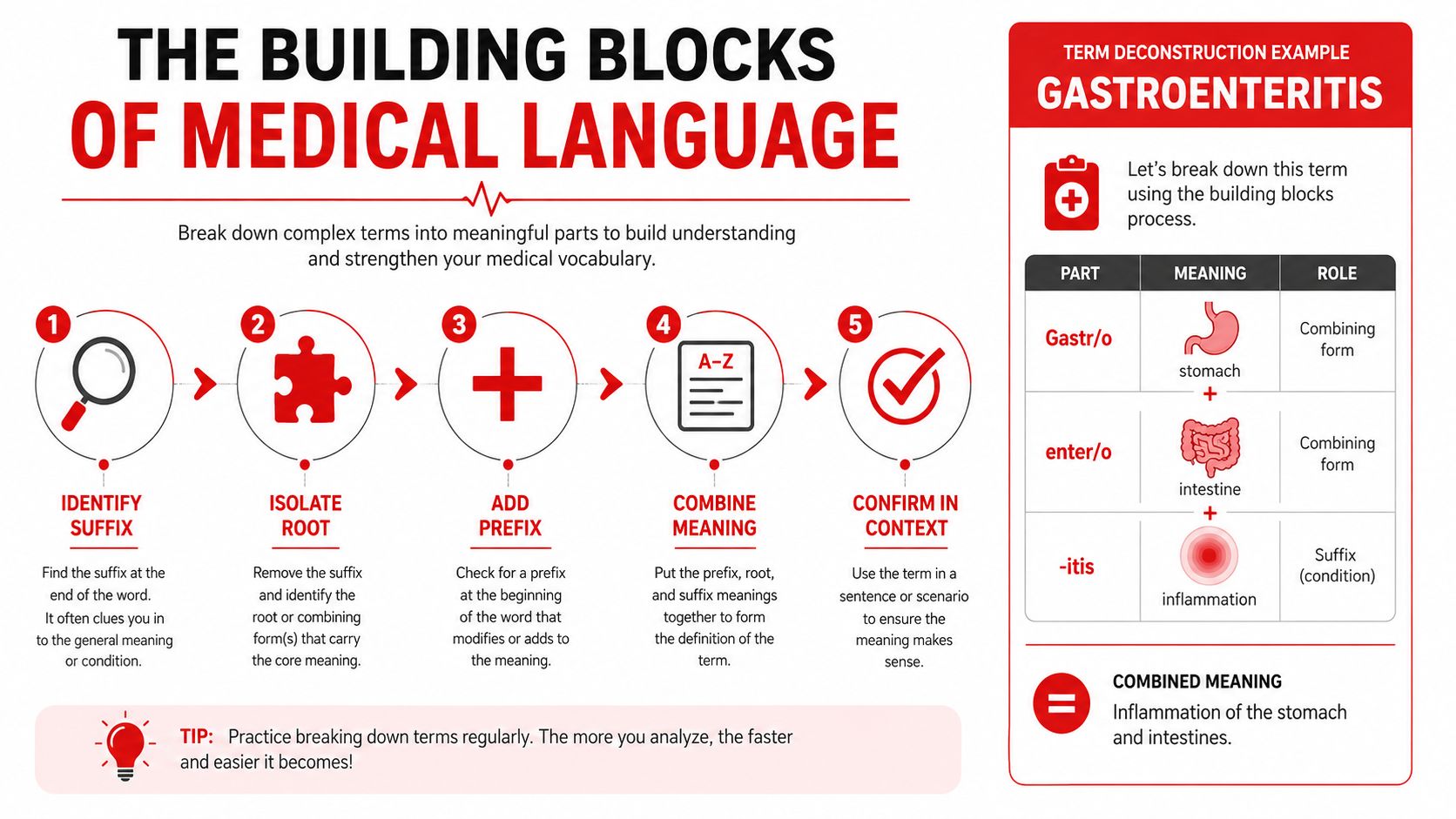
A five-step decoding process
- Identify the suffix. In gastroenteritis, -itis means inflammation.
- Isolate each root. Gastr/o refers to the stomach, and enter/o refers to the intestine.
- Add any prefix. This term has no prefix.
- Combine the meanings. The result is inflammation involving the stomach and intestine.
- Confirm the context. The patient's symptoms and findings must support that interpretation.
Combining vowels make pronunciation possible and connect word parts. The letter o is the most common combining vowel (Guide to Common Medical Terminology). Keep the vowel when joining two roots, as in gastr/o plus enter/o. Keep it when a suffix begins with a consonant, but usually drop it before a suffix beginning with a vowel (medical terminology combining-vowel rules).
Consider three additional examples:
| Term | Parts | Plain-language meaning |
|---|---|---|
| Subhepatic | sub- + hepat + -ic | Relating to below the liver |
| Nephrolithiasis | nephr/o + lith + -iasis | Condition involving kidney stones |
| Gastroenteritis | gastr/o + enter/o + -itis | Inflammation of the stomach and intestine |
Prefixes don't take a combining vowel. In subhepatic, sub- attaches directly to the root associated with the liver. You'll also encounter terms that don't follow a perfectly transparent pattern, including eponyms and abbreviations. Decode what you can, then use anatomy and context rather than forcing every word into a formula.
A short daily drill paired with active recall practice works better than passive rereading. Cover the definition, identify the suffix, name the root, and explain the complete term aloud.
High-Yield Roots Prefixes and Suffixes Reference
The most useful components are the ones that recur across systems. Learn the meaning first, then attach it to a clinical example. Pronunciation varies by instructor and region, so prioritize accurate recognition and spelling over an accent-specific pronunciation.
| Component | Type | Meaning | Clinical Example | System |
|---|---|---|---|---|
| cardi/o | Root | Heart | Cardiology, study of the heart | Cardiovascular |
| angi/o | Root | Vessel | Angiography, imaging of vessels | Cardiovascular |
| -stenosis | Suffix | Narrowing | Aortic stenosis | Cardiovascular |
| pneum/o | Root | Lung or air | Pneumonia, a lung infection | Respiratory |
| bronch/o | Root | Airway or bronchus | Bronchoscopy | Respiratory |
| -pnea | Suffix | Breathing | Apnea, absence of breathing | Respiratory |
| gastr/o | Root | Stomach | Gastritis | Gastrointestinal |
| enter/o | Root | Intestine | Enteritis | Gastrointestinal |
| hepat/o | Root | Liver | Hepatitis | Gastrointestinal |
| neur/o | Root | Nerve | Neuropathy | Neurological |
| encephal/o | Root | Brain | Encephalitis | Neurological |
| -paresis | Suffix | Weakness or partial paralysis | Hemiparesis | Neurological |
| oste/o | Root | Bone | Osteomyelitis | Musculoskeletal |
| arthr/o | Root | Joint | Arthritis | Musculoskeletal |
| my/o | Root | Muscle | Myopathy | Musculoskeletal |
| nephr/o | Root | Kidney | Nephritis | Genitourinary |
| cyst/o | Root | Bladder or sac | Cystoscopy | Genitourinary |
| -uria | Suffix | Urine or a urinary condition | Hematuria | Genitourinary |
| hyper- | Prefix | Excessive or above normal | Hyperglycemia | General |
| hypo- | Prefix | Deficient or below normal | Hypoglycemia | General |
| tachy- | Prefix | Fast | Tachycardia | General |
| brady- | Prefix | Slow | Bradycardia | General |
| endo- | Prefix | Within or inner | Endocardium | General |
| exo- | Prefix | Outside or outward | Exocrine | General |
| -itis | Suffix | Inflammation | Appendicitis | General |
| -ectomy | Suffix | Surgical removal | Appendectomy | General |
| -logy | Suffix | Study of | Neurology | General |
| -algia | Suffix | Pain | Neuralgia | General |
A frequent error involves reversing hyper- and hypo-. Put them on the same flashcard and force yourself to retrieve both meanings. The same paired approach works for tachy- and brady-, and for endo- and exo-.
Another misconception is that every term ending in -itis names an infection. The suffix indicates inflammation, not its cause. Inflammation may arise through infectious, autoimmune, traumatic, or other mechanisms, so the vignette still matters.
Build a searchable deck or a paper reference sheet with four fields: component, meaning, example, and a near-miss. For instance, pair nephr/o with cyst/o to distinguish kidney-related language from bladder-related language. A medical flashcard system becomes more useful when each card asks you to produce the meaning rather than just recognize it.
Dangerous Look-Alike Terms and Abbreviations
Similar terms often differ by one root, but that small difference can change the clinical meaning completely. Dysphagia concerns difficulty swallowing, while dysphasia concerns impaired language. The shared dys- suggests abnormal function, but -phagia relates to eating or swallowing and -phasia relates to speech or language.
Use the clinical domain as a second check. A patient who coughs during meals and cannot transfer food safely points toward dysphagia. A patient with impaired naming or comprehension points toward dysphasia. Don't select based on visual familiarity alone.
| Term or Abbreviation | Common Confusion | Distinguishing Feature | Board-Safe Alternative |
|---|---|---|---|
| Dysphagia | Dysphasia | Swallowing difficulty versus language impairment | Expand the term in your notes |
| Hypopnea | Hypoxia | Reduced breathing versus reduced tissue oxygenation | State “reduced ventilation” or “low oxygenation” |
| Ileus | Ileitis | Functional bowel-motility problem versus inflammation of the ileum | Identify motility versus inflammation |
| U | Zero or other symbols | Unclear handwritten or typed dose abbreviation | Write “unit” |
| MS | Morphine sulfate or magnesium sulfate | Same abbreviation can represent different medications | Write the complete medication name |
| Trailing zero | Tenfold dose error | A decimal expression may be misread | Avoid unnecessary trailing zeros |
| .5 | 5 | Missing leading zero can cause misreading | Write 0.5 |
The Joint Commission's prohibited-abbreviation guidance exists because ambiguous notation can be misread during medication use and documentation. For exam questions, the same principle applies: expand the abbreviation mentally, ask whether more than one meaning is possible, and match the result to the vignette.
Pause before committing: Expand the abbreviation, identify the root, check the clinical setting, and then compare the interpretation with the answer choices.
Other pairs deserve deliberate practice. Hypopnea means diminished breathing, while hypoxia refers to inadequate oxygen at the tissue level. Ileus describes impaired intestinal movement, while ileitis means inflammation of the ileum. The suffix or root tells you what kind of process the question is describing.
Patients can also misinterpret ordinary clinical language. In a 2022 cross-sectional study, 79% interpreted “impressive” imaging as good news, 67% correctly understood “positive lymph nodes” as bad news, and just 2% correctly interpreted “occult infection” (University of Minnesota summary of the study). For board preparation, translate jargon into plain language first, then return to the formal term. For clinical documentation, use approved, unambiguous language rather than study shorthand. A focused review of CV meaning in medical terminology can reinforce this distinction.
Memory Techniques and Mnemonics That Work
Terminology becomes durable when you retrieve the word parts in context. Rereading a list may feel familiar, but an exam asks you to generate meaning while processing a clinical vignette. Your study method should rehearse that exact task.
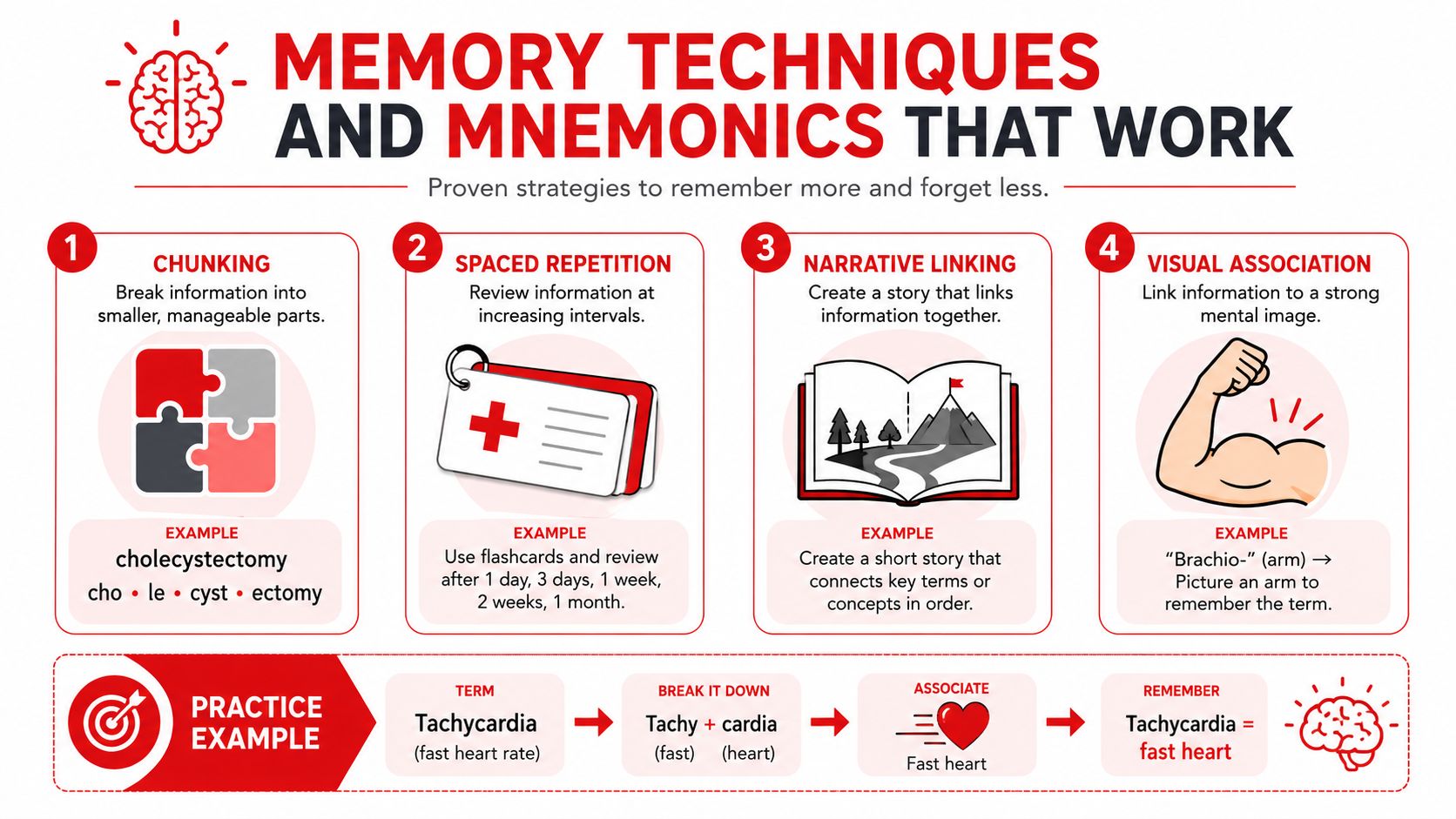
Use four complementary encoding methods
- Chunking: Divide cholecystectomy into recognizable units, such as chole, cyst, and -ectomy. Retrieve the meaning of each part before stating the whole definition.
- Spaced repetition: Review a new component, then revisit it at expanding intervals such as 1, 3, 7, and 14 days. The schedule is a practical study structure, not a guaranteed formula.
- Narrative linking: Connect several roots in a short original clinical story. A liver term, a blood term, and an inflammation suffix become easier to retrieve when they belong to one coherent scene.
- Visual association: Link brachio- with an arm image, nephr/o with a kidney-bean shape, or tachycardia with a fast-moving heart.
Opposite pairs deserve special treatment because they're easy to reverse under pressure. Place hyper- and hypo-, tachy- and brady-, or endo- and exo- on the same card. The front can show one component, while the back asks for its meaning, opposite, and a clinical example.
A useful flashcard template has three prompts:
- What does the component mean?
- What term uses it?
- What nearby component could be confused with it?
For -pnea, the answer might include breathing, apnea, and the distinction from -oxia. That last prompt turns a vocabulary card into a discrimination exercise.
Memory improves when the card makes you choose between meanings, not when it merely displays a definition.
Use a spaced-repetition workflow alongside question review. When you miss a term in a practice question, create a card from the error, include the sentence context, and write the explanation in plain language. Don't add every unfamiliar word to your deck. Prioritize recurring components and terms that caused an actual interpretation mistake.
From Exam Prep to Clinical Documentation
The roots that decode a board-style vignette also support precise clinical communication. In an electronic health record, recognizing a term is only the first step. Documentation must express a clinical concept that another professional and the terminology system can interpret consistently.
SNOMED CT records clinical concepts such as problems, diagnoses, and findings. LOINC supports observations and measurements, while ICD systems serve classification and reporting functions. Local expressions can be mapped to these standards so the intended meaning remains consistent across systems, a principle described in this clinical terminology standards overview.
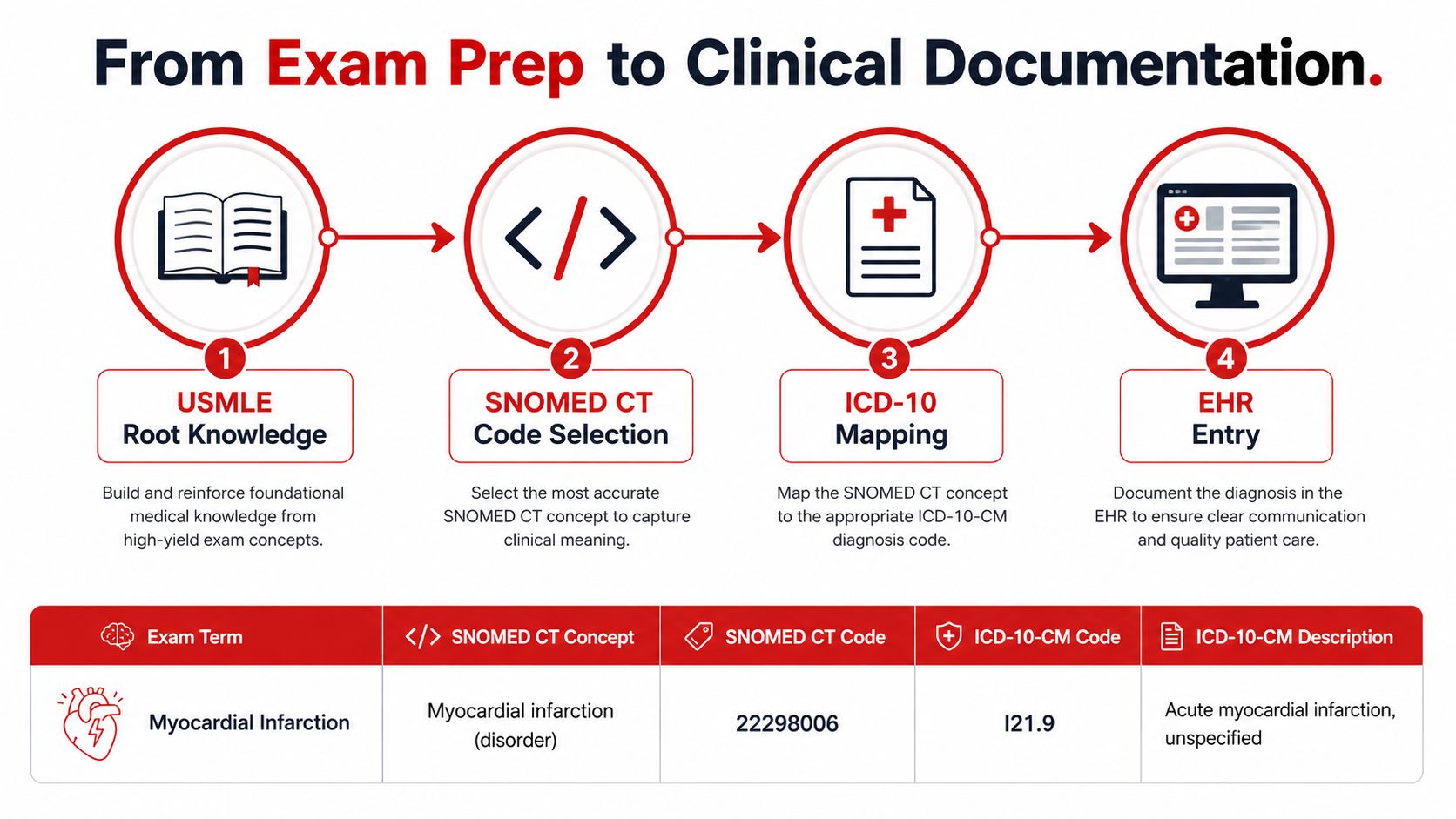
SNOMED CT and ICD-11 serve different purposes, so mapping one to the other requires more than translating labels. Alignment methods combine ontology modeling with rule-based queries (SNOMED CT and ICD-11 alignment research). For exam purposes, separate the clinical idea from the coding category. A vignette may ask you to identify a finding, whereas a classification system may require a more specific diagnosis or reporting category.
In the U.S. interoperability setting, SNOMED CT is used for clinical concepts, and the SNOMED CT U.S. Edition includes more than 126,000 source concepts mapped to ICD-10-CM. For U.S. coding, consult the FY 2026 ICD-10-CM Official Guidelines for Coding and Reporting, issued jointly by the Centers for Medicare & Medicaid Services and the National Center for Health Statistics (FY 2026 ICD-10-CM guidelines).
Documentation self-audit
- Specify anatomy: Name the affected organ and laterality when clinically relevant.
- State the condition clearly: Separate a symptom, finding, diagnosis, and procedure.
- Clarify timing: Use acute or chronic only when the clinical record supports it.
- Avoid unsafe shorthand: Write the complete medication, dose unit, and instruction.
- Check semantic fit: Confirm that the documented concept matches the organization's terminology standard.
Classroom shorthand also differs from approved clinical documentation. A personal note might use “MI” to save space, while a formal record may require the complete diagnosis and supporting detail. Terminology knowledge helps you decode shorthand. Documentation standards determine what belongs in the record.
Your Terminology Study Framework
Keep terminology review short, frequent, and connected to questions. The schedule below fits around broader USMLE, COMLEX-USA, or Shelf preparation rather than competing with pathology, physiology, pharmacology, and clinical reasoning.
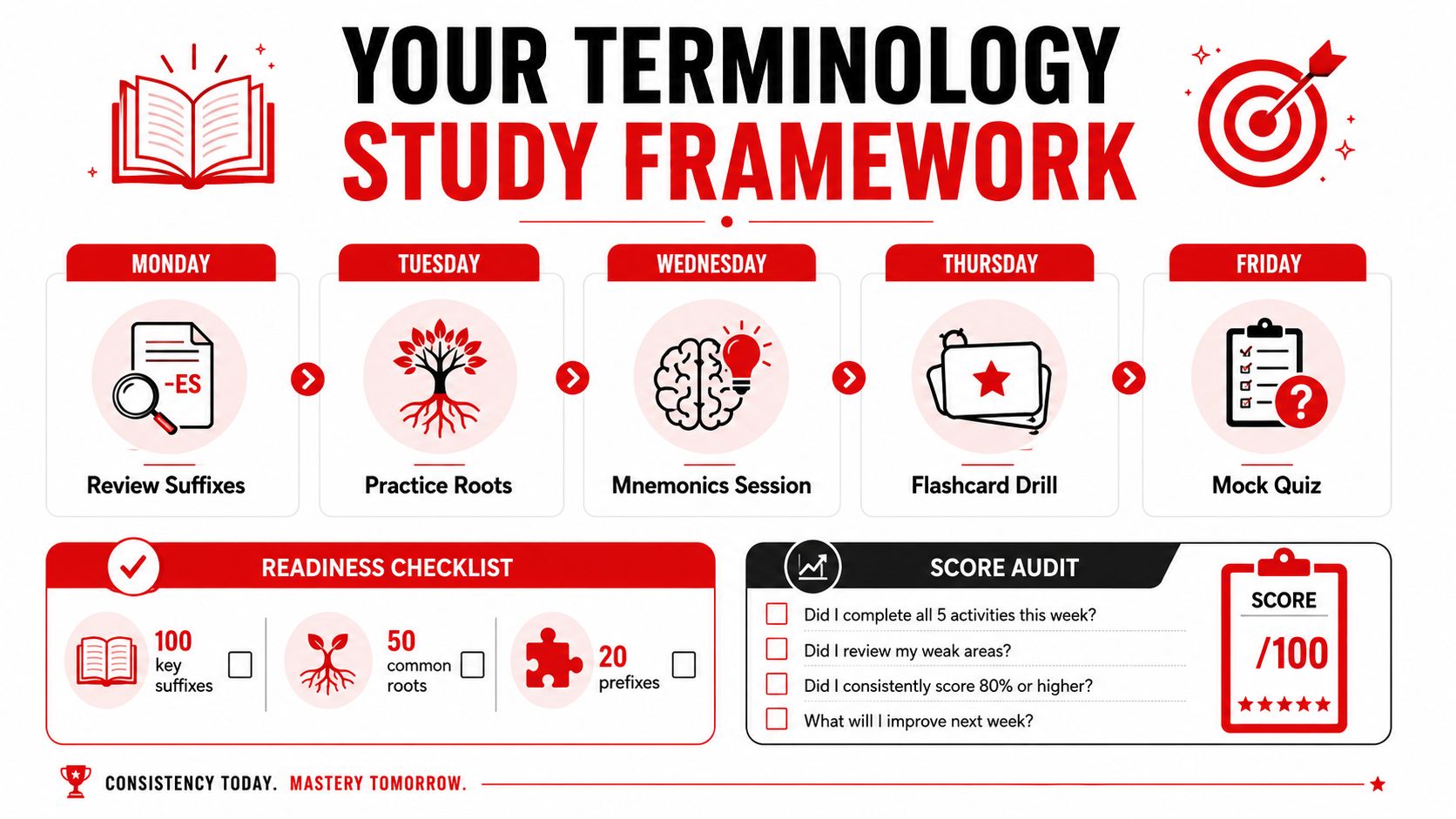
| Study day | Terminology task | Output |
|---|---|---|
| Monday | Review suffixes | Define each suffix and give a clinical example |
| Tuesday | Practice roots | Group roots by organ system |
| Wednesday | Use mnemonics | Create one visual or narrative association |
| Thursday | Complete flashcard drills | Retrieve meaning without seeing the answer |
| Friday | Take a short original quiz | Record errors by component type |
Use a card format that tests transfer:
- Front: “A term ends in -ectomy. What kind of process does the suffix suggest?”
- Back: “Surgical removal. Identify the organ from the root and confirm the meaning in context.”
For an original practice item, consider this example: a vignette describes a patient with difficulty swallowing, but the answer choices include dysphasia. The correct approach isn't to memorize the pair as a visual pattern. Identify -phagia as swallowing-related, compare it with -phasia as language-related, and then match the word to the symptom described.
At the end of each week, audit three categories:
- Recognition errors: You've seen the component but can't define it.
- Direction errors: You reversed a pair such as hyper- and hypo-.
- Context errors: You decoded the term correctly but misapplied it to the vignette.
A readiness checklist can include 100 key suffixes, 50 common roots, and 20 prefixes, as a structured target rather than a claim about exam requirements. Add terms from missed questions, and stop adding cards when the deck begins to crowd out essential disease mechanisms. A personalized study plan should protect sleep, question review, and recovery time instead of turning terminology into a marathon memorization block.
Frequently Asked Questions
Do I need to know Latin or Greek?
No. You need to recognize recurring components and use them accurately. Medical terminology is a structured language, not a test of classical-language fluency.
How long does functional terminology knowledge take?
It depends on your baseline and exam schedule. Start with common suffixes, roots, and opposing prefixes, then reinforce them through questions rather than waiting to memorize an entire dictionary.
Can terminology mastery improve my board score?
It can help you interpret stems and answer choices, but it can't replace content knowledge or clinical reasoning. Treat terminology as a tool that reduces avoidable reading errors.
What should I do with a completely unfamiliar term?
Read the suffix first, identify recognizable roots or prefixes, translate the word into plain language, and test that interpretation against the vignette. If the word is an eponym or acronym, rely more heavily on context and targeted memorization.
Should I use medical abbreviations in my notes?
Use whatever shorthand supports private studying, but distinguish it from approved clinical documentation. Ambiguous abbreviations can create confusion, so formal records require precise language and current institutional standards.
Ace Med Boards offers diagnostic tutoring and personalized study-plan support for students preparing for medical board and related medical-school examinations. If terminology errors are appearing in your question review, visit Ace Med Boards to explore a focused plan that connects root-word decoding with broader exam preparation.