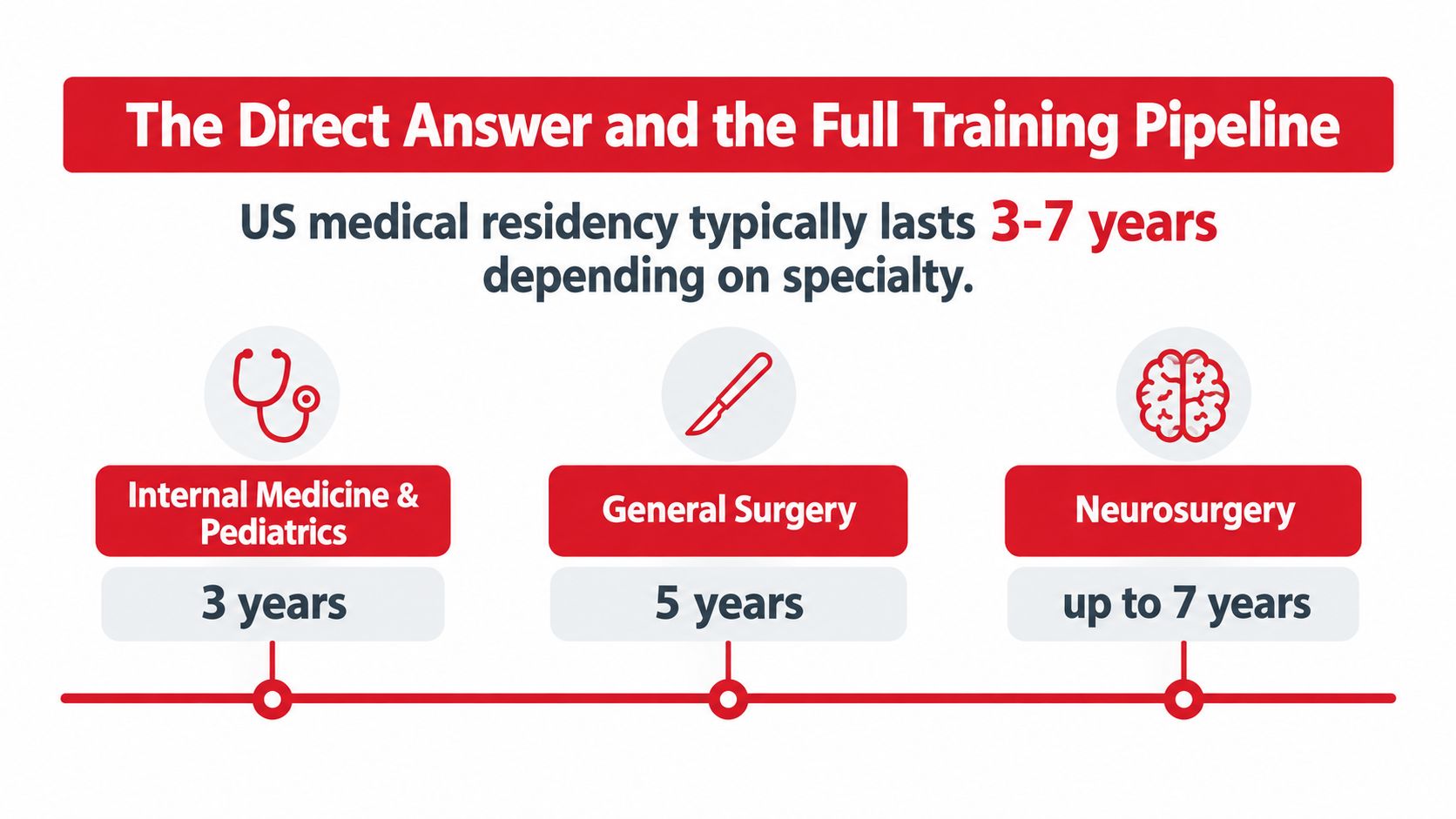
US medical residency typically lasts 3 to 7 years, depending on the specialty. Internal medicine and pediatrics commonly take 3 years, general surgery usually takes 5 years, and neurosurgery can last up to 7 years.
The counterintuitive part is that residency is neither the beginning nor the end of physician training. It's the supervised bridge between medical school and independent practice, and the length you should plan for depends on your specialty, training system, application route, and whether you pursue fellowship afterward. The Cleveland Clinic's overview of medical residency describes this specialty-based structure clearly.
The Direct Answer and the Full Training Pipeline
A U.S. applicant's path usually begins with premedical education, followed by medical school, licensing milestones, residency, and possibly fellowship. Undergraduate study commonly takes about four years, while medical school is generally structured as a four-year program. The exact route can differ for career changers, nontraditional applicants, and students who need additional prerequisite coursework.
During medical school, students move from foundational science into clinical rotations. Licensing exams, including the United States Medical Licensing Examination (USMLE) sequence for many medical students, become important checkpoints. Osteopathic medical students may also take the Osteopathic Medical Licensing Examination of the United States (COMLEX-USA). The exam sequence and timing should be confirmed through the responsible organizations and the applicant's school.
A pipeline, not one clock
After medical school graduation, applicants typically enter the residency application process through the Electronic Residency Application Service (ERAS) and the National Resident Matching Program (NRMP), subject to current eligibility rules and program requirements. Match Week and the Supplemental Offer and Acceptance Program (SOAP) are application milestones, not training years.
Residency then provides supervised clinical responsibility. Some physicians enter practice after residency, while others add an optional fellowship for subspecialization. The full explanation of how residency works can help applicants distinguish training, licensing, and career stages.
A realistic planning map looks like this:
| Stage | What it does |
|---|---|
| Premedical education | Builds academic preparation and completes prerequisites |
| Medical school | Develops scientific knowledge and clinical skills |
| Licensing exams | Measures readiness at defined points in training |
| Residency | Provides specialty training under supervision |
| Fellowship | Adds optional subspecialty training |
| Board certification and licensure | Supports practice within applicable rules |
| Independent practice | Marks the transition to an attending role |
The timeline can change because of research, leave, additional degrees, specialty changes, or reapplication. A longer path isn't automatically a weaker one. It may reflect a deliberate academic decision or circumstances that required flexibility.
Residency Terms Every Applicant Should Know
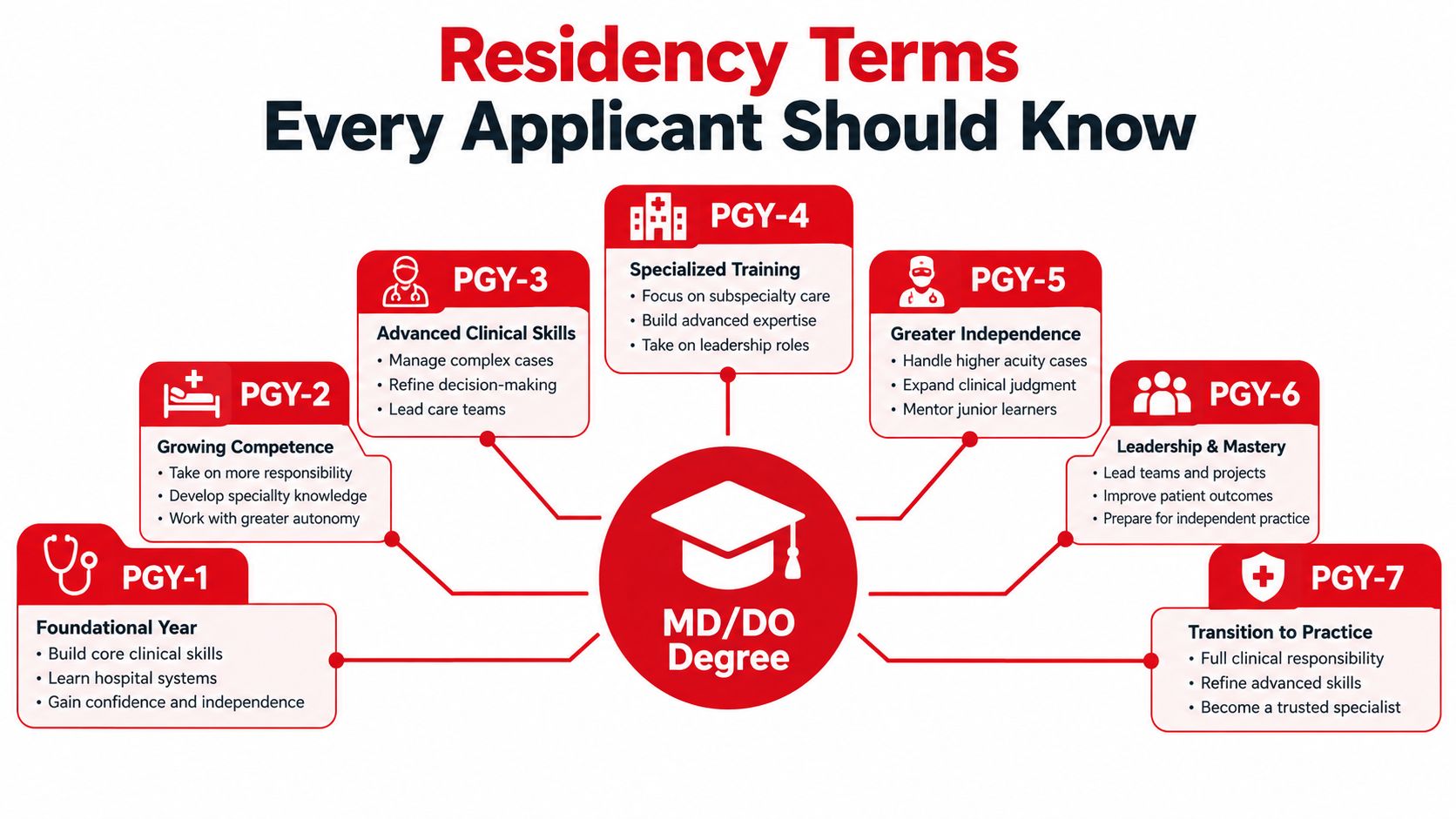
Residency conversations become confusing when applicants treat every training position as interchangeable. The first distinction is the postgraduate year, or PGY, designation. PGY-1 is the first year after medical school, and later numbers identify subsequent years of postgraduate training. A program can use terms such as intern, junior resident, senior resident, and chief resident, but titles vary by specialty and institution.
A categorical position generally includes the complete training sequence for a specialty. A resident who enters a categorical internal medicine program expects to progress through the program's required years, assuming satisfactory advancement and compliance with institutional policies. A preliminary position usually provides an initial period of broad training before the applicant enters an advanced position, re-applies, or transitions to a categorical slot.
A transitional year is a broad first postgraduate year that may precede advanced training in another specialty. It isn't the same as completing a full categorical residency. Applicants should read each program's structure carefully because an advanced position may require a separate intern year.
A concrete PGY example
Consider a hypothetical applicant who enters a three-year categorical internal medicine residency. That physician begins at PGY-1, commonly called the intern year, then advances to PGY-2 and PGY-3. Completion of the program doesn't mean every internal medicine resident follows the same career path. Some enter general internal medicine practice, while others apply for fellowship.
Combined programs join related fields into one planned pathway. Internal medicine-pediatrics, often called med-peds, is one example. Psychiatry-neurology is another combined option. These programs aren't merely a shortcut. They require applicants to compare the clinical work, curriculum, eligibility rules, and total training commitment.
For a focused explanation of the first postgraduate year, review what PGY-1 means in residency. The label tells you where someone is in training, but it doesn't by itself establish the program's total duration.
How Long Residency Is by Specialty
The specialty determines the baseline answer to “medical residency how long.” The American Medical Association's specialty guidance gives examples such as 4 years for anesthesiology and 5 years for general surgery, reinforcing that applicants should research the exact field rather than rely on a generic average.
The table below organizes commonly cited specialty structures for quick planning. Applicants should verify each program's current requirements through the Accreditation Council for Graduate Medical Education (ACGME) and the individual specialty organization before building an application timeline.
| Specialty | Years | Notes |
|---|---|---|
| Internal medicine | 3 | Common categorical duration |
| Pediatrics | 3 | Common categorical duration |
| Family medicine | 3 | Common categorical duration |
| Emergency medicine | 3 | Standard programs may vary by structure |
| Psychiatry | 3 | The specialty duration should be checked against current program information |
| Obstetrics and gynecology | 4 | Specialty residency |
| Pathology | 4 | Program structure can differ by pathway |
| Anesthesiology | 4 | Includes the required preliminary or clinical base structure |
| Dermatology | 4 | Often follows an initial intern year structure |
| Neurology | 4 | Confirm the required first-year arrangement |
| Physical medicine and rehabilitation | 4 | Usually includes prerequisite clinical training |
| Diagnostic radiology | 4 | Commonly follows an intern year |
| Ophthalmology | 4 | Uses an early match and separate intern-year structure |
| Orthopedic surgery | 4 | Confirm the current program format |
| Otolaryngology | 4 | Specialty-specific structure |
| General surgery | 5 | Standard categorical duration |
| Integrated vascular surgery | 5 | Integrated pathway |
| Urology | 5 | Uses an early match and separate intern-year structure |
| Integrated plastic surgery | 5 | Integrated pathway |
| Neurosurgery | 6 to 7 | Can last up to 7 years |
| Integrated thoracic surgery | 6 to 7 | Confirm the program's exact structure |
| Integrated interventional radiology | 6 | Integrated pathway |
The table is a planning aid, not a substitute for an official program review. Some fields include a separate preliminary year, while others incorporate that training into an integrated structure. That distinction affects how an applicant counts years after graduation.
Applicants comparing demanding specialties may also benefit from educational resources on managing exam-related distress, including how cognitive behavioral therapy can help with anxiety and obsessive-compulsive disorder. That resource addresses a different topic, but it may be useful for readers who recognize that anxiety is affecting preparation or decision-making. For a closer look at one surgical pathway, see urology residency length.
Variations That Add or Remove Time
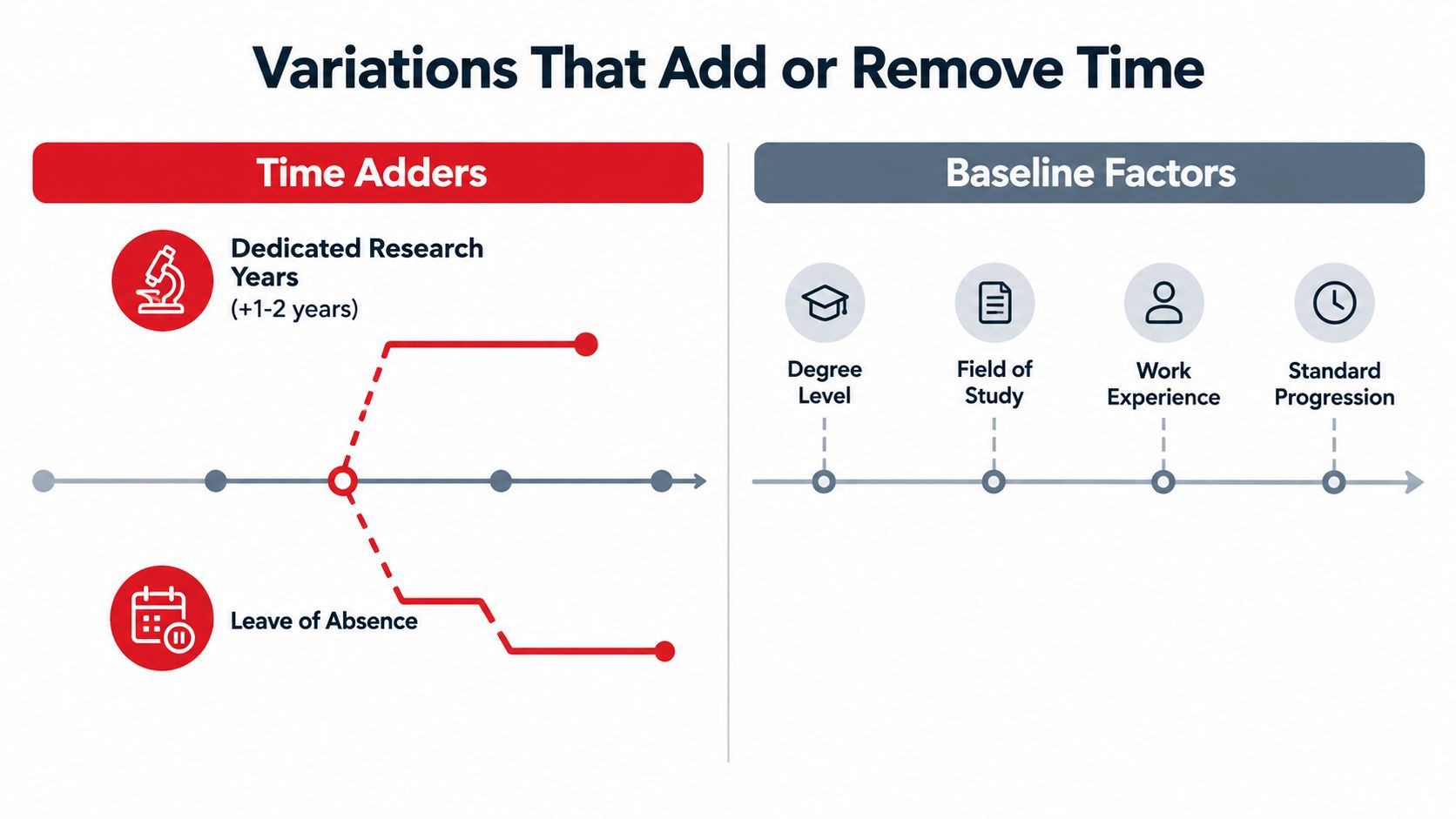
The standard specialty duration is a starting point, not a guarantee of the calendar date when a physician finishes training. Programs may approve a leave of absence, require remediation, support research, or offer an integrated pathway with a different structure. The responsible authority is usually the training program, its sponsoring institution, and applicable accreditation rules.
Common time adders
- Dedicated research years: A resident may step away from clinical duties for research inside or between program years. The added period should be confirmed with the program rather than assumed.
- Leave of absence: Medical, parental, academic, or personal leave can change advancement and graduation timing. Approved and unapproved leave may carry different consequences.
- Dual degrees: An MD-MPH or MD-MBA may add time depending on the school's curriculum and whether the degree is integrated.
- Program transitions: A preliminary year followed by an advanced position can make the overall sequence look different from a categorical pathway.
A labeled composite can make the arithmetic easier to understand. Composite example, not an Ace Med Boards case: an internal medicine resident takes one dedicated research year and then completes the clinical residency. If the research year is added to the standard three-year structure, the resident becomes a four-year trainee in calendar time.
A second composite example, not an Ace Med Boards case, involves a general surgery resident who takes parental leave during internship. The leave may shift the expected graduation date because the resident's program must determine how completed rotations, competencies, and remaining requirements fit together.
Practical rule: Treat any change in training length as a program-specific academic and administrative question, not as a personal judgment.
Shortened or accelerated pathways require early commitment and competitive selection. Integrated vascular surgery and pediatric neurology are examples of pathways that organize training differently from a conventional sequence. The advantage is structural, not automatic. Applicants still need to compare the field's daily work, eligibility requirements, call expectations, and long-term goals.
Extensions are also common enough to plan for calmly. Before ranking programs, ask how the institution handles leave, research, remediation, transfer credit, and graduation requirements. Written policies are more reliable than informal assumptions.
How DO and IMG Timelines Compare
Osteopathic medical students and international medical graduates (IMGs) don't follow a separate residency-duration scale in the United States. Once accepted into a U.S. specialty program, training remains specialty-based. The difference lies in the preparation, credentialing, documentation, and application steps that occur before training begins.
| Applicant Type | Primary Exam | Credentialing Body | Common Added Steps |
|---|---|---|---|
| U.S. MD student | USMLE | Medical school and applicable licensing authorities | Clinical rotations, letters, ERAS application, and Match participation |
| U.S. DO student | COMLEX-USA, with possible USMLE use depending on strategy | Medical school and applicable licensing authorities | Osteopathic documentation, exam planning, audition rotations, and program-specific requirements |
| IMG | USMLE for many U.S. applicants | Educational Commission for Foreign Medical Graduates (ECFMG) and applicable licensing authorities | ECFMG certification, source-document verification, clinical experience, visa planning, and ERAS application |
DO applicants should decide early how COMLEX-USA and the USMLE fit their target programs. The ACGME's single accreditation system means osteopathic graduates apply within the same general graduate medical education framework, but programs can still publish their own requirements and preferences. Osteopathic recognition, audition rotations, and documentation may influence application planning without changing the specialty's formal duration. Applicants comparing educational routes can review DO degree versus MD.
IMGs may need ECFMG certification, verification of medical credentials, U.S. clinical experience, and visa planning. A J-1 or H-1B visa can involve different requirements, and not every program supports every visa category. Observerships also aren't interchangeable with hands-on clinical rotations, so applicants should describe experience accurately.
Recent graduation status and time since graduation can affect competitiveness, but they don't change the legal length of the residency itself. Applicants should sequence Step 2 Clinical Knowledge (CK), or the relevant COMLEX-USA examination, early enough to meet program and application expectations. Because ERAS dates and ECFMG policies can change, verify current dates directly before committing to an exam or submission plan.
Fellowship and the Path to Subspecialization
Residency answers the specialty question. Fellowship answers the subspecialty question. After completing core residency, many physicians pursue an additional one to three years of fellowship training, as described in the peer-reviewed review of postgraduate medical education in this National Library of Medicine article.
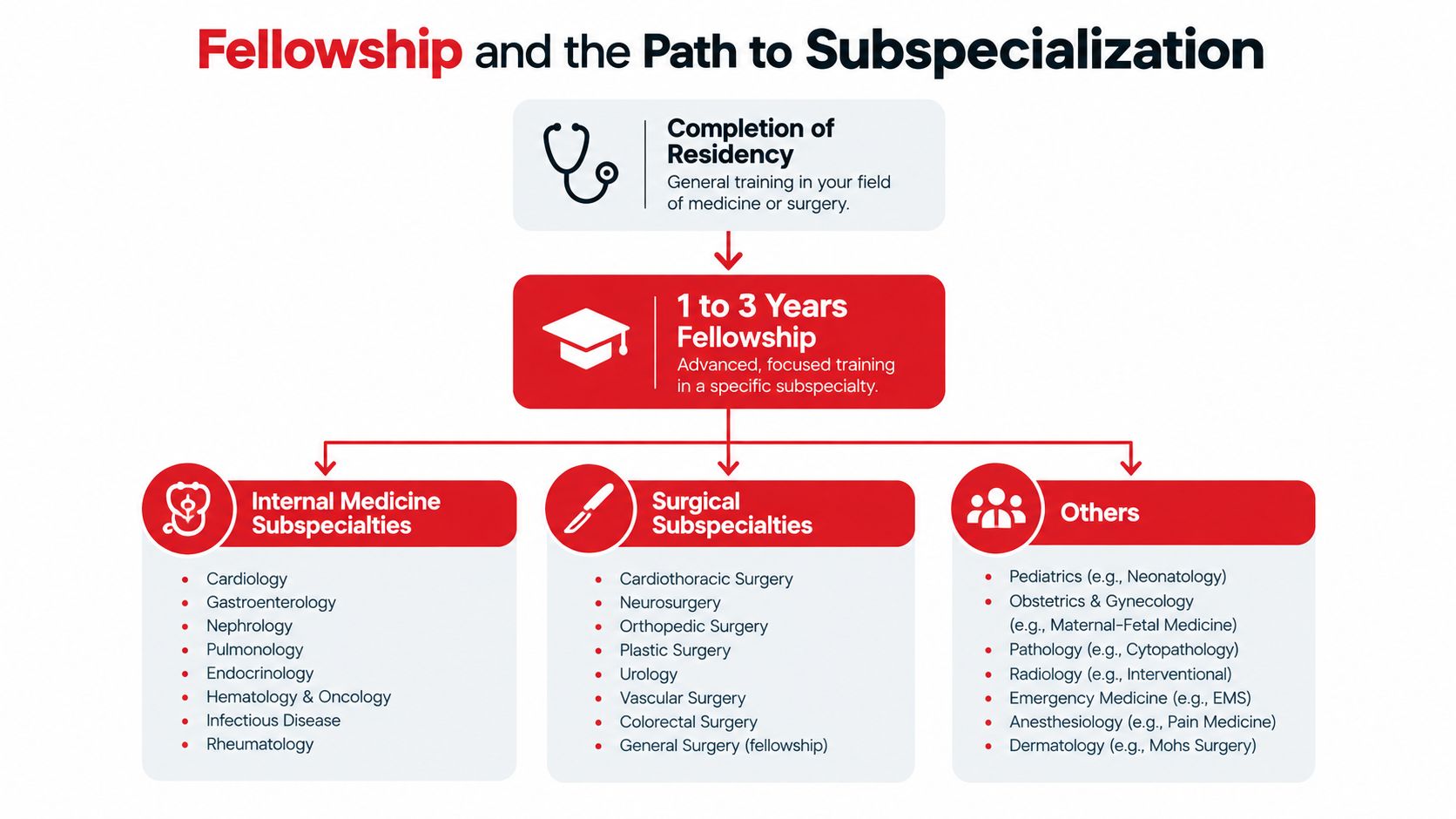
Internal medicine illustrates the multi-stage model. Cardiology, gastroenterology, hematology-oncology, and nephrology commonly require additional fellowship training after internal medicine residency. Pulmonary-critical care generally adds two to three years, while geriatrics commonly adds one year. These figures are planning anchors, and applicants should verify current requirements with the relevant specialty board and fellowship program.
Surgical subspecialty fellowships vary. Many add about one year, while cardiothoracic surgery pathways can add two to three years, depending on the training model. Some programs use integrated residencies that fold advanced training into the initial specialty pathway, so a candidate must compare the structure rather than add fellowship years automatically.
When fellowship planning begins
Residents often begin researching subspecialty options well before residency ends. Many fellowship applications occur during the PGY-2 or PGY-3 year, often through ERAS, with the applicable match timeline determined by the specialty. A resident in a three-year program may need to make meaningful decisions by the middle of PGY-2 to arrange mentors, research, letters, and application materials.
Fellowship length affects the total time from medical school to attending practice. It doesn't change the original residency designation. A physician remains a residency graduate who completed additional subspecialty training, rather than someone whose core residency was formally lengthened by the fellowship.
The right question isn't only “How long is residency?” It's also “What work do I want to perform independently, and does that work require fellowship?” A generalist role and a subspecialist role can require different timelines, responsibilities, and credentialing steps.
A Practical Planning Checklist for Applicants
A useful timeline starts with the desired training start date and works backward. Don't rely on memory for ERAS, NRMP, SOAP, ECFMG, or school deadlines. The medical residency application timeline guide can serve as a planning reference, but current official calendars control.
Build the calendar
- Confirm application dates: Check the current ERAS and NRMP calendars, including application opening, submission, interview, rank order list, and Match Week milestones.
- Plan examination timing: Confirm score-release windows for USMLE or COMLEX-USA and leave enough time for programs that expect results before application review.
- Request letters early: Ask supervisors and faculty for letters well before the application deadline, using the program's current requirements.
- Document IMG requirements: Track ECFMG certification, credential verification, clinical experience, and visa documentation separately.
- Record school obligations: Add graduation requirements, transcript processing, dean's letter timing, and institutional submission rules.
SOAP deserves its own line on the calendar. It operates during Match Week for eligible unmatched applicants, but eligibility, participation steps, communication rules, and offer procedures are controlled by current NRMP policies. Read the official rules rather than relying on forum summaries.
Use a backward-planning exercise
Start with the residency start date you want. Then list the latest acceptable dates for:
- Required licensing-exam results.
- Clinical rotations and specialty exposure.
- Letters of recommendation.
- Research products or scholarly work.
- Personal statement and application review.
- ERAS submission and program-specific materials.
- Rank order list certification.
For a resident considering fellowship, add a second backward plan from the intended fellowship start. A resident in a three-year program should clarify specialty deadlines, research expectations, and letter requirements early enough to act during PGY-2.
Review the plan every six months. Your specialty preference, personal circumstances, visa situation, and program requirements can shift. A written checklist makes those changes visible and gives you time to respond without treating one missed milestone as a career-ending event.
Common Follow-Up Questions
When does SOAP happen?
SOAP takes place during Match Week for applicants who are eligible to participate and didn't initially obtain a position. The exact schedule, communication rules, and offer procedures can change, so applicants should use the current NRMP materials. Don't assume that every unmatched applicant receives the same options or that informal advice reflects the current process.
What are the longest residency paths?
The longest pathways depend on the specialty structure. Neurosurgery can last up to 7 years, and integrated plastic surgery is commonly described as a 7-year pathway in specialty planning materials. An optional research year or other approved interruption can extend calendar time beyond the standard program length.
What are the shortest residency options?
Family medicine, internal medicine, and pediatrics commonly use 3-year residency structures. Emergency medicine and psychiatry are also listed among three-year fields in the comparison above, but applicants should verify the exact format and prerequisites for each program.
Can residents switch specialties?
A switch is possible, but it can require a new application, transfer approval, additional prerequisite training, or repeating portions of a curriculum. Preliminary positions can sometimes provide a bridge, but they don't guarantee entry into a new categorical program. Speak with the program director, designated institutional official, and specialty programs before making a transition plan.
Does a chief resident year add time?
A chief resident year may be part of the established program sequence or may be an additional leadership year, depending on the institution and specialty. Ask whether the role carries a separate appointment and whether it changes the expected graduation date. Moonlighting rules also differ by program and depend on licensure, duty-hour compliance, supervision, and institutional policy.
After residency, some physicians pursue locum tenens work, while others wait until they meet full state licensure and employer credentialing requirements. The timing is jurisdiction-specific. Review the applicable medical board and institution policies before accepting clinical work.
Ace Med Boards provides one-on-one preparation for USMLE, COMLEX-USA, selected Shelf exams, and residency-related planning support, which can help applicants organize examination milestones within a broader residency timeline. Visit Ace Med Boards to learn about the available support and request a free consultation.