You're probably juggling the same mix most medical students are. Anki reviews you're behind on, shelf prep you should've started earlier, one attending who asks excellent questions, and another who seems to assess your entire future based on whether you anticipated the potassium recheck. In that setting, “leadership development” can sound like extra homework for people who want administrative titles later.
That's the wrong frame.
In medicine, leadership starts long before you run a department. It shows up when you give a clean patient presentation, calm a tense team interaction, close a communication loop, or speak up when a discharge plan doesn't make sense. Those are clinical behaviors. They affect how people trust you, teach you, evaluate you, and eventually rank you.
The students who understand this early don't necessarily spend more time. They spend their time better. They choose a few visible, credible leadership habits that improve patient care, strengthen rotation performance, and give them stronger material for residency interviews. That's the version of medical leadership development worth building.
Beyond the Textbook What Medical Leadership Really Means
A lot of students hear “leadership” and picture hospital executives, committee meetings, or polished LinkedIn posts. On the wards, that feels far away from what matters. You're trying to learn the differential, avoid slowing the team down, and survive the next shelf exam.
But bedside medicine already demands leadership.
When a patient's family is upset and the intern is overloaded, someone has to organize the conversation. When a consultant gives a plan that conflicts with what the primary team discussed, someone has to clarify it respectfully. When rounds are chaotic, the student who presents clearly and anticipates next steps is already doing leadership work.
Leadership is a clinical skill set
The most useful definition is simple. Medical leadership development means building the habits that help a team deliver safer, clearer, more coordinated care. You don't need a title for that.
A few examples make this easier to see:
- During a code or rapid response: Leadership isn't volume. It's concise communication, role clarity, and closed-loop confirmation.
- On rounds: Leadership often looks like synthesizing data, naming the key problem, and helping the team move from information to action.
- In patient advocacy: Leadership can be the decision to raise a concern when a discharge plan ignores language barriers, transport issues, or medication access.
That's why leadership shouldn't sit in your mind as an extracurricular category. It overlaps with communication, professionalism, systems-based practice, and team function. If you've reviewed the ACGME core competencies for trainees, you've already seen how much of “being a strong resident” is leadership by another name.
Practical rule: If a behavior makes your team more organized, your patient safer, or your handoff clearer, it counts as leadership.
Why the textbook version falls short
Formal adoption of leadership education has grown, but it's still uneven. Leadership training is integrated into approximately 54.5% of U.S. allopathic medical schools, and only 19% offer it longitudinally across all four years according to a review published in the National Library of Medicine archive. That gap matters because many students still learn leadership indirectly, by watching good residents and bad ones.
So don't wait for your curriculum to make this systematic.
Use what's available. Read practical frameworks, ask for targeted feedback, and borrow tools from outside the usual med school pipeline when they're relevant. One useful example is this Acheloa Wellness, Inc. resource on leadership development training, which is helpful because it treats leadership as a trainable professional skill rather than a personality trait.
The students who grow fastest usually stop asking, “Am I a leader yet?” They ask better questions. Did I communicate clearly? Did I make the team's work easier? Did I advocate well? That mindset is more valuable than any title on a club roster.
Why Leadership Skills Boost Your Match Success

Residency programs rarely say, “We're ranking this student because they led well on rounds.” They say other things instead. Dependable. Teachable. Mature. Strong communicator. Handles pressure well. Works effectively with the team. Those phrases are often shorthand for leadership potential.
That's why medical leadership development has career value even if you never become class president or start a major initiative. Program directors and clerkship evaluators notice who improves team function.
Leadership shows up in rotation grades
On clinical rotations, students usually think they're judged only on knowledge. Knowledge matters, but so does how you function in a live team environment.
Preceptors notice when you:
- Anticipate needs: You track pending labs, update the list, and know what the team is waiting on.
- Communicate cleanly: Your presentations are concise, and your handoffs don't create confusion.
- Handle friction professionally: You don't become defensive when corrected, and you can manage disagreement without escalating tension.
- Support the workflow: You volunteer for appropriate tasks and follow through without needing repeated reminders.
Those behaviors often influence comments that end up shaping your clinical evaluations and your MSPE. Students who seem “easy to work with” usually aren't just pleasant. They reduce cognitive load for the team.
Leadership helps with exams too
This matters for boards more than many students realize. Step-style questions often test judgment in team-based, systems-based, or communication-heavy scenarios. The right answer isn't always the most medically detailed one. Often it's the response that clarifies roles, de-escalates conflict, protects the patient, or addresses a process problem before it causes harm.
That's leadership thinking.
A student who's practiced case presentations, handoffs, team communication, and small workflow improvements usually handles those vignettes better because the logic feels familiar. You're not memorizing an abstract professionalism rule. You've seen how these situations unfold in real care settings.
For broader application strategy, the practical advice in these residency application tips pairs well with building leadership examples that are specific and believable.
Structured training changes how you perform
Many graduates know they need these skills but don't feel prepared. In one study discussed in the Pennsylvania Academy of Family Physicians journal, 56.2% cited lack of time in the curriculum as a key barrier to leadership preparation. The same source also notes that targeted leadership programs improve self-efficacy, increase leadership aspirations, and can reduce emotional exhaustion and burnout.
That matters for matching because burned-out students don't interview well, don't rotate well, and don't consistently show their best judgment under pressure.
Program directors can teach a resident new workflows. It's harder to teach maturity, accountability, and presence from scratch.
If you're aiming for a competitive specialty, leadership won't replace scores, grades, or letters. But it does something those metrics can't. It helps people picture you as the resident who can be trusted with patients, teams, and responsibility.
The Three Pillars of Medical Leadership
The easiest way to make leadership practical is to break it into three parts. Not titles. Not committee roles. Just three domains you can improve during medical school.
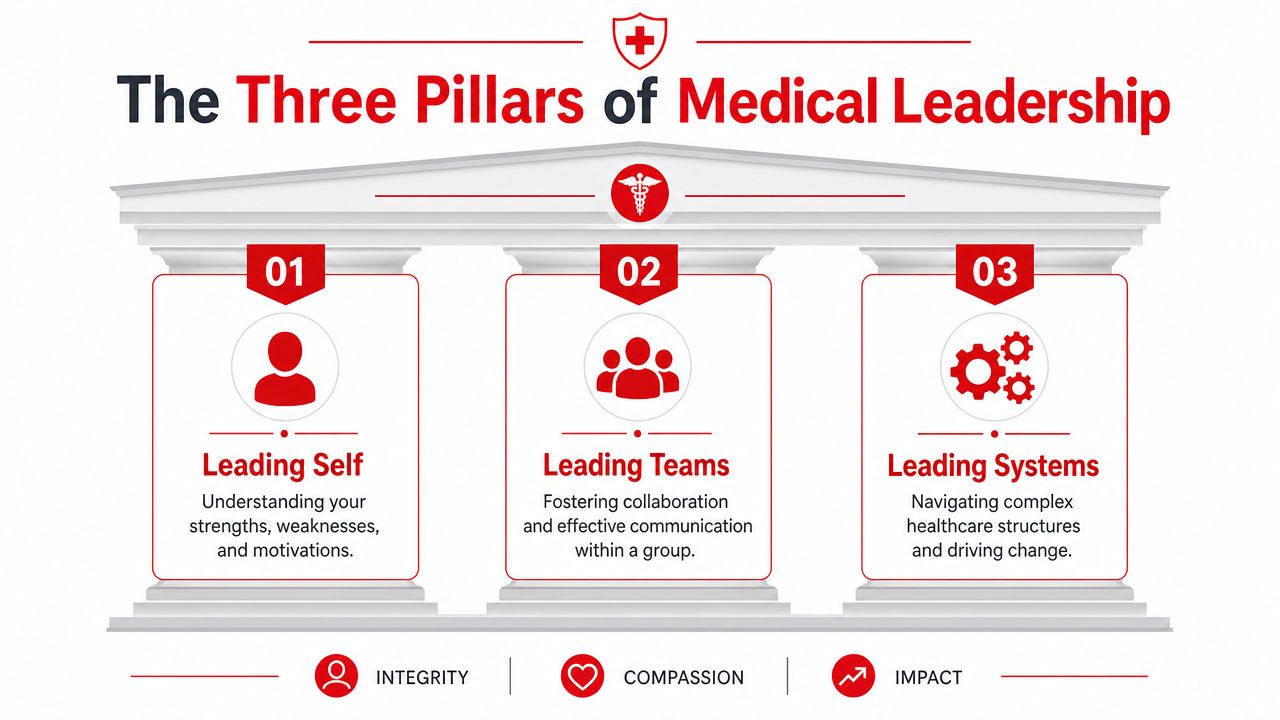
Leading self
This is the foundation. If you can't manage your attention, emotions, and reactions, everything else gets shaky fast.
Leading self includes self-awareness, emotional regulation, follow-through, and honest response to feedback. In med school, this often looks less glamorous than students expect. It's noticing that you shut down after public correction. It's learning that your pre-rounding system is unreliable and fixing it. It's recognizing when stress is making you defensive, scattered, or too quiet.
A student with strong self-leadership doesn't need to appear confident all the time. They need to be coachable.
Here's what that can look like in practice:
- After feedback: Instead of saying, “I was going to mention that,” write down the correction and use it on the next patient.
- Before a hard week: Build a realistic plan for study blocks, rotation tasks, and sleep instead of trusting motivation.
- After a mistake: Review what happened, own your part, and change one behavior immediately.
Leading teams
Medicine is a team sport whether you like that phrase or not. Patients experience your team's coordination, not your individual intentions.
Leading teams means communicating clearly, listening well, resolving tension early, and helping people work toward the same plan. As a student, you won't run the service, but you can absolutely influence whether the day feels more organized or more chaotic.
The highest-yield team skill is often communication. Not eloquence. Clarity.
That includes the habits covered in this guide to communication skills for doctors, especially concise speaking, active listening, and adapting your message to the person in front of you.
Good team leadership often sounds plain. “Just to confirm, the plan is…” is one of the most useful leadership phrases in the hospital.
Leading systems
This pillar is where students often underestimate themselves. You don't need authority to notice a broken process.
Leading systems means seeing how care is delivered across handoffs, documentation, discharge planning, consults, and clinic flow. It includes quality improvement, patient advocacy, and the ability to ask, “Why does this keep going wrong?”
A quick way to separate the three pillars is this:
| Pillar | Core question | Student example |
|---|---|---|
| Leading self | How am I managing myself? | You build a better workflow after repeated late presentations |
| Leading teams | How am I helping people coordinate? | You clarify a handoff so the night team gets the right follow-up |
| Leading systems | What process is making good care harder? | You notice discharge instructions are inconsistent and help standardize them |
Students who develop all three become noticeably stronger on rotations. They're steadier under feedback, better with people, and quicker to identify where care breaks down. That combination is what faculty often mean when they say someone is “ahead of their level.”
How to Build Leadership Skills in Medical School
You don't need a custom fellowship track to build leadership. You need a few opportunities that force you to act, reflect, and improve in public. The common mistake is choosing activities that sound impressive but don't stretch you.
The better approach is to choose experiences where other people can see your judgment, reliability, and communication.
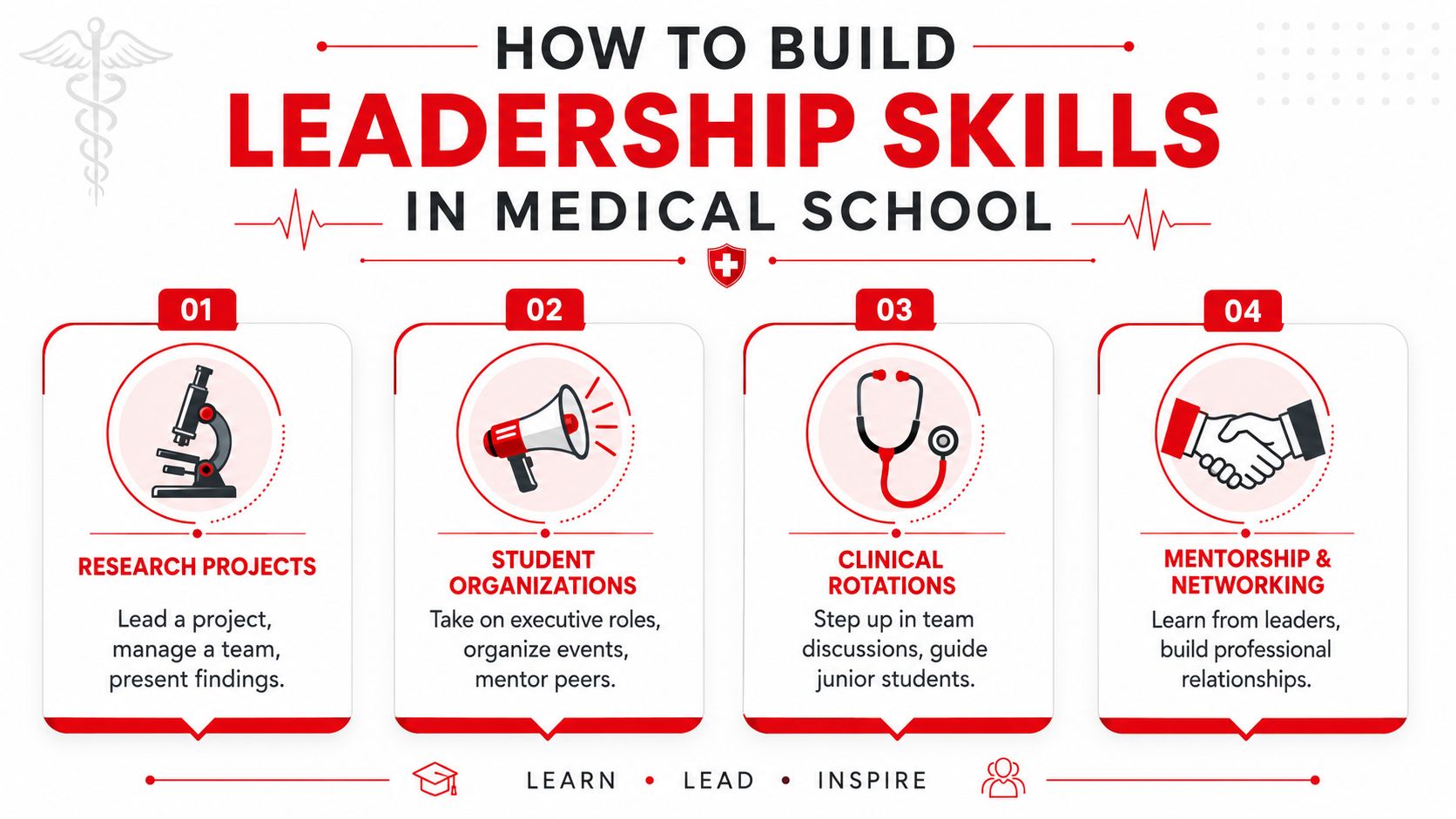
Start with formal options, but screen them hard
Some schools offer leadership electives, tracks, or workshops. These can help, but only if they move beyond passive attendance.
A useful screen is simple:
- Does the course require applied work? Projects, simulations, or team problem-solving are far more valuable than lectures alone.
- Will someone observe you and give feedback? If not, growth is harder to measure.
- Can you point to a concrete output later? A process improvement, teaching session, toolkit, or reflection portfolio is better than “participated in leadership seminar.”
One reason this matters is that physicians consistently prefer experiential learning. In a review on leadership development in medicine, action learning in workplace projects was associated with measurable improvement in communication, conflict resolution, and teamwork. That's much closer to how you function in clerkships and residency.
A student I mentored once joined a school leadership elective because it fit her schedule. The lecture content was fine, but the useful part came later when she had to facilitate a small group after a disagreement over task ownership. She left that semester remembering almost none of the slide deck and a lot about how to redirect a tense conversation without embarrassing anyone.
Find one mentor who cares about your growth, not just your CV
Most students think mentorship means finding the most impressive physician in the department. Usually, it's better to find the person who watches how you work and is willing to be honest.
A good mentor for leadership development can do three things:
- Spot patterns you can't see yourself
- Give you stretch opportunities at the right level
- Translate your growth into language faculty understand
One student on internal medicine asked a senior resident for one specific kind of feedback every Friday: “What's one thing I do that helps the team, and one thing that slows me down?” That question improved her faster than any general “How am I doing?” check-in.
Ask for behavior-based feedback, not personality judgments. “Was my handoff clear?” is better than “Do I seem confident?”
Use quality improvement as your leadership lab
If you want one activity that builds systems thinking, teamwork, and residency-ready talking points, do a small QI project.
It doesn't need to be huge. In fact, smaller is usually better because you can finish it.
A realistic student example looks like this:
- On surgery, a student notices that post-op handoff details are inconsistent.
- He asks the chief resident whether this is a recurring problem.
- He drafts a short handoff checklist with the intern.
- The team tests it for a limited set of patients.
- He gathers informal feedback, revises it, and presents the process at a student or department meeting.
That student didn't “transform the hospital.” He did something more credible. He identified a workflow problem, collaborated with people who owned the process, tested a fix, and learned how hard implementation really is.
That's leadership.
For students who need ideas beyond formal titles, these extracurricular activities for medical school can be useful if you filter them through one question: will this let me own a problem and work with others to solve it?
Practice in lower-stakes environments
Simulation, peer teaching, and student organizations are underrated because they feel less clinical. They're still valuable if you use them correctly.
A student organization role helps when you have to coordinate people, manage deadlines, and communicate under mild friction. Peer teaching helps when you have to explain clearly and adjust in real time. Simulation helps when you need to speak up, assign roles, and avoid freezing under pressure.
The key is to avoid collecting titles without stories.
Here's a quick comparison:
| Activity | Weak version | Strong version |
|---|---|---|
| Student organization | Attend meetings | Plan an event, manage volunteers, solve a scheduling problem |
| Mentorship | Occasional advice chats | Regular feedback, clear goals, visible growth |
| QI project | Join a large team vaguely | Own a narrow workflow issue from observation to revision |
| Simulation | Show up once | Repeat scenarios, review communication mistakes, apply lessons on rotation |
If your schedule is packed, don't chase all four. Pick one clinical route and one nonclinical route. That's usually enough to build real substance without hurting your grades.
Showcasing Leadership on Your Residency Application
Doing leadership work isn't enough. You have to describe it in a way that sounds concrete, credible, and relevant to residency. A lot of good applicants weaken their own experience by writing vague CV bullets and giving mushy interview answers.
Program directors don't need you to sound grand. They need to understand what you did.

Replace titles with actions
Start by reviewing your CV line by line. If an entry mainly tells the reader what group you were part of, it's probably too weak.
Here's the difference:
| Before | After |
|---|---|
| Member, Surgery Interest Group | Coordinated a student-run skills session, communicated with faculty facilitators, and helped organize peer instruction for knot-tying practice |
| Participant, Quality Improvement Project | Identified recurring handoff omissions on surgery, collaborated with residents on a simple checklist, and presented lessons learned to the student QI forum |
| Peer Tutor | Led small-group review sessions, adapted explanations to different learners, and incorporated feedback to improve session structure |
The stronger version does three things. It names the work, shows ownership, and hints at a transferable skill.
Build a portfolio while the experience is fresh
Strong leadership development depends on deliberate practice, not course attendance alone. Standards described in an NHS and FMLM leadership framework presentation emphasize SMART objectives, portfolio evidence, and feedback methods such as 360-degree review. The lesson for students is straightforward. Keep proof of growth.
That portfolio can be simple:
- A running document of leadership examples: difficult conversations, small process fixes, teaching sessions, handoff improvements
- Feedback snippets: comments from residents, attendings, peers, or project leads
- Reflection notes: what you tried, what failed, what changed the second time
- Artifacts: agendas, checklists, teaching slides, project summaries
This becomes gold when you write your personal statement or prepare for interviews.
For formatting and phrasing, a polished medical residency curriculum vitae guide can help you translate experiences into strong entries without sounding inflated. If you're also adapting the document for software screening or employer systems, these Resumey.Pro ATS tips are useful for keeping the formatting readable and keyword-friendly.
Use STAR, but keep it clinical
Interview answers get stronger when they follow the STAR pattern. Situation, Task, Action, Result. The problem is that many students overdo the setup and underdescribe their actual contribution.
A better version is compact.
Weak answer:
“I was involved in a team project, and there were communication issues, but we all worked together and it turned out well.”
Stronger answer:
“On my surgery rotation, the post-op plan wasn't always passed clearly between day and night teams. My task was small, but I wanted to reduce missed details. I asked the intern which points were most often lost, drafted a short handoff prompt, and tested it with feedback from the resident team. The result was a cleaner sign-out process on the patients we used it for, and I learned that implementation depends more on making a tool easy to use than making it exhaustively detailed.”
The best interview stories are modest in scale and clear in ownership. Small, real examples beat inflated ones every time.
Tie leadership to residency value
When you describe leadership, always connect it to resident-level usefulness. That usually means one of four things:
- Reliability: You follow through and close loops.
- Team function: You reduce confusion and communicate clearly.
- Coachability: You respond well to feedback.
- Systems awareness: You notice process problems early.
That's the language programs understand. Not “I'm passionate about leadership.” Show them that you already behave like someone who can carry responsibility.
Your First Step to Becoming a Physician Leader
The hardest part of medical leadership development is that it doesn't feel dramatic while you're building it. There's rarely a moment when someone hands you authority and says you're ready. More often, you become more useful week by week. Your presentations get tighter. Your feedback habits improve. You notice workflow problems earlier. People start trusting you with more.
That's how this develops in real training.
Leadership isn't separate from becoming a strong applicant or a strong future resident. It sharpens the same traits that help with case-based exams, clerkship evaluations, letters of recommendation, and interview performance. The mistake is thinking you need a major role before you can practice it.
You don't.
Pick one action for the next week and make it specific:
- Ask a resident for one piece of feedback on your communication.
- Volunteer to lead a patient presentation and aim for tighter assessment and plan language.
- Identify one recurring workflow problem on rotation and ask who owns it.
- Run one peer teaching session on a shelf topic and ask what was confusing.
Then write down what happened. That reflection step matters because it turns experience into a repeatable skill.
Start with the smallest visible behavior that improves patient care or team function. Then do it consistently.
Patients need physicians who can think clearly, communicate under pressure, and help teams work well when the day gets messy. Those aren't bonus traits. They're part of the job. If you build them now, your application gets stronger. Beyond that, your clinical identity gets stronger too.
Ace Med Boards helps medical students turn strong effort into stronger performance on the exams and milestones that shape residency options. If you want targeted support for USMLE, COMLEX, shelf exams, or residency planning, explore Ace Med Boards for one-on-one guidance built around your goals.