You're probably staring at a half-finished document right now. Maybe you downloaded a clean-looking template, pasted in your school, rotations, and test scores, and still feel that the CV doesn't sound like someone programs should rank. Or maybe you're carrying a harder concern. A failed exam attempt, a gap you can't hide, a prior non-match, or an application history that doesn't look as tidy as the sample PDFs online.
That anxiety is normal. Most medical CV templates are built for idealized applicants with straight-line timelines and no complicated decisions. Real applicants aren't built that way.
A strong medical CV template doesn't just organize your history. It helps a reviewer understand your trajectory quickly, trust your professionalism, and see evidence that you can function in the role. That is what separates a polite “we'll review your file” from a serious interview consideration.
Your Medical CV Is Not Just a Standard Resume
A reviewer opens your file with 200 others in the queue. They are not asking, “Is this polished?” They are asking, “Can I verify this applicant fast, and do I trust what I'm seeing?” That is why a medical CV has to do more than look clean.
A medical CV is a record of training, licensure, clinical work, scholarship, and progression. A standard resume is usually a shorter, selective document built to market fit for a job. In medicine, that difference matters immediately. The British Medical Association guidance on writing your medical CV advises a structured document that gives enough space to show qualifications and experience clearly, not a stripped-down one-page summary.
Applicants get into trouble when they borrow rules from general hiring advice and apply them to residency, fellowship, or hospital posts. I see this often with candidates who use a corporate resume template because it looks modern. The result is predictable. Missing dates, buried licensure, vague rotation descriptions, and no clear account of what happened during weak periods in the timeline. A generic template hides the exact information reviewers need to confirm readiness.
If you're comparing formats across healthcare roles, a comprehensive guide for aspiring nurses can be useful for seeing how hiring documents change by profession. The lesson is not to copy nursing or corporate conventions into a physician CV. The lesson is that each role is judged differently.
Medical CV vs Standard Resume at a Glance
| Attribute | Medical CV | Standard Resume |
|---|---|---|
| Primary purpose | Verified academic and clinical history | Brief role-targeted summary |
| Typical use | Residency, fellowship, hospital posts, academic appointments | Corporate jobs, many non-academic roles |
| Length | Based on training history, publications, and experience | Usually kept short |
| Education detail | Full training path with dates and credentials | Condensed |
| Publications and presentations | Included when relevant | Often reduced or omitted |
| Licensure and registrations | Prominent and easy to verify | Sometimes brief |
| Tone | Formal, factual, and traceable | Selective and persuasive |
The stronger approach is to treat your CV as a living professional document. Keep a master version. Update it every time you finish a rotation, publish, present, teach, renew certification, or change roles. Then tailor the order and emphasis for the specific program. That is how you avoid last-minute omissions and inconsistencies.
This matters even more if your file has stress points. A gap, a failed USMLE attempt, a transfer, a delayed graduation, or a prior non-match should not be left for reviewers to piece together from scattered dates. A standard resume tries to minimize weak spots. A medical CV should frame them clearly, accurately, and in a way that preserves trust.
It also needs to work for both human reviewers and software filters. Programs often read your CV beside the rest of your application, which is why it helps to understand what programs actually look at in ERAS. If your document reads like generic job-market copy, you risk looking less prepared than you are.
Practical rule: if a reviewer cannot find your degree timeline, exam history, licensure status, and current role in seconds, the CV is costing you interviews.
The best medical CV template is plain, ordered, and built for verification. In this field, clarity beats style every time.
Building the Essential Framework of Your CV
A reviewer opens your file with 40 more to get through before noon. They are not looking for personality first. They are looking for orientation. If they cannot identify your training level, current role, exam path, and legal ability to practice within a few seconds, your application starts in the wrong pile.
That is why the safest medical CV structure is predictable, reverse chronological, and easy to verify. It helps human reviewers scan quickly, and it gives applicant tracking systems a better chance of reading your dates, titles, and section headings correctly. Many hospitals and large health systems now use screening software somewhere in the hiring process, so unusual layouts, text boxes, and decorative formatting create avoidable risk.
The section order that works
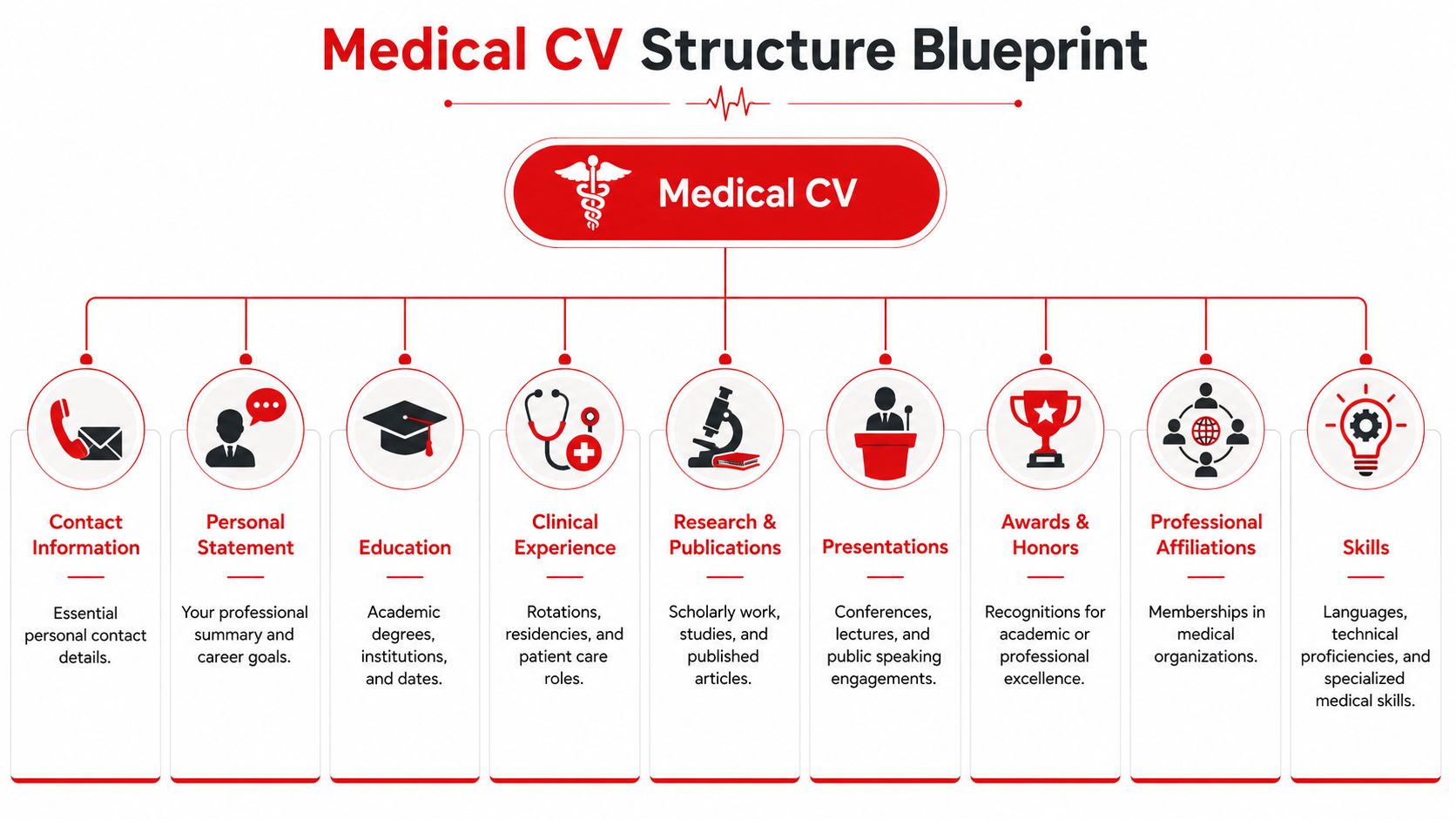
For most applicants, this sequence works well:
- Header and contact details
- Career statement
- Education
- Licensure and certifications
- Clinical experience
- Research and publications
- Presentations and teaching
- Awards and honors
- Professional affiliations
- Skills and languages
- Referees or references if required
This order reflects how reviewers assess risk. First they confirm who you are and where you are in training. Then they check whether your qualifications and registrations support the role. After that, they look at clinical experience, academic output, and the extras that may tip a close decision.
There are trade-offs. A senior doctor with a long practice history may place clinical appointments ahead of education. A final-year student or early postgraduate applicant usually benefits from keeping education near the top because it gives immediate context for rotations, exam timing, and expected progression.
What belongs in the opening block
The first block should answer basic verification questions without forcing the reader to hunt. Include your full name, professional email, phone number, and current location if it affects eligibility or interview logistics. Add registration and identification details relevant to the role, such as GMC registration or a national training number for UK applications. If the post asks for referees, include them where requested. If it does not, “available on request” is enough.
Then write a short career statement. Two or three lines is enough.
The statement should cover three points: your current level, your clinical direction, and the type of role you are pursuing. Keep it factual. If you mention a strength, make sure the rest of the CV proves it. “Interested in surgery” is weak. “Foundation doctor with recent general surgery and acute care exposure, applying for roles with high operative support, clear supervision, and regular audit participation” gives the reviewer something concrete.
Do not use this space to hide a weak point. If you have a gap, delayed graduation, or a failed exam attempt, the opening block is not the place to explain it away. Its job is orientation. The explanation belongs later, in the right section, with dates that line up cleanly.
Build sections that can survive a skeptical read
Every heading should earn its place. “Education” needs institution, degree, dates, and distinctions if relevant. “Licensure and certifications” needs current status, issuing body, and expiration or renewal details where applicable. “Clinical experience” needs title, setting, department or specialty, dates, and a clear enough description that a reviewer can understand scope without guessing.
Research deserves its own section if it is real and attributable. If you have posters, abstracts, manuscripts, audits, or ongoing projects, separate them clearly rather than burying them under generic experience. Applicants trying to strengthen this part of the file should focus on substance before polishing wording. This guide on how to get research experience is a useful starting point if your academic section is still thin.
Applicants often make one damaging mistake here. They mix categories. Volunteer work gets folded into clinical experience. Unpublished projects are listed like peer-reviewed papers. A conference attendance line appears under presentations as if it were a delivered talk. Reviewers notice. So do background checks.
Section order should reflect your strongest verified signal
I advise applicants to move one strong, defensible section higher if it materially improves the first page. For an IMG with recent US clinical experience, that experience may deserve more prominence. For an applicant with a significant publication or a completed higher degree, research may need to sit closer to the top. For someone returning after a gap, current clinical employment or a recent supervised role may be the most reassuring signal in the file.
What matters is the logic. The order should help a reviewer trust the application faster, not admire your formatting.
That same logic applies outside formal applications. If you are contacting consultants, principal investigators, or department leads directly to ask about openings, use the same clear structure in the attached CV. Pair it with a concise outreach message. This effective cold email guide for job seekers is useful if you are pursuing research roles, observerships, or unadvertised posts.
A strong framework does one job well. It lets a reviewer confirm your trajectory, credibility, and current readiness before they read a single descriptive bullet.
Writing Compelling Descriptions That Get You Noticed
A tidy template gets your foot in the door. Your descriptions decide whether anyone remembers you.
The biggest writing failure in medical CVs is listing responsibilities instead of evidence. Reviewers already know what an intern, sub-intern, resident, research assistant, or clinic volunteer is supposed to do. Repeating job duties wastes space. The better move is to show scope, context, and output.

Data-backed guidance supports this. Quantifying clinical achievements with specifics such as procedure volume or patient counts correlates with stronger interview shortlisting, while subjective traits like “highly motivated” or “great team player” have zero predictive value in early screening (medical CV writing advice with quantified achievements).
Replace duties with proof
Here's the shift I tell applicants to make.
| Weak version | Stronger version |
|---|---|
| Responsible for patient care in internal medicine rotation | Managed daily follow-up for inpatient internal medicine patients, with responsibility for note preparation, result review, and escalation of acute changes to senior residents |
| Assisted in surgery | Assisted in operative cases across general surgery service and documented perioperative plans, post-op updates, and discharge instructions |
| Participated in research | Contributed to data collection, literature review, and abstract preparation for a faculty-led project in cardiometabolic disease |
| Worked with multidisciplinary team | Coordinated with nursing, pharmacy, and case management to support discharge planning and medication reconciliation |
Notice what changes. The stronger version doesn't rely on inflated language. It adds specificity, workflow, and role clarity.
Use measurable detail when you genuinely have it
Not every line needs a number. Forced quantification often sounds fake. But when you do have concrete measures, use them. Useful examples include:
- Clinical volume: Number of patients followed in a service block, clinic schedule, or consult load
- Procedural exposure: Procedure types and approximate volume if documented accurately
- Teaching reach: Student sessions delivered, workshops led, or recurring teaching role
- Research output: Poster, abstract, manuscript status, oral presentation, or data role
What doesn't help:
- Empty adjectives: compassionate, dynamic, motivated, excellent communicator
- Inflation: expert, outstanding, exceptional, world-class
- Generic filler: responsible for, helped with, participated in
If a bullet could belong to any applicant in your class, it isn't doing enough work.
Good bullets sound clinical, not theatrical
Use action verbs, but keep the tone professional. Good verbs include managed, coordinated, presented, documented, analyzed, synthesized, assisted, reviewed, supervised, audited, developed, and implemented.
A practical pattern that works is:
- Action
- Setting
- Scope
- Result or value
Example:
- Developed teaching materials for peer review sessions in pathology, supporting small-group preparation before exams and improving consistency across student-led sessions.
That bullet works even without a number because it shows initiative and purpose.
Match your language to the role
A community program may care more about continuity, communication, and service. A research-heavy program may want to see publications, conference activity, and disciplined academic output. Competitive specialties often expect cleaner evidence of commitment, including aligned electives, mentors, presentations, and specialty-specific work.
This is also where outreach matters. If you're contacting faculty, coordinators, or potential mentors to build opportunities before the cycle, this effective cold email guide for job seekers is worth reading. A surprising number of strong CV lines begin with a well-written email that led to research, shadowing, teaching, or informational conversations.
For applicants who want a visual walk-through on tightening language, this short video is useful before your final rewrite:
A few lines that usually need revision
Some recurring fixes:
Instead of: Hard-working team player with leadership skills
Use: Served as student coordinator for clinic volunteers, organizing schedules and handoff communication across shiftsInstead of: Passionate about underserved care
Use: Volunteered in a student-run clinic serving uninsured patients and assisted with follow-up coordination and patient educationInstead of: Excellent research skills
Use: Conducted chart review, data abstraction, and manuscript drafting support for retrospective faculty project
The point is not to sound impressive. The point is to sound credible, specific, and useful.
Formatting for Human Reviewers and AI Screeners
A program coordinator opens your file after clinic, already twenty applications behind. If the dates are hard to find, the section labels are odd, or the PDF scrambles in the hospital's screening system, your CV loses ground before anyone weighs your strengths.
That is the practical formatting standard. Your CV has to read cleanly for a human under time pressure and parse cleanly for the software that often touches it first.
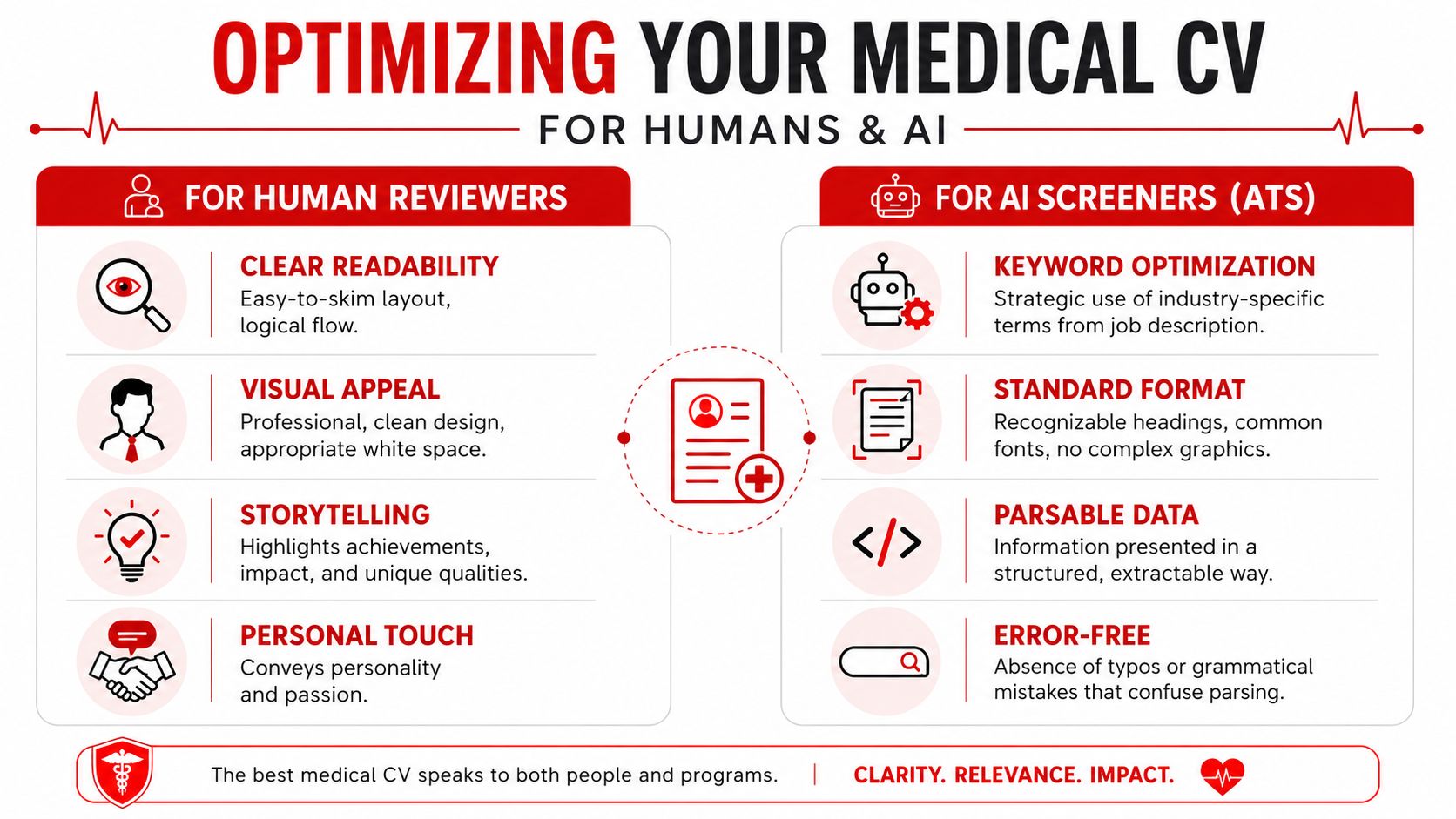
The AMA advises keeping formatting simple because complex layouts can create problems for screening software. The same guidance notes that physician CVs are often longer than standard resumes, while trainees usually benefit from a tighter document that a reviewer can scan quickly (AMA medical CV guidance).
Formatting errors matter more for applicants with any friction point in their file. If you are asking a reviewer to give fair weight to a leave of absence, a failed exam attempt, a late specialty pivot, or uneven chronology, you cannot afford confusion created by your layout. Clean structure keeps attention on your story instead of your document.
Format choices that usually work
Applicants do not need visual flair. They need a format that survives upload, parsing, printing, and a thirty-second skim.
- Use standard fonts: Arial, Calibri, and Times New Roman are reliable.
- Use familiar section titles: Education, Clinical Experience, Research, Publications, Presentations, Licensure, Certifications.
- Keep dates easy to spot: Right-aligned or consistently placed dates help reviewers reconstruct your timeline fast.
- Use basic bullets: Circles or hyphens are safer than icons, tables, or text boxes.
- Leave enough white space: Dense blocks of text slow down faculty and coordinators.
- Export carefully: PDF is usually the safest choice if the application portal accepts it. If a system specifically requests Word, follow the portal instructions.
I have seen strong applicants hurt themselves by forcing a polished-looking design onto a document that needed clarity instead. In medicine, plain formatting often reads as organized and professional.
Write for searchability without sounding robotic
Screening systems usually look for recognizable terms, credentials, and role alignment. Human reviewers do the same, just with better judgment.
Use the language of the posting where it is true. If a program values inpatient medicine, continuity clinic, quality improvement, EMR use, resident teaching, transitional care, or scholarly output, name those experiences in those terms. Do not stuff keywords into every line. Repetition looks artificial to a reader and can make weak experience look weaker.
This matters across the full application, especially in ERAS, where your CV, personal statement, and experience descriptions should point in the same direction. A practical guide to ERAS application strategy and CV optimization can help you align wording and emphasis across the file.
What to avoid immediately
These choices create preventable problems:
- Tables for core content
- Graphics inside experience sections
- Unusual fonts
- Headers or footers that contain important dates or credentials
- Tiny text used to force the CV onto fewer pages
- Creative section names that software and reviewers may not recognize
- Two-column layouts for chronology-heavy sections
One final point. AI-assisted screening is now common enough that formatting is no longer a cosmetic decision. It affects whether your chronology is readable, whether your credentials are captured correctly, and whether a reviewer gets a clean first impression of an already complicated application.
Strategically Addressing Gaps and Special Cases
Most templates implicitly assume you had a clean score history, no interruptions, and a straightforward match path. Many applicants don't.
That doesn't make you uncompetitive. It does mean your CV has to be more deliberate. The medical CV world still offers poor guidance for issues like exam failures or prior non-match cycles, even though 15 to 20% of residency applicants face those kinds of high-stakes red flags annually (discussion of red flags in healthcare CVs).
Don't hide what is already visible elsewhere
A failed attempt, transcript irregularity, unexplained time gap, or abrupt shift in specialty interest usually appears somewhere in the broader application. If your CV creates a suspiciously polished timeline, reviewers don't become reassured. They become cautious.
Your job is not to confess dramatically. Your job is to create a coherent professional story.
If you have a gap
Label the time accurately if it was used productively. Examples might include research, caregiving, exam preparation, clinical observerships, volunteer work, or a formal degree. A brief, accurate label is enough.
Examples:
- Research Fellowship, Department of Neurology
- Dedicated USMLE Preparation Period
- Family Caregiving and Professional Re-entry Preparation
- Clinical Observerships and Scholarly Activity
What you shouldn't do is leave a date hole and hope no one notices.
If there was a failed exam attempt or transcript issue
The CV itself is usually not the place for a long explanation. It is the place to show stabilization and forward movement. That means recent clinical engagement, current activity, updated scores if favorable, and a document that shows order rather than drift.
If your transcript includes complications, many applicants need a clearer plan for when and how those issues get contextualized across the application. This discussion of a W on transcript is relevant because the same principle applies. Isolated setbacks matter less when the rest of the file is transparent, current, and coherent.
Reviewers can work with imperfection. They struggle with vagueness.
Better framing for difficult histories
A few examples of the tone that works:
- Non-match applicant: Continued clinical and academic development during the current cycle through research coordination, observerships, and targeted specialty-specific mentorship.
- IMG with complex path: ECFMG-certified physician with prior clinical training abroad and recent U.S.-based observership and research experience.
- Exam setback: Maintained continuous preparation and clinical engagement following an early licensing setback, with subsequent performance demonstrating readiness for residency-level work.
These lines do not overshare. They orient the reader.
Special cases need selective emphasis
Applicants with unusual paths should position the strongest stabilizing signals high in the document. Depending on the case, that might be:
- Recent U.S. clinical experience
- ECFMG certification
- Updated exam success
- Specialty-aligned research
- Strong teaching or leadership continuity
- Current supervised clinical role
- Language skills relevant to patient populations
An IMG, a reapplicant, and a dual-degree candidate should not use the same template emphasis. The best medical CV template is one that preserves standard structure while adjusting what gets prominence.
That's the trade-off. You want predictability in format and strategy in emphasis. Not reinvention.
The Final Pre-Submission Review Checklist
Most CV problems happen after the content is written. Applicants stop too soon, send the wrong version, leave dates inconsistent, or submit a file that still reads like a draft.
The final review should feel like pre-op. Slow, systematic, and unforgiving.
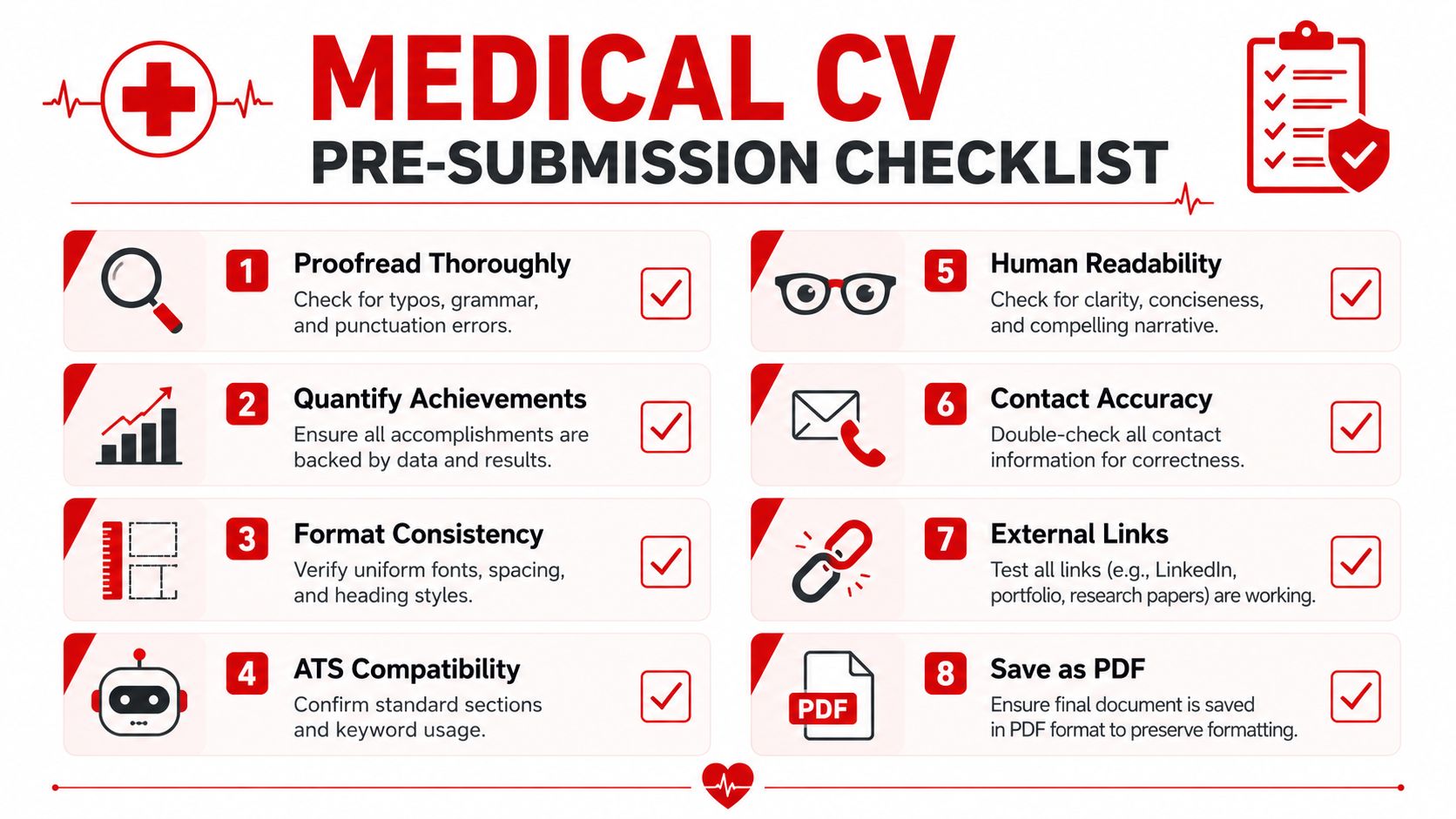
Use this before every submission
- Read dates line by line: Check month and year consistency across education, exams, research, and work history.
- Verify section order: Make sure the document still follows a standard medical sequence.
- Check tense: Current roles use present tense. Completed roles use past tense.
- Remove weak adjectives: Cut words that praise you without evidence.
- Confirm contact details: One typo in your email or phone number is enough to cost you interviews.
- Test every link: If you include publications, profiles, or portfolio material, make sure they work.
- Review the file name: Use your name and role clearly, not “CV final final newest.”
- Export carefully: Preserve formatting in PDF unless a portal requires another format.
Get one outside read
A mentor, chief resident, attending, advisor, or detail-oriented colleague will catch things you no longer see. Ask them two questions only:
- Where did you get confused?
- What looked weak, vague, or overstated?
That feedback is more useful than generic praise.
For applicants managing deadlines across exams, letters, signals, and application assembly, it helps to keep the broader ERAS application timeline visible while you revise. A great CV submitted late or in the wrong version still loses.
Your medical CV template should end up doing one quiet thing very well. It should make a reviewer trust that you are organized, honest, current, and ready for the next step.
If you're preparing for board exams, rebuilding after a non-match, or trying to present a stronger residency application overall, Ace Med Boards offers targeted support for USMLE, COMLEX, shelf exams, and match strategy. If your CV problems are really a bigger application strategy problem, that kind of focused help can save a lot of wasted cycles.