

The MCAT total score ranges from 472 to 528, each of the four sections is scored from 118 to 132, and the midpoint is 500. Because the whole exam spans only 56 total score points, even a single point can matter a lot when you're comparing yourself with other applicants.
If you've just opened your score report, that compressed scale can feel more intense than a simple number should. The good news is that once you understand how the mcat range of scores works, the report becomes much easier to interpret, especially when you look at section balance, percentiles, and school-specific expectations instead of the total alone.
Understanding the MCAT Scoring Scale
You can stare at an MCAT score report and still feel unsure what it means in practice. That confusion is normal, because the exam doesn't use raw percentages, it uses a scaled system built around a narrow score band.
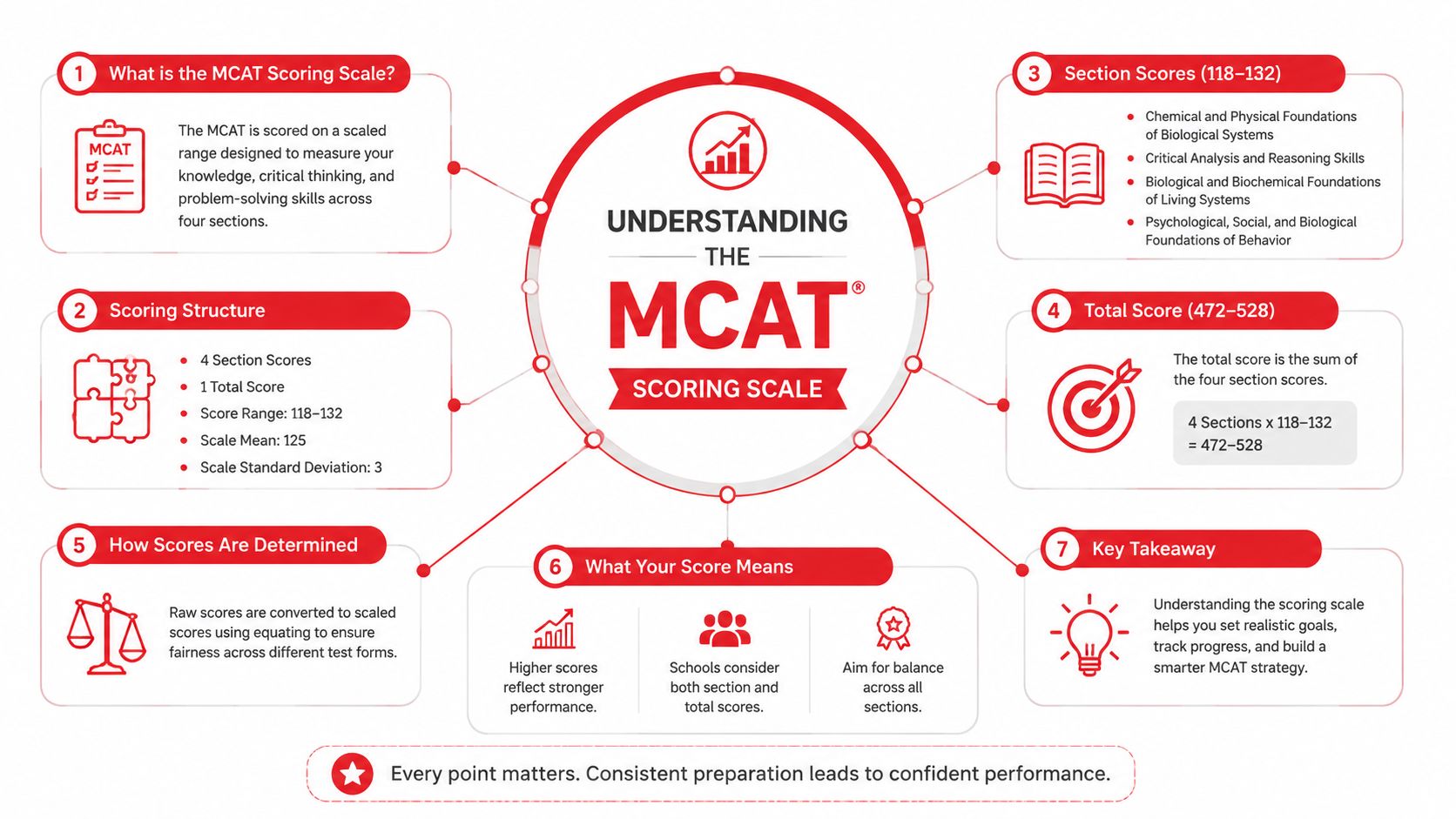
The four sections are Chemical and Physical Foundations of Biological Systems, Critical Analysis and Reasoning Skills, Biological and Biochemical Foundations of Living Systems, and Psychological, Social, and Biological Foundations of Behavior. Each section is scored from 118 to 132, with 125 at the midpoint, and the total score runs from 472 to 528, with 500 at the midpoint (AAMC score scale). That means the center of the exam is not a percentage, it's a scaled score designed to summarize performance in a consistent way.
Why the scale feels so tight
A 500 is the center of the scale, not a failure point, and 528 is the highest possible score while 472 is the floor. The AAMC also reports total scores with an approximate ±2-point confidence band, so a reported 500 can correspond to a true-score range of roughly 498 to 502 (AAMC score scale).
Practical rule: don't read one point as a full story. On a compressed scale, a tiny change can still be meaningful, but it should be interpreted alongside your section pattern and your target schools.
If you're comparing scores, think of the scale like a narrow staircase instead of a wide highway. Every step still matters, but you need context to know whether the step moved you toward your goal.
For a simple primer on how the test is structured, this guide to what the MCAT is scored out of can help anchor the numbers.
How Scaled Scores Differ from Raw Percentages
A lot of pre-meds assume the MCAT works like a classroom exam where the final number is a percentage of questions correct. It doesn't. The score you receive is scaled, which means the AAMC converts raw performance into a standardized result that can be compared across test forms.
That conversion matters because not every MCAT form is identical in difficulty. A scaled score helps keep a 125 on one test date equivalent to a 125 on another test date, even if the mix of questions changed slightly. In other words, the number on your report is meant to reflect performance level, not just how many questions you happened to get right that day.
Why the raw score never appears
You'll never see a raw percentage on the report because the scaled score is the official result used in admissions screening. That's one reason the mcat range of scores can feel abstract at first. It isn't meant to tell you “you missed X percent,” it's meant to place your performance on a consistent admissions scale.
A useful analogy is a weather map. The raw answers are like the local conditions, while the scaled score is the forecast label that lets everyone compare the same day across different locations. The AAMC's score architecture makes that comparison possible across testing dates and forms (AAMC percentile ranks).
For students who are practicing with official-style full lengths, the main habit to build is consistency. That's why a tool like AAMC MCAT full-length practice exams matters so much during prep, because it helps you see how scaled performance behaves over time.
A one-point change in a compressed scale can look small, but admissions screening often treats that small change as meaningful because the scale has limited room to move.
The key mental shift is simple. Stop asking, “What percentage did I get?” and start asking, “What score level did this performance represent, and how does that compare with the schools I'm targeting?”
MCAT Percentiles and What They Mean for Admissions
Percentiles are where the score starts to feel real. They show how your result compares with everyone else in the testing pool, which is far more useful than treating the number as if it were a standalone grade.
The AAMC's percentile tables use rolling testing data, not just one year, so the comparisons stay current (AAMC percentile ranks). Independent summaries drawing on AAMC data report that the average MCAT score for all test-takers is about 500.7 to 501, while successful U.S. MD matriculants typically average around 511 to 512. Kaplan also reports that 515 sits around the 91st percentile. Those numbers help explain why the same score can feel “fine” in one context and “competitive” in another.
MCAT Score to Percentile Reference
| Total Score | Approximate Percentile | Competitiveness Context |
|---|---|---|
| 500 | Around the center of the scale | Around average for all test-takers |
| 501 | Around the center of the scale | Around average for all test-takers |
| 511 | Higher than average | Around the level reported for successful U.S. MD matriculants |
| 512 | Higher than average | Around the level reported for successful U.S. MD matriculants |
| 515 | Around the 91st percentile | Strong upper-end performance |
If you're looking for a broader benchmark, this overview of the average MCAT score is a helpful companion. It reinforces the main point, the average test-taker and the average matriculant are not the same audience.
What the gap means
The spread between the average test-taker score and the typical U.S. MD matriculant score is large on a 56-point scale. That's why applicants often focus on the 510+ range when they're thinking about competitiveness. It's also why a score in the low 500s can still be a legitimate planning point, depending on the rest of the application.
Admissions lens: percentiles tell you where you stand relative to the pool, not whether a number is “good” in isolation.
If you want a school-specific explanation of score targets, the next section goes deeper than the general labels people throw around online.
What Medical Schools Consider a Competitive MCAT Score
A competitive MCAT score isn't a universal number. It depends on the school, the applicant pool, and how your score fits with the rest of your file.
Broad labels still show up everywhere. People talk about average as around 500, competitive as roughly 509 to 514, and strong as 515+. Those labels are useful starting points, but they're not admissions rules. A school with a different mission, state-residency focus, or class profile may read the same score very differently.

Balance matters more than many guides admit
A total score can hide a section weakness. A 512 with one very low section may be viewed differently from a balanced 512, because admissions committees often read the section pattern as part of your academic readiness. The same total score can therefore tell two different stories.
That's where section-level review becomes important. The four sections all use the same 118 to 132 scale, but committees don't always weigh them the same way for every applicant. School mission, state residency, and cohort expectations all shape how that score is interpreted.
A practical way to research competitiveness is to look for the middle of a school's own reported score range and compare it with your total and section spread. If you're building systems for that kind of tracking, a resource like test prep center software can help organize score data, though your decision still has to be based on the school list you're targeting.
For a more direct discussion of score labels, this guide on a good MCAT score is a useful companion.
The main takeaway is simple. A score becomes competitive when it fits the school's context and the rest of your application, not when it hits a magic number on a generic chart.
Score Audit Checklist and Target Setting Framework
A score report is most useful when it leads to a decision. If you're reviewing a current score or planning a retake, a structured audit keeps you from chasing vague improvement goals.
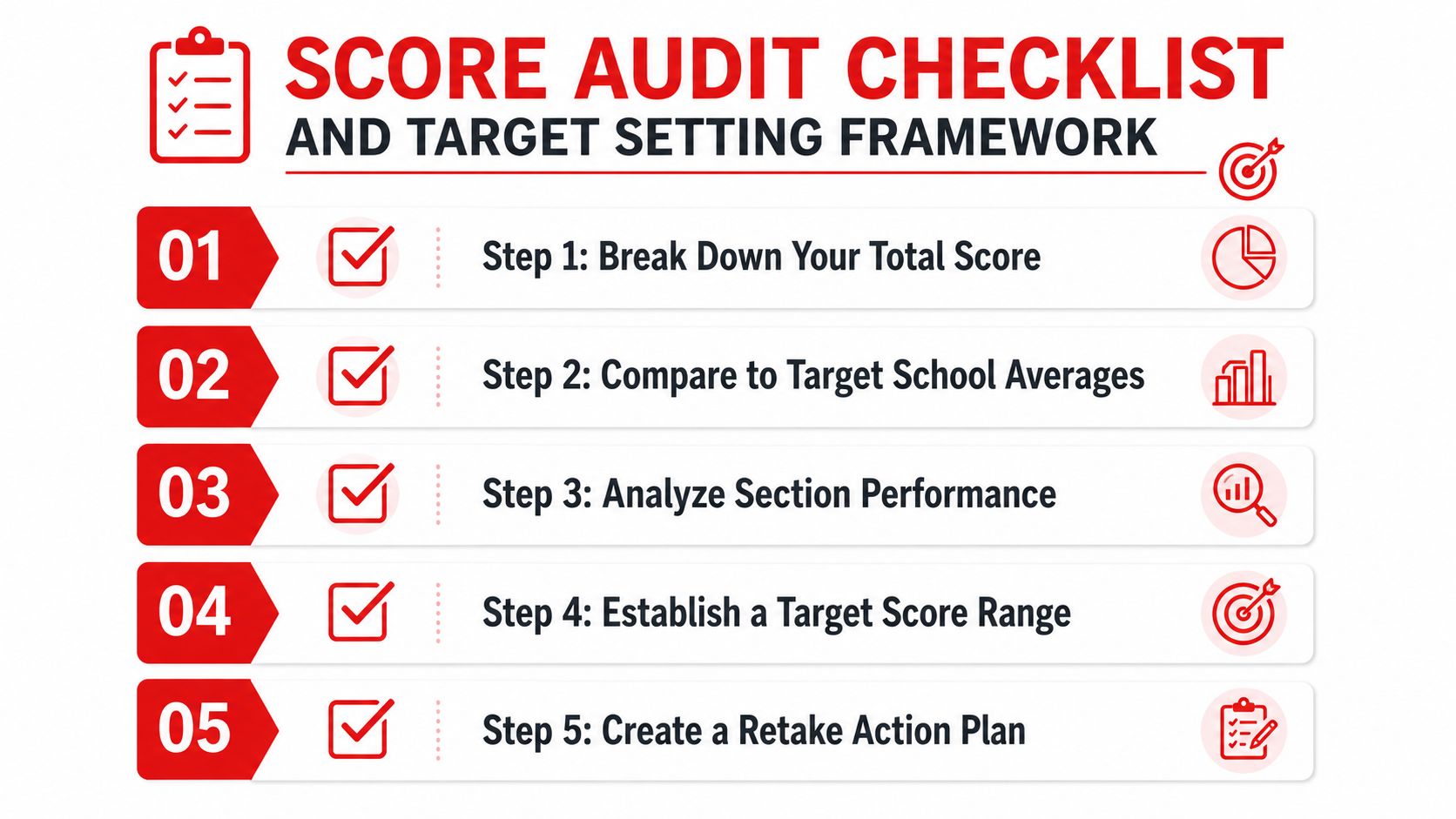
A five-step score audit
Break down your total score.
Start with the full number, then look at each section on its own. The total matters, but the section pattern usually tells you where the biggest opportunity is.Compare to your target schools.
Don't compare yourself only with anonymous averages. Measure your result against the schools you'd submit to.Identify your lowest section.
One weak section can explain why a score feels less competitive than the total suggests. That's the first place to focus your next prep block.Check the confidence band.
Because the AAMC reports total scores with an approximate ±2-point confidence band (AAMC score scale), a close result may deserve more nuance than a flat retake decision.Build a retake plan only if the gap is real.
If you retake, your study time should target the section that dragged the score down, not the whole exam in equal amounts.
A simple planning framework
Use your lowest section to set the first part of your plan, then reserve extra review time for the content areas and passage types that keep resurfacing in practice. If your total is already in the range you want, the goal may be refinement, not a complete rebuild.
Best use of prep time: spend the most time where your score report is most uneven, not where it feels most comfortable to study.
If you want a fast way to organize that planning, a service like MCAT score interpretation and planning support can be one option among others, especially if you want a structured second look at what the number means. A score audit doesn't replace hard work, but it makes the work more targeted.
Moving Forward After a Lower Than Expected Score
A lower-than-expected score can feel heavy, especially if you tied it to a specific admissions plan. That feeling is real, and it doesn't mean your path is over.
The first question is whether the score is out of range for your target schools or just lower than your personal goal. Those are not the same problem. If your score sits below your target but your GPA, experiences, and narrative are strong, you may still have a workable application strategy. If the score is the main limiter, a retake may be worth considering.
When a retake makes sense
A retake is most useful when the gap is specific and fixable. If one section pulled down the total, if practice exams were consistently higher than test-day performance, or if your score is far from the schools you're aiming for, a second attempt can be reasonable.
The key is not to retake on emotion alone. Review your section breakdown, compare it with your school list, and look at the rest of your file. For a grounded discussion of this decision point, this page on a low MCAT score gives a helpful starting point.
A lower score also doesn't erase other strengths. Admissions committees still look at the whole application, including academic history, experiences, and fit with the program.
If the number disappointed you, give yourself a day to absorb it, then move back to the facts. The next decision should be strategic, not reactive.
Key Takeaways and Next Steps
The mcat range of scores is compressed, so small differences can carry real weight. A 500 sits at the middle, 528 is the top, and 472 is the floor, which is why section balance and percentile context matter so much.
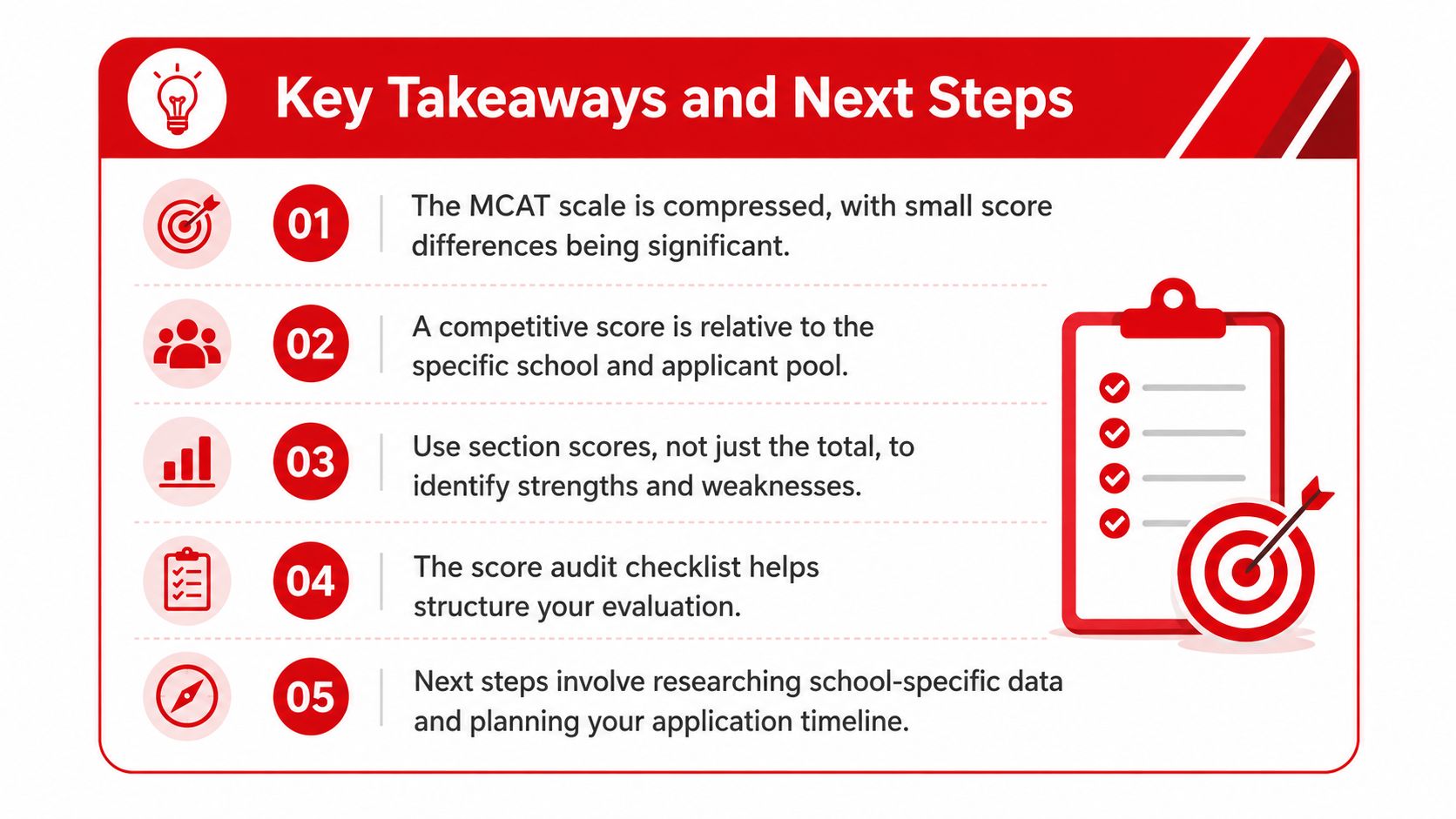
A strong plan starts with the score report, not with a guess. Compare your sections, check the percentile context, and decide whether your number fits the schools on your list before you commit to a retake.
The most useful next step is a score audit. If you want help translating your MCAT result into an actual application plan, Ace Med Boards offers MCAT preparation and admissions support that can help you think through score targets, section balance, and retake decisions with more clarity.
If you're unsure how your MCAT score fits your school list or whether a retake is worth the time, Ace Med Boards can help you sort out the numbers and build a plan around them. Visit Ace Med Boards to explore MCAT preparation and admissions support, then schedule a free consultation when you're ready for a more personalized score review.