A student three weeks into the internal medicine clerkship has a coat pocket full of notes and a reading list longer than the shift. The useful answer is not a prestige ranking. Internal medicine books for medical students pay off when each title has one job: reference, clinical reasoning, or retrieval practice. The default that covers most clerkship and exam needs is one core text plus one practice source.
A textbook explains why a disease behaves as it does. A casebook shows how reasoning moves from a presentation to a diagnosis. A review book compresses what to remember, and a question bank tests whether it stuck. Name the job before opening the cover.
Key takeaways
- Sort by job, not fame. If two books do the same job, keep the one that fits this stage.
- One core text and one practice source cover most needs. Extra titles usually repeat a job already covered.
- Missed questions should send a student to a short matching section, not a cover-to-cover reread.
- Confirm the edition on the publisher page before buying, because internal medicine changes faster than a printed spine.
Four Internal Medicine Book Types Compared
| Book type | Main job | Depth | Time cost |
|---|---|---|---|
| Core textbook | Explains mechanisms, disease patterns, and management | Comprehensive | High; read selectively |
| Clinical reasoning casebook | Walks through cases and differential diagnosis | Medium; case-linked | Medium |
| Concise review book | Condenses high-yield points for a final pass | Medium; condensed | Low |
| Question bank with explanations | Builds retrieval and tests reasoning | Set by how long each explanation is | Medium to high; timed blocks |
| Bedside reference handbook | Quick look-up of workup and treatment | Concise reference | Low; look-up use |
Core textbook. This is the book that connects a mechanism to the bedside finding and the treatment choice. It is too long for a nightly cover-to-cover read.
Clinical reasoning casebook. Each chapter starts from a presentation, not from a disease name, and shows how a differential narrows.
Concise review book. This is a final-pass compression tool. It does not replace the explanation a student still cannot reconstruct.
Question bank with explanations. Retrieval is the test of whether the earlier reading stuck. Timed blocks also show pacing problems that rereading hides.
Bedside reference handbook. On a rotation day this answers what to look up before rounds. It is the wrong book for building a new framework after sign-out.
Practical rule: A deeper book costs more hours, so one core text paired with one practice source covers most needs.
On clerkship days, the handbook is for look-up between patients. Casebooks and review books belong to after-shift study. A quick shelf test is simple. Name the job of every book already owned. If two books do the same job, keep the one that matches the current stage and set the other aside.
Core Textbooks for Building Internal Medicine Knowledge
A patient's symptoms, examination findings, and test results are easier to connect when you can follow a disease from mechanism to management. A core textbook gives you that structure, but its job is to clarify a question you are studying, not to supply a nightly cover-to-cover reading assignment.
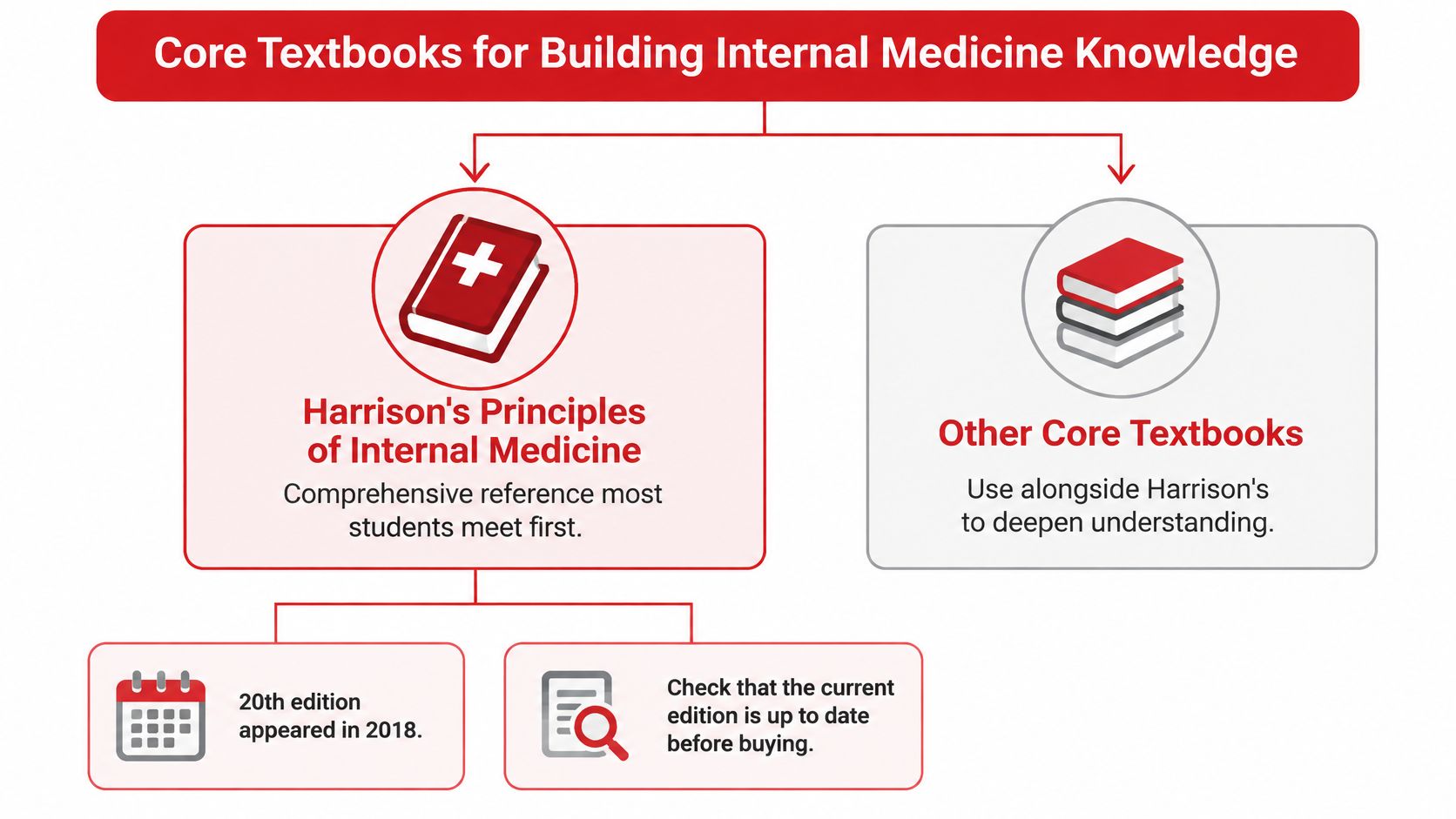
Harrison's Principles of Internal Medicine is a broad reference for tracing those connections. The textbook's publication history and editorial details list the 20th edition as released on August 17, 2018, with J. Larry Jameson, Anthony S. Fauci, Dennis Kasper, Stephen Hauser, Dan Longo, and Joseph Loscalzo as editors. The series began in 1950. Since editions change, confirm the current edition and price on the publisher's page before buying.
What the breadth is for
Breadth helps when a shelf or Step question asks you to connect pathophysiology with a clinical pattern, a test, and a management choice. Use pathophysiology to connect mechanisms with clinical findings, rather than memorizing mechanisms as isolated lists. Harrison's works well as a reference when one link in that chain is unclear; it is less suited to a quick review of everything before an exam.
Other core texts serve different purposes. Current Medical Diagnosis and Treatment is used for differential tables and drug details. The Washington Manual of Medical Therapeutics focuses on management and quick bedside look-up. Choose the book that answers the question in front of you, then return to practice questions to check whether you can use what you read.
What one clerkship cohort actually found
Format alone may matter less than how you study. In a prospective cohort of 114 third-year internal medicine clerkship students, electronic versus print reading did not significantly predict National Board of Medical Examiners (NBME) examination performance (p > 0.80). Any use of Harrison's was associated with an approximately 3-point higher NBME score (p < 0.04; SD 1.4), according to the Teaching and Learning in Medicine cohort report. This observational association does not show that buying or reading the book caused the difference.
Keep the routine simple: choose one core text and one practice source. After a missed question, read the section that addresses the gap, then record the relevant differential or mechanism in your notes. That way, the textbook explains the problem and practice tests whether you can retrieve and apply the explanation.
Clinical Reasoning Casebooks for Clerkship Cases
A patient with worsening breathlessness and swollen legs appears in a clerkship vignette. A reference book might begin with heart failure; a clinical reasoning casebook begins with the symptoms and asks how to distinguish heart failure from its mimics. That makes a casebook useful for practicing the sequence of differential diagnosis, discriminating findings, and test selection. For a concise explanation of the skill, see what clinical reasoning involves.
A breathlessness case, worked as exam practice
Use the vignette to practice decisions, not just recall:
- Frame the pattern. Breathlessness with edema suggests a cardiopulmonary or volume problem, but does not identify one diagnosis.
- List competing explanations. Heart failure, chronic lung disease with cor pulmonale, and kidney disease with fluid retention could all fit. A useful casebook asks you to name alternatives before revealing the answer.
- Predict what would separate them. Raised jugular venous pressure and a third heart sound would favor heart failure. A quiet chest and heavy proteinuria would shift attention toward kidney disease.
- Explain what the finding changes. Identify how a result would affect the next diagnostic or management decision. This is the step that turns a memorable case into a reusable reasoning pattern.
Case-based practice with feedback can help students develop clinical reasoning more actively than passive reading alone. The casebook is a practice tool, not a replacement for a core text: it helps you work through decisions, while the text supplies the disease knowledge those decisions depend on.
A checklist for any casebook
Case Files Internal Medicine is one example of a case-based format. Check the edition on the publisher's site before buying. Then look for features that make the cases useful for deliberate practice:
- Cases that begin with a presentation, so you must identify the problem before seeing the diagnosis.
- Decision algorithms you can redraw from memory.
- Tables that compare mimics, rather than listing only the classic features of one disease.
- Explanations for wrong answers, which show why a plausible alternative does not fit.
- End-of-chapter cases that test the same decision in a different scenario.
Use the book to rehearse a repeatable sequence: define the pattern, compare likely explanations, identify the discriminating finding, and state how it changes your next step. Keep the focus on exam learning; decisions about real patients require appropriate clinical supervision.
Review Books and Question Banks for Shelf and Step 2 CK
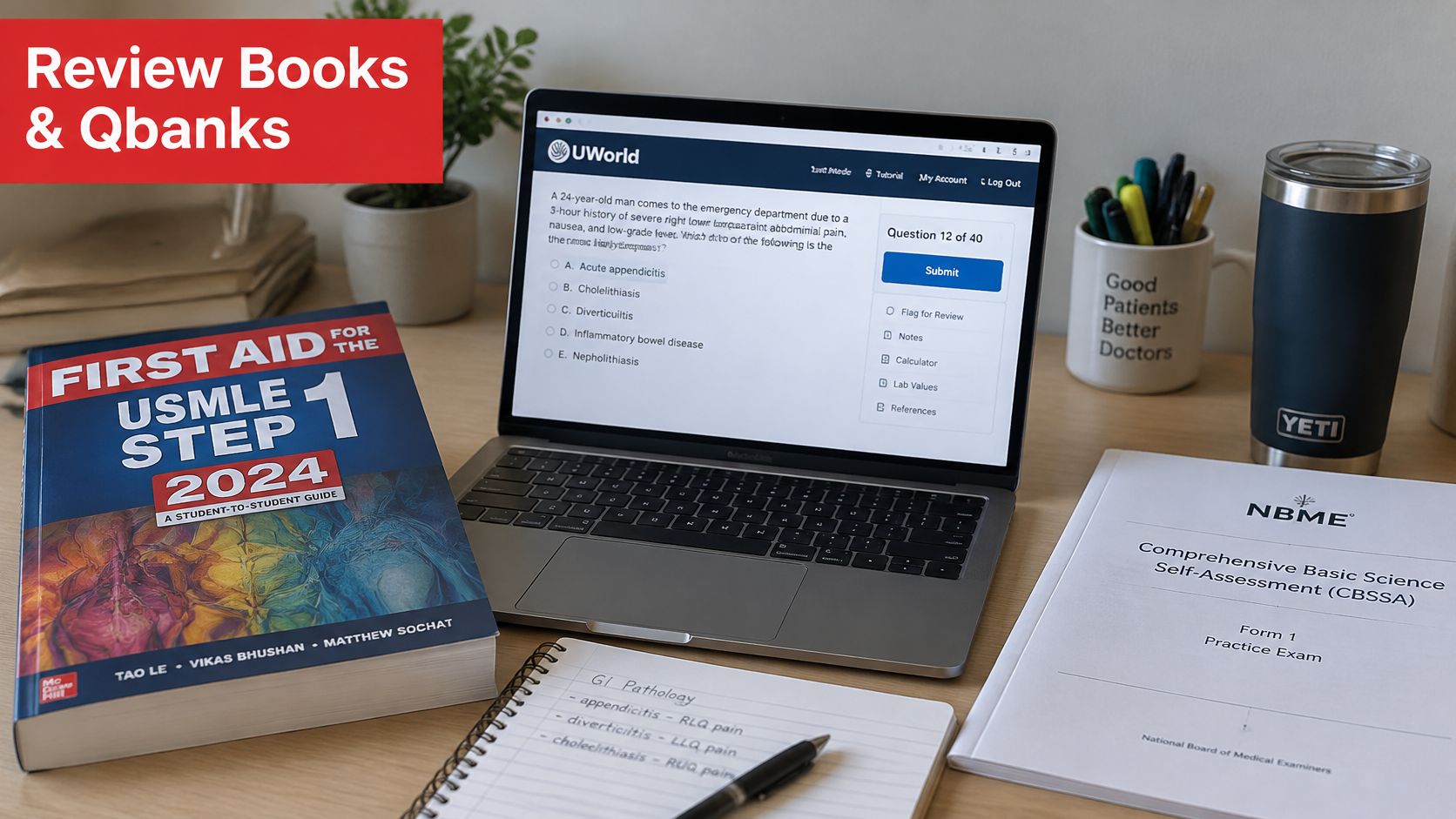
A student preparing for an internal medicine shelf exam needs three different tools for three different jobs. A concise review book refreshes high-yield facts; an official NBME practice exam provides a standardized self-assessment; and a question bank offers repeated practice with explanations. For a shelf-focused plan, Ace Med Boards' internal medicine shelf review is another resource to consider.
Where MKSAP fits, and where it does not
The American College of Physicians (ACP) Medical Knowledge Self-Assessment Program (MKSAP) is a digital internal medicine learning system for physicians and trainees. The 2025 MKSAP release includes nearly 2,000 unique multiple-choice questions mapped to the American Board of Internal Medicine (ABIM) blueprint, 16 evidence-based subspecialty areas, and hundreds of images, tables, and algorithms. Its formats include traditional questions, Quick Qs, and Virtual Dx image-based questions.
That breadth can serve as a reference and practice resource, but its intended audience is physicians and trainees, subspecialists, and primary care physicians. A medical student should check whether the content and level of detail fit the exam being prepared for. ACP released the subscription-based program on February 3, 2025, replacing MKSAP 19 as the current edition, according to ACP's notice about MKSAP 19. Before comparing it with another bank, check the edition, access period, and included question formats.
UWorld is a separate third-party question bank used by many USMLE candidates. It is not an ACP product, and this description does not imply affiliation with UWorld, NBME, or USMLE.
What to compare before paying
- Explanation quality. A correct answer matters less if the explanation does not show why it is right and why the alternatives are wrong.
- Exam fit. Step 2 CK and COMLEX-USA Level 2-Cognitive Evaluation (CE) are different exams. Choose a bank that matches the exam you plan to take.
- Practice format. Timed blocks can reveal pacing problems that untimed tutor mode may hide.
- Edition, price, and access period. Subscription terms change, so check the current details before buying.
- Question source. Use legitimate study materials; this description does not reproduce or claim access to live exam content or copyrighted question-bank material.
Stage Pairings and a Repeatable Study Routine
The stage map below is a planning frame, not a rule. Students repeating an exam, students in osteopathic programs, and students in schools outside the United States should check NBME, the National Board of Osteopathic Medical Examiners (NBOME), or USMLE pages as of the date they register. Third-party summaries go stale.
| Stage | Core reference | Reasoning or review | Practice | Adjust when |
|---|---|---|---|---|
| Pre-clinical years | Core text used selectively | Optional concise review book | Optional question bank tied to course exams | Course exam misses cluster in one system |
| Clerkship and shelf prep | Core text plus internal medicine casebook | Concise review book for final pass | NBME shelf practice exam and question bank | Reasoning errors repeat across cases |
| Step 2 CK or COMLEX-USA Level 2-CE prep | Core text for mechanisms and management checks | Review book and ACP MKSAP or comparable question source | Timed blocks and full-length practice | Same pattern persists across two practice cycles |
The default set at every stage is still one core text, one practice source, and one review tool. Adding a fourth book usually duplicates a job.
What the miss is telling the student
Triggers are more useful than a longer shopping list.
Repeated reasoning errors, such as a differential that never names a mimic, point toward a casebook. Repeated recall errors, such as forgetting the mechanism or the first-line drug, point back to a short section of the core text. Timing problems, such as a correct idea that arrives after the block ends, point to timed blocks rather than another reread.
A low practice score or a prior unsuccessful attempt is a signal to change the mix, not a verdict on a career. The next cycle should attack the tagged pattern.
Eight steps, then a week
- Choose one core text and one question source.
- Set a fixed block before opening either book.
- Review every item. Tag each miss as a knowledge gap, a reasoning error, or a test-taking issue.
- For a knowledge gap, read only the matching core-text section.
- For a reasoning error, write an illness script: risk, mechanism, finding, test, and management consequence.
- Retest that topic within a week with new questions. Spaced repetition is the point of the delay, not a second brand of flashcard.
- Use the bank's own tracking. ACP describes a personalized Learning Plan that links gaps to syllabus sections, questions, and flashcards, plus unlimited custom quizzes, an Exam Practice preset with timed options, answer strikethrough, notes, and time-to-answer tracking, on its board-review certification prep page.
- If the same pattern persists across two practice cycles, add one-on-one tutoring as a complement to official NBME materials, not as a replacement for them.
Three question blocks, two review sessions, and one reference-reading session make a full week. Protect the reference session so it stays short and tied to misses.
That rhythm keeps the core text in service of questions. It also leaves room for a shelf week, when the review book takes the reading slot and the core text is opened only for a mechanism that still will not stick.
Confirm Editions and Plan Your Next Step

Buying the wrong edition wastes both money and the weeks before a shelf. Finish this check before enrolling in a bank or ordering a book.
- Edition year. Match the year on the cover to the publisher page, not to a used-sale photo.
- Digital expiry. Confirm whether online access ends on a date and whether updates are included.
- Price with an as-of date. Promotional prices change. Write the date next to the number.
- Exam format. Check NBME, NBOME, or USMLE pages rather than a third-party summary. Step 2 CK, a shelf, and COMLEX-USA Level 2-CE are not interchangeable.
- Stage match. A resident-level self-assessment can be the wrong depth for a first clerkship.
- Next step. Decide whether the gap calls for a book, an official practice exam, or tutoring. A Step 2 CK study materials page is the place to separate dedicated-period tools from clerkship tools.
Ace Med Boards offers private online tutoring for USMLE Step 1, Step 2 CK, and Step 3, for COMLEX-USA Level 1, Level 2-CE, and Level 3, and for selected Shelf and COMAT examinations, including internal medicine among other core rotations. Students who already have a core text, a question source, and a clear pattern in missed questions can request a free consultation through the tutoring services page. That review looks at the pattern. It does not promise a score or a result.
Names worth checking against primary pages, as of the date of use, include NBME, NBOME, and USMLE for exam rules, ACP for MKSAP edition and question counts, the publisher page for Harrison's and for Frameworks for Internal Medicine, and the clerkship cohort and the 27-study review cited above for how active case work compares with passive reading.
Ace Med Boards offers online one-on-one tutoring for USMLE, COMLEX-USA, and selected Shelf and COMAT exams, including internal medicine, for students sorting a core text against question review. The sessions complement official practice materials rather than replacing them. Students who want help matching a book and a question source to a shelf or Step 2 CK plan can visit Ace Med Boards to schedule a free consultation.