You are in the middle of a lecture, staring at a slide full of abbreviations everyone else seems to recognize instantly. A classmate mentions a “Step score,” someone else asks about “away rotations,” and you realize half the room grew up hearing this language at home, while you're translating it in real time. That moment can feel isolating, but it does not mean you don't belong in medicine. It means you need a map, not more pep talks.
What It Means to Be a First Generation Medical Student
The first day I noticed I was a first generation medical student, I was sitting in anatomy lab and heard two classmates compare the residency advice they'd gotten from their parents. One had a dad who could explain board exams over dinner. Another knew how to talk about specialties like they were family businesses. I knew how to study hard, but I didn't know the family script everyone else seemed to have inherited.
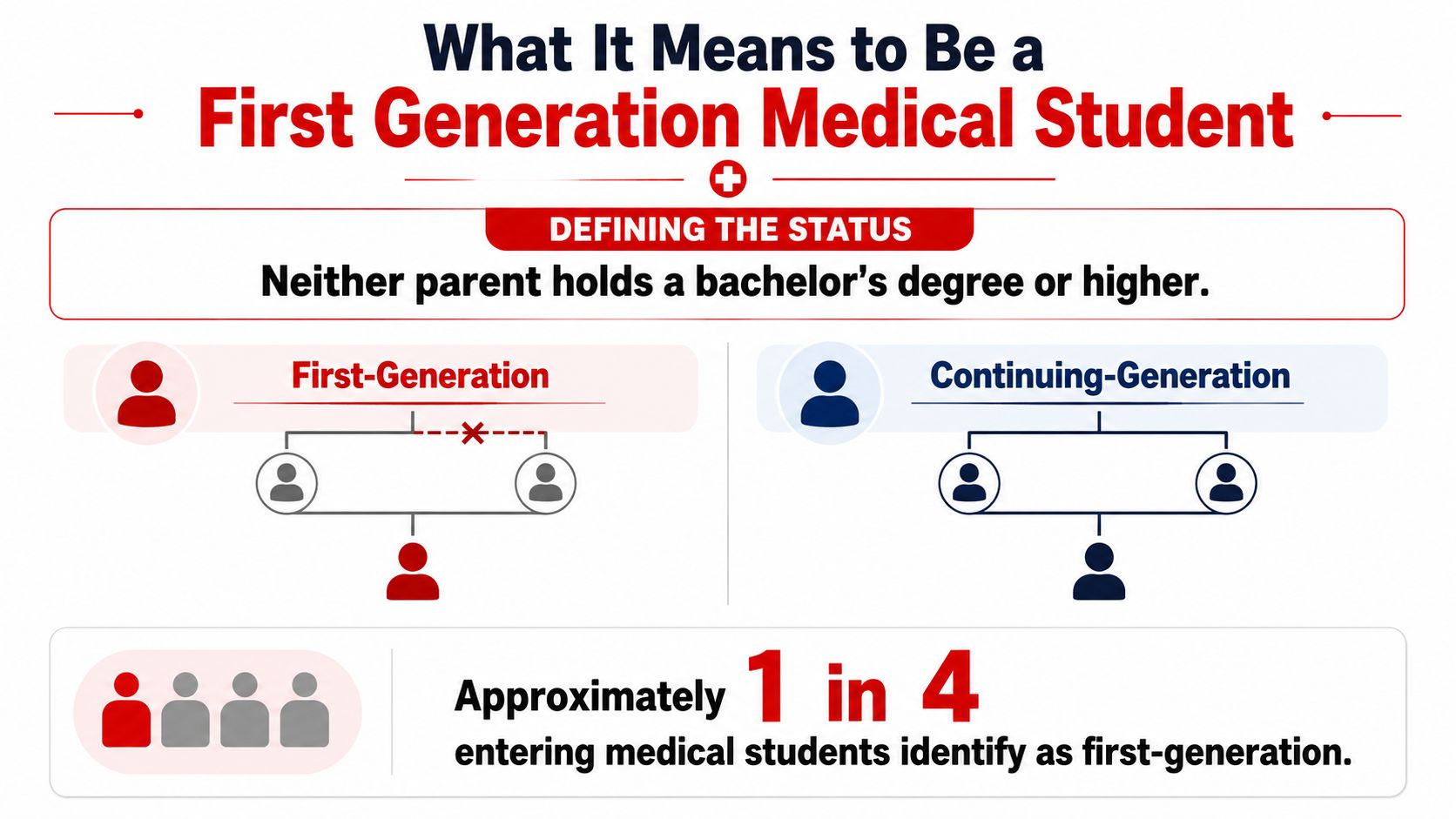
The standard definition is simple. A first generation medical student is someone whose parents did not obtain a bachelor's degree or higher. That definition matters because it captures access, not intelligence. It tells you who had to learn the hidden rules without a built-in map, and that difference shows up in day-to-day life long before it shows up in match lists or exam scores.
The numbers show that first-generation students are present, but still underrepresented. AAMC data show they were 15% of the 2022 to 2023 matriculant pool, while the share of applicants was 13.8% and the share of matriculants in 2024 to 2025 was also 13.8%. Earlier national research found they were 7.4% of U.S. medical students overall from 2002 to 2015, and their share of matriculants declined from 8.7% in 2002 to 7.1% in 2015. The AAMC also reported an increase in the first-generation share of MD matriculants from 10.8% in 2018 to 2019 to 12.4% in 2021 to 2022. AAMC data on first-generation medical students
That trend is encouraging, but it does not erase the lived experience. Being first generation often means you're learning the profession and the culture at the same time. You may be the person who has to ask what an ICU is, what a shelf exam is, or how to introduce yourself on a rotation, while others are already comfortable with those phrases.
If you've been waiting for permission to call yourself first generation, you have it. The label is not a limitation. It is a practical way to access support, from mentoring and scholarships to student services designed for people who entered medicine without family precedent. For schools and programs that center that support, see Ace Med Boards' diversity in medicine resource.
Key Structural and Resource Challenges for First-Generation Medical Students
The biggest mistake people make is treating first-generation struggle like a motivation problem. The more accurate frame is resource insecurity, a mix of academic, financial, social, and structural pressure that keeps stacking in the same direction. For a first-generation student, that can feel like trying to study with a backpack that keeps filling up with other people's rules.
Academic strain is often a knowledge-gap problem
A lot of first-generation students are perfectly capable of the science, but they are asked to perform while still decoding unfamiliar systems. The problem is not only content mastery. It is learning what people mean when they say a course is “high yield,” how to interpret an NBME-style question, and how to recover from a disappointing exam without a parent or sibling who has lived through the same process.
That gap can look small from the outside and huge from inside the room. If you have never watched someone else study medicine before, even ordinary terms can feel like a second language. The fix is rarely raw effort alone. It is getting explicit about the rules, asking for examples, and building a study routine around how your school tests, not around vague advice.
Financial pressure changes how you study
Money problems do not stay separate from academics. If you are choosing between a question bank and groceries, or between transportation and textbooks, your attention gets split before you ever open Anki. That pressure is why the hidden burden of medical school matters so much. Basic needs, not just motivation, can shape whether someone has enough bandwidth to keep up.
A practical rule helps here. If money stress is affecting your schedule, treat it as an academic variable, not a personal flaw. That means tracking the exact places where cost is changing your behavior, then looking for lower-cost options, campus support, or temporary triage before the stress turns into missed study time.
Social capital is not evenly distributed
Some students already know which professors write strong letters, how to ask for research, or what counts as normal rotation behavior. Others are figuring that out from scratch. That gap affects confidence, but it also affects access. Mentorship, introductions, and informal coaching are real advantages, and first-generation students often have to build them deliberately instead of inheriting them.
A useful comparison is to a hospital map. If you already know where the doors are, you move faster. If you do not, you can still get there, but you spend more energy asking which hallway leads to the next room. The workaround is to make the invisible rules visible early, by asking direct questions, saving examples of strong emails and presentations, and identifying one or two people who will explain the process without making you feel behind.
Structural barriers show up as attrition risk
The downstream effect is not abstract. Compared with non-first-generation peers, first-generation and low-income students are less likely to apply to medical school, have lower acceptance rates when they do apply, are more likely to take a leave of absence during training, and are more likely to leave medical training altogether. Low-income students are also less likely to secure residency placements. JAMA Network Open on training pipeline outcomes
A useful self-check is this. If your biggest barrier right now is time, the fix is structure. If it is money, the fix is funding and triage. If it is social confusion, the fix is explicit coaching. If it is burnout, the fix is support systems, not tougher self-talk.
Decoding the Hidden Curriculum Nobody Explains
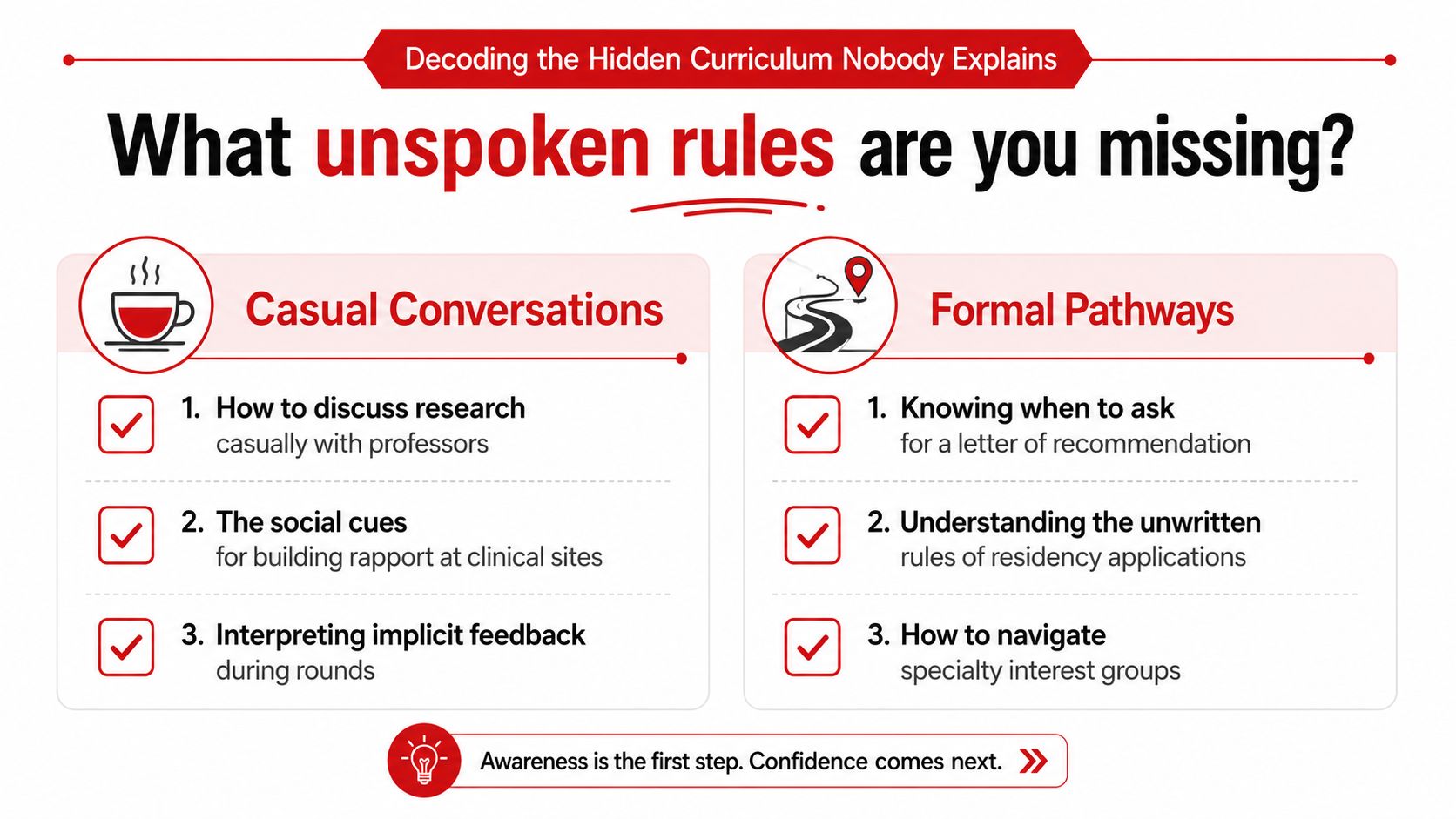
Most of what trips up a first-generation student is not hidden because it is secret. It is hidden because nobody says it out loud. Medical education assumes you already know the rules around exams, rotations, and professional behavior, and that assumption can be brutal if your family has never been inside a hospital hierarchy.
Start with the words people use casually
A Step exam is not just “another test.” It is a milestone with consequences, and people talk about it casually because they've been around it for years. An ICU is not just a more intense ward. It is a setting with different patient complexity, staffing patterns, and expectations. Rotation etiquette also matters more than many students expect. On day one, you need to know who to introduce yourself to, how to ask where to stand, and when to speak up versus when to observe.
Learn what people mean when they give vague feedback
One of the hardest parts of clinical training is interpreting feedback that sounds polite but isn't specific. “Be more confident” can mean speak more clearly on rounds, or it can mean prepare before patient presentations. “Read more” might mean you need better pre-round organization, not longer study sessions. If you were never taught how academic feedback works, ask for examples, not just general impressions.
Ask direct questions that close the gap fast
Ask one person at a time. A resident, senior student, or clerkship director can usually clarify more in ten minutes than you can figure out alone in ten days.
Use questions that are concrete:
- “What does a strong presentation sound like on this rotation?”
- “What should I know before I start this specialty block?”
- “Who usually writes the best letters for students interested in this field?”
- “What does this exam emphasize?”
The medical-education literature has started naming these everyday gaps more clearly, including the knowledge that many students are expected to already have, such as the cost of materials, the meaning of common clinical settings, and practical rotation etiquette. Academic Medicine on the hidden curriculum
A video can help make this feel less abstract. Watch the embedded overview below, then write down three rules you wish someone had explained earlier.
If you leave this section with one habit, make it this. Turn every confusing moment into a question you can ask once, clearly, to the right person.
Study Strategies and Test Prep That Actually Work
The best study plan for a first-generation student is usually not the fanciest one. It is the one that survives a job, a commute, family obligations, and a budget that does not leave room for endless subscriptions. That means your system has to be simple enough to repeat and strong enough to measure.
Build around active recall, not rereading
Passive reading feels productive because it is comfortable. It also fades quickly. Use retrieval first. Close the notes and ask yourself what you remember. Then check the gaps. That can look like practice questions, blank-paper recitation, or teaching a concept out loud as if you were on rounds.
Use spaced repetition to stop relearning the same material
Anki, a simple review calendar, or a notebook-based repetition system can all work if you revisit information on schedule. The point is not the tool. The point is forcing your brain to encounter weak material again before it disappears. That matters most when your time is tight, because you cannot afford to keep starting over.
Make questions the center of your week
Question-bank review is where a lot of first-generation students gain traction. Do not just mark items right or wrong. Write down why you missed them. Was it knowledge, wording, or timing? That error pattern tells you what to fix next. If you want a more detailed framework for this, the study-planning guide at Ace Med Boards' medical student study tips page is a useful place to compare routines and build a schedule around rotation demands.
A realistic weekly structure might look like this:
- Two focused content blocks for weak topics
- Daily question sets with review
- One cumulative review session to prevent forgetting
- One buffer block for catching up after clinic or family responsibilities
Useful benchmark: If your schedule only works on perfect days, it's not a schedule yet.
When tutoring is worth it
One-on-one tutoring helps most when the problem is not effort but efficiency. If you are studying hard and still missing the same question patterns, targeted coaching can compress the hidden-curriculum gap. It is not a replacement for self-study. It works best when you already have a base routine and need someone to sharpen your question analysis, explain exam logic, or keep you from wasting time on low-yield habits.
Building Mentors, Networks, and Research Opportunities
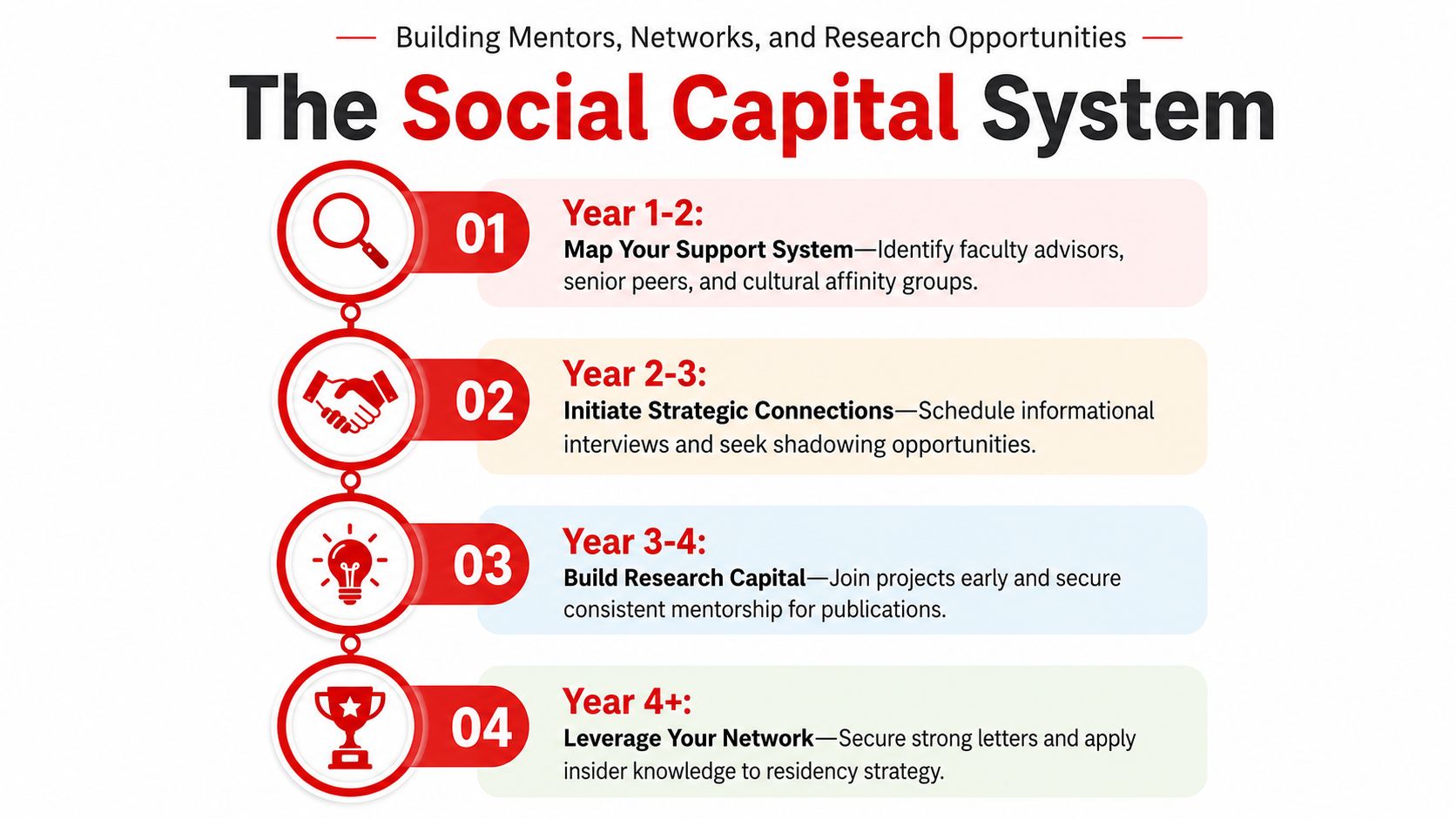
A first-generation student usually does not need more talent. They need more access to people who can open doors, explain norms, and make the next step less opaque. Mentorship, networking, and research are not three separate chores. They are one social-capital system.
Find mentors who understand the resource lens
The best mentor is not always the most famous one. It is usually the person who listens well, gives specific feedback, and understands that “I'm behind” may really mean “I'm also working, supporting family, or navigating uncertainty.” Faculty advisors, clerkship mentors, and senior residents can all play this role if they are consistent.
Ask in a way that makes it easy to say yes
Keep the first ask small. Instead of requesting broad career mentoring immediately, ask for a short conversation about one concrete issue. For example, “Could I get fifteen minutes to ask how you approached research as a student?” or “Would you mind sharing what you looked for in a strong letter of recommendation?” That kind of ask is easier for busy clinicians to answer and easier for you to repeat.
Research access grows from repetition
Research often feels closed because the gatekeeping is informal. Start with one project, show up on time, and keep your communication clean. Then ask what the next step is. If you need help getting started, Ace Med Boards' guide to how to get research experience fits naturally into that process, especially if you do not have family contacts in academic medicine.
A simple 30-60-90 day plan can look like this:
- First 30 days: Identify one advisor, one senior student, and one affinity group.
- By 60 days: Have two informational conversations and one shadowing or research ask.
- By 90 days: Be on one project, one recurring meeting, or one mentorship thread you can maintain.
One relationship done well is more useful than ten names in your inbox.
The goal is not to network like a salesperson. The goal is to build a support web before you need it urgently, because residency applications reward people who already know how the system works.
Scholarships, Grants, and Funding the Practical Way
Money is often the point where a hard path starts to feel impossible. A better funding plan is not to apply everywhere at random. It is to layer the right sources without creating conflicts or missing costs that do not show up until later.
Start with the aid that matches your stage
Need-based aid should come first, because it usually brings the least complication. Then look at school-specific scholarships, first-generation support funds, and diversity-oriented awards. After that, consider federal loan options and service-commitment pathways if they fit your goals. Read the eligibility rules carefully so you do not stack restrictions that cancel each other out.
A common mistake is treating every award like the same kind of money. A scholarship that covers tuition may still leave you short on exam fees or travel, and a service-based award may shape where you train or what you can say yes to later. First-generation students often lose time by chasing aid that looks generous on paper but creates a mismatch in the rest of the budget. If you want a starting point for organized searching, the Ace Med Boards' medical school scholarship page lays out scholarship options in a way that can help you compare the tradeoffs.
Budget for the costs people forget
Tuition is only part of the bill. Board exam fees, question banks, away rotation travel, interview expenses, and professional clothing all show up at the wrong time. Build a running list of those costs now, not when they become urgent.
It helps to track expenses by stage. Pre-med costs look different from M1 expenses, and M4 interview costs are a different category altogether. A simple spreadsheet can do the job if you update it before each semester starts. If your school financial-aid office offers emergency support, ask what counts before you need it, because the answer is often more specific than students expect.
Use outside resources strategically
If a scholarship is tied to service, specialty choice, or geographic commitment, treat it like a contract, not free money. That does not make it bad. It means you need to understand the tradeoff before signing.
Some students also need help with the emotional side of the financial grind. If money stress is feeding self-doubt, imposter syndrome therapy can be a useful outside resource to explore alongside campus support. The point is to have one steady place to sort through pressure, especially when the hidden curriculum makes you feel like everyone else already knows the rules.
A practical rule is simple. Match the money to the milestone. Pre-med costs are different from M1 expenses, and M4 interview costs are different again. A first-generation student who tracks funding by stage usually avoids panic spending later.
Mental Health, Resilience, and Surviving the Pipeline
Resilience gets overused in medicine because people like to praise endurance while ignoring the system that made endurance necessary. For first-generation students, mental health usually improves most when support is concrete, not motivational.
Build a support stack, not a private struggle
Your support stack may include student affairs, counseling, a peer group, an affinity organization, a trusted resident, and one faculty mentor who knows how hard things are. If food insecurity, housing stress, or family pressure is part of your week, therapy alone won't solve it, but it can help you stay functional while you address the practical problem.
For students dealing with imposter feelings that are getting stuck in their head, imposter syndrome therapy can be a useful outside resource to explore alongside campus support. The point is not to outsource your whole life. It is to give yourself another steady place to sort through doubt, shame, and pressure.
Know the warning signs early
Burnout often looks like sleep disruption, irritability, cynicism, avoidance, or the sense that you are always behind no matter how hard you work. If you notice those patterns, don't wait for a collapse. Talk to student wellness, counseling, or your dean of students sooner rather than later.
Treat leave of absence as a strategy when needed
Some students need time off for health, finances, or family care. That is not failure. It is often the safer move. The important thing is to ask about paperwork, timelines, and return conditions before making assumptions. School-based guidance can keep a temporary break from becoming a permanent derailment.
For a more focused school-based resource, the mental health page at Ace Med Boards' medical student mental health resource is worth keeping on hand if you want to compare support options while you train.
Your Year by Year Roadmap and Final Checklist
A first-generation path gets easier when every year has one job. Not ten jobs. One main job, with a few nonnegotiables attached.
| Stage | Top Priorities | Common Pitfalls |
|---|---|---|
| Pre-med | Build science foundations, clinical exposure, and a clear application story | Waiting too long to ask for advising, underestimating costs |
| M1 | Learn the language of medical school, find a study system, identify support | Isolating yourself, passively reading instead of testing recall |
| M2 | Tighten board prep, review weak areas, begin research | Overloading on resources, avoiding structured practice questions |
| M3 and M4 | Excel on Shelf exams, secure letters, plan residency strategy | Hoping people will notice your work without asking for feedback |
Year by year priorities
Pre-med. Learn the basics early, build clinical exposure, and ask for mentorship before application season gets frantic. If no one in your family has gone through this process, you need at least one advisor who can translate the timeline.
M1. Focus on systems. Find your study method, learn how your school evaluates students, and get comfortable asking what everybody else seems to know already.
M2. Start board prep with structure, not panic. This is the year to identify weak content patterns and convert them into question practice.
M3 and M4. Treat rotations like auditions with real learning goals. Ask for feedback, make relationships visible, and build your application materials early enough that they don't become a last-minute scramble.
Final checklist
- Know your main academic support person.
- Keep one active funding plan.
- Ask at least one direct question every week about hidden-curriculum topics.
- Maintain one mentor relationship and one peer support relationship.
- Review your exam and rotation plan monthly, not only when stress spikes.
If you're wondering what happens when the first match attempt doesn't go as hoped, the short answer is this, you regroup, get advice fast, and treat reapplication as a strategy problem, not a character judgment.
Ace Med Boards works with medical students who need structured help across exam prep, study planning, and residency strategy, which makes it relevant if you're trying to close the gap between effort and results. If you want one-on-one tutoring, exam-focused guidance, or a clearer plan for the next stage of training, visit Ace Med Boards and see how its support can fit your path.