You're a few questions into a UWorld block, and the stem drops a phrase like “chromatin remodeling defect” or “epigenetic silencing.” You vaguely remember that euchromatin is “open” and heterochromatin is “closed,” but then the answer choices start throwing around histone marks, Barr bodies, methylation, replication timing, and transcription factors. That's where a simple memorized definition stops being enough.
For the USMLE, euchromatin and heterochromatin aren't just cell biology trivia. They connect genetics, pathology, biochemistry, cancer biology, and lab interpretation. If you can organize this topic the right way, a lot of scattered facts start to make sense.
Why Chromatin Structure Is a High-Yield Topic
Chromatin shows up on boards because it sits at the intersection of gene expression and disease. A cell can have perfectly normal DNA sequence and still behave abnormally if that DNA becomes packaged in the wrong way. That's why exam writers like this topic. It lets them test whether you understand regulation, not just memorized genes.
A classic board trap is this: the question isn't really asking, “What is heterochromatin?” It's asking whether you can infer the consequence of tightly packed DNA, or whether you recognize that loosely packed DNA is more available to transcription machinery. If you miss that link, the stem feels harder than it is.
Why students get stuck
Most students learn a binary shortcut early:
- Euchromatin = open = active
- Heterochromatin = closed = silent
That shortcut helps at first, but boards often push one level deeper. They may ask about:
- Histone modifications linked to each state
- DNA methylation and gene silencing
- Barr body as facultative heterochromatin
- Centromeres and telomeres as constitutive heterochromatin
- Experimental setups involving chromatin accessibility
- Disease states involving failed chromatin maintenance
If you want a broader Step review framework, this list of USMLE Step 1 high-yield topics helps place chromatin in the bigger picture.
The board-relevant question is usually not “Can you define the term?” It's “Can you predict what the cell will do because of that chromatin state?”
The exam mindset
Treat chromatin like a gene access problem. If DNA is easy for proteins to reach, genes are more likely to be expressed. If DNA is packaged into a protected region, genes are more likely to be silenced or structurally stabilized.
That framing helps with histology, molecular biology, and pathology questions. It also helps you avoid overcomplicating a stem that's really testing one simple principle: structure controls access, and access affects function.
Euchromatin vs Heterochromatin The Core Comparison
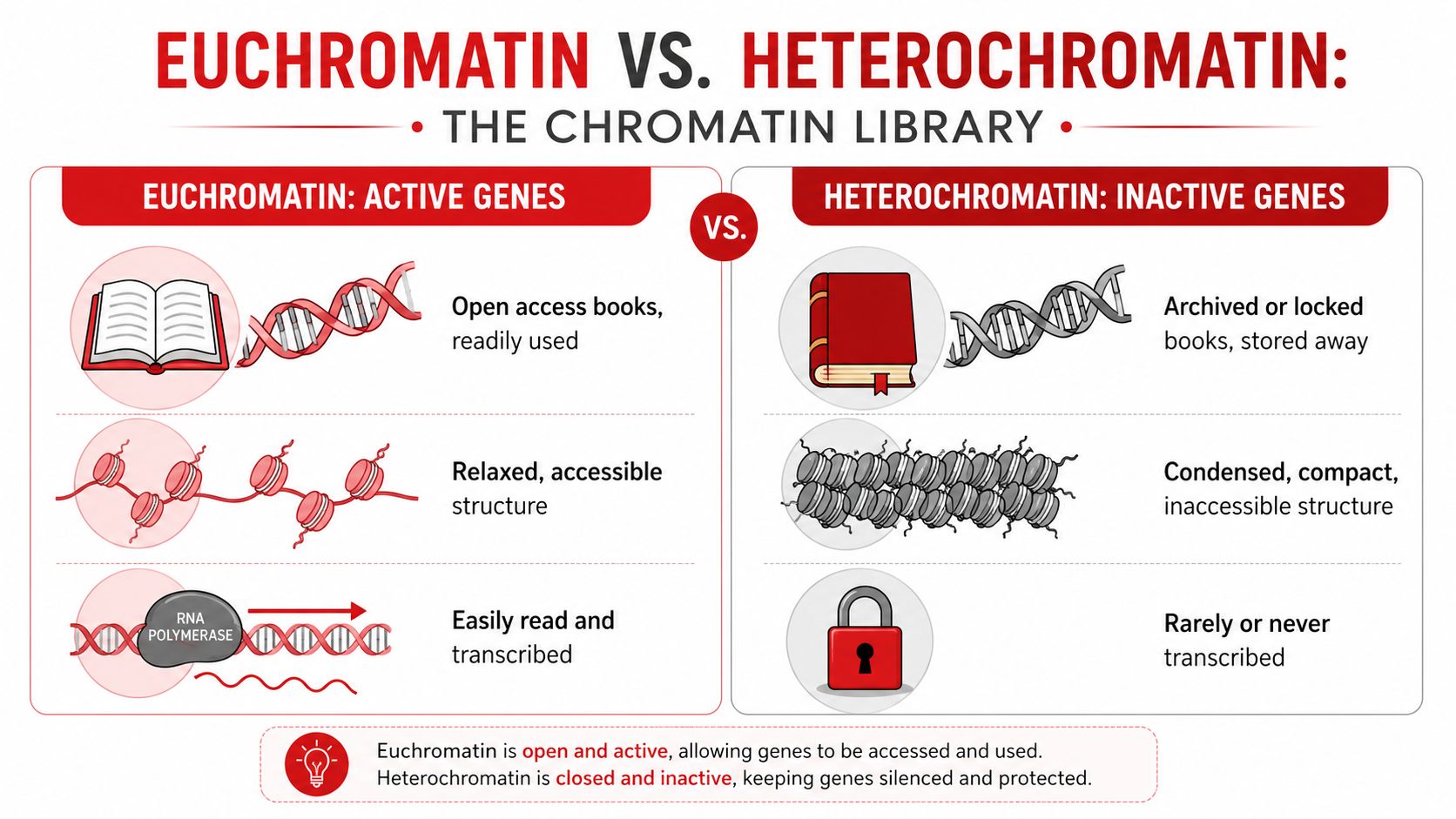
The easiest way to remember this topic is to use a library analogy.
Think of the genome as a massive medical library. Some books are on open shelves where students can grab them immediately. Other books are locked in an archive room, preserved and harder to access. In that analogy, euchromatin is the open-shelf material, and heterochromatin is the archived material.
The quick visual distinction
Under the microscope, euchromatin stains lightly because it's less densely packed. Heterochromatin stains more darkly because it has higher DNA density. This is the original histologic distinction that gave rise to the terms.
That simple image matters for boards. When a pathology image shows a nucleus with pale, dispersed chromatin, think greater transcriptional activity. When the nucleus shows dense, dark clumping, think more compact chromatin.
The side-by-side view
Here's the high-yield comparison students should know cold:
| Feature | Euchromatin | Heterochromatin |
|---|---|---|
| Packing | Looser | Tighter |
| Staining | Light | Dark |
| Gene content | Gene-rich | Gene-poor |
| Transcription | More active | Typically silent |
| Accessibility | More accessible | More restricted |
| Typical role | Gene expression | Gene silencing and structural stability |
A useful conceptual pairing appears in operon-based regulation too, where accessibility and transcriptional control stay tightly linked. If you want to compare those ideas, this review of the parts of an operon is a good companion.
One number worth knowing
Euchromatin constitutes approximately 92% of the human genome, while the remaining 8% consists of heterochromatin according to this overview of euchromatin in the human genome. For exam purposes, that means most genomic material is in the more lightly packed state, while the denser fraction is a smaller but functionally important compartment.
Board memory aid: Eu = useful, expressed, uncoiled.
Hetero = hidden, hushed, highly condensed.
Students sometimes confuse “gene-poor” with “unimportant.” Don't make that mistake. Heterochromatin may be less transcriptionally active, but it still matters enormously for genome organization, repetitive DNA control, and chromosome stability.
The Molecular Basis of Chromatin State
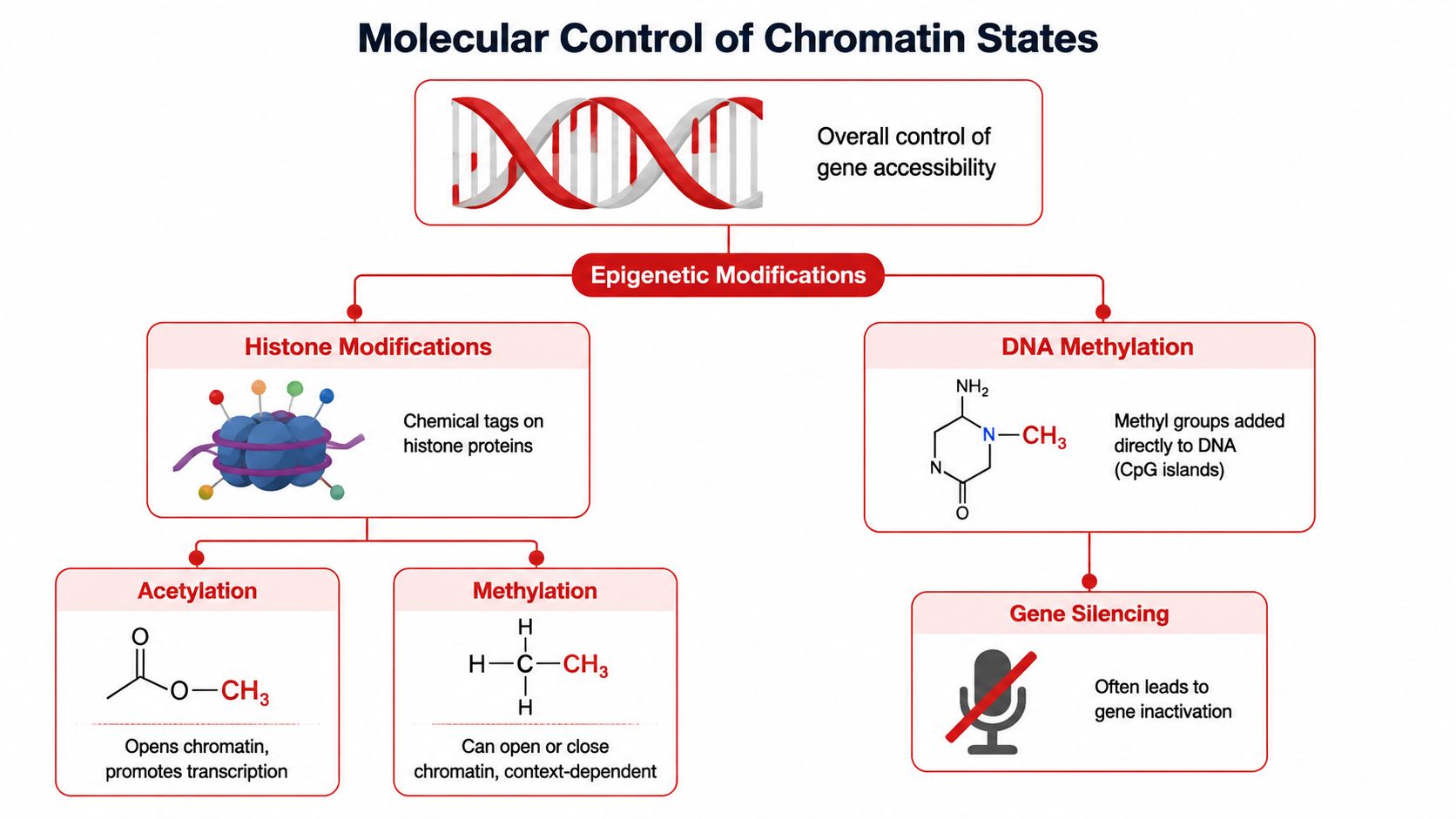
At the molecular level, chromatin state depends heavily on how DNA interacts with histone proteins. DNA wraps around histones to form nucleosomes, and those histones can be chemically modified. Those modifications help determine whether a chromatin region is relatively open or relatively compact.
Histone acetylation and open chromatin
A high-yield rule is that acetylation usually opens chromatin. Euchromatin is enriched in acetylated histones H3 and H4, including modifications such as H3K9ac, and that open state supports transcription, as described in this review of chromatin domains and histone features.
If you've studied enzyme regulation in biochemistry, this should feel familiar. Add a chemical tag, change the interaction, change the function. That's one reason chromatin biology fits naturally with core biochemistry for medical students.
High-yield rule: Acetylation is the mark most students should associate with a more open, transcription-friendly chromatin state.
A practical way to remember it is this: acetylation makes the chromatin “friendlier” to the transcription machinery. On exams, if answer choices include histone acetylation, that often points toward increased gene expression.
Here's a useful visual refresher before going further:
Methylation and compact chromatin
Heterochromatin is different. It shows hypermethylation with numerous methyl marks, particularly on histone H3, whereas euchromatin is relatively hypomethylated in comparison, as noted in the same chromatin review cited above.
That gives you a classic USMLE contrast:
Euchromatin favors acetylation. Heterochromatin favors methylation-associated silencing.
Be careful here. Methylation can be context-dependent in molecular biology, so don't oversimplify every methyl mark into one meaning. But for board-style comparison questions about euchromatin and heterochromatin, the broad pattern is straightforward: more compact, more methylated, less transcriptionally active.
DNA methylation and reinforcement of silencing
Boards also like to link DNA methylation with gene repression. If a stem says a promoter region becomes methylated, think decreased transcription. If that methylation pattern persists, the cell can maintain a stable silenced state.
This is one reason epigenetics is so clinically important. A gene doesn't have to mutate to become functionally unavailable. The cell can shut it down through packaging and methylation.
Students often ask whether chromatin state is fixed. It isn't. Cells can remodel chromatin in response to developmental programs and regulatory signals. That's why the word epigenetic matters so much. It describes heritable or persistent regulation that isn't solely a DNA sequence change.
Functional Consequences Transcription and Replication
All of the histone marks and packaging details matter for one reason. They change what the cell can do with the DNA.
Transcriptional activity
In euchromatin, the looser arrangement allows transcription factors and RNA polymerase to reach DNA more easily. That makes these regions the major sites of active transcription. If a USMLE stem describes a gene being actively transcribed, you should picture that gene sitting in a more open chromatin environment.
By contrast, heterochromatin tends to limit that access. Tighter packing makes transcription far less likely. In practical terms, this is why heterochromatin is associated with silencing.
Replication timing
Chromatin structure also affects when DNA gets replicated.
A useful board rule:
- Euchromatin tends to replicate earlier in S phase
- Heterochromatin tends to replicate later
That pattern fits the larger theme. DNA that is easier to access tends to be processed earlier, while compacted regions are handled later.
If you need a replication refresher, the core logic fits nicely with the semi-conservative model of DNA replication, where DNA accessibility and template use are central ideas.
The exam-level takeaway
When you get a stem, ask these questions:
- Can proteins reach the DNA easily?
- Is the gene likely to be transcribed?
- Is this region serving an active expression role or a structural silencing role?
A dense nucleus usually means less transcription. A pale, dispersed one usually means more.
That single pattern solves a surprising number of questions in histology and genetics.
Clinical Examples and Pathologies
This topic gets easier once you attach it to concrete examples. The most testable examples are Barr body, centromeres, and epigenetic disease states.
Barr body and facultative heterochromatin
The Barr body is the classic example of facultative heterochromatin. One X chromosome becomes inactivated and condensed, which allows dosage compensation in cells with more than one X chromosome.
This is high-yield because it shows that heterochromatin isn't only a permanent structural feature. Some chromatin becomes compacted depending on developmental context.
Centromeres and telomeres
Constitutive heterochromatin is the type that stays densely packed as part of chromosome architecture. Think centromeres and telomeres. These regions are not famous for active gene expression. Their importance is structural and organizational.
That distinction is worth memorizing:
- Facultative heterochromatin = can switch states depending on context
- Constitutive heterochromatin = usually remains compact and stable
When regulation fails
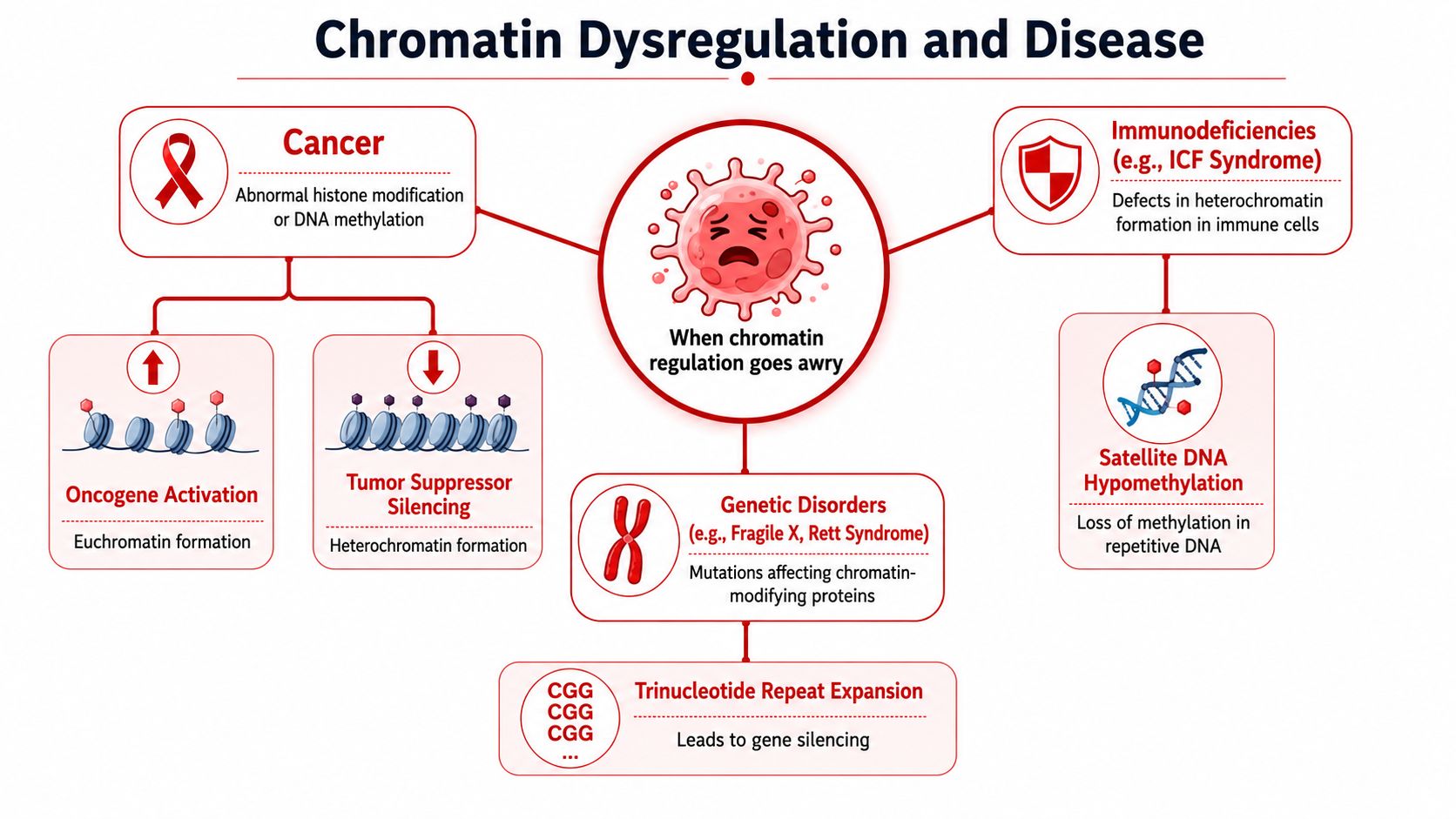
Clinical disease appears when chromatin regulation breaks down. A tumor suppressor gene can become abnormally silenced. A region that should remain compact and stable can lose proper methylation. A gene that should stay quiet may become inappropriately active.
This is why chromatin biology matters in cancer, immunologic disease, and inherited disorders. In broad terms:
- Excess silencing can shut off protective genes
- Loss of proper heterochromatin control can destabilize repetitive DNA regions
- Abnormal epigenetic regulation can alter cell identity and growth behavior
For students studying genomic medicine, these principles connect directly to disease interpretation and targeted molecular thinking in genomics and personalized medicine.
A newer board-relevant layer
Recent work adds detail that standard review books often skip. Transcription factors Pax3 and Pax9 are essential for maintaining intact heterochromatin at repetitive DNA regions, and enzymes Prdm3 and Prdm16 are critical for establishing H3K9me1, a key step in heterochromatin formation, according to this overview of heterochromatin formation mechanisms.
You probably won't need every one of those names for a basic exam question. But the direction matters. Heterochromatin maintenance is an active, regulated process. It isn't just “DNA packed tightly and left alone.”
Clinical pearl: If the question describes repetitive DNA instability, failed silencing, or defective chromatin maintenance, think beyond sequence mutation alone. The problem may be epigenetic architecture.
How Scientists Study Chromatin Structure
Sometimes the board stem starts with, “In an experiment, investigators treated nuclei with an enzyme…” That's your cue to think like a test writer. They're asking whether you understand how scientists infer chromatin accessibility.
DNase sensitivity and open chromatin
A classic principle is that open chromatin is easier for enzymes to access. So if a DNA region is more vulnerable to nuclease digestion, that suggests a more open chromatin state. Historically, that's the logic behind DNase hypersensitivity assays.
The key idea is simple. If proteins and enzymes can physically reach the DNA, the chromatin is likely less compact.
ATAC-seq and ChIP-seq
Modern questions may mention tools like ATAC-seq, which identifies accessible chromatin regions, or ChIP-seq, which maps where specific proteins or histone modifications are located on DNA.
You don't need to memorize every lab step. What you do need is the board-level translation:
- ATAC-seq asks where chromatin is accessible
- ChIP-seq asks where a specific histone mark or DNA-binding protein is present
So if a question says ChIP-seq shows enrichment of an activating histone mark near a promoter, think increased likelihood of transcription. If it shows a silencing-associated pattern, think repression.
Why the old binary model is being revised
A useful modern nuance is that the classic “open equals accessible, closed equals inaccessible” model is incomplete. Recent 2024 to 2025 data show that heterochromatin can exhibit moderate accessibility over extended timeframes and behaves more like a gel, while euchromatin is more liquid-like, according to this discussion of chromatin accessibility in living cells.
That doesn't erase the high-yield exam rule. It refines it. Heterochromatin is still the more compact, more silent state in standard board logic. But biologically, chromatin accessibility is dynamic, not absolute.
If a stem tries to tempt you into thinking heterochromatin is a brick wall, be careful. It's better thought of as strongly restricted access, not zero access.
High-Yield Review Mnemonics and Practice Questions
This is the part to keep in your head for test day.
Fast mnemonics
- Euchromatin = Expressed, Exposed, Easier to transcribe
- Heterochromatin = Hidden, Hushed, Highly condensed
- Acetylation opens
- Methylation often marks silencing in this comparison
- Barr body = facultative heterochromatin
- Centromere and telomere = constitutive heterochromatin
Euchromatin vs Heterochromatin High-Yield Summary
| Feature | Euchromatin | Heterochromatin |
|---|---|---|
| Packing | Loosely packed | Densely packed |
| Staining | Light | Dark |
| Gene density | Gene-rich | Gene-poor |
| Histone pattern | Acetylation-rich | Methylation-associated silencing pattern |
| DNA methylation trend | Relatively lower | Relatively higher |
| Transcription | More active | Usually silenced |
| Replication timing | Earlier | Later |
| Example | Actively transcribed genes | Barr body, centromeres, telomeres |
Practice question 1
A researcher examines nuclei from two cell populations. One group shows pale, dispersed chromatin and high messenger RNA production. Which chromatin state best explains these findings?
A. Constitutive heterochromatin
B. Euchromatin
C. Barr body formation
D. Telomeric silencing
Answer: B. Euchromatin
The clue is pale, dispersed chromatin plus high mRNA production. That points to the less condensed, transcriptionally active chromatin state. Barr body formation, telomeric silencing, and constitutive heterochromatin all point toward compacted chromatin rather than active gene expression.
Practice question 2
A stem describes an X chromosome that has become condensed and transcriptionally inactive in a somatic cell. Which term best describes this structure?
A. Euchromatin
B. Constitutive heterochromatin
C. Facultative heterochromatin
D. Replication origin complex
Answer: C. Facultative heterochromatin
The inactivated X chromosome is the classic Barr body example. It's called facultative because this compact state reflects regulated inactivation rather than a permanently fixed structural region like a centromere.
Practice question 3
A pharmacologic agent increases histone acetylation in a population of cells. What is the most likely downstream effect?
A. Increased chromatin compaction and gene silencing
B. Decreased access of transcription machinery to DNA
C. More open chromatin and increased transcriptional potential
D. Conversion of all euchromatin into constitutive heterochromatin
Answer: C. More open chromatin and increased transcriptional potential
This is one of the cleanest board associations in molecular biology. Increased histone acetylation generally correlates with a more open chromatin state and greater transcriptional accessibility.
Last-minute rule: If the exam gives you a choice between “accessible and active” versus “condensed and silent,” first decide whether the stem is describing euchromatin or heterochromatin. That usually eliminates most wrong answers quickly.
If you want help turning dense topics like chromatin biology into board-style pattern recognition, Ace Med Boards offers personalized tutoring for USMLE, COMLEX, Shelf exams, and more. Their one-on-one approach is built for students who want clearer explanations, smarter question analysis, and a study plan that fits how they learn.