An ERAS Letter of Recommendation (LoR) is one of the most powerful tools in your residency application. These letters give program directors a firsthand look at your clinical skills, professionalism, and overall fit for their program, making them a cornerstone of your profile.
Sources and Scope of This ERAS Letter Guide
The workflow details here — portal mechanics, assignment limits, and format rules — come from the AAMC's current Letter Writer Portal documentation and the published guidance of the specialties named. Published research on standardized letters is cited where relevant. The comparison table and decision rules below are illustrative aids for typical situations, not a substitute for the requirements listed in each program's own instructions.
Decoding Your ERAS Letter of Recommendation
Program directors sift through hundreds, sometimes thousands, of applications. After a while, many candidates start to look the same on paper, making your LoRs especially important. A generic letter gets lost in the shuffle, but a detailed, personal endorsement sharing specific anecdotes about your performance can make you stand out. Just as applicants often use tools like ParakeetAI to refine their resumes, the same drafting discipline applies to the materials your writers see.
To understand how these endorsements fit into the broader review process, learn what other factors programs look at for ERAS.
Quality Over Quantity Is Key
While ERAS lets you upload an unlimited number of letters, you can only assign a maximum of four to any single program. It's a common mistake to think that hitting this maximum is always the best move. The golden rule is, and always will be, quality over quantity. Three stellar letters will always be more impactful than four mediocre ones.
Submitting a lukewarm or generic letter just to fill a slot can actively harm your application. It's better to have fewer, more powerful endorsements than to dilute your profile with a weak letter from someone who barely knows you.
Programs differ in how many letters they require and which types they accept, so follow each program's stated instructions rather than a generic rule. A portfolio of four strong letters gives you flexibility to tailor what you send: you might assign a research-heavy letter to a major academic institution and swap it for a more clinically-focused one for a community-based program.
ERAS Standardized Letter vs Narrative Letter: Which Should You Use?
The single biggest source of confusion in ERAS letter planning is the difference between a narrative letter and a standardized one, and choosing the wrong format can undermine an otherwise strong application. Understanding the distinction between narrative and standardized ERAS letters of recommendation is essential before you request anything.
A narrative letter is the classic free-form LoR: an attending writes several paragraphs describing what they observed, with anecdotes, comparisons to past trainees, and an explicit endorsement. Its strength is advocacy. A standardized letter of evaluation uses a fixed form with checkboxes and scaled ratings for defined competencies, plus comparative rankings against peers in the same clerkship. Its strength is consistency — programs can scan and compare scores across hundreds of applicants. The SLOE (Standardized Letter of Evaluation) is emergency medicine's version of this format, and a committee letter, where your school offers one, synthesizes multiple faculty assessments into a single document.
| Narrative LoR | Standardized specialty-specific letter | SLOE (Emergency Medicine) | |
|---|---|---|---|
| Who usually writes it | Any attending who supervised you | Clerkship director or designated specialty faculty for the specialty's form | EM clerkship director or EM faculty |
| Format | Free-form prose on letterhead | Fixed rating form with competency scales and rankings | EM-specific standardized evaluation form |
| What programs extract | Anecdotes, judgment, personality, strength of endorsement | Comparable scores and peer percentile across applicants | Quantified EM performance plus narrative comments |
| Specialties that commonly expect it | Most specialties | Varies by specialty and cycle; the 2027 standardized pilot includes dermatology, urology, and integrated plastic surgery | Required by EM programs |
| When it helps | When the writer knows you well and advocates specifically | When applying within the specialty that uses the form | Any EM application |
| When it hurts | When it is generic or from someone who barely supervised you | When sent to programs that don't use or expect that form | Sending a plain narrative letter instead to EM programs |
How did standardized formats gain this much ground? The shift became visible in emergency-medicine recruitment in the early 2010s. In a 2011–2012 analysis of 278 applicants from U.S. allopathic medical schools, researchers examined 1,037 recommendation letters. Emergency physicians wrote 724 of those letters, and standardized letters of recommendation (SLORs) accounted for 602 documents, or 57.9% of all letters and 83.1% of letters written by emergency physicians. The numbers show that the standardized format was not merely an administrative experiment (PubMed). Standardized letters gained influence because residency programs viewed them as efficient screening tools, but their value depended on consistent completion and honest scoring. In a survey of emergency-medicine program directors, 150 of 159 respondents completed the questionnaire, producing a 94.3% response rate. Nearly every respondent—149 of 150, or 99.3%—agreed that the standardized letter of recommendation should continue to be used. Among the programs surveyed, 91 of 150, or 60.7%, required at least one standardized letter, while another 55 programs, or 36.7%, recommended one (PubMed).
Three decision rules follow from this:
- If your target specialty has a standardized form in current use, get it. For EM, that's the SLOE, and substituting a narrative letter is widely treated as a red flag. Always check each program's instructions rather than assuming one format.
- If your specialty has no standardized format, narrative advocacy is your lever. A detailed, specific letter from someone who watched you manage patients will outperform any checkbox form.
- When you're applying to two specialties, plan the portfolio deliberately. A standardized letter built for one specialty's form may add nothing to an application in a different field, where a strong narrative letter from that field's faculty matters more.
Writing a compelling letter requires clear communication. If your letter writers want to improve academic writing, structured resources can help them articulate your strengths more effectively.
Finding Your Best Letter Writers

Choosing who will write your ERAS letters of recommendation is one of the most high-stakes decisions you'll make during the entire residency application process. It's easy to get star-struck by big names, but the best letters don't come from the person with the most prestigious title. They come from faculty who have seen you in action and can vouch for your skills with genuine enthusiasm.
Think beyond the professor who gave you an A in a preclinical course. Program directors are looking for proof of your clinical competence. They want to hear from attendings who watched you manage a complex patient, collaborate with the care team, or show resilience during a brutal rotation.
A powerful letter is a narrative endorsement, not just a confirmation of your grades. It's built on a real professional relationship.
Prioritize Quality of Interaction Over Rank
I'll say it again: a well-known department chair who can only write a generic paragraph about you is far less valuable than a junior attending you worked with closely for a month. Why? Because that attending can provide specific, compelling anecdotes that make your application unforgettable.
Look for mentors who have observed:
- Your clinical reasoning: How you work through a differential diagnosis.
- Your teamwork and communication: The way you interact with nurses, residents, and patients.
- Your work ethic and initiative: Did you stay late to follow up on labs? Did you read up on cases and come to rounds prepared with insightful questions?
- Your teachability: How you respond to and incorporate feedback—a critical skill for any resident.
These are the details that turn a good letter into a great one. A letter that says, "Sarah showed curiosity," is fine. A letter that says, "On a complex case, Sarah independently researched the latest treatment guidelines and presented a concise summary that directly informed our team's care plan," is the one that gets you an interview.
Building Rapport With Busy Attendings
Connecting with a busy attending can feel intimidating, but it's absolutely essential for getting a personalized letter. You have to make yourself memorable for the right reasons. Show up early, stay engaged, and volunteer for tasks that prove your commitment.
Ask thoughtful questions that show you're thinking critically. Instead of just asking about a diagnosis, try something like, "I noticed we chose drug A over drug B for this patient; could you walk me through the clinical factors that guided that decision?" This signals you're considering patient care, not just checking boxes.
As you coordinate with your writers, remember that any discussion about clinical experiences needs to be secure. For virtual meetings, using HIPAA-compliant video conferencing platforms is a smart move to maintain patient confidentiality.
A letter from a faculty member who can say, "I would be thrilled to have this student as a resident in my own program," is the gold standard. This single statement signals an incredibly high level of confidence to program directors.
To get a letter that powerful, you have to make your writer's job as easy as possible. You can dive deeper into this by reading our full guide to residency letters of recommendation. By giving them a packet with your CV, personal statement, and a summary of your shared experiences, you're handing them the tools they need to write with detail and genuine enthusiasm.
Crafting the Perfect LoR Request
How you ask for your letter of recommendation matters as much as who you ask. A thoughtful, professional request helps secure a "yes" and equips your letter writer to draft a powerful, detailed endorsement.
Your initial email sets the tone for everything that follows. Start by expressing genuine respect for their work and mentorship. Jog their memory. Remind them of the specific rotation or project you worked on together, like a particularly challenging case you managed or a presentation you gave under their supervision.
This specificity is the secret sauce. It turns your request from just another task on their to-do list into a personal appeal, making it far easier for them to recall concrete examples of your skills, work ethic, and unique strengths.
Assembling Your Support Packet
To make it easy for your writer to say yes and write a stellar letter, you need to hand them everything on a silver platter. Prepare a digital packet and attach it to your request email. This simple step shows respect for their busy schedule.
Your packet should include:
- Your updated CV: This gives them the full 360-degree view of your academic and extracurricular journey.
- Your personal statement draft: This is your story. It gives them useful insight into your motivations, career goals, and the narrative you're building for your application.
- A concise summary: Briefly list the programs or specialties you're targeting. Even better, highlight a few key experiences or qualities you're hoping they can speak to.
- The ERAS Letter Request Form: Don't forget this! Include the form generated from MyERAS, which contains the details your writer needs to access the Letter Writer Portal.
This level of preparation signals professionalism and leaves a lasting positive impression. For more examples, check out our guide with letter of recommendation samples for residency.
The FERPA Waiver Explained
When you finalize a letter request in MyERAS, you'll face a decision on the FERPA waiver. This asks if you want to waive your right to see the letter of recommendation that will be written about you.
You should always waive your right to view your letters. No exceptions. Doing so signals complete confidence in your performance and trust in your chosen letter writer. Program directors often view non-waived letters with skepticism, as it can suggest the writer wasn't able to provide a completely candid assessment.
While AAMC guidelines encourage evaluators to provide objective assessments, the strongest letters are powerful acts of advocacy. In fact, 75% of strong letters highlight specific achievements like awards or leadership roles. These details aren't just fluff; they are linked to 22% higher acceptance rates for applicants. This shows how a candid, advocacy-focused letter can significantly boost your chances, a sentiment often echoed in discussions about the impact of letter content on SDN forums.
By waiving your rights, you allow your writer to speak freely and with genuine conviction. That's exactly what you need in an ERAS letter of recommendation. It's a small but critical step that demonstrates your professionalism and trust in the process.
Managing LoR Submission and Deadlines in ERAS
Getting a "yes" from your letter writer is a huge relief, but your job isn't done. For the 2027 ERAS cycle, your writers submit letters through the AAMC Letter Writer Portal — they no longer email or upload PDFs on your behalf outside that system — while you handle everything on your side inside MyERAS: requesting the letter and assigning it to programs. The AAMC's letter writer FAQ walks through the current cycle-specific mechanics.
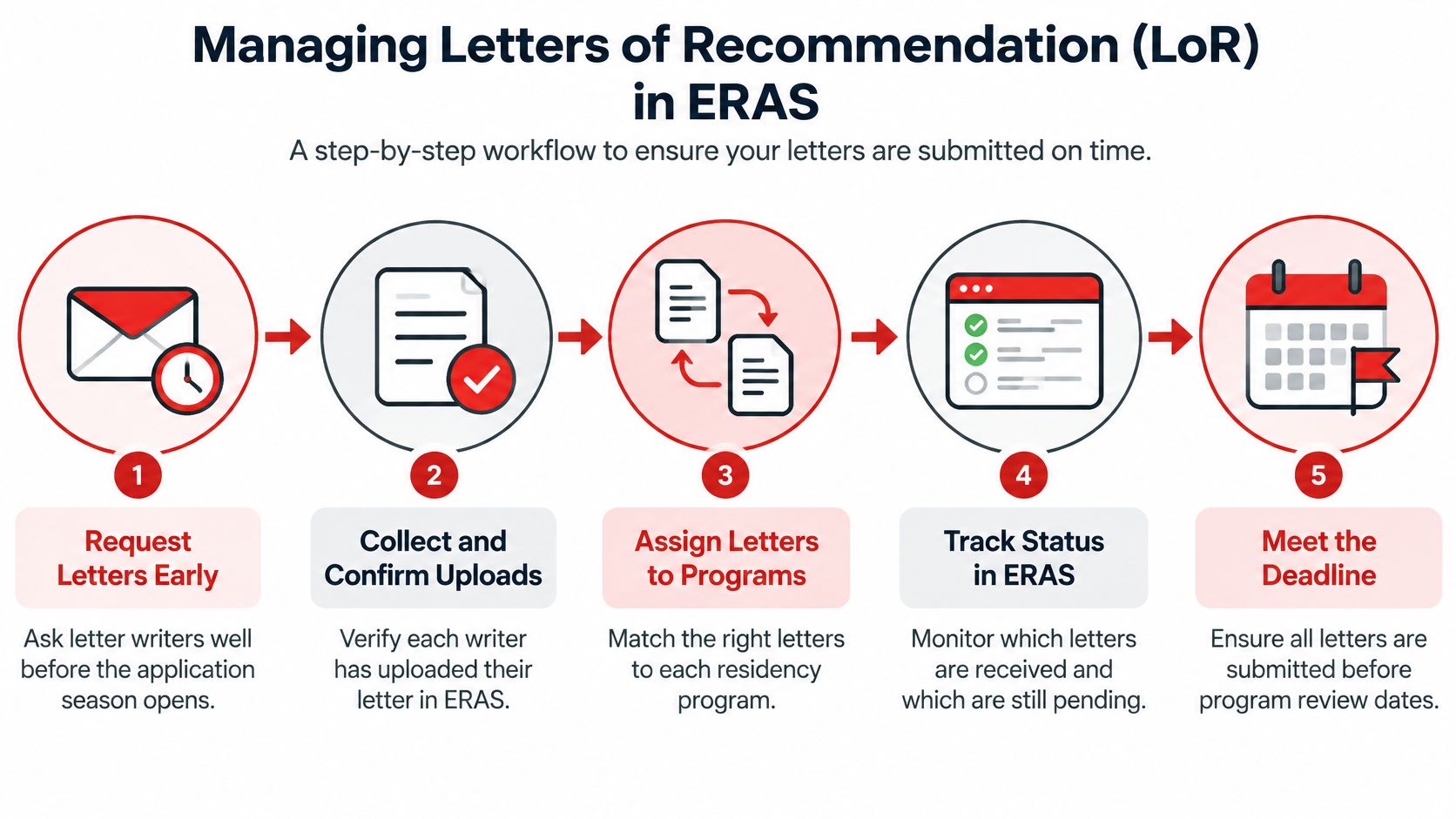
When you create a request in MyERAS, the system generates the information your writer needs to access the Letter Writer Portal. Get that to them promptly — they can't submit without it.
Assignment Is a Separate Step From Requesting
Most logistical mistakes happen during this process. Uploading a letter does not make it visible to any program. You must actively assign letters to each program, and you may assign up to four per program — the program, not you, determines how many it requires and what types it accepts.
At the point of request, you designate the specialty a letter is intended for; a narrative letter can be designated General, which keeps it usable across multiple specialties. Choosing a specialty at request time doesn't automatically send the letter anywhere — it only labels the request. Assignment to individual programs happens later, and the selections you make lock once you submit your application to that program, per the Letter Writer Portal terms.
Two clearly hypothetical examples show how this plays out:
- Single-specialty applicant (pediatrics): You request three letters — a pediatrics chair, a ward attending, and a research mentor. At request time you label all three for pediatrics (or General), then assign the two clinical letters plus the research letter to every pediatrics program on your list, matching each program's stated count.
- Dual applicant (EM and internal medicine): You request an SLOE through your EM clerkship and two narrative letters — one from an IM attending (designated General) and one from your research mentor. EM programs get the SLOE plus your strongest narrative letters; IM programs get the IM attending's letter and the research letter instead. The same account, two different assignment patterns.
Common pitfalls: assigning the wrong letters to a program (your glowing pediatrics letter going to a backup IM program), assuming a letter was delivered because it shows as "received" in your account, and discovering too late that your intended assignment was locked after you applied. A simple spreadsheet mapping each program to its assigned letters prevents all three.
The Importance of Timeliness
In the residency application cycle, timing isn't just important—it's everything. Your goal should be having all letters submitted through the portal and assigned before programs can start viewing applications in late September. Programs often review applications as they come in, and being "complete" from day one puts you at a real advantage.
An application that's missing even a single letter can easily get pushed to the bottom of the review pile. When you ask, give your writers a clear but polite deadline that is at least one or two weeks before the actual date programs get access.
A polite follow-up can make all the difference. Send a gentle reminder email about two weeks before your requested deadline. Something as simple as, "Just wanted to send a friendly reminder about the letter of recommendation for my residency application, which I'm hoping to have finalized by [Your Date]," is professional and effective.
For a complete breakdown of key dates, check out our guide on the full ERAS application timeline.
Matching Your Letters to Your Medical Specialty
Letter formats are not interchangeable across specialties, and each field's guidance changes from cycle to cycle. Before requesting anything, read the current instructions for your target specialty — not generic advice from a previous application year.

Specialty Formats and the 2027 Standardized Pilot
For the 2027 cycle, dermatology, urology, and integrated plastic surgery participate in the standardized-letter pilot. If you request a standardized letter for one of these specialties, the request uses the standardized form built into the Letter Writer Portal — your writer completes it there, rather than uploading a PDF of a form they found elsewhere. Other specialties may accept uploaded narrative or standardized PDF letters, subject to that specialty's current guidance and each program's stated preferences. Applicants should consult the official guidance published by the American Academy of Dermatology, the American Urological Association, and the American Society of Plastic Surgeons for cycle-specific requirements. The AAMC Letter Writer Portal terms govern how these submissions are handled.
The SLOE for Emergency Medicine
If you're applying to Emergency Medicine, there's one letter that matters more than any other: the Standardized Letter of Evaluation (SLOE). This isn't just a preference; it is required by EM programs. The SLOE is a comparative evaluation that ranks your performance against your peers on the same rotation. Submitting a generic LoR instead is a massive red flag for EM programs. Securing a strong SLOE from your EM rotation should be your absolute top priority — and if you're dual-applying, remember the SLOE serves your EM applications, not your other specialty's. Refer to the Council of Emergency Medicine Residency Directors (CORD) for current SLOE instructions.
Other competitive fields have their own expectations. For specialties like Orthopedics, Dermatology, or Neurosurgery, letters from department chairs or nationally recognized leaders carry immense weight. These endorsements signal to programs that you've already impressed the top minds in their field, which can make all the difference in a hyper-competitive applicant pool.
For residency programs, obtaining strong endorsements from science faculty is crucial. Data suggests that having such letters can correlate with a 25% boost in matching into competitive specialties like dermatology or orthopedics. This highlights how a strategic ERAS letter of recommendation from the right person can significantly impact your match outcome. Discover more insights on how letter strength influences matching success at Shemmassian Consulting.
Advice for International Medical Graduates
For International Medical Graduates (IMGs), your letters have one primary job: prove you are ready to hit the ground running in the U.S. healthcare system.
The most powerful way to do this is with letters from hands-on U.S. clinical experience (USCE). These letters must come from physicians who have personally watched you work with patients, communicate with teams, and handle the pressures of an American clinical environment.
While letters from your home country can speak to your character, they don't carry the same weight. Program directors need assurance from U.S. physicians that you have what it takes. Prioritize rotations that will yield strong letters from attendings who can confidently vouch for your skills and professionalism.
To get a better sense of how these letters fit into the bigger picture, check out a complete ERAS application sample and see how a strong application comes together.
Common ERAS Letter of Recommendation Questions
What Is a Narrative Letter vs a Standardized Letter?
A narrative letter is an act of advocacy: free-form prose in which a supervising physician argues for you with specific anecdotes and an explicit endorsement. A standardized letter is an act of evaluation: a fixed form with scaled competency ratings and peer comparisons that lets programs score you consistently against other applicants. Most strong applications use narrative letters for depth and standardized formats where the specialty expects them. When weighing the eras standardized letter vs narrative letter options, always defer to your target programs' stated preferences.
What Is a Standardized Letter of Evaluation in Internal Medicine?
Applicants frequently ask what is a standardized letter of evaluation in internal medicine. Unlike emergency medicine, which relies on the SLOE, internal medicine programs generally expect traditional narrative letters. Some institutions may offer structured evaluations, but you must verify the exact format each program requires for the current cycle rather than assuming a universal internal medicine standardized form exists.
How Many Letters Should I Assign to Each Program?
You can assign up to four letters per program, but the program's stated requirements — number of letters, writers, and formats — should drive your decision, not the maximum. Always meet the minimum. Add a fourth only if it's exceptional and adds a perspective the others don't cover, such as a well-known research mentor's letter for a research-heavy academic program. Never add a lukewarm letter just to hit four.
Also, don't infer requirements from generic advice. A useful tracking matrix for your own planning should list, for each program: the letter source, the application cycle, the required format, and your assignment status. That last column matters because assignment selections lock once you submit to a program.
What if My Letter Writer Is Unresponsive?
If a writer goes silent after agreeing to write, wait at least two weeks before sending a gentle, professional reminder. Keep it short:
"Dear Dr. Smith, I hope you're having a good week! I'm just checking in on the letter for my residency application. I'm aiming to have everything finalized by September 10th — please let me know if you need anything else from me. Thanks again for your support!"
If a second polite email also goes unanswered after another week, activate your backup plan. This is exactly why experienced applicants request one or two more letters than they think they'll need. If you're unsure whether your letter portfolio is strong enough, a free consultation with Ace Med Boards can help you review your targets, timeline, and support needs.
Can I Use a Letter from a Previous Application Cycle?
Technically, you can. But should you? Almost always, the answer is no.
Reusing an old letter can send unintentional negative signals: that you couldn't secure new letters, or that your past year didn't generate a fresh endorsement. If you're a reapplicant, focus on new letters from your most recent clinical, research, or work experiences. The only exception worth considering is a phenomenal letter from a giant in the field — and even then, ask them to update the date and add a sentence reflecting your continued relationship.
Is a Letter from a Resident or Fellow Valuable?
A letter from a resident or fellow you worked with closely can be a fantastic addition, but it should never replace a letter from an attending physician. Program directors expect evaluations from faculty who officially supervised and taught you.
A co-signed letter gets you the best of both worlds: the resident drafts rich, on-the-ground detail about your day-to-day performance, and the attending edits, frames, and co-signs it with their authority. This gives program directors a powerful view of your capabilities.
Navigating your residency application, from your ERAS letter of recommendation to your USMLE scores, is a marathon. At Ace Med Boards, we specialize in providing the one-on-one tutoring and strategic guidance you need to cross the finish line with confidence. Let our expert tutors help you build an application that stands out. Learn more about our personalized residency support services.
| Letter Type | Typical Author | Primary Purpose | Best For Specialties |
|---|---|---|---|
| Standard LoR | Attending Physician or Faculty | Provides a personal, detailed account of your clinical performance, skills, and character. | All Specialties |
| SLOE | Department Chair/Clerkship Director | A standardized, comparative evaluation of your performance against your peers. | Emergency Medicine (required) |
| Committee Letter | Medical School Pre-Health Committee | A comprehensive, synthesized summary of your academic record and faculty feedback. | All Specialties (if offered) |