You're on an internal medicine rotation, the patient in front of you has greasy stools, weight loss, and odd blood glucose readings, and the attending asks one question that suddenly matters a lot: is the pancreas failing on the exocrine side, the endocrine side, or both? That's the exam trap too. Once you learn to separate duct delivery from bloodstream delivery, a whole category of USMLE, COMLEX, and Shelf questions gets easier fast.
The cleanest way to think about endocrine and exocrine glands is simple. Endocrine glands release hormones into blood, while exocrine glands send secretions through ducts to a surface or body cavity, a distinction that still anchors modern anatomy and physiology teaching Cleveland Clinic, Leeds Histology. The pancreas is the board exam's favorite exception because it does both, and that dual role is exactly why students miss points when they reduce gland biology to memorized lists NCBI Bookshelf. For a focused review path, the endocrine systems material at Ace Med Boards endocrine review is a useful companion after you finish this article.
Why This Distinction Matters for Your Boards
A third-year student on wards sees a patient with bloating, poor nutrition, and high glucose, then hears “pancreatic dysfunction” and freezes. That reaction makes sense, because board questions often hide digestion and glucose control in the same stem. If you cannot decide whether the stem is testing ducts, hormones, or the one organ that does both, the question can be lost before you reach the answer choices.
The old classification still pays off. Endocrine glands release products without ducts, while exocrine glands send secretions through ducts NCBI Bookshelf. That split predicts where the secretion goes, how it acts, and what kind of clinical clue the test writer is building into the stem. For a focused review path, the endocrine systems material at Ace Med Boards endocrine review is a useful companion after you finish this article.
Practical rule: If the stem says “into the blood,” think endocrine. If it says “through a duct” or “onto a surface,” think exocrine.
The pancreas is the exam trap that students miss most often. Its exocrine portion makes digestive enzymes for the gut, while its islets of Langerhans release insulin and glucagon into blood to control glucose NCBI Bookshelf. One organ, two jobs, and the test can ask about it from anatomy, histology, physiology, or pathology. That is why the pancreas keeps appearing in Step, COMLEX, and Shelf style questions, and why a quick mnemonic like “ducts digest, islets direct glucose” helps under pressure.
Here is the board-level payoff. When a vignette mixes malabsorption with abnormal glucose handling, you should immediately ask which pancreatic side is failing, and whether the clue points to enzyme loss, hormone loss, or both. That habit keeps you from treating every pancreas question like a single-topic memorization item. It turns a confusing stem into a classification problem, which is exactly how these questions are written.
Endocrine vs Exocrine Glands Compared
A pancreas question can look routine and still punish a shallow reading. The first move is to classify the secretion by destination. Endocrine signaling sends products into the blood for body-wide control, while exocrine signaling sends products through ducts for local use Leeds Histology. That split explains why one group regulates metabolism, growth, and reproduction, while the other handles digestion, lubrication, thermoregulation, and protection.
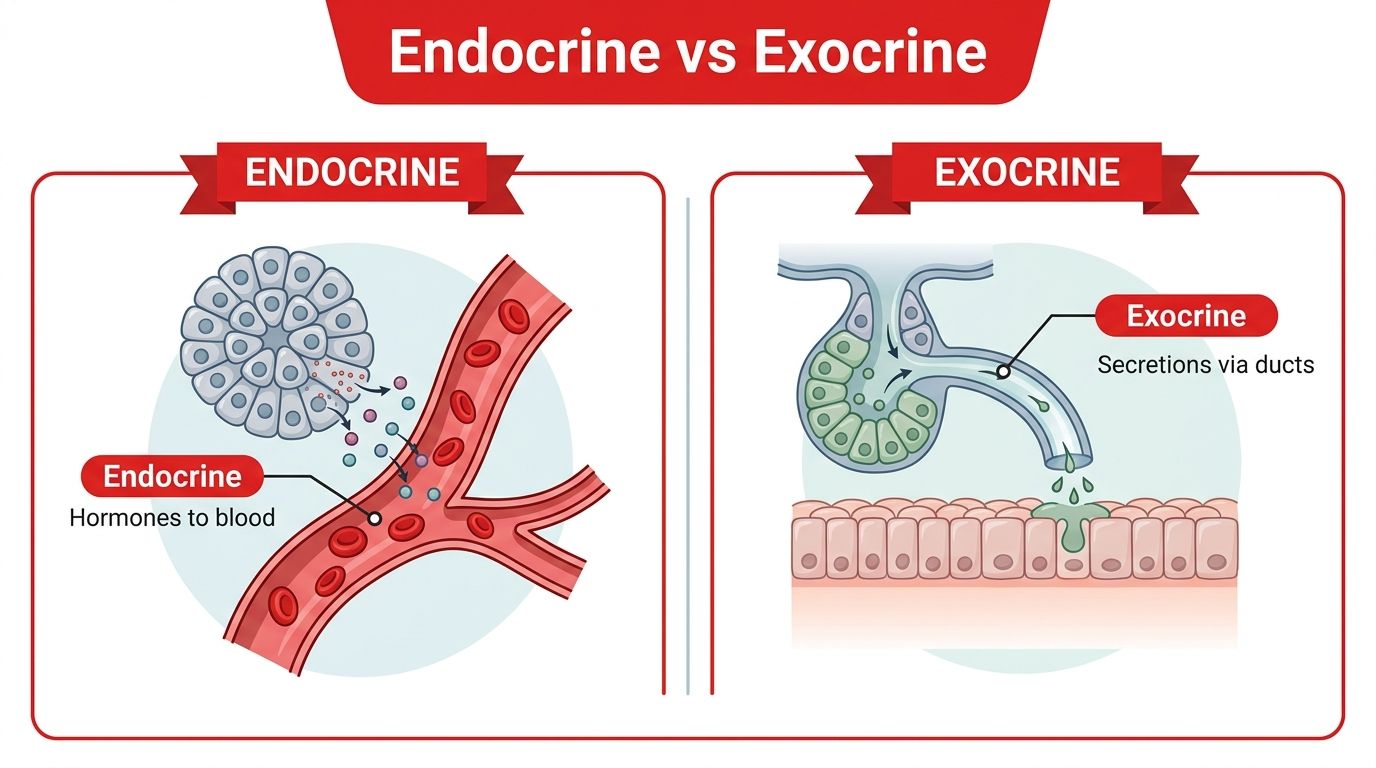
| Feature | Endocrine Glands | Exocrine Glands |
|---|---|---|
| Delivery route | Directly into blood | Through ducts |
| Structural hallmark | Ductless | Duct system present |
| Main target range | Distant tissues and organs | Local epithelial surfaces or body cavities |
| Typical output | Hormones | Enzymes, mucus, sweat, sebum |
| Physiologic style | Systemic regulation | Local rapid action |
The board-relevant difference is spread versus precision. Endocrine glands use capillary networks and small amounts of high-impact signal to influence distant tissues. Exocrine glands collect secretion in a duct and deliver it right where it is needed, which is why salivary glands, sweat glands, and the gut-facing portion of the pancreas matter so much in daily physiology. If you want a fast memory anchor, use the high-yield idea from the causes of pancreatitis mnemonic: the pancreas is the organ where test writers most often force you to separate enzyme failure from hormone failure.
Test-day shortcut: If the question emphasizes circulation, hormones, or distant effects, choose endocrine. If it emphasizes a surface, lumen, or duct, choose exocrine.
A third-year student on wards sees a patient with bloating, poor nutrition, and abnormal blood glucose, then hears the words “pancreatic dysfunction” and freezes. That stem is built to test whether you can separate the exocrine portion, which makes digestive enzymes for the gut, from the islets of Langerhans, which release insulin and glucagon into blood to control glucose. One organ, two jobs, and the exam may approach it from anatomy, histology, physiology, or pathology.
The safest way to answer these questions is to sort glands by what they release and where that release goes. Endocrine glands broadcast through the bloodstream. Exocrine glands aim at a duct, a lumen, or a surface. When a stem mixes malabsorption with abnormal glucose handling, ask whether the clue points to enzyme loss, hormone loss, or both. That habit turns a confusing pancreas question into a clean classification problem, which is exactly how these items are written.
Major Glands and Tissues You Must Know
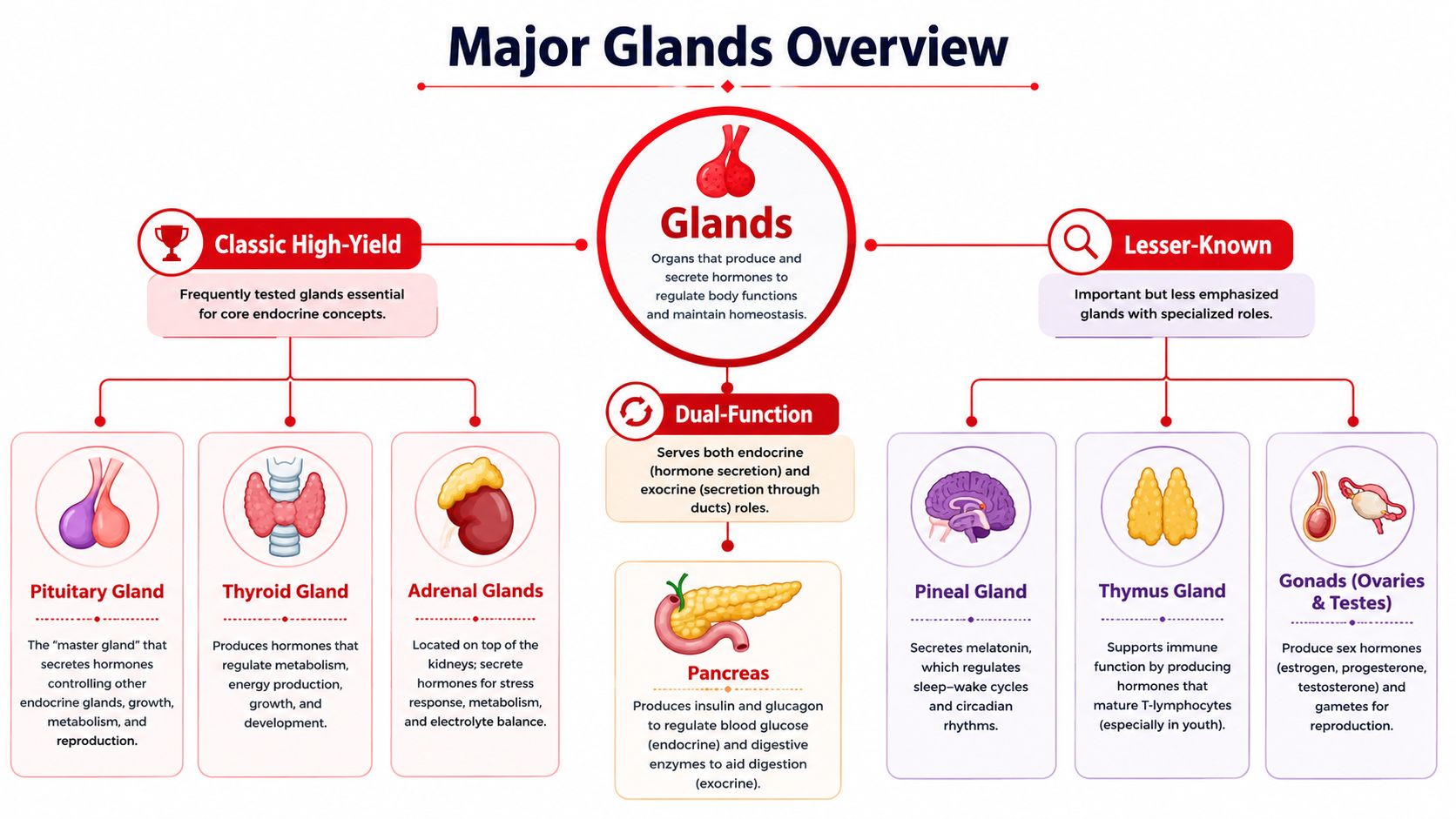
A good exam stem often starts by asking you to sort the gland before you sort the disease. The fastest approach is simple, first identify the clearly ductless organs, then the ducted glands, then stop and isolate the mixed organ that loves to confuse test takers. That last category is where the pancreas becomes the classic trap, because one tissue behaves like an endocrine gland and the other behaves like an exocrine gland.
Classic endocrine glands
The pituitary, thyroid, parathyroids, adrenals, and pineal gland should be recognized immediately as endocrine glands. They release hormones into the blood, so their effects can show up far from the gland itself. The hypothalamus also belongs in that same conversation because it sits in the broader regulatory network and is often taught as neuroendocrine rather than purely glandular.
Classic exocrine glands
Salivary glands, sweat glands, sebaceous glands, and the mammary glands fit the exocrine pattern because their secretions travel through ducts to an epithelial surface or into a body cavity Cleveland Clinic. That duct route is the clue. If a stem mentions lubrication, secretion onto skin, or food processing in the mouth, exocrine should come to mind first.
The pancreas still deserves its own mental file. Its exocrine tissue makes the digestive secretions that go to the gut, while its endocrine islets regulate blood sugar with insulin and glucagon. That dual identity is the reason pancreas questions can look like GI, endocrine, or pathology items depending on which cell population the writer wants you to notice. In study sessions, it helps to keep the pancreas separate from the ordinary one-function glands and tie it back to a focused review like the endocrine system study guide.
Board habit: When you see “pancreas,” slow down and ask which compartment the stem is describing.
A few anatomy references also organize glandular structures by secretion mode, duct pattern, and location, so the list of named examples can vary a little across resources List of glands of the human body. The exam does not punish you for minor naming differences. It does expect you to know the main glands, separate hormone release from duct drainage, and keep the pancreas from slipping through the cracks.
Histology and Embryology of Glandular Tissue
A slide question gets easier when you stop staring at the whole image and ask the same three checks every time. First, are ducts present. Second, what do the secretory units look like. Third, does the tissue pattern fit a ductless endocrine gland or a ducted exocrine gland. That sequence keeps you from overreading a pattern that is already trying to tell you the answer.
What the microscope is really showing
Exocrine glands usually show a recognizable duct system that drains secretory units to a surface or lumen. That duct architecture is part of the defining difference between exocrine and endocrine tissue, because the exocrine product has a route out of the gland, while endocrine secretions are released toward nearby capillaries.
Endocrine glands are built around hormone-producing cells closely associated with capillaries, because the product needs direct access to blood. On histology, that usually means a more cellular, less duct-centered pattern.
The pancreas gives the cleanest image-based contrast, and it is the exam trap students miss when they rush. One part is exocrine tissue producing digestive secretions for the gut. The other part is the endocrine islets of Langerhans, which release hormones into the bloodstream. That dual arrangement is why histology questions may show a mixed section and ask you to identify the compartment being highlighted.
Board habit: When you see “pancreas,” slow down and ask which compartment the stem is describing.
Why embryology can still trip you up
Many glandular structures begin as epithelial invaginations that then specialize into ducts or secretory tissue. In practical exam terms, that means a gland's embryologic origin often mirrors its architecture, especially when the question asks you to reason from tissue pattern rather than recall a label. The safe move is to anchor on structure first, then use origin as a second check.
The pancreas matters here for a different reason. It is a single organ with two functional programs, so it creates a common exam mistake where a student names the organ correctly but assigns the wrong cell population. If the tissue looks vascular and ductless, endocrine is the better fit. If ducts feed secretory units, exocrine is the better fit.
Image-reading rule: Ducts point you toward exocrine tissue. Dense capillary association points you toward endocrine tissue.
That same logic helps with glandular pathology slides and with question stems that ask about “which part is damaged.” If the stem gives you malabsorption, think exocrine failure. If it gives you glucose dysregulation, think endocrine failure. If it gives you both, the pancreas should be at the top of the list.
A quick memory check helps on board exams: exocrine glands route secretions out through ducts, endocrine glands send signals into blood. For hormone chemistry, the peptide versus steroid hormone guide is a useful companion because receptor location follows hormone type. Peptides usually signal at the cell surface, while steroids act inside the cell.
Regulatory Pathways and Key Hormones
Hormones don't show up on exams as isolated facts for long. They show up in loops, and the loop usually starts in one gland, moves to a receptor, and ends in a target organ that feeds back on the original signal. That's why the hypothalamic-pituitary-target axis is so important to keep straight, and why hormone type matters as much as hormone name.
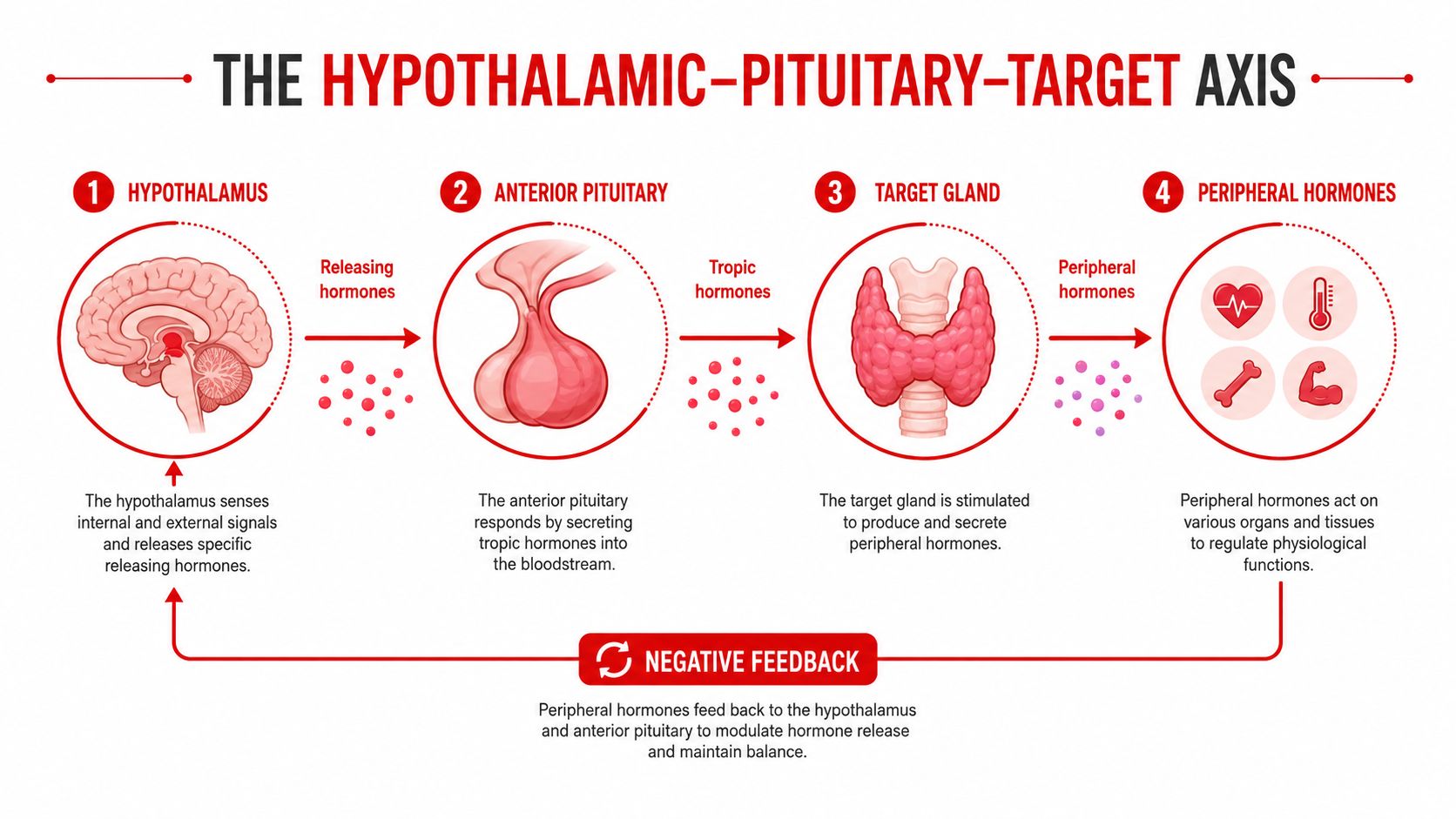
The classic flow is straightforward. The hypothalamus releases releasing hormones, the anterior pituitary releases tropic hormones, and a target gland produces peripheral hormones that feed back to suppress the upstream signal. That architecture is the same logic behind many of the board exam's endocrine vignettes, even when the stem hides it under fatigue, weight change, or reproductive complaints. Receptor class also matters. Peptide hormones usually act through surface receptors, while steroid hormones enter cells and act at intracellular receptors, which is why the peptide versus steroid hormone guide is worth reviewing after this topic.
The pancreas adds a second layer of regulation. Its endocrine and exocrine compartments communicate through neural, hormonal, and vascular pathways, and recent physiology work treats that crosstalk as an active research gap rather than a settled footnote PMC review on endocrine-exocrine integration. That matters on exams because one organ can fail in one compartment while the other still functions, which is exactly what makes the pancreas such a useful teaching model.
High-yield takeaway: Boards love the relationship between source, route, and target. Don't memorize a hormone alone. Memorize where it goes and how it gets there.
Common Pathologies and Clinical Presentations
A patient with diabetes plus steatorrhea should make you pause. That stem is testing whether you can separate endocrine failure from exocrine failure, then recognize that the pancreas can produce both at the same time. The board exam likes that trap because one organ can fail in one compartment while the other still works.
Type 1 diabetes is the cleanest place to see the overlap. In the evidence review, severe exocrine pancreatic insufficiency was reported in a meaningful subset of children with type 1 diabetes, and in adults with type 1 diabetes the estimate ranged higher. The same review also describes moderate insufficiency in many adults, and one cohort of 95 patients with type 1 diabetes found 34% had severe insufficiency when fecal elastase-1 below 200 µg/g was used as the cutoff, with values above 500 µg/g considered normal PMC evidence review. That is the board-relevant point. The pancreas is not just a glucose regulator. It is also a digestive gland, which is why a diabetes stem can still be hiding malabsorption.
The same logic applies to pancreatitis, cystic-fibrosis-related pancreatic disease, and salivary disorders. A stem may give you abdominal pain, oily stools, poor weight gain, or altered glucose control, and your job is to identify whether the problem is in acinar secretion, islet function, or both. For the glucose side of the question, a review of how to interpret thyroid function tests is a useful reminder that endocrine labs must be read in context, not by pattern-matching one isolated value alone. On exams, that habit prevents you from missing a pancreatic process just because the stem also includes a hormone abnormality. If your study group wants a short way to sort these patterns, the microlearning guide for L&D teams shows why small, repeated review blocks work well for material like this.
The practical clue is pattern recognition. Endocrine failure usually shows up as metabolic instability, while exocrine failure shows up as digestive symptoms and nutrient problems. When both are present, the pancreas should move to the top of your differential immediately.
High-Yield Mnemonics and Practice Questions
A pancreas stem can look simple and still be a trap. The test writer may give you diabetes, greasy stools, and weight loss in the same vignette, then ask which part of the organ is failing. The first move is to sort the problem by route, then by function. Blood is endocrine, tubes are exocrine is the anchor rule that keeps the answer choices straight.
Use that rule to place the major glands. The pituitary, thyroid, parathyroids, adrenals, and pineal gland belong in the endocrine group. The salivary glands, sweat glands, sebaceous glands, and mammary glands belong in the exocrine group. The pancreas belongs in both groups, and that dual role is why it deserves its own flashcard and its own practice question.
Short review blocks help this material stick. The microlearning guide for L&D teams makes the same point for study design, and it fits gland physiology well because the topic is easier to remember when you separate route, organ, histology, and pathology into small pieces.
Practice question 1
A 19-year-old with type 1 diabetes reports oily stools and unintended weight loss. Which pancreatic compartment is most likely contributing to the digestive symptoms?
A. Endocrine islets only
B. Exocrine acini
C. Adrenal cortex
D. Thyroid follicular cells
E. Posterior pituitary
Correct answer: B. Exocrine acini
The digestive symptoms point to impaired enzyme secretion, which is an exocrine problem. The islets handle insulin and glucagon, while the acinar cells make the digestive enzymes that support nutrient absorption NCBI Bookshelf.
Practice question 2
A question stem describes a gland that releases its product directly into the bloodstream without a duct. Which term fits best?
A. Exocrine
B. Endocrine
C. Apocrine skin appendage only
D. Serous acinus
E. Compound tubular gland
Correct answer: B. Endocrine
The defining feature is ductless secretion into blood. If the stem says a product travels through a duct or onto an epithelial surface, exocrine is the better answer.
Practice question 3
A student is asked which organ is the most important single example of dual endocrine and exocrine function. Which answer is best?
A. Pituitary
B. Thyroid
C. Pancreas
D. Pineal gland
E. Parathyroid
Correct answer: C. Pancreas
The pancreas is the classic board exam trap because its exocrine tissue sends digestive enzymes to the gut, while its endocrine islets release hormones such as insulin and glucagon into blood. That dual role is one of the highest-yield ideas in gland physiology, and the pancreas is the organ that exam writers use when they want you to confuse secretion route with secretion product.
If you want tighter recall, rehearse one rule, one organ, one disease, and one slide feature at a time. That is the level of clarity that holds under a timed block.