In 2024, active physicians in the United States were 56.1% White, 19.8% Asian, 6.7% Hispanic or Latino, 5.3% Black or African American, 0.3% American Indian or Alaska Native, and 0.1% Native Hawaiian or Other Pacific Islander, while 9.1% had unknown race or ethnicity, according to AAMC physician workforce data (AAMC key findings). Those numbers matter because diversity in medicine is not just a moral aspiration, it shapes who gets care, where care is delivered, and whether patients can trust the system in front of them.
What Diversity in Medicine Actually Means
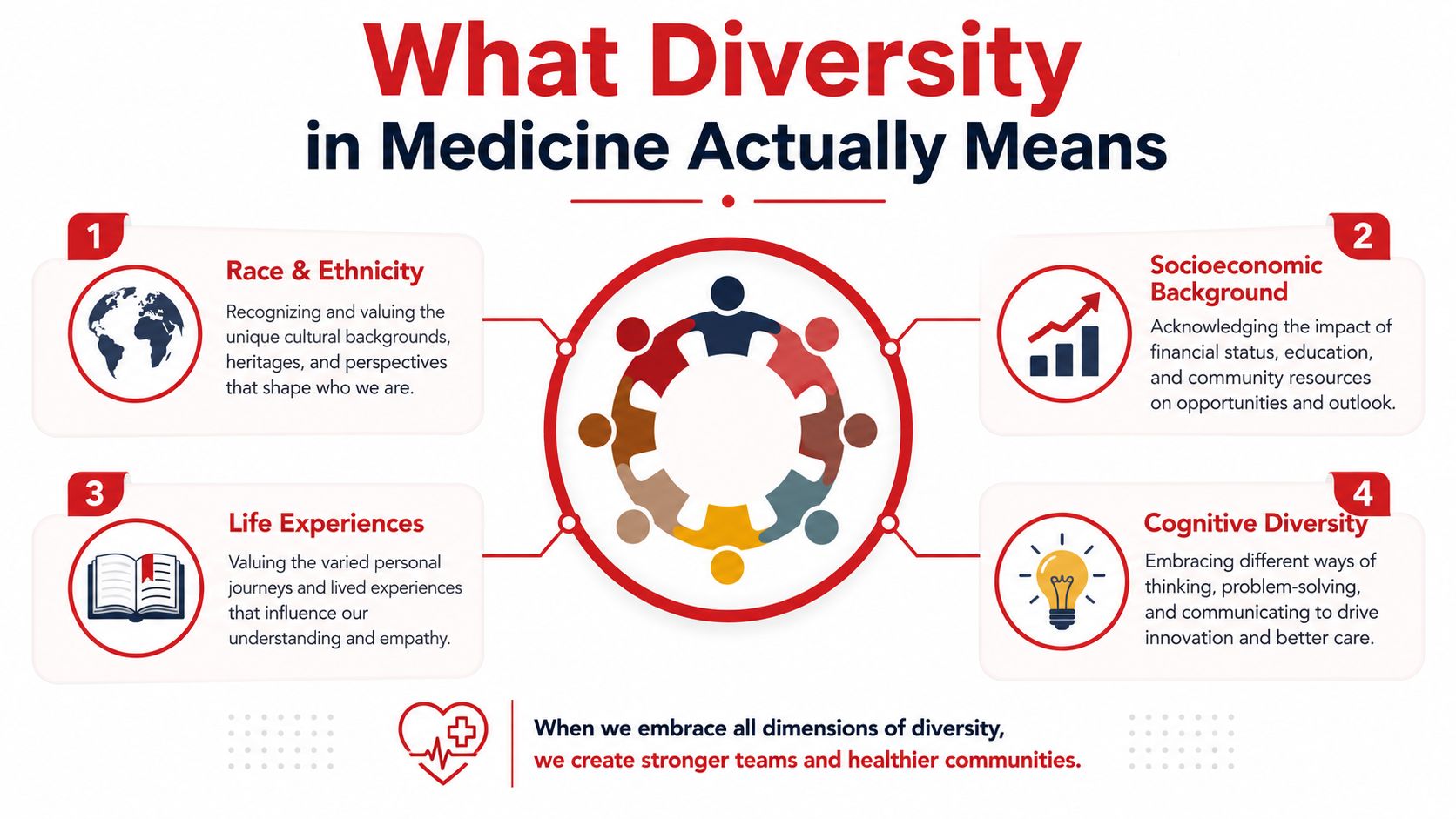
Diversity in medicine starts with visible demographics, but it cannot end there. If you only count race or ethnicity, you miss how class background, disability, language, sexual orientation, gender identity, and geography shape who becomes a physician and how that physician practices. The point is not to broaden the definition for style, it is to describe the workforce and the patients it serves.
The current U.S. physician workforce makes that narrow view hard to defend. In 2024, active physicians were 38.7% female, and 25.6% were international medical graduates, which shows that global migration is already a major part of physician diversity in a large market like the U.S. (AAMC key findings). That mix matters because it affects training, communication, and the kinds of communities physicians can serve effectively.
A broader definition is more useful
A physician can add diversity to a department in more than one way. A first-generation student from a rural county, a doctor who overcame disability access issues, or a bilingual trainee who understands language barriers all bring experiences that can improve the learning environment and patient care. If you want a practical overview of how culture and competence intersect in training, this guide on cultural competency in healthcare is a useful companion resource.
Practical rule: If a diversity plan only tracks who gets admitted, it is incomplete. It also needs to track who feels included, who stays, and who can practice without avoidable barriers.
That broader frame helps students and administrators talk more precisely. A school can be racially more balanced and still fail students with disabilities. A residency can recruit from many backgrounds and still leave out people from lower-income households or underrepresented geographic regions. The goal is not a perfect label, it is a workforce that reflects patients in a way that improves care.
For students exploring the business side of healthcare leadership, a flexible online MBA for healthcare careers can be one route into the policy and management decisions that shape inclusion. Diversity is partly built in classrooms, but it is also built in budgets, admissions policies, and promotion systems.
How Physician Diversity Changes Patient Outcomes
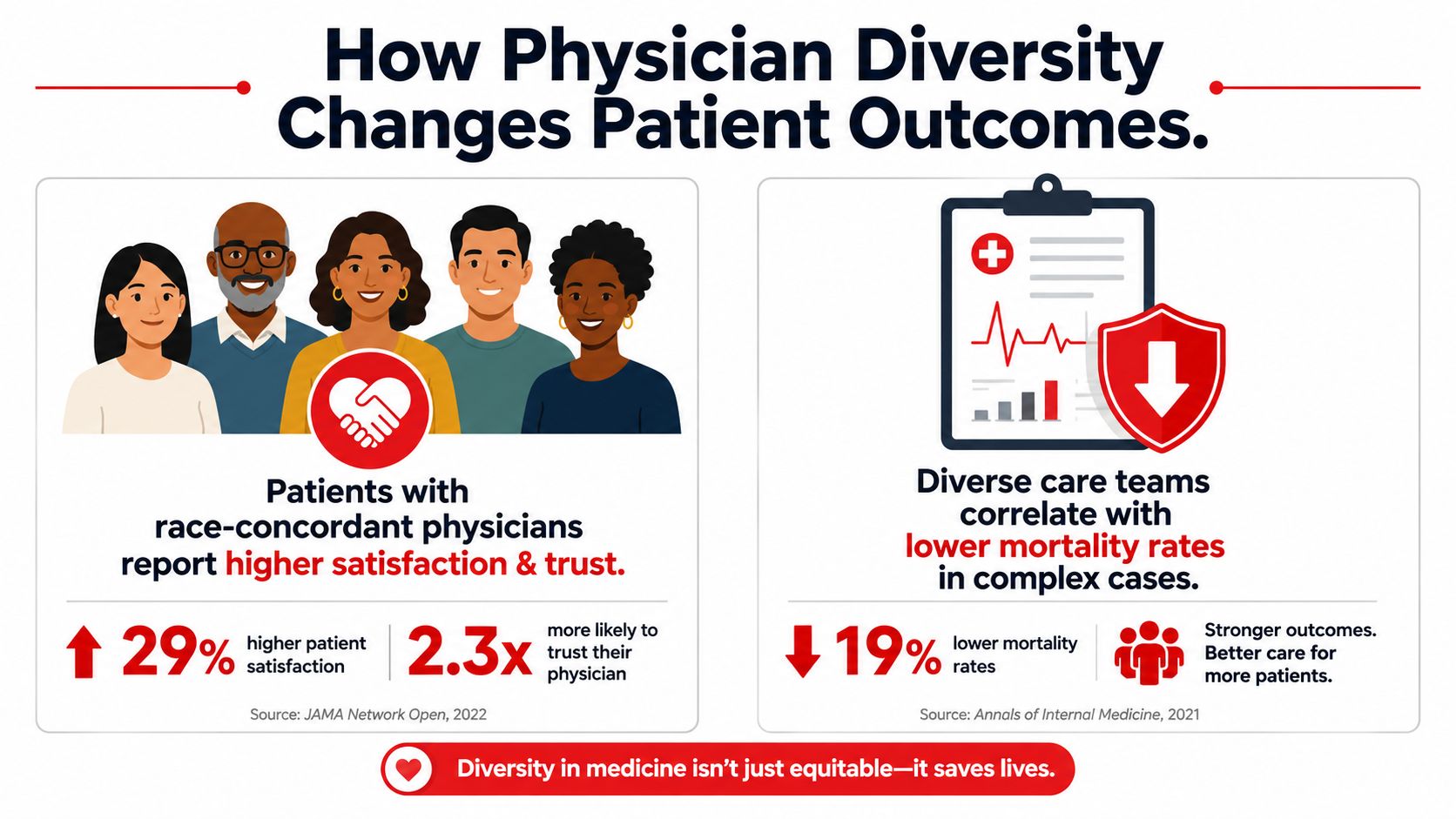
The strongest case for diversity in medicine is operational. Physicians from underrepresented minority groups are more likely to practice in underserved areas, care for higher shares of minority, low-income, and Medicaid patients, and work in shortage areas, which changes where care is available and who can reach it (NIH review). That means diversity affects service delivery, not just representation charts.
Access improves when physicians practice where need is highest
The service-delivery effect is easy to miss if you focus only on admissions numbers. A diverse workforce does more than mirror the population, it expands access in places that are already stretched thin. The NIH review noted that minority physicians were more likely than White physicians to practice in or adjacent to shortage areas, 53% vs. 26% (NIH review). That single comparison helps explain why workforce diversity is a health systems issue.
This is also why the conversation cannot stop at fairness. If underrepresented physicians are more likely to work where patients struggle to find care, then pipeline decisions affect community access years later. Students often think of diversity as an admissions outcome, but the downstream effect is the distribution of clinicians across neighborhoods, clinics, and safety-net settings. For students who are the first in their family to pursue medicine, a first-generation medical student guide can help show how background shapes those long-term choices.
Trust matters, even when the diagnosis is the same
Patient experience changes when patients feel understood. The literature on race concordance and disability inclusion points in the same direction, patients often report better satisfaction and greater use of care when the physician relationship fits their needs and lived experience (Harvard HPOD on disability and diversity). That does not mean every patient needs a physician with the same identity. It means trust, communication, and cultural understanding influence whether care is accepted and followed.
Patients do not just need access to a physician. They need access to a physician who can interpret barriers, beliefs, and constraints without dismissing them.
Medical educators should treat this as a practical lesson. If a student asks why diversity matters beyond representation, the answer is that it shapes where physicians practice, who they care for, and how likely patients are to use the system. That is a measurable service-delivery impact, not a slogan.
The same pattern shows up in specialty choice and community mission. A school can celebrate a diverse entering class, but if graduates concentrate in already well-served areas, the benefit to patients shrinks. For students writing about mission fit, the better question is whether a school prepares physicians to serve where care gaps are largest.
Where the Medical Pipeline Breaks Down
The pipeline leaks at several points, and the leak is not always where people expect it. In 2025, 54,699 people applied to U.S. medical schools, a 5.3% increase from 2024, and women made up 57.2% of applicants and 55.0% of matriculants (AAMC applicant and matriculant data). The headline looks encouraging, but the deeper pattern is more fragile than it first appears.
Gains can reverse quickly
Over the past nine years, the share of Black first-year enrollees rose from 7.2% to 10.3%, and the share of Hispanic, Latino, or Spanish Origin students rose from 9.2% to 12.3% (AAMC applicant and matriculant data). Then, after the 2023 Supreme Court decision ending affirmative action, AAMC-reported data showed a more than 10% drop in enrollment for Black and Latino students in 2024-25. The lesson is direct, gains can reverse quickly when policy shifts.
Applicant growth alone does not solve representation. If the environment that screens, ranks, and admits students keeps favoring the same profiles, the pipeline keeps leaking. A recent cross-sectional analysis found that all racial and ethnic groups were underrepresented among both applicants and matriculants over the last decade except Asian individuals, and the representation gap worsened for Black females from applicants to matriculants, with representation index values of -1.19 vs. -1.46 (P < 0.001). That finding matters because it shows admissions can amplify inequity rather than correct it.
First-generation and underserved students need more than encouragement
Many students assume the main barrier is getting interested in medicine. In reality, the harder barrier is sustaining momentum through the premed years, the application process, and interview season. First-generation students, rural students, and students from lower-income backgrounds often have fewer built-in models for handling test prep, research, and letters of recommendation. That is why support has to be structured, not left to chance, and why resources such as this guide for first-generation medical students can be practical.
Practical rule: If a program celebrates “holistic review” but still rewards the same standardized signals without context, it has not fixed the pipeline. It has only renamed it.
The key insight is that the pipeline is not one gate, it is many. Interest, preparation, application screening, interviews, and matching all matter. If one stage filters out too many capable students, the next stage starts with a weaker pool, and the loss compounds.
Practical Strategies for Students Educators and Programs
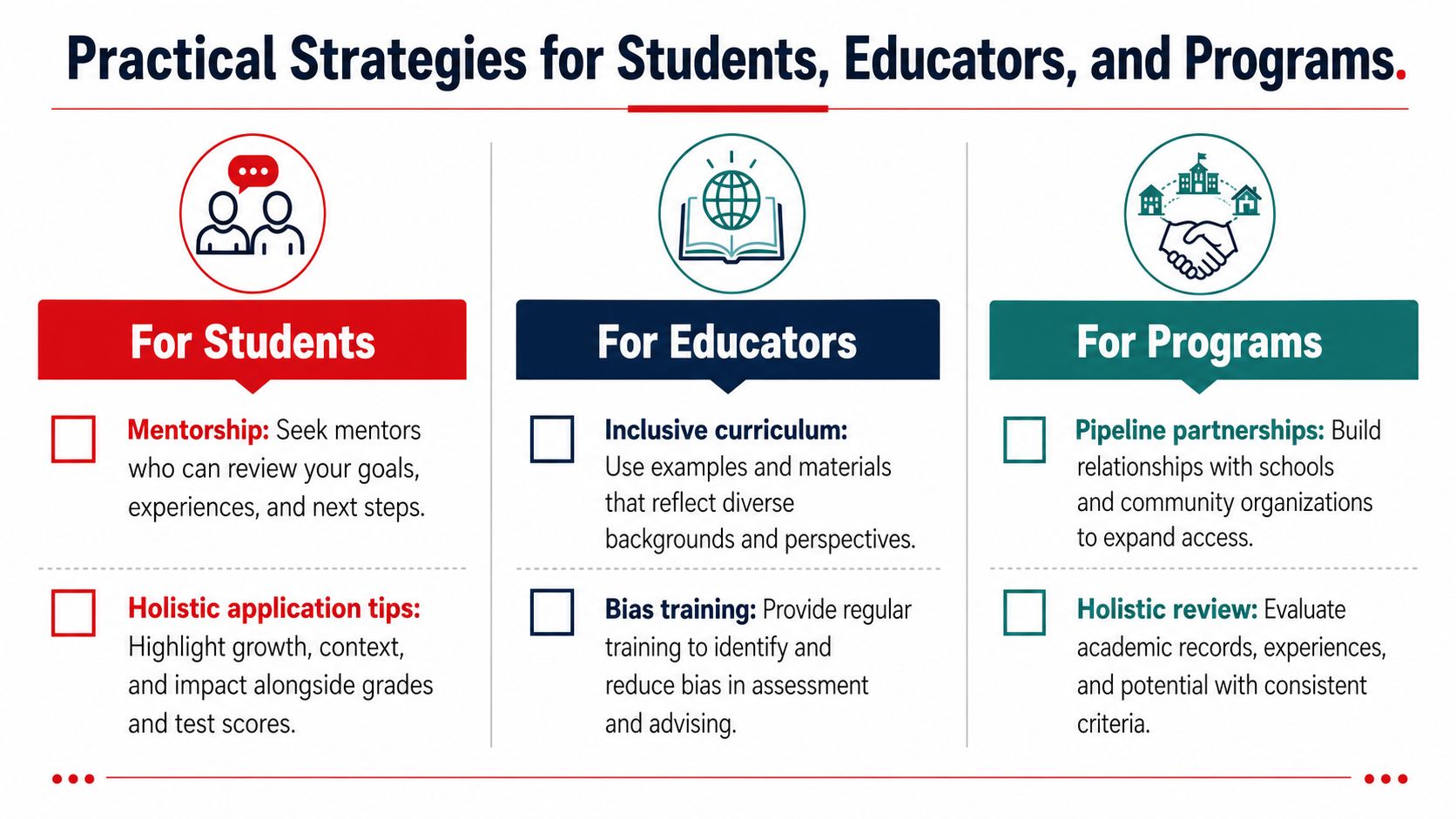
Action has to match the problem. Students need tactics they can use this semester, educators need teaching methods they can use in the classroom, and programs need admissions and retention systems that change outcomes. The right strategy depends on your role, but the common thread is the same, make inclusion visible in the process, not just in the mission statement.
For students
Students usually think they need one perfect résumé line. They don't. They need a coherent story, evidence of service, and a support network that understands the process. A strong diversity statement, when it's appropriate, should connect lived experience to service, reflection, and future goals, not just identity markers, and this writing guide can help students frame that clearly.
Three useful moves stand out:
- Find mentors early. Seek physicians, residents, or advisers who can explain hidden steps, from choosing activities to preparing for interviews.
- Use your background strategically. If you've worked with underserved communities, bilingual patients, or family caregiving, show how that shaped your goals.
- Prepare for review systems, not just exams. The review process considers context, so document your service, leadership, and persistence in ways an admissions committee can interpret.
For educators
Educators shape what students notice as “real medicine.” If the curriculum treats disparities, racism, disability access, and language barriers as side topics, students learn they are optional. When those issues are integrated into core teaching, students learn they are part of routine care.
A useful approach is to place inclusion inside clinical cases. A diabetes case can include food insecurity. A surgery case can include disability access and informed consent. A pediatrics case can include language interpretation and family structure. The point is to train students to see systems, not just symptoms.
For programs
Admissions and retention decisions send the clearest signal. Programs should examine whether their review policies are changing who gets interviewed and matched. They should also build partnerships with schools, community colleges, and community organizations in underserved areas, then support students after arrival through advising, peer networks, and accessible learning environments.
Practical rule: Recruitment without retention is a revolving door. The program looks active, but the workforce doesn't change.
One underused option is to pair admissions review with climate monitoring. If students from certain backgrounds feel isolated, overloaded, or excluded, the institution should know before they leave. That's where diversity work becomes retention work.
Expanding Diversity Beyond Race and Ethnicity
Race and ethnicity matter, but they are only part of the picture. A medical school that treats diversity as a single category can miss disability, socioeconomic status, language access, sexual orientation, gender identity, and geography. Those dimensions shape who can apply, who can train with less friction, and who can serve patients effectively.
Disability and access deserve direct attention
Guidance on diversity in medicine treats diversity as a systems problem, not only an applicant problem, and that shift matters. Universal design, accessibility, and the participation of people with disabilities in planning all help reduce the hidden barriers that still appear in training environments (NCBI diversity guidance). Accessibility is not a courtesy. It is part of full participation.
The issue reaches admissions too. Ableist technical standards and outdated expectations can screen out talented applicants before they enter training. The Harvard Program on Disability has warned that medical school admissions can still create extra barriers for disabled applicants, and that disability inclusion belongs in health equity work, not at the end of the process (Harvard HPOD on disability and diversity).
Inclusion should be built into learning environments
A school can admit students from many backgrounds and still fail them if the environment is not accessible. Physical access matters. Communication access matters. Scheduling flexibility matters. Faculty training matters too. Programs also need to teach students how to deliver care across language and culture, because a physician who cannot adapt communication is not fully prepared for clinic work.
Programs that want to widen the lens should ask different questions, such as whether lecture materials are accessible, as discussed in our guide on online learning accessibility. Are disability accommodations normalized? Are multilingual students treated as assets or as exceptions? Are students from rural or low-income backgrounds able to participate without paying hidden costs in time and travel? Those questions reveal whether inclusion is real or only stated.
There is another reason to broaden the frame. Students often find it easier to advocate when diversity is presented as a whole-system issue. If you argue only for racial diversity, you may miss allies who care about disability justice, access, or first-generation support. If you frame diversity more broadly, you build a stronger coalition and a more durable institution.
Measuring Progress With Meaningful Metrics
If a school cannot measure diversity work, it cannot manage it. Good intentions do not appear in outcomes unless leaders track the right numbers and the right experiences. That means following who applies, who gets admitted, who stays, where graduates practice, and how patients respond to the care they receive.
Table
| Demographic Group | U.S. Population Share | Physician Workforce Share | Representation Gap |
|---|---|---|---|
| Hispanic | 20% | 7% | 13 percentage points |
| Black, AIAN, NHPI | Not provided in verified data | Underrepresented relative to population share | Gap exists, exact size not provided |
KFF's analysis of 2023 AAMC workforce data found that Hispanic, Black, AIAN, and NHPI physicians were all underrepresented relative to their population share, and that Hispanic people make up 20% of the U.S. population but only 7% of the physician workforce (KFF workforce analysis). That mismatch matters because it shows why programs cannot count on slow demographic drift to close the gap. For students and trainees, the numbers also help separate a hopeful mission statement from a measurable result.
Track the full pathway
The most useful metrics follow the pipeline from start to finish. Schools should watch applicant composition, interview offers, matriculation, retention, graduation, residency placement, and eventual practice location. They should also pay attention to belonging, because climate problems often appear before attrition does.
A second layer is service alignment. If the institution says it values underserved care, do graduates practice there? If the school claims an inclusive culture, do students with disabilities, multilingual backgrounds, or first-generation status report comparable support? If not, the mission statement is ahead of the evidence.
One practical step is to pair outcome tracking with regular review of who gets resources. Advising, research access, networking, and exam support often cluster around the most visible students. That leaves others with less informal help, even in schools that claim equity.
For students, a useful question is what the program tracks and how it responds when gaps appear. A guide to statistics for medical research can help you read the data with more confidence, especially when schools present dashboards or annual reports. For educators and administrators, the task is to publish outcomes clearly and adjust policy when a metric stalls. Diversity work becomes credible when the evidence is visible.
Bottom line: Measure what changes lives, not just what looks good in a brochure.
Building a More Inclusive Future in Medicine
Recent admissions data show a mixed picture. Medical school applications reached a record high in 2025, women now make up the majority of applicants and matriculants, and Black and Hispanic first-year enrollment had improved over nine years before the post-affirmative-action drop complicated that picture. The lesson is simple. Progress can hold only when institutions actively protect it, rather than assuming it will continue on its own.
Durable change rarely comes from one office or one policy. A student who grew up in an underserved neighborhood, a faculty member who redesigns a case conference so a learner with a disability can fully participate, and a program director who turns broad support language into measurable retention goals are all working on the same problem from different angles. Their roles are different, but the goal is the same. Each one helps build a medical training system that reflects the patients it serves.
The strongest case for diversity in medicine is no longer only moral. It has service-delivery consequences that patients feel. Diverse physician teams can improve access, shape where doctors choose to practice, and influence whether patients trust and use the care that is available. They also make medical education more accurate, because a profession that trains only one kind of doctor will keep missing too many kinds of patients.
For students, the practical question is where your story fits into service. For educators, it is what the curriculum leaves out and which assumptions it repeats. For program leaders, it is what the data show, what the mission rewards, and whether support reaches the learners who need it most.
Ace Med Boards supports students who need structured help with admissions, exam preparation, and residency planning, including one-on-one tutoring and application strategy. If you are thinking about how to present your background, strengthen your academic record, or plan a path into medicine, visit Ace Med Boards and explore the resources that fit your next step.