Most advice on books for Step 1 is lazy. It tells students to buy the same small stack, then pretends every learner has the same weaknesses, the same schedule, and the same tolerance for reading. That approach wastes time, and time is the resource you cannot get back.
The smarter question is not, “What are the best books?” It's, “Which book fixes my weakest area fast enough to justify the hours?” That matters even more now that Step 1 is pass/fail, because the old chase for a three-digit score gave way to a different standard, one built around conceptual mastery, question-answering efficiency, and clean integration across disciplines (USMLE Step 1 materials).
There's also a practical reality students keep ignoring. Books only help if they change how you answer vignettes. If a title doesn't improve recall, pattern recognition, or your ability to eliminate wrong choices, it's dead weight. A strong plan starts by matching each book to a specific gap, then trimming anything that doesn't pull its weight.
Why Most Step 1 Book Lists Fail Modern Students
Most Step 1 book lists still assume that collecting more resources automatically improves preparation. That made more sense when students were chasing every detail for a numeric score. It falls apart in a pass/fail exam where the task is to build integrated understanding and answer mixed clinical-style questions quickly and accurately.
The problem with “best overall” thinking
A single “best book” usually does not exist. A student who keeps missing physiology needs a different resource than a student who misses pharmacology mechanisms, and a strong student does not need to read a massive text just to feel covered. The right question focuses on which book fixes your weakest area fast enough to justify the hours.
That is why the usual book roundups disappoint. They recycle the same names and leave students to guess how to use them. If you need a practical starting point for broader study-material selection, use this Step 1 study material guide as a reference, then strip your stack down to the few resources that improve your question performance.
Practical rule: If a book does not help you solve a missed question faster on the next pass, it belongs on the cut list.
What changed after pass/fail
The pass/fail shift changed how students should think about reading. Under a numeric-score mindset, some learners tolerated more depth because every extra point felt worth the time. Now, books have to earn their place by improving efficiency, especially since question banks and self-assessments dominate serious prep.
That does not make books obsolete. It narrows their job. The best books for Step 1 compress high-yield mechanisms, make weak systems easier to revisit, and support active recall instead of passive reading. If a title turns into endless note-taking without better question performance, it is a poor fit for this exam.
A student who owns five books but uses none of them to fix missed concepts is not prepared. That student is overloaded.
Understanding the Current Step 1 Exam Format
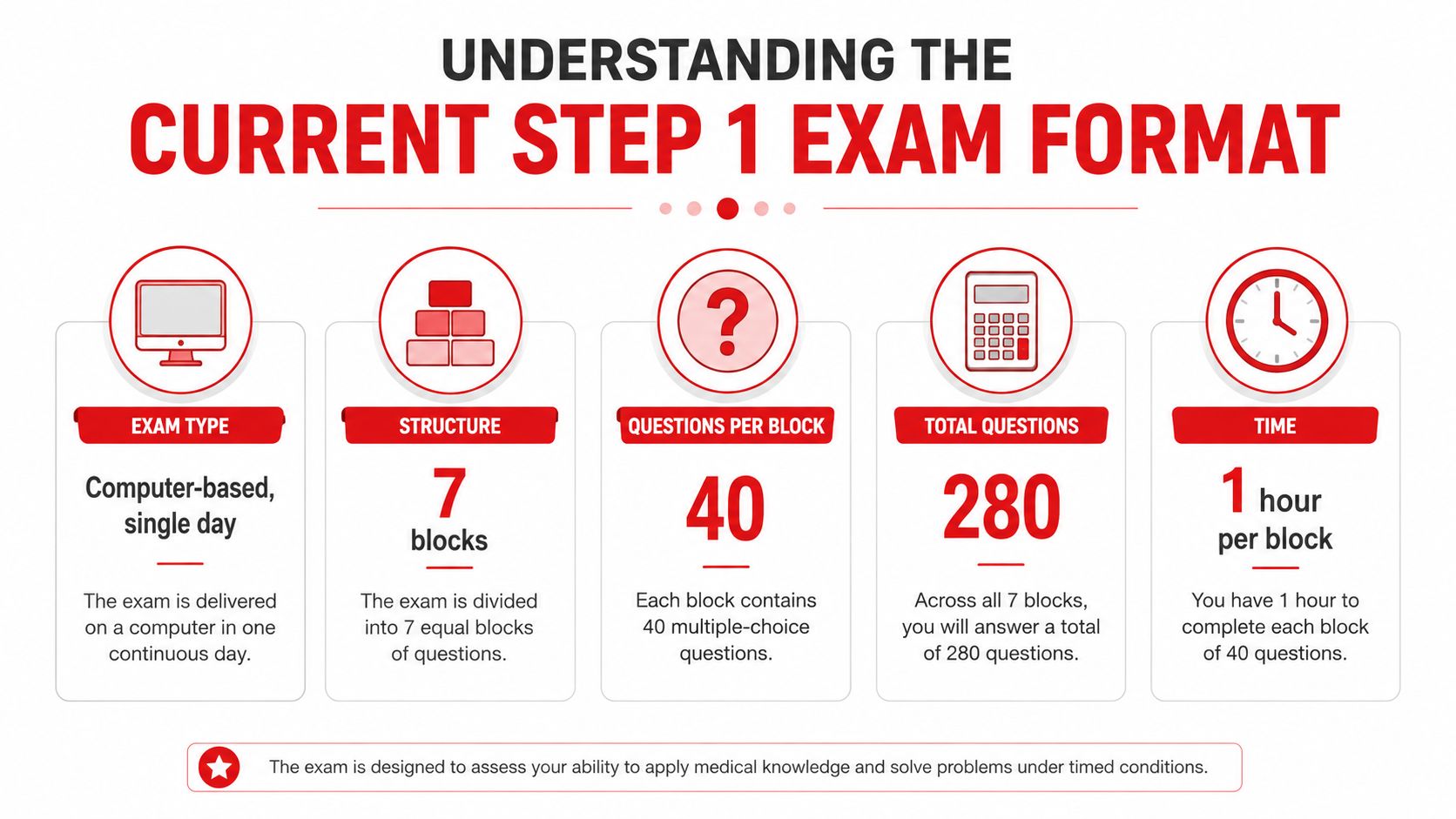
Step 1 is a single-day computer-based exam with 7 one-hour blocks, up to 40 multiple-choice items per block, and up to 280 total items. A detailed breakdown of the USMLE Step 1 format is available here. That structure explains what useful study resources must do. They need to train you to think in vignettes, shift between disciplines, and identify the underlying mechanism quickly.
Why the format favors high-yield books
A test built around broad integration does not reward slow, linear reading. It rewards rapid mapping, connecting a symptom to physiology, pathology, pharmacology, or microbiology without getting lost in detail. That is why condensed review books stay popular. They help students organize a messy set of basic sciences into one exam framework.
The older habit of treating Step 1 like a content encyclopedia no longer fits. A dense textbook may teach beautifully, yet it remains a weak investment if it does not help you answer integrated questions under time pressure. The official exam design makes that clear, because the content is system-based rather than isolated by subject.
What the scoring change means for resource choice
The January 2022 move from a three-digit score to pass/fail changed student behavior around books. Students now care less about squeezing out tiny score gains and more about building enough confidence to avoid careless misses. That favors shorter, more usable resources.
So when you pick a book, ask a blunt question. Does it help you recognize patterns, or does it just add pages? A good Step 1 book should support fast recall, not bury you in extra theory. If it cannot do that, your question bank should replace it, not sit beside it.
Recommended Books by Subject Area and Learning Gap
The best way to choose books for Step 1 is by deficit, not by brand loyalty. A student who is weak in physiology needs a different tool than someone who forgets microbiology organisms or confuses pharmacology side effects. The same book can be perfect for one learner and a waste of time for another.
The core stack by subject
| Subject Area | Primary Book | Best For | Skip If |
|---|---|---|---|
| Physiology | BRS Physiology | Students who need a clearer mechanism-first explanation of systems | You already understand physiology well and only need recall refreshers |
| Pathology | Pathoma | Learners who need disease processes organized into simple, repeatable patterns | You've already built a strong pathology framework and only want quick review |
| Pharmacology | A concise review text or drug-focused notes | Students who keep mixing up mechanisms, adverse effects, and drug classes | Pharmacology is already one of your stronger areas |
| Microbiology | A high-yield micro resource | Learners who need organisms tied to clinical clues and testable associations | You retain bugs well from question banks and flashcards |
| Biochemistry | A condensed, clinically oriented review | Students who need pathways tied to disease and inheritance patterns | Pure memorization is not your issue and you only need light review |
| Behavioral science | A short applied review | Learners who need ethics, stats concepts, and communication principles in exam format | You already answer those items reliably in questions |
Where First Aid fits
First Aid for the USMLE Step 1 remains the anchor text because the 2024 edition is an 848-page consolidated review and the publisher describes it as a blueprint for test-day content (First Aid 2024). That makes it a framework, not a deep-learning textbook. Students should annotate it, cross-link it to question-bank misses, and use it as the spine of the whole plan.
If you need an organized overview of how that anchor text fits into a study stack, the First Aid for Step 1 guide is a useful companion.
How to decide what to buy
If your problem is comprehension, buy the book that explains mechanisms cleanly. If your problem is recall, buy the shortest resource that hits the weak system. If your problem is test-taking, don't buy another book at all, buy questions and use the book only to annotate misses.
Bottom line: A book earns its place when it fixes a named weakness. “Good reputation” is not a study strategy.
Integrating Books with Qbanks and Video Lectures
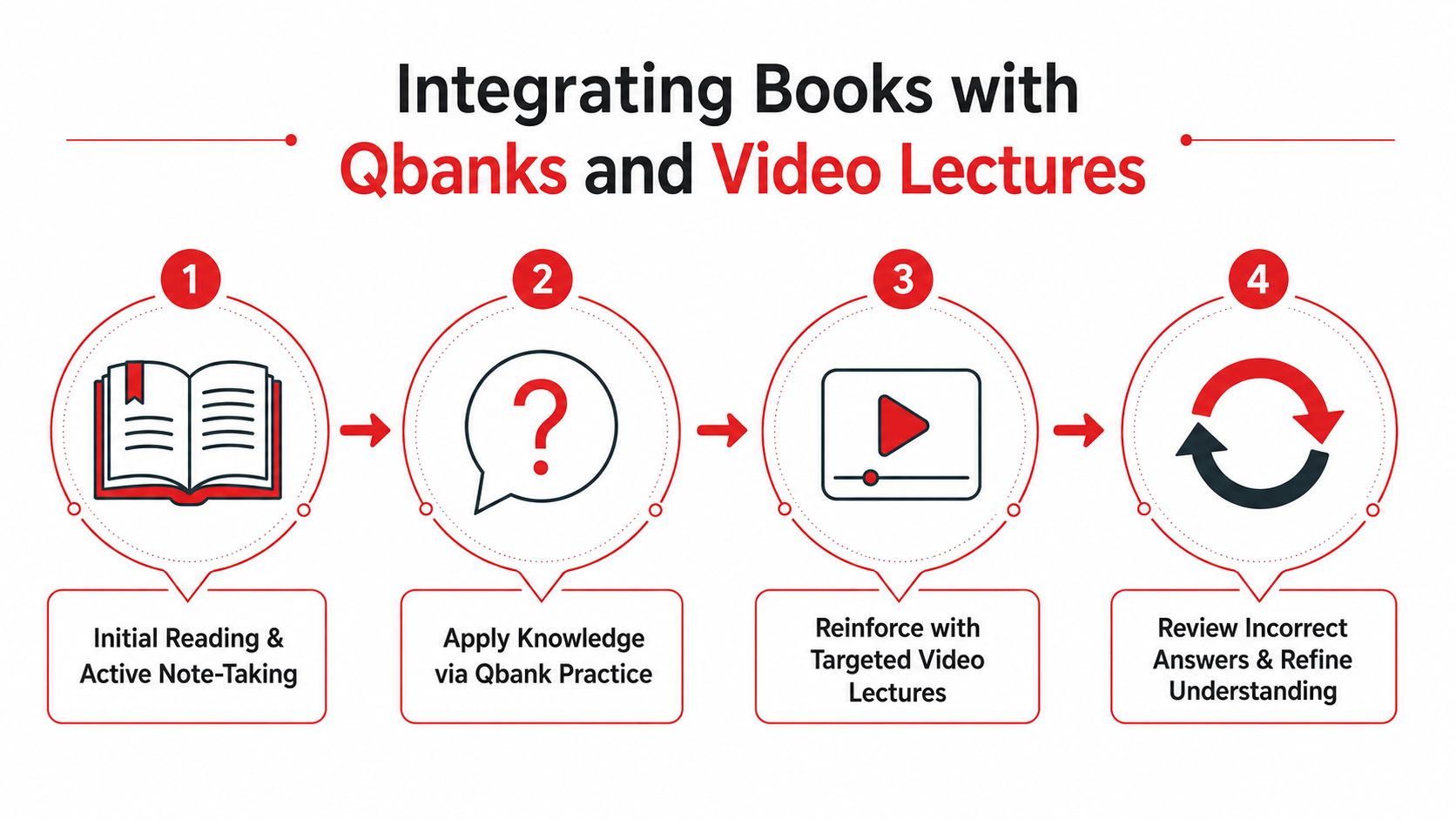
The most common mistake is reading first and hoping questions will later “test” the material. That's backwards. You should read just enough to form a usable model, then immediately test that model against questions, then go back and tighten the gaps.
A workflow that actually works
Start with a short reading block in the book that matches your weakness. Then move straight into a focused set of questions from your question bank, using the missed items to annotate your review text. That loop turns the book into a living document instead of a passive chapter outline.
A useful modern workflow is to pair text with targeted digital tools. Students who want a structured note layer often compare general note apps with resources like best AI note taking apps, especially when they're trying to turn missed questions into searchable study notes. Use that kind of tool only if it speeds up review. If it adds friction, drop it.
When video lectures help
Video lectures are a substitute when the book's explanation feels too dense or too abstract. They're a supplement when you already understand the concept and just need a fast visual refresh. Use video to approach a topic, not to replace thinking.
That's why many students pair reading with concise explanations from lecture-based resources, then return to the book for structure. The strongest approach is not book-only, lecture-only, or questions-only. It's a read, test, review, repeat loop that keeps every modality honest.
The USMLE Step 1 question bank guide is helpful if you want to choose practice resources that match this workflow.
A simple daily structure
Use one block for reading, one for questions, and one for review. If you spend more time reading than answering and reviewing, you've overinvested in passive learning. The exam does not reward that habit.
Sample Study Timelines for Different Preparation Windows
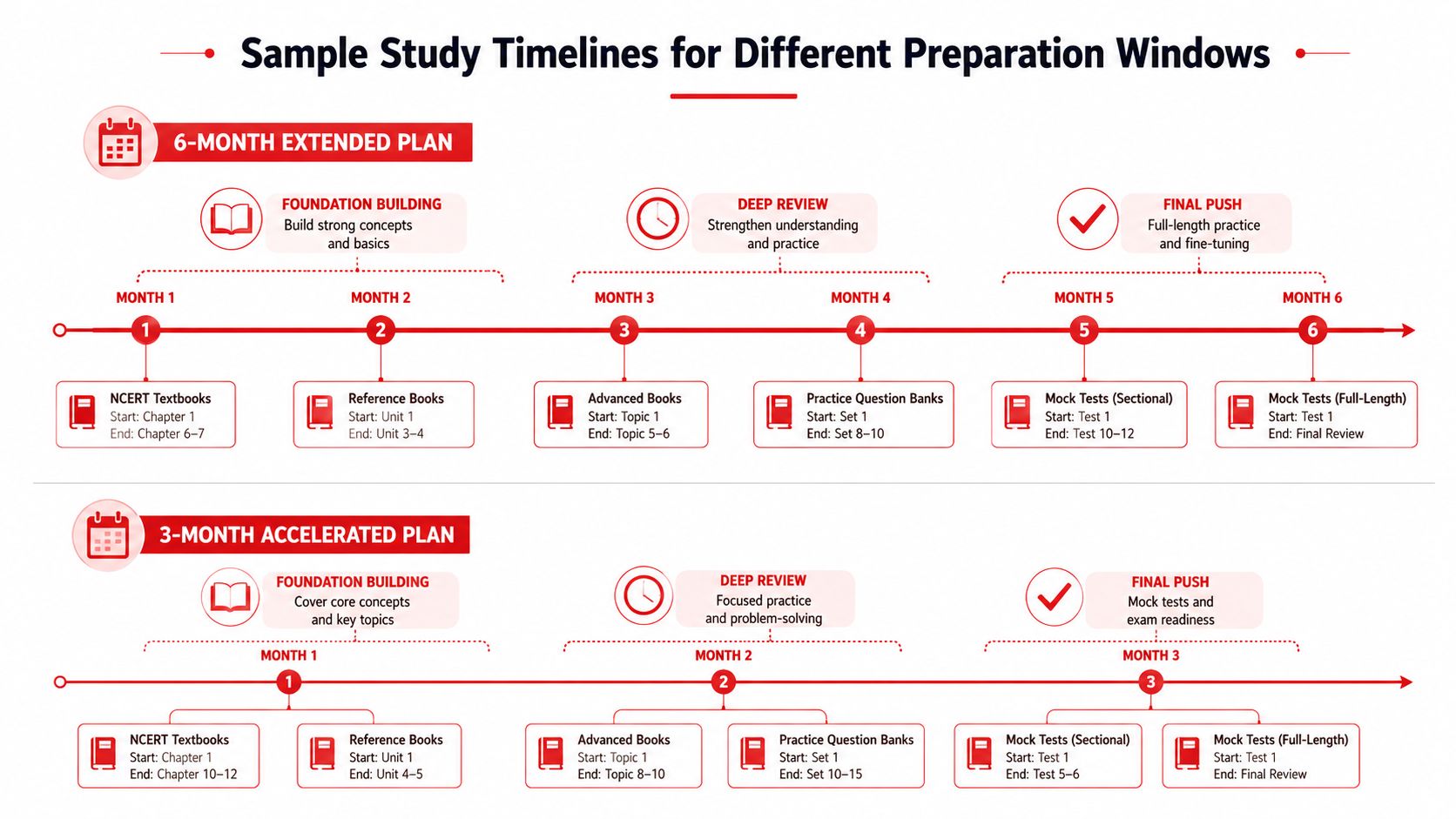
A student studying alongside coursework needs books to function as scaffolding. A student in dedicated time needs books to act as a short bridge, then fade out as the exam gets closer. Those plans are built for different constraints.
Six-month extended plan
In a longer runway, start with the weakest system and the lightest usable book. Read enough to understand one topic, then move into questions on that same topic before shifting to the next area. Keep First Aid open from the beginning, but use it as the annotation spine, not the book you try to “finish.”
By the middle of the timeline, reading should get narrower. You stop opening every book every day and return only to the resource that fixes the weakness you just exposed in questions. Near the end, the books shrink to quick review, error logging, and last-pass annotations.
Eight-week dedicated plan
In a dedicated window, books need a tighter job. Spend the first stretch clearing major gaps with the shortest effective explanations, then shift fast into question-heavy days. Anything that still feels too slow or too detailed gets cut.
A short dedicated period centers on control of attention rather than access to materials. Practical time blocking from time management tips for students helps because the core problem is usually drift, not scarcity. You do better with fewer distractions and cleaner transitions between reading, questions, and review.
For calendar structure, the USMLE Step 1 study plan schedule gives a workable frame for organizing the week and deciding when a book has earned its place.
Rule of thumb: As test day gets closer, books should disappear from your day before questions do.
How Personalized Tutoring Amplifies Book-Based Study
Books can't watch you reason. They can't tell you why you keep missing the same renal physiology question, or why you confuse two similar drugs under pressure. That's where one-on-one tutoring becomes useful, because the tutor sees the pattern your books keep missing.
Where tutoring pays off
A tutor helps most when you're stuck in a loop. You read, you highlight, you do questions, and the same error shows up again. At that point, the issue is usually not lack of effort. It's a broken decision process, and a good tutor can isolate it quickly.
That's also where adaptive learning logic matters. The idea behind benefits of adaptive learning for L&D maps well to Step 1 prep, because effective study should respond to the learner's actual gaps rather than force everyone through the same sequence. A tutor does that in real time.
Ace Med Boards offers one-on-one online tutoring for Step 1, which fits this model when a student needs customized pacing, targeted explanation, or help rebuilding a study schedule around weak areas. That kind of support doesn't replace books. It makes the right books more useful.
What a tutor should do for you
A tutor should tighten your schedule, expose flawed reasoning, and help you choose what to stop reading. If every session just repeats content you already know, the value is low. If it changes how you approach questions, the value is high.
Practical rule: Use tutoring to correct thinking, not to collect more content.
Common Book Selection Mistakes and How to Avoid Them
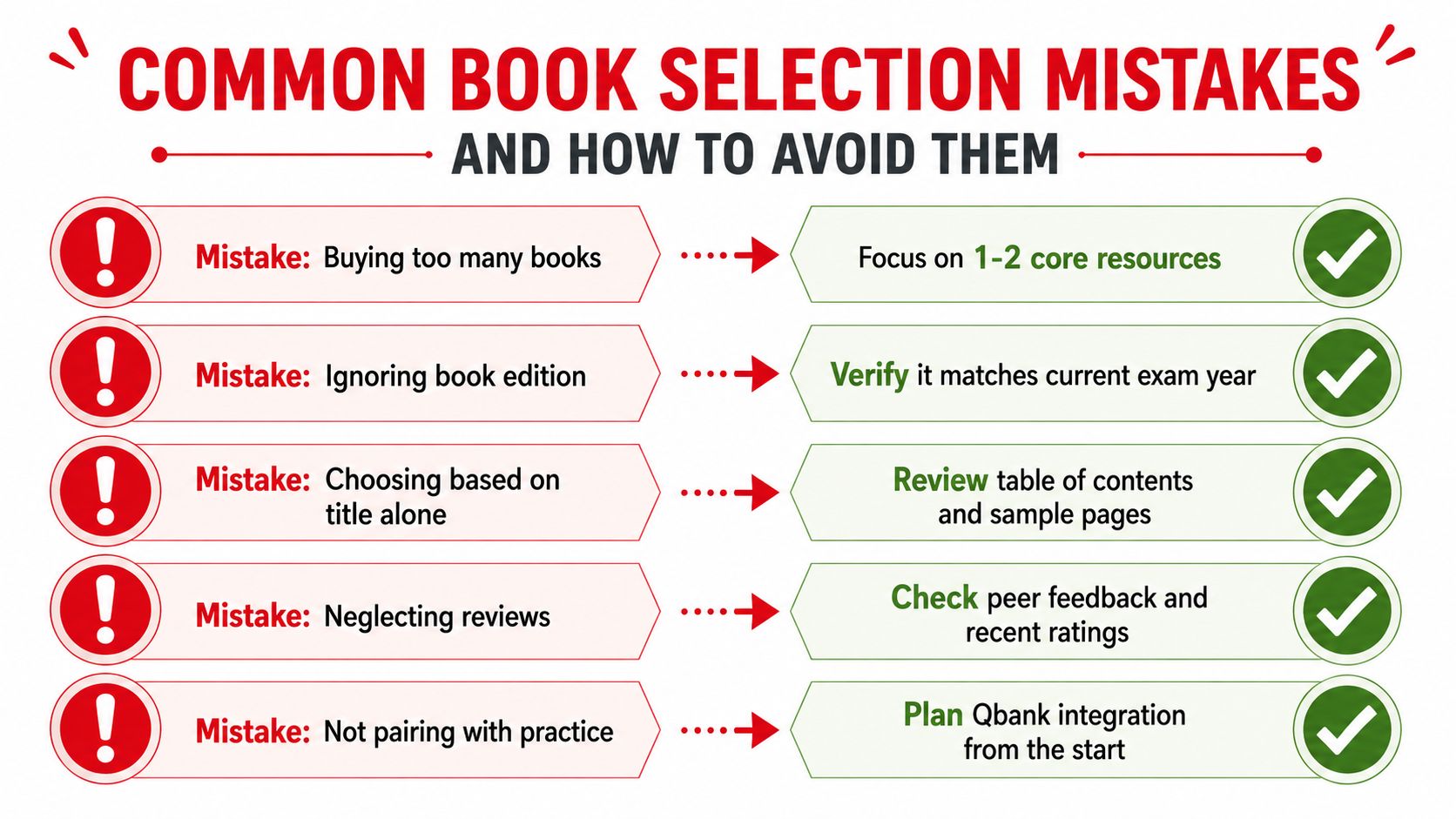
The fastest way to waste Step 1 time is to buy resources before you define the gap. Students also lose weeks by chasing the newest title, reading passively, or refusing to quit a book that clearly isn't helping.
- Buying too many books. Keep 1 to 2 core resources and cut the rest before they become clutter.
- Ignoring the edition. Use the version that matches the current exam year and current content framing.
- Choosing by title alone. Check the table of contents and a few sample pages before you commit.
- Skipping peer feedback. Use recent student feedback to learn whether the book is too thin or too detailed.
- Not pairing books with practice. Build your Qbank routine first, then place the book around it.
The checklist is simple. Does the book fix a defined weakness, does it fit your current timeline, and does it improve question performance? If the answer to any of those is no, remove it from your plan.
If you want a resource stack built around your actual Step 1 weak spots, not a recycled list, Ace Med Boards can help you map books, questions, and tutoring into one efficient plan. Use the right book for the right gap, then stop spending time on resources that don't move your score readiness forward.