A COMLEX calculator is not an official score report, and no tool can turn one into one. COMLEX-USA Level 1 reports pass or fail for candidates who tested on or after May 10, 2022, COMLEX-USA Level 2-CE requires a three-digit standard score of 400, and COMLEX-USA Level 3 requires 350.
So why does a search for a COMLEX calculator keep returning pages that offer to convert 68 percent on a question bank into a three-digit score? Most of those pages were written for an exam that no longer reports a number at Level 1, and the rest borrow a threshold from the wrong level. The figure they hand back looks precise. Precision is the one thing that isn't available here.
What is available is narrower and more useful. The National Board of Osteopathic Medical Examiners (NBOME) reports official results, publishes a percentile converter for a reported three-digit score, and defines what each level's passing standard means. Everything else a calculator claims to do rests on assumptions the reader can't see. Sorting those claims by the question you're asking is the whole skill, and it takes about ten minutes to learn.
Which COMLEX Calculator Matches Your Question
Before any conversion happens, it's worth knowing what NBOME publishes. NBOME issues the official result and provides a percentile converter that starts from a reported three-digit score inside a named testing cycle. It publishes no raw-percentage calculator and no COMLEX-to-USMLE formula.
Four different questions hide behind one search term, and only one of them has an official tool behind it. A student holding a 450 wants to know where it stands. A student six weeks from a test date wants a target. A student staring at a question bank percentage wants a score. A student weighing a second licensing exam wants a conversion. Those are separate jobs with separate inputs, and blending them is how people end up trusting a number nobody ever computed.
| Calculator type | Valid input | Trustworthy output | Do not use it to |
|---|---|---|---|
| Score to percentile | Official three-digit score and its testing cycle | Relative standing in that cycle's first-time cohort | Set a residency cutoff |
| Target-score planner | Exam level and a personal goal | Gap from 400 or 350, or a Level 1 pass goal | Promise the official result |
| Percent-correct tool | Question-bank or raw percentage | A labeled practice band | Produce a three-digit COMLEX score |
| COMLEX to USMLE converter | No input NBOME publishes for conversion | No official converted score | Predict a USMLE result |
Read the last column first. It names the misuse each tool attracts, and that misuse is usually the reason someone typed the search in the first place.
The empty cell in the bottom row is the honest answer, not an oversight. No official body publishes a converted score, so every published equivalence is somebody's model rather than a rule. A candidate who needs a USMLE number sits the USMLE.
Labels a percentile needs before it means rank
NBOME recalculates percentiles from all candidates in each testing cycle, so the same three-digit score can map to a different percentile from one cycle to the next, as the NBOME percentile score guidance sets out. That makes a static score chart risky, especially one that mixes Level 2-CE data from an earlier cycle with this year's applicants. Nothing on such a chart announces its vintage, so the error passes unnoticed and the reader never knows to doubt it.
Four labels belong beside any percentile: the exam level, the testing window, the first-time candidate cohort, and the NBOME tool it came from. Remove one and the figure stops describing anyone in particular.
What a percentile never settles
A score just above 400 is not a specialty cutoff. Percentile rank describes relative performance among examinees in one cycle, and it doesn't establish a program's filter or guarantee interview strength. Program screens live with program directors, and they move as applicant pools move.
Choice rule: a question bank percentage stays a practice band, an official three-digit score goes to that cycle's percentile converter, and a hoped-for USMLE number leaves the calculator entirely.
Practice-tool interpretation is its own problem. The guide to COMSAE to COMLEX conversion handles the case where the input is a self-assessment rather than an official score, and it's the right place to go before reading anything into a practice result.
COMLEX Passing Standards by Exam Level
The Osteopathic Medical Licensing Examination of the United States (COMLEX-USA) is the licensing sequence for osteopathic medical students and physicians. Results come from NBOME, and they differ by level and, at Level 1, by testing era.
As of the current NBOME examination score guidance, Level 2-CE and Level 3 each report a three-digit standard score, with minimum passing standards of 400 and 350. Level 1 reports pass or fail for candidates who tested on or after May 10, 2022. Candidates who tested on or before April 30, 2022 received both a numeric score and a pass/fail result.
Those outcomes aren't interchangeable. Level 1 still carries a listed passing standard of 400, but a current Level 1 examinee never sees that number printed on a report, so treating it as a target confuses the published standard with the reported result. Using the Level 2-CE bar of 400 to judge Level 3 performance repeats the same error in the other direction.
| Exam and era | Result you receive | Passing standard | Safe calculator use |
|---|---|---|---|
| Level 1, tested on or after May 10, 2022 | Pass or fail | Listed standard 400, not a reported three-digit score | Pass readiness only |
| Level 1, tested on or before April 30, 2022 | Three-digit score and pass or fail | 400 | Historical interpretation for that reporting era |
| Level 2-CE | Three-digit standard score | 400 | Cycle-specific percentile after an official score |
| Level 3 | Three-digit standard score | 350 | Cycle-specific percentile after an official score |
NBOME judges performance on the total examination rather than requiring a separate passing result in each content area. A weak block in one system doesn't create its own gate; it pulls on the total. That's why a content-area breakdown is diagnostic material rather than a pass/fail ledger, and why a student can score below the passing standard overall while showing strength in specific systems.
If standard-setting language is still unfamiliar, the explainer on board exam passing scores walks through how thresholds get set and reviewed across licensing exams.
Key Takeaways
- Match level and era first. A 2019 Level 1 score, a current Level 1 pass, a Level 2-CE 450, and a Level 3 380 are four different kinds of fact.
- Apply 400 and 350 only to the exam that reports them. 400 belongs to Level 2-CE and to historical Level 1. 350 belongs to Level 3.
- Discard any tool that asks for a current Level 1 three-digit target. That number isn't reported, so the tool is working from a retired scale.
From Raw Answers to a Standard Score
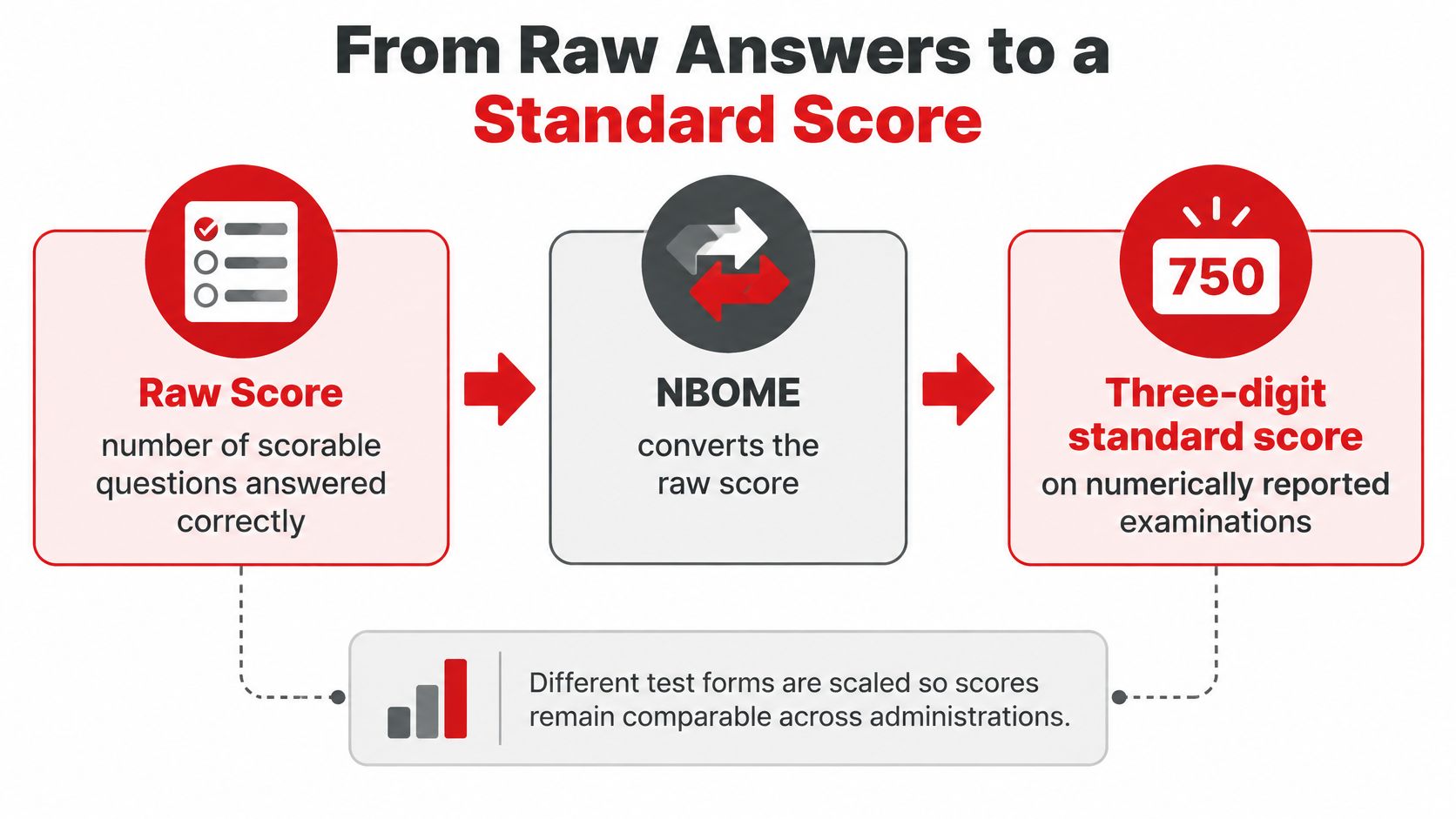
The raw score is the count of scorable questions answered correctly, and it isn't what anyone reports. On the examinations that still return a number, NBOME converts that raw count into a three-digit standard score, and the COMLEX-USA Bulletin of Information describes the conversion as a way to compare candidates fairly across test forms whose difficulty varies.
One conversion step sits between a counted answer and a reported score. Nothing in between is a percentage.
Why a harder form isn't punished twice
Picture a course that runs two versions of its final. One version is brutal, the other gentle, and a student who reaches 70 percent on the brutal version has demonstrated more than a classmate who reaches 70 percent on the gentle one. A licensing exam faces the same problem at far greater scale, and its answer is to place each form on a common reporting metric rather than publish a fixed percentage threshold.
Every scorable question counts the same. That is a different statement from "a fixed number of misses predicts a pass," and the two get blended constantly.
Criterion-referenced, not curved
Pass or fail is criterion-referenced, and NBOME states plainly that the standard isn't a preset percentage of candidates who must fail. No form is curved to manufacture a chosen failure count. The standard itself gets revisited periodically, which is one reason a conversion built years ago drifts away from current practice without anyone editing the page.
That review cycle is why a spreadsheet can't reconstruct an official score. Without the specific form and NBOME's scoring process, the arithmetic has nothing to anchor to, and the number of items a candidate can miss isn't fixed because form difficulty isn't fixed.
Other professions run into the same scaling problem. If you want to see how a different testing program handles the raw-to-scaled step, you can convert your raw LSAT score and compare how that converter labels its inputs. The labeling is the transferable lesson.
Once an official score exists, the COMLEX score percentile guide covers how to read the cycle-specific rank without overclaiming what it means. Three jobs stay separate throughout: estimate practice readiness, judge pass risk, and convert a reported score to a percentile. A single box claiming all three is doing at least one of them without the information required.
Worked Examples Without False Precision
Three illustrations follow, and each one is labeled as an illustration. None uses a recalled exam item or a proprietary formula, because neither is public, and none should be read as an NBOME prediction.
A score report in hand is the moment most calculator searches begin, and it's also the moment the most careless reading happens.
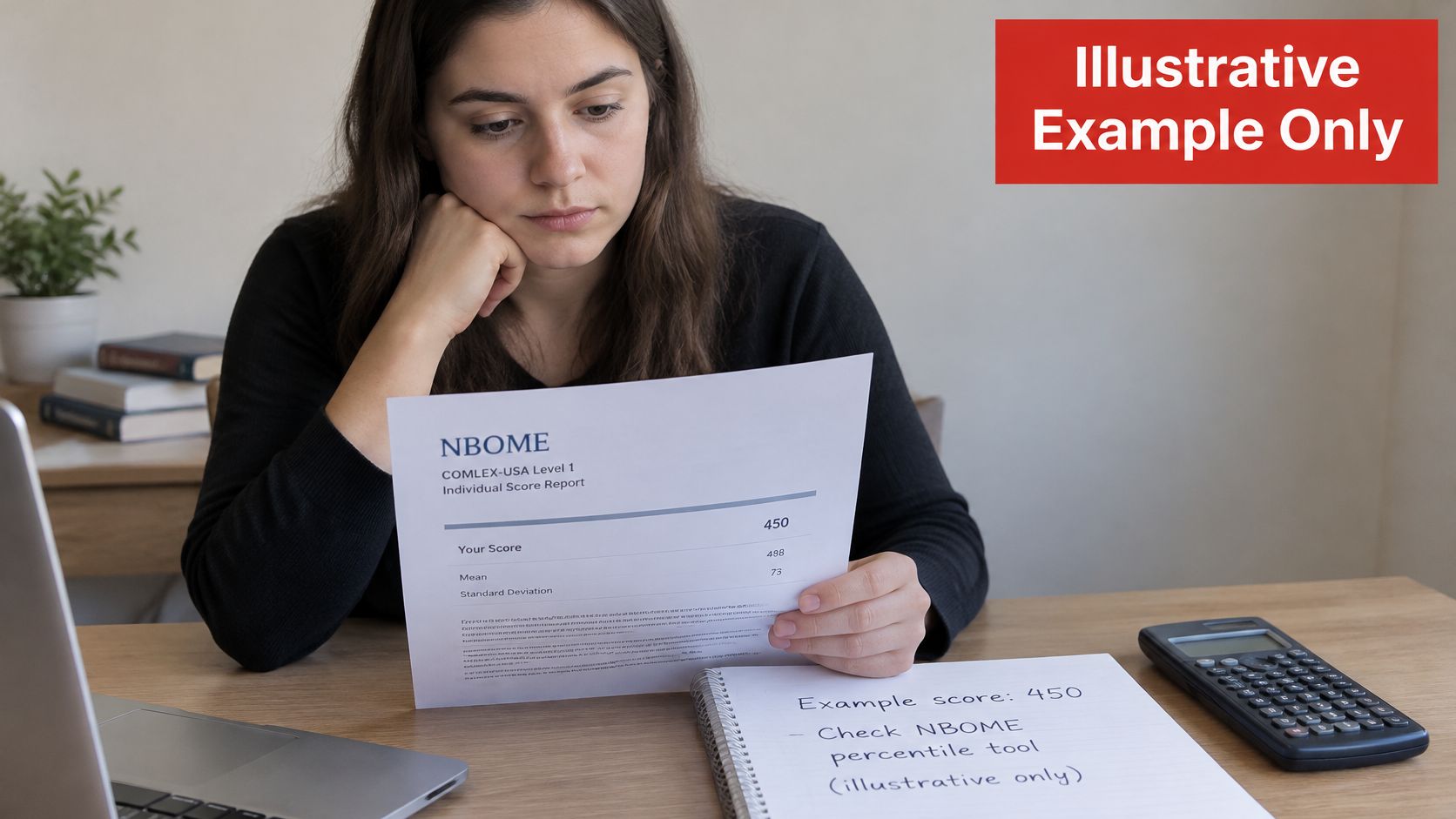
Example A, an official Level 2-CE score of 450
Input: an official three-digit Level 2-CE score of 450 and the cycle in which it was earned.
The forbidden conclusion is a percentile lifted from a chart saved two years ago, or a translated USMLE figure. Neither is a fact about this candidate's cohort, and the USMLE figure has no official basis at all.
The useful next step is the NBOME percentile converter for that specific cycle, then a written record of the percentile with its date and cohort attached. From there the question becomes diagnostic: was the shortfall in knowledge, in vignette reasoning, or in the final blocks of each section? How a score is read during application season is a separate matter, covered in the guide to COMLEX scores and residency match for DO students.
Example B, a current Level 1 candidate at about 68 percent
Input: roughly 68 percent correct across recent question bank blocks.
The forbidden conclusion is a three-digit score. Level 1 stopped reporting one for candidates who tested on or after May 10, 2022, as the NBOME announcement on Level 1 numeric scores documents, so any figure presented as an equivalent three-digit result is fabricated at the interface level.
The honest output is a readiness note with three entries: which content clusters are thin, whether timing holds on the last ten questions of a block, and whether performance is consistent across blocks or swings by subject. A pass-risk judgment follows from that pattern, not from the percentage alone.
Example C, a Level 3 candidate aiming to clear 350
Input: a goal of 350 and a running count of missed items.
Counting misses can't be converted into points, because the allowable number wrong depends on the form a candidate receives. The forbidden conclusion is "twelve more correct answers gets me there."
The decision branches on equated practice. If COMSAE (Osteopathic Medical Self-Assessment Examination) results sit repeatedly below the passing region, the next block of study repairs two weak systems and rebuilds pacing. If those results sit comfortably above it, the work shifts to protecting endurance and keeping osteopathic principles sharp rather than chasing a percentile that doesn't exist for a practice test.
A low result or a failed attempt is information for the next plan. It isn't a verdict on a career, and it isn't a permanent label. Treat it as a set of clues with dates attached, then act on the most actionable one.
A Checklist Before You Trust the Number
NBOME typically reviews minimum-competence standards every three to five years, and the NBOME frequently asked questions page describes standard-setting methods such as the modified Angoff procedure, in which qualified panelists judge how a minimally competent candidate would perform on individual items. A calculator built against an older standard is answering an older question.
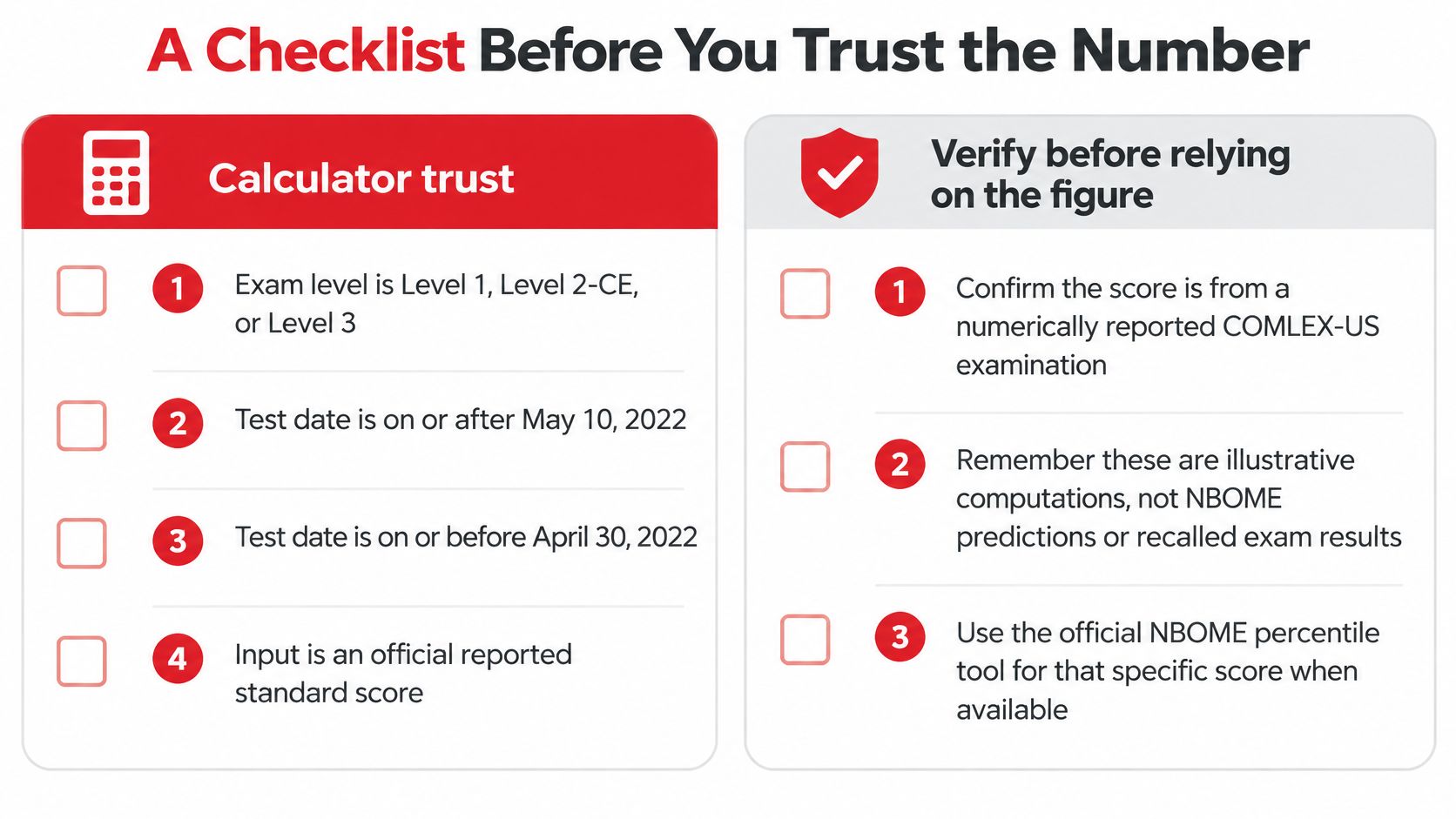
Calculator trust, five checks
- Exam level: the page names Level 1, Level 2-CE, or Level 3, and its answer would change if the level changed.
- Testing era: a Level 1 input is labeled as on or after May 10, 2022, or on or before April 30, 2022.
- Input type: an official score and a practice percentage are never handled as the same quantity.
- Cohort: any percentile names its testing cycle and its first-time candidate group.
- Content areas: no single content area is treated as its own pass gate.
Reject it if the page hides the level, the era, or the cycle, or prints one conversion meant to last forever.
Interface practice with official materials
- Start with the source. Open the current NBOME examination tutorial and a COMSAE for the same level rather than a commercial look-alike that guesses at screen layout.
- Run timed blocks. Full sets under the clock, so pacing becomes automatic instead of aspirational.
- Use only the tools the tutorial provides. Highlight, flag, and navigation work as the official software presents them; practice habits built on imaginary features waste time on test day.
- Read the full vignette before the choices. Answering from a half-read stem is the most common avoidable error in long clinical items.
- Watch the last items in a block. If they're rushed, the problem is pacing, not a missing formula.
Maintained by the Ace Med Boards Editorial Team and current as of 2026, this page treats scoring rules as time-sensitive and sends changeable ones back to the NBOME Bulletin and score pages rather than to a cached chart. This is examination education, not medical advice, and nothing here reproduces a real or recalled COMLEX item.
Plan the Next Study Block From the Result
Close on a decision rather than on a table. If the input was a practice percentage, schedule repair of the missed systems plus one timed block, and skip the search for a better converter. If an official Level 2-CE or Level 3 score is in hand, write down the cycle-specific percentile and classify the gap as knowledge, vignette reasoning, or pacing. If Level 1 is still ahead, define a pass-readiness check built on official practice material and drop the numeric-score goal entirely.
A repeated attempt or a flat COMSAE deserves the same calm sorting as a first pass. One weak cluster, one reasoning error, and one pacing change per week gives a study plan something to measure, and the Level 1 study schedule framework shows how to lay those weeks out around a test date.
When that sorting is hard to do alone, one-to-one COMLEX tutoring supports students preparing for Level 1, Level 2-CE, and Level 3, including students facing a plateau or returning after an unsuccessful attempt. Sessions cover content review, clinical reasoning, question approach, and pacing, and a free COMLEX consultation can match the exam level and timeline before any hours are booked. Bring the labeled calculator output to that conversation and the first meeting starts from evidence rather than from scratch.
Ace Med Boards provides one-to-one COMLEX tutoring for Level 1, Level 2-CE, and Level 3, built around content review, clinical reasoning, question approach, and pacing for students who want a second set of eyes on their practice data. Bring the labeled output from this article, including the exam level, the testing cycle, and the practice band, and a free consultation can turn it into a weekly plan. Visit Ace Med Boards to see current COMLEX packages, available hours, and consultation details.