

A student can recognize autonomy in a practice question and still hesitate between discussing a refusal, calling the attending, or requesting an ethics consultation. COMLEX Level 2 ethics preparation works best when students practice a reasoning sequence, not just memorize principles. The task is to identify the competing duties, recognize the facts that change those duties, and select the most appropriate next action.
Ace Med Boards Editorial Team
Educational scope: The scenarios below are original examination-teaching examples, not official or recalled examination items. They aren't medical or legal advice. Qualified physician review remains necessary before these examples are used as reviewed clinical teaching material; jurisdiction-specific legal questions require appropriate legal review.
What Level 2-CE Ethics Covers and How It Is Weighted
A patient with capacity declines a recommended biopsy, and the item asks for the next step. The examiner is not testing whether you can recite autonomy. The examiner is testing whether you can see the sequence: capacity, information, voluntariness, then action.
Ethics is woven through COMLEX-USA Level 2-Cognitive Evaluation (Level 2-CE) rather than tested as a separate subject. The NBOME Level 2-CE overview describes a one-day, computer-based assessment that integrates clinical and foundational science with osteopathic principles, patient care, communication, systems-based practice, professionalism, and ethics. A case may therefore turn on permission to share information, a patient's refusal, or a physician's duty when another clinician creates a safety concern.
Blueprint Domains and What They Signal
The official Level 2-CE blueprint sets minimum weightings by domain. Use the current official blueprint to confirm the exact figures for your test date. For ethics review, the more useful question is why the domains overlap.
| Blueprint domain | Ethics content it tends to carry | How it changes a question |
|---|---|---|
| Professionalism | Ethical conduct, accountability, and duty in the physician-patient relationship | An item asks who bears responsibility for a safety concern or a boundary problem |
| Interpersonal and communication skills | Informed consent, shared decision-making, and delivering difficult news | A patient agrees but seems not to understand the purpose of the procedure |
| Systems-based practice | Access to care, fair allocation of resources, and regulation of care | Two patients need a limited resource, or a policy creates an unfair barrier |
These are domain floors, not a combined ethics percentage. Professionalism includes more than ethics, and an ethical conflict can appear inside a communication or systems question. The COMLEX Level 2 blueprint guide can help organize review around the official domains.
Turn Topics Into Clinical Decisions
A useful topic map pairs each concept with a decision rather than a definition alone.
- Ethical principles: A limited-resource scenario asks which competing obligation should guide allocation.
- Informed consent: A patient agrees to a procedure but appears not to understand its purpose.
- Decision-making capacity: A patient refuses a recommendation, prompting assessment of the decision-making process.
- Confidentiality and exceptions: A colleague requests access to a chart without explaining a care-related need.
- Reporting duties: A vignette raises suspected abuse or possible clinician impairment.
- Boundaries and professionalism: A patient offers a substantial personal gift.
- End-of-life care: A family's request conflicts with the patient's documented wishes.
- Research ethics: A recruitment plan raises questions about consent, privacy, or Institutional Review Board oversight.
When you miss an ethics item, label the miss. A principle-recognition miss means you misread the duty at stake. An action-selection miss means you saw the duty but chose a step that was too fast, too passive, or outside your role. That label tells you what to practice next. Some reporting and consent rules also vary by state and care setting, so keep the ethical duty separate from the local legal rule.
The Six Ethical Principles and What Each Asks
The NBOME competency blueprint names autonomy, beneficence, nonmaleficence, fidelity, justice, and utility as principles candidates must explain and apply. It also connects ethics to humanistic behavior, accountability, cultural competency, patient needs, and equitable application of moral, legal, and professional guidelines.
The principles are starting questions, not automatic answer selectors.
The Six Blueprint Principles and Their Usual Exam Signals
| Principle | What it asks the physician to do | Typical exam signal |
|---|---|---|
| Autonomy | Respect a capable patient's right to decide | A patient declines a recommendation, and the question turns on capacity and information |
| Beneficence | Promote the patient's wellbeing | An option most clearly helps the individual patient |
| Nonmaleficence | Avoid causing harm | Options differ mainly in the harms they create |
| Fidelity | Maintain commitments, honesty, and trust | Error disclosure, promises, or conflicts of interest |
| Justice | Distribute care and resources fairly | Access barriers, limited resources, or unequal treatment |
| Utility | Seek the best overall outcome for a group | Benefits and burdens across patients or a program |
Recognize Overlap Without Losing the Decision
Consider an original educational scenario in which a patient declines testing because transportation and missed work make follow-up difficult. Autonomy matters, but recording refusal may overlook the barrier preventing meaningful participation.
An effective response explores the concern, explains the recommendation clearly, and considers feasible alternatives. That response brings together autonomy, beneficence, and justice without treating the patient's circumstances as evidence of poor judgment.
The blueprint's broader ethics content includes confidentiality, access to care, regulation of care, provision or withholding of care, and research conduct. Its practice behaviors include proper consent, physician accountability, shared decision-making, attention to social and economic circumstances, respect for human diversity, and compassionate responses to health misinformation.
Practical rule: A principle identifies the obligation. The vignette's facts determine the action.
A compassionate answer isn't necessarily a permissive answer, and a safety-focused answer isn't necessarily a coercive one. Strong options usually protect patient participation and safety while preserving confidentiality, meeting applicable legal requirements, and maintaining accountability.
For focused practice, students can label three recent questions from official or licensed materials with the principle each tests. Each label should include a brief explanation of the decisive fact and whether recognition was immediate or uncertain. Recalled examination questions shouldn't enter the review process.
Reporting, Boundaries, End-of-Life and Research Ethics
These topics become easier when students identify who has authority, what duty has been triggered, and what must happen next. Ethical reasoning supplies a framework, but it doesn't replace applicable law or institutional procedures.
Reporting and Professional Boundaries
Reporting duties may arise with suspected abuse, neglect, or an impaired colleague. When the applicable reporting threshold is met, the educational priority is appropriate reporting and protection, not a solo investigation intended to prove the entire case first.
The trigger, recipient, and deadline are jurisdiction dependent. Clinician-impairment cases may also involve distinct supervisory, institutional, licensing, or other reporting pathways. Students shouldn't assume that every concern goes to the same authority.
Boundary questions involve dual relationships, gifts, personal relationships with patients, or public disclosure of patient information. A useful comparison is between an answer that protects the therapeutic relationship and one that satisfies a personal preference at the patient's expense.
Documentation and escalation should fit the concern's urgency. An immediate safety threat shouldn't wait merely because documentation remains incomplete.
Patient Wishes and Research Responsibilities
For end-of-life questions, the starting point is whether the patient can participate and whether relevant wishes are known. When surrogate decision-making is appropriate, the educational emphasis is on the patient's known preferences and values rather than the physician's personal preference.
- Advance directives: Determine what the document addresses and how it applies to the scenario.
- Surrogates: Distinguish expressing the patient's values from substituting the surrogate's preferences.
- Palliative support: Recognize symptom relief and supportive care as compatible with other appropriate care goals.
- Research oversight: Consider consent, data privacy, fair recruitment, and the Institutional Review Board's role in approving and monitoring protocols.
A research objective doesn't erase the physician's clinical responsibility to a participant. Likewise, unfamiliar cultural preferences shouldn't be treated as incapacity or noncooperation; the cultural competency in healthcare discussion offers related communication context.
For practice, students can write an original stem for each topic and identify its deciding principle. All legal triggers require jurisdiction-specific verification, and real cases may require licensed counsel, institutional leadership, or the relevant authority.
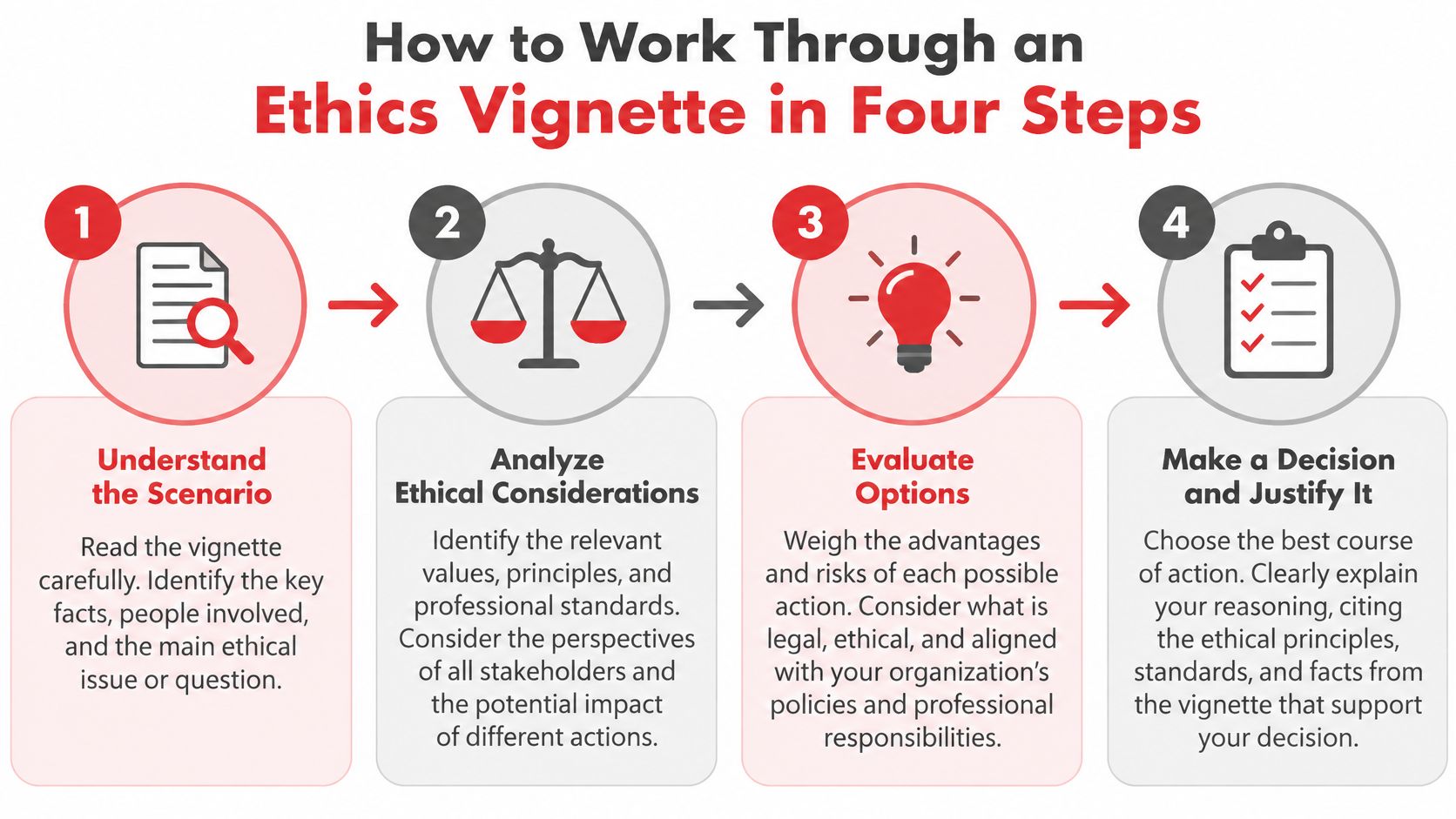
How to Work Through an Ethics Vignette in Four Steps
The NBOME Bulletin of Information places examination preparation within an integrated assessment framework. A practical way to prepare for that integration is to rehearse the same reasoning order across different clinical contexts.
Establish the Problem and Priorities
Step 1. Write a one-sentence problem representation. Name the person whose decision matters, the pending action, and the relevant constraint. For example, a capable adult is considering refusal while a relative requests information without established permission.
This step prevents answering a nearby but different question. The common slip is solving the medical diagnosis when the item asks about disclosure or consent.
Step 2. Rank the competing duties. Consider immediate safety, autonomy, confidentiality, applicable legal obligations, and professional responsibilities in the context presented. This is a case-specific ranking, not a universal hierarchy in which the same principle always wins.
Ranking prevents the first recognizable ethical term from becoming the answer. A student who sees autonomy must still determine whether the stem establishes capacity, adequate information, or a relevant exception.
Compare Actions and Their Order
Step 3. Eliminate options that create an unjustified violation. Each rejected answer should receive a short reason, such as unauthorized disclosure, unsupported coercion, avoidable harm, or a boundary violation.
This step forces comparison of actual consequences rather than tone. An answer can sound kind while bypassing the patient or revealing unnecessary information.
Step 4. Select the action that resolves the immediate problem while preserving appropriate care. Determine whether a bedside conversation, protective action, or attending notification must occur before consultation.
This step tests sequence. Ethics consultation can help resolve genuine uncertainty, but it shouldn't become a substitute for an action the physician already has a duty to take.
The strongest explanation states both why an action is appropriate and why it belongs next.
Students can combine this method with broader test-taking strategies by distinguishing a knowledge gap from a question-reading or sequencing error. During untimed work, all steps should appear on paper. During timed work, the same sequence can become a brief mental checklist rather than a lengthy written exercise.
An Original Consent Vignette With Annotated Reasoning
Original educational scenario: A 58-year-old adult presents to an emergency department with chest discomfort. After evaluation, the physician recommends hospital admission. The patient is alert and oriented, declines admission, and asks to leave against medical advice.
The patient's adult daughter asks the physician to share the results with her first and hold the discharge paperwork. The question asks for the most appropriate next action, assuming the stem supplies no independent legal authority to detain the patient.
Compare the Available Actions
- A. Share the results with the daughter first. This bypasses the patient and assumes permission that the scenario hasn't established.
- B. Admit the patient over objection without assessing decision-making capacity. This treats disagreement as sufficient justification for overriding the patient.
- C. Assess capacity, explain the results to the patient, document informed refusal if appropriate, offer safer alternatives, and ask whether the daughter may participate.
- D. End the discussion and refuse to involve anyone. This avoids disclosure but also prevents the patient from choosing support and leaves the refusal discussion unfinished.
C is the strongest educational answer. It addresses the missing assessment while preserving communication, patient participation, and continuity.
Apply the Reasoning Sequence
The problem representation is: An adult considering refusal of recommended admission needs an informed, decision-specific assessment, while a relative requests priority access and control over departure.
The first priority is establishing whether the patient can make this decision and has the information needed to do so. Alertness and orientation alone don't establish that conclusion. An exam-focused assessment considers whether the patient can understand relevant information, appreciate its personal implications, reason about the options, and communicate a choice.
Disclosure should occur directly with the patient in a form the patient can understand. The physician should explore the reason for leaving rather than assume indifference to risk. A concern about caregiving, cost, or fear may open a different conversation without changing who makes the decision.
Option A teaches that family involvement requires a basis, not merely a family request. Option B teaches that a recommendation and a refusal don't, by themselves, establish authority for involuntary admission. Option D teaches that protecting information doesn't require excluding support the patient wants.
The patient's choice should emerge from the discussion, not from a signature alone. Documentation should reflect the assessment, information exchanged, decision, and appropriate follow-up arrangements rather than treat an against-medical-advice form as the entire process.
For related conceptual review, the informed consent and autonomy guide addresses the relationship between information and patient choice. Capacity standards, detention authority, documentation, and family-involvement rules require jurisdictional and institutional verification. This vignette requires qualified physician review before publication as clinically reviewed teaching content and must not guide care for a real patient.
Common Traps and How to Review Missed Items
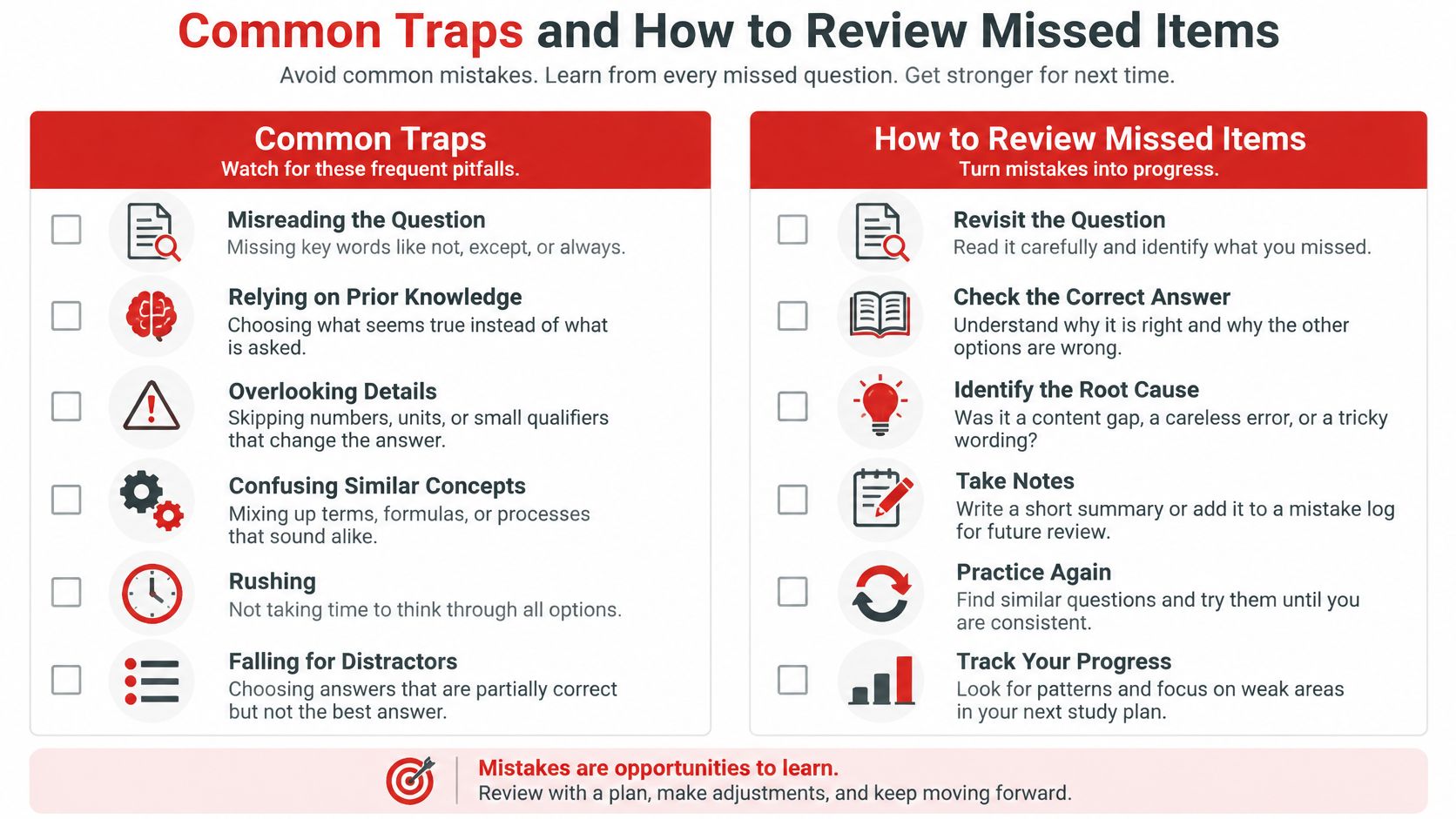
A missed ethics question doesn't automatically mean the student lacks ethical understanding. Sometimes the principle was clear, but the student selected an action that occurred too late, involved the wrong person, or required facts absent from the stem.
Name the Trap Precisely
- Privacy versus confidentiality: Privacy concerns access to the person and personal sphere; confidentiality concerns protection of information entrusted within a relationship.
- Family preference as an override: A relative's concern doesn't independently transfer an adult patient's decision-making authority.
- Excessive disclosure: An otherwise justified communication can still include information unnecessary for its purpose.
- Consultation before responsibility: Requesting help doesn't replace an immediately indicated bedside action or supervisory notification.
- Capacity versus legal competence: Decision-specific clinical capacity assessment shouldn't be confused with a court's legal determination.
Legal terminology isn't perfectly uniform across jurisdictions. Mandatory reporting, consent involving minors, and documentation requirements need particular care because rules and exceptions differ. A question's stated facts may establish the applicable rule, but students shouldn't invent a universal rule when the stem doesn't provide one.
For real cases, relevant state law, institutional policy, and appropriate legal or regulatory guidance matter. An examination explanation isn't sufficient authority for patient-specific legal action.
Build a Useful Missed-Question Record
According to the NBOME examination-scoring guidance, every scorable question contributes equally to the examination score. A missed ethics item therefore isn't an extra penalty applied to the entire professionalism domain.
That perspective supports proportionate review rather than avoidance or alarm. The useful question is what failed in the reasoning.
| Review field | Entry that helps guide practice |
|---|---|
| Principle tested | Name the obligation and the fact that activates it |
| Error category | Principle recognition or action selection |
| Trap | Identify the specific assumption or confusion |
| Failed step | Problem representation, ranking, elimination, or sequencing |
| Repair | Write a short explanation distinguishing the best answer from the tempting one |
| Re-test date | Schedule a new attempt that tests the concept without relying on answer memory |
Review insight: Correctly naming autonomy but choosing the wrong escalation pathway calls for sequencing practice, not another definition sheet.
The log should record uncertain correct answers too. A correct guess can conceal the same reasoning weakness as a missed question.
A Review Schedule for Ethics Questions
An ethics plan should begin with the examination date and available study time, not with an assumed universal preparation period. The schedule below is an editorial planning template, not a validated readiness benchmark or a requirement set by NBOME.
Four-Phase Ethics Review Schedule
| Phase | Focus | Practice output |
|---|---|---|
| Weeks 1-2 | Blueprint topics and the six principles | One-line definition and one clinical example per topic |
| Weeks 3-4 | Consent, capacity, confidentiality, and reporting | Untimed vignettes with a written reason for each answer |
| Weeks 5-6 | Boundaries, end-of-life care, and research ethics | Mixed timed blocks of ethics items inside clinical cases |
| Ongoing from week 3 | Missed concepts | Re-test after 7-14 days, logged separately for principle recognition and action selection |
The proposed intervals are study-design choices, not official performance standards. Students with less time can combine phases, while those rebuilding foundational understanding may need longer before timed work becomes useful.
The log should determine what happens within each phase. Persistent principle-recognition errors call for concise content review followed by fresh examples. Accurate recognition with weak action selection calls for comparison of competing options, attention to missing facts, and explanation of what must happen first.
Interpret Progress Without Inventing a Passing Percentage
The NBOME scoring and reporting page states that the Level 2-CE passing standard is a three-digit standard score of 400 or higher, with pass/fail determined for the examination as a whole rather than by a separate ethics threshold. That standard score isn't a percentage correct or a raw question count.
A weak ethics area deserves targeted work, but it doesn't independently establish examination failure. Likewise, a strong ethics practice block doesn't establish overall readiness.
NBOME's performance profile can help students identify relative strengths and weaknesses across domains and clinical disciplines. It shouldn't be converted into an unsupported ethics-specific passing target.
Useful readiness signs include the ability to explain why tempting alternatives fail, identify when jurisdictional information is missing, and choose the next action without relying on memorized answer phrasing. NBOME doesn't publish a standalone ethics pass rate, so commercial ethics-specific success claims shouldn't determine the schedule.
Decide Whether to Add One-on-One Practice
The error log provides a more useful decision rule than frustration alone. When students repeatedly misidentify the principle, targeted blueprint review and carefully selected practice questions usually come first.
When students recognize the issue but cannot order competing actions, guided reasoning may help. The discussion should require the student to explain the decisive fact, defend the next step, and identify why an attractive alternative is premature.
Match Support to the Error Pattern
- Content gaps: Revisit a narrow topic, then test it in a new clinical context.
- Sequencing errors: Compare plausible actions and explain which prerequisite remains unmet.
- Timing problems: Preserve the reasoning sequence while shortening written explanations.
- Improving independent performance: Continue the self-study approach rather than adding support automatically.
The discussion of one-on-one tutoring benefits can help students consider that learning format. The COMLEX tutoring information page is the relevant service reference. Official NBOME materials and licensed question banks remain primary study resources, not materials that tutoring replaces.
Ace Med Boards is not affiliated with or endorsed by the National Board of Medical Examiners or the National Board of Osteopathic Medical Examiners. For a study plan used in 2026, students should confirm current examination details directly with NBOME; this article doesn't represent live verification of policy changes.
Key Takeaways
- Practice decisions, not labels: Recognizing a principle is only the beginning.
- Separate error types: Content gaps and action-selection errors need different practice.
- Respect legal limits: Jurisdiction-specific rules cannot be replaced by ethical shorthand.
- Use the log: Study adjustments should follow recurring errors rather than isolated misses.
Sources
Primary references include the NBOME Level 2-CE overview, competency blueprint, Bulletin of Information, examination-scoring guidance, and scoring and reporting page, linked at their relevant claims above.
Ace Med Boards offers COMLEX Level 2-CE tutoring using clinical vignettes to practice diagnosis, management decisions, and reasoning through competing answer choices. Students whose error logs show persistent ethics-sequencing difficulties can visit Ace Med Boards to schedule a free COMLEX consultation about their examination level and timeline; students progressing steadily can continue the independent plan.